GLM-5.3-Flash Guide: Ox Alpha, API Pricing, and Local Deployment
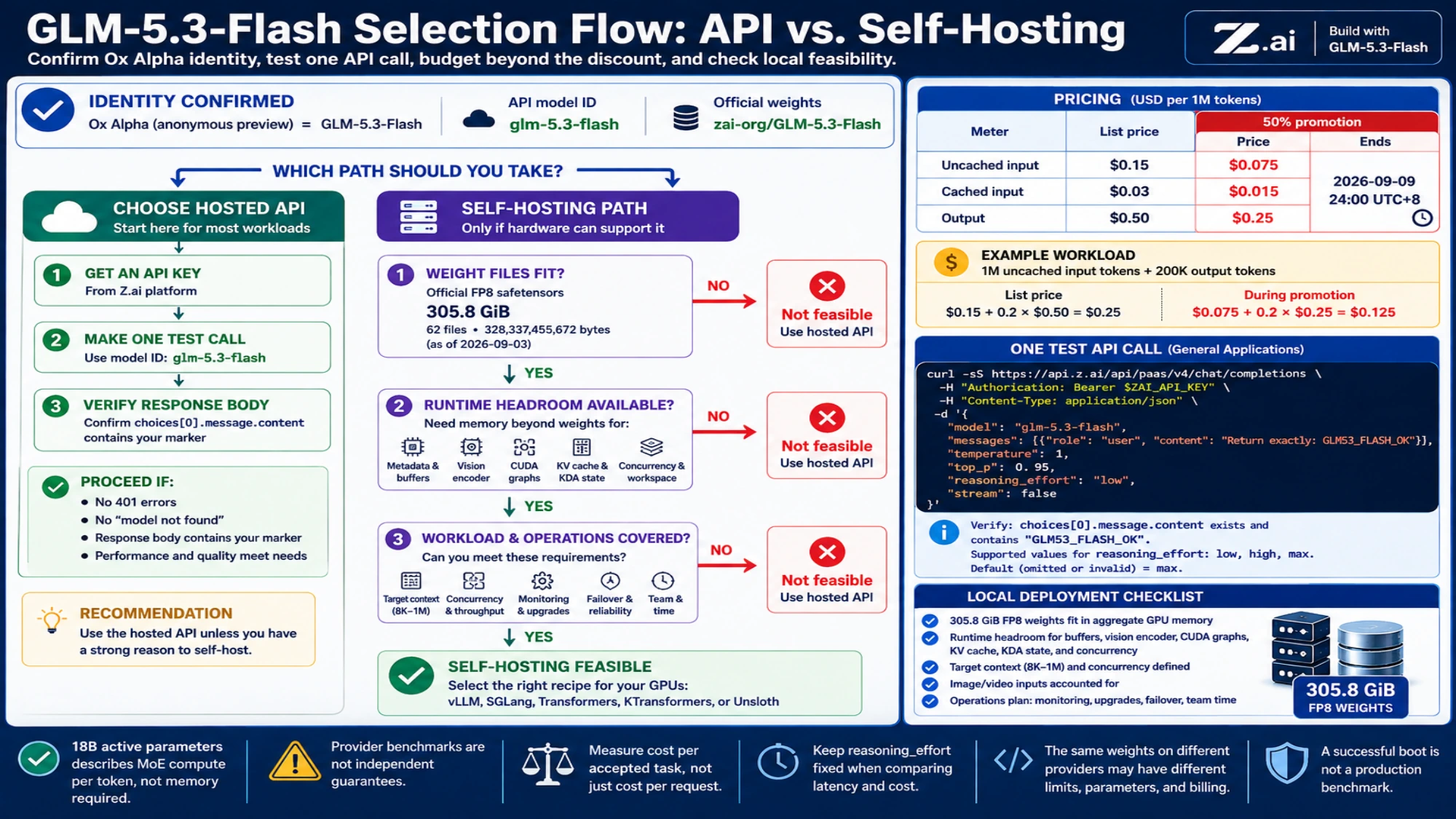
Start with the hosted API unless your GPUs can hold roughly 305.8 GiB of FP8 weights plus runtime and cache headroom. The 18B active-parameter figure is not a memory requirement.
On this page
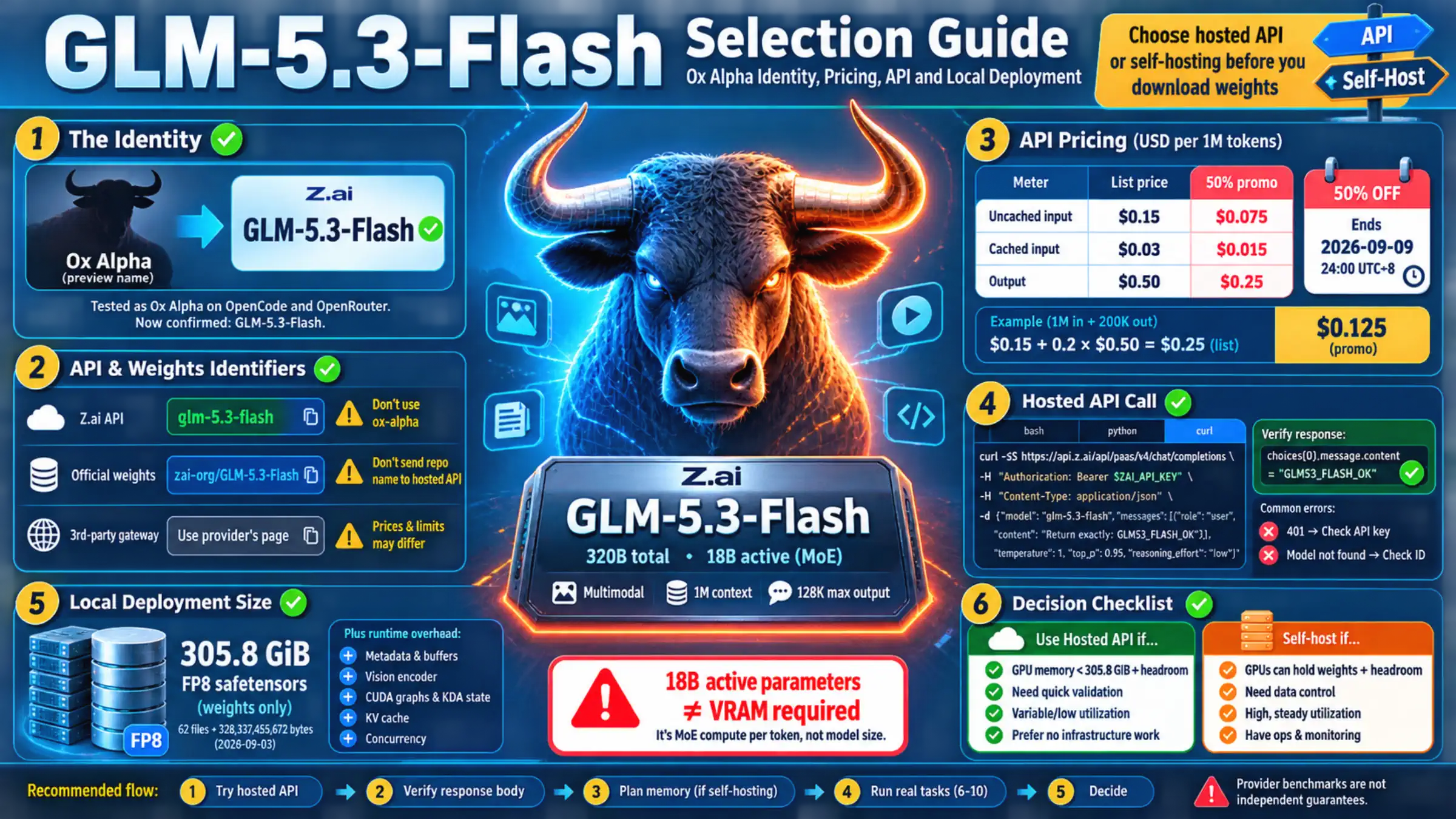
Ox Alpha is no longer an unidentified preview model. Z.ai says the model tested under that name on OpenCode and OpenRouter was GLM-5.3-Flash. For a production configuration, use glm-5.3-flash on the Z.ai API and zai-org/GLM-5.3-Flash for the official open-weight repository. The names are related, but they are not interchangeable identifiers.
Most individuals and small teams should validate the model through a hosted API before planning a local server. The official FP8 weight files alone occupy about 305.8 GiB. “18B active parameters” describes the mixture-of-experts computation per token; it does not turn the checkpoint into an 18B model that fits a consumer GPU.
Use the model ID for your chosen service
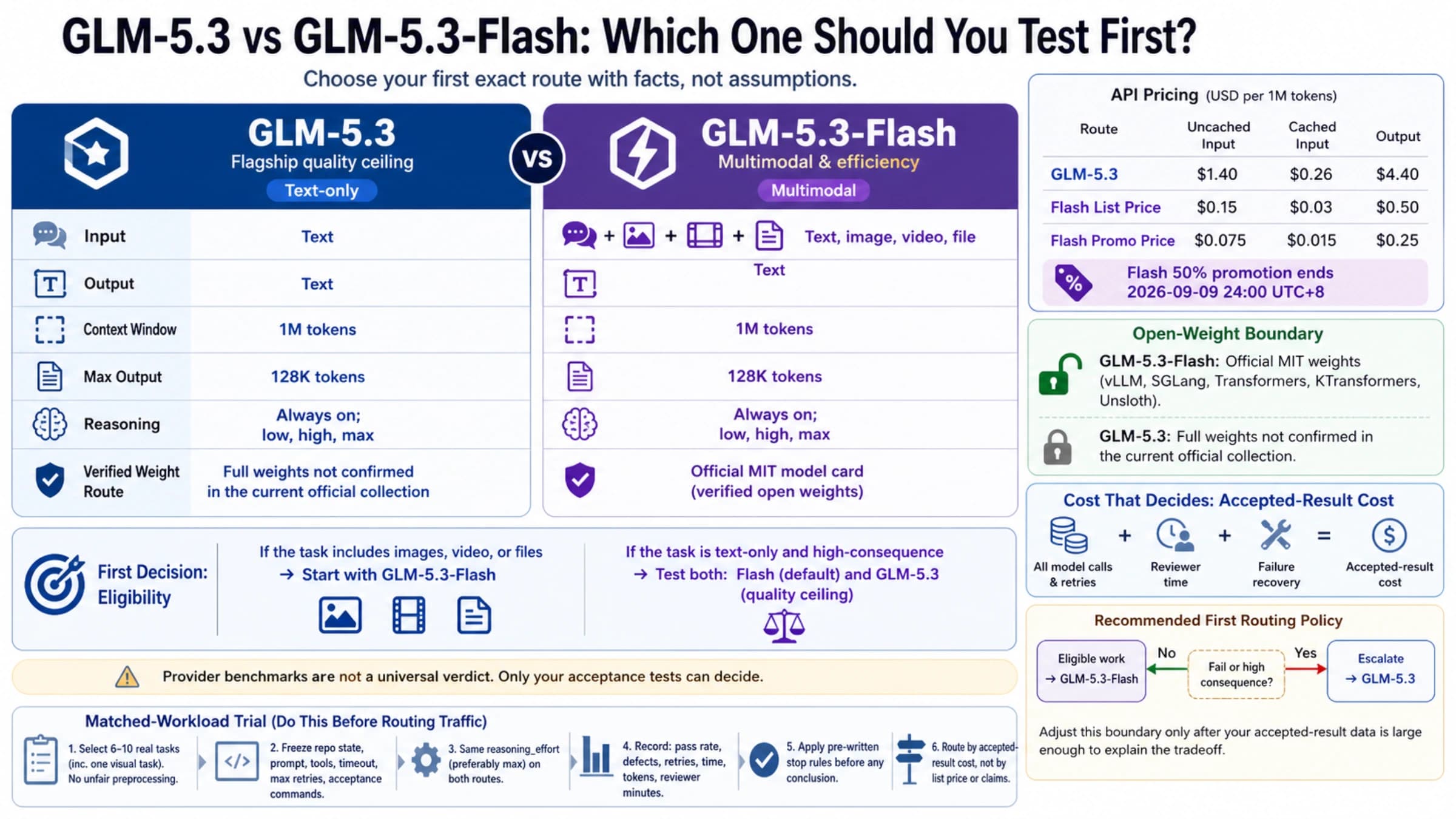
The official GLM-5.3-Flash guide describes a newly trained 320B-total, 18B-active mixture-of-experts model. It is the first natively multimodal member of the GLM-5 family, accepting text, images, video, and files while returning text. The documented context window is 1M tokens and the maximum output is 128K tokens.
Z.ai also reports a hybrid sparse-and-linear attention design and lower attention compute and KV-cache use than GLM-5.3. Those vendor measurements help explain the serving price. They do not establish latency, accuracy, or agent reliability for your repository.
Use the identifier that belongs to the service you are actually calling:
| Where you run it | Identifier to start from | Common mistake |
|---|---|---|
| Z.ai hosted API | glm-5.3-flash | Keeping the ox-alpha preview name |
| Official weights | zai-org/GLM-5.3-Flash | Sending the repository name to every hosted API |
| A third-party gateway | Its current model page | Assuming Z.ai prices and limits carry over |
A gateway may adapt parameters, change context limits, or bill failures differently. The same underlying weights do not make two providers operationally identical.
Budget with the list price, then account for the temporary discount
As checked on September 3, 2026, the Z.ai pricing page lists USD prices per 1M tokens:
| Meter | List price | Promotion price through September 9 |
|---|---|---|
| Uncached input | $0.15 | $0.075 |
| Cached input | $0.03 | $0.015 |
| Output | $0.50 | $0.25 |
The promotion was scheduled to end on September 9, 2026 at 24:00 UTC+8, according to the September 3 pricing check. Use the list-price column for a durable budget and the discounted column only to reconcile calls made during the promotion.
A workload with 1M uncached input tokens and 200K output tokens costs $0.25 at list price before retries or tool charges:
$0.15 + 0.2 × $0.50 = $0.25
Under the announced promotion, the same token quantities cost $0.125. The decision metric should still be cost per accepted task, not cost per request. Include retries, reviewer time, and recovery from a bad tool action. A cheap call that needs three attempts can be less attractive than its token table suggests.
Make one hosted call and verify the response body
General applications use the Z.ai endpoint documented at https://api.z.ai/api/paas/v4. The separate Coding Plan endpoint, https://api.z.ai/api/coding/paas/v4, is intended for supported coding tools, not arbitrary SDK, website, bot, or SaaS traffic. The API introduction keeps that distinction explicit.
This small request checks the key, endpoint, and model ID:
curl -sS https://api.z.ai/api/paas/v4/chat/completions \
  -H "Authorization: Bearer $ZAI_API_KEY" \
  -H "Content-Type: application/json" \
  -d '{
    "model": "glm-5.3-flash",
    "messages": [
      {"role": "user", "content": "Return exactly: GLM53_FLASH_OK"}
    ],
    "temperature": 1,
    "top_p": 0.95,
    "reasoning_effort": "low",
    "stream": false
  }'
Do not stop at HTTP 200. Confirm that choices[0].message.content exists and contains the requested marker. A 401 points first to the Authorization header or an API key from the wrong platform. “Model not found” usually warrants checking for ox-alpha, a Hugging Face repository name, or an unsupported provider alias.
GLM-5.3-Flash supports low, high, and max for reasoning_effort. The official documentation says omitted or unrecognized values fall back to max. Keep the effort level fixed when comparing latency and cost; otherwise a parameter change can look like a model change.
For an image, use a messages[].content[] array containing type: image_url and the URL or Base64 Data URL in image_url.url. Multimodal input does not imply image or video generation: the documented output is text. See the official image-input instructions.
A local fit check starts at 305.8 GiB, not 18B
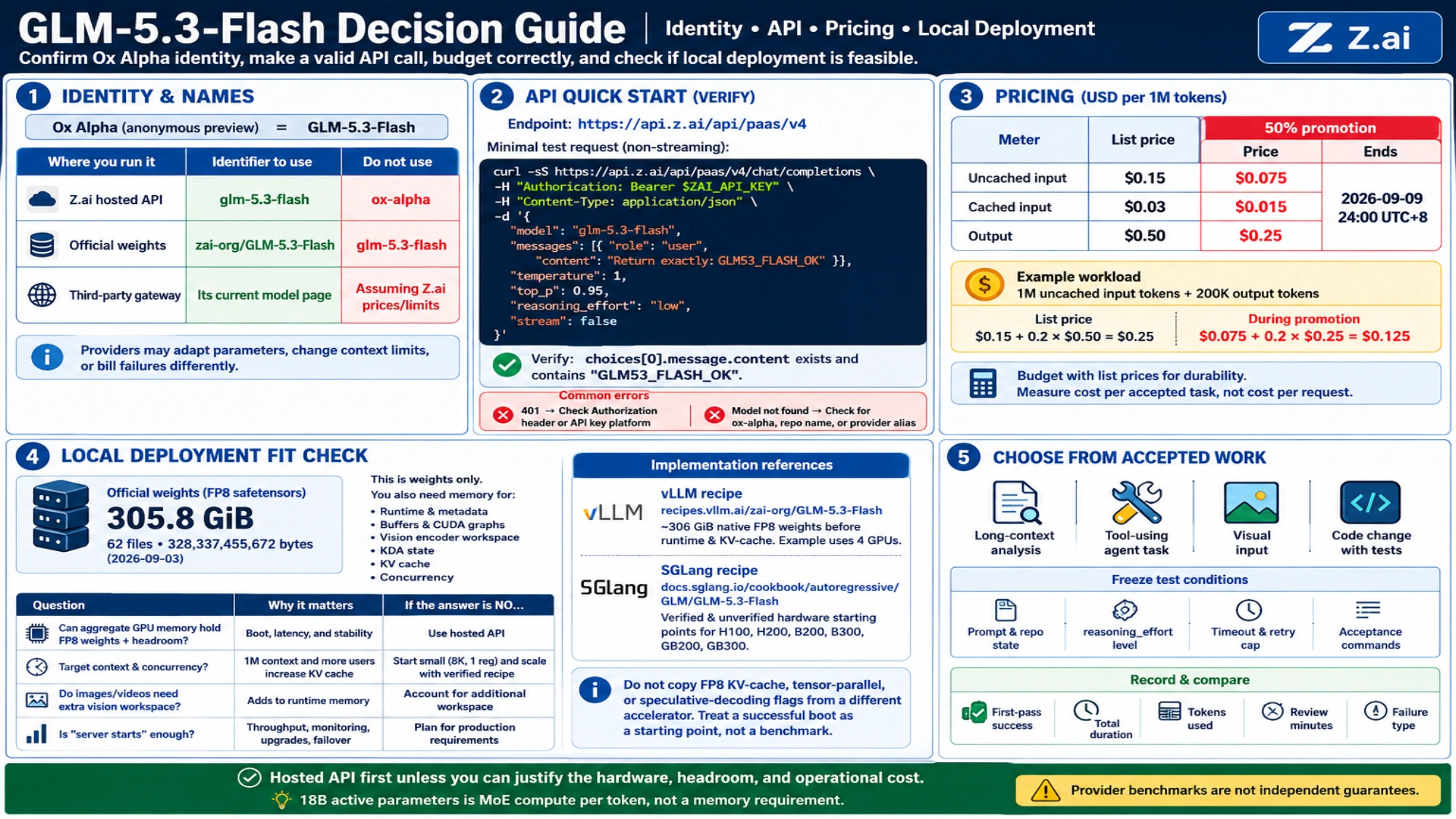
The official Hugging Face model card labels the weights MIT and links serving support for SGLang, vLLM, Transformers, KTransformers, and Unsloth. On September 3, the repository API reported 62 FP8 .safetensors files totaling 328,337,455,672 bytes, or about 305.8 GiB.
That number answers only whether the weight files fit. A running service also needs memory for metadata, buffers, the vision encoder, CUDA graphs, KDA state, KV cache, and concurrency. Longer contexts and more simultaneous requests increase the headroom. Moving weights to CPU or disk can make a process start while leaving first-token latency and throughput unsuitable for real use.
The current vLLM recipe independently describes roughly 306 GiB of native FP8 weights before runtime and KV-cache overhead. Its initial example uses tensor parallelism across four high-end GPUs. The SGLang recipe provides hardware-specific starting points for H100, H200, B200, B300, GB200, and GB300, and distinguishes verified from unverified combinations.
Before downloading, answer these questions:
- Can the aggregate GPU memory hold the FP8 weights and meaningful runtime headroom?
- Is the target context 8K, 128K, or near 1M, and how many requests must run together?
- Do image and video inputs require additional vision workspace?
- Is “the server starts” enough, or do you need measured throughput, monitoring, upgrades, and failover?
If the first answer is no, use the hosted API. If it is yes, select the recipe for the exact GPU generation and begin with a short context and one request. Do not copy FP8 KV-cache, tensor-parallel, or speculative-decoding flags from a different accelerator and treat a successful boot as a production benchmark.
Choose from accepted work, not launch benchmarks
A useful first evaluation needs only 6–10 tasks from the real backlog: one long-context analysis, one tool-using agent task, one visual input, and one code change with automated acceptance. Freeze the prompt, repository state, reasoning_effort, timeout, retry cap, and acceptance commands. Record first-pass success, total duration, tokens, review minutes, and failure type.
A hosted trial lets you assess the model on your work before buying or configuring hardware. Self-hosting becomes interesting when data control, consistently high utilization, or predictable capacity outweigh infrastructure and maintenance cost. Idle accelerators belong in that calculation too.
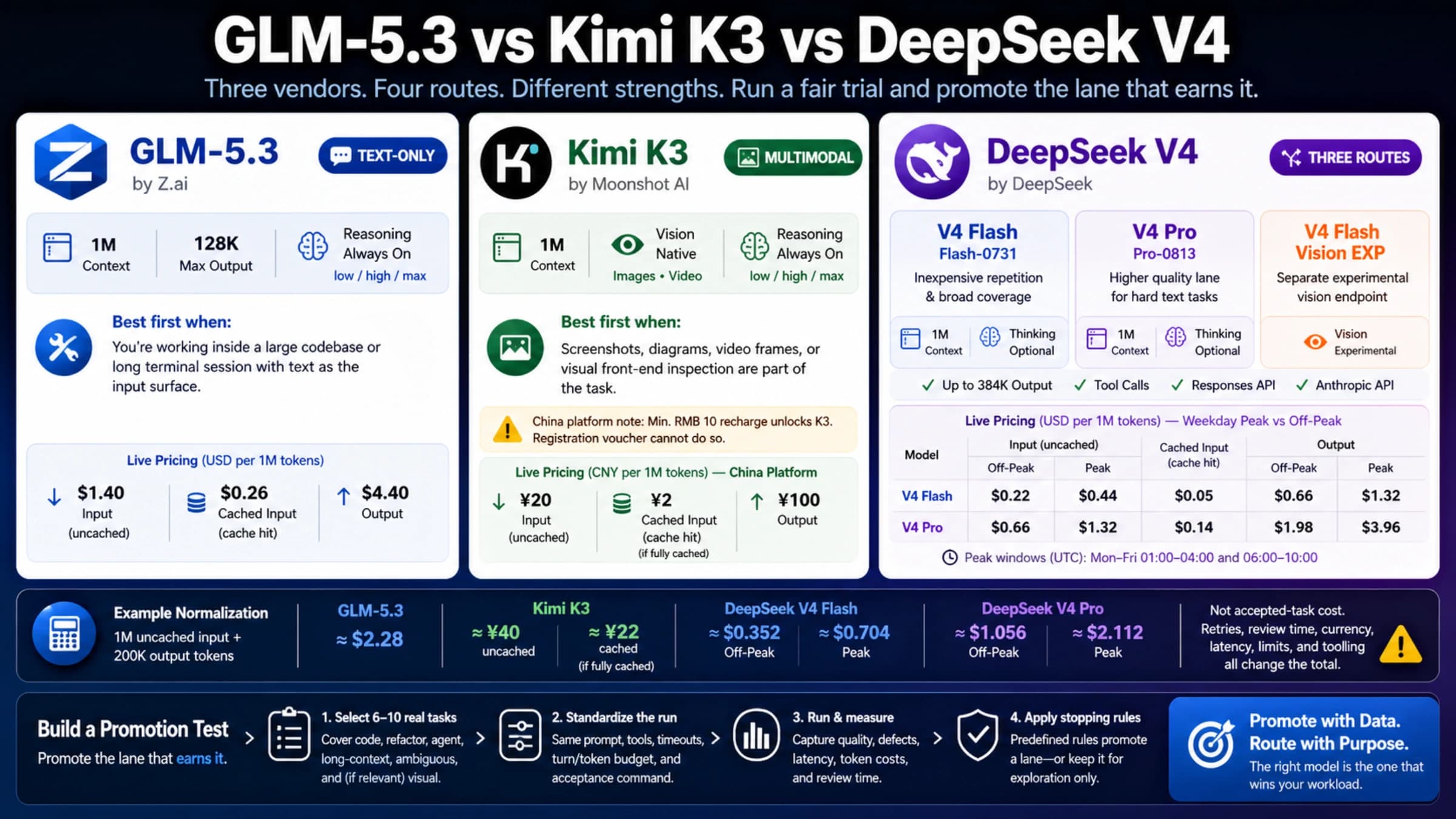
If the remaining question is whether demanding coding tasks benefit from GLM-5.3 instead, use the separate GLM-5.3 versus GLM-5.3-Flash test guide. For a Flash-only decision, begin with a hosted request and the task evaluation above. Consider self-hosting once your memory plan includes runtime and cache allocations as well as the weights.
Sources6
External pages this guide links to, in the order they appear. Last updated Sep 3, 2026.
Sources6
External pages this guide links to, in the order they appear. Last updated Sep 3, 2026.
- 1.official GLM-5.3-Flash guidedocs.z.ai/guides/vlm/glm-5.3-flash
- 2.Z.ai pricing pagedocs.z.ai/guides/overview/pricing
- 3.API introductiondocs.z.ai/api-reference/introduction
- 4.official Hugging Face model cardhuggingface.co/zai-org/GLM-5.3-Flash
- 5.vLLM reciperecipes.vllm.ai/zai-org/GLM-5.3-Flash
- 6.SGLang recipedocs.sglang.io/cookbook/autoregressive/GLM/GLM-5.3-Flash