Kimi K3.1 Pro vs MiniMax M3.1 Flash: Is 14× the Cost Worth It?
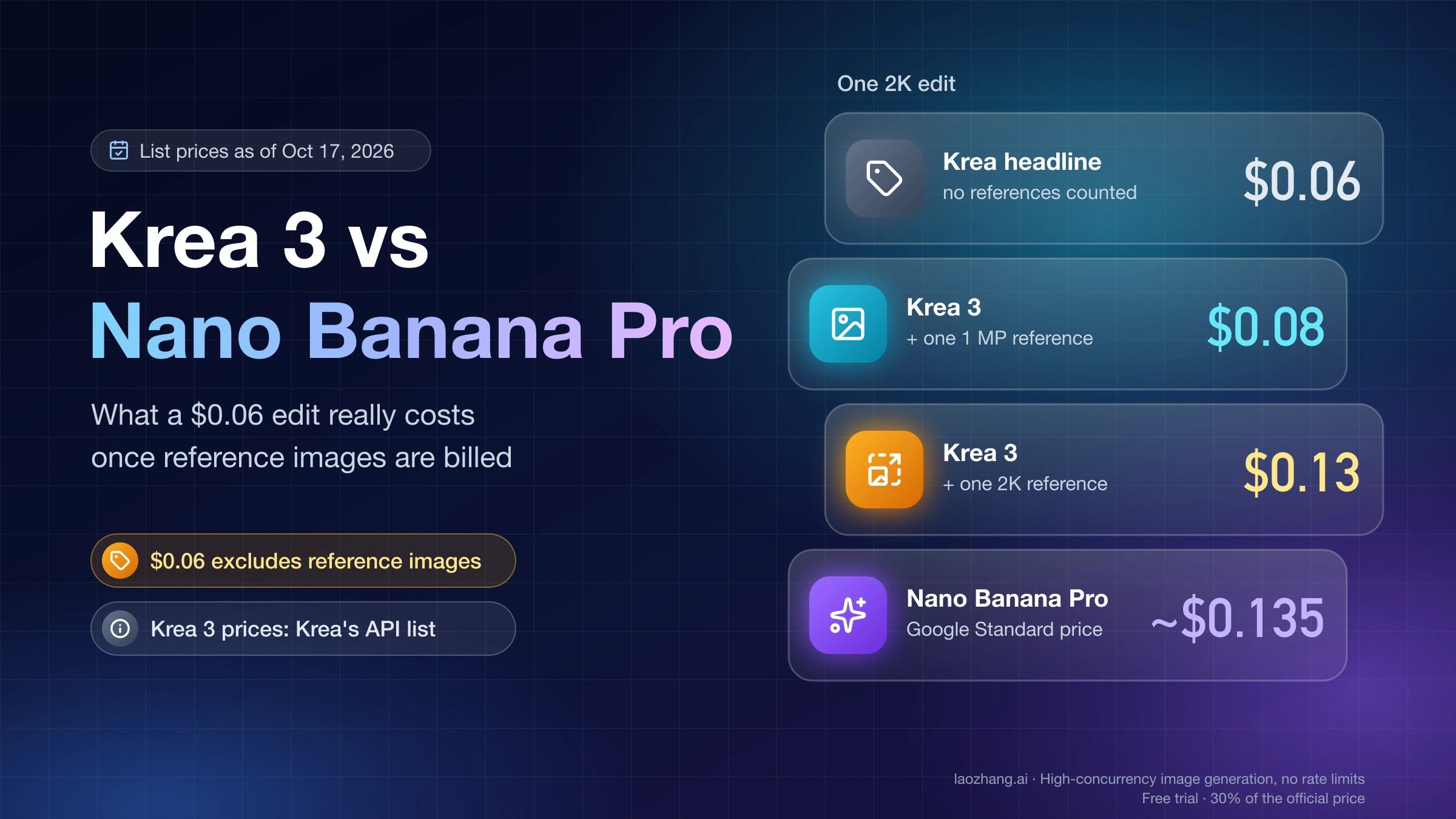
Kimi K3.1 Pro costs about 14× MiniMax M3.1 Flash per request. Flash holds up on routine, checkable work; K3.1 Pro earns its price on agents and facts.
On this page
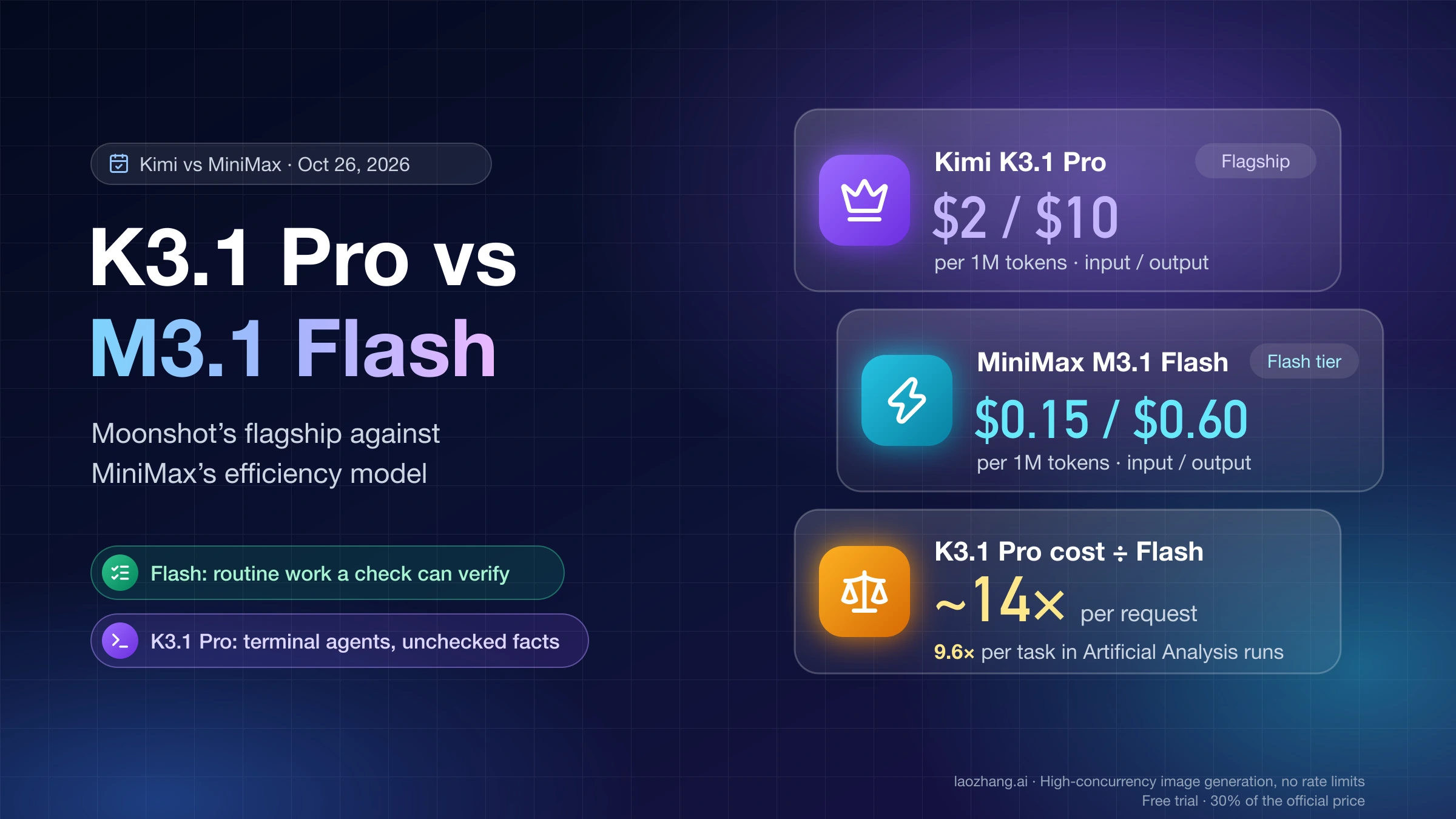
Make MiniMax-M3.1-Flash the default for high-volume work whose output something can check: business automation, extraction, long-document arithmetic, and code that runs against tests. Send the steps where a wrong answer is expensive and hard to catch to kimi-k3.1-pro: multi-step terminal or agentic coding, long rule-heavy specifications, and factual answers that go out without a checker. As of October 26, 2026, Kimi's price list puts K3.1 Pro at $2 input and $10 output per million tokens, and MiniMax's puts Flash at $0.15 and $0.60. That is roughly 14 times the cost for the same request, and 9.6 times per task in Artificial Analysis's runs, because Flash writes more tokens to finish the same job.
These two are not the same tier. K3.1 Pro, released on October 23, is Moonshot's new flagship; M3.1 Flash, generally available since October 19, is MiniMax's efficiency model, with a "Pro" promised for later. Whichever one you call, set reasoning_effort: "high" explicitly. Both default to max and neither lets you switch thinking off. In the test below, high cut output tokens by 55% on Flash and 79% on K3.1 Pro, and the only pass it cost was one K3.1 Pro formatting slip.
What was actually run: on October 26, 2026, both models answered the same 11 single-turn tasks, with checks written in advance, through one API gateway at high and at their defaults. The same day, OpenRouter's public endpoint list for both models was read and the request costs were recomputed from the official price lists. The test left out long agentic or terminal sessions and the direct Moonshot and MiniMax endpoints, so the broad quality picture below comes from Artificial Analysis.
Same tier? No: Moonshot's flagship against MiniMax's Flash model
Kimi K3.1 Pro (kimi-k3.1-pro) is the first model in Moonshot's K3.1 series, "a post-trained version of Kimi K3, with substantially larger post-training compute," according to the Kimi K3.1 Pro quickstart. Artificial Analysis lists it at 2.8 trillion total and 104 billion active parameters. Its weights are not public yet. Moonshot says they "will be released by Nov 4," so for now it is an API-only model. kimi-k3.1-pro-highspeed is a separate model ID rather than a setting: Moonshot rates it at 2–3× the speed of K3.1 Pro, at double the price ($4 input, $20 output).
MiniMax M3.1 Flash (MiniMax-M3.1-Flash) rolled out on October 19, 2026, according to the MiniMax M3.1 Flash launch post. Despite the name, it is not a small model: about 428 billion total and 23 billion active parameters, with weights on MiniMax's Hugging Face repository since October 23. If you saw a coding test of "Space Bunny," that was an earlier anonymous build of the same model, and requests to the old MiniMax-M3.1-Flash-Preview name are now served by the GA model. MiniMax says a more capable "Pro" will arrive later, without a date.
So this is a flagship against a budget model, and headlines saying Flash "beats Kimi" are about the older Kimi K3, not K3.1 Pro. On Artificial Analysis's Intelligence Index v4.3.2, K3.1 Pro scores 55 and Flash 43 as of October 26, 2026. VentureBeat reported 42 for Flash at launch; the index has been re-run since, so the two numbers don't contradict each other. A 12-point gap is large, which is why the useful question is where that gap shows up in your workload.
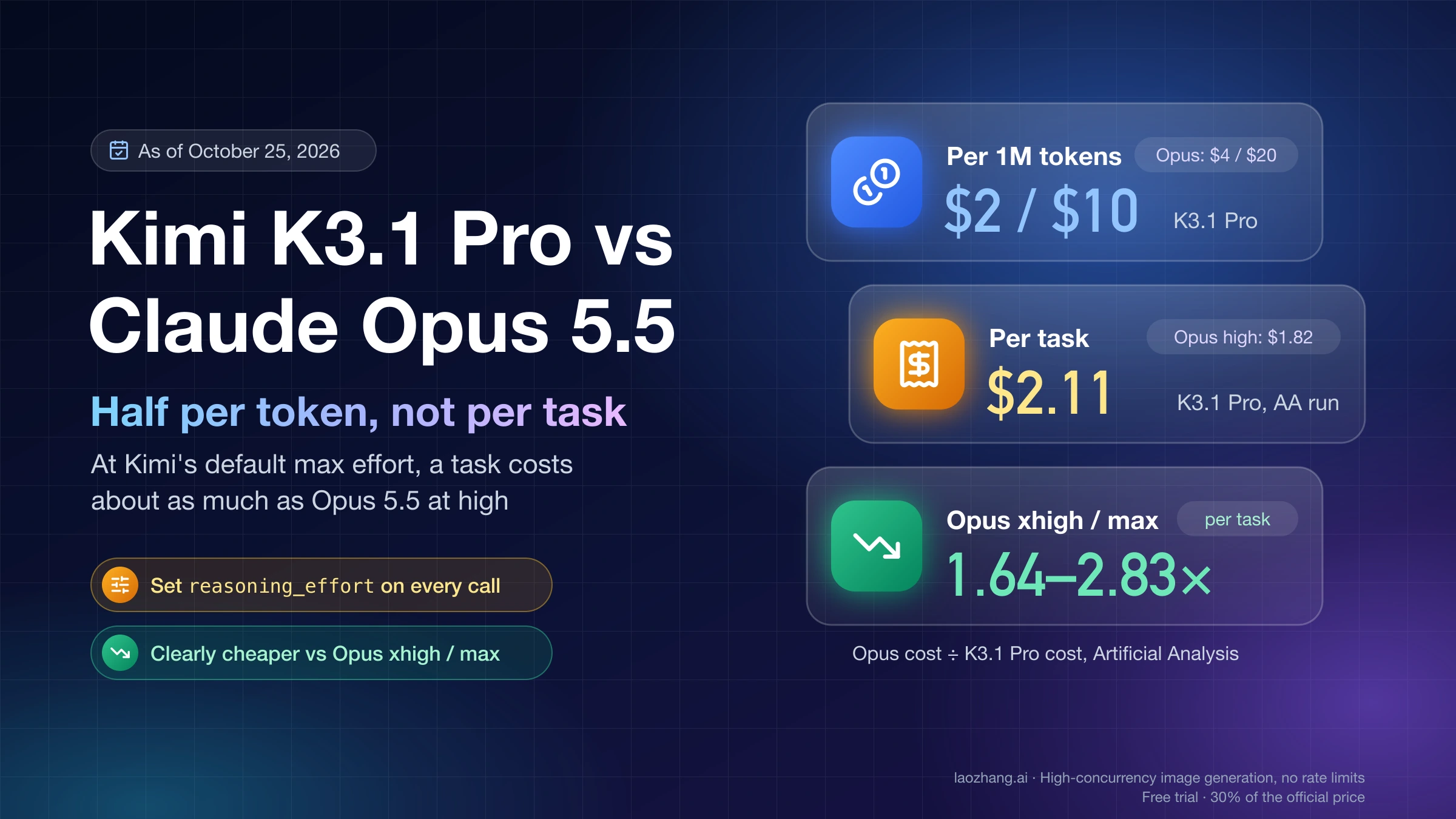
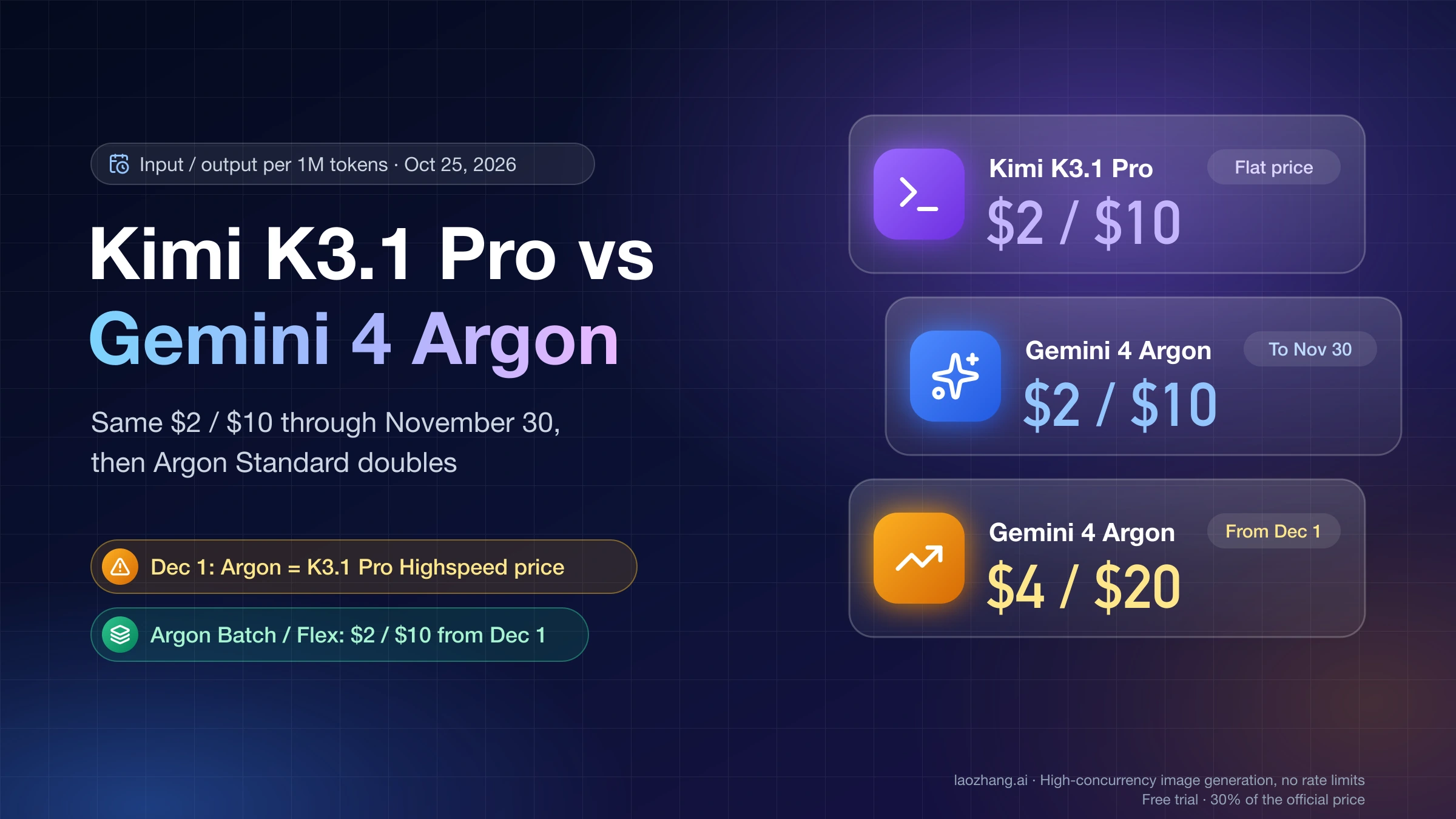
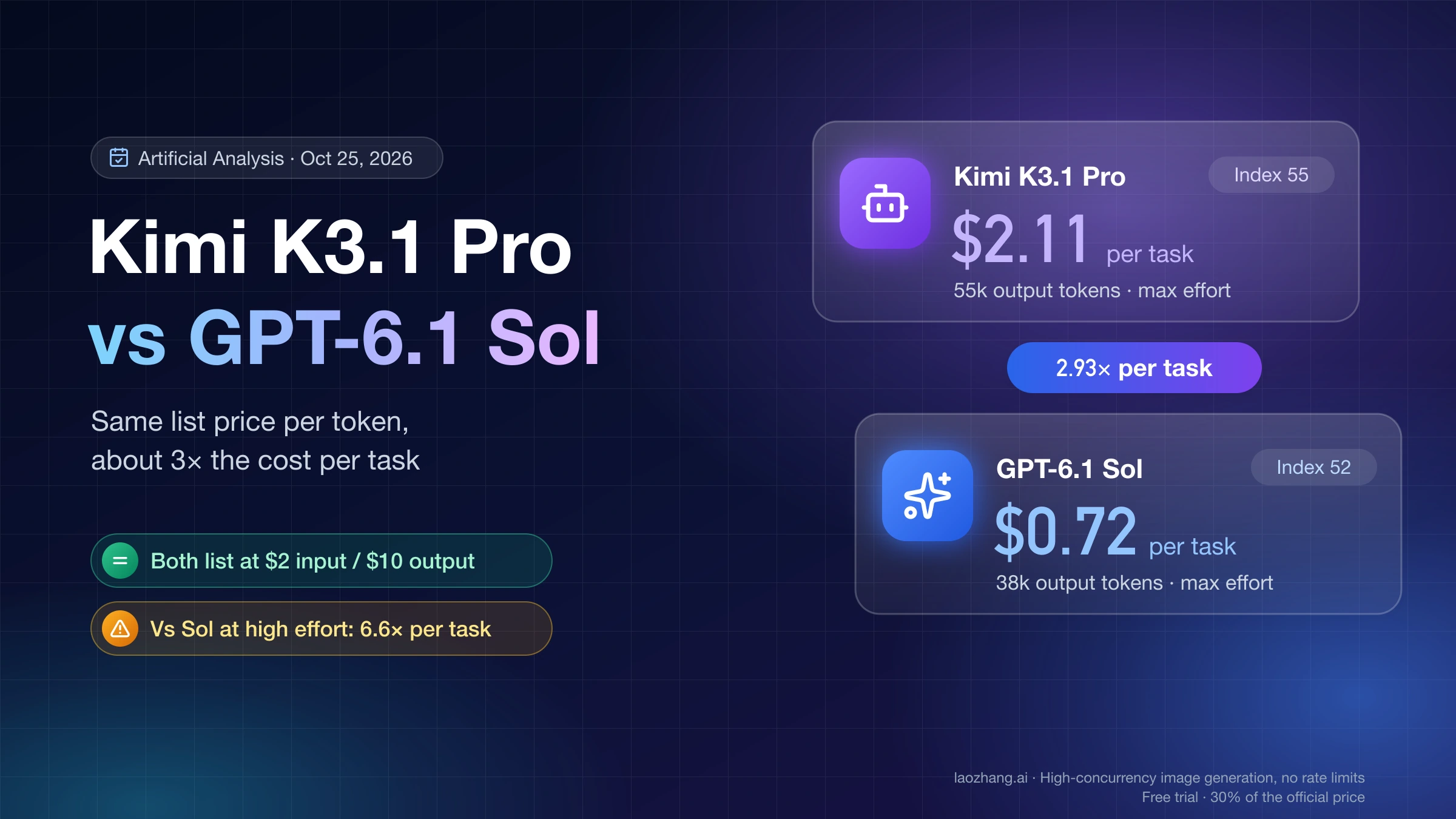
Whether Kimi is the best model overall is a different question, because a score of 55 has to be set against other flagships rather than against a Flash model. Those matchups are in Kimi K3.1 Pro vs GPT-6.1 Sol: Same $2/$10, 3× the Cost per Task, Kimi K3.1 Pro vs Claude Opus 5.5: Half per Token, Not per Task and Kimi K3.1 Pro vs Gemini 4 Argon: Same Price Only Until Dec 1.
How much more K3.1 Pro costs: about 14× per request, 9.6× per task
Per token, K3.1 Pro costs 13.3 times Flash on input and cache reads and 16.7 times on output, so any request lands between those two ratios. The table below applies both list prices to the same token counts. It was recomputed on October 26, 2026, from Kimi's chat model pricing page and MiniMax's pricing overview.
| Request shape | kimi-k3.1-pro | MiniMax-M3.1-Flash | K3.1 Pro ÷ Flash |
|---|---|---|---|
| Short request: 20K input + 2K output | $0.0600 | $0.0042 | 14.3× |
| Agent turn on a warm cache: 10K new + 140K cached input + 3K output | $0.0780 | $0.0054 | 14.4× |
| Long document: 500K input + 5K output | $1.0500 | $0.0780 | 13.5× |
| Reasoning-heavy answer: 2K input + 30K output | $0.3040 | $0.0183 | 16.6× |
| Short request, Flash writing 1.44× the output tokens | $0.0600 | $0.0047 | 12.7× |
| Artificial Analysis, measured cost per index task | $2.11 | $0.22 | 9.6× |
The inputs are the international list prices per million tokens: K3.1 Pro charges $2 for input, $0.20 for a cache hit and $10 for output, and Flash charges $0.15, $0.015 and $0.60. Output includes reasoning tokens on both. The short request on K3.1 Pro, for example, is 20,000 × $2 ÷ 1,000,000 + 2,000 × $10 ÷ 1,000,000 = $0.06, and the same request on Flash is $0.003 + $0.0012 = $0.0042. Prefixes sent for the first time are billed at the input rate on both, because Kimi charges its 5-minute cache write at the input price and MiniMax lists no write price. Neither model adds a long-context surcharge: K3.1 Pro keeps one rate up to 1,048,576 tokens and MiniMax lists no context tiers for Flash. At volume, 10,000 short requests come to $600 on K3.1 Pro and $42 on Flash.
The per-task gap is smaller than the per-token gap because Flash writes more. In Artificial Analysis's runs Flash used 79,000 output tokens per task against 55,000 for K3.1 Pro (55,000 against 35,000 of them reasoning), which is the 1.44× in the fifth row. Effort settings move the ratio further than the token mix does: on the same tasks in the October 26 test, K3.1 Pro cost 7.5–10.2× Flash when both ran at high and 17.6–20.6× when both ran at their default max.
Where K3.1 Pro is better on Artificial Analysis, and where Flash ties
The 12-point gap is concentrated in agentic work. On Artificial Analysis's Kimi K3.1 Pro vs MiniMax M3.1 Flash comparison, as of October 26, 2026, the widest gap is Terminal-Bench 4.0, agentic coding and terminal use, where K3.1 Pro scores 67% and Flash 26%. The two agentic knowledge-work Elo ratings and AA-Omniscience follow. On AutomationBench-AA, which covers agentic SaaS workflows, the two tie at 73%, and on reasoning, physics and long-context reasoning Flash is within 3–6 points.
| Artificial Analysis evaluation | What it measures | Kimi K3.1 Pro | MiniMax M3.1 Flash |
|---|---|---|---|
| Terminal-Bench 4.0 | Agentic coding and terminal use | 67% | 26% |
| GDPval-AA v2.1 | Agentic real-world work tasks, Elo | 1846 | 1458 |
| AA-Briefcase v1.1 | Agentic knowledge work, Elo | 1678 | 1473 |
| AA-Omniscience | Knowledge, penalizing wrong answers | 30 | 16 |
| GDP.pdf | Professional document reasoning | 31% | 21% |
| SciCode | Scientific coding | 61% | 53% |
| AA-LCR v1.1 | Long-context reasoning | 86% | 80% |
| Humanity's Last Exam | Reasoning and knowledge | 52% | 48% |
| CritPt | Physics reasoning | 25% | 22% |
| AutomationBench-AA | Agentic SaaS workflows | 73% | 73% |
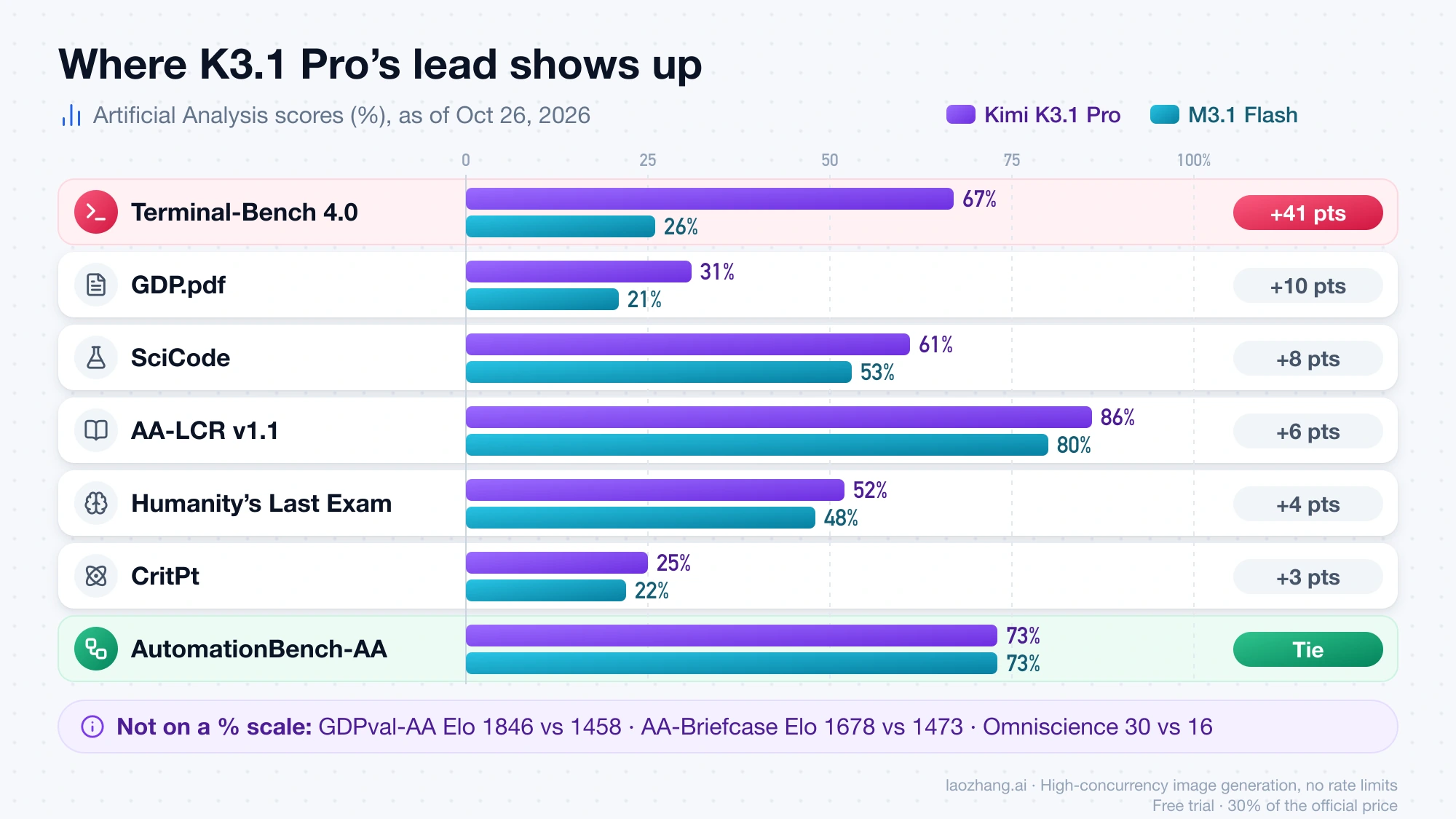
Read this as a map of where to spend. If your workload is a coding agent that runs shell commands over many steps, the Terminal-Bench gap is the number that matters, and it is the one Flash is furthest behind on. If it is a business workflow that calls SaaS tools, AutomationBench says Flash already does as well. Artificial Analysis tests K3.1 Pro at its default max effort; the page does not label which effort it used for Flash, whose default is also max. Company-reported results such as MiniMax's OSWorld or BankerToolBench scores and Moonshot's own Terminal-Bench figure come from different test setups and can't be set against each other.
Flash is also faster. On the same page it streams 116 output tokens per second against 52, shows its first answer token after 18.32 seconds against 41.29, and finishes an index task in 577 seconds against 935. These speed figures change from day to day, so treat them as an October 26 snapshot.
Same-prompt test, October 26: where MiniMax M3.1 Flash broke
Flash matched K3.1 Pro on 9 of the 11 tasks and failed on two kinds: a long, rule-heavy specification and a question about a Python function that does not exist. On October 26, 2026, both models received the same prompts through one key on LaoZhang's API gateway (laozhang.ai), which is run by the same team as this blog, using OpenAI-compatible Chat Completions with every call streamed, max_tokens set to 32,000, and no system prompt or tools. Each model ran at reasoning_effort: "high" and at its default max. The checks and hidden tests were written before any answer was read, and costs are vendor list prices applied to the usage each call returned.
Disclosure: laozhang.ai is our own service. Its prices are platform pricing, not an independent comparison.
Eight of the tasks were everyday ones: a word problem, three small coding functions, a five-bullet summary of a 6,723-word article, an expression evaluator written without eval, a CSV line parser, and a digit-sum counting problem. The three added tasks were an npm-style semver range matcher with 36 hidden tests, the same long article with three inserted correction notes that change a budget calculation, and a JSON question about four Python 3.13 standard-library functions, two of them made up. The three added tasks ran two samples on every configuration. The expression evaluator, CSV parser and digit-sum problem ran twice on Flash and once on K3.1 Pro, which is why the totals differ.
| Task | Flash, default | Flash, high | K3.1 Pro, default | K3.1 Pro, high |
|---|---|---|---|---|
| 8 everyday tasks (coding, maths, summary) | 11 of 11 | 11 of 11 | 8 of 8 | 7 of 8 |
| Long document with correction notes, answer $76.80 | 2 of 2 | 2 of 2 | 2 of 2 | 2 of 2 |
| Semver range matcher, 36 hidden tests | 0 of 2 | 1 of 2 | 2 of 2 | 2 of 2 |
| Two real and two made-up Python functions | 0 of 2 | 0 of 2 | 2 of 2 | 2 of 2 |
| Total passed | 13 of 17 | 14 of 17 | 14 of 14 | 13 of 14 |
On the semver task, one Flash run at the default spent the whole 32,000-token budget thinking and returned no code; the two other failing runs missed 8 and 5 of the 36 hidden tests, on basic comparators, hyphen ranges and prerelease ordering. On the made-up-function question, all four Flash answers described statistics.winsorized_mean as a real function, and one invented a keyword argument for it, while every Flash answer correctly said functools.memoize_method does not exist. K3.1 Pro got both tasks right every time. Its one miss was a format slip at high: two summary bullets of 28 and 27 words against a 25-word limit.
| Configuration | Output tokens, all calls | Median time to first answer token | Cost, 5 basic tasks | Cost, 3 added tasks × 2 samples |
|---|---|---|---|---|
Flash, default (max) | 119,631 | 32.7 s | $0.0084 | $0.0360 |
Flash, high | 54,388 | 16.2 s | $0.0052 | $0.0214 |
K3.1 Pro, default (max) | 94,058 | 51.2 s | $0.1731 | $0.6325 |
K3.1 Pro, high | 19,761 | 20.0 s | $0.0528 | $0.1598 |
On identical tasks, K3.1 Pro cost 10.2× and 7.5× Flash at high, and 20.6× and 17.6× at the defaults. Switching from the default to high cut output from 119,631 to 54,388 tokens on Flash and from 94,058 to 19,761 on K3.1 Pro, while Flash passed one more task and K3.1 Pro lost only the summary-format check, so the default max buys little on tasks like these. It also makes calls long: K3.1 Pro at the default took 930 and 883 seconds on the two semver runs, about 15 minutes each, for roughly 28,000 output tokens.
The gateway itself had trouble that day. K3.1 Pro calls received eight HTTP 429 responses saying the upstream was saturated, while Flash got none, and two K3.1 Pro calls at the default stopped at exactly 16,384 output tokens with finish reason engine_overloaded and no answer. All of them succeeded when retried 30 seconds later. That was launch-week load on one gateway, not a Moonshot service level, but the lesson carries over: stream long max calls, set timeouts in minutes rather than seconds, and retry.
The limits are real. This was 11 tasks with one or two samples each, through one gateway on one day, with no tool calling, multi-turn agents or images, which is exactly where Artificial Analysis shows the widest gap. The test shows which kinds of task tripped Flash up, not an overall ranking.
Can you trust MiniMax M3.1 Flash's answers? It rarely says "I don't know"
Flash's problem is not knowing less but guessing more. On AA-Omniscience as of October 26, 2026, Flash answers more questions correctly than K3.1 Pro, 56.2% against 51.0%. When it does not know, though, it almost always answers anyway: 92.8% of its non-correct answers were confident wrong answers rather than abstentions, against 43.9% for K3.1 Pro. That is why its Omniscience score is 16 against 30. VentureBeat's launch report on M3.1 Flash described the same pattern as "an exceptionally high tendency to generate incorrect answers rather than acknowledge uncertainty," and the invented statistics.winsorized_mean in the test above is that behavior on a small scale.
So Flash is a safe default wherever something downstream checks its output: unit tests, a JSON schema, a lookup against the source document, or a human review. Where answers go straight to a user or into a decision with nothing in between, such as API questions, product facts or compliance answers, either send those calls to K3.1 Pro or give Flash the source text and verify every name it returns against real documentation.
Flash by default, K3.1 Pro for the hard steps: when the split pays
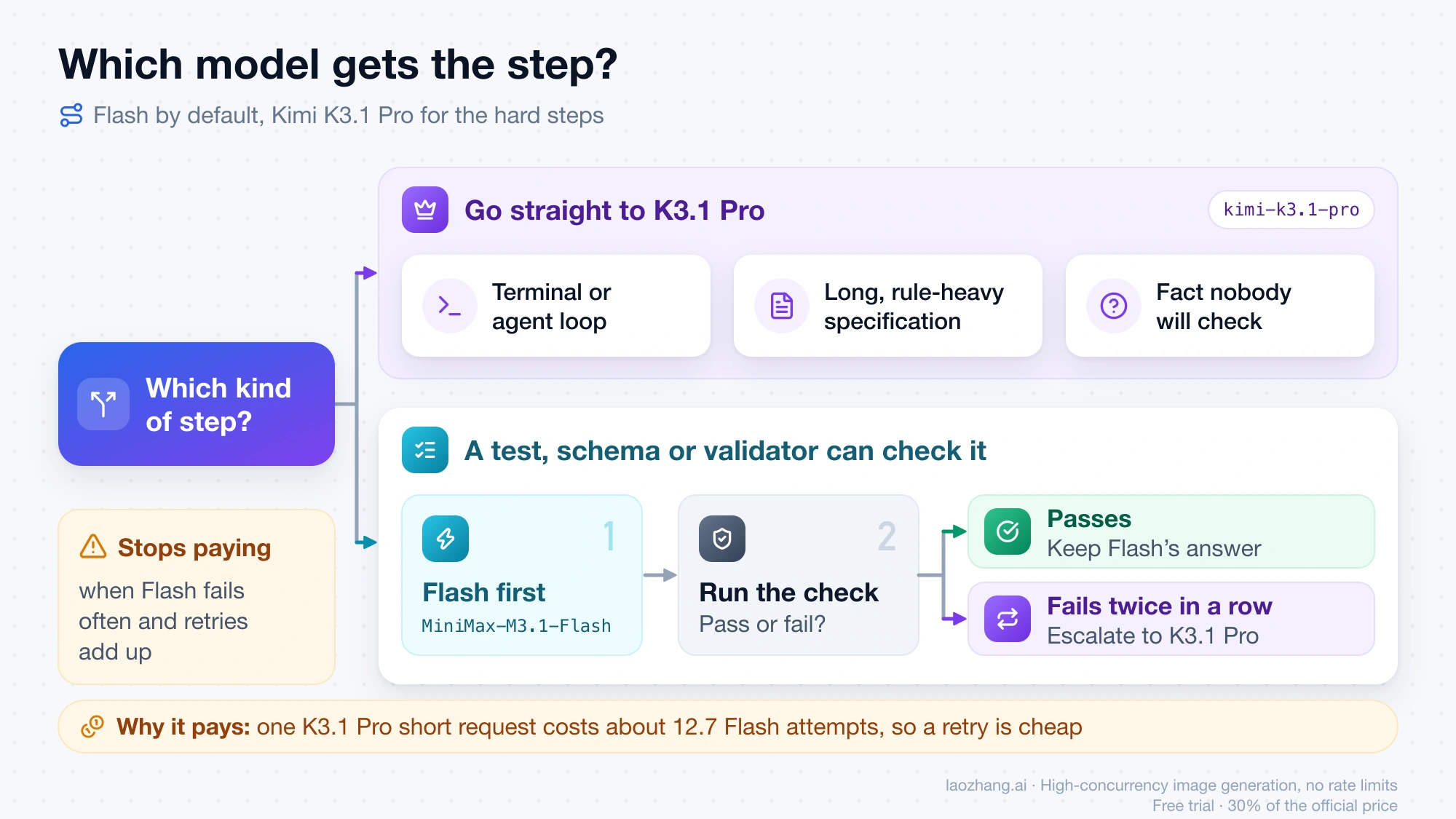
A split works when Flash handles the steps a check can verify and K3.1 Pro handles the rest. Send a step to Flash first if a test, schema or validator can tell you whether the answer is right, and escalate to K3.1 Pro when that check fails twice in a row. Go straight to K3.1 Pro when the step is a multi-step terminal or agent loop, a long specification with many interacting rules, or a factual answer that nobody will check. The economics favor this because one K3.1 Pro short request costs as much as about 12.7 Flash attempts at Artificial Analysis's token ratio, so a retry or two on Flash is still cheap. The split stops paying when Flash fails often enough that retries, slower turnaround and your own debugging time add up to more than that.
Two Kimi limits shape the design. Kimi's international API unlocks K3.1 Pro after a top-up of at least $1, but that Tier0 account allows 3 requests per minute and one concurrent request; Tier1, reached at $10, raises it to 100 requests per minute and 15 concurrent, according to Kimi's rate limits page. An agent that escalates often needs Tier1 before it goes live. K3.1 Pro also has no Batch API, so offline jobs pay full price. MiniMax publishes no LLM rate limits on its pricing pages.
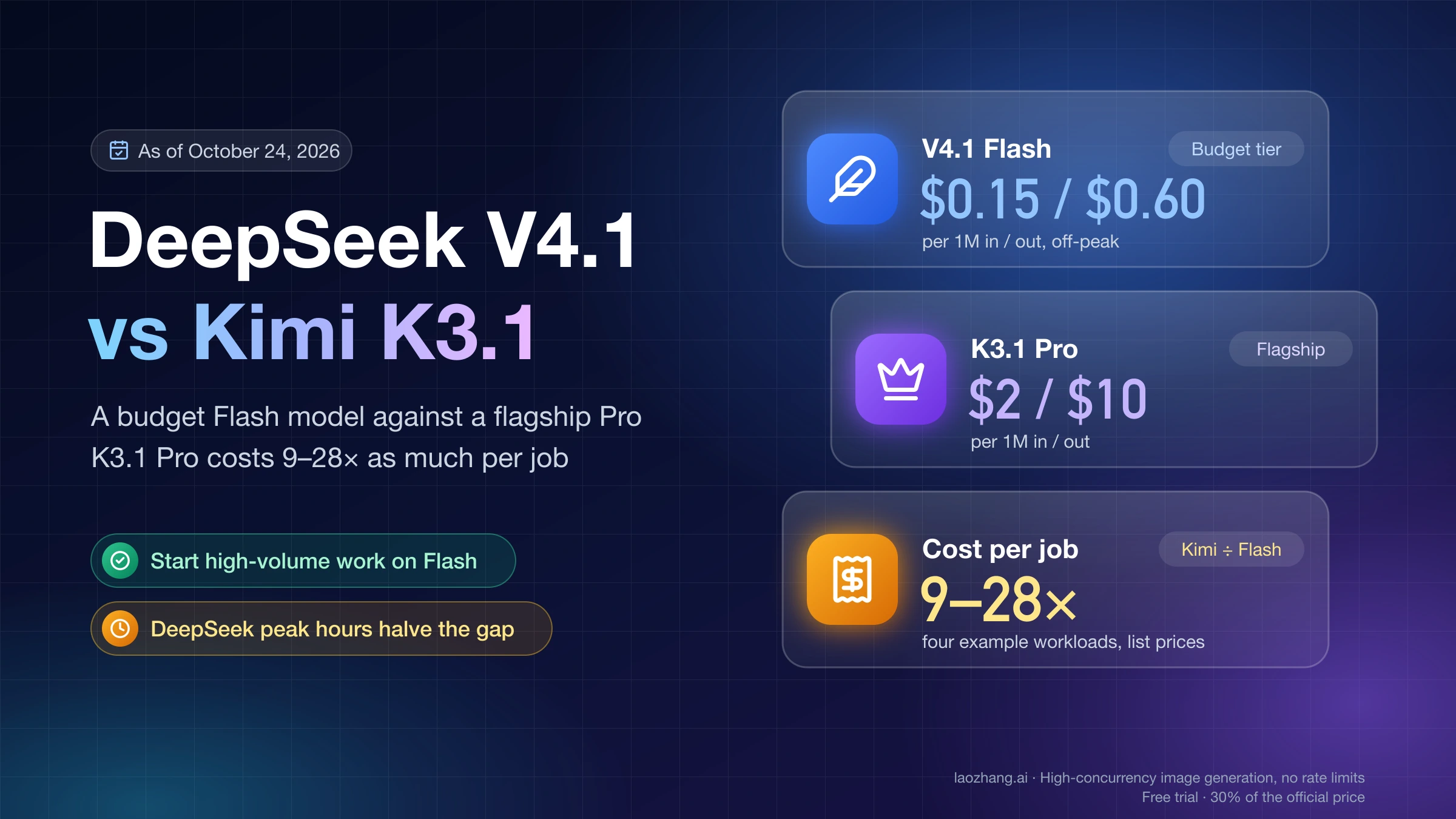
The same Flash-versus-flagship decision with DeepSeek's cheap model is covered in DeepSeek V4.1 vs Kimi K3.1: Flash vs Pro and a 9–28× Cost Gap.
Switching between kimi-k3.1-pro and MiniMax-M3.1-Flash: what changes in code
Both speak OpenAI-compatible Chat Completions, return reasoning in reasoning_content, fix their sampling parameters and default to max effort, so most code moves with a new base URL, key and model ID. The differences that break things are the effort values, the output cap, image input and access limits. The details below come from the Kimi K3.1 Pro quickstart, Kimi's reasoning effort guide and MiniMax's text generation guide, as of October 26, 2026.
| What you set | kimi-k3.1-pro | MiniMax-M3.1-Flash |
|---|---|---|
| Thinking | Always on, no off switch | On by default; thinking: {"type": "disabled"} or effort: "none" returns 400 "requires adaptive thinking" |
| Effort values | low, high, max (no medium) | low, medium, high, xhigh, max |
| Default effort | max | max |
| Effort field | reasoning_effort | reasoning_effort (Chat Completions), output_config.effort (Anthropic-compatible), reasoning.effort (Responses) |
| Sampling | temperature=1.0, top_p=0.95, n=1 and both penalties fixed; omit them | temperature has no effect (always 1); top_p always 0.95 |
| Output limit | max_completion_tokens defaults to 131,072, up to 1,048,576 | 131,072 recommended, 524,288 maximum |
| Context window | 1,048,576 tokens | 1,000,000 tokens |
| Multi-turn and tool calls | Send back the full assistant message, including reasoning_content and tool_calls | Function tools supported |
| Image input | Base64 or ms://<file-id> only; no public image URLs | Text, image and video input |
| Access before first call | Top-up of at least $1; Tier0 is 3 RPM, 1 concurrent | No LLM rate limits published |
| Batch API | None for K3.1 Pro | None listed on MiniMax's pricing pages |
Two changes catch people out. Moving from Flash to K3.1 Pro, a medium or xhigh effort value has no equivalent, so map it to high or max. Moving from K3.1 Pro to Flash, a max_completion_tokens above 524,288 exceeds Flash's ceiling. If you run Kimi inside Codex, the config.toml setup is in Kimi K3.1 Pro vs GPT-6.1 Sol: Same $2/$10, 3× the Cost per Task.
Free access, other hosts and self-hosting for K3.1 Pro and M3.1 Flash
Neither model has free API access as of October 26, 2026: OpenRouter lists no free endpoint for either, and Kimi's API unlocks K3.1 Pro only after a paid top-up. What differs is how many places sell them. In OpenRouter's public endpoint data as of October 26, 2026, K3.1 Pro had two endpoints, both run by Moonshot AI: the standard model at $2/$10 and Highspeed at $4/$20. M3.1 Flash had 13 endpoints, from Relace at $0.09 input and $0.50 output to SambaNova at $0.30 and $1.20, with most providers, MiniMax included, at $0.15 and $0.60.
That cheapest host is where the "$0.09/M input and $0.50/M output" on some comparison pages comes from; it is not MiniMax's own price. Hosts also serve Flash at different quantizations, from fp4 to fp16, so a cheaper endpoint can behave differently from MiniMax's, and a trial should use the host you plan to pay. The OpenRouter page for M3.1 Flash and the OpenRouter page for K3.1 Pro show the current list, which is likely to change for Kimi once its weights are out.
If you mostly use Flash inside coding tools, MiniMax's M Plan subscription is another way to pay: Go, Explore and Build tiers at $22, $55 and $132 a month, half price for the first month during the launch, with a key that works in MiniMax Code, Claude Code, Codex, Cursor and OpenCode. MiniMax does not publish the absolute usage each tier allows per window.
For self-hosting, only Flash is possible today. Its weights are under the MiniMax Community License, which is not an OSI open-source license and attaches attribution and notice conditions to commercial use; parameter counts, download sizes and hardware are in MiniMax M3.1 Flash Size: 428B Params, 252 GB on Hugging Face. K3.1 Pro's weights are promised by November 4, 2026, and until they appear it should not be described as open-source.
How to test K3.1 Pro against M3.1 Flash on your own workload
A small trial on your own tasks answers the question better than any benchmark, and it costs little: the 11-task test above came to $1.71 at list price for both models at both effort levels, retried calls included.
- Pull 10–20 real tasks from your logs, including the ones that hurt when they go wrong, and write the check for each before running anything: unit tests, an expected value, or a JSON schema.
- Add at least one task with no correct answer, such as a made-up function or a field that isn't in the document, and count it as passed only if the model says so.
- Call both models with the same prompts at an explicit
reasoning_effort: "high", then once more at the default. Stream every call and set timeouts of 15 minutes or more for K3.1 Pro atmax. - Run at least two samples per task on Flash, so you can tell a one-off failure from a task type it can't do.
- Compute cost per accepted answer from the returned
usage, counting retries and failed calls, rather than cost per call. - Assign each task type: Flash where it passes every sample, K3.1 Pro where Flash fails repeatedly or where nothing checks the answer. Re-run the trial when K3.1 Pro's weights bring new hosts or MiniMax ships its Pro model.
For other low-cost models to put in the same trial, DeepSeek V4.1 Flash vs GLM-5.3-Flash: Which Is Cheaper, and When and AI API Price Comparison: Cheapest Model by Input and Output Mix list the current options.
Sources13
External pages this guide links to, in the order they appear. Last updated Oct 26, 2026.
Sources13
External pages this guide links to, in the order they appear. Last updated Oct 26, 2026.
- 1.Kimi's price listplatform.kimi.ai/docs/pricing/chat
- 2.MiniMax'splatform.minimax.io/docs/guides/pricing
- 3.Kimi K3.1 Pro quickstartplatform.kimi.ai/docs/guide/kimi-k3-1-pro-quickstart
- 4.MiniMax M3.1 Flash launch postminimax.io/blog/minimax-m31f
- 5.MiniMax's Hugging Face repositoryhuggingface.co/MiniMaxAI/MiniMax-M3.1-Flash
- 6.Artificial Analysis's Kimi K3.1 Pro vs MiniMax M3.1 Flash comparisonartificialanalysis.ai/models/comparisons/kimi-k3-1-pro-vs-minimax-m3-1-flash
- 7.VentureBeat's launch report on M3.1 Flashventurebeat.com/technology/minimaxs-new-m3-1-flash-beats-deepseek-and-opus-5-on-a-key-business-benchmark-at-lower-cost-but-with-a-high-hallucination-rate
- 8.Kimi's rate limits pageplatform.kimi.ai/docs/pricing/limits
- 9.Kimi's reasoning effort guideplatform.kimi.ai/docs/guide/use-reasoning-effort
- 10.MiniMax's text generation guideplatform.minimax.io/docs/guides/text-generation
- 11.OpenRouter page for M3.1 Flashopenrouter.ai/minimax/minimax-m3.1-flash
- 12.OpenRouter page for K3.1 Proopenrouter.ai/moonshotai/kimi-k3.1-pro
- 13.M Plan subscriptionplatform.minimax.io/docs/m-plan/intro