Haiku 5.5 vs Opus 5.5: 40x Cheaper per Token, 23–29x per Task
Claude Haiku 5.5 costs 1/40 of Opus 5.5 per token on prompts up to 100K and 23–29x less per task at equal effort. Move checkable work; keep agents on Opus.
On this page
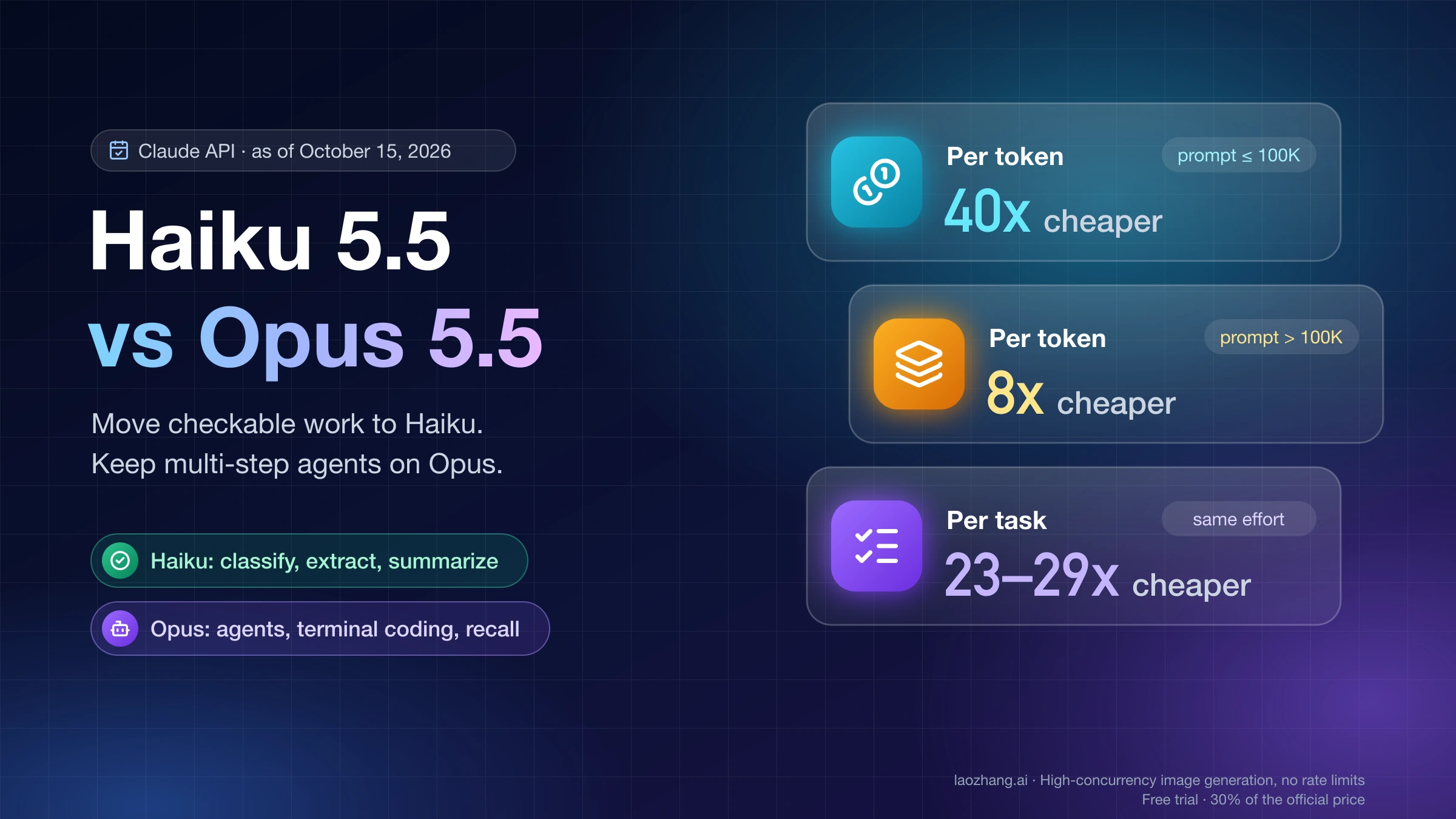
Move narrowly scoped work that code can check to Claude Haiku 5.5. Keep multi-step agents, terminal-heavy coding and answers that rely on the model's own knowledge on Claude Opus 5.5. Haiku 5.5, released October 7, 2026, lists at one-fortieth of Opus 5.5's price per input and output token, but only while a request's prompt stays at or under 100,000 tokens. Above that line the gap is 8x. Per finished task the gap is also smaller than the token price suggests: in Artificial Analysis runs as of October 15, 2026, Opus 5.5 cost 23–29x as much as Haiku 5.5 at the same effort level. When Haiku ran at max effort to reach the overall score of Opus at low, Opus cost only 2.6x as much, and it finished each task 4.9x faster.
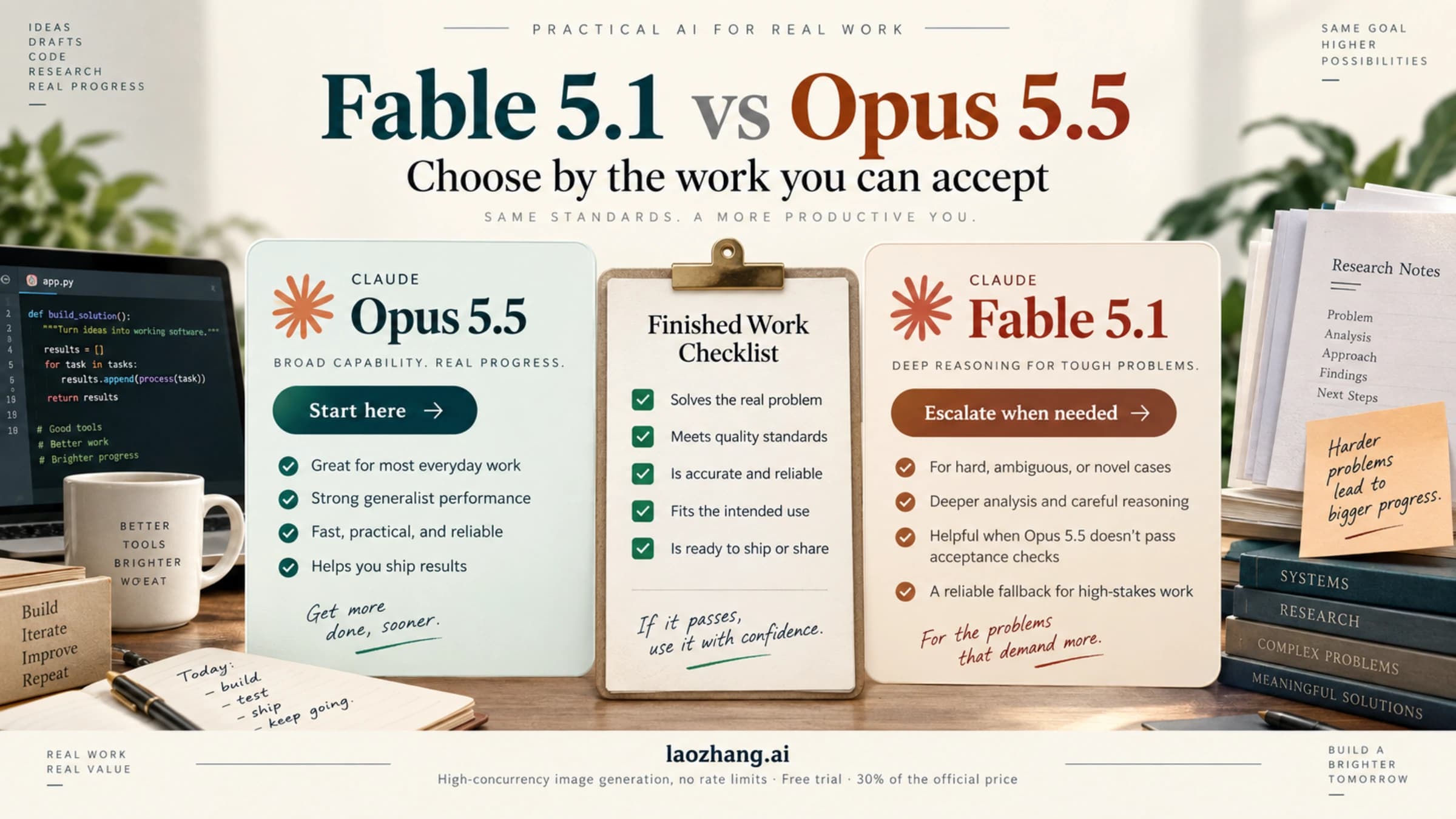
Anthropic's models overview tells anyone unsure to start with Opus 5.5, so most teams already run it everywhere. The practical decision is which jobs to move down:
| Work | Run it on | Why |
|---|---|---|
| Classification, extraction, routing, tagging at volume | Haiku 5.5 at low or medium | Output is easy to validate. 1M calls of 2K input and 300 output tokens cost about $350 on Haiku vs $14,000 on Opus at list price |
| Summaries, compaction, questions over documents you supply | Haiku 5.5 at medium or high | Long-context reading score stays within a few points of Opus. Watch the 100K price line |
| Codebase search in Claude Code (the built-in Explore subagent) | Haiku 5.5 | Read-only, and Anthropic positions Haiku 5.5 for subagent work |
| Multi-step automation, long agentic coding runs | Opus 5.5 | Haiku's best AutomationBench score (36.0%) sits below Opus at its lowest effort (52.9%) |
| Answers from the model's own memory, with no retrieval | Opus 5.5 | Knowledge-reliability scores of 3–11 for Haiku vs 39–46 for Opus |
The rest of the page shows where each number comes from, how to estimate your own saving, and how to move Claude Code's Explore subagent onto Haiku.
Is Haiku 5.5 cheaper than Opus 5.5? 40x per token, only up to 100K
Yes. At Claude API list prices Haiku 5.5 is 40x cheaper per input, output and cache-write token on prompts up to 100,000 tokens, and 8x cheaper above that. Cache reads, the bulk of an agent's input, are 20x and 4x cheaper. Prices as of October 15, 2026, from Anthropic's API pricing page:
| Price per million tokens | Haiku 5.5, prompt up to 100K | Haiku 5.5, prompt over 100K | Opus 5.5 | Opus ÷ Haiku |
|---|---|---|---|---|
| Input | $0.10 | $0.50 | $4 | 40x / 8x |
| 5-minute cache write | $0.125 | $0.625 | $5 | 40x / 8x |
| 1-hour cache write | $0.20 | $1 | $8 | 40x / 8x |
| Cache read | $0.01 | $0.05 | $0.20 | 20x / 4x |
| Output (includes thinking) | $0.50 | $2.50 | $20 | 40x / 8x |
| Batch input / output | $0.05 / $0.25 | $0.25 / $1.25 | $2 / $10 | 40x / 8x |
Opus 5.5 has one price across its whole 1M-token window. Haiku 5.5 has two, and three rules decide which one a request pays:
- The 100K line counts the entire prompt, cached parts included. The pricing page says a request's prompt length "counts all of its input tokens, including cache reads and cache writes." A request over the line pays the higher prices on every token, cache hits too. Each request is priced on its own, so earlier turns keep the price they were billed at.
- Cache reads are 20x, not 40x. Opus 5.5 cache reads cost 0.05x its input price, a special rate. Haiku 5.5 uses the standard 0.1x. An agent loop that rereads a cached context every turn therefore gets 20x below 100K and only 4x above it.
- Haiku 5.5 carries all of its earlier thinking. According to What's new in Claude Haiku 5.5, it keeps thinking blocks from every earlier assistant turn in context and bills them as input tokens. A long Haiku conversation crosses 100K sooner than its visible text suggests. Thinking block clearing removes the older blocks.
Two more details apply to both models. Haiku 5.5 uses the same newer tokenizer as Claude 4.7 and later models, Opus 5.5 among them, so the same text counts as the same number of tokens on both. Batch processing halves both models' prices, and the 1.1x surcharge for US-only inference applies to both Haiku bands as well as to Opus. Anthropic says prompts up to 100K made up about 90% of requests to the previous Haiku model, so most short, high-volume jobs stay in the cheap band.
Opus 5.5 also has a fast mode, a research preview on the Claude API, at $8 input and $40 output per million tokens. For Opus 5.5 price history against Opus 5, batch details and fast mode, see Claude Opus 5.5 Pricing and Limit Reset: What Each One Changes.
Haiku 5.5 vs Opus 5.5 cost per request: from 40x down to 5x
The ratio you actually pay depends on how much of each request is cache reads and whether the prompt crosses 100K. Each row below uses list prices and the same formula: tokens × price per million ÷ 1,000,000, summed over input, cache reads and output. Cache writes on the first turn are left out, and both models are assumed to use the same number of tokens.
| Request | Haiku 5.5 | Opus 5.5 | Opus ÷ Haiku |
|---|---|---|---|
| 10K input + 1K output | $0.0015 | $0.060 | 40x |
| Agent turn: 90K cache read + 5K new input + 2K output | $0.0024 | $0.078 | 32.5x |
| Same turn with 150K cache read | $0.0150 | $0.090 | 6x |
| Long session: 500K cache read + 2K input + 3K output | $0.0335 | $0.168 | 5x |
| 99K input + 2K output | $0.0109 | $0.436 | 40x |
| 150K input + 2K output | $0.080 | $0.640 | 8x |
To check the second row: Haiku costs 90,000 × $0.01 plus 5,000 × $0.10 plus 2,000 × $0.50, divided by one million, which is $0.0024. Opus costs 90,000 × $0.20 plus 5,000 × $4 plus 2,000 × $20, divided by one million, which is $0.078. Push the cached context to 150K and Haiku's whole request moves to the higher band, so the same turn becomes $0.0150 against $0.090.
At volume the difference is large. One million classification calls of 2,000 input tokens and 300 output tokens each cost about $350 on Haiku 5.5 and $14,000 on Opus 5.5.
Plug your own token profile into the same formula. If most of your requests are short prompts with short answers, expect close to 40x per request. If they are long agent turns with hundreds of thousands of cached tokens, expect 4–8x. These rows still assume both models spend the same tokens, which they don't, and that is what the per-task numbers below measure.
Cost per task: 23–29x at equal effort, 2.6x at equal score
Measured per finished task, Opus 5.5 costs 23–29x as much as Haiku 5.5 when both run at the same effort level. Artificial Analysis's Haiku 5.5 vs Opus 5.5 release comparison ran both models at all five effort levels on its Intelligence Index v4.3.2, an average of 10 evaluations. Figures as of October 15, 2026:
| Effort | Opus 5.5: score, cost per task | Haiku 5.5: score, cost per task | Opus cost ÷ Haiku cost |
|---|---|---|---|
low | 42, $0.55 | 29, $0.02 | 27.5x |
medium (API default on both) | 51, $1.34 | 34, $0.05 | 26.8x |
high | 54, $1.82 | 38, $0.08 | 22.8x |
xhigh | 56, $3.46 | 41, $0.12 | 28.8x |
max | 58, $5.98 | 43, $0.21 | 28.5x |
The effort names are the same on both models, but they are calibrated separately. Haiku at max (43) lands on Opus at low (42), not on Opus at max. At that matched score Haiku costs $0.21 per task against $0.55, 38% of the Opus price, and takes 423 seconds per task against 87. Opus at medium, its default, scores 51, which is 8 points above anything Haiku reaches.
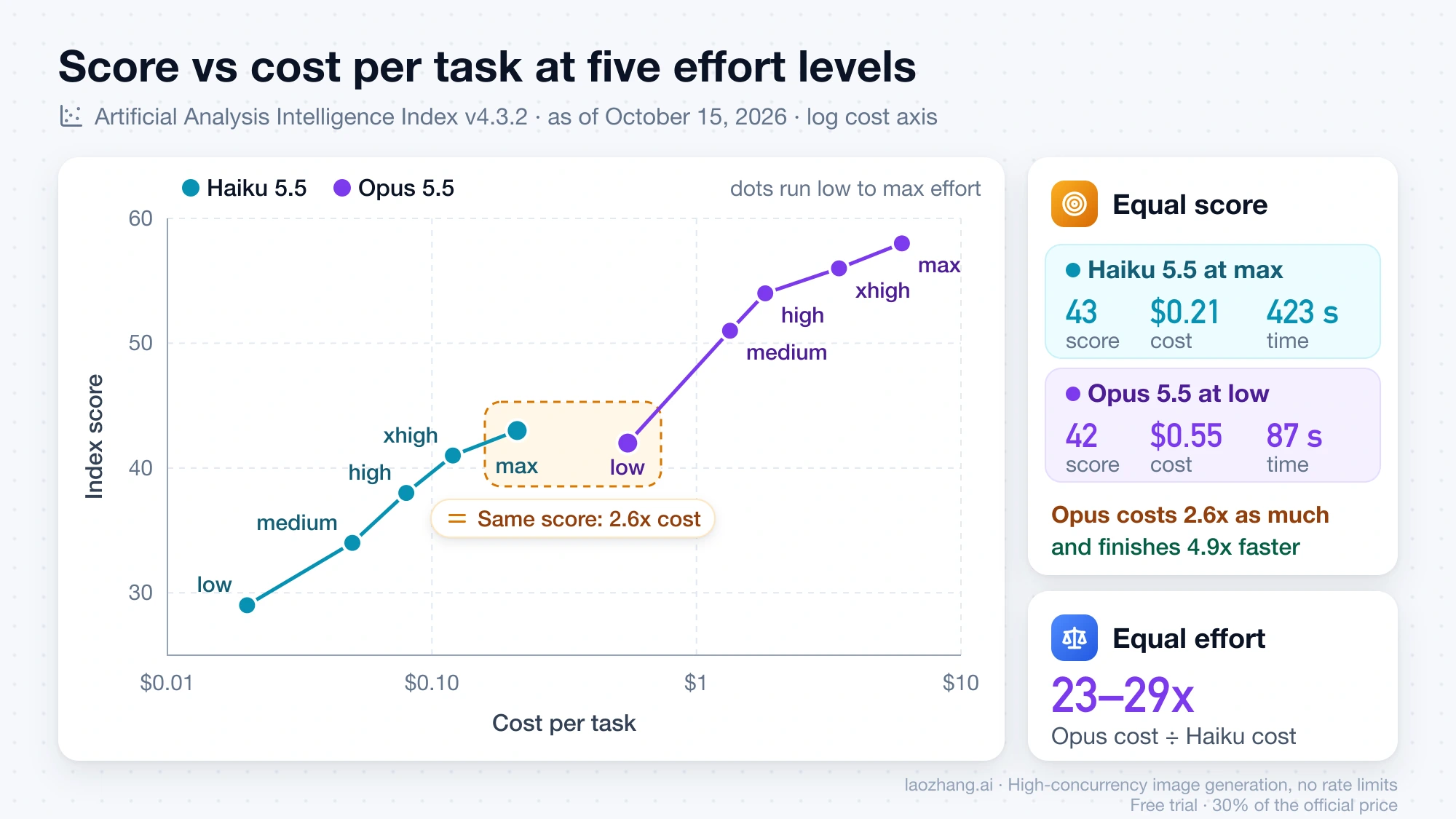
Three limits apply to this table. Artificial Analysis prices every Haiku task at the up-to-100K rates, so tasks with long prompts may be under-priced for Haiku. Its Opus 5.5 runs are labeled "with fallback". And the index is an average that hides large gaps between individual tests, which the next section breaks out.
Single projects can land far from both ratios. MindStudio's October 9, 2026 write-up comparing Claude Haiku 5.5, Sonnet 5.5 and Opus 5.5 covers one creator's same-prompt test. It put a 3D product landing page at about $30 on Haiku and about $55 on Opus, with Opus producing the most polished result. The write-up gives no effort levels or token counts. Treat it as a reason to measure your own jobs, not as a ratio to plan with.
Which is better, Opus or Haiku? The sub-scores that decide it
Opus 5.5 outscores Haiku 5.5 on the overall index whenever both run at the same effort level, but the gap is uneven. Haiku 5.5 stays close on long documents and knowledge-work deliverables, and falls far behind on automation, terminal coding and facts recalled from memory. The table pairs each model's default (medium) with the matched-score pair from the previous section. Artificial Analysis figures as of October 15, 2026:
| Test (what it measures) | Opus 5.5 medium | Opus 5.5 low | Haiku 5.5 max | Haiku 5.5 medium |
|---|---|---|---|---|
| Intelligence Index | 51 | 42 | 43 | 34 |
| AutomationBench-AA (automation tasks) | 61.2% | 52.9% | 35.4% | 28.6% |
| Terminal-Bench 4.0 (command-line agent tasks) | 52.5% | 31.3% | 32.8% | 15.2% |
| AA-Omniscience (knowledge reliability, penalizes made-up answers) | 40 | 39 | 11 | 4 |
| AA-LCR v1.1 (long-context reasoning) | 84.3% | 80.7% | 82.7% | 77.3% |
| GDPval-AA v2.1 (knowledge work) | 1584 | 1235 | 1618 | 1275 |
| AA-Briefcase v1.1 (knowledge work) | 1625 | 1280 | 1578 | 1372 |
| Cost per task | $1.34 | $0.55 | $0.21 | $0.05 |
| Time per task | 219 s | 87 s | 423 s | 136 s |
Read it as a decision rule:
- Haiku holds on documents you hand it. On long-context reasoning Haiku stays within 7 points of Opus in every column, and Haiku at
max(82.7%) beats Opus atlow(80.7%). On GDPval-AA, Haiku atmax(1618) edges out Opus at its default (1584), at about a sixth of the cost per task. - Haiku breaks on long chains of actions. Its best AutomationBench score at any effort, 36.0% at
xhigh, is below Opus atlow. On Terminal-Bench, Haiku atmaxonly ties Opus atlow, and Opus atmediumscores about 20 points higher than Haiku's best. Anthropic's own Claude Haiku 5.5 launch post says Sonnet 5.5 and Opus 5.5 "remain better choices for complex agentic coding tasks" and that Haiku 5.5 is "best suited to more narrowly scoped tasks … like compaction, summarization, or subagent work." - Haiku is unreliable on recall. AA-Omniscience penalizes confident wrong answers. Haiku scores 3–11 and Opus 39–46, and Opus barely drops when you lower its effort. If an answer depends on what the model remembers rather than on a document or search result you supply, keep it on Opus or give Haiku retrieval.
Anthropic's Prompting Claude Haiku 5.5 guide lists the failure modes to watch for, each with a system-prompt fix:
- At
loweffort with a long agent system prompt, Haiku sometimes stops early and hands the task back. In Anthropic's testing, moving fromlowtomediumroughly halved early stopping and more than doubled the output tokens per attempt. - At
lowandmedium, it sometimes reports a code change as done without running a check. - With thinking turned off and structured JSON output requested, it may skip a tool call it needs.
None of these are visible in a price table, and the second one in particular produces a confident "done" that a cost comparison will count as a success.
How much faster is Haiku than Opus? About 2x per output token
Haiku 5.5 generates output about twice as fast as Opus 5.5 at standard speed, and it finishes tasks sooner at the same effort level. It is not faster once you raise its effort to match the overall score of Opus at low. Artificial Analysis figures as of October 15, 2026:
- Output speed: 139–237 tokens per second for Haiku against 73–95 for Opus. At the default
mediumit is 143 against 73. - Time to first token: 12.2 seconds for Haiku at
mediumagainst 27.4 for Opus atmedium. These times include thinking, so they grow with effort: Haiku atmaxwaits 337 seconds before its first token. - Time per task at equal effort: Haiku is quicker at every level, for example 136 against 219 seconds at
medium. - Time per task at equal score: Haiku at
maxtakes 423 seconds, Opus atlowtakes 87.
Anthropic's comparative latency labels are "Fastest" for Haiku 5.5 and "Moderate" for Opus 5.5. The models overview adds that actual latency depends on prompt length, output length and effort. The launch post adds a footnote that Haiku 5.5 "runs less quickly than our Opus models in Fast Mode." Opus fast mode, a research preview on the Claude API only, promises up to 2.5x faster output at double the standard price.
Lower Opus 5.5 effort first when Haiku fails your evals
If Haiku 5.5 doesn't pass your tests on a job, dropping Opus 5.5 to a lower effort level is the next cheapest option, and it keeps Opus's strengths. Anthropic's cost and intelligence guide measured Opus 5.5 on a subset of SWE-bench Pro. Against high, medium scored about 2.5 points lower for about 70% of the cost, and low about 8 points lower for about a third of the cost. Running everything at low and re-running only the failures at high passed about 97% of tasks for about $0.17 each, against 95.3% for $0.29 when everything ran at high. Anthropic calls these results internal and directional, not guarantees.
Lower effort narrows the cost gap but doesn't close it. On Artificial Analysis's tasks, Opus at low ($0.55) still costs 27.5x as much as Haiku at low and 11x as much as Haiku at medium. The two options trade differently:
- Choose Opus at
lowwhen the work involves automation or recall, or when you need the answer quickly. It keeps AutomationBench at 52.9% and AA-Omniscience at 39, and finishes in 87 seconds per task. - Choose Haiku at
highormaxwhen the work is report writing or reading long documents and cost matters more than time. It costs $0.08–$0.21 per task, but takes 218–423 seconds.
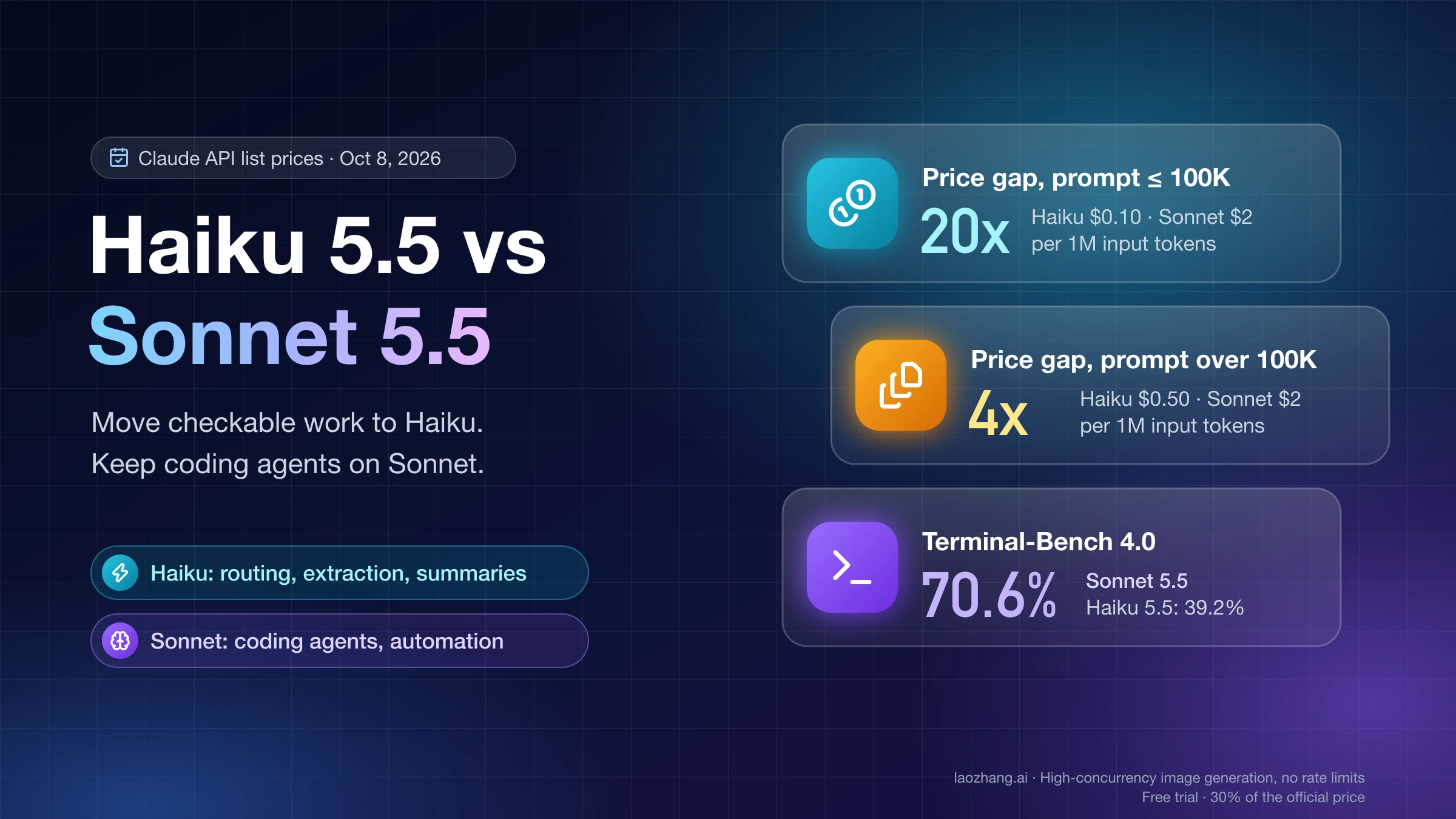
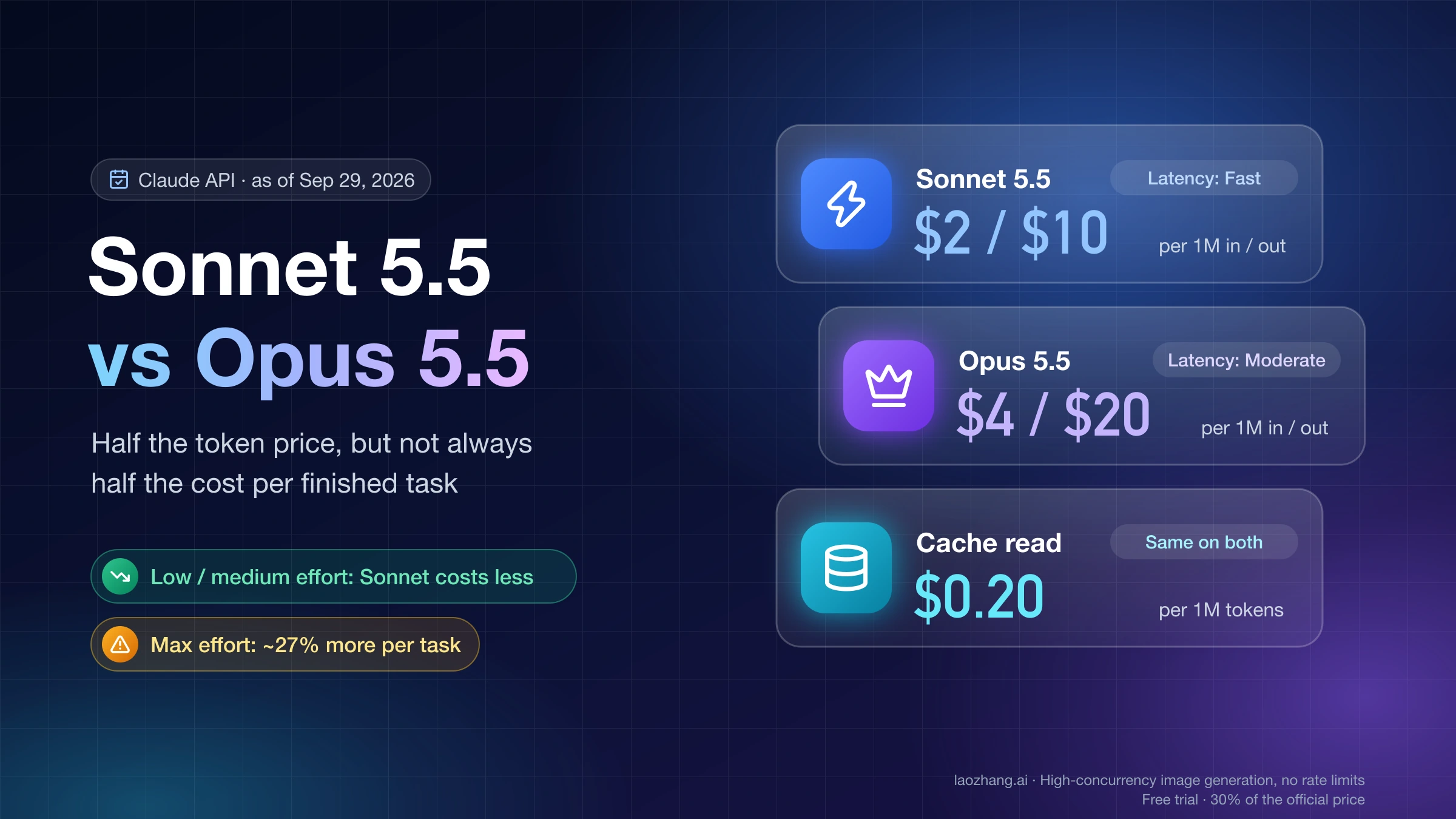
The middle tier is a third option. Claude Sonnet 5.5 lists at $2 / $10 per million input and output tokens, half of Opus 5.5 and 20x Haiku 5.5 below 100K. Claude Sonnet 5.5 vs Opus 5.5: When Half the Price Really Saves and Claude Haiku 5.5 vs Sonnet 5.5: When the 20x Price Gap Pays Off cover those pairs.
Haiku first, Opus on failure: cheaper once Haiku passes 3.7%
Sending every task to Haiku 5.5 first and re-running only the failures on Opus 5.5 beats running everything on Opus as long as Haiku completes more than about 3.7% of tasks acceptably. That holds only if your code can tell a failure from a success.
The arithmetic, using Artificial Analysis's per-task costs at medium as an illustration: expected cost per task = $0.05 + (1 − p) × $1.34, where p is the share of tasks Haiku completes. Haiku-first is cheaper whenever p is above 0.05 ÷ 1.34, about 3.7%.
| Share Haiku completes (p) | Cost per 1,000 tasks, Haiku first | Cost per 1,000 tasks, Opus only |
|---|---|---|
| 50% | $720 | $1,340 |
| 70% | $452 | $1,340 |
| 90% | $184 | $1,340 |
Replace $0.05 and $1.34 with your own measured costs and p with your own pass rate. The estimate breaks down in three places:
- Undetected failures aren't priced. Escalation only fires on a failure your code catches: a failing test, a schema check, a label outside the allowed set, a validator. A wrong answer that passes those checks costs nothing in the table and everything in production. Haiku's low AA-Omniscience score makes this more likely on recall-heavy work.
- Escalated tasks pay twice in time. At these effort levels an escalated task waits for Haiku's 136 seconds and then Opus's 219.
- The table assumes Opus fixes what Haiku failed. If both fail the same tasks, you pay for two attempts.
When you replay a Haiku request on Opus 5.5, a few request settings have to change, because the two models accept different parameters. From the Opus 5.5 and Haiku 5.5 migration notes:
- Thinking: Haiku 5.5 accepts
thinking: {"type": "disabled"}athigheffort or below. Opus 5.5 returns a 400 error for it, and for a manualbudget_tokens. Omitthinkingor send{"type": "adaptive"}on the Opus request, and control depth withoutput_config.effort. - Forced tool use: Haiku 5.5 accepts a forced
tool_choiceofanyor a named tool. Opus 5.5 returns a 400 error for both. Switch totool_choice: {"type": "auto"}with strict tool use, or say in the prompt when the tool applies. - Reasoning carried over: On the Claude API and Google Cloud, Opus 5.5 reads Haiku 5.5's thinking blocks, so a conversation escalated mid-way keeps Haiku's reasoning. The reverse doesn't hold: Haiku 5.5 can't read Opus 5.5's blocks, and the API drops them without an error. Keep the conversation append-only when you switch, since a changed system prompt, tool list or earlier message can invalidate the carried thinking blocks.
- Going the other way: code written for older models can break on Haiku 5.5. It rejects assistant prefill, any
top_k, andtemperatureortop_pvalues other than their defaults. - Refusals: both models can return
stop_reason: "refusal". Opus 5.5 supports server-side fallback in beta. Haiku 5.5 doesn't, so handle the refusal in your client.
Claude Code: move the built-in Explore subagent from Opus 5.5 to Haiku
In Claude Code, the built-in Explore subagent runs on your main conversation's model. On an Opus 5.5 session, every codebase search Claude delegates to Explore runs on Opus 5.5. If your main session runs Fable and you connect with a Claude subscription, an Anthropic Console account or an LLM gateway, Explore runs on the model the opus alias resolves to, which is Opus 5.5 on the Anthropic API. Explore is read-only and starts without your CLAUDE.md files, so it is a low-risk first job to move. The Claude Code subagents documentation describes two ways to do it.
Before either one:
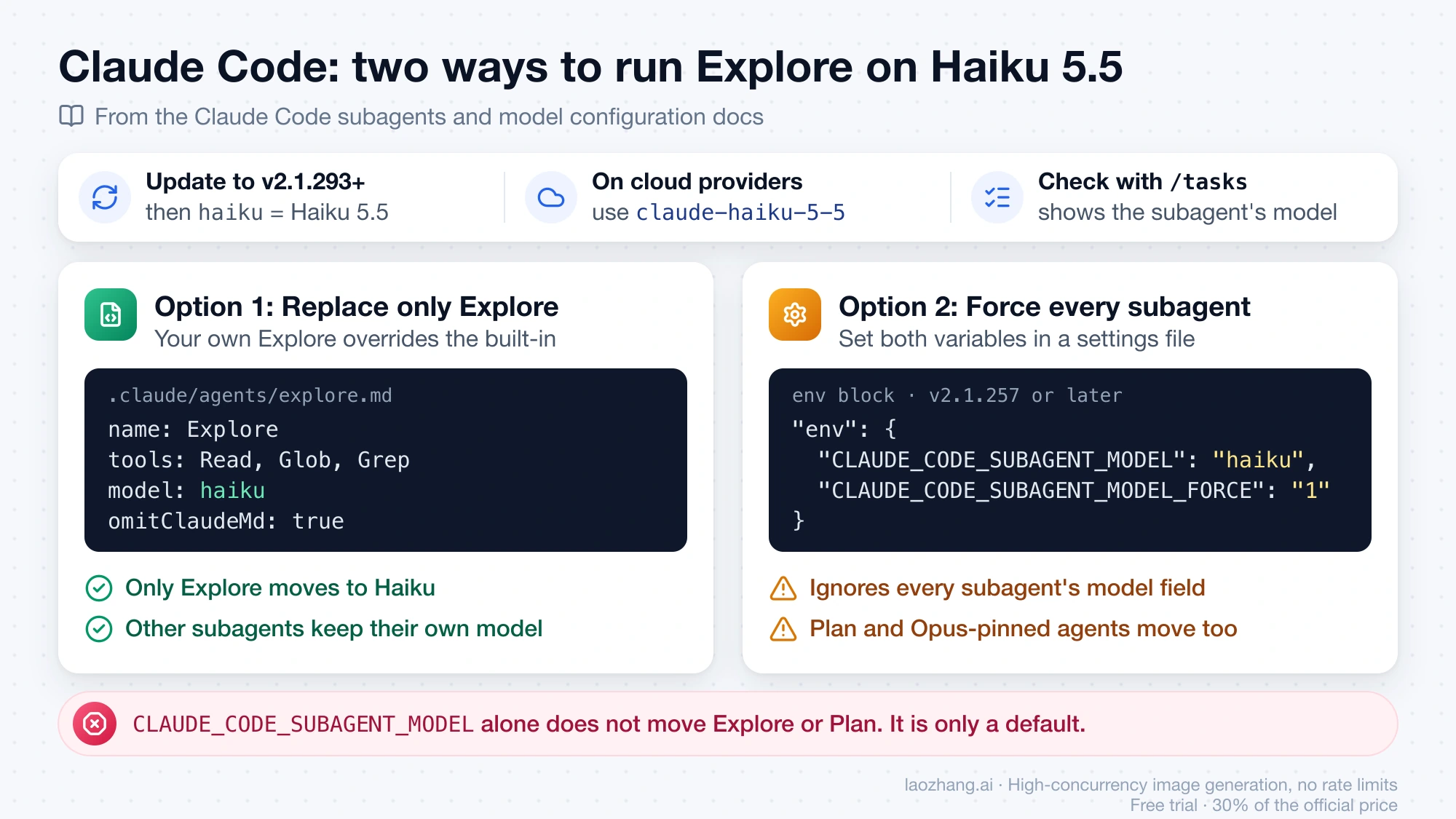
- Update Claude Code to v2.1.293 or later with
claude update. From that version, thehaikualias resolves to Haiku 5.5 on the Anthropic API. - On Claude Platform on AWS, Amazon Bedrock, Google Cloud's Agent Platform and Microsoft Foundry,
haikustill resolves to Haiku 4.5, according to the Claude Code model configuration docs. Use the full model IDclaude-haiku-5-5there instead of the alias. - To see what a subagent runs on, run
/taskswhile it is working. Its row names the model and any effort level set for it (v2.1.242 or later).
Option 1: replace only Explore. A user or project subagent named Explore overrides the built-in one and keeps its own model field. Save a file such as .claude/agents/explore.md in the project, or ~/.claude/agents/explore.md for every project. The definition below follows the documented frontmatter fields:
---
name: Explore
description: Fast read-only agent for file discovery, code search, and codebase exploration
tools: Read, Glob, Grep
model: haiku
omitClaudeMd: true
---
You explore codebases without changing them. Find the files, symbols, and code paths
the task asks about, and report what you found with file paths and short excerpts.
Your definition replaces the built-in Explore entirely, so the body above becomes its whole system prompt. tools keeps it read-only. Add Bash if you want it to run commands such as git log, keeping in mind that Bash can also change files. omitClaudeMd: true (v2.1.271 or later) keeps it starting without your CLAUDE.md files, as the built-in one does. Claude Code watches both agent folders and picks up the new file within seconds. If the agents folder didn't exist when the session started, restart Claude Code once.
Option 2: run every subagent on Haiku. Setting CLAUDE_CODE_SUBAGENT_MODEL alone does not move Explore or Plan. It is only a default for subagents that have no model of their own. To force one model onto every subagent, Explore included, set both variables in the env block of a settings file (v2.1.257 or later). This is the documented example:
{
  "env": {
    "CLAUDE_CODE_SUBAGENT_MODEL": "haiku",
    "CLAUDE_CODE_SUBAGENT_MODEL_FORCE": "1"
  }
}
This is the blunter tool. While it is on, Claude Code ignores the model field in every subagent definition, so a custom reviewer you pinned to Opus also runs on Haiku, and Claude can't pick a model when it starts a subagent. Plan moves to Haiku too. Forks and skills that run in a subagent with model: inherit stay on the main model.
What changes after the move:
- Cost per search drops, but not always 40x. Explore rereads files into its own context. Once a single request's prompt passes 100K tokens, Haiku's price rises 5x for that request, and the gap to Opus narrows to 8x on input and 4x on cache reads.
- Search can get shallower. Explore runs at the session's effort unless you set one. Claude Code's default is
mediumon both models, and thinking can't be turned off on either. If Haiku-run searches start missing files, addeffort: highto the custom Explore definition before going back to Opus. - Subscription plans don't publish a ratio. On Pro and Max plans the saving shows up as usage limits rather than dollars. Anthropic says usage depends on the model and effort level, but it doesn't publish how much less a Haiku request counts.
- Don't switch the main session with
/modelto save money mid-task. Each model keeps its own prompt cache, so a switch rereads the whole conversation without cache hits, and a switch to Opus also moves every subagent that inherits the session's model.
For where the subagent docs live and how to write a safe read-only helper of your own, see Claude Code Subagents Documentation: Official Docs, Safe Templates, and When to Use Them. Claude Code's cost guide gives the same advice for any simple custom subagent: set model: haiku in its configuration.
Haiku 5.5 vs Opus 5.5 FAQ
Is Haiku 5.5 at high effort as good as Opus 5.5 at low?
No, but it is close and much cheaper. On Artificial Analysis's index, Haiku 5.5 at high scores 38 and Opus 5.5 at low scores 42. Haiku costs $0.08 per task against $0.55, but takes 218 seconds against 87. To match Opus low on the overall score you need Haiku at max (43, $0.21), and even then Opus stays far ahead on multi-step automation and recall.
Can an army of Haiku 5.5 subagents beat Opus 5.5?
As helpers under an Opus lead, there is one vendor-reported data point in favor. Cognition says in Anthropic's launch post that Devin Fusion with Opus 5.5 as the lead and Haiku 5.5 as the "sidekick" holds a FrontierCode score of 66.2 while cutting cost and latency. It gives no cost or latency figures. As a replacement for Opus on the lead role, the sub-scores argue against it: Haiku's best Terminal-Bench result only ties Opus at its lowest effort, and its best AutomationBench result falls short of it.
Is Opus 5.5 cheaper than Opus 5?
Yes. Opus 5.5 lists at $4 / $20 per million input and output tokens, against $5 / $25 for Opus 5, and its cache reads cost $0.20 against $0.50. The full breakdown is in Claude Opus 5.5 Pricing and Limit Reset: What Each One Changes.
Where does Sonnet 5.5 fit between Haiku 5.5 and Opus 5.5?
Sonnet 5.5 costs $2 / $10 per million tokens, half of Opus 5.5, and has one price across its whole context window. Anthropic groups it with Opus as the better choice for complex agentic coding. It is the option to test when Haiku fails your evals but Opus is more than the job needs.
Can I use Haiku 5.5 and Opus 5.5 on the free Claude plan?
You can use Haiku but not Opus. Claude's pricing page lists Haiku and Sonnet on Free and all three models on Pro, Max 5x and Max 20x. Usage on paid plans depends on the model and effort you choose, but Anthropic doesn't publish a conversion rate between them.
What are the API model IDs?
claude-haiku-5-5 and claude-opus-5-5. Both have a 1M-token context window, up to 128K output tokens, image and text input, and medium as the default effort. Set effort per request with output_config.effort.
Sources11
External pages this guide links to, in the order they appear. Last updated Oct 15, 2026.
Sources11
External pages this guide links to, in the order they appear. Last updated Oct 15, 2026.
- 1.models overviewplatform.claude.com/docs/en/about-claude/models/overview
- 2.Anthropic's API pricing pageplatform.claude.com/docs/en/about-claude/pricing
- 3.What's new in Claude Haiku 5.5platform.claude.com/docs/en/models/haiku-5-5/whats-new-haiku-5-5
- 4.Artificial Analysis's Haiku 5.5 vs Opus 5.5 release comparisonartificialanalysis.ai/models/releases/comparisons/claude-haiku-5-5-vs-claude-opus-5-5
- 5.MindStudio's October 9, 2026 write-up comparing Claude Haiku 5.5, Sonnet 5.5 and Opus 5.5mindstudio.ai/blog/claude-haiku-5-5-vs-sonnet-opus
- 6.Claude Haiku 5.5 launch postanthropic.com/claude-haiku-5-5
- 7.Prompting Claude Haiku 5.5 guideplatform.claude.com/docs/en/build-with-claude/prompt-engineering/prompting-claude-haiku-5-5
- 8.cost and intelligence guideplatform.claude.com/docs/en/about-claude/models/optimizing-for-cost-and-intelligence
- 9.Claude Code subagents documentationcode.claude.com/docs/en/sub-agents
- 10.Claude Code model configuration docscode.claude.com/docs/en/model-config
- 11.cost guidecode.claude.com/docs/en/costs