Is Qwen-Image-2.1 Uncensored? Filters, License, and the Law
Official Qwen-Image-2.1 weights have no safety checker; Alibaba-hosted versions filter prompts. The “Uncensored GGUF” is the same model, still non-commercial.
On this page
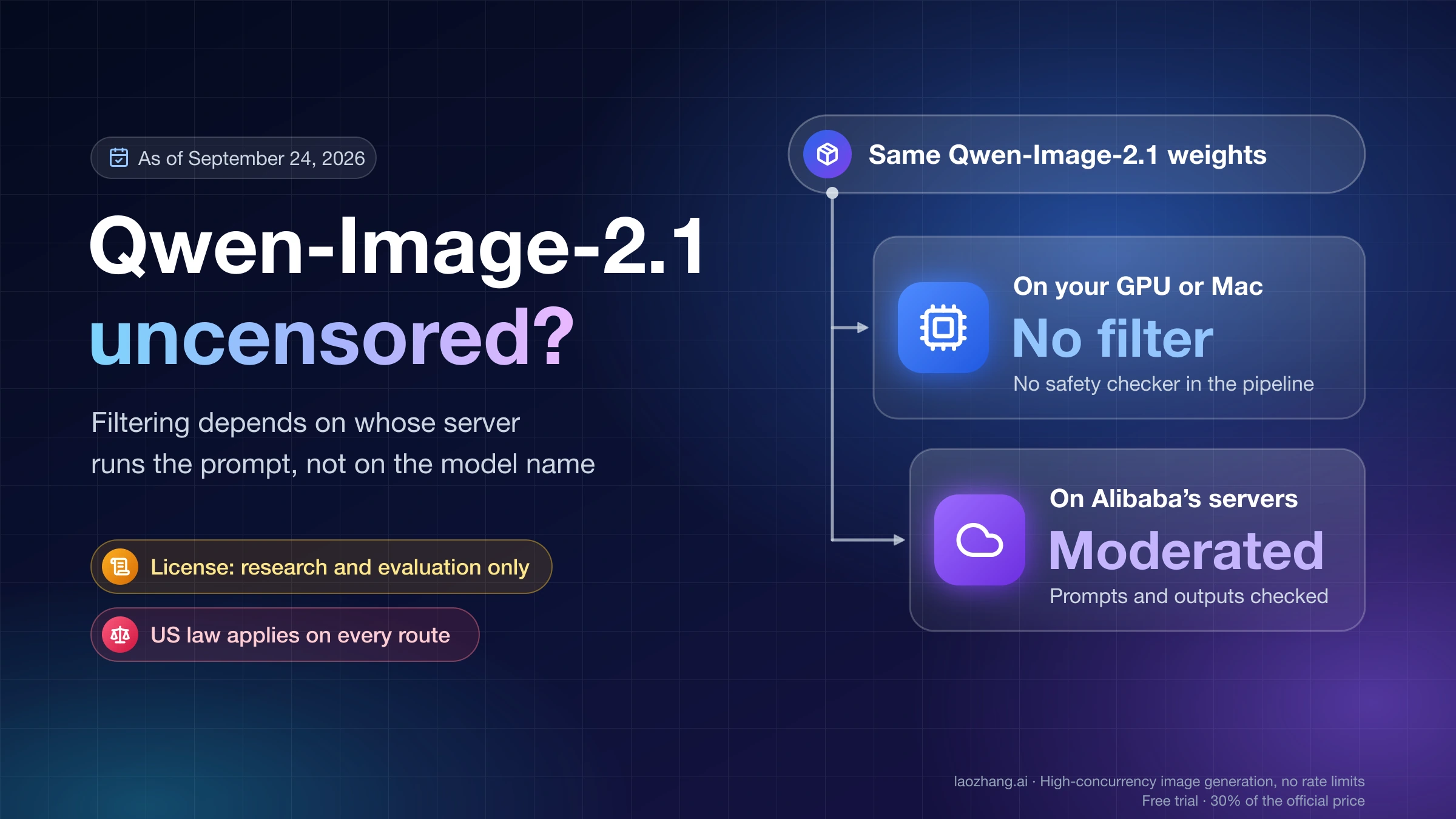
Run locally from the official weights, Qwen-Image-2.1 has no content filter to switch off. Its pipeline contains no safety checker, and early users report that it follows adult prompts without refusing. The filtering people run into lives in Alibaba's hosted services, including the official Hugging Face demo, which forwards every request to Alibaba Cloud. The “Uncensored GGUF” uploads that appeared on release day are plain quantizations of the same weights, not a modified model.
Two things stay fixed no matter how you run it. The weights ship under the Qwen Research License, which covers research and evaluation only, so running the model as a paid service or inside a product needs a separate agreement with Alibaba. Whether you can sell individual images you generate is less settled. And US law draws lines that no setting moves: no sexual imagery of minors, including computer-generated images, and no sexual imagery of real people without their consent. Everything below is as of September 24, 2026; Qwen released the model on September 20.
Where filtering happens, depending on how you run it
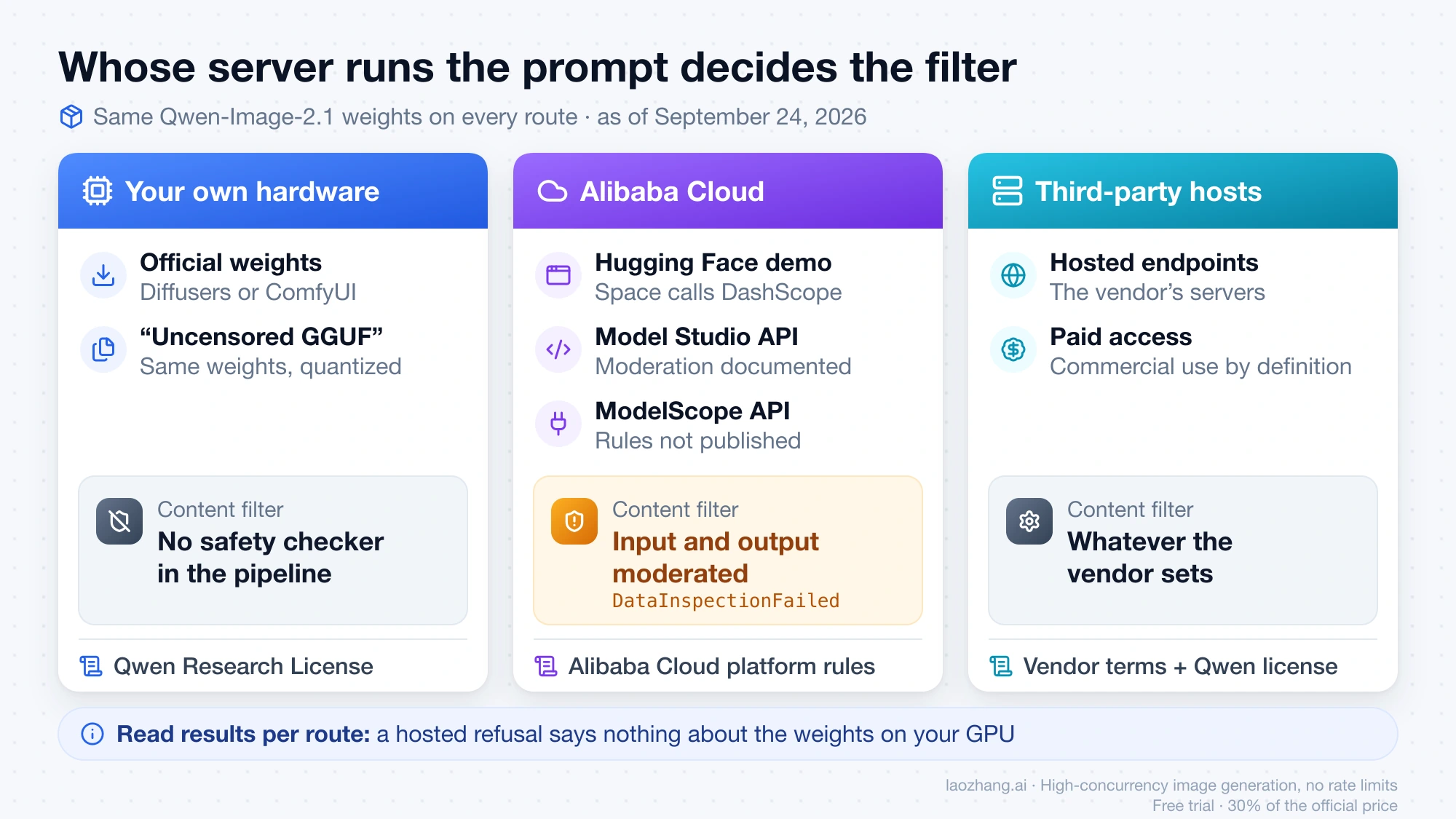
Whether a prompt gets blocked depends on whose server processes it, not on the model name. The same weights behave very differently on your own GPU and behind an Alibaba API.
| How you run it | Where the prompt is processed | Content filter | Terms that apply |
|---|---|---|---|
| Official weights in Diffusers or ComfyUI | Your own GPU or Mac | None in the pipeline | Qwen Research License |
| “Uncensored GGUF” uploads | Your own machine, same weights quantized | Same as the official weights | Qwen Research License |
Official Hugging Face demo (Qwen/Qwen-Image-2.1 Space) | Alibaba Cloud DashScope, called by the Space | Expect Alibaba's moderation on input and output | Alibaba Cloud platform rules |
| Alibaba Cloud Model Studio API | Alibaba Cloud | Every prompt and negative prompt is moderated | Model Studio terms; 2.1 is not in its model list |
| ModelScope free API-Inference | Alibaba's ModelScope | Not documented for adult prompts | Non-commercial trial, real-name verification required |
| Third-party hosted endpoints | The vendor's servers | Whatever the vendor sets | Vendor terms plus Qwen's license |
The local rows rest on the files themselves. The Diffusers model_index.json for Qwen/Qwen-Image-2.1 lists a processor, a scheduler, a Qwen3-VL text encoder, the image transformer and a VAE. There is no safety_checker component, and neither the model card nor the GitHub README has a section on content policy.
The official demo is where most confusion starts. It sits under the Qwen organization on Hugging Face and looks like the model itself, but its app.py sends each request to an Alibaba Cloud endpoint (poc-dashscope.aliyuncs.com) with an API key and shows the error message when a task fails. Alibaba's Model Studio text-to-image documentation says that all prompt and negative_prompt inputs are subject to content moderation, and that a non-compliant request is blocked with a DataInspectionFailed error. The error code table lists that error with two messages, “Input data may contain inappropriate content.” and “Output data may contain inappropriate content.”, so output is checked as well as input. The demo's endpoint belongs to the same platform, so expect the same rules there, although Alibaba doesn't document the demo separately.
That split cuts both ways. A refusal in the demo says nothing about what the weights do on your machine, and a result from your machine says nothing about what a hosted service will accept. A DataInspectionFailed response is the operator's policy decision, not a malfunction.
The ModelScope row is a genuine unknown. ModelScope offers free API-Inference for the exact Qwen/Qwen-Image-2.1 model as a non-commercial trial that requires Alibaba Cloud real-name verification, but its moderation rules for this model aren't published. Treat it as an Alibaba-hosted service under Alibaba's platform terms, not as a local install. How to call it is covered in Qwen Image 2.1 Free API: ModelScope Setup and Python Example.
Qwen also publishes optional prompt rewriters, Qwen/Qwen-Image-2.1-PE-T2I and Qwen/Qwen-Image-2.1-PE-I2I, fine-tuned from Qwen3.5-VL 9B. They run locally and expand short prompts before generation, each with its own system_prompt.txt. The README doesn't say how they handle sensitive requests, so don't assume they pass every prompt through unchanged.
The “Uncensored GGUF” is the same model
On September 20, an X post with about 1,800 likes claimed Qwen-Image-2.1 had been “uncensored overnight” with its “refusal layer removed”. Four Hugging Face repositories named Qwen-Image-2.1-Uncensored-GGUF appeared under different accounts. According to StashBase, all four hold the same five files with the same SHA-256 hashes, which makes them one upload copied three times.
The upload's own README contradicts the headline. The 0xSojalSec card states: “These are quantizations of the original Qwen-Image-2.1 weights; no fine-tuning, abliteration, or other weight modification was applied.” Abliteration is a technique for editing a model's weights to suppress refusals. None was needed here, because the official pipeline had no refusal layer to remove. The same card says the files still fall under the Qwen Research License and need the original text encoder and VAE to run.
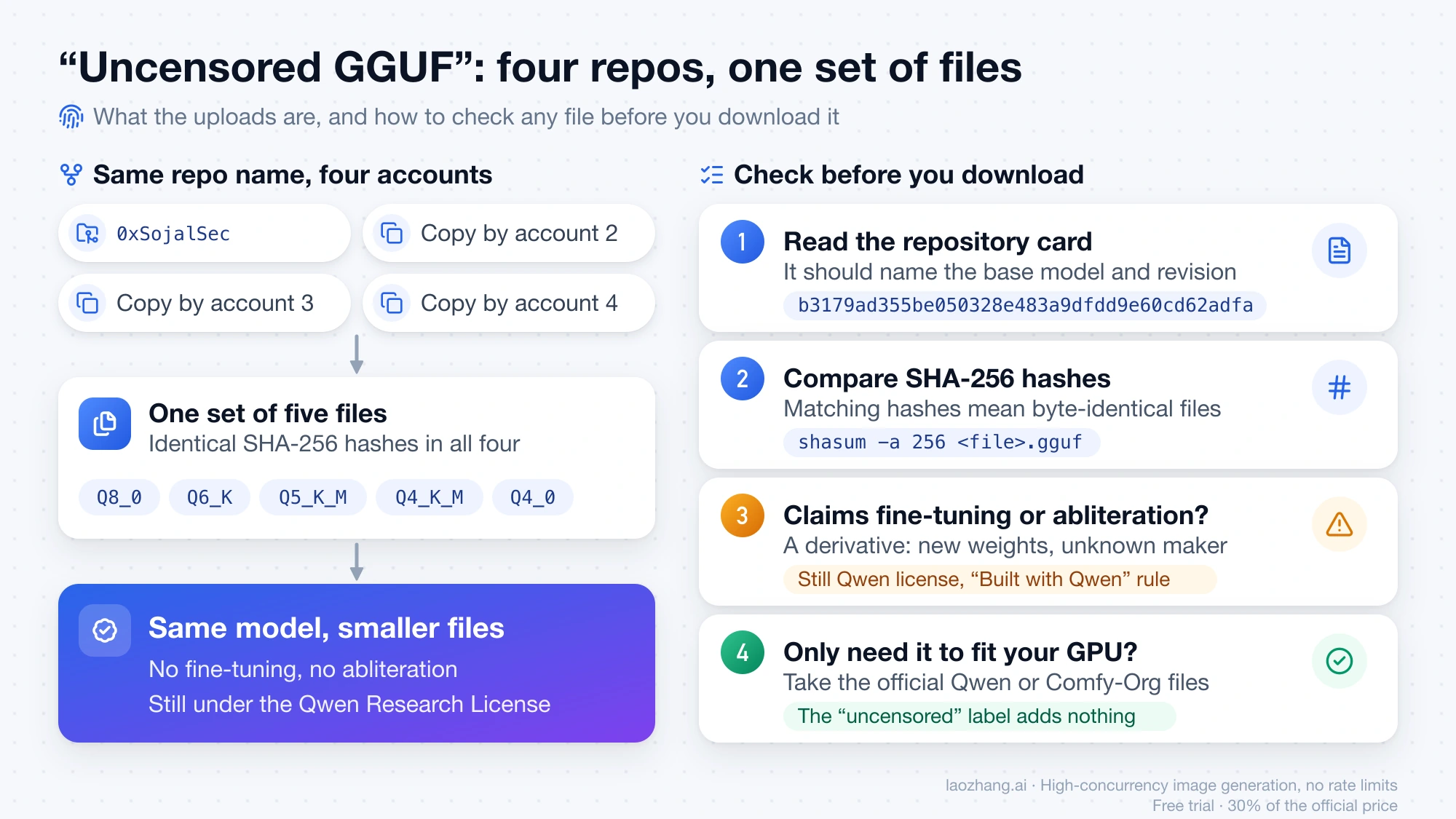
What the upload does offer is smaller files, which matters for memory, not content:
| Quantization | File size |
|---|---|
| Q8_0 | 7.59 GiB |
| Q6_K | 5.88 GiB |
| Q5_K_M | 5.22 GiB |
| Q4_K_M (recommended by the uploader) | 4.6 GiB |
| Q4_0 | 4.05 GiB |
Claims that these files have their safety checkers or content filters “removed” don't match either the README or the official model_index.json. Before you download any file sold or labeled as “uncensored”, check what it actually is:
- Read the repository card. A straight quantization should name its base model and, ideally, the exact revision; the 0xSojalSec card lists base revision
b3179ad355be050328e483a9dfdd9e60cd62adfa. - Compare hashes. Hugging Face shows a SHA-256 for each large file on its file page. Run
shasum -a 256 <file>.ggufon a Mac orsha256sum <file>.ggufon Linux and compare the result with the hash from a second upload of the same quantization. Matching hashes mean byte-identical files. - If a card claims real changes such as fine-tuning or abliteration, you are looking at a derivative model, with different weights and an unknown maker. It still falls under the Qwen license, including the “Built with Qwen” attribution rule for anything redistributed.
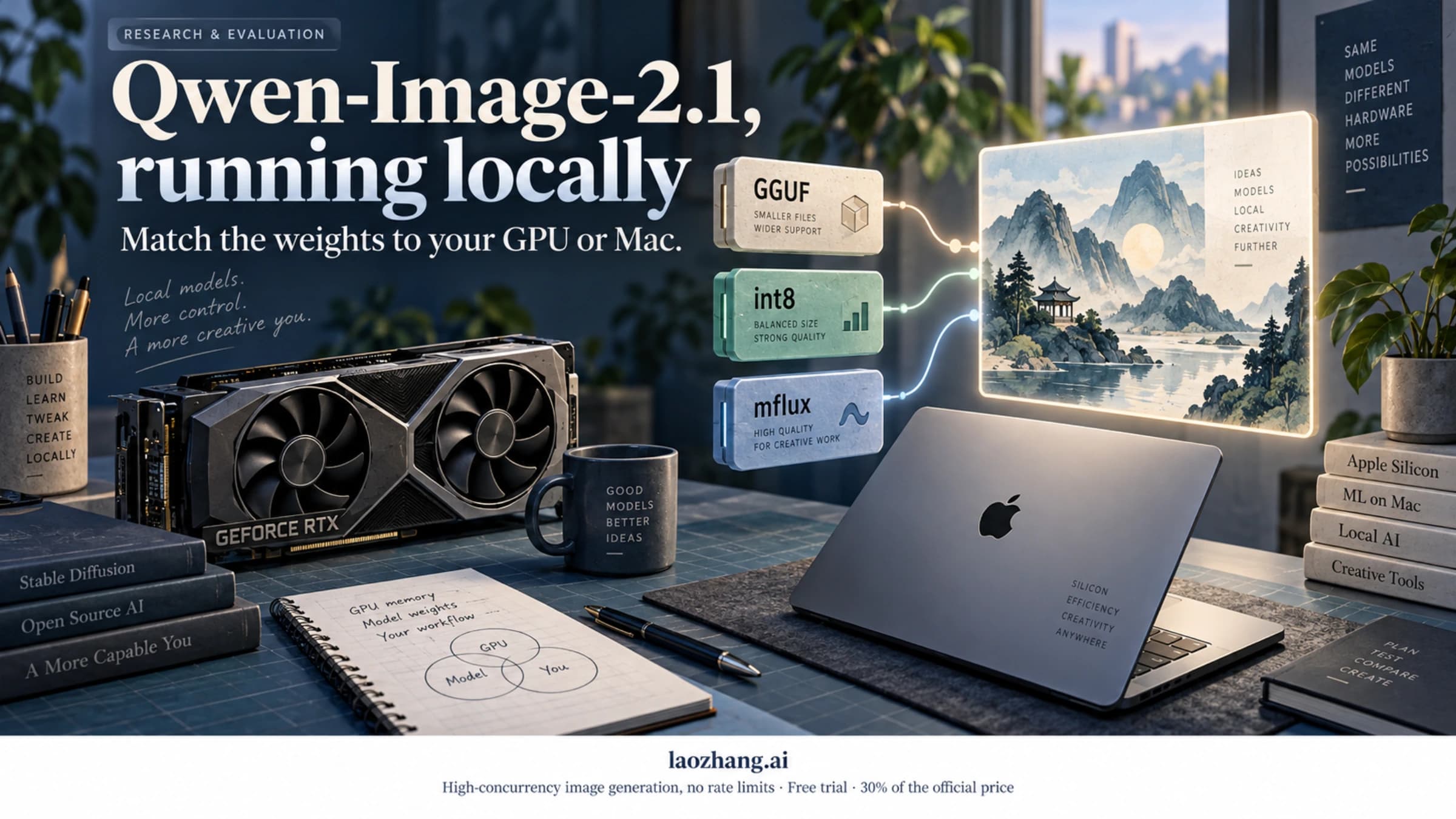
- If you only need the model to fit your GPU, take files from the official Qwen or Comfy-Org repositories, or a GGUF whose card names its source. The “uncensored” label adds nothing. Run Qwen-Image-2.1 Locally: Which Weights Fit Your GPU or Mac covers which files fit which card and how to load them.
What “no safety checker” does and doesn't tell you
A missing checker means nothing stops a prompt. It doesn't show what the model learned. The model card doesn't describe how much adult material, if any, was in the training data, so whether the model renders such content well is a separate question.
User reports so far agree on the first point and split on the second. These are users' own accounts, not controlled tests:
- In a discussion on the official repository, a user running INT8 weights with an INT8 Qwen3-VL 8B encoder in ComfyUI on an RTX 4060 Ti 16 GB (about 20 seconds per image, about 60 seconds per edit, around 15 GB peak VRAM) wrote that the local pipeline generated the requested adult result “without refusing or showing any obvious content filter”, and added that behavior may vary by quantization and deployment.
- In a Comfy-Org repository discussion, another user wrote that the model “can directly output NSFW contents” and that the text encoder doesn't need abliterating.
- Other early testers were less convinced. One Korean user couldn't tell whether the model was restricted or simply hadn't learned such content, and a Japanese user found the output “not very erotic.”
So the absence of a refusal mechanism is well supported. How good the adult output is, and whether it holds up across prompts, remains an open question that no public test settles yet.
Older Qwen-Image LoRAs don't carry over
Qwen-Image 1.0 (August 4, 2025) and Qwen-Image-2512 (December 31, 2025) are 20B models. Qwen-Image-2.1 is a new architecture: a 7B visual generator built from 32 single-stream transformer layers. A LoRA trained on the older models was fitted to a different, larger network, so what it learned doesn't map onto 2.1.
The failure is silent, which is the trap. A hosted-API vendor published a test in which a Qwen-Image-2512 LoRA at strength 1 and at strength 2 produced images almost identical to a run with no LoRA at all. The job succeeded, and nothing reported an error. If an old LoRA seems to “work” on 2.1, compare against a run without it before trusting the result.
LoRAs for 2.1 have to be trained on 2.1. The official training path is DiffSynth-Studio. Any LoRA you train is a derivative of the weights, so the license terms below apply to it as well.
The license: research and evaluation only
Qwen-Image-2.1 is not Apache 2.0 like the two earlier Qwen-Image releases. It ships under the Qwen Research License Agreement, dated September 20, 2026, and the terms that matter here are short:
- Purpose: the license grants use “for non-commercial purposes only”, and defines non-commercial as “research or evaluation purposes only”. That is narrower than “anything I don't charge for”.
- Commercial use: using the model for a commercial purpose needs a separate license from Alibaba, requested through model-business@notice.qwencloud.com. Running 2.1 as a paid generator or API, inside a product, or in a pipeline that produces client work falls on that side.
- Derivatives: if you distribute a fine-tune, LoRA or other derivative, it must prominently display “Built with Qwen” or “Improved using Qwen”, and “Qwen” can't be its main name.
- Breach: the license terminates and you must delete the materials. It is governed by PRC law, with Hangzhou courts as the venue.
Generated images are a separate question, and an unsettled one. The license text says nothing explicit about outputs. On September 21, the Qwen team posted on X that outputs are not part of the licensed Materials and that users keep the rights to images they generate. The post is relayed in discussion #6 on the model repository, where commenters point out that a social post doesn't amend the LICENSE file. Treat it as the team's stated position, not a license term. The same thread asks whether personal hobby use counts as “research or evaluation”, and there is no official answer yet.
Owning an image doesn't change what the law says about it. The legal lines below apply whoever holds the rights, and nothing in the license should be read as permission for particular content.
A hosted endpoint that charges for Qwen-Image-2.1 generation is running the model as a paid service, which is commercial use on the host's side. At least one vendor selling explicit-content access to 2.1 notes on its own blog that commercial use needs a separate Alibaba license, but doesn't say whether it holds one. Before paying any host, ask it directly.
US law: two lines no setting changes
Local weights remove the software filter, not your legal responsibility. What follows is a summary of federal law, not legal advice, and states add their own rules on top.
Minors: never. That holds for fictional, drawn or AI-generated images, whether or not a real child is depicted and whether or not you share the result. Under 18 U.S.C. §1466A, producing, distributing, receiving or possessing an obscene visual depiction “of any kind, including a drawing, cartoon, sculpture, or painting” of a minor in sexually explicit conduct is a federal crime, and the statute says the minor depicted need not actually exist. Separately, 18 U.S.C. §2256 counts a computer-generated image that is “indistinguishable from” that of a minor engaging in sexually explicit conduct as child pornography, with no obscenity test.
Real people without consent: never. Don't create sexual images of an identifiable person who hasn't agreed to it. The TAKE IT DOWN Act (Public Law 119-12, signed May 19, 2025) made it a federal crime to knowingly publish non-consensual intimate images of identifiable people, explicitly including “digital forgeries” made with software, machine learning or AI. The maximum sentence is 2 years when the person depicted is an adult and 3 years when a minor, and threatening to publish is also a crime. Since May 19, 2026, the FTC has enforced the platform side: covered platforms must remove a reported image, and known identical copies, within 48 hours of a valid request, with civil penalties of up to $53,088 per violation according to the FTC's compliance guidance. Victims can file complaints at TakeItDown.ftc.gov.
Sexual content showing fictional adults is a different question. Whether it's lawful turns mainly on where and how you share it and on your state's rules, and hosting platforms enforce their own policies. Who owns the resulting images doesn't settle that, and running the model as a paid service still needs Alibaba's license.
If you build something that EU users can reach, one more rule arrives soon. Amendments adopted through the EU's Digital Omnibus add an AI Act prohibition, applying from December 2, 2026, on AI systems that generate non-consensual intimate images of identifiable people or child sexual abuse material, and the AI Act's open-source exemption doesn't cover prohibited practices.
Before you download or pay
Run through these in order. Each one can change the answer:
- Where will the prompt be processed? On your hardware, the pipeline has no filter. On the official demo, Model Studio or ModelScope, Alibaba's platform rules apply, and a rejection is final for that service.
- What is the file? A GGUF labeled “uncensored” should be a plain quantization; confirm through the card's base revision or a hash comparison, or use the official or Comfy-Org files.
- Which base does your LoRA target? Only LoRAs trained on 2.1 do anything. An old 20B Qwen-Image LoRA fails without an error.
- Is your use research or evaluation? Running 2.1 as a paid service, inside a product or in a client pipeline needs a commercial license from Alibaba, and a paid host serving you 2.1 output should hold one. Selling individual images you generated is unsettled: the Qwen team says outputs are yours, but the license text doesn't address them.
- Does the image involve a minor or a real person? If it could depict a minor, or a real person who hasn't consented, don't make it. No license, setting or host changes that.
If all five check out and you want to run the model on your own hardware, the next step is Run Qwen-Image-2.1 Locally: Which Weights Fit Your GPU or Mac.