Qwen 4 Max vs Opus 5.5: 3.4x Cheaper on Short Calls, 4x the Wait
On 12 short tasks, Qwen4-Max cost 1/3.4 of Claude Opus 5.5 at medium but took 4x as long. On Artificial Analysis's suite it costs more per task.
On this page
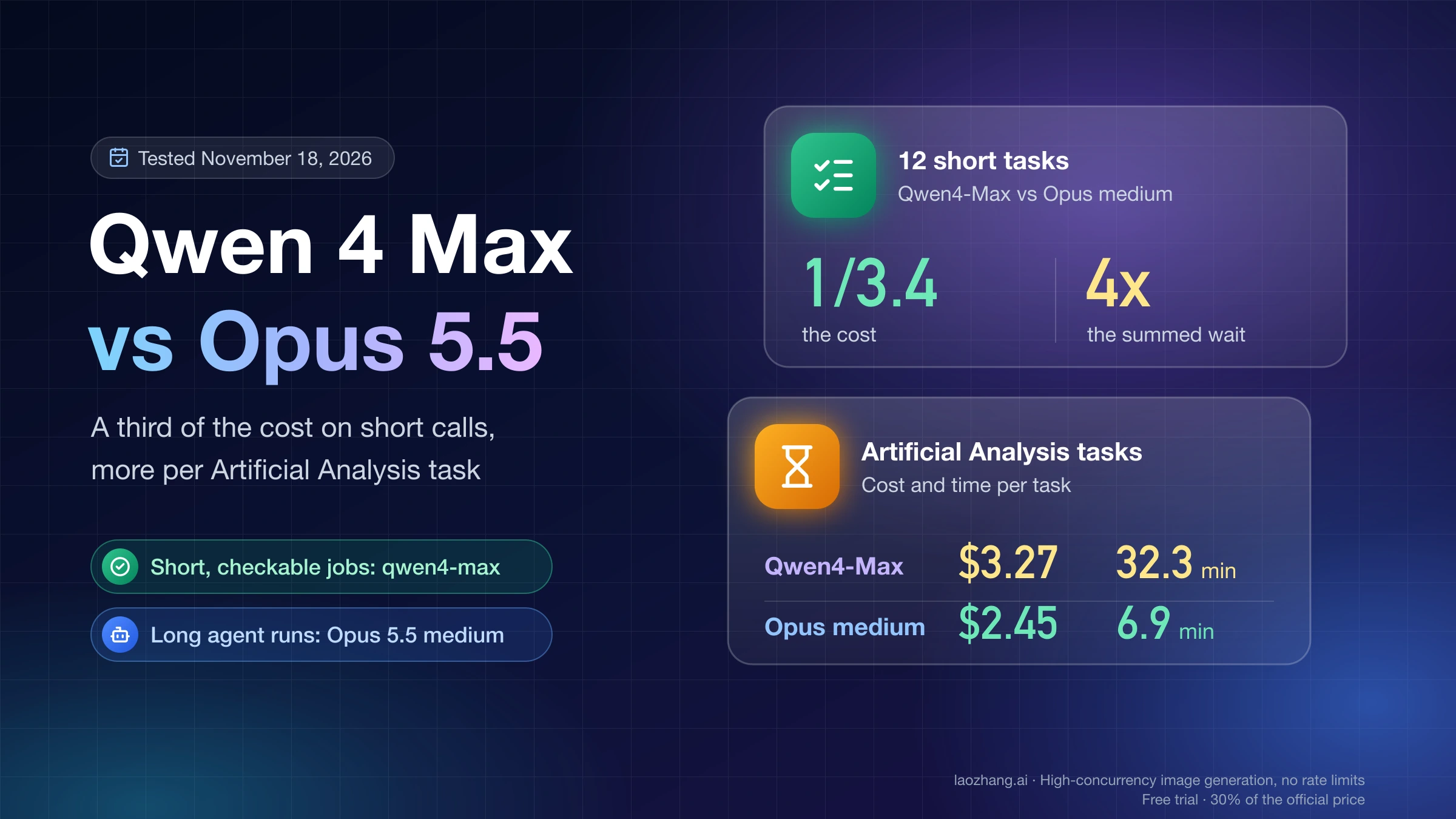
Qwen4-Max (qwen4-max), which Alibaba released on November 16, 2026, lists at $1.50 per million input tokens and $4.50 per million output tokens on Alibaba Cloud Model Studio's Qwen4-Max page, against $4 and $20 for Claude Opus 5.5 (claude-opus-5-5) on Anthropic's Claude API pricing page. Run through the LaoZhang API gateway on the same 12 short coding, reasoning, and summary tasks, both models passed all 12; Qwen4-Max ran on November 18, 2026, and the Opus 5.5 results on the same prompts came from November 11 and 18. Qwen4-Max at its default setting cost $0.1074 in total at list price and Opus 5.5 at medium effort $0.3698, or 3.4 times as much; Qwen took 518 seconds of summed call time to Opus's 131. On the longer, harder tasks of the Artificial Analysis Intelligence Index, cost runs the other way: $3.27 per task for Qwen4-Max against $2.45 for Opus 5.5 at medium, 32.3 minutes against 6.9, and an index score of 43 against 48, as of November 18, 2026.
Disclosure: laozhang.ai is our own service. Its prices are platform pricing, not an independent comparison.
So move short, well-specified work that nobody watches in real time to qwen4-max: bulk summaries, extraction, small functions with tests, counting through logs. Keep Opus 5.5 at medium for long agent runs, hard reasoning and coding, and anything a person sits and waits on. If you switch, control Qwen's thinking with enable_thinking: false or a thinking_budget, because reasoning_effort: "low" saved nothing in the November 18 test.
Two exceptions point the other way. Qwen4-Max scored highest of all six configurations on Artificial Analysis's AutomationBench and accepts video input, which Opus 5.5 doesn't. And if your goal is simply a smaller Opus bill on hard tasks, Opus 5.5 at low effort costs $0.98 per Artificial Analysis task, well under Qwen's cost, although it scores only 35.
Should you move work from Opus 5.5 to Qwen 4 Max? Split it by job
Move a job to Qwen4-Max when it is short, has an answer you can check automatically, and can wait a minute; keep it on Opus 5.5 when it runs long, depends on hard reasoning, or has a person waiting for the reply. Qwen thinks by default and bills that thinking as output, so its savings can shrink as tasks get longer and harder, and on Artificial Analysis's suite they turn into a higher cost per task, while its waiting time is high at every length. The table sorts common kinds of work by that rule, using the same-prompt gateway test for short and log tasks and Artificial Analysis for long, hard ones.
| Your work | Start with | Why | What to watch |
|---|---|---|---|
| Short requests in bulk with checkable answers: extraction, summaries, small functions with tests | qwen4-max, thinking capped | 12/12 passed at 1/3.4 of Opus medium's cost in the same-prompt test | About 43 seconds per call at the default setting |
| Long documents or logs with exact answers, run offline | qwen4-max at default | All 7 answers right on a 146 KB log at 0.40x the cost | 352 seconds against Opus's 58 |
| Office automation, forms, spreadsheets, finance work | Try qwen4-max | AutomationBench-AA 72.6% vs Opus medium's 61.2%; Finance index 54 vs 51 | Its cost per Artificial Analysis task is still above Opus medium's |
| Long agent runs, multi-step coding, terminal work | claude-opus-5-5 at medium | On Artificial Analysis, 75% of Qwen's cost per task in about a fifth of the time; Terminal-Bench 4.0 52.5% vs 48.5% | On one third-party agent task, Qwen cost a quarter to a third less, at about 6x the time |
| Hard science, math, frontier-level coding | Opus 5.5 at high or above | Qwen trails Opus medium by 6.5 to 20 points on HLE-Diamond, CritPt, Terminal-Bench-Science, FrontierCode | Opus xhigh and max cost $6.05 and $10.04 per task |
| Chat, IDE assistants, anything interactive | Opus 5.5 | Qwen's first answer token arrives after 148.6 seconds on Artificial Analysis | Turning Qwen's thinking off cuts the wait, but its quality wasn't graded across tasks |
| Video understanding | qwen4-max | Opus 5.5 takes text and images only | — |
The two effort scales don't line up. Qwen4-Max has three levels, low, high, and xhigh, and runs at high when you send nothing; Opus 5.5 has five, from low to max. Comparing Qwen's default with Opus at medium and high compares the settings people actually run, not equal levels, and calling Qwen's default "high, the same as Opus high" would be wrong.
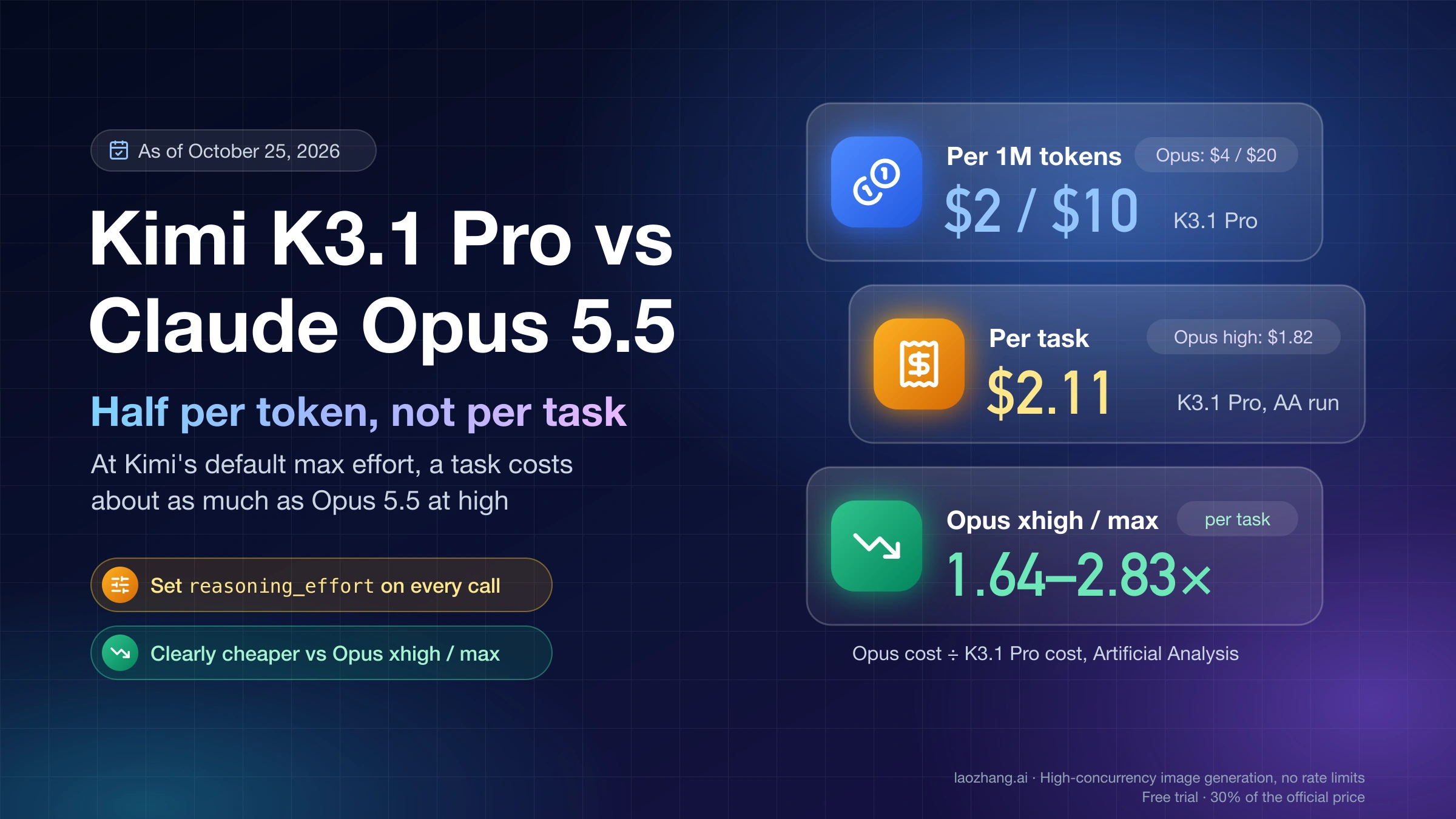
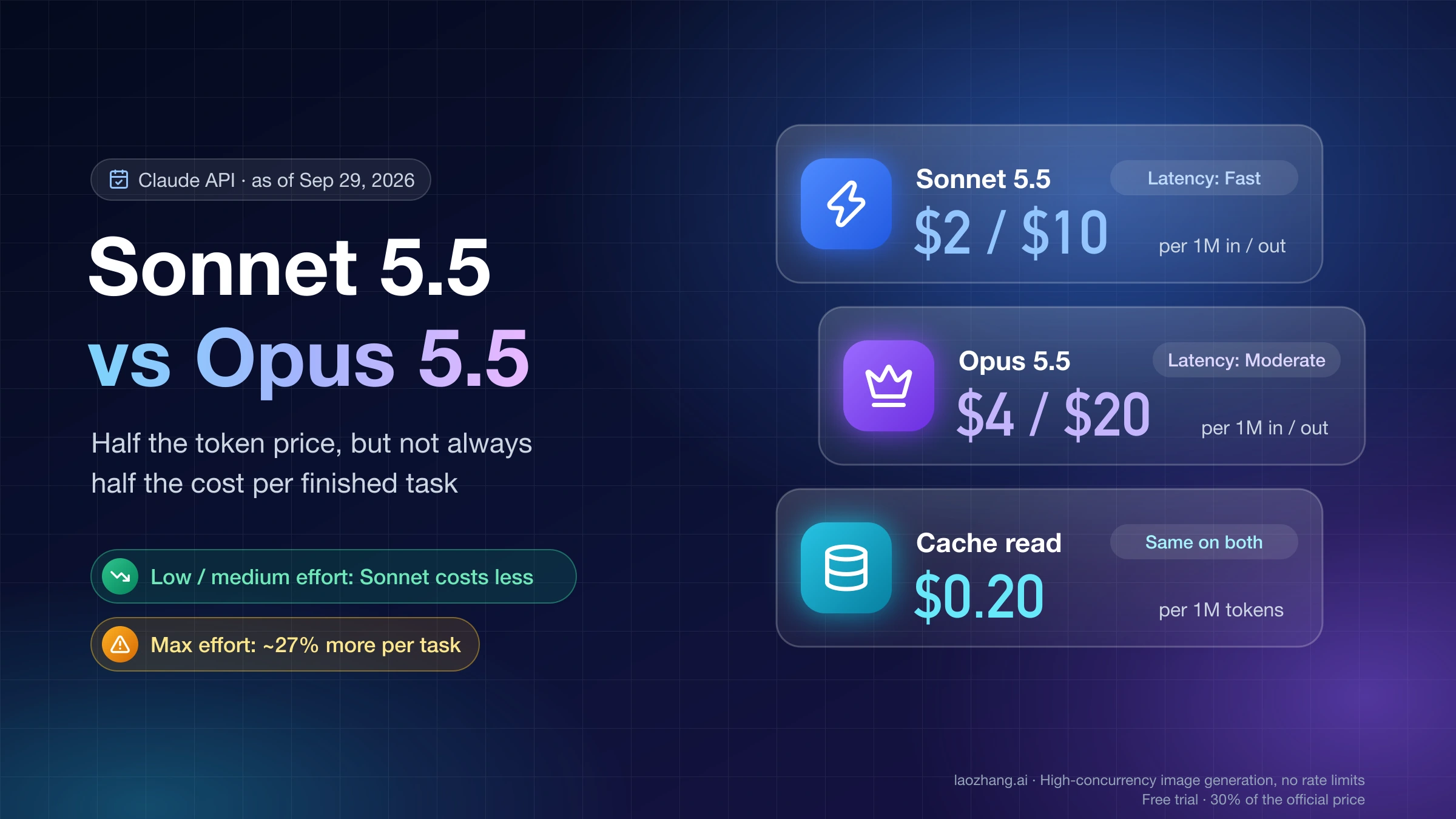
If you are weighing Qwen4-Max because Opus feels expensive, two other options answer the same question. Moonshot's flagship gets the same per-token versus per-task treatment in Kimi K3.1 Pro vs Claude Opus 5.5: Half per Token, Not per Task, and the cheaper Claude model is covered in Claude Sonnet 5.5 vs Opus 5.5: When Half the Price Really Saves.
Qwen 4 Max vs Opus 5.5 pricing: $1.50 / $4.50 against $4 / $20
Per token, Qwen4-Max costs 0.375 times Opus 5.5 on input and 0.225 times on output, so Opus is 2.67 times as expensive to read and 4.44 times as expensive to write, as of November 18, 2026. Both vendors bill thinking tokens as output; Model Studio labels its output column "chain-of-thought + response," and Qwen's price is the same with thinking on or off.
| Per 1M tokens, as of November 18, 2026 | Qwen4-Max (International, Singapore) | Claude Opus 5.5 |
|---|---|---|
| Input | $1.50 | $4 |
| Output, thinking included | $4.50 | $20 |
| Cache read | $0.075 | $0.20 |
| Batch input / output | Not offered on International; China (Beijing) only, $0.707 / $2.12 at a limited-time 50% discount | $2 / $10 |
| Context window | 1,000,000 tokens | 1M tokens |
| Inputs accepted | Text, image, video | Text, image |
| Free allowance | 1M tokens within 90 days, International only | — |
Model Studio's China (Beijing) region charges $1.413 input and $4.24 output, and its Global deployment scope, served from Hong Kong, Frankfurt, Virginia, and Tokyo, charges the same; OpenRouter lists qwen/qwen4-max at $1.425 and $4.275. Batch inference for Qwen4-Max is supported only in Beijing, so an International account has no Qwen batch option, while explicit and implicit caching work in every region. Qwen's cache-read price isn't in the Model Studio text; the $0.075 above is 5% of input, the rate Artificial Analysis and OpenRouter list. Opus adds cache-write charges of $5 per million tokens for 5-minute writes and $8 for 1-hour writes, and fast mode at $8 and $40. How those Opus charges add up, and how they relate to subscription limit resets, is in Claude Opus 5.5 Pricing and Limit Reset: What Each One Changes.
A lower token price only becomes a lower bill if the model doesn't use proportionally more tokens. On output-heavy work, Qwen4-Max stays cheaper as long as it bills less than about 4.4 times Opus's output tokens; on input-heavy work, the ceiling on its saving is the 2.67x input gap.
Same 12 tasks: Qwen 3.4x cheaper than Opus medium, 4x slower
All four configurations passed all 12 tasks, so this test measures what each model costs and how long it makes you wait, not which one is smarter. The tasks were single requests with hidden tests or exact answers: a word problem, merging intervals, parsing durations, counting top words, a five-bullet summary of a document of about 11,000 tokens, an expression evaluator, a CSV line splitter, a digit-sum puzzle, comparing and matching semantic version ranges, arithmetic from notes, and a standard-library-only coding task. Qwen4-Max ran on November 18, 2026 over streamed Chat Completions, once with no effort setting (its default, high) and once with reasoning_effort: "low". The Opus 5.5 rows reuse the same prompts and graders from runs on November 11 (eight tasks) and November 18 (four tasks), with adaptive thinking at medium and high effort.
| Configuration, 12 tasks | Passed | Output tokens (thinking) | Summed call time | Cost at list price |
|---|---|---|---|---|
Qwen4-Max default (high) | 12/12 | 15,915 (10,465) | 518.2 s | $0.1074 |
Qwen4-Max low | 12/12 | 16,924 (11,237) | 567.3 s | $0.1119 |
| Claude Opus 5.5 medium | 12/12 | 11,833 (not reported separately) | 130.5 s | $0.3698 |
| Claude Opus 5.5 high | 12/12 | 13,674 (not reported separately) | 159.3 s | $0.4067 |
Read the table left to right. Qwen4-Max wrote 1.35 times as many output tokens as Opus medium, two-thirds of them thinking, but at 0.225 times the output price its bill still came to under a third of Opus medium's: Opus medium cost 3.44 times as much and Opus high 3.79 times. The waiting went the other way: about 43 seconds per call for Qwen against 11 for Opus medium, and 113.9 seconds against 22.6 on the semver-range task, the longest one. Most of Qwen's wait is thinking: 443.5 of its 518.2 seconds passed before the first answer token appeared. Setting Qwen to low cost 4% more, wrote 6% more tokens, and took 9% longer than its default on this set, so it bought nothing.
A longer input shrinks the gap. On a 146 KB log of 1,500 lines with seven numbers to count exactly, every configuration got all seven right. Qwen4-Max at default read 76,037 input tokens and wrote 16,767, which at list price is 76,037 × $1.50 + 16,767 × $4.50 per million, or $0.1895, and took 352.5 seconds on November 18. Opus 5.5 at medium read 78,537 tokens and wrote 7,699, which is $0.4681 at $4 and $20, and took 57.6 seconds on November 11. Qwen cost 0.40 times as much but wrote 2.2 times the output and made you wait 6.1 times as long. At low, Qwen wrote 21,158 tokens and cost $0.2093, more than at default. The input was about 76,000 tokens, far below either model's 1M window, so the result says nothing about inputs near the limit.
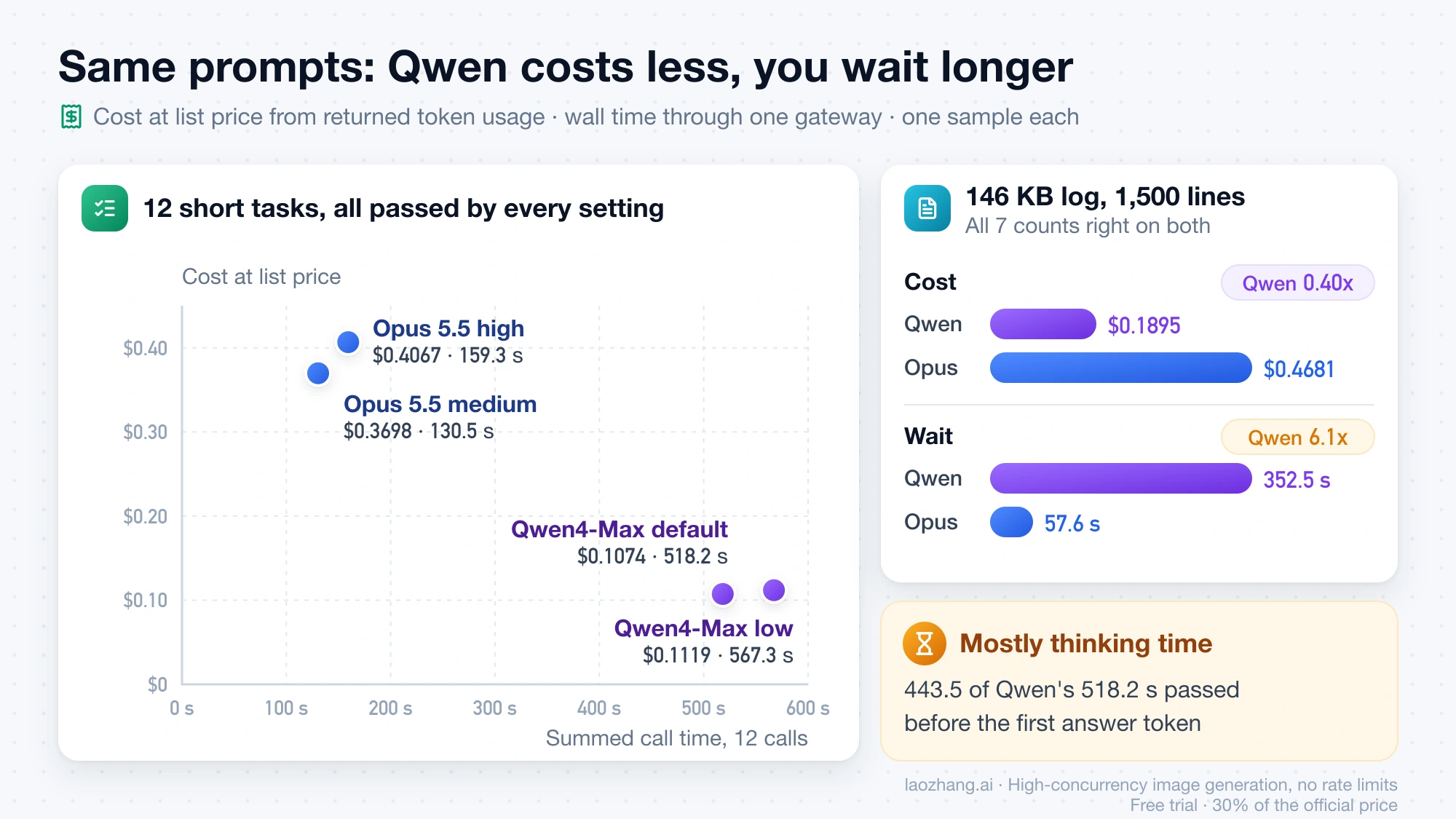
Four limits apply to all of these numbers. Each cell is one sample. The times are wall time through the gateway, with Qwen served from a mainland upstream channel and the Opus rows recorded on other days and partly without streaming, so they are what a gateway user saw, not the vendors' own latency. Costs are calculated at list price from the token usage each call returned. On the interval-merging task, both Qwen settings put the function and its tests in two separate code blocks, as Opus high had on November 11, and all passed 8 of 8 hidden tests once graded as separate files. The same 12 tasks also put Opus 5.5 against OpenAI's everyday model in GPT-6.2 Sol vs 6.1 Sol vs Opus 5.5: Benchmarks and Tested Cost.
Why Artificial Analysis says Qwen 4 Max costs more per task
Qwen4-Max is cheaper per token but spends far more tokens on long, hard tasks, and every thinking token is billed as output. On the 12 short tasks it wrote 1.35 times Opus medium's output, too little to cancel a 4.4x price gap. Artificial Analysis's index tasks are long multi-step jobs, and there the Artificial Analysis Qwen4 Max model page calls the model "notably slow per task and very verbose": it generated 127 million tokens running the index, against a median of 65.1 million for comparable models. The result, from the Artificial Analysis Qwen4 Max vs Claude Opus 5.5 comparison as of November 18, 2026, is that Qwen costs 1.33 times as much per task as Opus medium and takes 4.7 times as long.
| Artificial Analysis Index v5.0.1 | Index score | Cost per index task | Time per task | Output speed |
|---|---|---|---|---|
| Qwen4-Max | 43 | $3.27 | 32.3 min | 54 tokens/s |
| Claude Opus 5.5 low | 35 | $0.98 | 3.0 min | 105 tokens/s |
| Claude Opus 5.5 medium | 48 | $2.45 | 6.9 min | 106 tokens/s |
| Claude Opus 5.5 high | 52 | $3.46 | 9.3 min | 108 tokens/s |
| Claude Opus 5.5 xhigh | 57 | $6.05 | 15.8 min | 109 tokens/s |
| Claude Opus 5.5 max | 59 | $10.04 | 24.6 min | 117 tokens/s |
The closest pairing on cost is Opus high, which costs 6% more per task than Qwen, scores 9 points higher, and finishes in 9.3 minutes instead of 32.3. Qwen's time to the first answer token was 148.57 seconds, because it thinks before it answers, and it then generates at about half Opus's speed. Its 32.3 minutes per task also compare with a median of 12.4 minutes for models in its class.
Some readers on r/LocalLLaMA have asked whether the index is biased against Qwen. Three facts bound the result. Artificial Analysis lists a single Qwen4-Max entry and doesn't say which effort it ran; the API default is high. The figures were taken two days after release, and Artificial Analysis recalculates as it re-runs models. And the reversal is consistent with the same-prompt gateway test rather than in conflict with it: short tasks keep Qwen's token count close to Opus's, and Artificial Analysis's long ones don't.
A third-party agent test points the other way on cost, so Qwen costing more per long task is a result on Artificial Analysis's suite, not a rule. On atomicagent.io's Qwen 4 Max vs Opus 5.5 agent test, one multi-step coding task (a Python library of about 1,400 lines with 13 planted bugs, a missing feature, and 59 hidden tests) ran three times per setting through OpenRouter, Opus 5.5 on November 9 and Qwen4-Max on November 16, 2026, and every run passed 59 of 59. Qwen at high cost about $0.65 per task against $0.97 for Opus medium, a quarter to a third less, but took 25.0 minutes against 4.2. The authors credit Alibaba's implicit caching: each fully recorded Qwen run read about 2.7 million input tokens from cache, and without that discount the input alone would have cost more than $4. Speed is the one result every test here agrees on, and on Artificial Analysis Opus also keeps its score lead.
Make Qwen 4 Max cheaper and faster: thinking off or a budget, not low
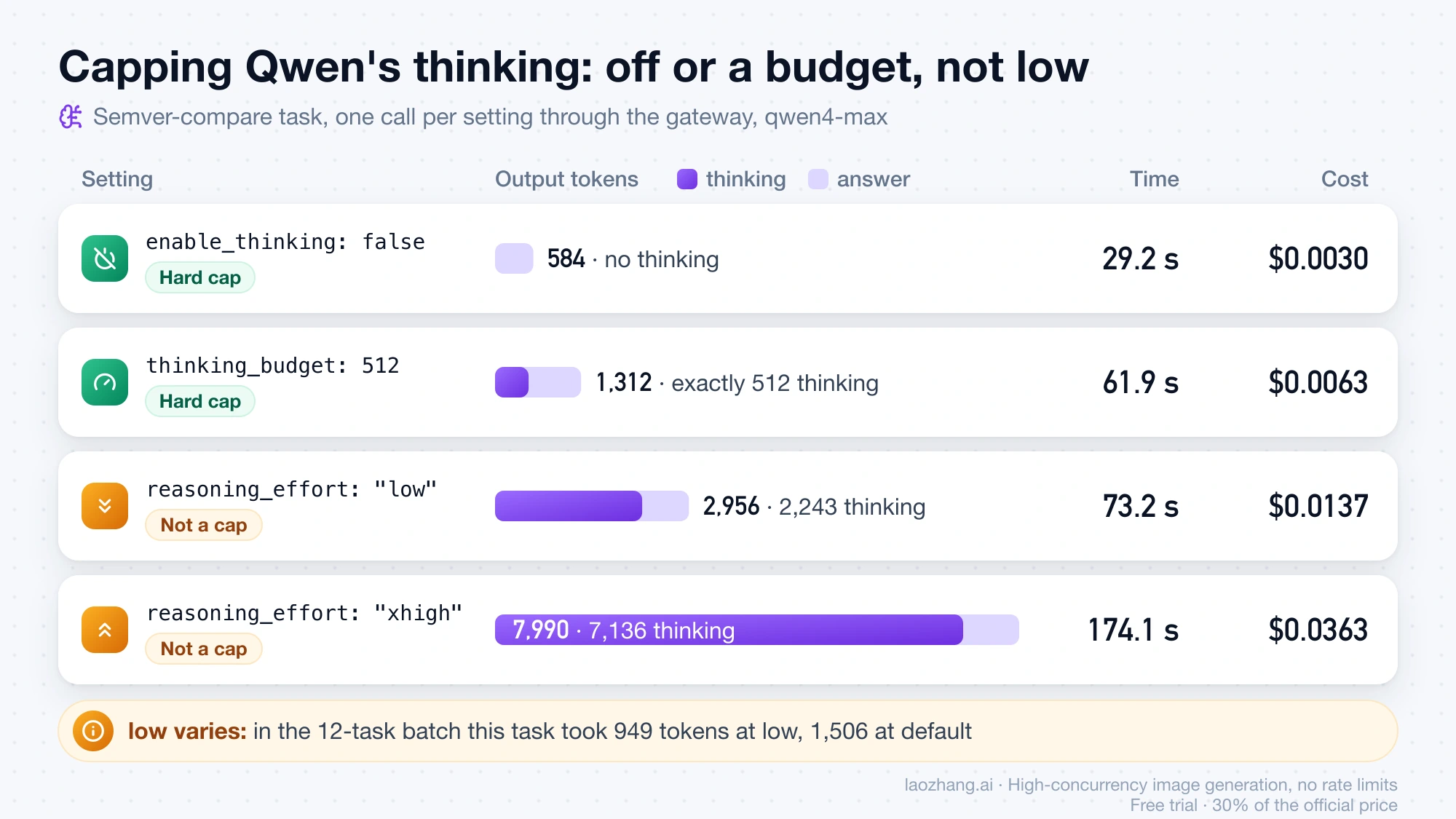
Turn thinking off with enable_thinking: false, or cap it with thinking_budget; in the November 18 test, reasoning_effort: "low" did not reliably shorten Qwen's thinking. According to the Model Studio page, Qwen4-Max runs with enable_thinking: true, reasoning_effort: "high", and thinking_budget: 131072 unless you change them, and the same effort values work on the Chat Completions, Responses, and Anthropic Messages interfaces. The table shows one task, the semver comparison, sent once per setting through the gateway on November 18, 2026.
| Setting on the semver-compare task | Output tokens (thinking) | Time | Cost |
|---|---|---|---|
enable_thinking: false | 584 (none) | 29.2 s | $0.0030 |
thinking_budget: 512 | 1,312 (exactly 512) | 61.9 s | $0.0063 |
reasoning_effort: "low" | 2,956 (2,243) | 73.2 s | $0.0137 |
reasoning_effort: "xhigh" | 7,990 (7,136) | 174.1 s | $0.0363 |
Only the first two settings put a hard limit on thinking. low didn't behave like a cap: the same task took 949 output tokens at low in the 12-task batch and 2,956 in this run, against 1,506 at the default, so one setting produced a wide spread between samples. With thinking off, the answer was present but was not graded, and thinking off was not tested across the other 11 tasks, so check accuracy on your own set before you turn it off for production work. A deliberately invalid value, reasoning_effort: "bogus", returned a 400 invalid_parameter_error, which shows that these fields reach Alibaba's validator through the gateway rather than being dropped.
On an OpenAI-compatible request, the fields go in the request body next to model and messages; with the OpenAI Python SDK, pass them in extra_body. On November 18, 2026, OpenAI Python SDK 2.24.0 sent extra_body={"enable_thinking": False} and extra_body={"thinking_budget": 2048} to qwen4-max through the gateway on one short prompt each; both calls returned the correct answer, and the first had no reasoning tokens. That shows the SDK passes them through, not how answer quality holds up; the 512-token cap above is the run that shows a budget actually limiting thinking.
{
  "model": "qwen4-max",
  "messages": [{ "role": "user", "content": "..." }],
  "enable_thinking": false
}
Replace "enable_thinking": false with "thinking_budget": 512, or another cap, when the task still needs some reasoning. If you are moving configuration over from Opus, watch the mapping: Qwen treats minimal as low, medium as high, and max as xhigh, so an Opus-style "medium" gets you Qwen's default, not a lighter setting.
Is Qwen 4 Max as good as Opus 5.5? Benchmarks by task type
Overall, no: Qwen4-Max scores 43 on the Artificial Analysis Intelligence Index v5.0.1, between Opus 5.5 at low (35) and at medium (48), as of November 18, 2026. It leads on office automation and some business domains, and trails on hard science, frontier coding, and factual recall. The sub-scores below come from the same Artificial Analysis comparison, with Opus at medium and at max for range.
| Benchmark (Artificial Analysis) | Qwen4-Max | Opus 5.5 medium | Opus 5.5 max |
|---|---|---|---|
| AutomationBench-AA | 72.6% | 61.2% | 69.5% |
| AA-Briefcase | 1686 | 1617 | 1800 |
| GDP.pdf | 26.2% | 25.6% | 26.2% |
| Terminal-Bench 4.0 | 48.5% | 52.5% | 59.6% |
| FrontierCode-AA 2.0 | 26.5% | 33.1% | 46.4% |
| HLE-Diamond | 44.9% | 51.4% | 67.9% |
| CritPt v2 | 43.0% | 54.0% | 68.0% |
| Terminal-Bench-Science | 23.3% | 43.3% | 59.0% |
| AA-Omniscience | 28 | 40 | 48 |
On AutomationBench, Qwen4-Max is the top score of all six configurations, Opus max included, and on AA-Briefcase it beats Opus medium. Its domain indexes are close to Opus medium's: Finance 54 against 51, Strategy and Operations 57 against 56, Legal 50 against 50, Healthcare 48 against 51, Engineering 50 against 54, Economics 51 against 53. The large gaps are on Terminal-Bench-Science, 20 points behind Opus medium, and on CritPt, Omniscience, FrontierCode, and HLE-Diamond, so research-grade reasoning and questions that depend on recalled facts are where Opus earns its price.
Alibaba's own launch figures, as reported by Yahoo! Japan, put Qwen4-Max at 75.7 on DeepSWE v1.1, the highest among the models compared there, Opus 5.5 included, and at 48.5 on Terminal-Bench 4.0, behind Opus 5.5 at 59.6. Those are Alibaba's numbers and settings, not an independent run. Users on r/LocalLLaMA describe the model as slightly behind Opus medium and clearly above Opus low, which matches the index.
Is Qwen 4 Max really 10x cheaper, and did it beat Opus 5.5?
Each of those claims is true of something, just not of Qwen4-Max against Opus 5.5 on the same work. Before you act on a headline ratio, find what it compares.
"3x cheaper" fits the per-token prices and the same-prompt gateway test against Opus medium: 4.44x on output, 2.67x on input, 3.4x on 12 short tasks, and 2.5x on the 146 KB log. "10x" or "11x cheaper" comes from a single generation task posted on X, $6.53 for Qwen 4 Max against $72.28 for Opus 5.5, with settings not given; it is one sample, and Artificial Analysis's per-task averages point the other way. A widely shared Facebook post says Qwen4-Max uses "50% fewer tokens" at "60%+ lower cost per task," which echoes Alibaba's claim of a 62% lower average task cost on its in-house Work360 evaluation. That comparison is against Alibaba's previous Qwen3.8-Max, not against Opus, and Artificial Analysis measures Qwen4-Max as very verbose next to comparable models, so neither the token claim nor the cost claim carries over to Opus.
"Qwen 4 beats Opus 5.5, 49.9 to 47.2" refers to a pre-release build called Qwen-4-Flash-Early on a game-creation benchmark, measured against Opus at XHigh, in Chinese press from November 6 to 10, 2026. The cost figures from the same reports, $0.4 per task for Qwen4-Flash and $0.16 for Qwen4-27B against $2.6 for Opus 5.5, are also about the smaller models. None of it describes the released Qwen4-Max. Qwen4-Max does beat Opus 5.5 on some benchmarks, AutomationBench on Artificial Analysis and DeepSWE in Alibaba's own numbers, but not on the overall index.
Where to call Qwen 4 Max and Opus 5.5
Qwen4-Max is an API model on Alibaba Cloud Model Studio and OpenRouter; Opus 5.5 is on the Claude API, the Claude apps on paid plans, Claude Code, and the major clouds. Model Studio offers OpenAI-compatible and Anthropic-compatible endpoints, plus the 1M free tokens for 90 days on International. Alibaba also ships the model in its Token Plan subscription and its QwenWork, Qoder, and Qwen Studio products, according to launch reporting. In Qwen Chat on November 18, 2026, the model picker for a signed-out visitor offered only Qwen3.7-Plus and Qwen3.8-Max, so plan on the API for now; the chat app's message caps are covered in Qwen Usage Limits: What Each Limit Message Means and What Helps.
Opus 5.5 runs on Amazon Bedrock, Google Cloud, and Microsoft Foundry as well as Anthropic's own API, but the Claude Free plan has no Opus access. Anthropic's supported-countries list applies to the clouds and authorized resellers too and doesn't include Russia, mainland China, or Hong Kong; the routes that work are compared in How to Access Claude Opus 5.5: 6 Ways In, Which Free Routes Work.
To run your own side-by-side, one laozhang.ai key calls both qwen4-max and claude-opus-5-5 over the same API, which is how the same-prompt test ran; Qwen4-Max is listed there at about $1.43 input and $4.29 output per million tokens.
Disclosure: laozhang.ai is our own service. Its prices are platform pricing, not an independent comparison.
Qwen 4 Max vs Opus 5.5: other questions
Is Qwen 4 Max open weight, and can you run it locally?
No. Qwen4-Max is a closed model available only as an API, and Model Studio doesn't offer fine-tuning or deployment for it, as of November 18, 2026. Alibaba describes it as a sparse mixture-of-experts model with 2.4 trillion total parameters and about 71 billion active per token, and has said smaller Qwen4 models will be open-sourced later, without a date.
How long a document can Qwen 4 Max take?
Model Studio lists a 1,000,000-token context, with a maximum input of 991,808 tokens, or 983,616 in thinking mode, and a maximum output of 131,072 tokens, or 262,144 in thinking mode, of which up to 262,144 can be chain of thought. On International, one price applies across the whole range up to 1M tokens.
When was Qwen 4 Max released?
A preview, qwen4-max-preview, arrived on November 11, 2026, and the general release, qwen4-max, on November 16, 2026, according to reporting on the Model Studio changelog. OpenRouter added qwen/qwen4-max the same day.
Sources5
External pages this guide links to, in the order they appear. Last updated Nov 18, 2026.
Sources5
External pages this guide links to, in the order they appear. Last updated Nov 18, 2026.
- 1.Alibaba Cloud Model Studio's Qwen4-Max pagedocs.modelstudio.console.alibabacloud.com/en/model-studio/qwen4-max
- 2.Anthropic's Claude API pricing pageplatform.claude.com/docs/en/about-claude/pricing
- 3.Artificial Analysis Qwen4 Max model pageartificialanalysis.ai/models/qwen4-max
- 4.Artificial Analysis Qwen4 Max vs Claude Opus 5.5 comparisonartificialanalysis.ai/models/comparisons/qwen4-max-vs-claude-opus-5-5
- 5.Qwen 4 Max vs Opus 5.5 agent testatomicagent.io/blog/qwen-4-max-vs-opus-5-5