Groq Free Tier Limits and Models (2026): 200K Tokens a Day
As of November 25, 2026, Groq's Free plan covers gpt-oss-120b, gpt-oss-20b, Qwen3.8 27B and Whisper; 200K tokens a day, not 1,000 requests, runs out first.
On this page
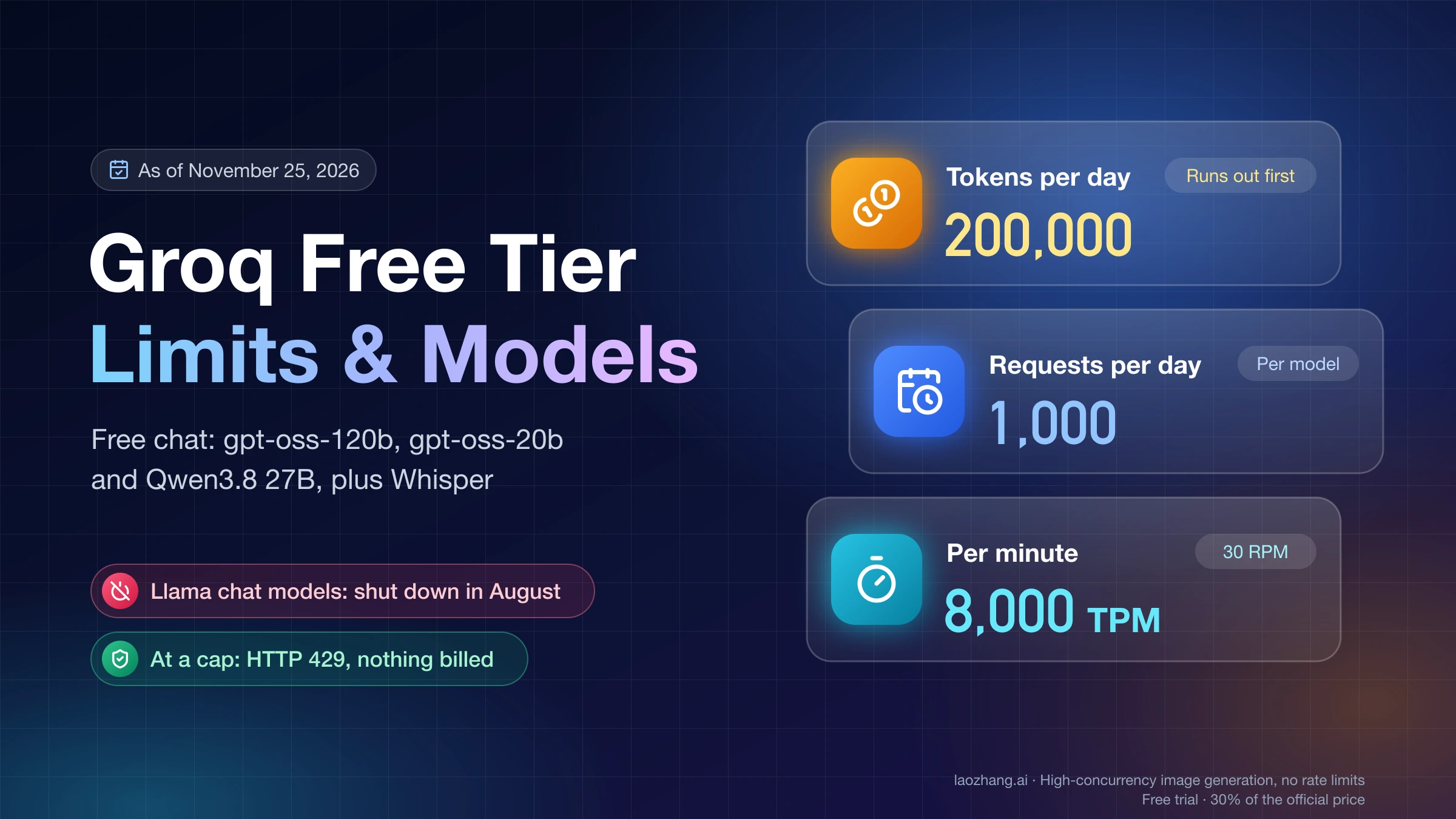
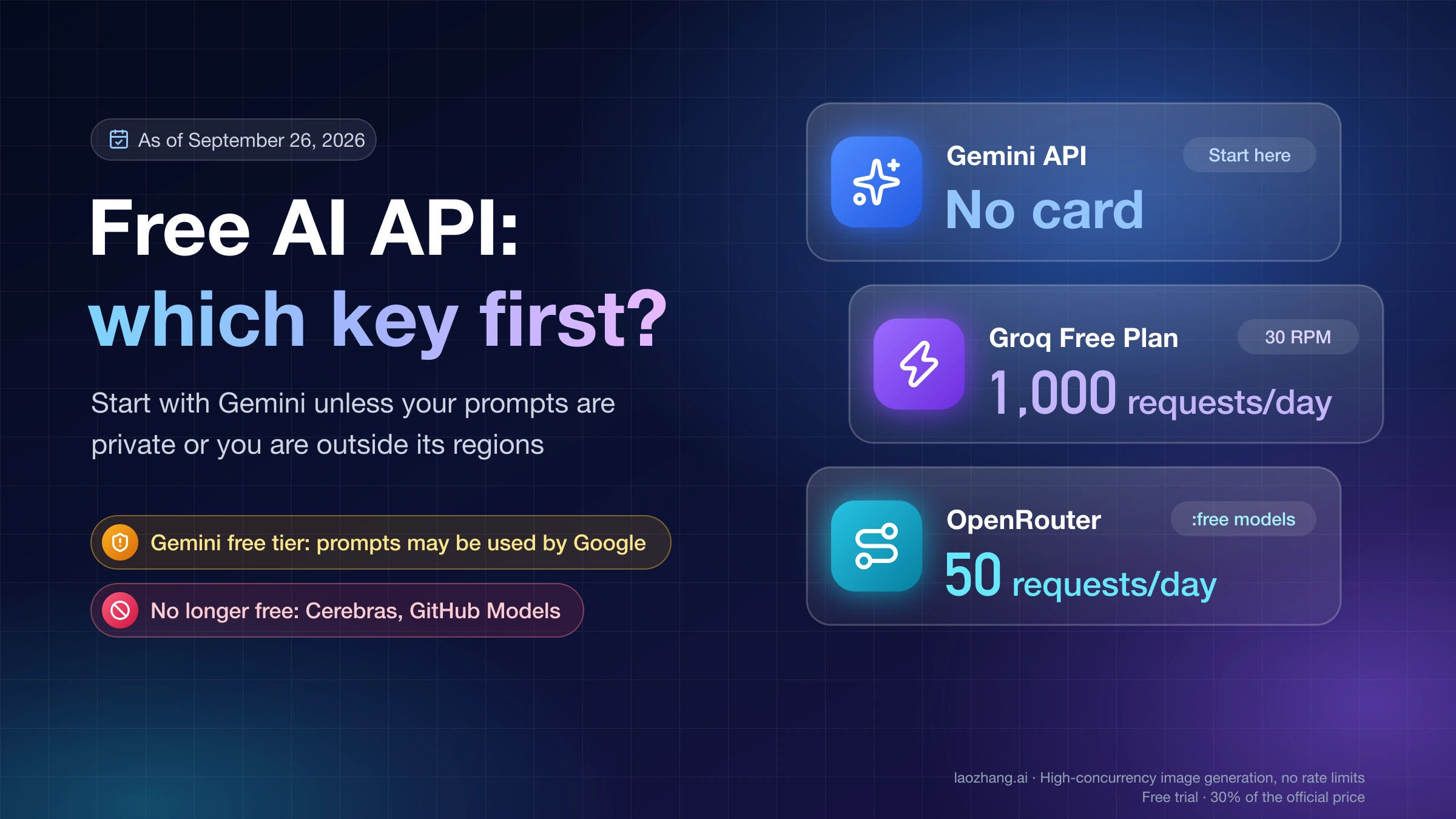
Groq's API is free to use on its Free plan, and every model on it has hard limits. As of November 25, 2026, the free chat models are openai/gpt-oss-120b, openai/gpt-oss-20b and qwen/qwen3.8-27b, each capped at 30 requests per minute, 1,000 requests per day, 8,000 tokens per minute and 200,000 tokens per day. Speech-to-text with whisper-large-v3-turbo or whisper-large-v3 gets up to 2,000 requests and 8 hours of audio a day. When you reach a cap, the API answers with HTTP 429 until the window resets; nothing is billed.
The Llama chat models are no longer on that list. llama-3.3-70b-versatile and llama-3.1-8b-instant were shut down for free and Developer-plan users on August 16, 2026, so code that still calls them should move to openai/gpt-oss-120b or openai/gpt-oss-20b. The figure of 14,400 requests a day that still circulates belonged to Llama 3.1 8B Instant, which is gone.
In practice, the daily token cap runs out long before the 1,000-request cap. A call that uses 1,000 tokens of prompt plus reply leaves you about 200 calls a day, and a 4,000-token call about 50. Groq calls its published table a summary with possible exceptions, so the exact values for your organization are on the Limits page of the GroqCloud console.
Which models are free on Groq: the Free plan table as of November 25, 2026
Ten models are on Groq's Free plan as of November 25, 2026, but only three of them are general chat models. The rest are one safety classifier, two prompt-injection classifiers, two text-to-speech voices and two Whisper transcription models. The values below come from Groq's rate limits documentation.
| Model ID | Use | Requests per minute (RPM) | Requests per day (RPD) | Tokens per minute (TPM) | Tokens per day (TPD) | Audio seconds per hour (ASH) | Audio seconds per day (ASD) |
|---|---|---|---|---|---|---|---|
openai/gpt-oss-120b | Chat, reasoning | 30 | 1,000 | 8,000 | 200,000 | – | – |
openai/gpt-oss-20b | Chat, reasoning | 30 | 1,000 | 8,000 | 200,000 | – | – |
qwen/qwen3.8-27b | Chat, multimodal (preview) | 30 | 1,000 | 8,000 | 200,000 | – | – |
openai/gpt-oss-safeguard-20b | Safety classification (preview) | 3 | 1,000 | 2,000 | 200,000 | – | – |
meta-llama/llama-prompt-guard-2-22m | Prompt-injection check | 30 | 14,400 | 15,000 | 500,000 | – | – |
meta-llama/llama-prompt-guard-2-86m | Prompt-injection check | 30 | 14,400 | 15,000 | 500,000 | – | – |
canopylabs/orpheus-v1-english | Text to speech | 10 | 100 | 1,200 | 3,600 | – | – |
canopylabs/orpheus-arabic-saudi | Text to speech | 10 | 100 | 1,200 | 3,600 | – | – |
whisper-large-v3-turbo | Speech to text | 20 | 2,000 | – | – | 7,200 | 28,800 |
whisper-large-v3 | Speech to text | 20 | 2,000 | – | – | 7,200 | 28,800 |
Limits apply to the whole organization, not to each user, so everyone in the same GroqCloud organization draws on one allowance. Whichever limit you hit first stops you, and cached tokens don't count toward any of them. Some organizations also have separate input and output caps inside the per-minute token limit; hovering over the TPM value on the console's Limits page shows an "X in / Y out" split if yours does.
For transcription, 7,200 audio seconds an hour is 2 hours of audio per clock hour, and 28,800 a day is 8 hours. For chat, pick openai/gpt-oss-120b or openai/gpt-oss-20b if the workload matters to you: Groq's supported models page lists both as production models, while qwen/qwen3.8-27b and openai/gpt-oss-safeguard-20b are preview models that Groq says are for evaluation and may be discontinued at short notice. The same page gives the list call that returns every model your key can use right now, which is the quickest way to confirm an ID before you deploy:
curl -X GET "https://api.groq.com/openai/v1/models" \
  -H "Authorization: Bearer $GROQ_API_KEY" \
-H "Content-Type: application/json"What left Groq's free tier in 2026, and what replaced it
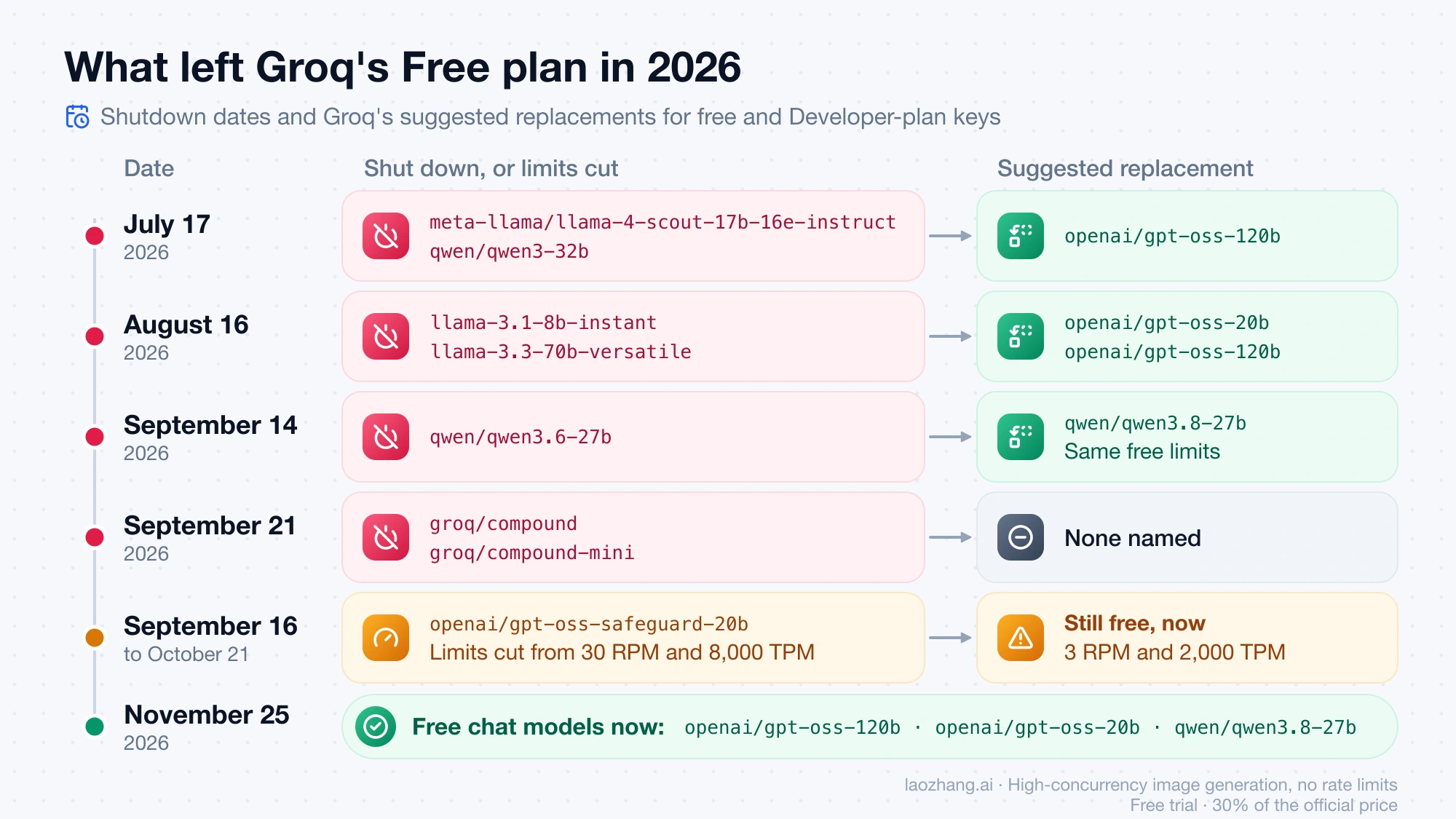
Llama 3.1 8B, Llama 3.3 70B, Llama 4 Scout, Qwen3 32B and both Compound systems all left the Free plan between July and September 2026, and the safety model's limits were cut. Wayback Machine copies of Groq's rate limits page from July 25, September 16, October 21 and November 7, 2026, compared with the live page on November 25, show when each row disappeared; the shutdown dates and replacements come from Groq's model deprecations page.
| Model | Free limits before it left (RPM / RPD / TPM / TPD) | What happened | Groq's suggested replacement |
|---|---|---|---|
meta-llama/llama-4-scout-17b-16e-instruct | Not in the July 25 copy | Announced June 17, shut down July 17, 2026 | openai/gpt-oss-120b or qwen/qwen3.6-27b |
qwen/qwen3-32b | Not in the July 25 copy | Announced June 17, shut down July 17, 2026 | openai/gpt-oss-120b |
llama-3.1-8b-instant | 30 / 14,400 / 6,000 / 500,000 | Announced June 17, shut down August 16, 2026 | openai/gpt-oss-20b |
llama-3.3-70b-versatile | 30 / 1,000 / 12,000 / 100,000 | Announced June 17, shut down August 16, 2026 | openai/gpt-oss-120b or qwen/qwen3.6-27b |
qwen/qwen3.6-27b | 30 / 1,000 / 8,000 / 200,000 | Shut down September 14, 2026 | qwen/qwen3.8-27b, same free limits |
groq/compound, groq/compound-mini | 30 / 250 / 70,000 / – | Announced August 24, shut down September 21, 2026 | None named |
openai/gpt-oss-safeguard-20b | 30 / 1,000 / 8,000 / 200,000 | Still free, cut to 3 RPM and 2,000 TPM between September 16 and October 21 | – |
Groq's deprecation notices say these shutdowns apply to free and Developer-plan usage; enterprise customers with a committed-spend contract are not affected. That is why both Llama chat models still appear on the models page, now marked Enterprise with "Contact Sales" in place of a price. On a free key, calls to them fail.
The older numbers explain most of the confusion. 14,400 requests a day was the Llama 3.1 8B Instant figure. On today's table it appears only for the two Llama Prompt Guard classifiers, which take 512 tokens of context and can't hold a conversation. And 30,000 tokens a minute matches no model on the Free plan as of November 25, 2026; the highest per-minute token cap there is 15,000, again for the Prompt Guard models. If a tutorial or an AI answer quotes either figure for a chat model, it describes a free tier that no longer exists.
How many API calls are free on Groq? Tokens, not requests, set the limit
For the three free chat models, the number of calls you get per day depends on how many tokens each call uses, prompt and reply combined. The 1,000-requests-a-day cap only binds if every call averages 200 tokens or fewer, because 1,000 calls × 200 tokens already uses the full 200,000 tokens a day. Most real calls are larger, so the token caps decide.
The table below divides the November 25, 2026 limits (30 RPM, 1,000 RPD, 8,000 TPM, 200,000 TPD) by the tokens per call. It assumes input and output tokens both count and nothing is served from cache; retries add to the count.
| Tokens per call (prompt + reply) | Calls per minute | Calls per day | Limit that stops you |
|---|---|---|---|
| 250 | 30 | 800 | 30 RPM, then 200,000 TPD |
| 500 | 16 | 400 | 8,000 TPM, then 200,000 TPD |
| 1,000 | 8 | 200 | 8,000 TPM, then 200,000 TPD |
| 2,000 | 4 | 100 | 8,000 TPM, then 200,000 TPD |
| 4,000 | 2 | 50 | 8,000 TPM, then 200,000 TPD |
| 8,000 | 1 | 25 | 8,000 TPM, then 200,000 TPD |
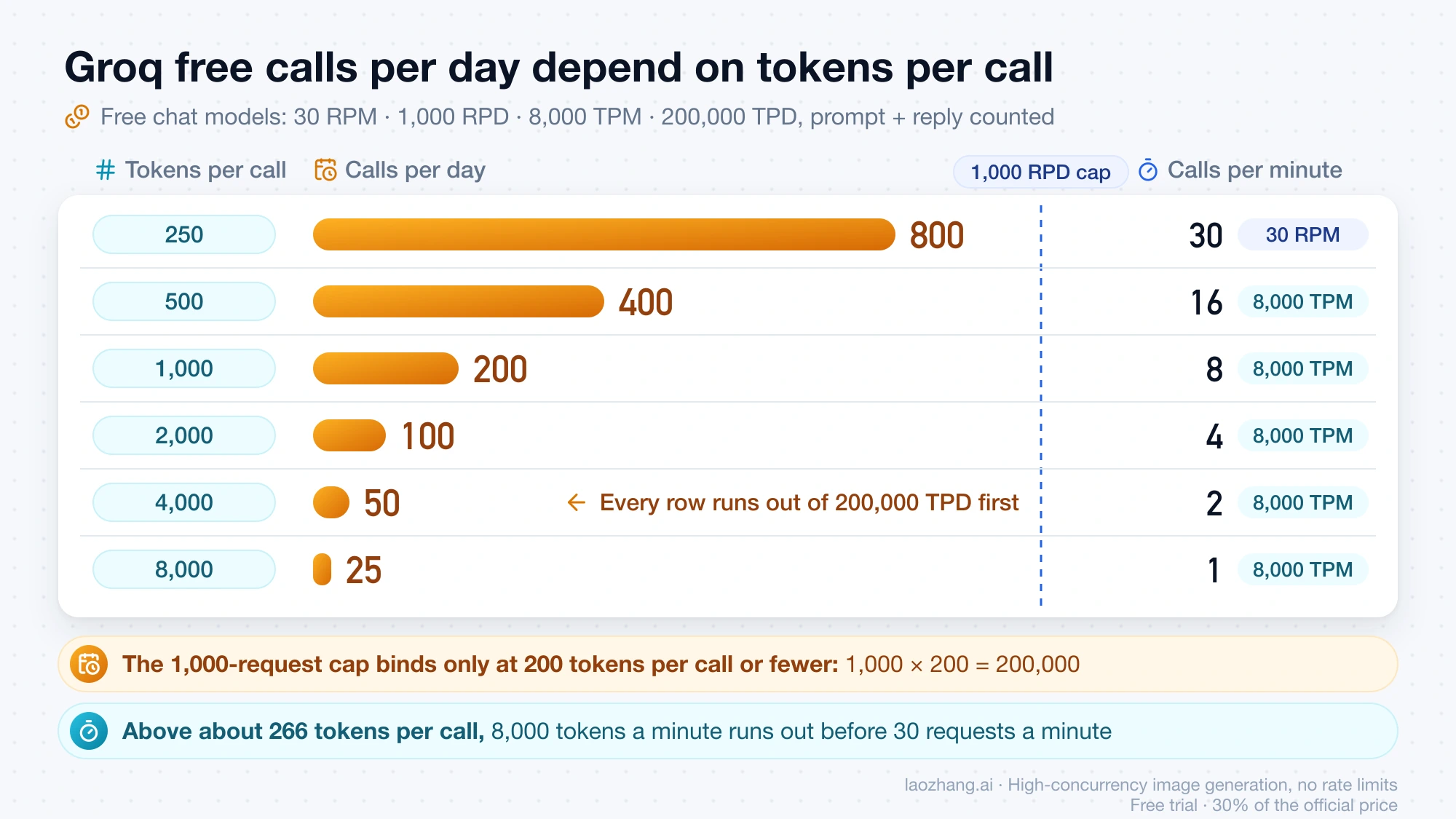
Two thresholds fall out of the arithmetic. Above about 266 tokens per call, 8,000 tokens a minute runs out before 30 requests a minute does. And if you run at the full per-minute token rate, 200,000 tokens last about 25 minutes, so a batch job at full speed uses up the day's allowance in under half an hour.
Agent chains are where this bites. An n8n or LangChain flow that makes five calls of 2,000 tokens each spends 10,000 tokens per task, which gives you 20 tasks a day on the Free plan; the per-minute cap lets only four of those calls through each minute. Long context hits the same wall. These models accept 131,072 tokens of context, but at 8,000 tokens per call the Free plan allows one call a minute and 25 a day. Repeating the same long system prompt helps only if those tokens are served from Groq's cache, since cached tokens don't count.
Groq rate limit headers and the 429 response
Every Groq API response carries headers showing how much of your request and token allowance is left, and a request over any limit returns 429 Too Many Requests. According to the rate limits documentation, the request headers always describe the daily request cap and the token headers always describe the per-minute token cap:
| Header | What it reports |
|---|---|
x-ratelimit-limit-requests | Your requests-per-day limit |
x-ratelimit-remaining-requests | Requests left today |
x-ratelimit-reset-requests | Time until the requests-per-day count resets |
x-ratelimit-limit-tokens | Your tokens-per-minute limit |
x-ratelimit-remaining-tokens | Tokens left in the current minute |
x-ratelimit-reset-tokens | Time until the tokens-per-minute count resets |
retry-after | Seconds to wait; sent only with a 429 |
No header reports tokens per day, and that is the cap most chat workloads hit first. To see it coming, keep a running total of the tokens your calls use and compare it with 200,000. The example values in Groq's documentation (14,400 requests, 18,000 tokens) are illustrative, so read the numbers your own responses return rather than those.
When a 429 arrives, wait the number of seconds in retry-after before sending again; immediate retries spend requests you no longer have. If a task can't wait, LLM API Retry vs Fallback: Five Gates Before Another Model Call covers when to send the call to a different model instead.
How much does Groq cost past the free tier? Developer plan prices
Paying for Groq means moving to the Developer plan, which charges per token and, for the three chat models, raises the per-minute caps by a factor of about 30 (250K tokens and 1,000 requests a minute against 8K and 30). It also adds Batch and Flex processing and a spend-limit setting. The Free plan has no spend limit to set: Groq's spend limits page says the feature is only available on paid plans, because a free account simply stops at its caps.
The prices and Developer limits below come from Groq's supported models page as of November 25, 2026. The last column shows what a full free day would cost at Developer prices, so you can judge whether upgrading is worth it: 200,000 tokens at the input price if every token were input, up to the output price if every token were output. For Whisper it is 8 hours at the hourly rate.
| Model | Developer price | Developer limits | One full free day at Developer prices |
|---|---|---|---|
openai/gpt-oss-120b | $0.15 input / $0.60 output per 1M tokens | 1,000 RPM, 250,000 TPM | $0.03–$0.12 |
openai/gpt-oss-20b | $0.075 input / $0.30 output per 1M tokens | 1,000 RPM, 250,000 TPM | $0.015–$0.06 |
qwen/qwen3.8-27b | $0.80 input / $4.00 output per 1M tokens | 1,000 RPM, 250,000 TPM | $0.16–$0.80 |
whisper-large-v3-turbo | $0.04 per hour of audio | 400 RPM, 400,000 ASH | $0.32 |
whisper-large-v3 | $0.111 per hour of audio | 300 RPM, 200,000 ASH | about $0.89 |
So the Free plan on openai/gpt-oss-120b is worth at most 12 cents a day at list prices. If you are hitting the caps every day, the cost of upgrading is small; if you only need more speed for a short batch, Batch or Flex on the Developer plan is the option Groq points to. Upgrades start from the plans page in the GroqCloud console. Groq's documentation on limits, models and spend limits doesn't say whether the Free plan requires a card. To compare per-token prices for the same open models across providers, see Cheapest LLM API Provider: Where the Same Model Costs Less.
When another free AI API fits better than Groq
Groq's Free plan suits short, fast calls: prototypes, classification, quick agent steps and transcription up to 8 hours a day. It is a weaker fit for long-context work or multi-call chains that run all day, because 200,000 tokens and 8,000 tokens a minute go quickly. In a Reddit r/LangChain thread about sustained multi-call chains, users reported hitting limits on both Groq and Gemini, and one said Mistral's free tier held up better for that pattern, while an r/vibecoding post calls Groq's free tier enough for 90% of what people use agents for. Both are personal reports, not measurements.
If your workload needs larger daily allowances, different models or different data-use terms, Best Free AI API Provider: Pick by Limits, Data Use, and Region compares the free tiers side by side. The two largest alternatives have their own pages: Gemini API Free Tier 2026: Limits, Free Models, and Free API Keys and OpenAI API Free Tier: What's Actually Free and What Still Bills.
Sources4
External pages this guide links to, in the order they appear. Last updated Nov 25, 2026.
Sources4
External pages this guide links to, in the order they appear. Last updated Nov 25, 2026.