How to Increase Nano Banana Pro API Quota in 2026: What Tier 3 Actually Changes
You do not upgrade Nano Banana Pro itself to Tier 3. You upgrade the Gemini project that serves `gemini-3-pro-image-preview`. This guide explains the current public tier ladder, what higher tiers change for Nano Banana Pro workloads, and what to do before T3 lands.
On this page
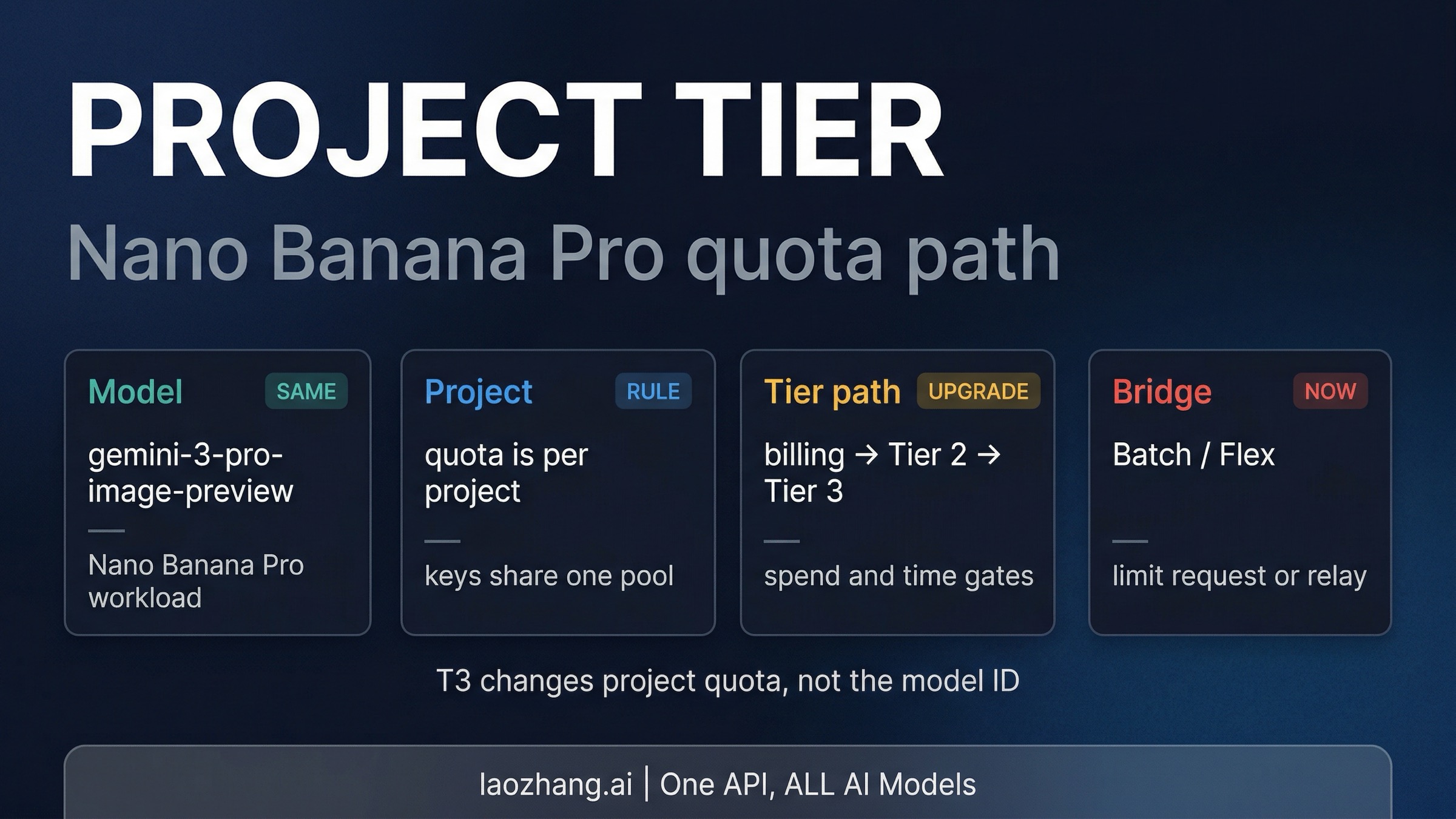
You do not upgrade Nano Banana Pro itself to Tier 3. You upgrade the Gemini project that serves gemini-3-pro-image-preview. As of April 7, 2026, the current public path is active billing for Tier 1, $100 in cumulative billed spend plus 3 days for Tier 2, and $1,000 plus 30 days from the first successful payment for Tier 3. That changes quota headroom, not the model ID and not the current public per-image price.
For Nano Banana Pro workloads, the practical effect is capacity, not a different Pro switch. Higher tiers can expand public batch headroom and make heavier image pipelines easier to run, but they do not create a separate T3 key, a cheaper version of Pro, or a different model family. If you need more throughput before Tier 3 arrives, the right bridge is to verify your current project tier, use the official Batch or Flex route where latency allows, and use the correct paid-capacity escalation path instead of hunting for model tricks.
The numbers in this guide were rechecked against Google's public rate-limits, pricing, and Vertex model pages on April 7, 2026. Where Google does not expose a clean logged-out table for every interactive limit of gemini-3-pro-image-preview, this article says so directly instead of inventing precision.
Current Path At A Glance
| If your problem is... | Current answer | Why it matters |
|---|---|---|
| "I need more Nano Banana Pro API quota right now" | Move the project tier up, not the model | Tier logic belongs to the Gemini project and billing history |
| "I need Tier 3" | The current public path is $1,000 billed spend + 30 days from the first successful payment | Old $250 + 30 days advice is stale |
| "I need more capacity before T3 lands" | Use Batch/Flex, the correct paid-capacity escalation path, or a relay route only if you accept a different contract | The bridge route depends on latency, governance, and ownership |
| "I made a second API key, why is quota unchanged?" | Keys inside one project still share the same quota pool | Rate limits are enforced per project, not per API key |
The shortest safe mental model is this: Nano Banana Pro is the workload name most readers care about, but quota upgrades live one layer above it. Once you see the project as the real quota boundary, most of the common wrong moves stop looking attractive.
What Tier 3 Means For Nano Banana Pro API
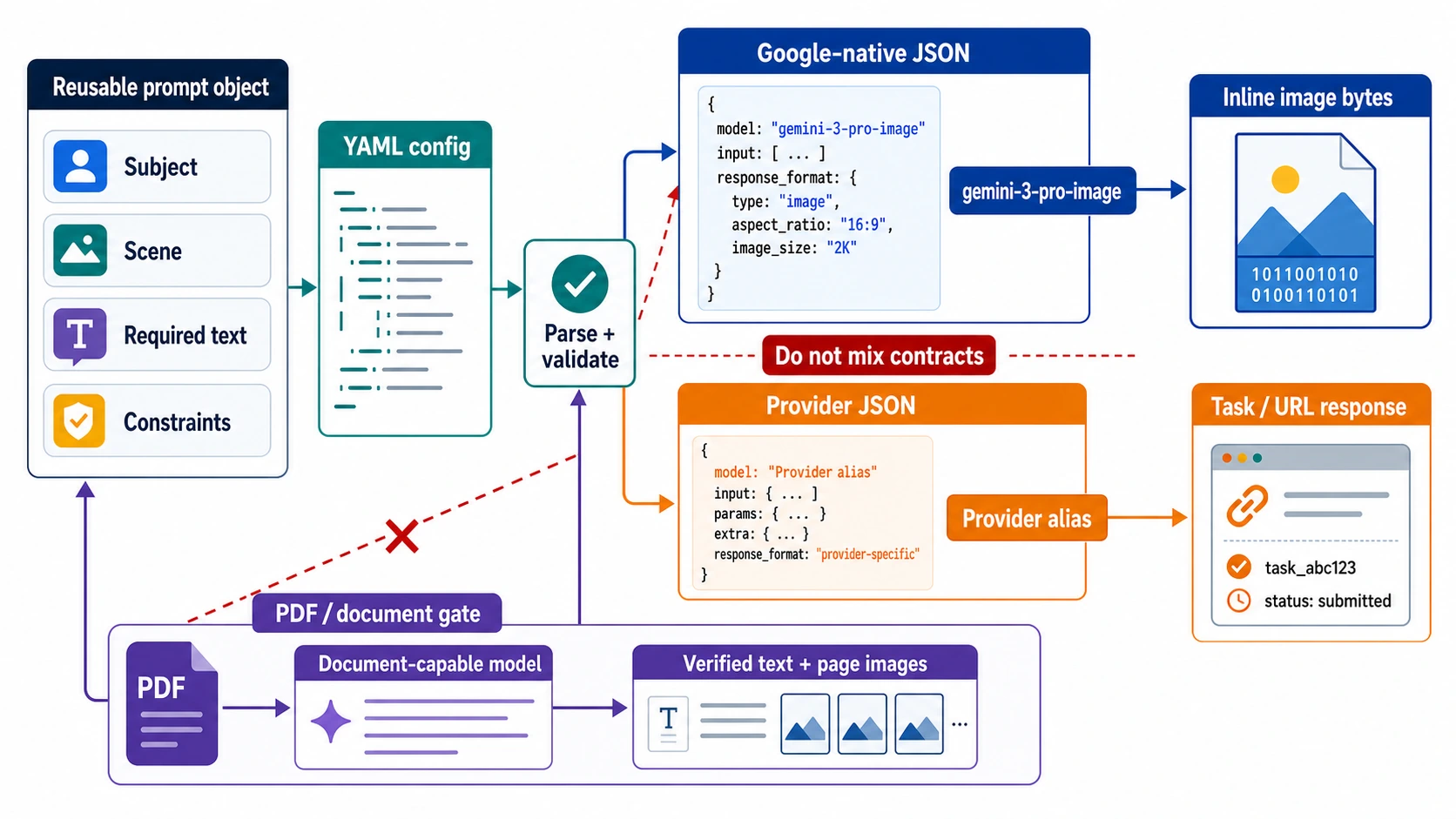
Tier 3 is a Gemini API usage-tier concept, not a Nano Banana Pro setting. The model you are actually calling is still gemini-3-pro-image-preview, and the rate-limit rules are attached to the Google project that owns the billing history behind that workload. That is why a page about Nano Banana Pro quota has to start by correcting the boundary first: the quota problem is real, but the object being upgraded is the project.
This matters because the wrong mental model wastes time fast. If you think T3 is a special key type, the natural next move is to create more keys. If you think it is a model-level switch, the natural next move is to search for a hidden Nano Banana Pro upgrade toggle. Neither route fixes the bottleneck. Google's current rate-limit docs describe the tier system at the project level, and they are explicit that quota enforcement is tied to the project rather than the individual API key. Ten keys in one project do not give you ten quota pools.
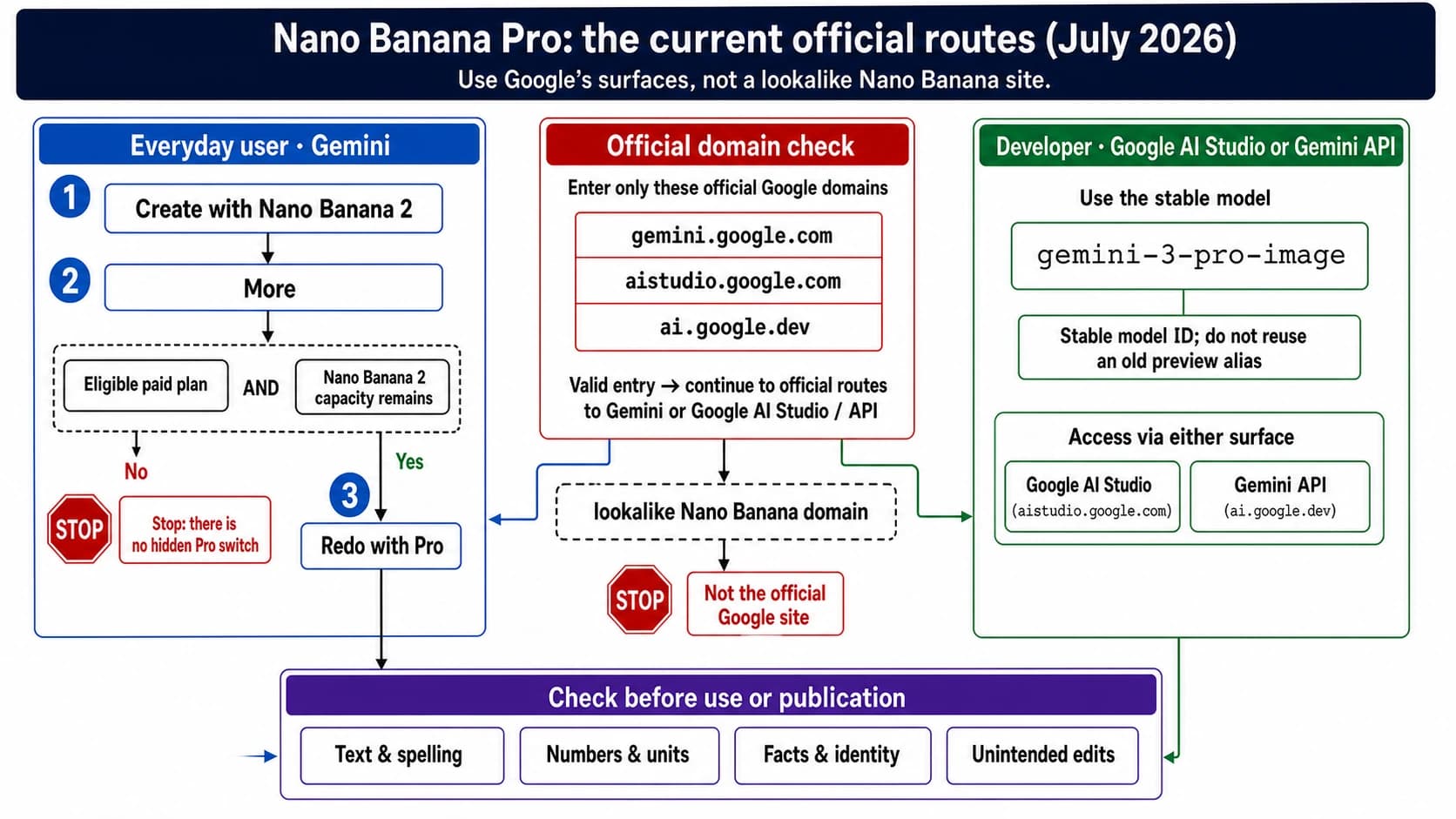
There is also a naming trap around Google's consumer surfaces. The Gemini app now defaults image generation to Nano Banana 2, while paid flows can surface Redo with Pro. AI Mode help pages also use the phrase Thinking with 3 Pro. Those are product-surface labels, not evidence that the API has a separate consumer-style Pro plan or a shortcut to Tier 3. If your job is backend image generation with Nano Banana Pro, keep those surfaces in the background and keep the API contract in the foreground.
If you still need the underlying setup flow, start with our Nano Banana Pro API key guide. The point here is narrower: once the key works, quota growth is a project-tier problem.
The Current Upgrade Path From Billing To Tier 3
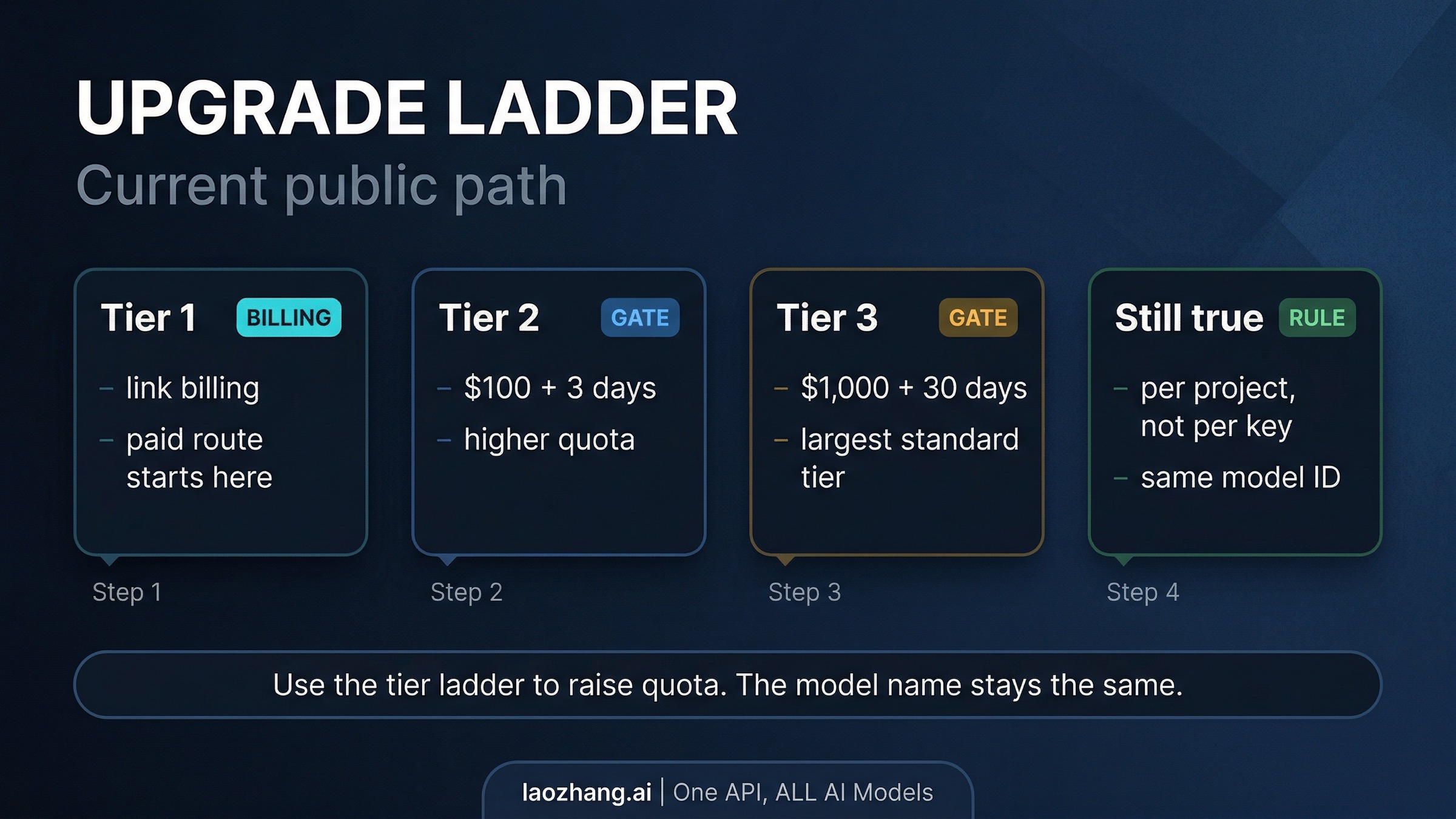
The current public ladder is simpler than a lot of older guides suggest, but it is also less forgiving if you are working from stale numbers. As of the rate-limits page updated on April 1, 2026, the public qualification path is:
| Tier | Current public qualification | What it means in practice |
|---|---|---|
| Tier 1 | Active billing account | The project leaves the unpaid state and can use paid-tier capacity rules |
| Tier 2 | $100 cumulative billed spend + 3 days from the first successful payment | This is the first real time-and-spend threshold, and it arrives much earlier than older 30-day lore |
| Tier 3 | $1,000 cumulative billed spend + 30 days from the first successful payment | This is the current public top tier for normal self-serve progression |
Two details are more important than the table itself. First, the waiting window is now part of the contract, not a rumor you discover later. It is not enough to spend money quickly; the successful-payment clock still matters. Second, the qualification language is about billed spend and successful payment history, not about how many prompts you ran or how many keys you created. The project's commercial history is doing the work.
That is why the common March-era advice is no longer safe. Older pages in this topic cluster still describe Tier 2 as $250 + 30 days. That is not the public contract Google is showing now. If you are planning capacity or budgeting around Nano Banana Pro workloads in April 2026, use the current public ladder and keep the verification date visible in your head when you revisit the article later.
The practical takeaway is straightforward. Tier 1 is the immediate switch, Tier 2 is the early growth threshold, and Tier 3 is the heavier production threshold. If your workload is just moving from prototype to real traffic, the biggest near-term step is often billing plus a clean understanding of what Tier 2 now requires. If your workload is already large enough that Tier 3 is the real target, the 30-day clock becomes part of the schedule whether you like it or not.
For the broader state of Gemini API tiers across models, read the wider Gemini API rate limits guide. For this article, the important point is narrower: the Nano Banana Pro workload inherits this ladder because the workload sits inside that project contract.
What Higher Tiers Change For gemini-3-pro-image-preview
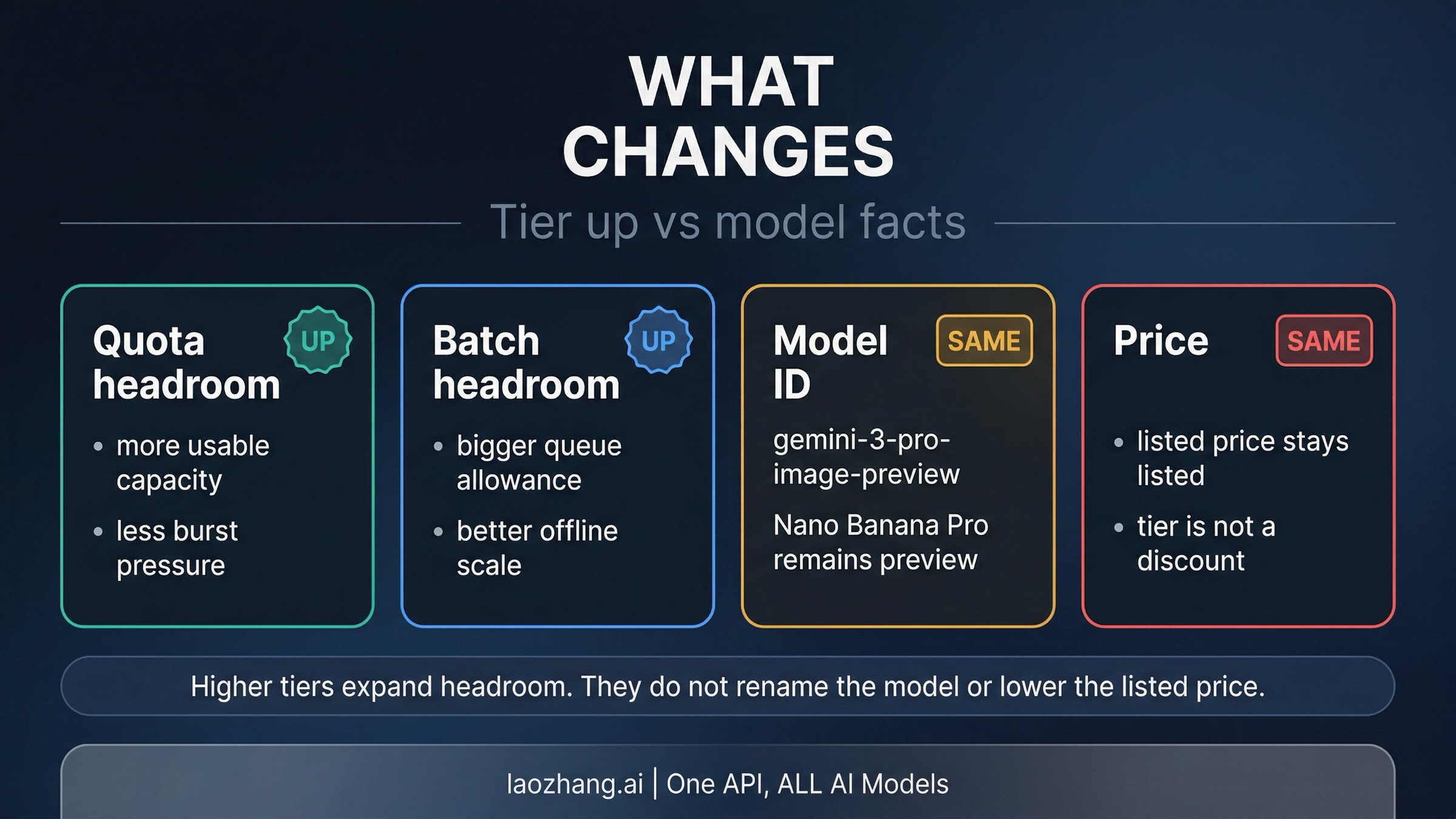
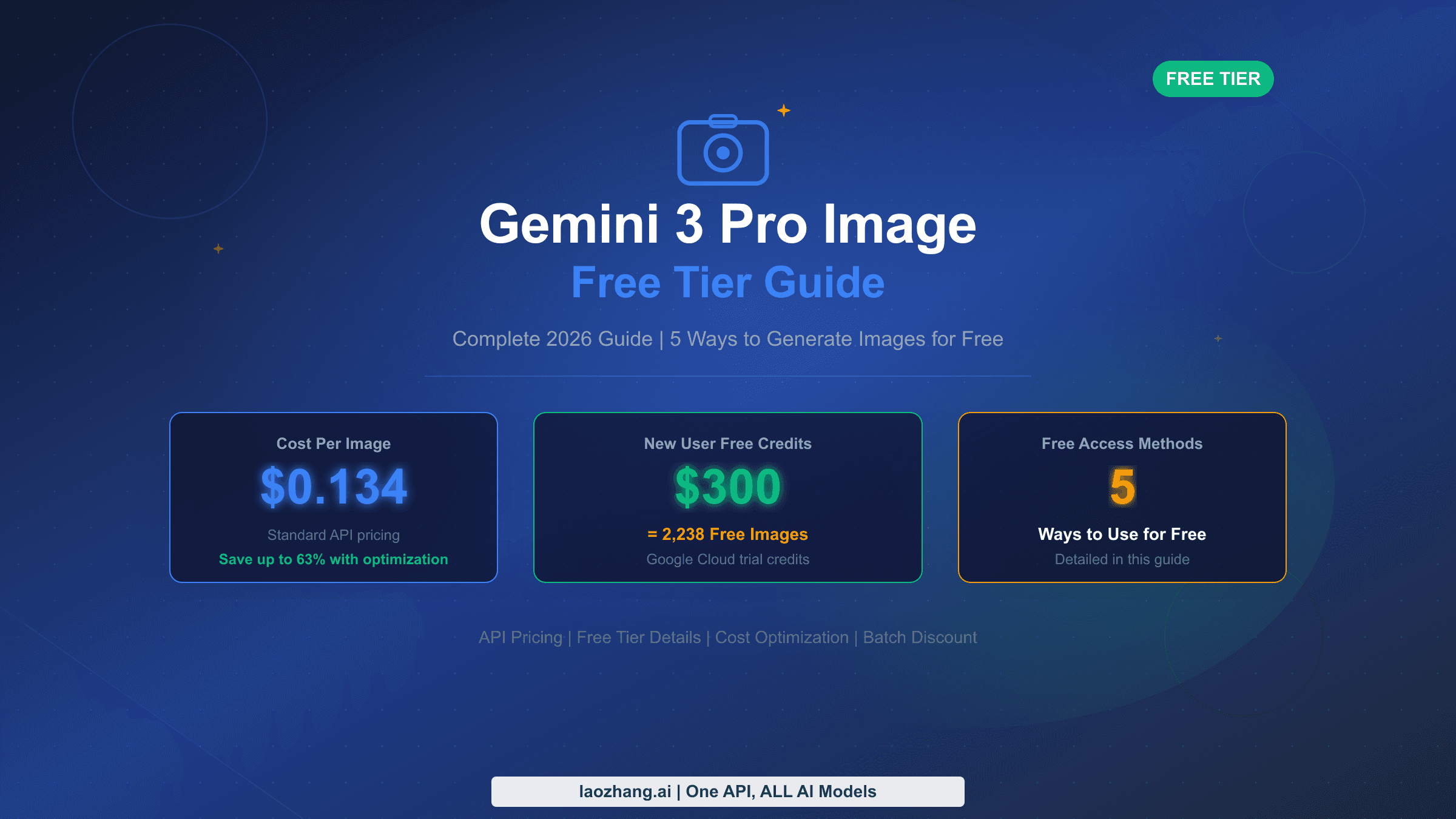
The cleanest way to think about a higher tier is: it buys room, not identity. The model string stays gemini-3-pro-image-preview. The current public price stays what the pricing page says it is today: $0.134 per 1K/2K image and $0.24 per 4K image on the standard path, with Batch/Flex at $0.067 and $0.12. And the model still shows up on Vertex AI as Gemini 3 Pro Image, where Google currently labels it as a preview model.
What does change is headroom. Google's public materials show that higher tiers expand the amount of batch capacity available to this model family. That is the most concrete model-specific consequence visible in the public docs right now, and it is the safest one to anchor on. If your Nano Banana Pro workload is queue-heavy, non-interactive, or operationally compatible with batch processing, higher tiers can materially change how much work you can keep in flight.
What the public docs do not give you, at least in a clean logged-out way, is one universal table of every interactive paid limit for gemini-3-pro-image-preview across every tier. That gap matters because many articles fill it with numbers copied from older tables, forum posts, or adjacent models. This guide does not do that. The current public evidence is strongest on the tier qualifications, the lack of a free public API tier for this model, the current per-image pricing, and the fact that higher tiers expand available headroom for batch-style work.
That distinction is useful because it clarifies whether Tier 3 solves your actual problem. If the bottleneck is project-level headroom, a higher tier helps. If the bottleneck is latency, architecture, governance, or the simple fact that the current public price is too high for the workload, Tier 3 alone does not magically fix that. A lot of quota-upgrade frustration comes from aiming the right tool at the wrong pain point.
If your real question is route economics rather than quota headroom, use the separate Nano Banana Pro API cheapest-route guide. Tier growth and route choice influence each other, but they are not the same decision.
How To Check Your Current Tier And Raise Capacity Safely
If you need more Nano Banana Pro throughput, the safe operator workflow is short.
- Identify the exact project behind the workload. Do not start from the prompt, the dashboard, or the model nickname. Start from the project that owns the API key or Cloud auth path sending the requests.
- Check whether that project is still effectively unpaid or already on a billed path. If billing is not active, the next move is Tier 1, not Tier 3.
- If billing is already active, compare the project's billed spend and the date of the first successful payment with the current public thresholds. This tells you whether Tier 2 or Tier 3 is even on the table yet.
- If the workload already exceeds the public tier you have, decide whether the real next step is a rate-limit increase path, a move to Vertex-governed capacity, or a change in workload shape such as Batch/Flex.
This sequence matters because it stops two expensive mistakes. The first is over-escalating when the project is still missing the obvious prerequisite: billing. The second is under-diagnosing a problem that is not really about tier at all. Some teams are actually blocked by bursty synchronous traffic, not by total project qualification. In that case, the fix may be queueing, batch processing, or a different serving path rather than simply waiting for Tier 3.
There is also one place where splitting resources does matter. If you genuinely need separate quota pools for unrelated workloads, that separation happens at the project level. Separate projects can create separate quota histories. Separate keys inside one project cannot. Use that split deliberately and only when you are willing to take on the operational overhead that comes with it.
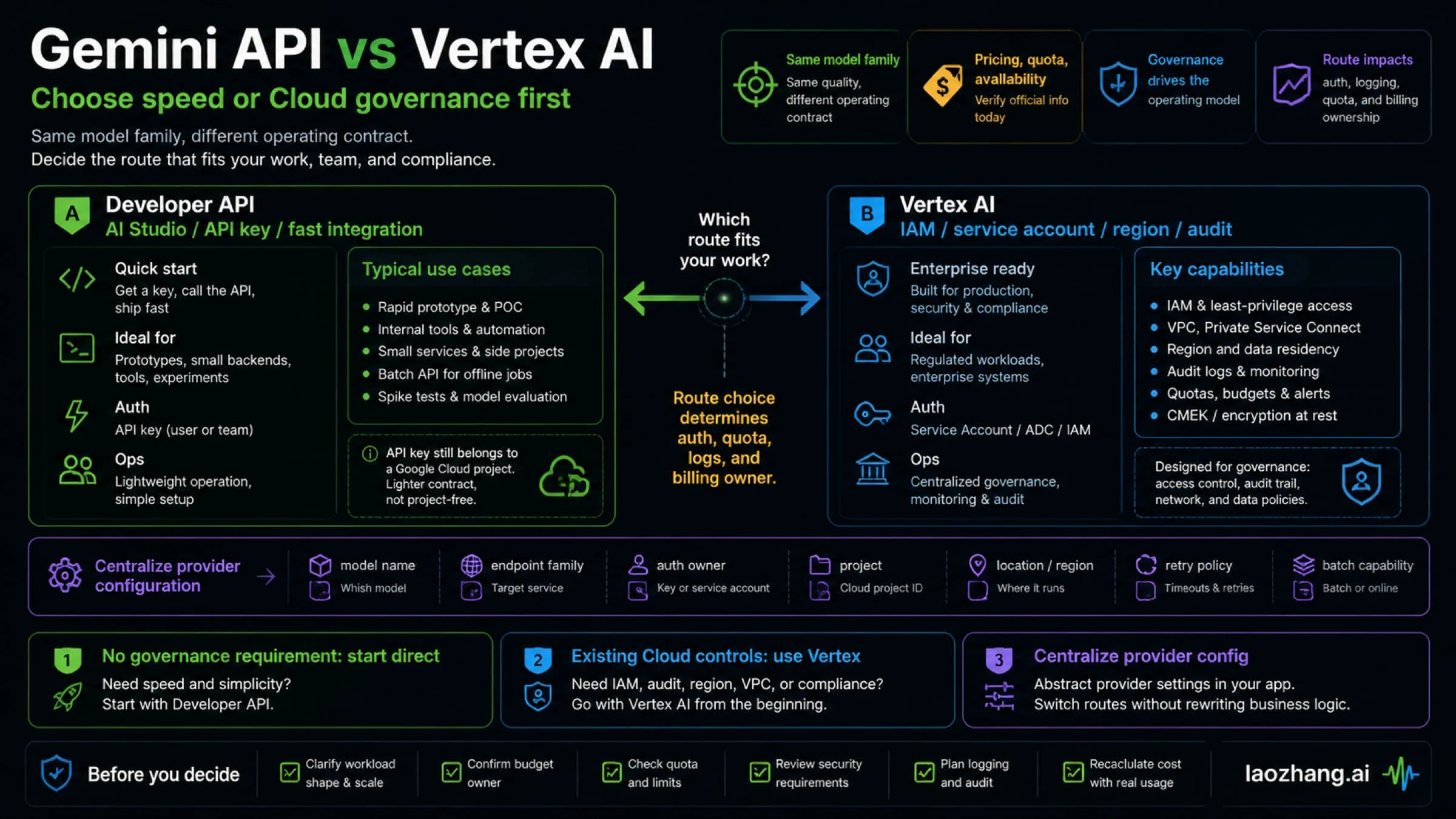
If your traffic is moving from one developer's API-key workflow into a governed production stack, this is also the point where Vertex AI starts to matter more. The model does not change, but the operating surface does. Vertex is where service-account auth, Cloud governance, batch prediction, and provisioned capacity discussions become more natural than trying to stretch an early AI Studio workflow forever.
What To Do Before T3 Lands
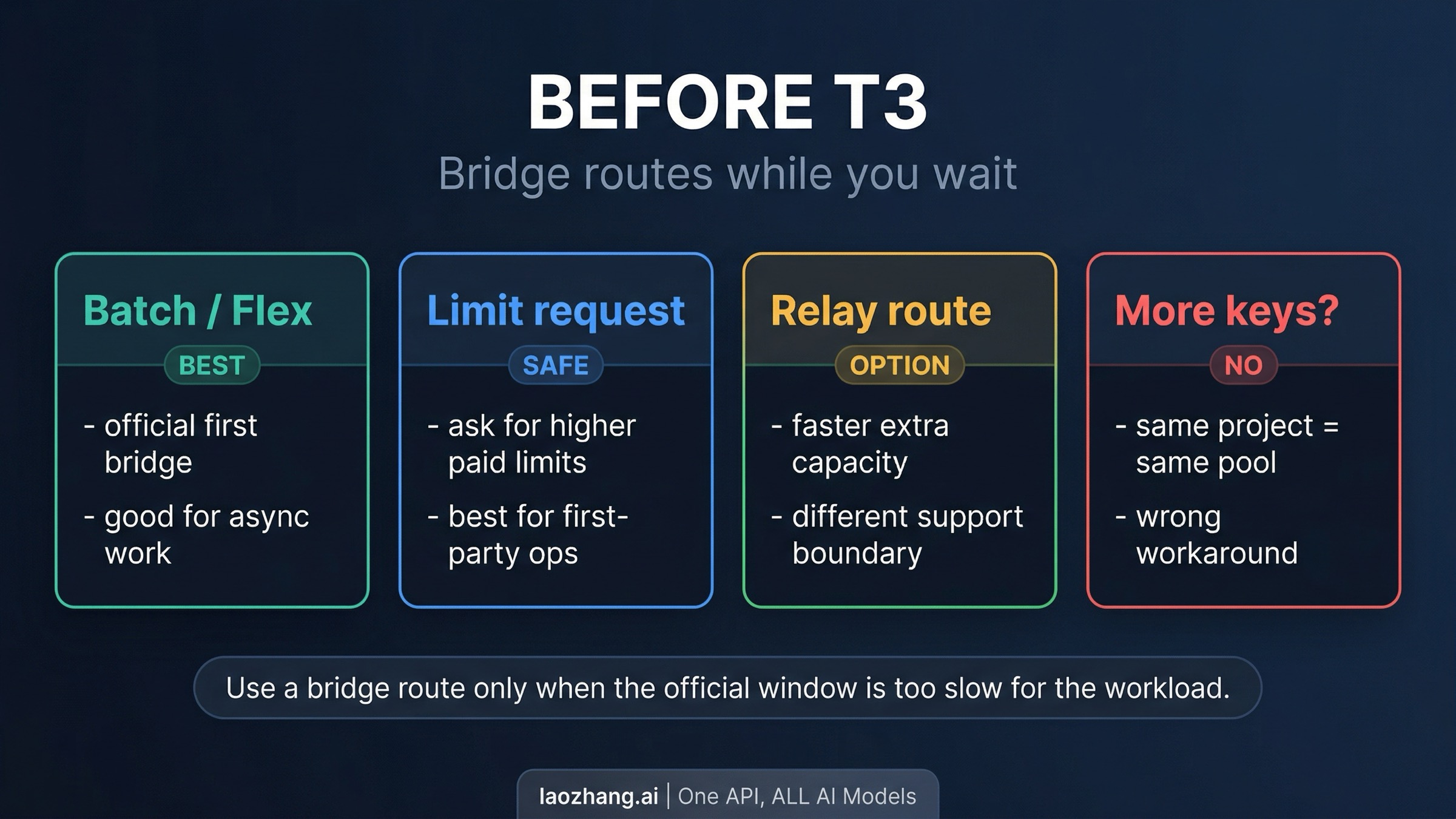
When the 30-day clock is the real blocker, you still have legitimate bridge routes. They are just not equivalent to each other.
Batch or Flex is the cleanest first-party bridge when latency is negotiable. The pricing page already gives the economic reason: the official Batch/Flex route cuts the current public image price in half. Just as important for this article, Google's public tier materials show that higher tiers expand batch-style headroom for the Pro image model. If your workload is offline rendering, campaign preparation, queued asset generation, or any other job that does not need a human staring at a spinner, Batch/Flex is the first bridge to evaluate.
If you want the exact implementation and pricing mechanics behind that official discount, continue with the dedicated Gemini 3 Pro Image Batch API discount guide.
A paid-capacity escalation path is the next bridge when the workload is legitimate but the public tier clock is too slow. This is especially relevant once the workload is already living in a Vertex-style production context. The question then is no longer "how do I unlock a secret T3 key?" The real question is whether the current project contract is the wrong fit for the production pattern. That is where rate-limit increase requests, governed capacity planning, or provisioned throughput discussions become more sensible than trying to force the traffic through the same early setup.
A relay route is a bridge only if you accept a different contract on purpose. Relay providers can be faster to start, and some surface cheaper real-time access, but that is not the same thing as Google granting you more Nano Banana Pro quota. You are changing the billing boundary, the support boundary, and often the governance boundary. Sometimes that is the right trade. Sometimes it is exactly the wrong move. Treat it as a bridge or an alternate contract, not as evidence that Google's own T3 path secretly changed.
There is also a fourth bridge that many readers ignore because it feels less glamorous: reduce the fraction of work that truly needs Pro. If only the highest-stakes images need gemini-3-pro-image-preview, the rest of the queue may belong on a cheaper model or on Nano Banana 2. That does not increase Pro quota, but it can buy you time more honestly than pretending every image in the workload deserves the premium path. If that tradeoff is live for you, read Nano Banana Pro vs Nano Banana 2 before you spend another week chasing headroom.
What Not To Do
Do not create more keys in the same project and expect new quota. This is the most common dead end because it feels technical enough to be plausible. Google's current contract is clearer than that. The project is the quota boundary. More keys only change credential count, not capacity.
Do not confuse consumer Pro labels with API tiers. Redo with Pro and Thinking with 3 Pro are real Google surface terms, but they are not a public API explanation of how Tier 3 works for gemini-3-pro-image-preview. If you treat those phrases as API evidence, the article in your head becomes harder to debug than the actual workload.
Do not assume a higher tier makes Nano Banana Pro cheaper. Current public pricing for the model is still current public pricing. The price lever Google exposes openly is the route choice between standard and Batch/Flex, not a secret per-image discount that appears at Tier 3.
Do not copy older threshold math into a 2026 production decision. This topic has already accumulated stale tables, stale waiting windows, and stale folk wisdom. The current public path is billing for Tier 1, $100 + 3 days for Tier 2, and $1,000 + 30 days for Tier 3. Start there or you will plan around a contract that is no longer live.
If your real problem is the error you hit after the quota runs out rather than the growth path itself, use our dedicated RESOURCE_EXHAUSTED troubleshooting guide for Nano Banana. This page is about how to raise capacity, not how to debug every downstream symptom.
FAQ
Can I buy Tier 3 directly with one click?
Not through a public "buy T3 now" switch that Google exposes as the normal self-serve path for this model. The public route is still qualification through billing history and time. If you need more than the public path gives you, the conversation shifts toward governed capacity choices rather than a retail upgrade button.
Does a new API key give me a fresh quota pool?
No. The current rate-limit contract is enforced per project, not per API key. A new key is useful for credential hygiene, not for multiplying quota inside the same project.
Does Tier 3 make gemini-3-pro-image-preview cheaper?
No. What the public pricing page shows today is route pricing, not tier-discount pricing. Standard and Batch/Flex have different costs, but the tier itself is about headroom, not a cheaper per-image sticker.
Is Nano Banana Pro free on the API?
Not on the current public pricing page. gemini-3-pro-image-preview is currently listed with Free Tier: Not available. If you need free-capable Gemini API context more broadly, read the separate Gemini API free tier guide.
What is the cleanest official bridge before Tier 3?
If latency is flexible, Batch/Flex is the cleanest first-party bridge because it lowers cost and fits queued work well. If the workload is production-critical and the public tier shape itself is the issue, the next conversation is about paid-capacity escalation or governed serving, not about magical keys.
Why does this article keep saying "project" instead of "Nano Banana Pro plan"?
Because that is where the quota contract actually lives. Nano Banana Pro is the workload readers care about. The project is the object Google uses for billing and rate-limit qualification. Mixing those layers is how people end up searching for features that do not exist.
The bottom line is simple. If you need more Nano Banana Pro API quota, stop looking for a model-level T3 switch and move the decision back to the Gemini project. That is where the current ladder lives, that is where the waiting windows live, and that is where the honest bridge options become visible.