Is Muse Video Free Without Watermark? Meta's App vs 'Muse' Sites
Meta's Muse app makes free 10-second clips in the US, Canada, Japan and Singapore; Meta hasn't said if downloads show a logo. No free Muse site is Meta.
On this page
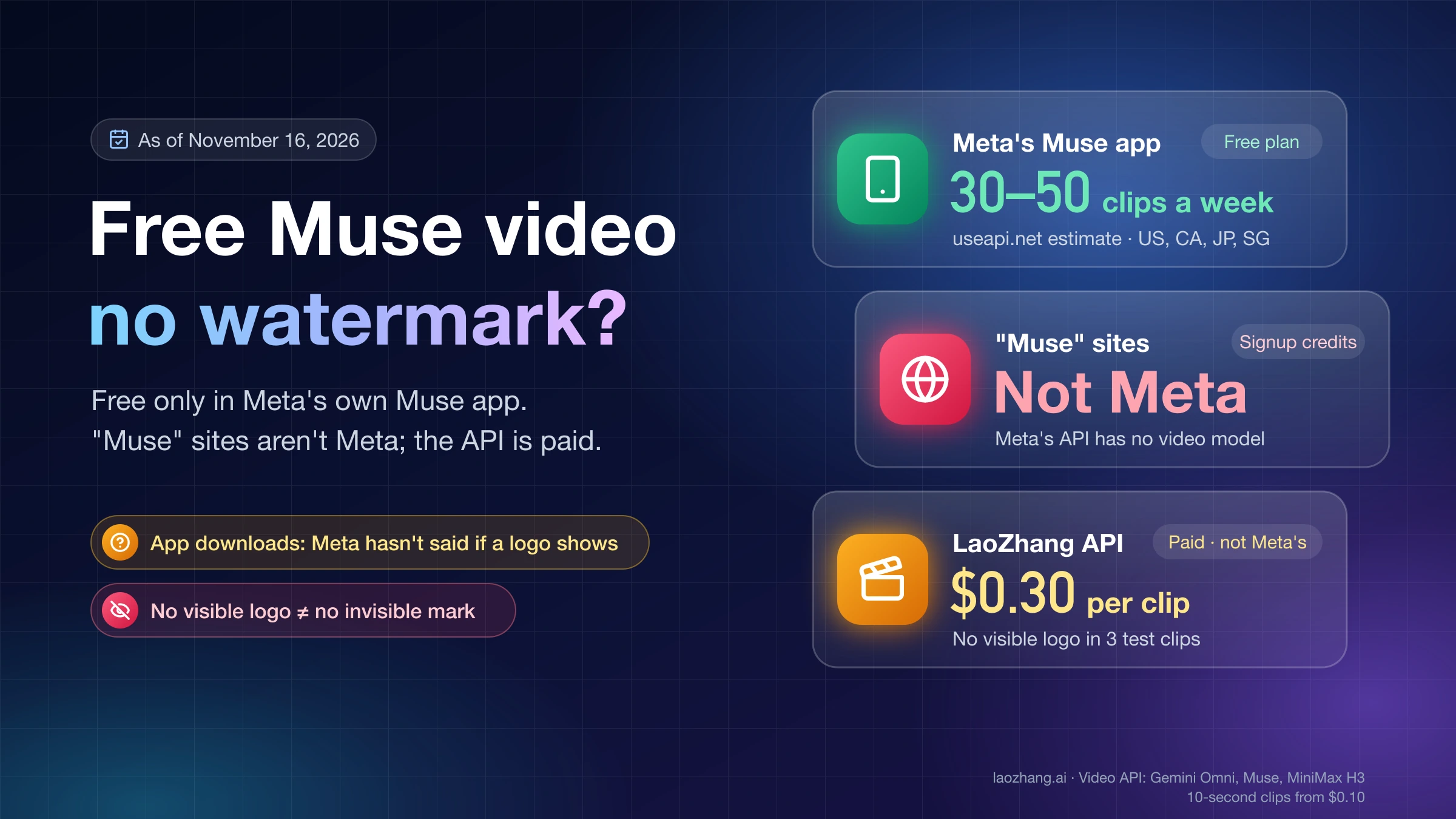
Yes, but only in Meta's own Muse app, and only part of the watermark question has an answer. Meta's Muse makes video in the Muse app (iOS, Android and muse.ai), which has launched in the US, Canada, Japan and Singapore and has a free plan. Meta doesn't publish how many clips that plan allows. useapi.net, a paid service that automates Muse accounts, measured each 10-second clip at 2–3% of the weekly allowance, or roughly 30 to 50 clips a week. As of November 16, 2026, Meta has not said whether a clip saved with the app's own download button carries a visible watermark. Frames from three Muse-made sample videos that useapi.net publishes show no logo, but those files were pulled through an API, not exported from the app.
The websites promising free Muse video with no watermark are not Meta. Meta's developer API has no video model, so none of them can be calling an official Muse video endpoint, and their own pages say as much: one says Muse Video "is not available in this workspace," another says "Paid plans remove the watermark." If you live outside the four launch countries, these sites are not a back door into Meta's Muse.
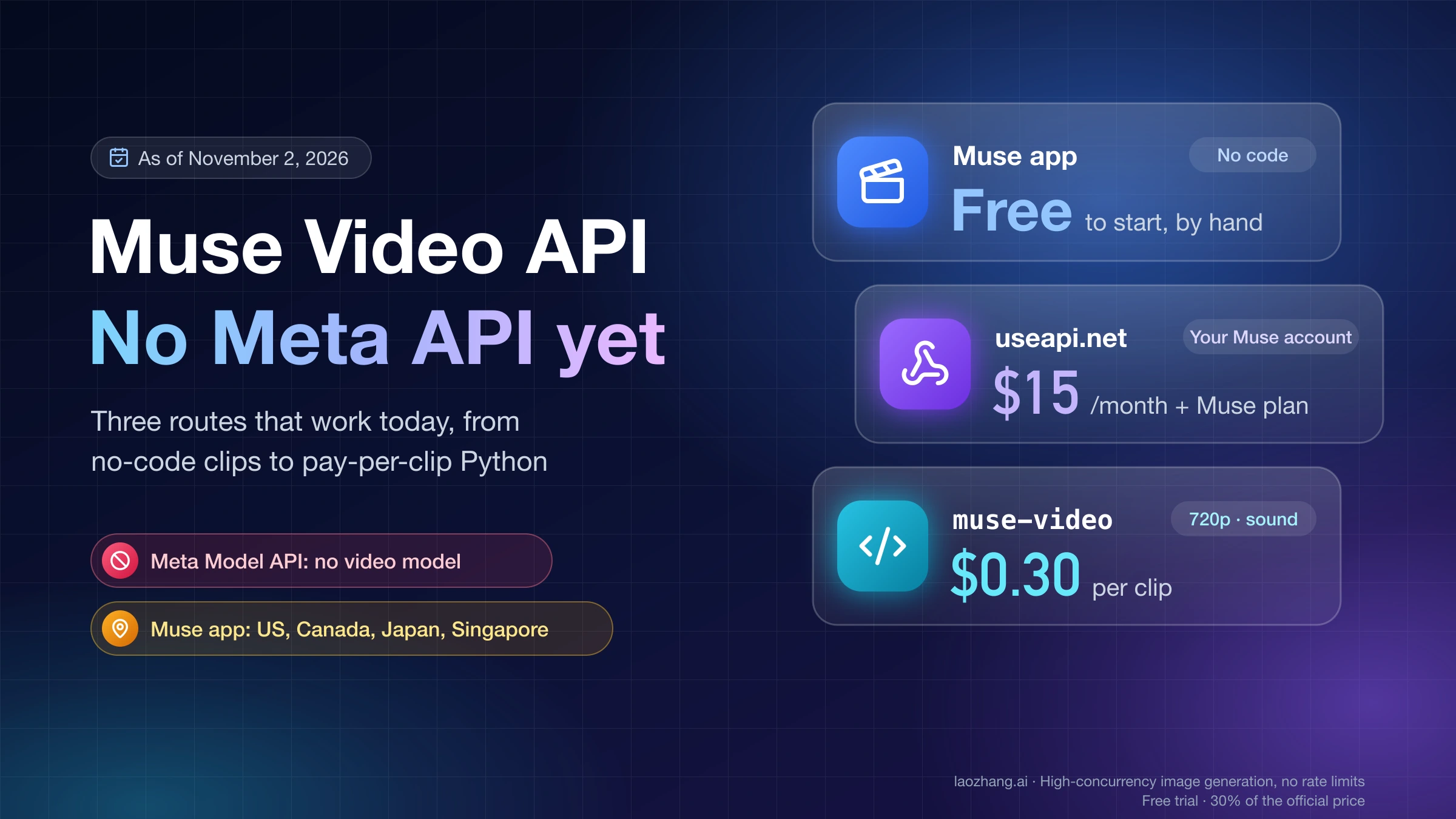
If you need clips with no visible logo that you can inspect before relying on them, the remaining route costs money. LaoZhang API's muse-video model charges $0.30 for each 5–10 second clip; three of its clips, made on November 2 and 3, 2026, showed no visible watermark and no Content Credentials manifest. It is pay-per-clip, not free, and it is not an API run by Meta. Keep in mind that no visible watermark is not the same as no marking at all: Meta has an invisible video watermark, Video Seal, and whether Muse clips carry one is not public.
Disclosure: laozhang.ai is our own service. Its prices are platform pricing, not an independent comparison.
Three Muse video routes: what's free and what shows a logo
Only one route is both free and really Meta's Muse: the Muse app's free plan, in the countries where it has launched. The other two either can't be shown to run Meta's model or cost money per clip. The Meta AI app, whose videos are the ones people mean when they say Meta adds a watermark, is a separate product and is covered further down.
| Route | What you pay | Visible watermark | Where it works | Is it Meta's Muse? |
|---|---|---|---|---|
| Muse app, free plan | Nothing; weekly limit Meta doesn't publish | Not stated by Meta for app downloads; Muse-made files fetched by API showed none | US, Canada, Japan, Singapore; 18+ | Yes |
| "Muse video" websites | Signup credits, then a subscription | Varies; one site says free renders carry one, another says downloads never do | Not stated on their pages | Not verifiable; some say Muse Video isn't on their site |
LaoZhang API muse-video | $0.30 per 5–10 s clip, up to $1.55 for 60 s | None seen in three test clips, as of November 16, 2026 | Anywhere the API is reachable | The provider says yes, through its own integration; it is not Meta's API |
Disclosure: laozhang.ai is our own service. Its prices are platform pricing, not an independent comparison.
Does the Meta Muse app add a watermark to videos?
Nobody official has said. Meta's July 7, 2026 announcement of Muse Image and Muse Video describes only one marking: images made by Muse Image in the Meta AI app and on meta.ai carry Content Seal, a hidden provenance signal, and Meta writes that it plans "to extend Content Seal to video soon." The post says nothing about a visible logo on videos, and as of November 16, 2026 there is no first-hand public report, on Meta's sites, Reddit or X, of what the app's download or share button exports. One Spanish-language YouTube tutorial has a chapter titled "Imágenes con Muse y descargas sin marca de agua" (Muse images and downloads without a watermark), which is one creator's claim in a chapter about images, not a verified check of video downloads.
The closest real evidence is Muse output itself. On November 16, 2026, frames were pulled with ffmpeg from three sample videos that useapi.net publishes in its Muse tutorial as output from Muse accounts it drives: muse-e2.mp4 (832×1104), muse-g2.mp4 (1280×720) and muse-g3.mp4 (1248×704), each exactly 10 seconds at 24 fps with AAC audio. Frames at 10%, 50% and 90% of each clip, nine in all, show no logo, text overlay or corner mark. The limit matters: useapi.net fetched these files from the account's library through its API, and its tutorial does not say which plan made each one. So the frames show that these Muse-made files carry no burned-in logo; they do not prove what the app's own download button exports.
Is Meta Muse video free? About 30–50 clips a week, by one count
Yes, the Muse app has a free plan that makes video, but Meta publishes no number for it. Meta's own line, from its Singapore launch post, is that Muse is "free for most of what people need, with subscription plans for people who want to do more." The paid plans listed on Meta's help center as of October 22, 2026 are Power at $20 a month (500 million Muse tokens a week) and Maximum at $100 a month (3 billion a week), with no token cost given per video.
The only figures come from third parties. On its Muse API documentation page, useapi.net reports that on the free plan "a video used 2 to 3 percent of the week," which it turns into "roughly 30 to 50 videos a week." Each clip was 10 seconds with sound, and one logged job came out at 1248×704 and took 138 seconds. Muse picks its own model, so there is no resolution or duration setting. A Chinese creator on X gave a similar figure of about 30 clips a week, and a Reddit post in r/MuseAgent notes that the app makes 10-second pieces and joins them rather than producing one longer continuous take.
The free plan only applies where the app has launched: the US (September 8, 2026), Canada (September 18), Japan (October 23) and Singapore (October 27), for adults 18 and over. As of November 2, 2026 it had not launched in South Korea, the European Economic Area, mainland China or Russia. What counts is where you are, not your language: a Spanish or Korean speaker living in the US can use it. Spanish-language YouTube tutorials walk through signing up from other countries with a VPN, but useapi.net warns that "Meta can switch off video for an account it sees used from elsewhere," so a free account set up that way can lose video without notice.
Are the free "Muse video" websites really Meta's Muse?
None of them is Meta, and none can prove its clips come from Muse. Meta's developer API lists no model that outputs video, so there is no official Muse video endpoint for a website to call. What each site says on its own page, as of November 16, 2026:
| Site | What it says about free use | What it says about a watermark | What it says about Muse |
|---|---|---|---|
| musevideos.io | "Free credits on signup — no card needed" | "Free renders carry a watermark"; "Paid plans remove the watermark" | Lists Kling 4.0, Seedance 2.5, Gemini Omni, MiniMax H3 and Wan 2.7 next to "Meta Muse Video" |
| museaivideo.com | Free plan is "1 generation daily" | Not stated on the page | "not a Meta product… Muse Video is not available in this workspace" |
| kling3.io/meta-muse-ai | "Free Trial" button | Not stated on the page | Its own FAQ says Muse Video is "coming soon" with no release date |
| musegen.org (image to video) | 15 free credits for a new account; Plus is $19.9 a month | "downloads never carry a watermark" | The models listed for image to video are Veo 3.1, Sora 2, Kling v3 and others, not Muse |
| miramuseai.net | Calls itself a "Free Muse AI Image & Video Generator" | Not stated on the page | Its FAQ asks whether Muse Video is "Available Now" on the site |
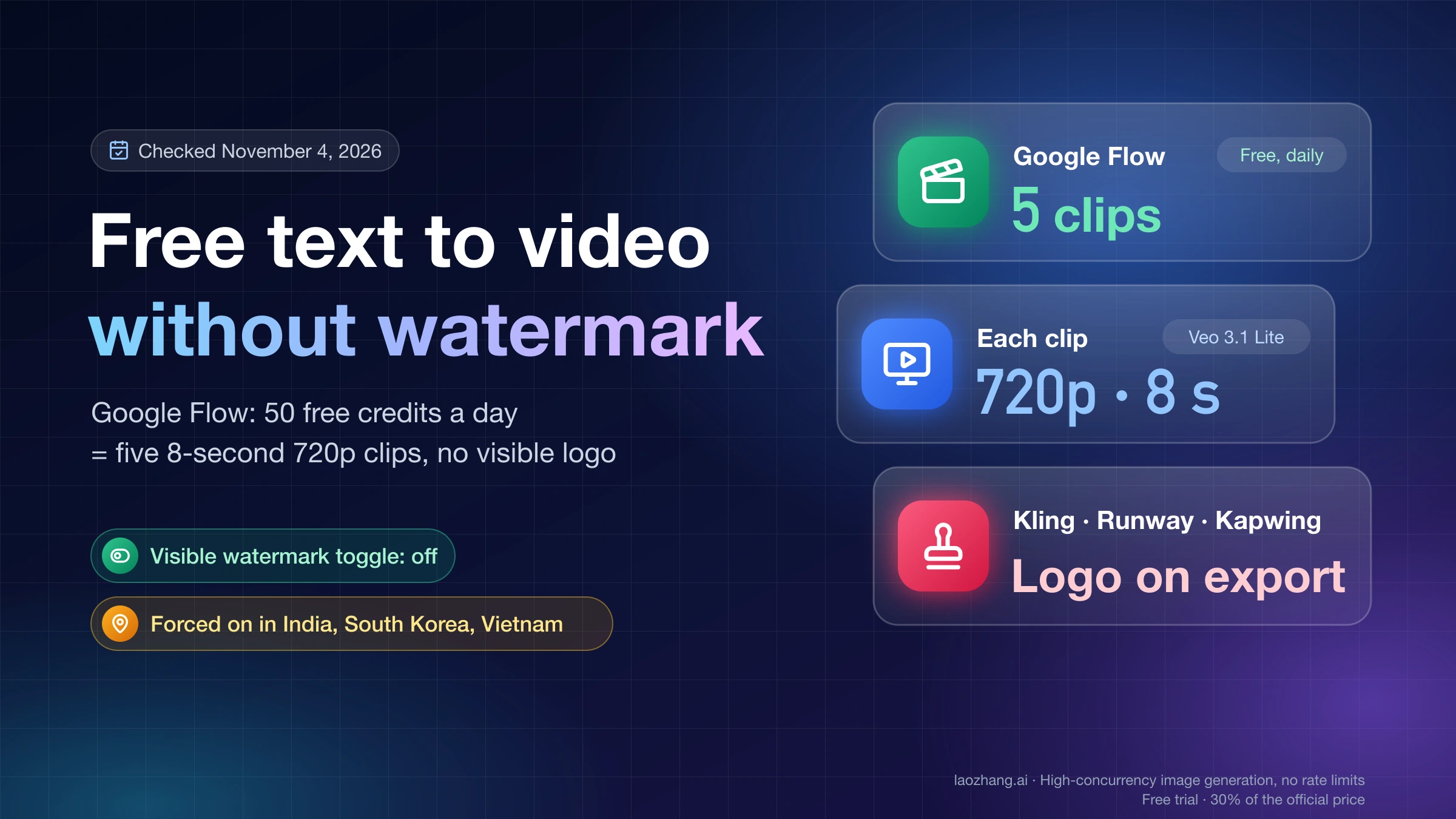
A site such as musegen.org may still give you a clip with no visible logo from its signup credits, but it comes from one of the models the site lists, none of which is Muse. If what you actually want is any free AI video without a logo rather than Muse in particular, Google Flow gave five 8-second 720p clips a day with no visible logo in a test from November 4, 2026, except in India, South Korea and Vietnam; see Free Text to Video AI Without Watermark: 5 Clips a Day in Flow.
Why Meta AI videos have a watermark: a different app
The watermark people complain about comes from the Meta AI app and its Vibes feed, not from the Muse app. Users on Reddit's r/MetaAI wrote around December 2025 that "if you animate a photo into a video, there is a floating watermark," and in May 2026 that "Images have the big logo/watermark now also"; a Korean-language thread from around May 2026 describes a mark near the center of the frame that would take a third of the picture to crop out. Removal tutorials for Meta AI videos circulate on YouTube in Spanish and Korean. Those reports describe Meta AI, which runs separately from the Muse app, so they say nothing about Muse downloads either way.
Muse video through an API: no visible logo in a test, $0.30 a clip
If you need Muse clips with no visible logo and can pay per clip, an API gives you the file directly, and that file can be checked. LaoZhang API sells a muse-video model on its POST /v1/videos endpoint. Its documentation says plainly that "Meta's official API has no video generation model yet; this route is integrated independently and priced on its own." The docs list no free quota for this model and don't mention watermarks either way, so the check below is the evidence.
Disclosure: laozhang.ai is our own service. Its prices are platform pricing, not an independent comparison.
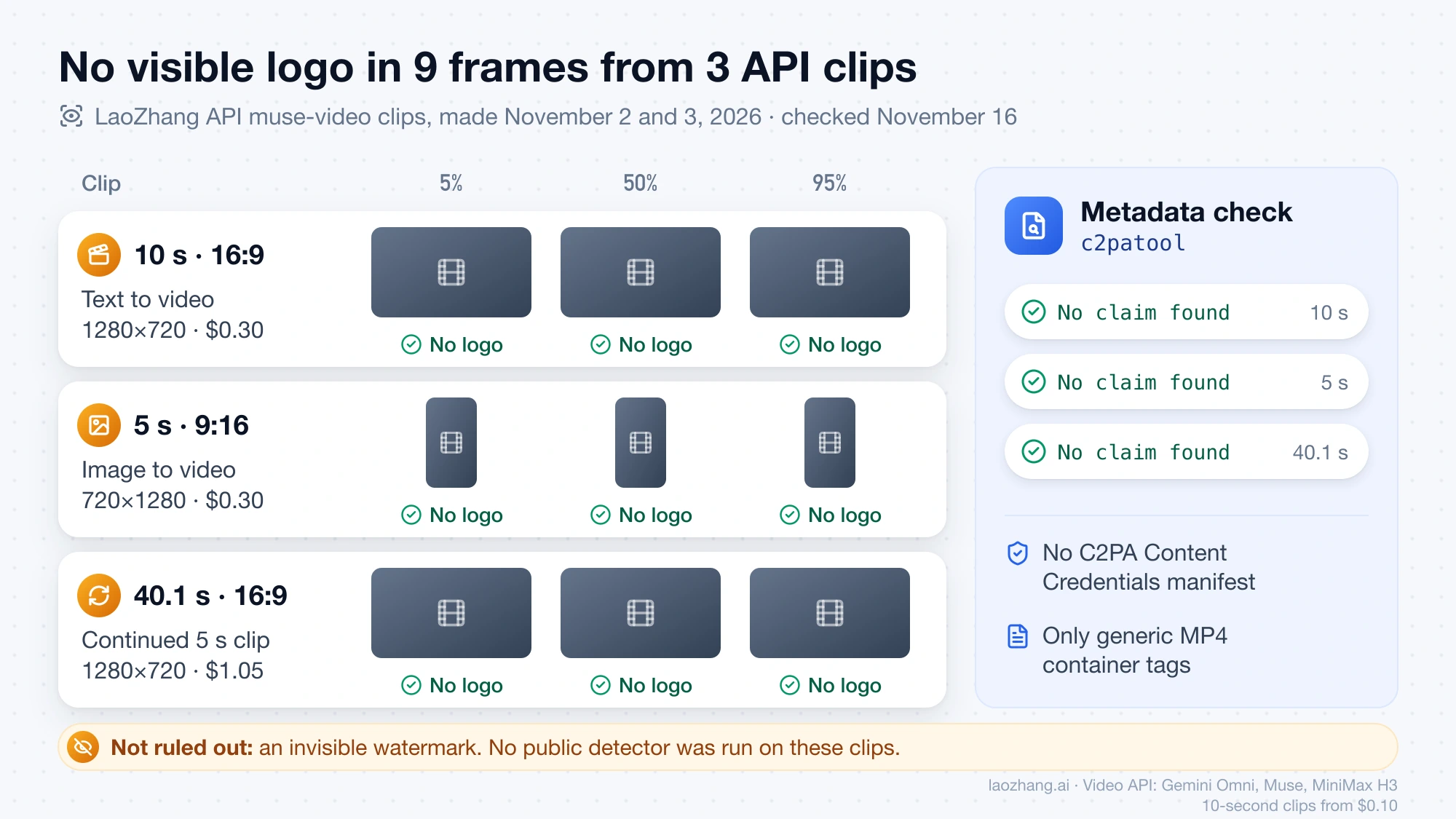
Three clips from this model were re-inspected on November 16, 2026. The first two were made on November 2, 2026: a 10-second 16:9 text-to-video clip of a red paper boat (1280×720, 24 fps, AAC audio, finished in 154 seconds, charged $0.30) and a 5-second 9:16 image-to-video clip (720×1280, 116 seconds, $0.30). The third, made on November 3 with muse-video-40s, continued a 5-second clip to 40.1 seconds (1280×720, stereo, 439 seconds from creation to completion, $1.05). Frames at 5%, 50% and 95% of each clip, nine full frames, show no logo, text overlay or corner mark. The c2patool utility returns "No claim found" on all three files, meaning no C2PA Content Credentials manifest, and the only container tags are generic MP4 ones. These are three clips from one account on two dates; no new clip was generated on November 16.
You can open two of LaoZhang's own unedited samples and look for a mark yourself. The 5-second Muse fox sample was made with muse-video at 16:9 from the prompt "A red fox walking through snowy forest at sunrise, cinematic"; it is also the clip that the 40-second test above continued. The 40-second Muse hot air balloon sample was made with muse-video-40s at 16:9 from "A hot air balloon rises over a valley at dawn, drifts over a river and a village, then lands in a meadow."
| Model | Clip length | Price per clip | Price per second |
|---|---|---|---|
muse-video | 5, 8 or 10 s | $0.30 | $0.03 at 10 s |
muse-video-20s | 20 s | $0.55 | about $0.028 |
muse-video-30s | 30 s | $0.80 | about $0.027 |
muse-video-40s | 40 s | $1.05 | about $0.026 |
muse-video-50s | 50 s | $1.30 | $0.026 |
muse-video-60s | 60 s | $1.55 | about $0.026 |
To put that next to the free plan: ten 10-second clips cost 10 × $0.30 = $3.00, and the 30 to 50 clips a week that useapi.net measured on a free Muse account would cost 30 × $0.30 = $9.00 to 50 × $0.30 = $15.00 through the API. That comparison rests on a third-party estimate of the free allowance, so treat it as a rough guide. Request fields, continuation and Python code are in Muse Video API: No Meta Endpoint Yet, How to Call It in Python.
Does no visible watermark mean a Muse clip can't be detected as AI?
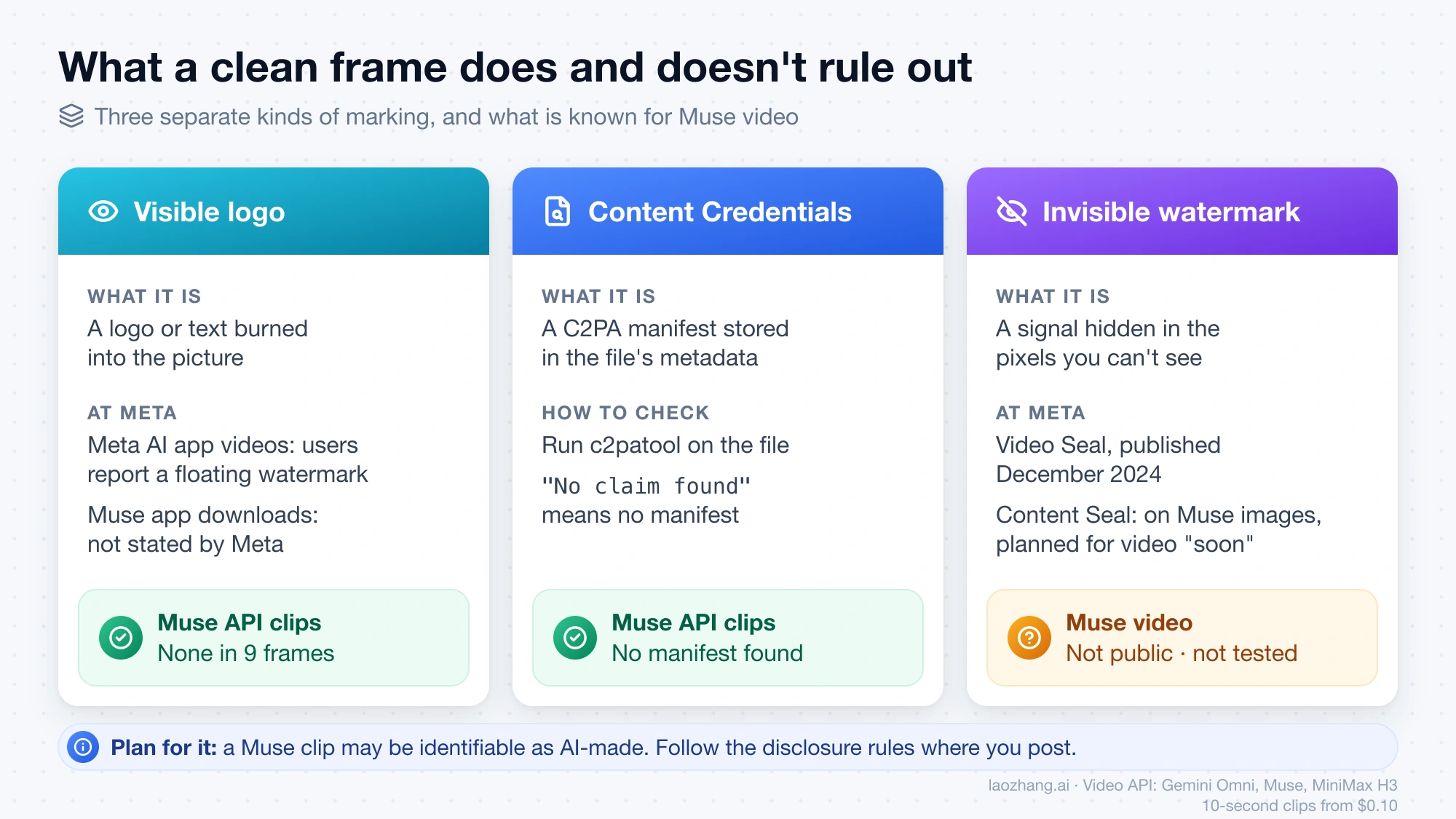
No. A clean frame only rules out a visible logo. Meta published Video Seal in December 2024, a technology that "embeds an invisible watermark into videos," and its July 2026 Muse announcement says Content Seal, already applied to Muse images in the Meta AI app, will be extended to video. Whether Muse video carries either today is not public. The November 16 check found no C2PA manifest in the three API clips, but no public detector for an invisible video watermark was run, so a pixel-level mark can be neither confirmed nor ruled out. Plan on the assumption that a Muse clip may be identifiable as AI-made even when nothing shows on screen, and follow the disclosure rules of wherever you post it.
Sources2
External pages this guide links to, in the order they appear. Last updated Nov 16, 2026.
Sources2
External pages this guide links to, in the order they appear. Last updated Nov 16, 2026.