Imagen 4 vs Nano Banana Retirement Guide: What to Use Now
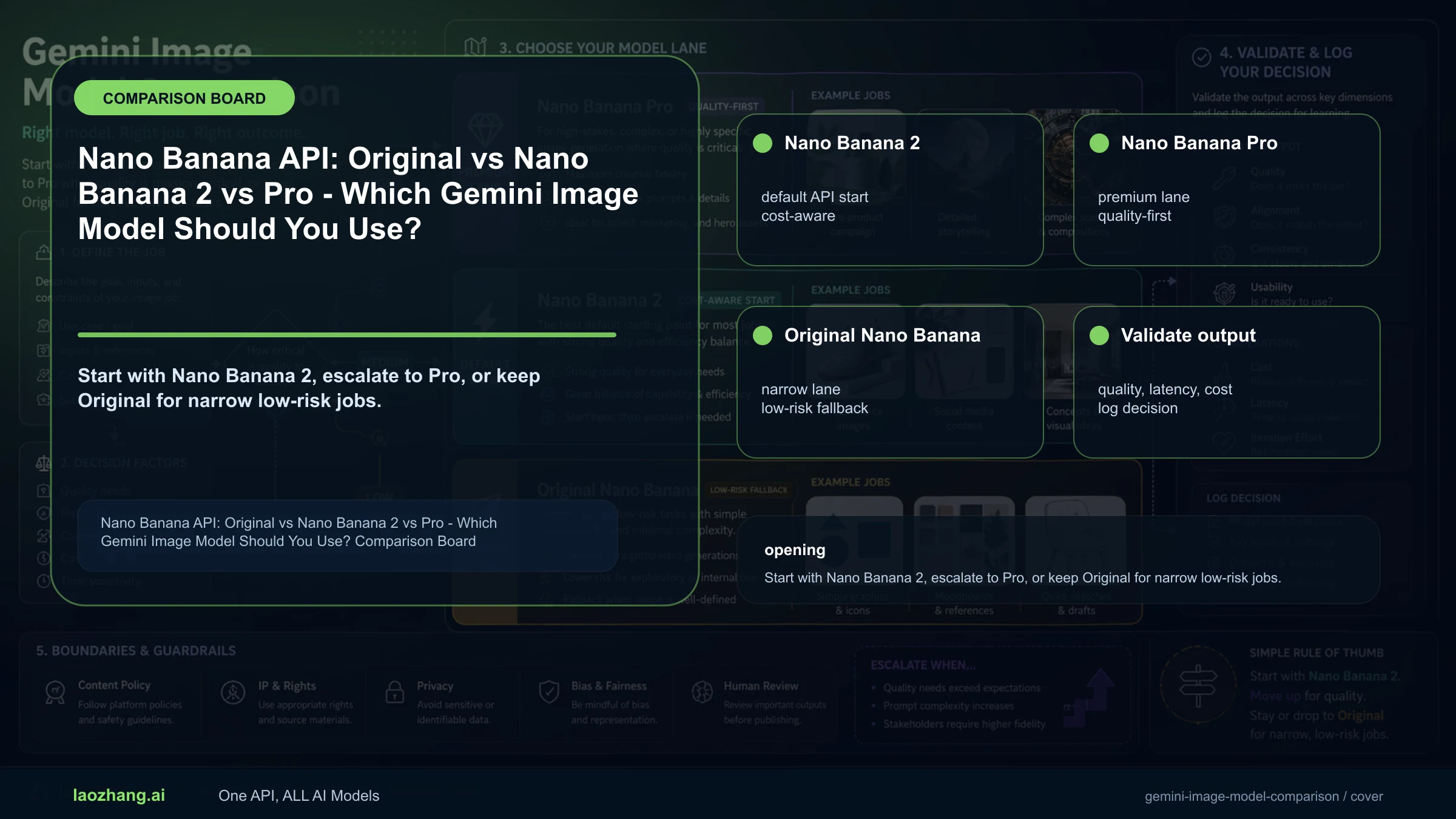
Start new Google image work on Nano Banana 2, escalate to Nano Banana Pro only when the job requires it, and keep Imagen 4 only as a temporary legacy route where your surface still allows it.
On this page
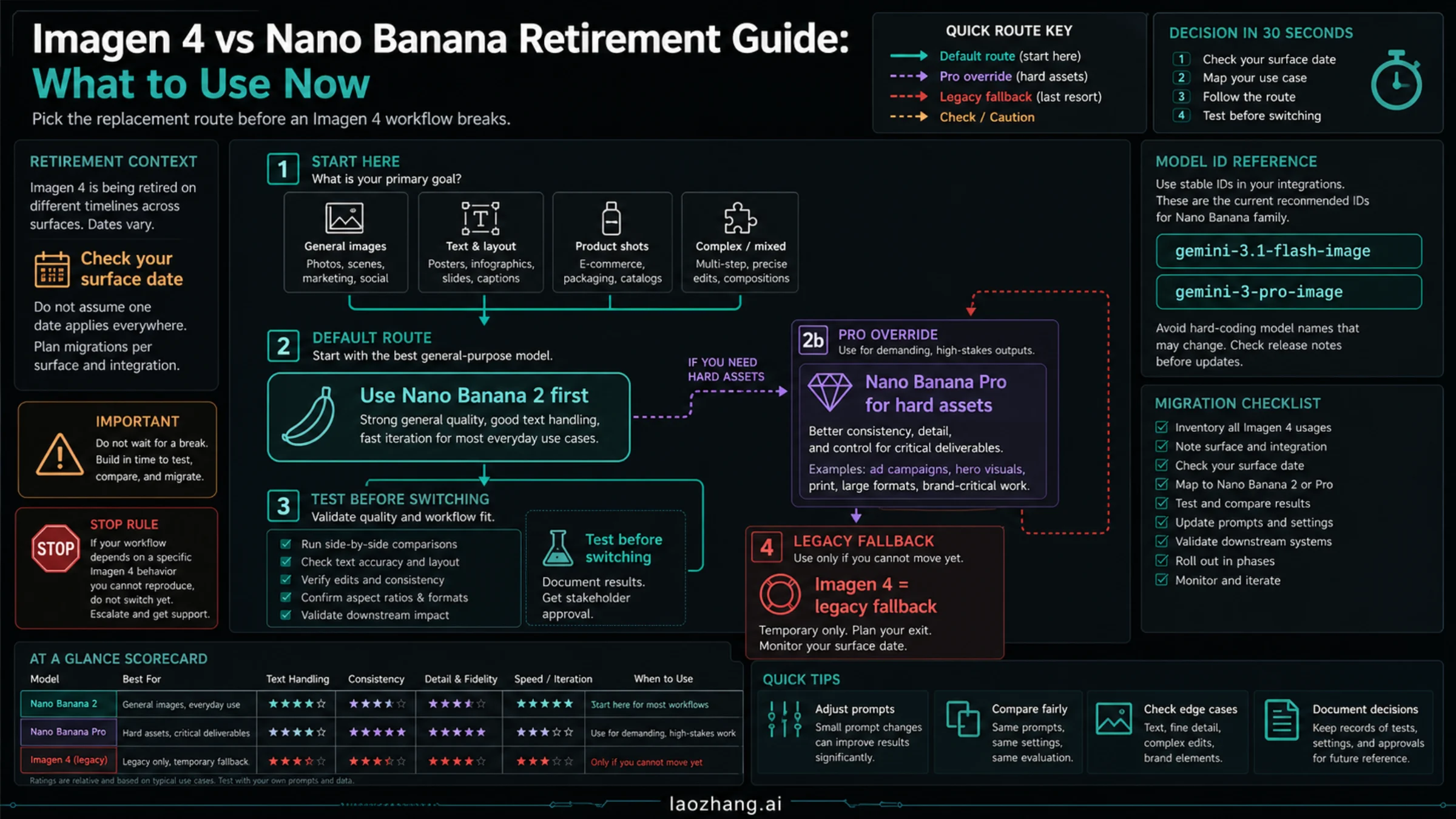
As of June 28, 2026, start new Google image work on Nano Banana 2 (gemini-3.1-flash-image) unless the job clearly needs Nano Banana Pro (gemini-3-pro-image). Keep Imagen 4 only as a short-lived legacy route when your exact Google surface still accepts it.
| If you need this now | Use this route first | Switch only when |
|---|---|---|
| New default image generation | Nano Banana 2 / gemini-3.1-flash-image | The same-prompt test shows text, reference, or final-asset failures |
| Text-heavy, reference-heavy, 4K, or final professional assets | Nano Banana Pro / gemini-3-pro-image | The higher cost is justified by fewer rejected or repaired outputs |
| Existing Imagen 4 code or prompts | Temporary legacy Imagen 4 route | Your exact surface still supports it and a replacement test is already scheduled |
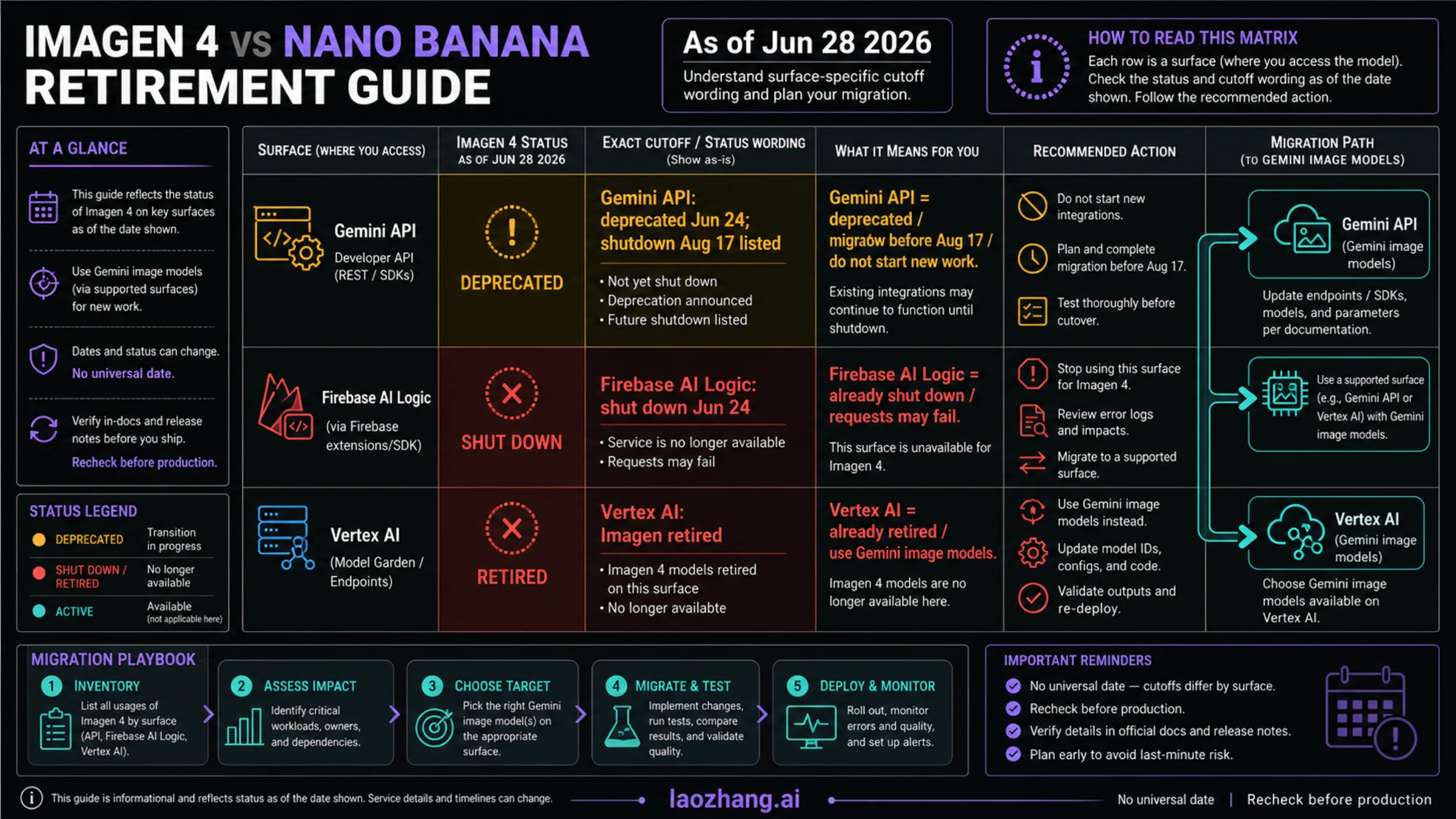
The cutoff is surface-specific. Google's Gemini API deprecation table lists Imagen 4 IDs as deprecated on June 24, 2026 with shutdown on August 17, 2026, Firebase AI Logic describes Imagen models as shut down on June 24, 2026 for that SDK route, and Vertex AI says Imagen on Vertex has retired. Before moving production traffic, run the same prompts against the replacement model, compare accepted outputs and rework, then update the model ID that passed.
The retirement date depends on the surface
The unsafe shortcut is "Imagen 4 retires on one date everywhere." That is not how the current Google surfaces describe the transition. Treat the date as part of the route contract.
| Surface | What the current docs say | Migration consequence |
|---|---|---|
| Gemini API | The Gemini API deprecations page lists Imagen 4 model IDs as deprecated on June 24, 2026 with shutdown on August 17, 2026 | Move new work now; use the remaining window only to validate replacement output |
| Firebase AI Logic SDK route | The Firebase AI Logic Imagen migration page describes Imagen models as shut down on June 24, 2026 for that SDK route | Do not plan new Firebase Imagen usage; update SDK model calls to Gemini image models |
| Vertex AI | The Vertex AI image generation docs state that Imagen on Vertex AI has retired and point users to Gemini image models | Treat Vertex Imagen code as a migration item, not a supported new route |
| Vertex Imagen-to-Gemini migration guidance | The Vertex migration guide tells teams to update applications before June 30, 2026 to avoid disruption | Use Vertex-specific migration notes when the old workload was on Vertex, not the Gemini API |
This matters because urgency and fallback design change by surface. A Gemini API project may still see a documented shutdown date after deprecation. A Firebase route can already be past the shutdown language. A Vertex workload needs Vertex migration mechanics and project-specific testing.
The practical rule is simple: name the surface before naming the date. If your code uses a Gemini API model string, check the Gemini API deprecation table. If your app uses Firebase AI Logic, check the Firebase migration page. If the workload is on Vertex AI, check Vertex migration docs and project logs before assuming the Gemini API timeline applies.
Migrate by model ID, not by nickname
"Nano Banana" is useful search language, but production code needs exact model IDs. Google's image generation documentation now maps the active Gemini image routes to stable IDs that should be used in requests, logs, allowlists, and billing analysis.
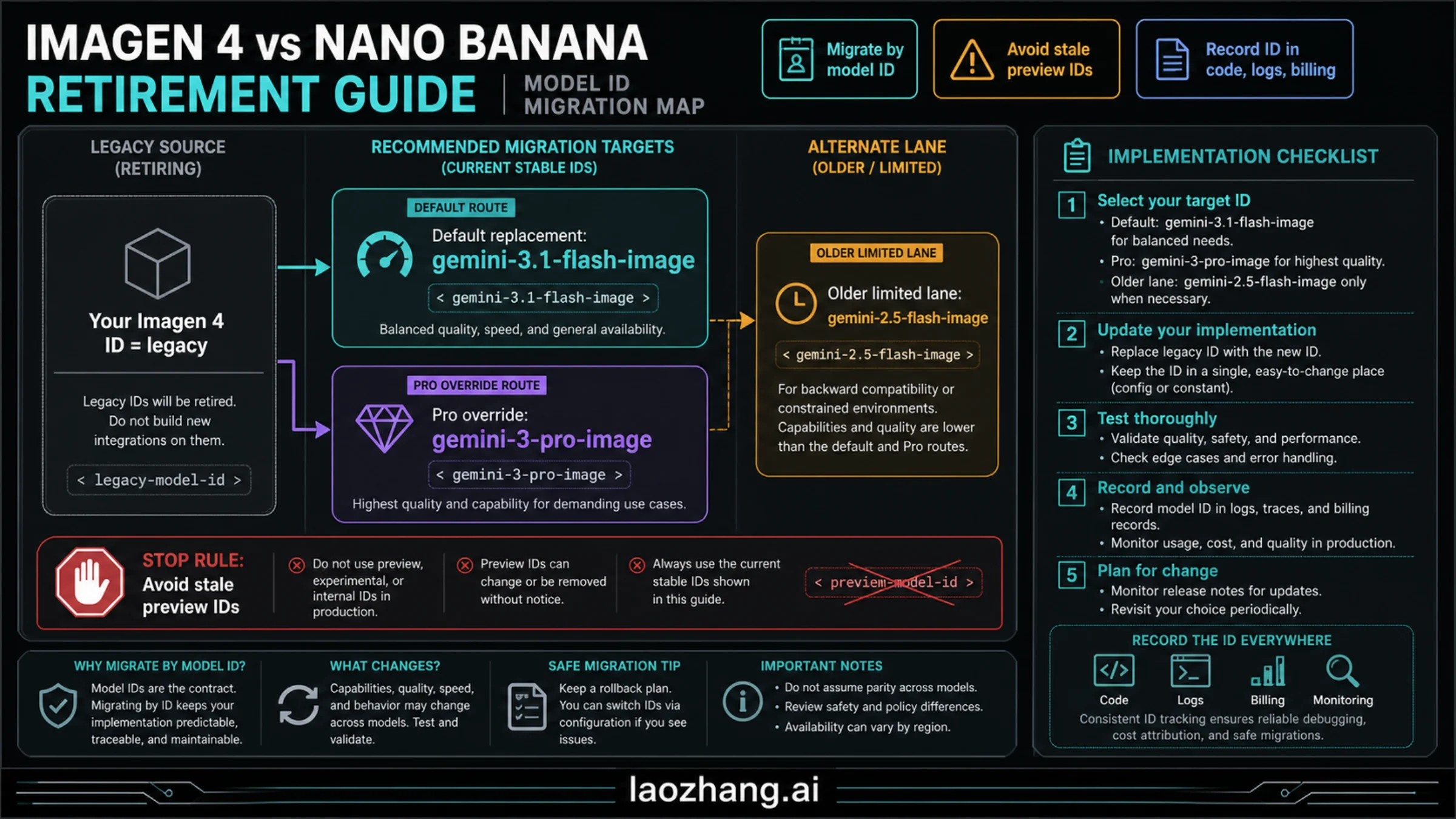
| Reader-facing route | Stable model ID | Use it when |
|---|---|---|
| Nano Banana 2 | gemini-3.1-flash-image | You need the default replacement for most new image generation, iteration, product imagery, and cost-sensitive API work |
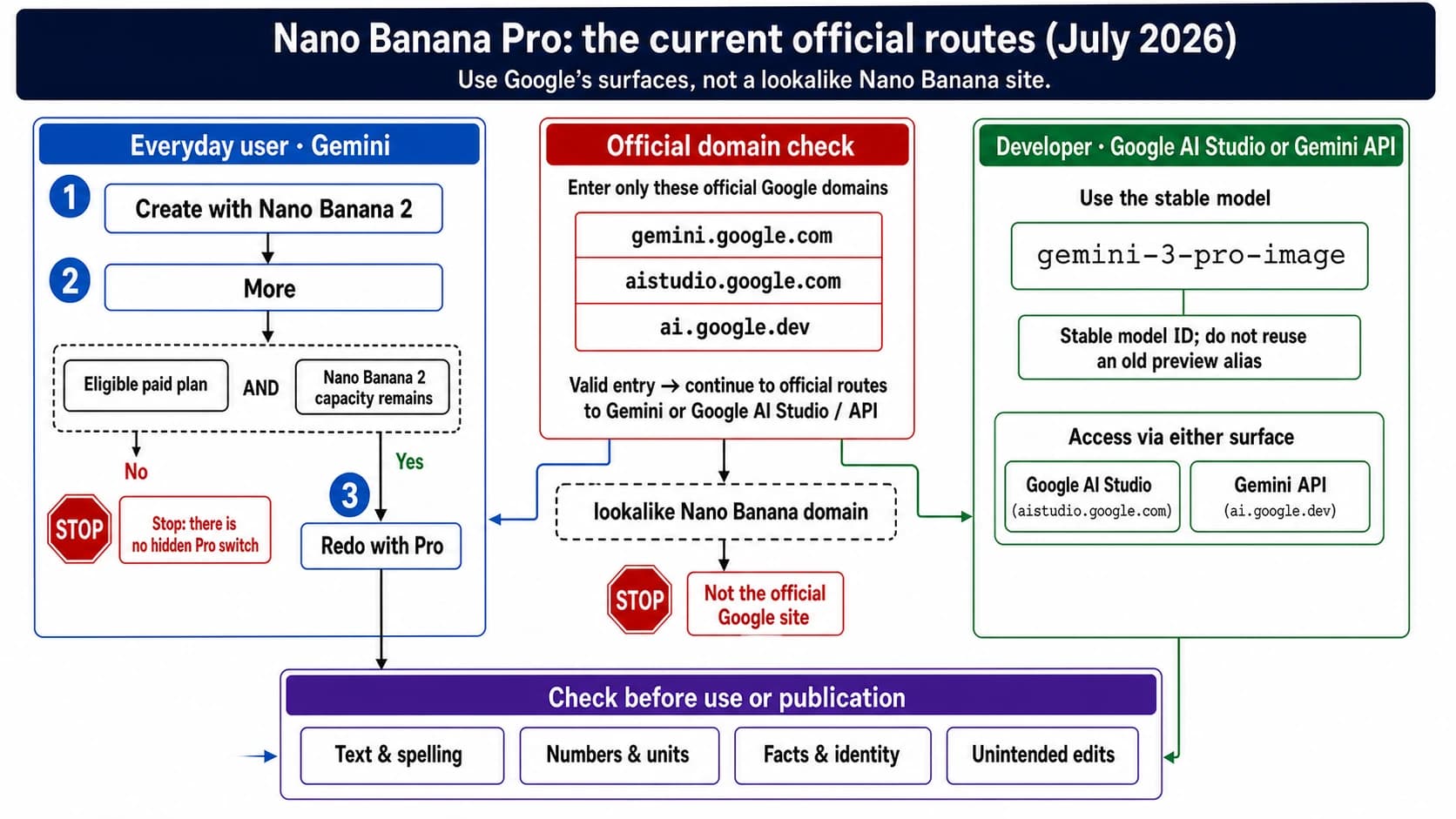
| Nano Banana Pro | gemini-3-pro-image | You need stronger text rendering, reference handling, higher-quality final assets, or 4K output where rejected images are expensive |
| Older Nano Banana lane | gemini-2.5-flash-image | You are preserving an older behavior or using the limited free-tier lane while verifying whether it still serves the job |
| Legacy Imagen 4 IDs | Surface-dependent legacy route | You have existing code that still runs on the exact surface and you are actively migrating it |
Do not migrate to preview IDs. The same Google deprecation table lists June 2026 preview image IDs as shut down in favor of stable replacements. A migration that replaces one expiring ID with another preview ID is not a migration; it is a delayed failure.
For implementation, keep two fields in your routing config: a human-readable route name and the exact model ID. That lets support, finance, and product teams discuss "Nano Banana 2" while logs and requests still show gemini-3.1-flash-image.
Use Nano Banana 2 first, then prove the Pro override
The most reliable comparison is not "which model is better?" It is "which model should be the default, and what evidence allows an escalation?"
| Workload | Start with | Escalate to Pro when |
|---|---|---|
| Drafts, variants, thumbnails, product ideation, and bulk iterations | Nano Banana 2 | It repeatedly fails the same prompt on text, layout, identity, or reference fidelity |
| Production marketing images with short labels or light text | Nano Banana 2 | Rework time or approval failures cost more than the Pro premium |
| Infographics, labels, UI mockups, diagrams, or dense text-bearing images | Nano Banana Pro | The image must preserve text structure, labels, and layout under close review |
| 4K final assets or client-facing delivery | Nano Banana Pro candidate | Output size, inspection risk, or replacement cost makes the higher price rational |
| Existing Imagen 4 prompt library | Nano Banana 2 test first | Pro wins the same-prompt acceptance test by enough to justify routing cost |
This default-and-override rule prevents two common mistakes. The first mistake is keeping Imagen 4 alive because the old prompt library feels familiar. The second is making Nano Banana Pro the default just because it is the premium route. Both choices can be expensive: one risks a broken retirement migration, the other pays Pro prices before the workload proves it needs Pro.
For a broader feature comparison between the active Nano Banana routes, use the Nano Banana Pro vs Nano Banana 2 guide. For the Imagen 4 retirement job, keep the decision narrower: choose the replacement route and verify the switch.
Run a same-prompt migration test before changing traffic
Quality anecdotes are useful for deciding what to test, not for deciding production routing. The migration gate should use the same prompts, the same reference inputs, and the same acceptance rules across the old route and replacement candidates.
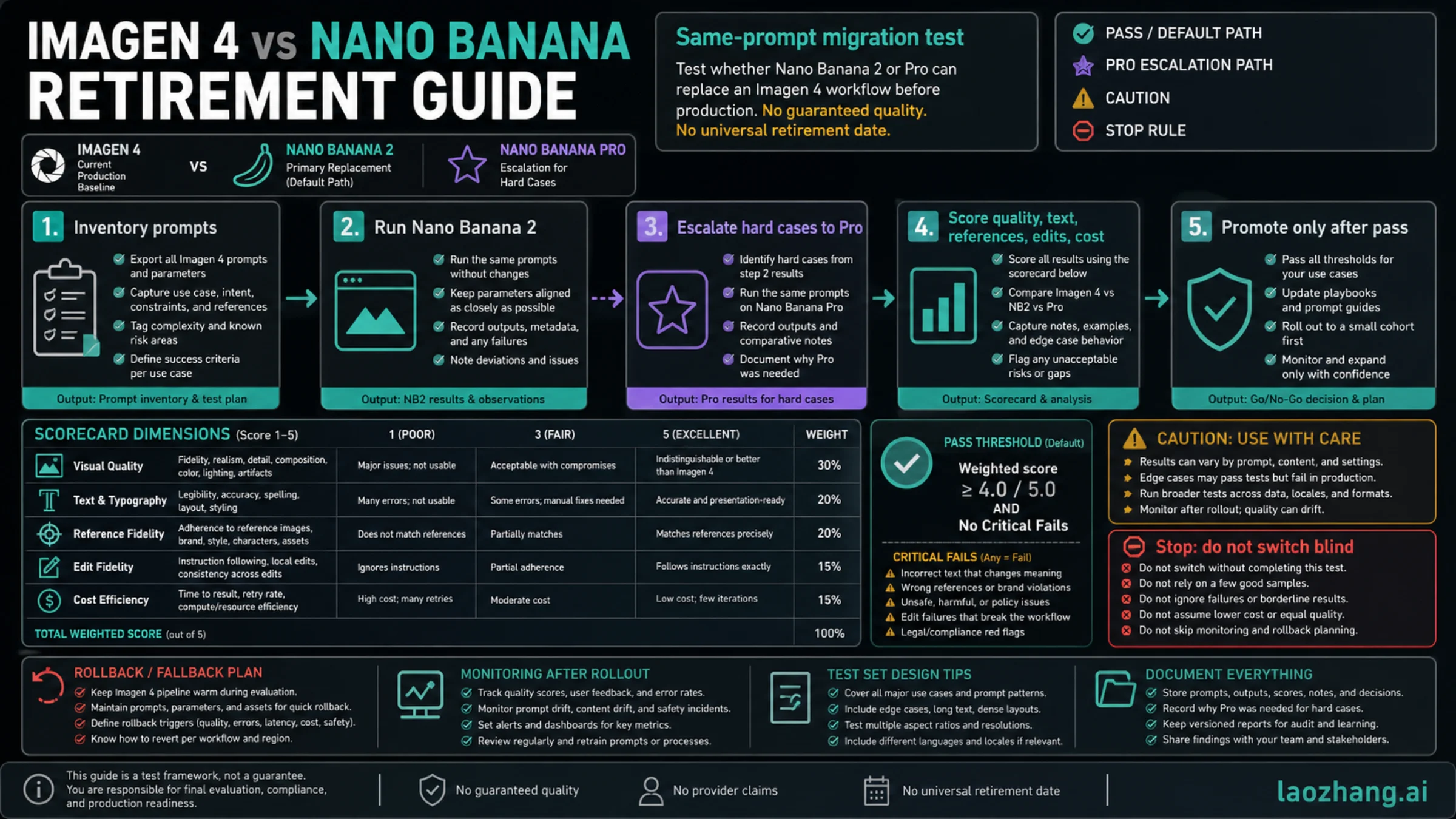
Use a small but representative test set:
| Test slice | Minimum sample | What to score |
|---|---|---|
| Simple generation prompts | 10 to 20 prompts | Prompt adherence, visual coherence, first-pass acceptance |
| Text-bearing prompts | 10 prompts with labels, cards, UI, or diagrams | Text accuracy, layout stability, and whether the image can ship without manual repair |
| Reference or editing prompts | 10 prompts with source images or identity constraints | Reference fidelity, unwanted drift, edit precision, and preservation of important details |
| Final asset prompts | 5 to 10 high-stakes prompts | Approval rate, rework minutes, size needs, and cost per accepted asset |
Score each candidate on accepted outputs, not only beautiful samples. A simple rubric works:
| Dimension | Why it matters | Promotion signal |
|---|---|---|
| Prompt adherence | The replacement must follow the same production intent | Candidate matches or beats the old route on most prompts |
| Text and diagram handling | Text failures create expensive rework | Pro is justified only if it materially reduces repair work |
| Reference fidelity | Product, character, or brand continuity may be the real constraint | Candidate preserves required identity or source details |
| Cost per accepted asset | A cheaper image is not cheaper if most outputs fail | Compare accepted images, not raw generations |
| Operational fit | Model ID, quota, latency, logging, and support must match the deployment | Route can be observed and rolled back |
Promote Nano Banana 2 when it clears the accepted-output threshold and keeps cost lower. Promote Nano Banana Pro when Pro reduces failed outputs or manual repair enough to outweigh its higher price. Keep a temporary Imagen 4 fallback only while the exact surface still permits it and only with a scheduled removal date.
Keep the cost boundary date-bound
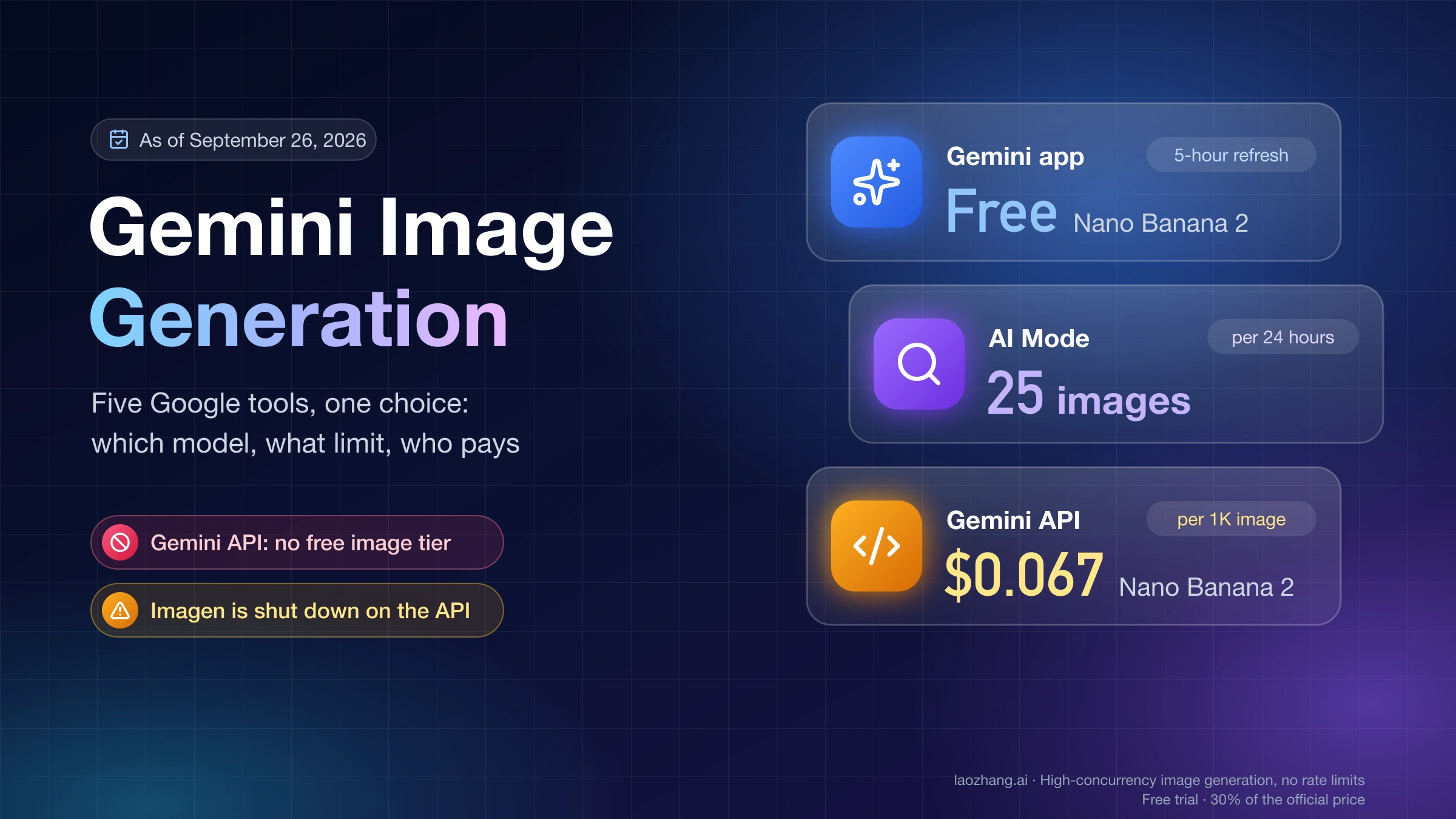
The migration decision is mostly about route safety and output acceptance, but cost still affects the default. As of June 28, 2026, Google's Gemini API pricing page shows no free tier for the current stable Nano Banana 2 and Nano Banana Pro image models.
| Model route | Current paid image price signal | Free-tier boundary |
|---|---|---|
gemini-3.1-flash-image | Standard image prices are listed by output size: $0.045 at 0.5K, $0.067 at 1K, $0.101 at 2K, and $0.151 at 4K | No free tier shown for the current stable Nano Banana 2 row |
gemini-3-pro-image | Standard image prices are listed as $0.134 for 1K/2K and $0.240 for 4K | No free tier shown for the current stable Nano Banana Pro row |
gemini-2.5-flash-image | The older Nano Banana lane still lists a limited free tier and paid output around $0.039 per image | Useful only when the older route genuinely fits the job |
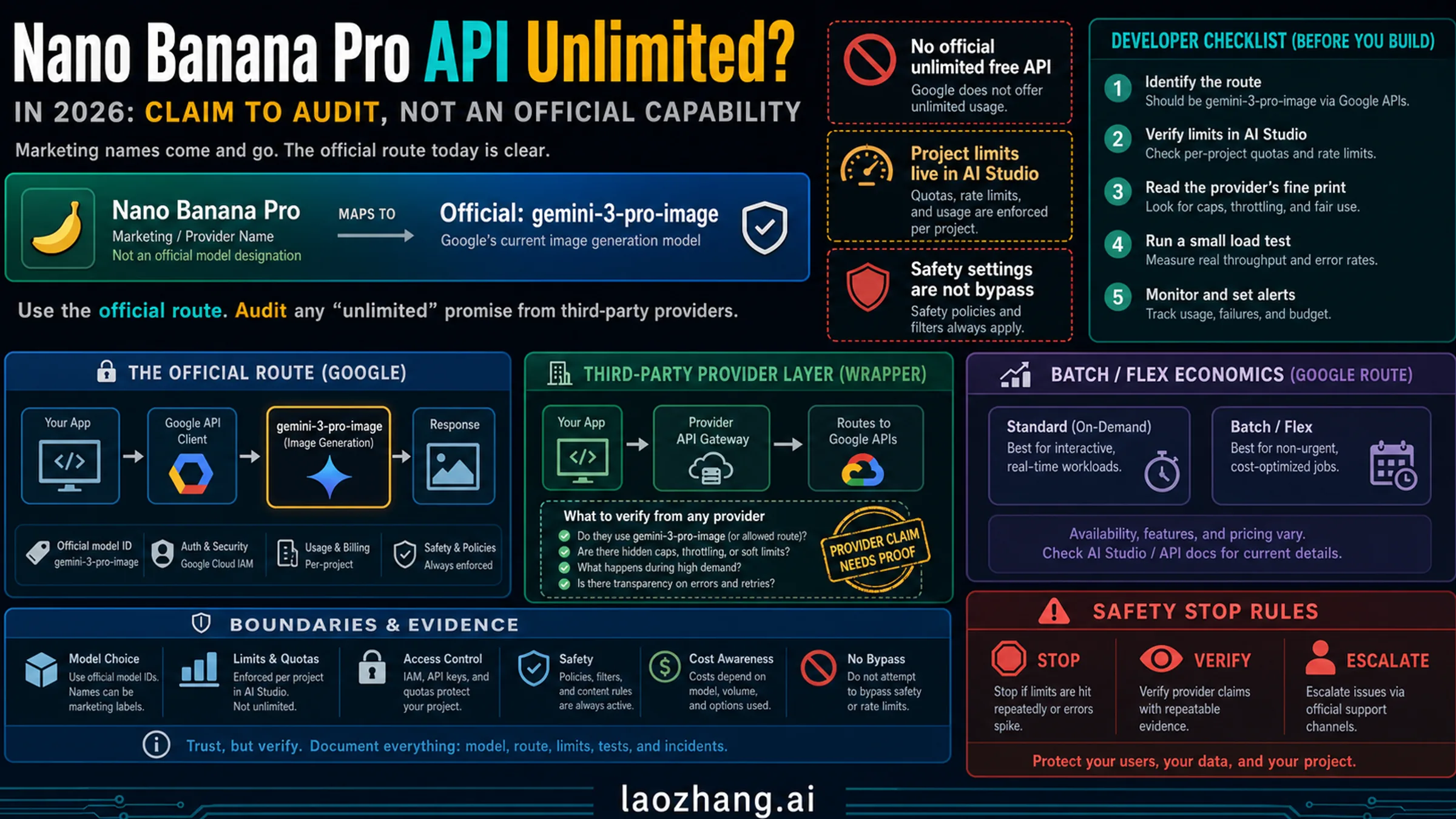
Do not mix official Google prices with gateway or provider claims. If you are comparing outside routes, first anchor the official row, then compare the provider's model coverage, output size, retry policy, data handling, support path, and billing owner. The Nano Banana API pricing guide is the better place for detailed price rows, while the AI image API pricing comparison is better for multi-provider budget planning.
If the migration blocker is access, billing, regional setup, or multi-model routing rather than model choice, use the cheap Gemini image API guide and the AI Studio access guide as adjacent route checks. Do not let those route questions change the official retirement facts.
A production migration checklist
Use this checklist before replacing an Imagen 4 route in code or workflow documentation.
- Identify the exact surface: Gemini API, Firebase AI Logic, Vertex AI, consumer product, or provider route.
- Record the old Imagen 4 model ID or surface name, plus the last successful request date.
- Choose the first replacement:
gemini-3.1-flash-imageunless the workload has a known Pro trigger. - Run the same-prompt test against Nano Banana 2 and Nano Banana Pro where needed.
- Compare accepted output rate, manual repair time, output size, latency, and cost per accepted asset.
- Update config by stable model ID, not by nickname.
- Keep logs that show old route, new route, prompt family, acceptance result, and rollback path.
- Recheck official Google docs before a large migration, procurement decision, or customer-facing deadline.
The rollback path should be honest. If Imagen 4 is already unavailable on the surface, rollback means a previous Gemini image candidate, a lower-risk prompt template, or manual review. It should not mean "go back to Imagen 4" unless that exact route still runs.
FAQ
What should replace Imagen 4 now?
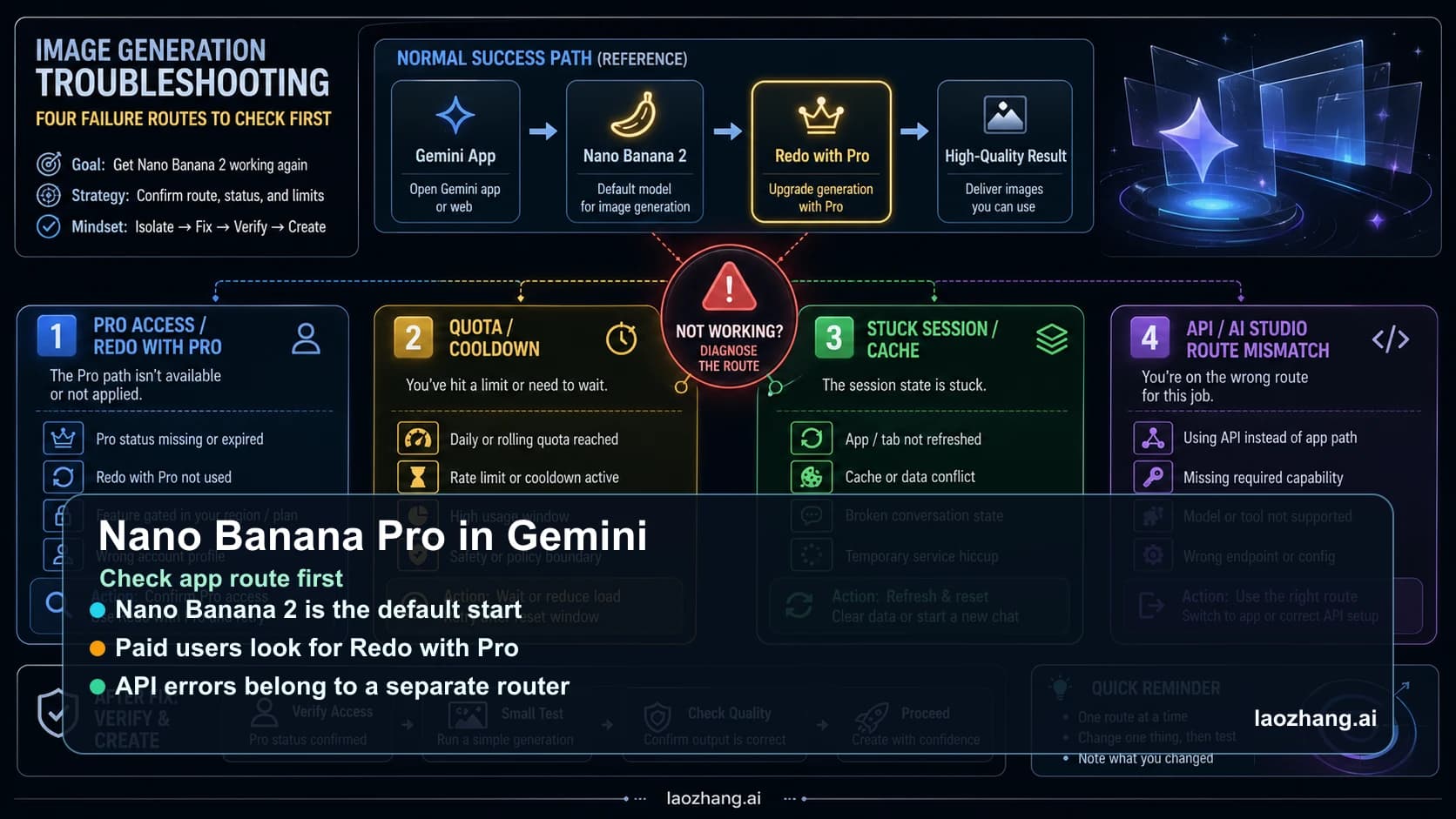
For most new Google image work, use Nano Banana 2 with gemini-3.1-flash-image. Use Nano Banana Pro with gemini-3-pro-image when text, references, 4K output, final quality, or rework cost justify the premium route.
Does Imagen 4 retire everywhere on the same date?
No. As of June 28, 2026, the Gemini API, Firebase AI Logic, and Vertex AI docs use different surface-specific cutoff language. Name the surface before treating any Imagen 4 date as actionable.
Which model ID is Nano Banana 2?
Nano Banana 2 maps to gemini-3.1-flash-image in Google's current image-generation docs. Nano Banana Pro maps to gemini-3-pro-image, and the older Nano Banana lane maps to gemini-2.5-flash-image.
When is Nano Banana Pro worth using?
Use Nano Banana Pro when the same-prompt test shows that Nano Banana 2 costs more in rejected outputs, manual repair, text errors, reference drift, or final-asset risk than the Pro price difference.
Can I keep Imagen 4 as a fallback?
Only if your exact access surface still accepts it and you have a scheduled replacement test. If the surface already describes Imagen as shut down or retired, the fallback must be another Gemini image route or a workflow rollback, not Imagen 4.
Is there a free replacement API route?
Not for the current stable Nano Banana 2 and Nano Banana Pro image API rows checked on June 28, 2026. The older gemini-2.5-flash-image lane still shows a limited free tier, but it should be chosen only when that older model fits the task.
What is the safest first test?
Run the same 25 to 50 prompts through Nano Banana 2, then run only the hard text, reference, or final-asset prompts through Nano Banana Pro. Compare accepted outputs and rework before changing the production model ID.