AI Image API Pricing Comparison 2026: Gemini 3 Pro vs Imagen 4 vs Grok Imagine vs GPT Image 1.5
As of February 2026, AI image API prices range from $0.009 to $0.24 per image. This guide compares Gemini 3 Pro Image, Imagen 4, GPT Image 1.5, and Grok Imagine across every quality tier, rate limit, and scale scenario to help you choose the right API for your budget.
On this page
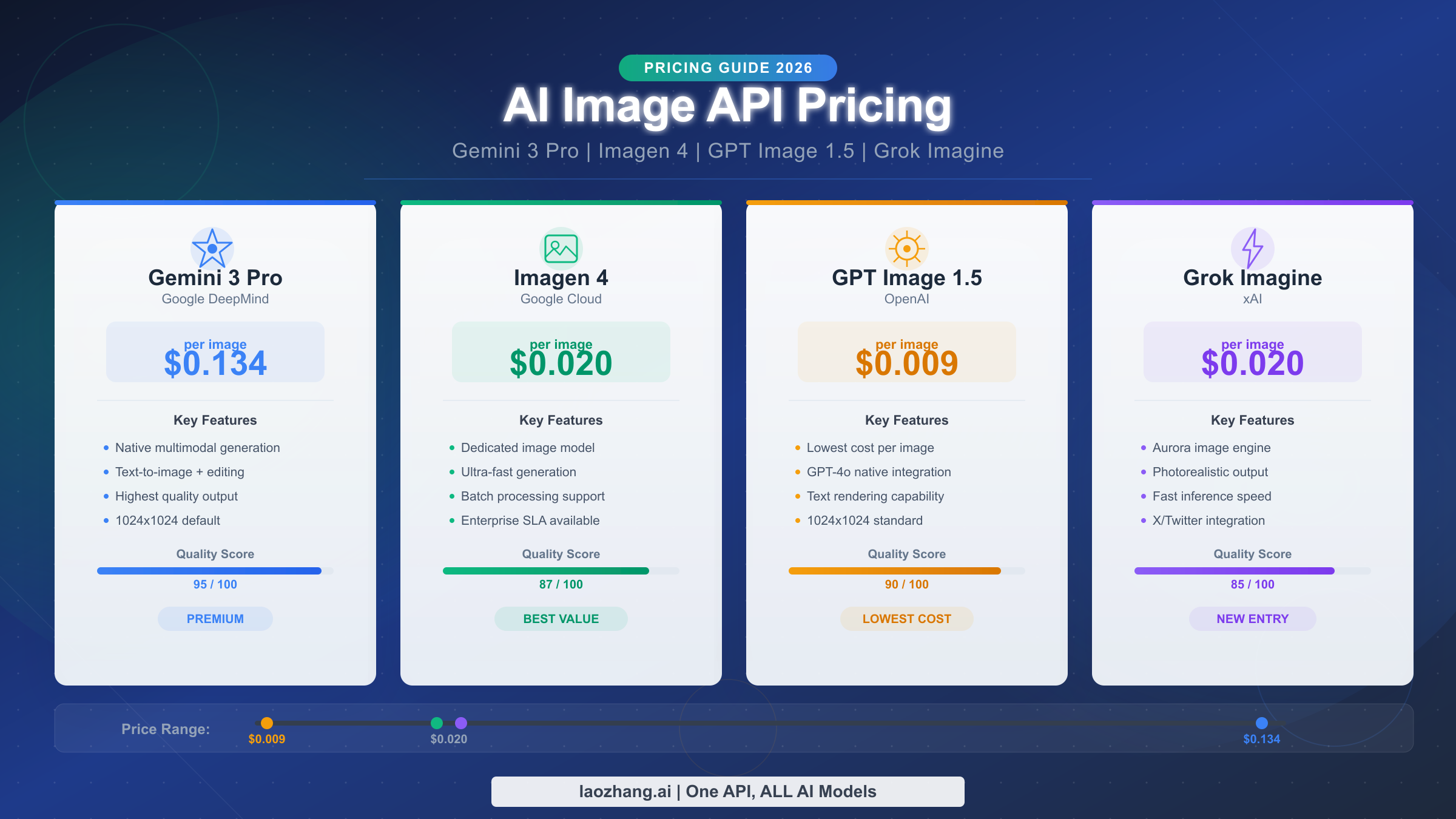
As of February 2026, AI image generation API prices range from $0.009 to $0.24 per image across four major platforms. Google's Imagen 4 Fast and xAI's Grok Imagine both offer the cheapest production-quality option at $0.02 per image, while OpenAI's GPT Image 1.5 starts at just $0.009 for low quality. Google's Gemini 3 Pro Image sits at the premium end at $0.134 per image but delivers native multimodal capabilities with 4K output. This guide compares all pricing tiers, rate limits, and cost optimization strategies across every platform available today.
TL;DR - Quick Pricing Comparison
If you are building an application that generates AI images and need to pick a provider right now, the table below gives you the complete picture at a glance. Every price listed here has been verified against official documentation as of February 2026, and the differences between these four platforms are significant enough that choosing the wrong one could cost your project thousands of dollars per month at scale.
| Platform | Cheapest Tier | Mid Tier | Premium Tier | Pricing Model |
|---|---|---|---|---|
| Imagen 4 Fast | $0.02/image | — | — | Per-image |
| Imagen 4 Standard | $0.04/image | — | — | Per-image |
| Imagen 4 Ultra | — | — | $0.06/image | Per-image |
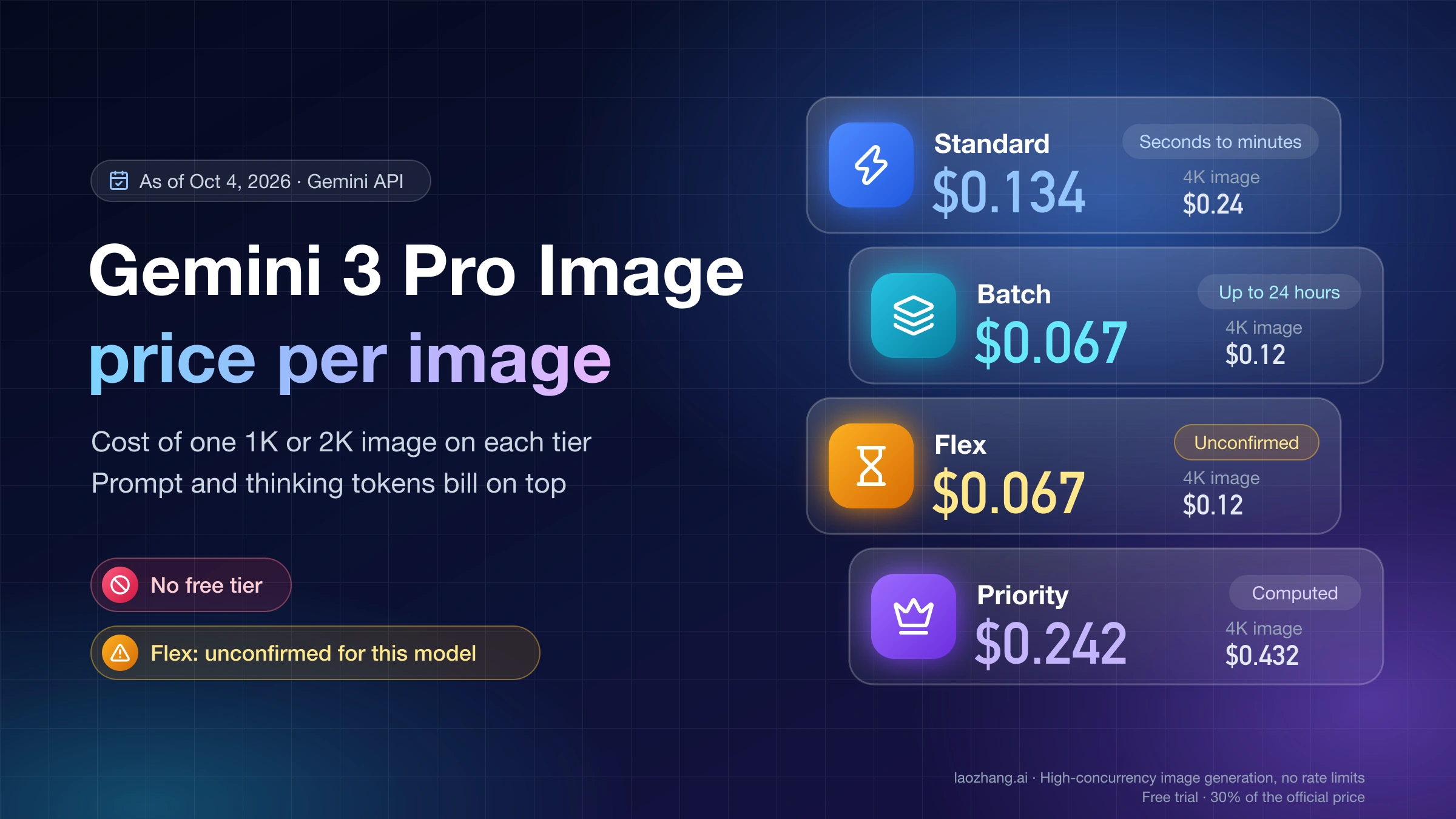
| Gemini 3 Pro Image | $0.067/image (batch) | $0.134/image | $0.24/image (4K) | Token-based |
| GPT Image 1.5 | $0.009/image (low) | ~$0.04/image (med) | ~$0.17/image (high) | Token-based |
| GPT Image 1 Mini | $0.005/image (low) | — | $0.036/image (high) | Per-image |
| Grok Imagine | $0.02/image | — | — | Per-image |
| Grok Imagine Pro | — | — | $0.07/image | Per-image |
The bottom line is straightforward: if you need the absolute cheapest per-image cost and quality is secondary, OpenAI's GPT Image 1 Mini at $0.005 per image is unbeatable. For production-quality images at the best price, Imagen 4 Fast and Grok Imagine both deliver at $0.02 per image, though Imagen 4 offers higher throughput with fewer rate limit restrictions. If you need the highest quality and are willing to pay a premium, Gemini 3 Pro Image at $0.134 offers native multimodal generation with text understanding, while GPT Image 1.5 High at approximately $0.17 provides excellent fidelity with OpenAI's latest architecture. At 10,000 images per month, your bill could range from $50 with GPT Image 1 Mini to $2,400 with Gemini 3 Pro at 4K resolution, making the choice of provider a genuinely consequential financial decision.
How AI Image API Pricing Works in 2026
Understanding how AI image APIs charge you is essential before comparing specific prices, because the billing models differ fundamentally between providers and these differences have real implications for your costs at scale. There are two primary pricing approaches in the market today, and conflating them is one of the most common mistakes developers make when evaluating options. The first approach, token-based pricing used by Gemini 3 Pro Image and GPT Image 1.5, means your per-image cost fluctuates based on prompt length, output resolution, and quality settings. The second approach, flat per-image pricing used by Imagen 4 and Grok Imagine, charges a fixed rate regardless of input complexity. Knowing which model applies to each provider is the foundation for making accurate cost projections and avoiding surprise bills. If you are looking for a broader comprehensive AI image API comparison that covers quality, speed, and features alongside pricing, that guide provides additional context for the decisions discussed here.
Token-Based Pricing
Google's Gemini 3 Pro Image and OpenAI's GPT Image 1.5 both use token-based pricing, where you pay for the tokens consumed by both your input prompt and the generated image output. This means the actual cost per image varies depending on your prompt length, the output resolution, and the quality setting you select. For Gemini 3 Pro Image, a standard 1024-pixel image consumes approximately 1,120 output tokens, which at the current rate of $10.00 per million output tokens translates to roughly $0.134 per image. Longer prompts with detailed instructions add to the input token cost, though this is typically a small fraction of the total since input tokens are priced at $1.25 per million. The key advantage of token-based pricing is that you get precise control over your costs by adjusting resolution and quality parameters, but the disadvantage is that predicting your exact monthly spend requires understanding your average token consumption per generation.
Per-Image Flat-Rate Pricing
Google's Imagen 4 family and xAI's Grok Imagine take a simpler approach with flat per-image pricing regardless of prompt complexity. When Imagen 4 Fast charges $0.02 per image, that price stays the same whether your prompt is five words or five hundred words, and regardless of any internal token consumption. This model makes budgeting straightforward since you can multiply your expected monthly volume by the per-image rate and know your cost with certainty. The tradeoff is less granular control over quality-cost optimization compared to token-based systems, where you can choose a lower quality setting to save money on images where premium output is unnecessary. For teams that need predictable billing and generate at high volumes, flat-rate pricing eliminates the variance that token-based models introduce, which is why many production applications prefer Imagen 4 or Grok Imagine for their cost predictability.
Gemini 3 Pro Image (Nano Banana Pro) Pricing
Google's Gemini 3 Pro Image, internally codenamed Nano Banana Pro, occupies a unique position in the AI image generation landscape because it is not a dedicated image model but rather Google's flagship multimodal model that can both understand and generate images natively within a conversation. This means you can use Gemini 3 Pro Image for complex tasks that require understanding existing images and generating new ones based on that understanding, something that dedicated image generation models cannot do. The pricing reflects this premium capability, starting at $0.134 per standard image and reaching $0.24 for 4K output, making it the most expensive option per image among the four platforms compared here. For a detailed Nano Banana Pro pricing breakdown covering every resolution tier and token calculation, we have a dedicated deep dive that supplements this comparison.
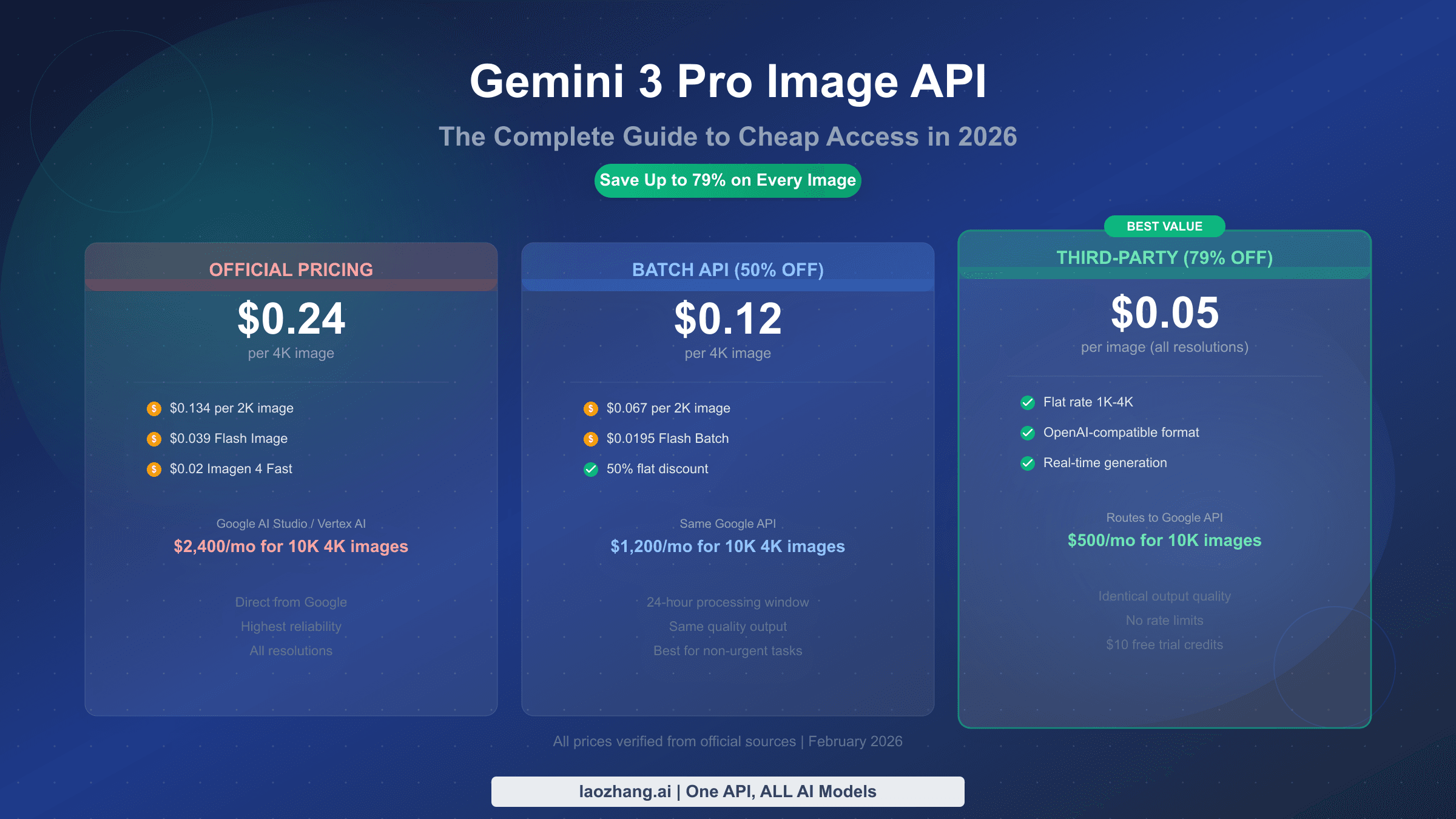
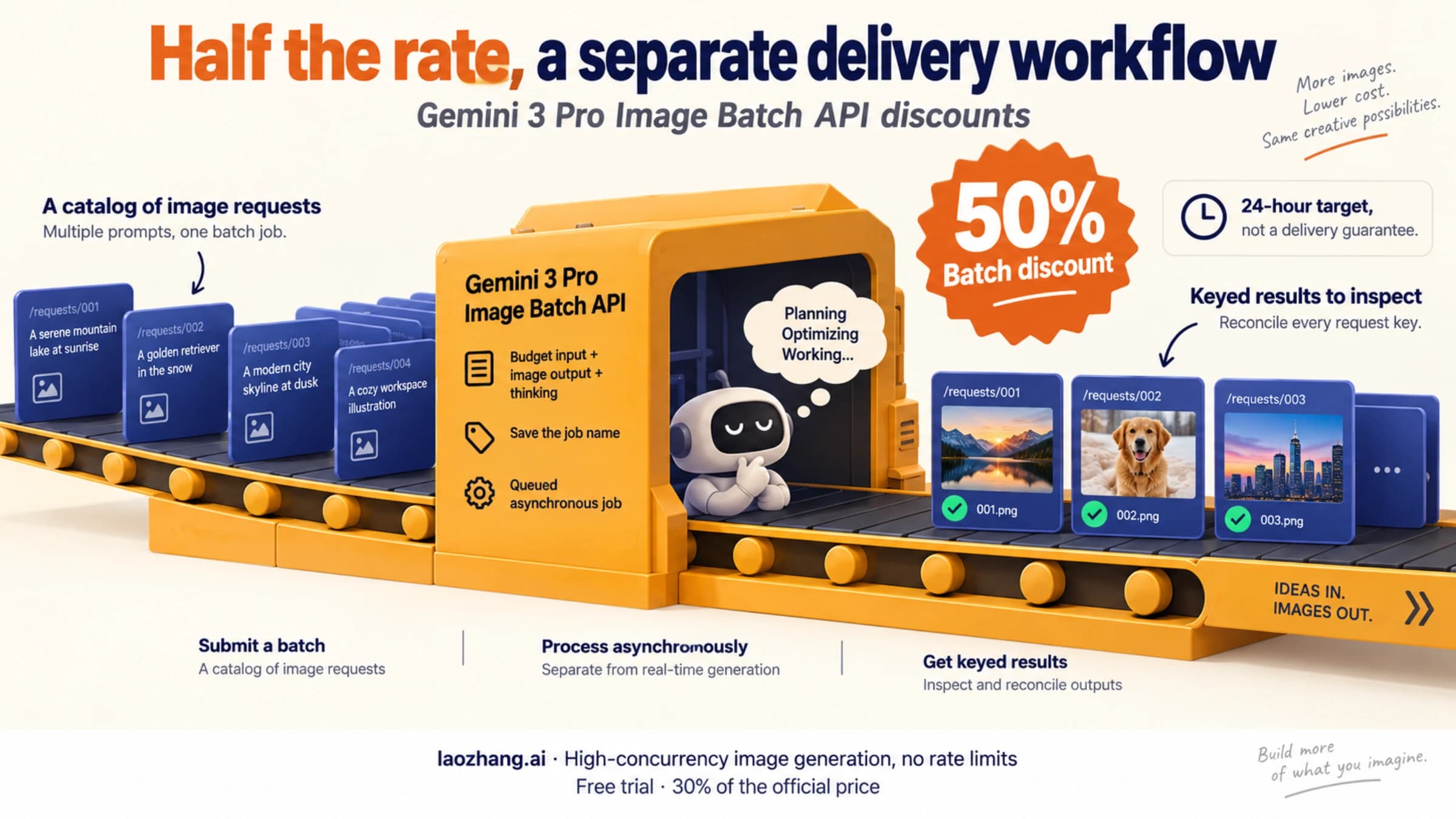
The standard generation cost of $0.134 per image assumes a 1024-to-2048-pixel output that consumes approximately 1,120 output tokens at $10.00 per million tokens, plus minimal input token costs at $1.25 per million (Google AI for Developers, February 2026). For 4K resolution output, the token consumption roughly doubles, pushing the per-image cost to approximately $0.24. What makes this pricing more palatable for high-volume users is Google's Batch API, which offers a flat 50 percent discount on all Gemini 3 Pro Image generations. Through the Batch API, your standard image drops to $0.067 and your 4K image to $0.12, which brings Gemini much closer to the pricing of other premium-tier options. The Batch API requires submitting jobs asynchronously rather than receiving real-time responses, so it is best suited for content pipelines, batch processing workflows, and any scenario where you do not need images returned in under a second. For more strategies on saving up to 80% on Gemini image API costs through batching and other techniques, check our optimization guide.
It is worth noting that Gemini 3 Pro Image does not offer a free API tier for image generation as of February 2026, though Google provides $300 in free credits for new Google Cloud accounts and free access through the AI Studio web interface for non-API usage. The free web access is useful for experimentation and prompt testing, but production applications that need API integration will need to budget for the per-image costs from the start. Rate limits for Gemini 3 Pro Image vary by project tier, but standard API access provides sufficient throughput for most production applications. For detailed Gemini 3 Pro Image speed and pricing benchmarks including response times and throughput measurements, our benchmark analysis covers the performance side alongside costs.
Google Imagen 4 Family Pricing: Fast, Standard, and Ultra
Google's Imagen 4 represents a completely different product line from Gemini 3 Pro Image, even though both come from Google. Where Gemini is a multimodal conversational model that happens to generate images, Imagen 4 is a dedicated image generation model optimized purely for visual output quality and speed. The Imagen 4 family includes three distinct tiers designed for different use cases and budgets, making it one of the most flexible offerings in terms of price-quality tradeoffs. Available through the Vertex AI API, Imagen 4 uses straightforward per-image pricing that eliminates the token calculation complexity of Gemini, and its pricing is aggressively competitive at every tier.
Imagen 4 Fast is the entry-level tier priced at $0.02 per image (Google Cloud Vertex AI, February 2026), designed for applications that prioritize generation speed and cost efficiency over maximum visual fidelity. At this price point, it matches Grok Imagine Standard and undercuts every other provider except GPT Image 1 Mini and GPT Image 1.5 Low quality. The Fast tier is ideal for thumbnail generation, content previews, social media imagery, and any scenario where good-enough quality at high throughput matters more than pixel-perfect output. Imagen 4 Standard steps up to $0.04 per image and delivers noticeably improved detail, coherence, and prompt adherence compared to the Fast tier. For most production applications including blog illustrations, product mockups, and marketing materials, the Standard tier hits the sweet spot between cost and quality. Imagen 4 Ultra represents the premium offering at $0.06 per image, which is still dramatically cheaper than Gemini 3 Pro Image's $0.134 while delivering Google's highest-quality dedicated image generation. The Ultra tier excels at complex scenes, fine text rendering, and photorealistic outputs where every detail matters.
Beyond the three generation tiers, Imagen 4 also offers auxiliary services that can further reduce costs in production pipelines. Image editing through Imagen 4 costs $0.02 per operation, allowing you to modify existing images rather than regenerating from scratch, which is particularly cost-effective for iterative design workflows. Upscaling is available at just $0.003 per image, meaning you can generate images at a smaller resolution using the cheaper Fast or Standard tier and then upscale them for high-resolution deliverables. This combination strategy of generating at Standard tier ($0.04) plus upscaling ($0.003) gives you high-resolution output for $0.043 total, which is still far cheaper than generating at Ultra tier or using Gemini 3 Pro Image directly. For teams processing tens of thousands of images monthly, these auxiliary pricing options can reduce total spend by 20 to 40 percent compared to generating everything at the highest tier.
OpenAI GPT Image 1.5 Pricing
OpenAI released GPT Image 1.5 on December 16, 2025, as a significant upgrade to the GPT Image 1 model with approximately 20 percent lower costs across all quality tiers (OpenAI API Pricing, February 2026). Like Gemini 3 Pro Image, GPT Image 1.5 uses token-based pricing where your cost depends on the quality setting and output resolution, giving developers granular control over the cost-quality tradeoff on a per-request basis. The model supports three quality tiers (low, medium, and high) across multiple resolution options, creating a wide pricing range that spans from $0.009 at the cheapest to approximately $0.17 at the most expensive for standard 1024x1024 output.
The low quality tier at approximately $0.009 per 1024x1024 image makes GPT Image 1.5 the second-cheapest option in this entire comparison after GPT Image 1 Mini, and it is genuinely useful for prototyping, placeholder content, and applications where image quality is not the primary concern. The medium quality tier at roughly $0.04 per image sits right alongside Imagen 4 Standard and DALL-E 3 Standard pricing, delivering a solid balance of quality and cost that works well for most production use cases including social media content, blog illustrations, and UI mockups. The high quality tier at approximately $0.17 per image produces OpenAI's best visual output and competes directly with Gemini 3 Pro Image at $0.134 for the premium segment of the market. The near-identical pricing between these two premium options means the choice between them comes down to capability differences rather than cost: GPT Image 1.5 excels at prompt interpretation and stylistic variety, while Gemini 3 Pro Image offers superior multimodal understanding and conversation-integrated generation.
OpenAI also continues to offer the previous generation GPT Image 1 alongside the 1 Mini variant for teams that want to maintain compatibility with existing integrations or need even lower costs. GPT Image 1 prices are roughly 20 percent higher than the equivalent 1.5 tiers at $0.011 (low), $0.042 (medium), and $0.167 (high) per 1024x1024 image. The GPT Image 1 Mini model is particularly noteworthy for budget-conscious applications, offering low-quality generation at just $0.005 per image and high-quality at $0.036 per image, making it the absolute cheapest image generation API available from any major provider. For applications that generate large volumes of images where acceptable quality is more important than best quality, GPT Image 1 Mini can reduce image generation costs by 75 to 95 percent compared to premium-tier options from any provider. OpenAI provides a free tier with limited credits for new accounts, and the standard API rate limits are generous enough for most development and small-to-medium production workloads.
xAI Grok Imagine API Pricing
xAI launched the Grok Imagine API on January 28, 2026, making it the newest entrant in the AI image generation market and one that most existing pricing comparisons completely overlook (xAI Developer Documentation, February 2026). Despite being the latest arrival, Grok Imagine has positioned itself competitively with a clean two-tier pricing structure that undercuts many established alternatives. The standard tier at $0.02 per image matches Imagen 4 Fast while the pro tier at $0.07 per image offers enhanced quality at a price point that sits between Imagen 4 Ultra and GPT Image 1.5 High, giving developers a straightforward choice between cost and quality without the complexity of token-based calculations.
The Grok Imagine standard model (grok-imagine-image) delivers solid image generation quality at $0.02 per image with a generous rate limit of 300 requests per minute, which translates to a maximum throughput of 432,000 images per day for applications that can sustain that volume. This combination of low per-image cost and high rate limit makes Grok Imagine Standard particularly attractive for high-volume content generation, automated marketing pipelines, and any scenario where throughput matters as much as unit cost. The pro model (grok-imagine-image-pro) increases quality significantly at $0.07 per image but comes with a much tighter rate limit of 30 requests per minute, limiting daily throughput to 43,200 images. This rate limit constraint is worth considering carefully: if your application needs both high quality and high volume, the 30 RPM limit on the pro tier could become a bottleneck that forces you to either accept standard quality or look at alternatives like Imagen 4 Ultra or GPT Image 1.5 High that offer higher throughput at similar or slightly higher price points.
One factor that makes Grok Imagine particularly accessible for evaluation is xAI's free credit program. New accounts receive $25 in free API credits upon signup, which is enough to generate 1,250 standard-quality images or approximately 357 pro-quality images without any payment. Additionally, xAI offers a data-sharing program that provides $150 per month in free credits for developers who opt in, which effectively makes Grok Imagine free for small-to-medium production workloads that stay under that credit threshold. These free credit programs are among the most generous in the AI image generation space and make Grok Imagine an easy recommendation for teams that want to evaluate multiple providers before committing budget. The API itself uses a simple REST interface compatible with the OpenAI SDK format, meaning existing codebases that use the OpenAI image generation API can switch to Grok Imagine with minimal code changes.
Head-to-Head Cost Analysis at Scale
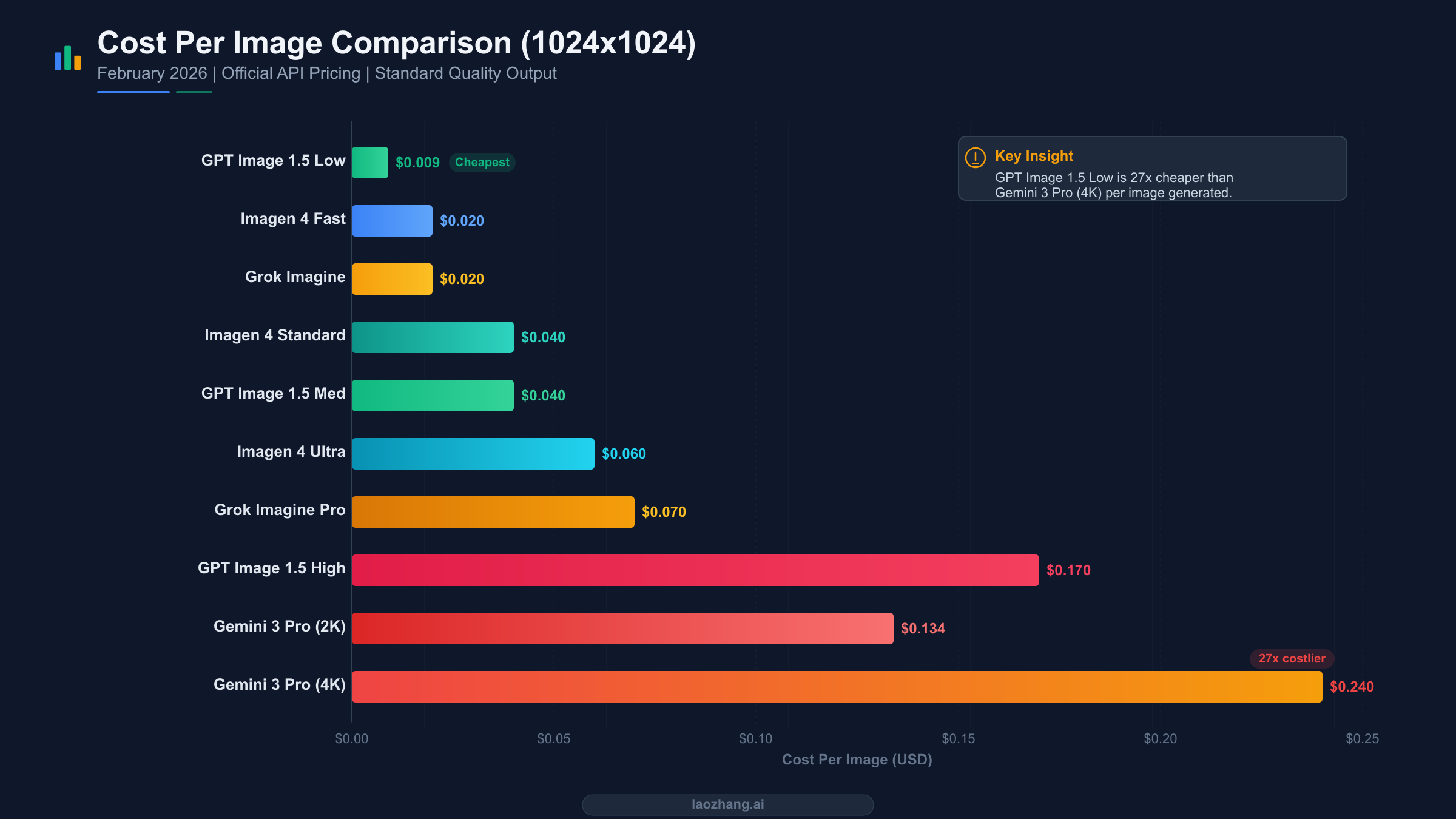
With all four platforms' pricing laid out individually, the real question every developer needs answered is how these costs compare when normalized to the same output and projected across production-scale volumes. The per-image prices we have discussed range from $0.005 to $0.24, representing a staggering 48x difference between the cheapest and most expensive options. But raw per-image cost only tells part of the story because quality tiers, rate limits, and batch processing capabilities all affect the true cost of generating images at scale. The comparison below normalizes everything to standard 1024x1024 output quality and projects costs across realistic production volumes.
Normalized Cost Comparison
The following table compares each provider at their closest equivalent to "medium quality, 1024x1024" output, which represents the most common production use case for web content, social media, and application interfaces. These are the prices you would actually pay for typical production-quality image generation.
| Provider / Model | Price per Image | Rate Limit | Max Daily Output | Monthly Cost (10K images) |
|---|---|---|---|---|
| GPT Image 1 Mini (high) | $0.036 | Standard | High | $360 |
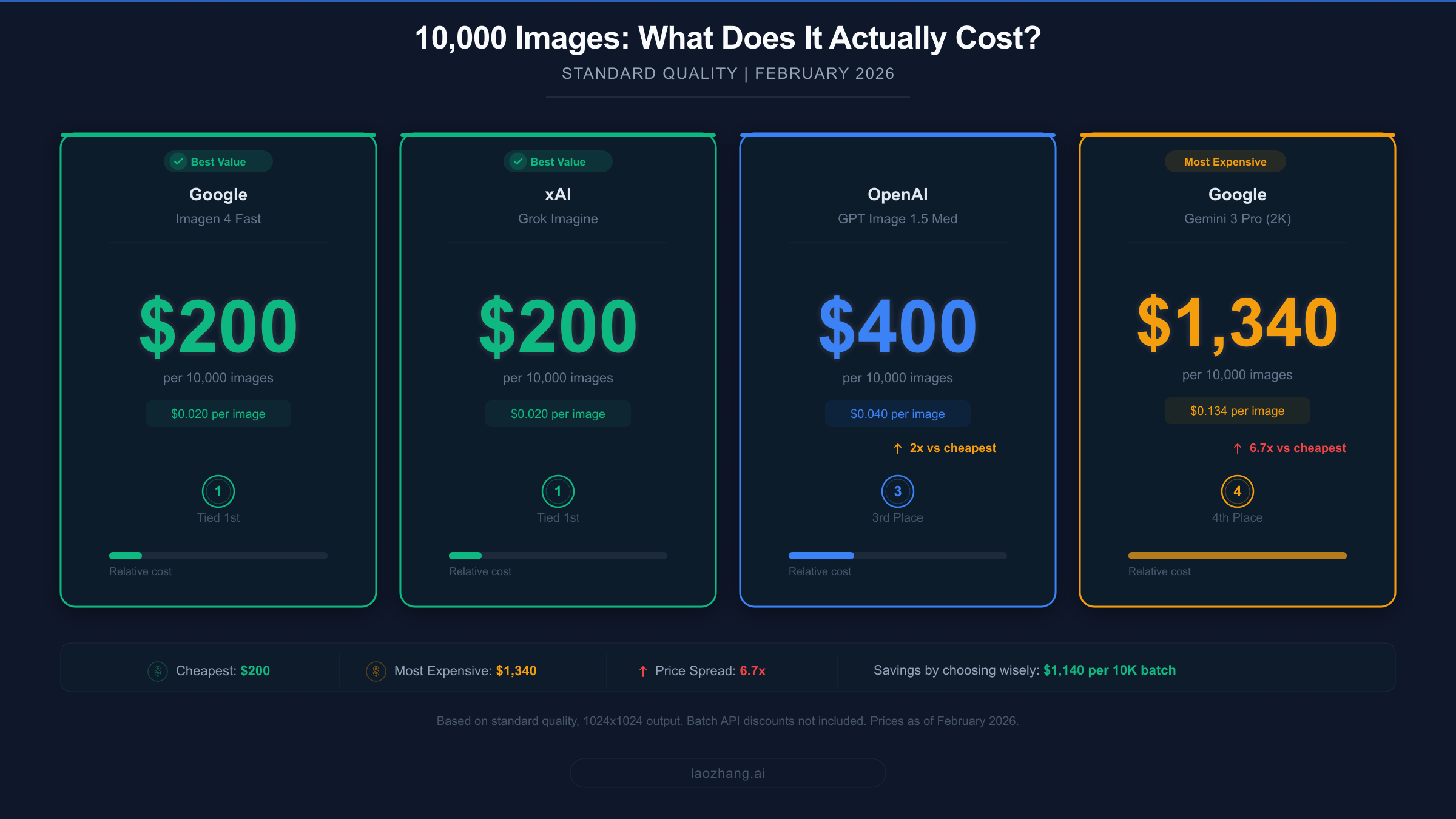
| Imagen 4 Fast | $0.02 | High | Very High | $200 |
| Grok Imagine Standard | $0.02 | 300 RPM | 432,000/day | $200 |
| Imagen 4 Standard | $0.04 | High | Very High | $400 |
| GPT Image 1.5 Medium | ~$0.04 | Standard | High | $400 |
| Imagen 4 Ultra | $0.06 | High | Very High | $600 |
| Grok Imagine Pro | $0.07 | 30 RPM | 43,200/day | $700 |
| GPT Image 1.5 High | ~$0.17 | Standard | High | $1,700 |
| Gemini 3 Pro Image | $0.134 | Standard | High | $1,340 |
| Gemini 3 Pro Image (4K) | $0.24 | Standard | High | $2,400 |
Cost at Scale Analysis
The scale projections reveal just how dramatically these pricing differences compound as volume increases. At 100 images per month, the difference between Imagen 4 Fast ($2) and Gemini 3 Pro Image ($13.40) is barely noticeable on any team's budget. But at 10,000 images per month, you are choosing between $200 and $1,340 per month, and at 100,000 images per month, the spread becomes $2,000 versus $13,400, a difference of over $136,000 annually. These numbers make it clear that provider selection is not just a technical decision but a significant business decision for any application generating images at scale.
| Volume | Imagen 4 Fast | Grok Standard | GPT 1.5 Med | Gemini 3 Pro | GPT 1.5 High |
|---|---|---|---|---|---|
| 100/month | $2 | $2 | $4 | $13.40 | $17 |
| 1,000/month | $20 | $20 | $40 | $134 | $170 |
| 10,000/month | $200 | $200 | $400 | $1,340 | $1,700 |
| 100,000/month | $2,000 | $2,000 | $4,000 | $13,400 | $17,000 |
Rate limits add another critical dimension to this analysis that most pricing comparisons ignore entirely. Grok Imagine Pro's 30 RPM limit means that even if you are willing to pay $0.07 per image, you can only generate about 43,200 images per day. If your application needs 100,000 images in a 24-hour burst, you would need more than two days of continuous generation at the maximum rate. By contrast, Imagen 4's higher rate limits and Gemini's batch processing capabilities can handle burst workloads more effectively, even if their per-image or per-batch costs are different. The effective cost of an API is not just its price per image but the combination of price, throughput, and the time value of your generation pipeline.
When you factor in rate limits, the pricing picture shifts considerably for high-volume applications. Consider a scenario where you need to generate 50,000 product images for an e-commerce catalog update. Using Grok Imagine Standard at $0.02 per image with 300 RPM, you could complete the job in approximately 2.8 hours for $1,000. Using Imagen 4 Fast at $0.02 per image with high rate limits, you could potentially complete the same job faster depending on your Vertex AI tier configuration. Using Gemini 3 Pro Image Batch API at $0.067 per image, the total cost would be $3,350 but with no rate limit pressure since batch jobs are queued. The right choice depends on whether your constraint is cost, speed, or a combination of both. For most teams, starting with the cheapest production-quality option (Imagen 4 Fast or Grok Imagine Standard) and scaling to premium tiers only for specific high-quality needs produces the best overall cost efficiency.
How to Cut AI Image Generation Costs by Up to 80%
Choosing the cheapest provider is only the first step in optimizing your AI image generation costs. Production teams that implement the strategies below routinely reduce their image generation spend by 50 to 80 percent compared to naive single-provider usage at default settings, and these savings compound significantly at scale. The key insight is that most applications do not need premium quality for every image, and the infrastructure choices you make around batching, routing, and caching have as much impact on your bill as the provider you select.
Batch Processing Discounts
The single highest-impact cost optimization available today is Google's Batch API for Gemini 3 Pro Image, which provides a flat 50 percent discount on all generations processed asynchronously. If your application can tolerate batch processing latency of minutes to hours rather than requiring real-time generation, using the Batch API drops your per-image cost from $0.134 to $0.067, making Gemini 3 Pro Image competitive with mid-tier options from other providers while maintaining its premium multimodal capabilities. The practical implementation is straightforward: queue your generation requests, submit them as a batch job, and retrieve results when processing completes. For content management systems, marketing automation pipelines, and any workflow where images are prepared in advance rather than generated on demand, batch processing should be your default approach. OpenAI also offers batch processing for its API with similar discount structures, and combining batch processing across multiple providers can yield cumulative savings of 40 to 60 percent compared to real-time generation.
Multi-Model Routing Strategy
The most sophisticated cost optimization technique is routing different types of image requests to different providers based on the quality requirements of each specific use case. Rather than selecting a single provider for all image generation, implement a routing layer that sends thumbnail and preview requests to GPT Image 1 Mini or Imagen 4 Fast at $0.005 to $0.02 per image, production web content to Imagen 4 Standard or GPT Image 1.5 Medium at $0.04 per image, and premium marketing assets to Gemini 3 Pro Image or GPT Image 1.5 High at $0.13 per image. For teams looking to simplify multi-provider integration, aggregation platforms like laozhang.ai provide unified API access to multiple image generation models through a single endpoint, eliminating the need to maintain separate SDKs and billing relationships with each provider while often offering reduced per-image costs compared to direct API pricing.
Disclosure: laozhang.ai is our own service. Its prices are platform pricing, not an independent comparison.
Resolution and Quality Right-Sizing
Many applications default to the highest quality setting when generating images, but this is almost always wasteful for images that will be displayed as thumbnails, used in mobile interfaces, or embedded in email templates where the full resolution will never be visible. A 256x256 thumbnail does not benefit from high-quality generation at $0.17 per image when low-quality generation at $0.009 per image produces visually identical results at that display size. Audit your application's image generation requests and categorize them by the display size and context where each image will be used, then map each category to the minimum quality tier that meets visual requirements. In practice, most applications find that 60 to 80 percent of their generated images can use a lower quality tier than they are currently using, which directly translates to 60 to 80 percent cost savings on those requests without any visible quality degradation for end users.
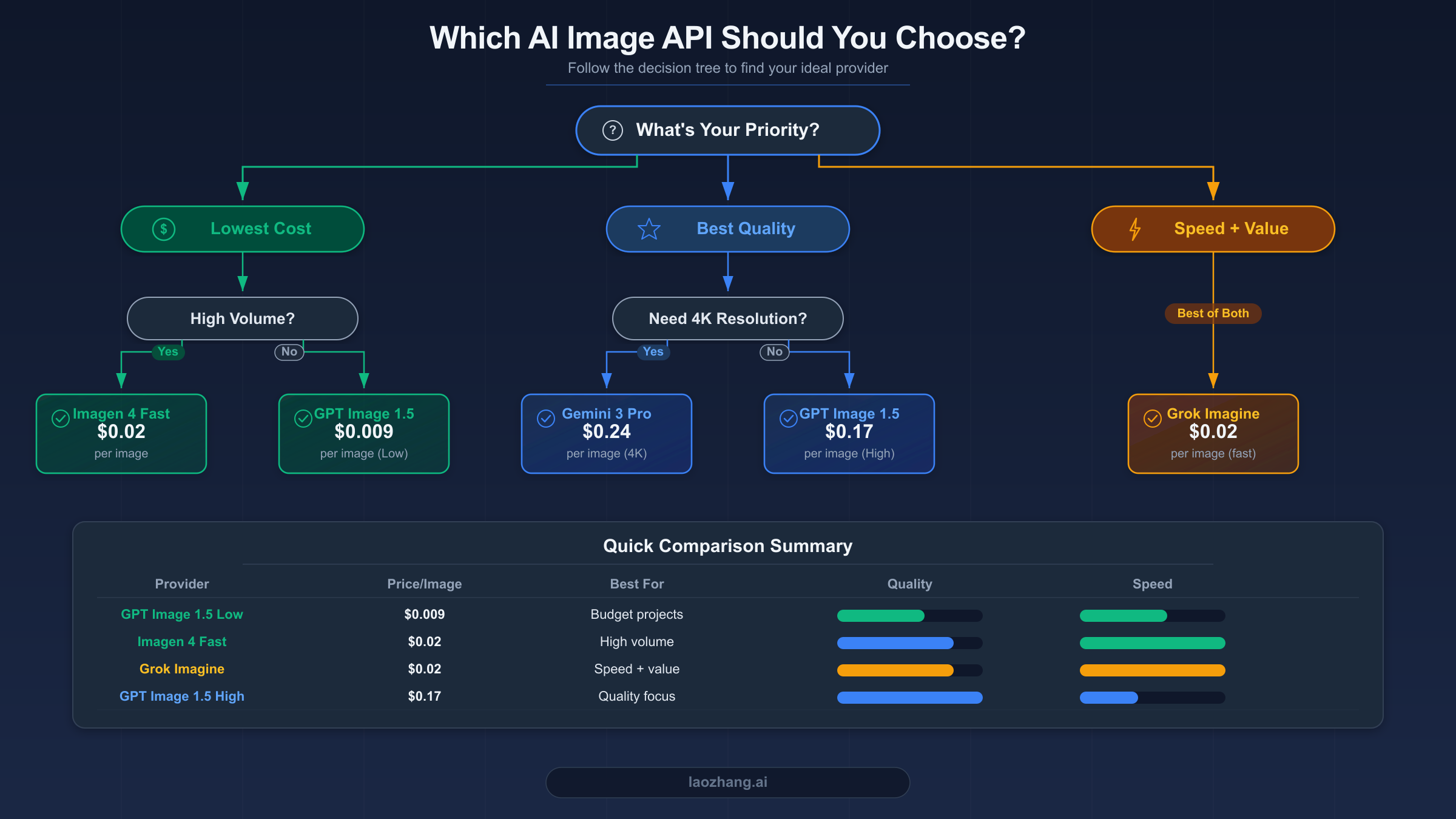
Consider building a tiered generation pipeline where each request is classified before being sent to the API. Requests for social media thumbnails and email headers route to GPT Image 1.5 Low or Imagen 4 Fast at $0.009 to $0.02 per image. Requests for website hero images and blog illustrations route to Imagen 4 Standard or GPT Image 1.5 Medium at $0.04 per image. Only requests explicitly tagged as premium, such as product photography, advertising creative, or print materials, route to GPT Image 1.5 High or Gemini 3 Pro Image at $0.13 or more per image. A team generating 10,000 images per month with a typical distribution of 60 percent thumbnails, 30 percent web content, and 10 percent premium might spend $54 (6,000 x $0.009) plus $120 (3,000 x $0.04) plus $170 (1,000 x $0.17) for a total of $307, compared to $1,700 if everything had been generated at GPT Image 1.5 High quality. That represents an 82 percent cost reduction with no perceptible quality loss for 90 percent of the generated images.
FAQ - AI Image API Pricing
Which AI image API is the cheapest in 2026?
OpenAI's GPT Image 1 Mini at $0.005 per image (low quality) is the absolute cheapest AI image generation API available as of February 2026. For production-quality images, both Google's Imagen 4 Fast and xAI's Grok Imagine Standard tie at $0.02 per image, representing the best value for applications that need reliably good visual output without premium pricing. If you are willing to sacrifice some quality for maximum cost savings, GPT Image 1.5 Low at $0.009 per image offers a middle ground between the cheapest option and production-quality tiers. The best choice depends on whether minimum cost or minimum acceptable quality is your primary constraint, and for most production applications, the $0.02 per image tier from Imagen 4 Fast or Grok Imagine offers the optimal balance.
How much does it cost to generate 10,000 AI images per month?
At the cheapest tier (GPT Image 1 Mini Low), 10,000 images costs approximately $50 per month. Using production-quality APIs like Imagen 4 Fast or Grok Imagine Standard, 10,000 images costs $200 per month. Mid-quality options like Imagen 4 Standard or GPT Image 1.5 Medium run about $400 per month. Premium quality through GPT Image 1.5 High or Gemini 3 Pro Image costs approximately $1,340 to $1,700 per month. The highest tier, Gemini 3 Pro Image at 4K resolution, reaches $2,400 per month for 10,000 images. These projections assume single-provider usage without batch discounts or multi-model routing, which can reduce costs by an additional 30 to 50 percent as discussed in the optimization strategies section above.
Is GPT Image 1.5 cheaper than GPT Image 1?
Yes, GPT Image 1.5 is approximately 20 percent cheaper than GPT Image 1 across all quality tiers at equivalent resolutions (OpenAI API Pricing, February 2026). Specifically, GPT Image 1.5 Low costs about $0.009 versus GPT Image 1 Low at $0.011, GPT Image 1.5 Medium costs about $0.04 versus GPT Image 1 Medium at $0.042, and GPT Image 1.5 High costs approximately $0.17 versus GPT Image 1 High at $0.167 for standard 1024x1024 output. Beyond the price reduction, GPT Image 1.5 also offers improved image quality and better prompt adherence, making it a strict upgrade from GPT Image 1 in both cost and capability. There is no technical reason to use GPT Image 1 over 1.5 for new projects unless you need compatibility with legacy integrations.
What is the difference between Gemini 3 Pro Image and Imagen 4?
Despite both coming from Google, these are fundamentally different products serving different use cases. Gemini 3 Pro Image (codenamed Nano Banana Pro) is a multimodal large language model that generates images as part of conversational interactions, priced at $0.134 per standard image via token-based billing. Imagen 4 is a dedicated image generation model available through Vertex AI, priced at $0.02 to $0.06 per image with flat per-image billing. Gemini excels when you need image generation integrated with text understanding, multi-turn conversations, or image editing based on natural language instructions. Imagen 4 is the better choice when you need pure image generation at high volume and lower cost, particularly through its Fast tier at $0.02 per image. For the best AI image model for your needs, the right choice depends on whether you need multimodal capabilities or pure image generation throughput.
Does Grok Imagine have an API?
Yes, xAI launched the Grok Imagine API on January 28, 2026, with two models available for developers. The standard model (grok-imagine-image) is priced at $0.02 per image with a rate limit of 300 requests per minute, and the pro model (grok-imagine-image-pro) is priced at $0.07 per image with a rate limit of 30 requests per minute. The API uses a REST interface that is compatible with the OpenAI SDK format, making integration straightforward for developers already using OpenAI's image generation API. New accounts receive $25 in free credits, and developers who opt into xAI's data-sharing program receive an additional $150 per month in free credits, making Grok Imagine one of the most accessible platforms for evaluation and small-scale production use.
How do I choose between these four AI image APIs?
Start with your primary constraint. If your budget is the deciding factor and you need production-quality output, choose Imagen 4 Fast or Grok Imagine Standard at $0.02 per image. If you need the highest possible quality and are building premium applications, choose between Gemini 3 Pro Image ($0.134) for multimodal capabilities or GPT Image 1.5 High (~$0.17) for stylistic variety. If you need predictable billing with no token calculation complexity, choose Imagen 4 or Grok Imagine's flat per-image pricing. If you need burst capacity and cannot tolerate rate limit bottlenecks, Imagen 4 offers the highest sustained throughput. And if you are not sure yet, start with Grok Imagine's free $25 credit and Imagen 4's free tier through Google Cloud's $300 trial credit to evaluate both before committing budget to either platform.
Will AI image API prices continue to drop?
The historical trend strongly suggests yes. When OpenAI launched DALL-E 3 in late 2023, standard quality images cost $0.04 each. By the end of 2025, GPT Image 1.5 brought the effective low-quality cost down to $0.009, a 78 percent reduction in just over two years. Google's introduction of Imagen 4 Fast at $0.02 per image and xAI's matching price point with Grok Imagine both reflect increasing price competition in the market. The entry of new providers like xAI forces incumbents to maintain competitive pricing, and improvements in model efficiency mean that the computational cost of generating an image continues to decline. For budget planning purposes, it is reasonable to expect that current prices will drop by another 20 to 40 percent over the next 12 months, though premium tiers that leverage cutting-edge capabilities may maintain higher price points. The best strategy is to build your integration with provider-agnostic abstractions so you can easily switch to cheaper options as they become available.