Fable 5.1 vs 5.2: Cheaper at Medium, Costlier at High and Max
Claude Fable 5.2 outscores 5.1 at every effort level and costs about 32% less per task at medium, but at high and above it uses more tokens and costs more.
On this page
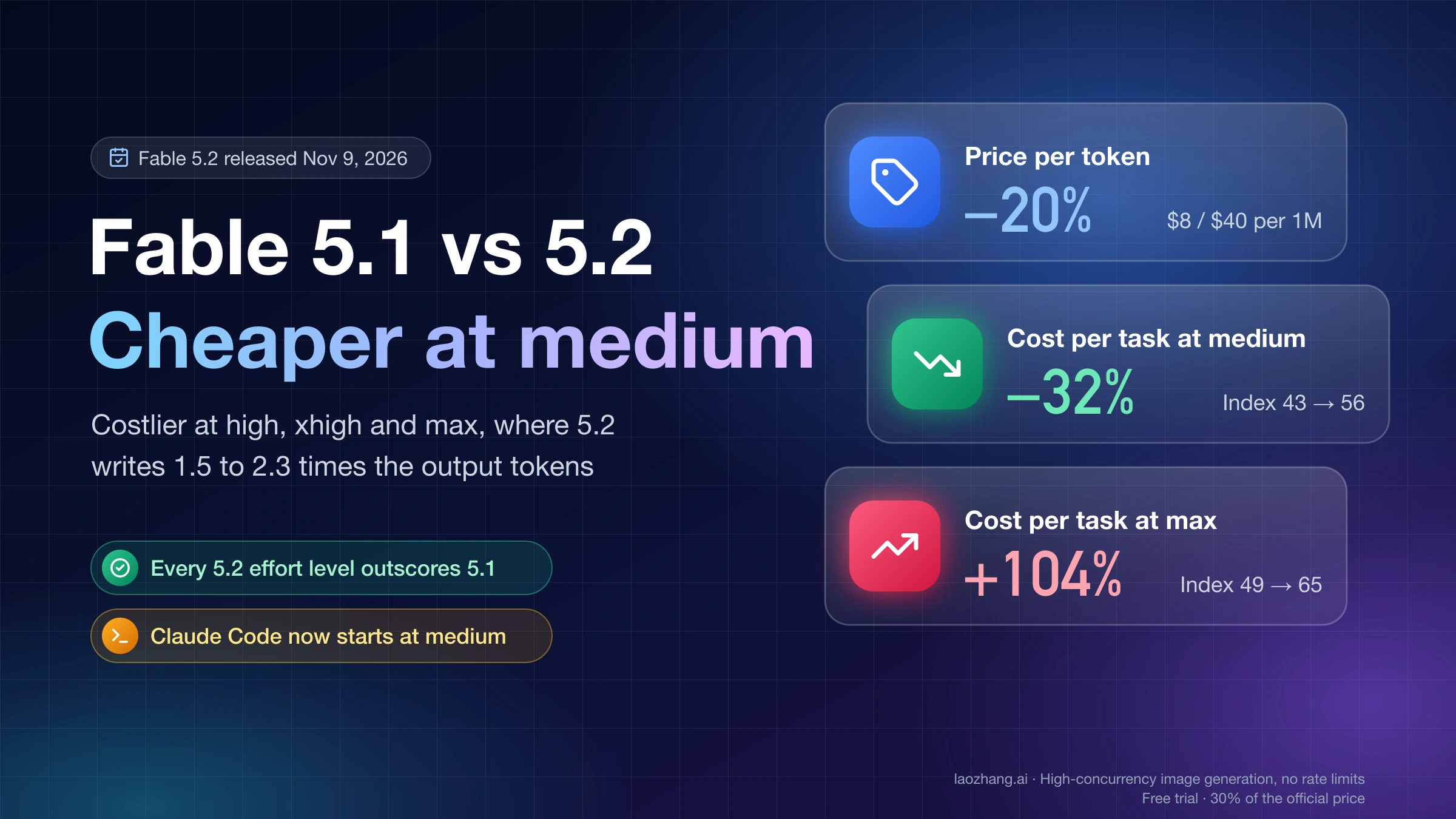
Claude Fable 5.2, released on November 9, 2026, is worth moving to from Fable 5.1, but the move only lowers your cost if you also pick the right effort level. Every token price fell 20% (input $10 → $8, output $50 → $40 per million tokens), and on Artificial Analysis's Intelligence Index v5.0.1, as of November 10, 2026, every Fable 5.2 effort level scores above every Fable 5.1 level. At low and medium, Fable 5.2 also costs 31–32% less per task. At high, xhigh and max it writes 1.5 to 2.3 times as many output tokens, so the same level costs 20% to 104% more per task and takes longer, despite the lower price.
What to set depends on where you run it. In Claude Code, selecting fable (now Fable 5.2) starts sessions at medium, which in those numbers scores higher than Fable 5.1 at its old high default for half the cost per task, so keep medium and raise it only for the tasks that need more. On the API, both versions default to high, so changing claude-fable-5-1 to claude-fable-5-2 and nothing else buys a higher score at about 20% more per task; if Fable 5.1 at high already did the job, test medium first. If you ran Fable 5.1 at xhigh or max, Fable 5.2 at low already outscores it at under a third of the cost. In the Claude app, both versions start at Medium, the level where 5.2 is both cheaper and stronger.
API code needs one test pass before traffic moves: Anthropic lists four changes that can break requests, the most likely being a stricter check on edited conversation history when your code builds its own messages array. Nothing changes when Claude Code, claude.ai or the Agent SDK manages the conversation. Fable 5.1 stays callable until at least September 1, 2027, so you can switch on your own schedule.
What changed between Fable 5.1 and Fable 5.2, and what didn't
Fable 5.2 changes the price, a handful of API rules and one Claude Code default; the model's shape is the same. Anthropic's Fable 5.2 migration guide calls the move "mostly drop-in", and the What's new in Claude Fable 5.2 page lists the differences below, as of November 10, 2026.
Fable 5.1 (claude-fable-5-1) | Fable 5.2 (claude-fable-5-2) | |
|---|---|---|
| Released / status | September 1, 2026 / Legacy | November 9, 2026 / current |
| Input / output per 1M tokens | $10 / $50 | $8 / $40 |
| Cache write 5 min / 1 hour, cache read | $12.50 / $20, $0.25 | $10 / $16, $0.20 |
| API rate limit | Shared with Fable 5 | Its own, separate limit |
| Prefix check on edited history | Default only for accounts created on or after August 31, 2026 | Every account |
computer_20251124 tool | Accepted | 400 except on Amazon Bedrock; use computer_toolset_20260801 |
| Advisor tool (beta) | Accepts other advisors | Advisor must be Fable 5.2 or Mythos 5.2 |
| Fast mode | Not listed on the fast-mode page | speed: "fast", up to 2.5x output speed, $16 / $80 |
| Claude Code default effort | high | medium |
| Unnecessary safety blocks | — | About 55% fewer than 5.1 in Anthropic's early testing |
| Context, max output, tokenizer | 1M, 128K, same tokenizer | Same |
| API default effort, effort levels | high; low to max | Same |
The rest of the request surface carries over unchanged: adaptive thinking is always on (disabling it or setting budget_tokens returns 400), assistant prefill and forced tool choice (tool_choice any or tool) still return 400, the reliable knowledge cutoff is June 2026, and both require 30-day data retention. Because the tokenizer is the same, the same prompt counts as the same number of tokens on both, so the 20% price cut is a real 20% on any fixed amount of text. Claude Mythos 5.2 (claude-mythos-5-2) is the same model with fewer safeguards for organizations verified through Anthropic's programs, and it follows the same rules. Posts from September 2026 about a "Fable 5.2" describe a rumored model; the November 9 release is the first official one.
Fable 5.2 vs Fable 5.1 at the same effort: cheaper only at low and medium
At the same effort level, Fable 5.2 costs less per task than Fable 5.1 at low and medium and more at high, xhigh and max, even though every token is 20% cheaper. The reason is volume: with prices 20% lower, Fable 5.2 breaks even with 5.1 when it uses 1.25 times the tokens (1 ÷ 0.8). It uses fewer at the two lower levels and far more than that at the three higher ones.
The table puts Artificial Analysis's same-effort rows for both versions side by side (Intelligence Index v5.0.1, as of November 10, 2026), with the changes recomputed from those rows on the same day. Cost per task is the cost of Artificial Analysis's own task mix at list prices, not a bill for your workload.
| Effort | Index, 5.1 → 5.2 | Cost per task, 5.1 → 5.2 | Output tokens per task, 5.1 → 5.2 | Time per task, 5.1 → 5.2 |
|---|---|---|---|---|
low | 39 → 54 | $4.47 → $3.10 (−31%) | 37.8k → 35.9k (0.95x) | 7.4 → 6.5 min (−12%) |
medium | 43 → 56 | $5.56 → $3.80 (−32%) | 48.5k → 43.1k (0.89x) | 9.7 → 8.3 min (−14%) |
high | 47 → 62 | $7.54 → $9.08 (+20%) | 66k → 97.8k (1.48x) | 13.2 → 17.7 min (+34%) |
xhigh | 50 → 62 | $10.85 → $14.83 (+37%) | 97.1k → 162k (1.67x) | 19.2 → 26.3 min (+37%) |
max | 49 → 65 | $12.99 → $26.54 (+104%) | 118k → 274k (2.32x) | 22.7 → 44.1 min (+94%) |
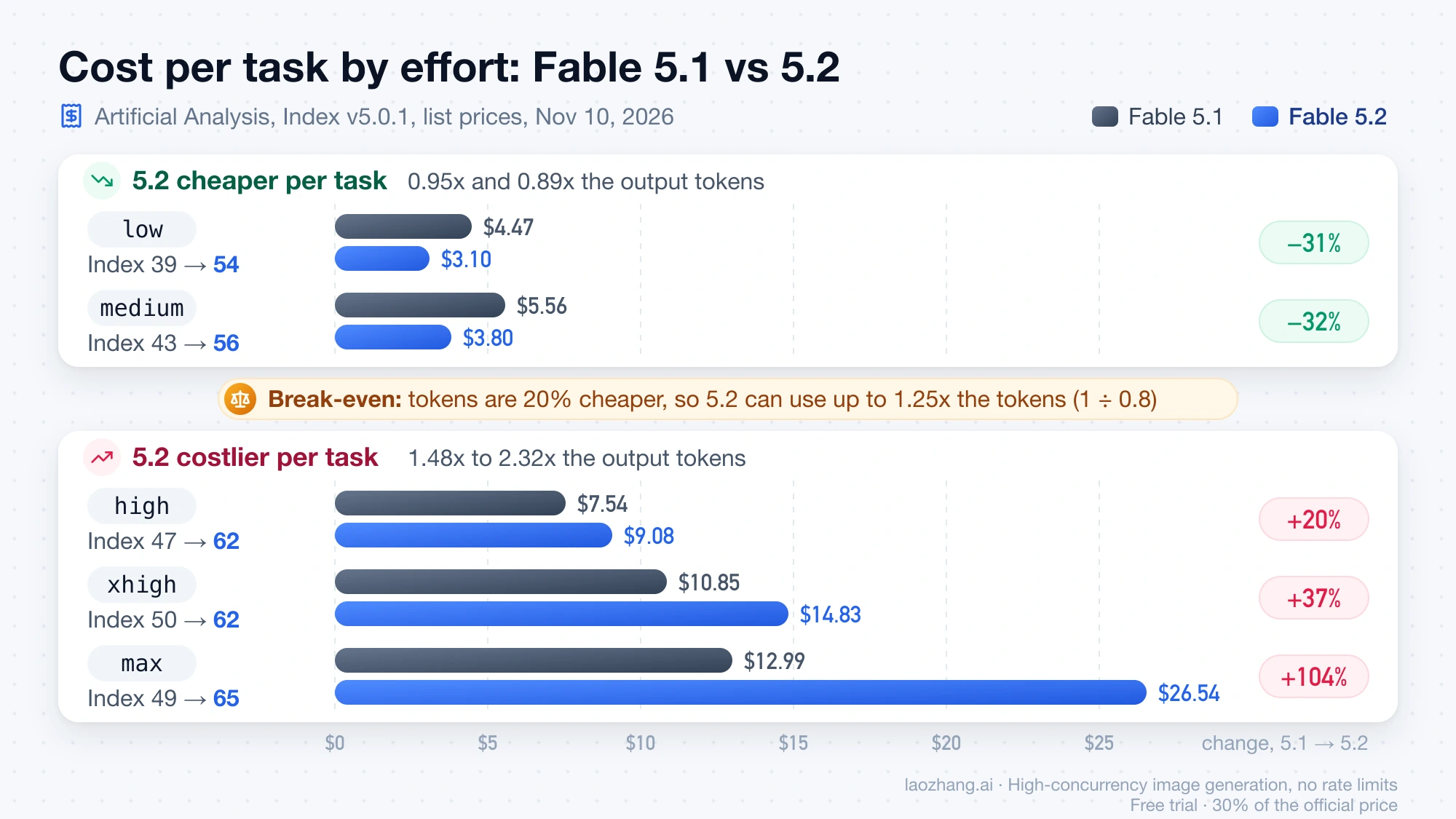
The scores come from Artificial Analysis's Fable 5.2 vs Fable 5.1 comparison and its per-effort pages; the index averages ten evaluations run in its own harness, and the site revises numbers without notice. The lowest Fable 5.2 score, 54 at low, is above the highest Fable 5.1 score, 50 at xhigh, which is why switching versions is an upgrade at any setting. The "30% cheaper" figure that circulated on launch day mixes two numbers: the price cut is 20%, and 30% is Anthropic's "up to 30% faster" speed claim.
Why Fable 5.2 max costs 79% more than xhigh for 3 more points
At max, Fable 5.2 spends 193k reasoning tokens per task against Fable 5.1's 71.4k, so its cost per task is $26.54, about twice Fable 5.1 max ($12.99, +104%). Within Fable 5.2, stepping from xhigh to max raises the index only from 62 to 65 while cost per task goes from $14.83 to $26.54 (about +79%) and time per task from 26.3 to 44.1 minutes. The top levels also stop paying off on individual tests. Fable 5.1 at max scores 49, below its own xhigh at 50. On FrontierCode 2.0 in Artificial Analysis's runs, Fable 5.2 peaks at high (49.1%) and then scores 47.6% at xhigh and 48.8% at max, so on that coding benchmark the two most expensive settings think longer and cost more for a lower result.
Anthropic's own guidance points the same way. Its effort documentation for Fable 5.2 says "most of the gain in capability is already present at high", suggests xhigh only for the hardest long-running coding and agentic work "where you've measured a gain", and says to "reserve max for measuring the model's ceiling and for the rare task where time and tokens don't matter." It also tells you to run an effort sweep on your own evals rather than carry settings over from Fable 5.1, which matters more than usual here because the same level now spends tokens differently.
Which effort to run after switching: API, Claude Code, or the app
Pick your Fable 5.2 effort by the surface you use, because the default you land on differs. On the Claude API both versions default to high. Claude Code defaults Fable 5.2 to medium but Fable 5.1 to high. In the Claude app, Anthropic calls Medium the default, and in a check on November 10, 2026 both Fable 5.1 and Fable 5.2 showed "Medium" when selected. The numbers below are the moves those defaults produce in Artificial Analysis's index, as of November 10, 2026.
| Where you run Fable | Default, 5.1 → 5.2 | What the default move does (index, cost per task, time) | Starting setting on 5.2 |
|---|---|---|---|
| Claude API | high → high | 47 → 62, +20% cost, +34% time | medium if 5.1 high was good enough; high if you need more than 5.1 gave you |
| Claude Code | high → medium | 47 → 56, −50% cost, −37% time | Keep medium; raise effort for a hard task, not for the whole session |
| Claude app | Medium → Medium | 43 → 56, −32% cost, −14% time | Keep Medium |
You ran 5.1 at xhigh | — | 5.2 low: 50 → 54, −71% cost, −66% time | low or medium first; high (62) still costs 16% less than 5.1 xhigh |
You ran 5.1 at max | — | 5.2 low: 49 → 54, −76% cost | Same as above; keep max only to measure the ceiling |
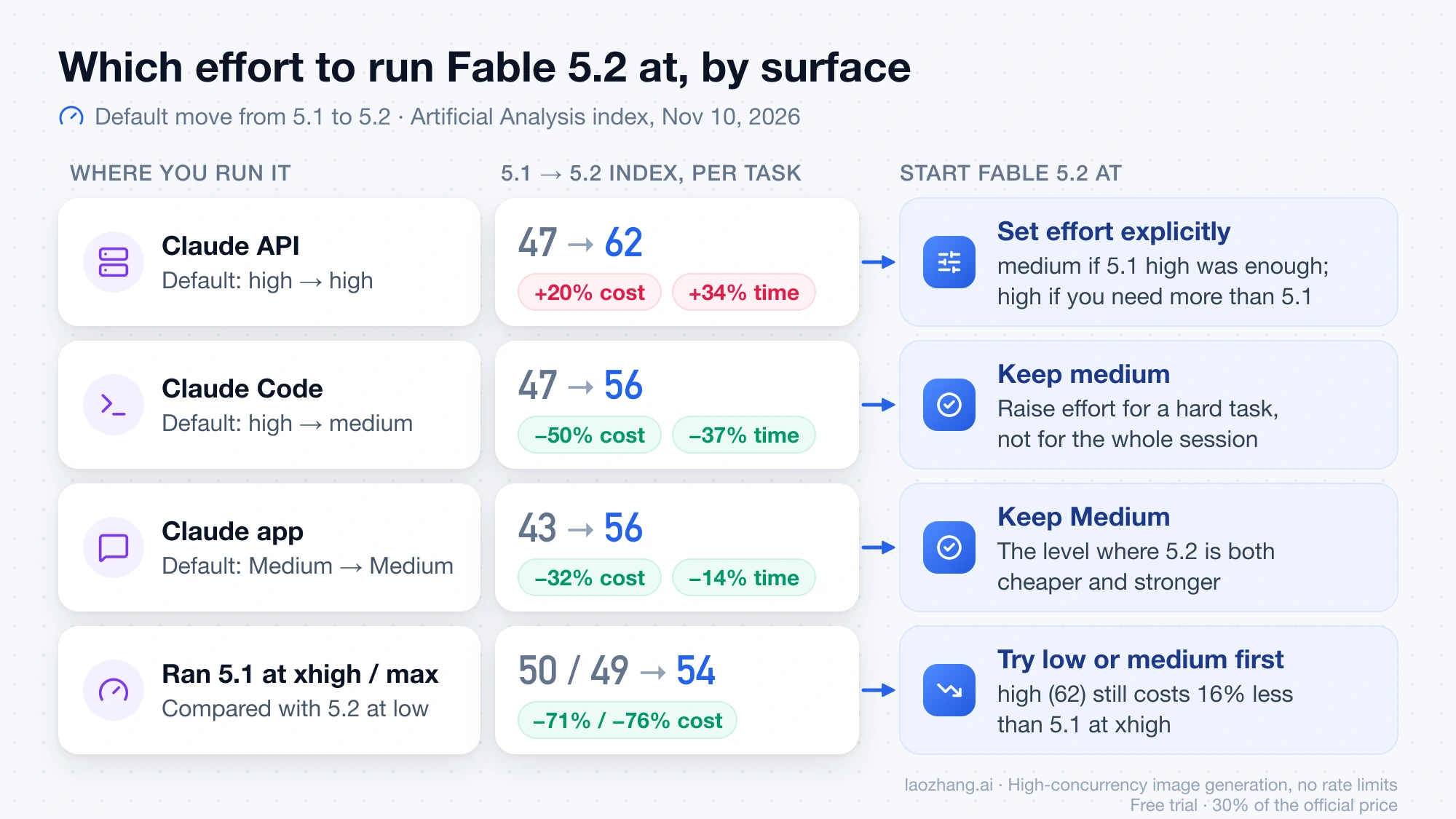
On the API, the rule is to set effort explicitly rather than inherit high. If your Fable 5.1 integration ran at high and its output was acceptable, Fable 5.2 at medium is the obvious first candidate: it scores above 5.1 high in the index at about half the cost per task. Stay at high when you moved to Fable for quality you didn't get before, and accept that the same level now costs more and runs longer.
In Claude Code, the lower default does most of the work for you, so the risk is the opposite one: a session that felt strong at Fable 5.1 high may now run at medium. Raise it for the tasks that need it rather than pinning xhigh or max for everything, since Anthropic also saw Fable 5.2 start subagents to review its own work at those levels, and subagents can account for a large part of what a session costs. How to set the level, and why a saved level may not stick, is covered in Claude Code Effort Level: Model Defaults and Why It Won't Stick.
Is Fable 5.2 faster? Faster tokens, longer tasks at high and above
Fable 5.2 generates tokens faster, but at high and above it takes longer per task, because it writes more of them. Anthropic says outputs are generated "up to 30% faster than Claude Fable 5.1" in its Fable 5.2 announcement; "up to" is a ceiling, not an average. Artificial Analysis measured output speed 4% to 23% higher depending on the level (for example 84 → 103 tokens per second at xhigh), as of November 10, 2026.
Time per task is what you actually wait for, and there the effort level decides again: 12–14% shorter at low and medium, 34–37% longer at high and xhigh, and 94% longer at max, where an Artificial Analysis task took 44.1 minutes against 22.7 on Fable 5.1. If speed is why you are switching, run 5.2 at medium or below. The six-prompt app test in the next section adds one more data point for short chats, without settling the question.
Fable 5.1 vs 5.2 in the Claude app: six prompts, 12 of 12 passed
On short, fully specified tasks in the Claude app, Fable 5.1 and Fable 5.2 at Medium both got everything right, and neither was clearly faster. On November 10, 2026, between about 08:20 and 08:50 (UTC+8), the same six prompts were sent once to each version on claude.ai, using incognito chats on one Ultra-plan account, with both models at the app's default Medium effort. Answers were graded against hidden tests and rule checks written before the run.
| Prompt | Fable 5.1 (Medium) | Fable 5.2 (Medium) | Result |
|---|---|---|---|
| Pricing word problem | 6.0 s | 4.5 s | Both correct |
| Digit-sum count without code | 11.4 s | 6.0 s | Both correct |
| Standard-library question with two made-up functions | 2.6 s | 1.6 s | Both said the functions don't exist |
| CSV line parser | 6.2 s | 3.8 s | Both 16/16 hidden tests |
| Expression evaluator | 10.0 s | 25.4 s | Both 25/25 hidden tests |
| Semver range matcher | 40.2 s | 35.0 s | Both 36/36 hidden tests |
| Total | 76.4 s | 76.3 s | 12 of 12 passed |
Times are wall time from pressing send to the end of streaming. Fable 5.2 finished sooner on five of the six prompts and later on the expression evaluator, where it wrote a 31% longer program (3,344 characters against 2,558); on the semver task its code was also 48% longer, with more comments and an extra helper. The totals came out the same.
Read this as a check that nothing regressed on everyday prompts, not as a speed benchmark. Each prompt ran once, on one account and one network, so a single timing can't separate the model from service load. The app shows no token counts, so the test says nothing about cost, and it covers neither the API, Claude Code, other effort levels nor long agentic work, where the Artificial Analysis numbers above are the better guide. In the app's picker, Fable 5.2 sits in the main list and Fable 5.1 under "More models".
Fable 5.2 benchmark gains in Anthropic's launch table
Anthropic's launch table shows the biggest Fable 5.2 gains in agentic and coding work rather than in knowledge tests. In the Fable and Mythos 5.2 announcement, with each model at its highest available effort unless noted, FrontierCode 2.0 rises from 32.4% to 49.1% (both at xhigh), AutomationBench from 31.4% to 51.4%, Terminal-Bench-Science 0.1 from 52.6% to 74.6%, and Remote Labor Index from 17.9% to 41.3% (5.2 at high). Smaller steps appear on OSWorld 2.1 (83.5% to 89.3%) and Humanity's Last Exam with tools (65.6% to 74.2%). These are vendor-reported, launch-day numbers, and the cost table above is the better guide to what each point costs you.
Before you swap the model ID in API code: what can break
If your API code builds its own messages array, run the checks below before moving production traffic from claude-fable-5-1 to claude-fable-5-2; if Claude Code, claude.ai, Claude Managed Agents or the Claude Agent SDK builds the requests, Anthropic says nothing changes for you. The list follows the four breaking changes and the behavior notes in Anthropic's Fable 5.2 migration guide as of November 10, 2026. In Claude Code, /claude-api migrate this project to claude-fable-5-2 asks Claude to make the code changes for you.
- Run one session with the
thinking-binding-controls-2026-08-01beta header andthinking.block_binding.prefix_mismatch_behavior: "drop_block", loginput_transformations, and fix everyprefix_binding_mismatchentry. Fable 5.2 checks for edits tosystem,toolsor earlier messages on every account, so code on an account created before August 31, 2026 can pass on 5.1 and fail on 5.2 with "Invalidsignatureinthinkingblock. The block is bound to a different conversation." Retrying the same body doesn't clear it, anddrop_blockis a stopgap that can raise output tokens. - Find every router, retry or refusal fallback that can send a conversation from Fable 5.2 back to Fable 5.1. Fable 5.1 can't read 5.2's thinking blocks, so the API drops them: the request succeeds and the dropped tokens aren't billed, but the first turn after the switch runs without that reasoning.
- Replace
computer_20251124with thecomputer_toolset_20260801toolset unless you run on Amazon Bedrock, and update the agent loop for it. - If you use the advisor tool with Fable 5.2 as the executor, set the advisor's
modeltoclaude-fable-5-2orclaude-mythos-5-2; a Fable 5.1 advisor returns 400. - Look for prompt lines like "answer directly without deliberating" paired with a small
max_tokens. Atmediumand above, Fable 5.2 thinks anyway, so the request can end withstop_reason: "max_tokens"before any text; raisemax_tokensor lower effort. - Check Fable 5.2's rate limit in your console, since it no longer shares the limit you sized for Fable 5.1 and Fable 5.
- Set
effortexplicitly, re-run your effort sweep, and re-measure cost per task and latency on your own evals instead of reusing 5.1's numbers.
Cache mechanics don't change between the versions: cache reads stay at 0.025 times the base input price, now $0.20 per million tokens. For how cache writes and reads are billed, see Claude Prompt Caching: How It Works, Costs, 512-Token Minimum.
Claude Code: what happens to a saved claude-fable-5-1
On Pro and Max plans, Claude Code moves a claude-fable-5-1 model saved in your user settings to the fable alias, which now means Fable 5.2, the first time you run v2.1.321 or later, according to the Claude Code model configuration docs as of November 10, 2026. The terminal's startup model line can show (auto-updated) once. On Team and Enterprise plans the move waits for your organization's settings, so it may come later or not at all; run /model to see what you are on.
After the move, sessions start at Fable 5.2's default effort, medium, unless you have set a level for it. An older top-level effortLevel key in your user settings still applies to Fable 5.1 but not to models released after Opus 5.5, so a high you saved for 5.1 won't carry over. Console accounts, third-party providers, and project, local or managed settings keep claude-fable-5-1 untouched. To go back to Fable 5.1, select it by ID with /model claude-fable-5-1 or claude --model claude-fable-5-1; /model fable always picks Fable 5.2, except in Claude apps gateway sessions, where you use /model claude-fable-5-2.
Do Pro, Max and Ultra plan limits treat Fable 5.2 differently?
No. Anthropic's Help Center article on Fable models on your plan says "Fable 5.2 and Fable 5.1 work the same way on these plans" as of November 10, 2026: Max and Ultra plans and premium Team or legacy Enterprise seats include Fable for up to 50% of the weekly usage limit, while Pro and standard Team seats pay for Fable with usage credits from the first request. The exception is launch week. From November 9 through November 16, 2026 at 11:59 pm PT, all Fable models are included on Pro and standard Team seats too, for up to 50% of weekly limits, with one Fable limit reset that expires at the same time. Anthropic does not say whether Fable 5.2 draws down a plan's limit faster or slower than 5.1. On Enterprise plans, Fable 5.2 stays off until an admin turns it on.
Can you stay on Fable 5.1, and until when?
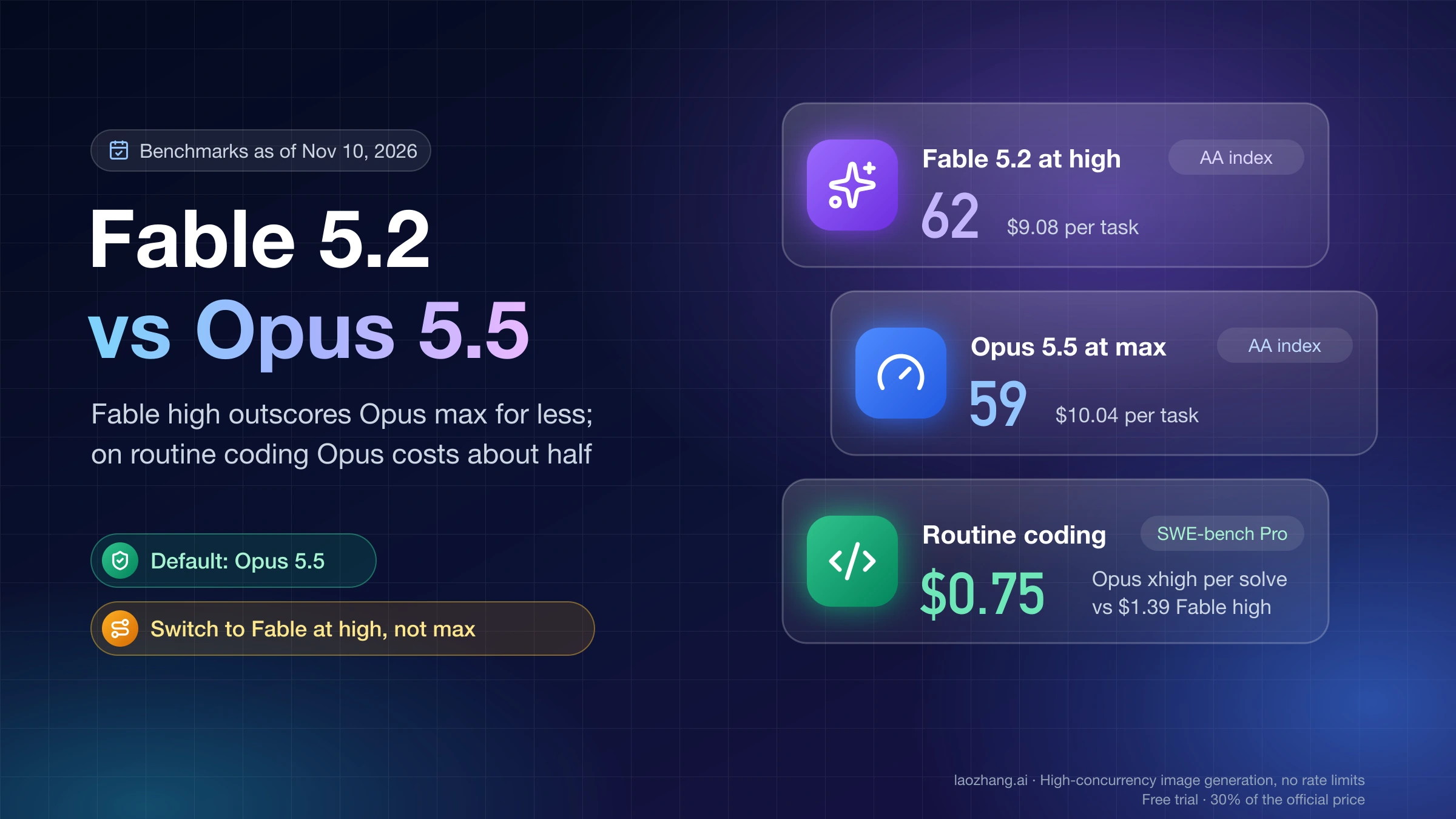
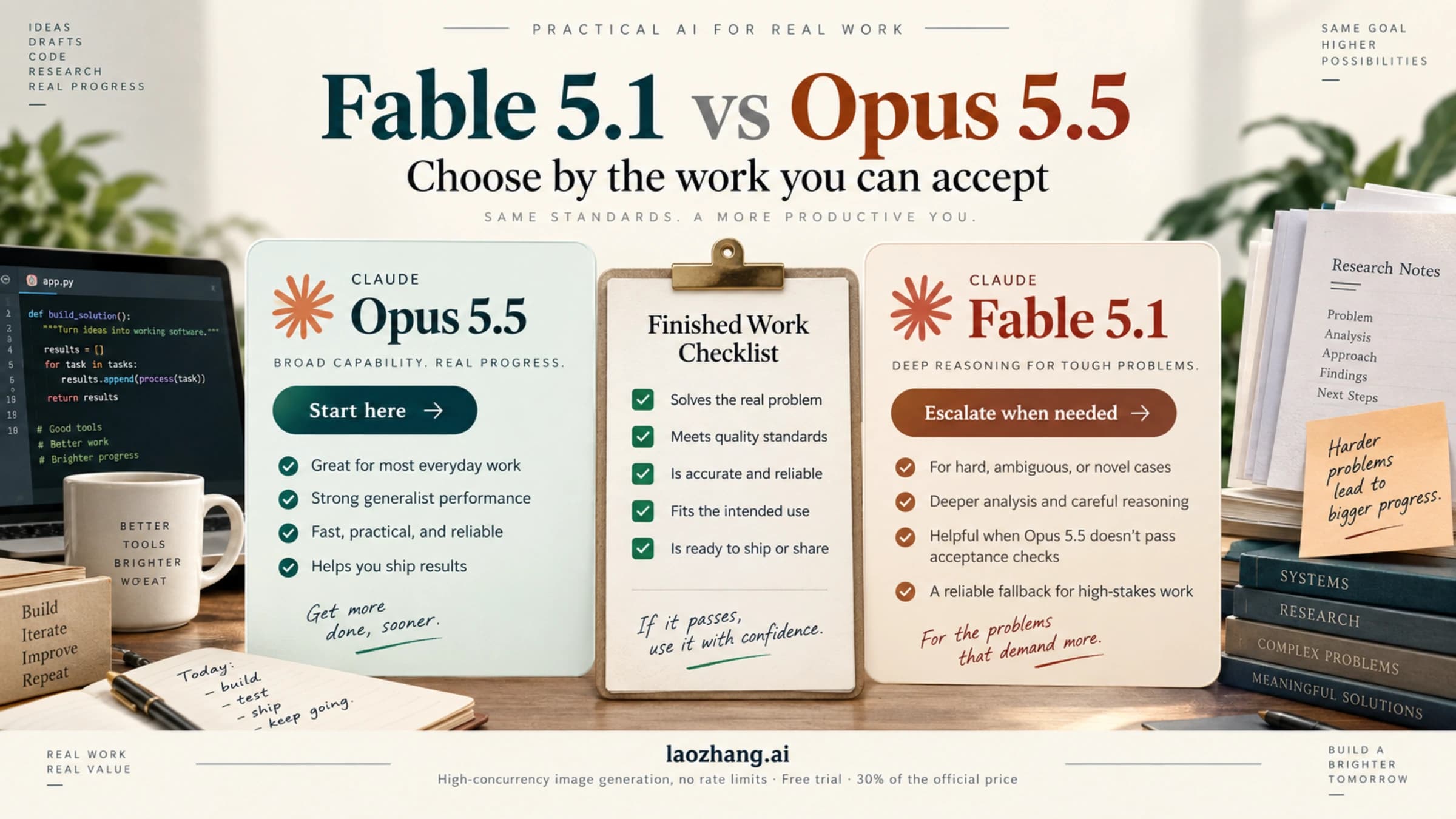
Yes. Fable 5.1 is labeled Legacy, not deprecated: its model page says it "is still available" while suggesting the move, and the model deprecations page sets its retirement no sooner than September 1, 2027, on the Claude API and the same cloud platforms that carry Fable 5.2. Staying makes sense while your API code fails one of the checks above, or when the provider you call doesn't serve Fable 5.2 yet. Gateways can add a new model later than Anthropic does: laozhang.ai added claude-fable-5-2 on November 10, 2026, a day after the release (its model list didn't show it earlier that morning), at Anthropic's list price of $8 / $40 per 1M tokens with usage-based billing, so check your provider's model list before changing the ID. If the real question is whether you need Fable at all, Anthropic suggests starting most work on Opus 5.5 and moving up only when evals demand it; if you are moving to 5.2, that choice is covered in Claude Fable 5.2 vs Opus 5.5: When Fable High Beats Opus Max, and if you are staying on 5.1, in Claude Fable 5.1 vs Opus 5.5: Which Should You Use?.
Disclosure: laozhang.ai is our own service. Its prices are platform pricing, not an independent comparison.
Sources9
External pages this guide links to, in the order they appear. Last updated Nov 10, 2026.
Sources9
External pages this guide links to, in the order they appear. Last updated Nov 10, 2026.
- 1.Fable 5.2 migration guideplatform.claude.com/docs/en/models/fable-5-2/migration-guide
- 2.What's new in Claude Fable 5.2platform.claude.com/docs/en/models/fable-5-2/whats-new-fable-5-2
- 3.Artificial Analysis's Fable 5.2 vs Fable 5.1 comparisonartificialanalysis.ai/models/comparisons/claude-fable-5-2-vs-claude-fable-5-1
- 4.effort documentation for Fable 5.2platform.claude.com/docs/en/build-with-claude/effort
- 5.Claude Codecode.claude.com/docs/en/model-config
- 6.Fable 5.2 announcementanthropic.com/claude-fable-and-mythos-5-2
- 7.Fable models on your plansupport.claude.com/en/articles/15424964
- 8.model pageplatform.claude.com/docs/en/models/fable-5-1/overview
- 9.model deprecations pageplatform.claude.com/docs/en/about-claude/model-deprecations