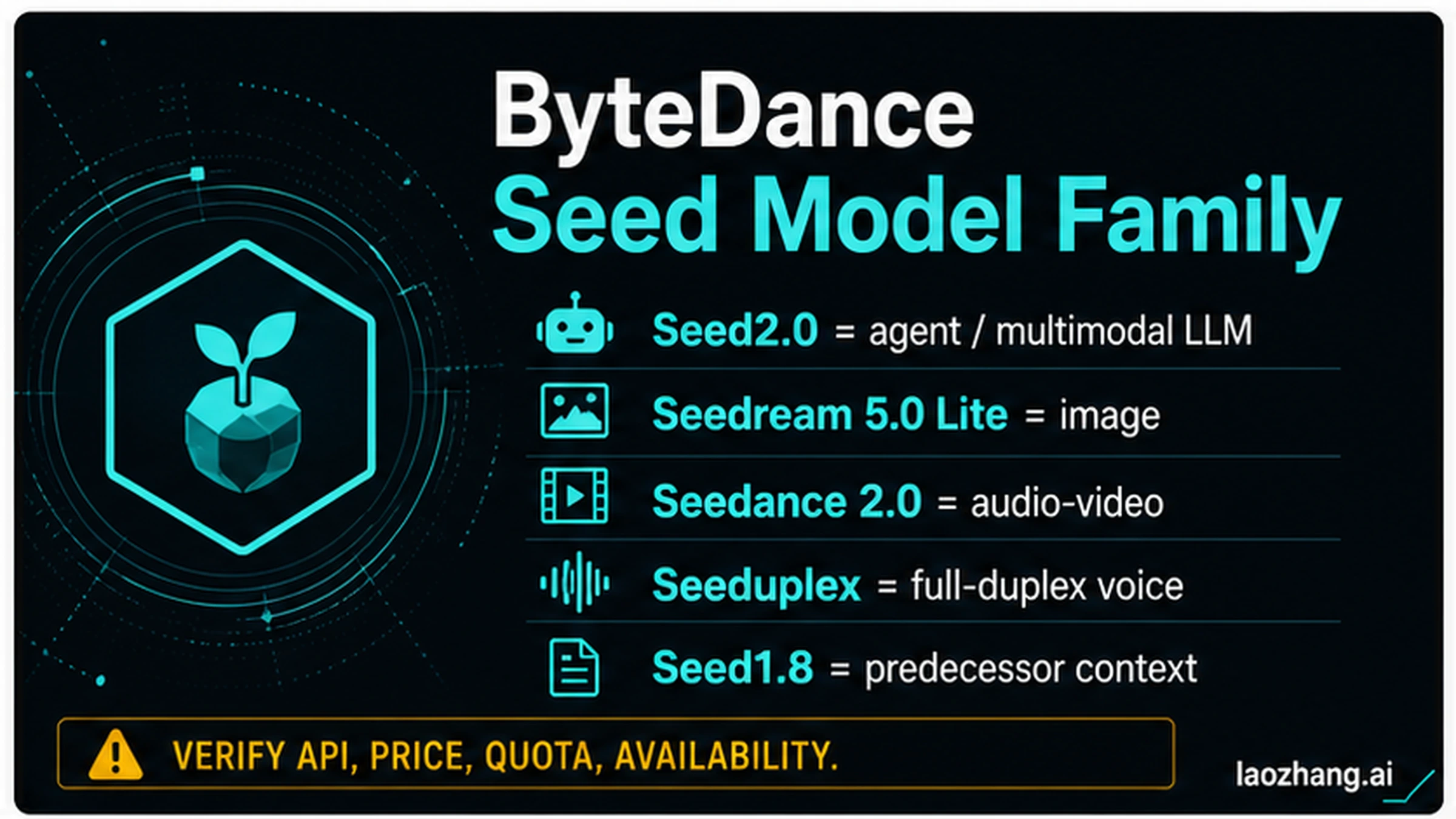
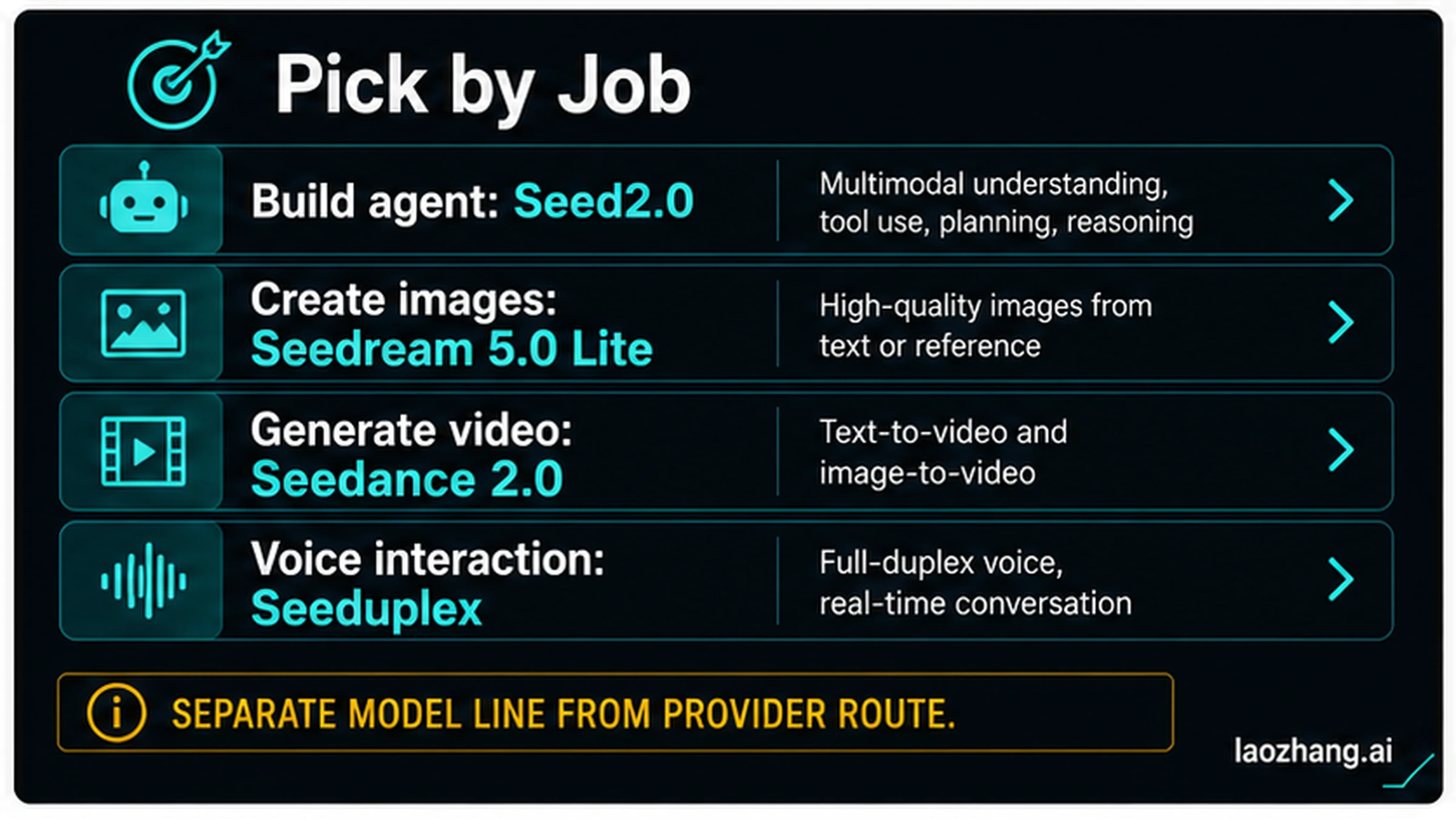
These names are not one comparable tier list. Use Seed2.0 Pro, Lite, or Mini when the job is agentic LLM work or multimodal understanding; use Seedream 5.0 Lite for image generation; use Seedance 2.0 for audio-video generation; use Seeduplex for full-duplex voice interaction; treat Doubao-Seed-1.8 or Seed1.8 as predecessor context, not the default starting point for a new build.
| Reader job | Start with | Why | Verify before build |
|---|---|---|---|
| Agentic LLM, reasoning, tool use, multimodal understanding | Seed2.0 Pro / Lite / Mini | This is the Seed2.0 tier family, so the real choice is capability, latency, and workload size. | Current model IDs, API route, quotas, regional access, and pricing. |
| Image generation from text or references | Seedream 5.0 Lite | ByteDance's public Seedream surface names the current image line as Seedream 5.0 Lite. | Whether the route you use exposes the same model and terms. |
| Audio-video or image-to-video generation | Seedance 2.0 | Seedance 2.0 is the separate Seed video line, not a Seed2.0 tier. | Public access path, provider wrapper limits, and dated price or trial claims. |
| Real-time voice interaction | Seeduplex | Seeduplex is a full-duplex speech LLM route for voice interaction. | App availability, API exposure, latency, safety policy, and rollout region. |
| Historical comparison or migration context | Seed1.8 / Doubao-Seed-1.8 | It helps explain lineage, but it should not own a new implementation decision. | Whether any old benchmark or wrapper claim still matches the current official route. |
As of May 7, 2026, official ByteDance Seed pages and launch posts own the naming boundary. Keep prices, free credits, API availability, quotas, speed, uptime, safety limits, and provider claims out of the first screen unless they have a fresh owner-source check.
Read the family as routes, not a ladder
ByteDance Seed is a research and product family, not a single model with one universal upgrade path. The mistake is to read "Seed2.0 Pro / Lite / Mini, Doubao-Seed-1.8, Seedream 5.0, Seedance 2.0, Seeduplex" as if every name belongs to the same benchmark table. They do not.
The useful map is simpler. Seed2.0 is the current general-purpose agent and multimodal-understanding line. Seedream is the image-generation line, and the public official page currently names the line Seedream 5.0 Lite. Seedance is the video and audio-video generation line; the official Seed page describes Seedance 2.0 as a unified multimodal audio-video generation architecture. Seeduplex is a speech route for full-duplex voice interaction, introduced in ByteDance's April 9, 2026 Seeduplex post. Seed1.8 is useful lineage, but it is the previous agentic model generation.
That framing changes the first question from "Which Seed model is best?" to "Which Seed line owns my job?" Once that is clear, you can compare tiers, access routes, and provider wrappers without mixing unrelated facts.
Seed2.0 is the agent and multimodal-understanding branch
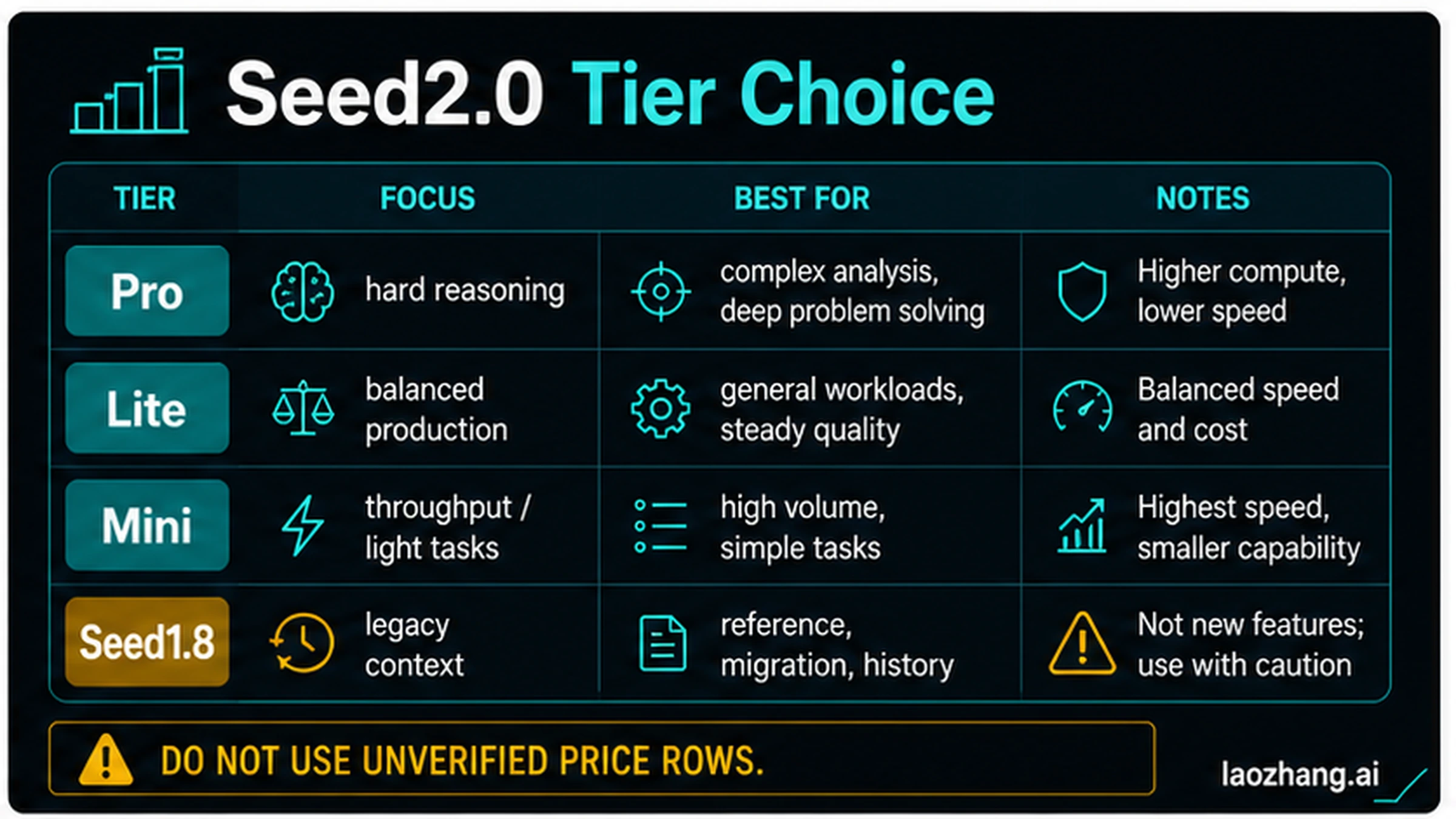
The official Seed2.0 page says Seed2.0 offers three general-purpose agent models in different sizes: Pro, Lite, and Mini. ByteDance's February 14, 2026 Seed2.0 launch post also mentions Seed2.0 Code, which matters for coding-agent and TRAE-oriented contexts, but the normal public choice starts with Pro, Lite, and Mini.
Use Pro when failure cost is high: hard reasoning, deep analysis, complex planning, or tasks where a wrong branch creates expensive cleanup. Use Lite when you need a balanced production default across many normal workloads. Use Mini when the task is light, high-volume, or latency-sensitive and the quality bar can be measured cheaply. None of those choices should be made from a name alone. Run the same task, same data, same success criteria, and same tool conditions before you change a default.
The Seed2.0 GitHub repository reinforces the developer shape: it points to model cards and examples around code agents, search agents, grounding, MCP, multimodal search, and video understanding. That does not mean every reader needs a cookbook here. It means Seed2.0 should be treated as the agentic and multimodal-understanding lane, while specific integration details belong in the current owner docs for the route you actually use.
Seed1.8 and Doubao-Seed-1.8 are predecessor context
Seed1.8 is not irrelevant. ByteDance's Seed1.8 launch post framed it as a generalized agentic model with multimodal input support and a Doubao/Volcano Engine try path. If you are reading older benchmarks, provider catalogs, or Doubao-Seed-1.8 references, that context helps explain why the Seed family moved toward agentic work.
It should not own a new implementation decision. When the listed names are mixed together, the practical question is whether to test Seed2.0, Seedream, Seedance, or Seeduplex first. Seed1.8 belongs in migration notes, legacy comparisons, or "why did the name change?" paragraphs. If a provider page still sells the older label as if it were the current default, treat that as a claim to verify, not as the route owner.
Seedream, Seedance, and Seeduplex solve different jobs
Seedream 5.0 Lite is the image line in this map. The official page describes it as a unified multimodal image generation model, so it belongs in visual creation, image editing, and image-quality comparisons. If your real question is whether to choose Seedream against Google-side image models, use a focused route such as Nano Banana 2 vs Seedream 5.0 Lite or Nano Banana Pro vs Seedream. The family-level decision should stay on model-line ownership, not become another image-model shootout.
Seedance 2.0 is the audio-video generation line. ByteDance's launch material says it supports text, image, audio, and video inputs, with multi-shot audio-video output. For implementation details, move to the narrower Seedance 2.0 API guide. For provider selection, use Seedance 2.0 API providers compared. For free/trial questions, use Seedance 2.0 pricing and free vs paid guide. For likeness and face boundaries, use Seedance 2.0 API real people. Family routing and API-policy routing are different jobs, so they should not be collapsed into one answer.
Seeduplex is the voice-interaction lane. ByteDance describes it as a native full-duplex speech LLM with listen-while-speaking behavior, interference suppression, and adaptive endpoint detection. That makes it relevant when the job is real-time voice conversation, turn-taking, and low-latency interaction. Do not assume that a speech research announcement automatically gives you the same public API route, pricing, or regional availability as another Seed line. Verify the surface where you will actually build.
Separate official identity from access route
The most expensive mistake is to copy one provider table into every Seed decision. Official identity answers "what is this model line?" Access route answers "where can I call it, under which terms, with which model ID?" Those are different contracts.
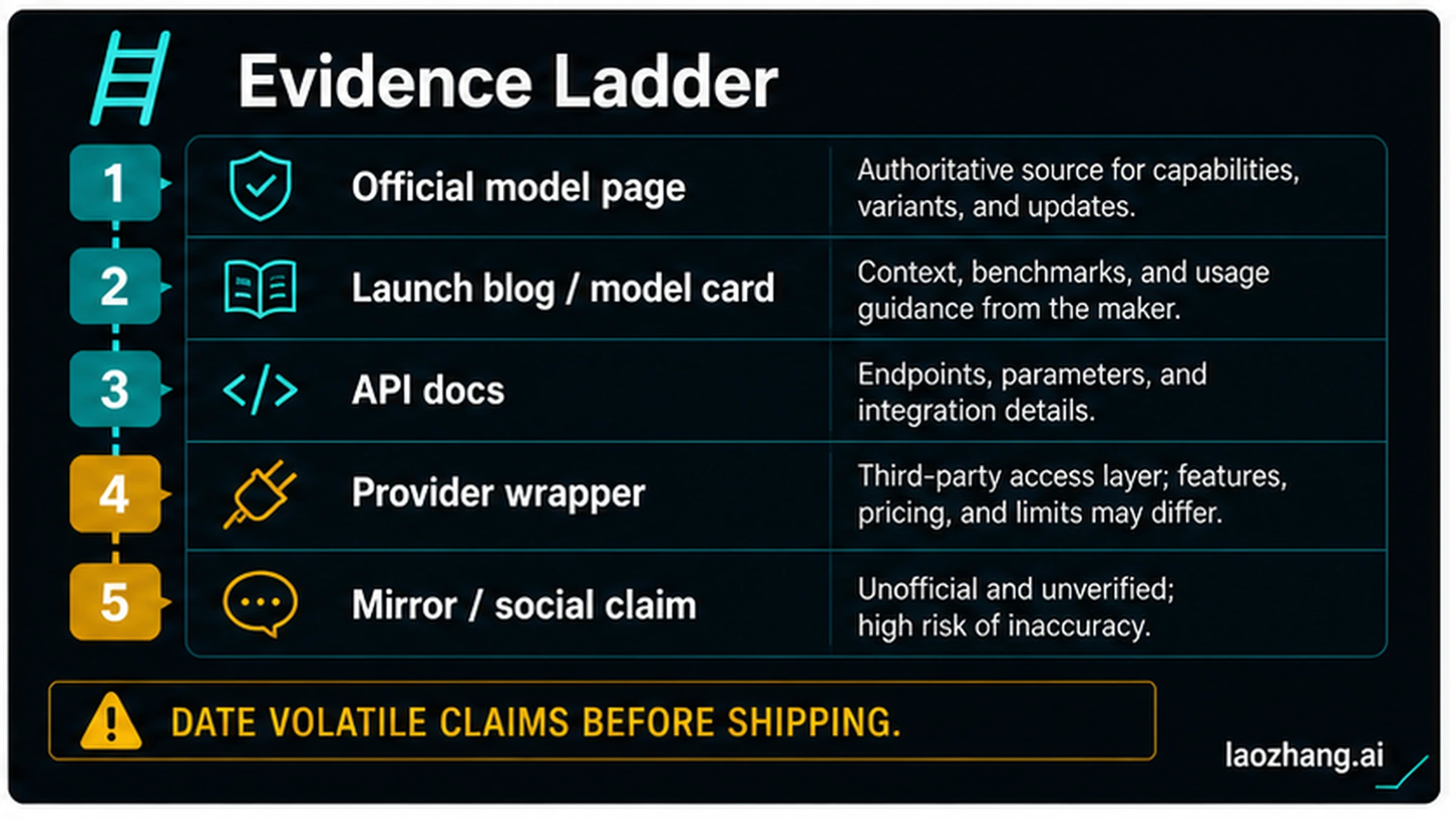
Use first-party Seed pages and ByteDance launch posts for model names, release context, and capability boundaries. Use API-owner documentation for endpoint, model ID, quota, region, billing, input format, and safety rules. Use provider wrappers as implementation options only after the wrapper states exactly what model it exposes and which owner contract it inherits or changes. Use social posts, mirrors, and SEO catalog pages as weak discovery signals, not as proof.
For Seedance, this distinction is especially important because public provider and wrapper pages are common. A wrapper can be useful, but it cannot turn a price, "free" claim, or availability claim into an official ByteDance fact. For Seedream, the naming distinction matters too: "Seedream 5.0" is a common shorthand, but the official public model page checked for the current naming boundary is Seedream 5.0 Lite.
A safe evaluation plan
After you route the job, compare only inside the relevant lane. For Seed2.0, test Pro, Lite, and Mini on the same prompts, same retrieval/tool setup, same data, and same pass/fail rubric. Measure answer quality, task completion, latency, retry rate, and human review time. If Mini passes, you get a cheaper or faster default. If Lite passes and Pro does not add measurable value, keep Lite. If Pro is the only tier that clears hard reasoning or tool-use risk, pay for that only where the risk exists.
For Seedream, evaluate visual fidelity, prompt control, text rendering, reference adherence, editing reliability, and production cost on the exact asset class you need. For Seedance, evaluate temporal consistency, input modality, reference control, portrait policy, provider queue behavior, output retention, and whether your route gives enough operational evidence. For Seeduplex, evaluate interruption handling, latency, noise robustness, turn-taking, and whether the user experience still feels natural under real microphone conditions.
The same-task rule keeps the decision honest: never change defaults because one demo looks strong. Change defaults when the same workload, same constraints, and same evaluation criteria show a repeatable win.
FAQ
Is Seedance 2.0 part of Seed2.0?
No. Seedance 2.0 belongs to the ByteDance Seed family, but it is a separate audio-video generation line. Seed2.0 Pro, Lite, and Mini are the agentic LLM and multimodal-understanding tier choices.
Is Seedream 5.0 the official name?
The public official model page checked for the current naming boundary names the model Seedream 5.0 Lite. "Seedream 5.0" can be a useful shorthand in search or provider pages, but the factual owner should use Seedream 5.0 Lite unless a newer official source changes the name.
Should I use Seed1.8 or Seed2.0 for a new build?
Start with Seed2.0 unless your job is specifically a legacy comparison, migration, or older Doubao route check. Seed1.8 explains lineage, but current route choice should not default to a predecessor label.
Which source should I trust first?
Trust official ByteDance Seed pages and launch posts for model identity. Trust the route owner's API docs for endpoints, IDs, quotas, region, and pricing. Treat provider wrappers and mirror pages as claims that need verification.
Where should implementation readers go next?
For video API implementation, start with How to Call the Seedance 2.0 API. For route selection across vendors, use Seedance 2.0 API providers compared. For image-model comparison, use Nano Banana 2 vs Seedream 5.0 Lite.