Gemini 3.1 Flash Image Preview vs Seedream 5.0 Lite: Which Image API Fits Your Workflow in 2026?
If your image workflow needs current information from Google Search and explicit 0.5K-to-4K sizing, start with Gemini 3.1 Flash Image Preview. If you need cheaper flat per-image pricing and multiple-reference workflows, start with Seedream 5.0 Lite.
On this page
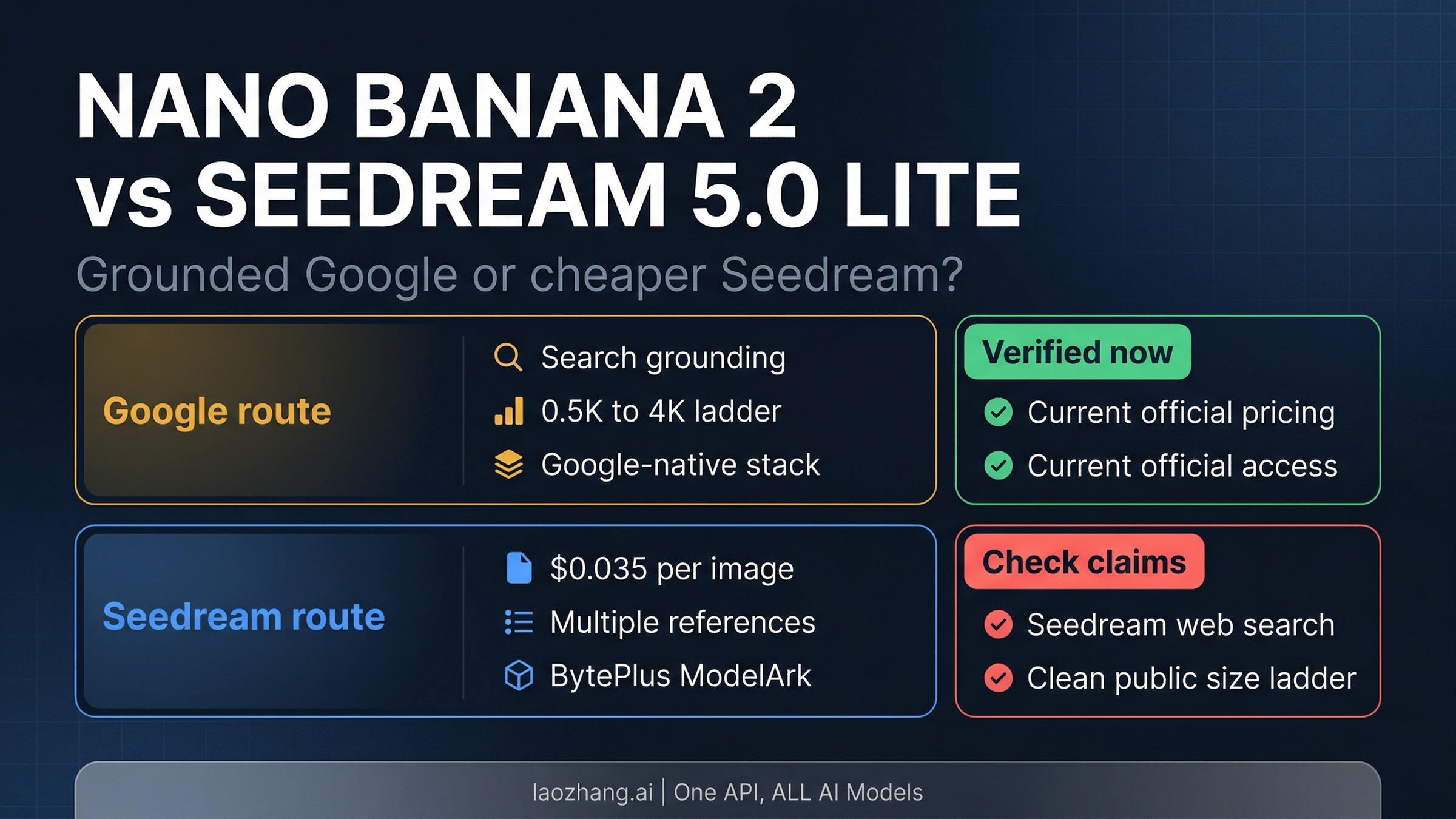
If your image workflow needs current information from Google Search plus an official output ladder from 0.5K through 4K, start with Gemini 3.1 Flash Image Preview. If your priority is lower per-image cost and multiple-reference image workflows, start with Seedream 5.0 Lite.
As of April 3, 2026, Google's current Gemini docs explicitly list Search grounding support and size-tier pricing for gemini-3.1-flash-image-preview. BytePlus's current Seedream pages list Seedream 5.0 Lite at $0.035 per image and expose text-to-image, image-to-image, multiple reference images, and batch generation through the current ModelArk surfaces. If you reached this page through the Nano Banana 2 alias, map that Google-side name to Gemini 3.1 Flash Image Preview and compare the current official routes from there.
This is not a useful place to force a universal image-quality winner. For most teams, the practical question is simpler: should you start with Google's route for current-information generation and explicit size control, or with BytePlus's cheaper route for reference-heavy work?
The 30-Second Route Split
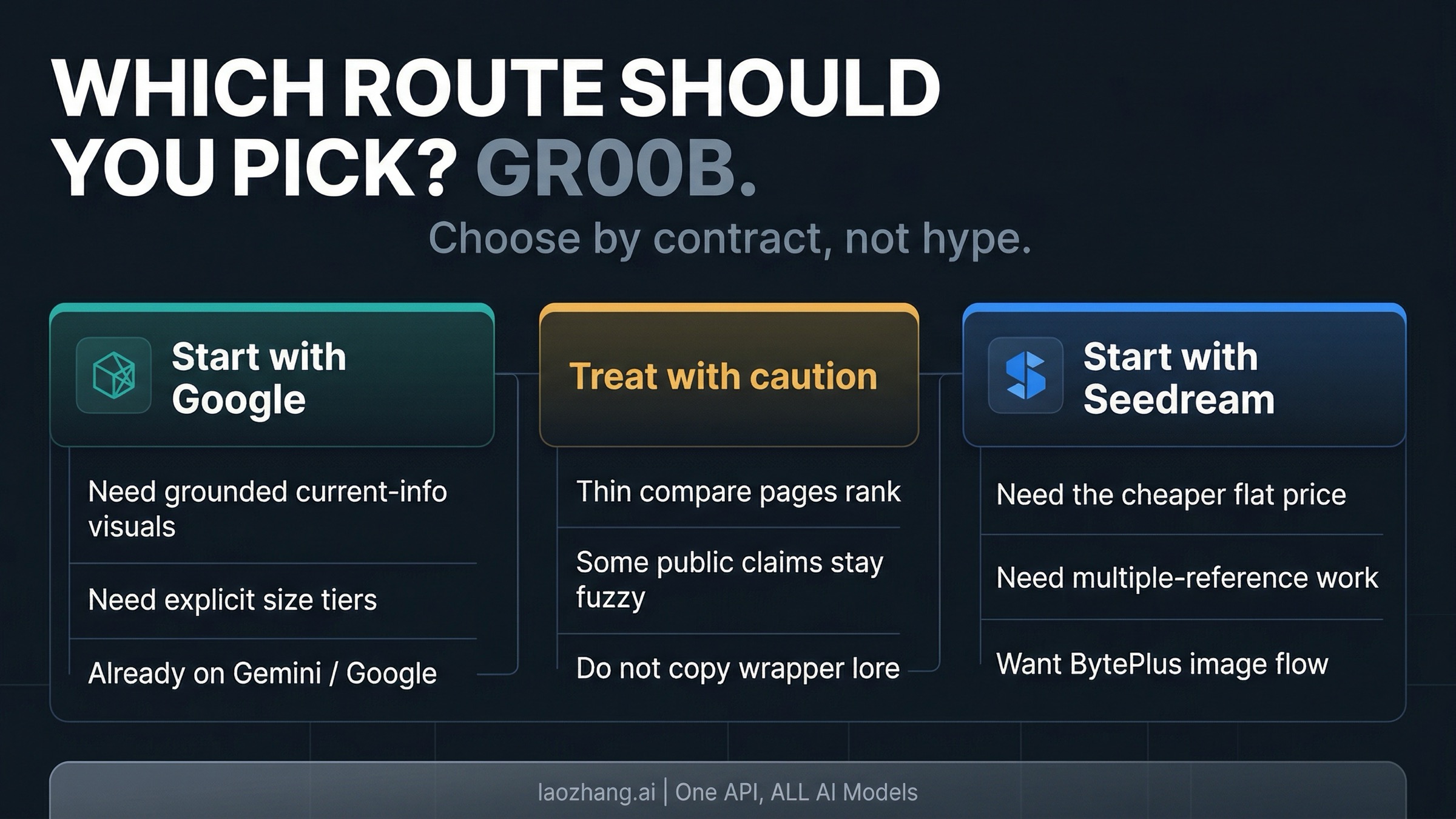
Start with Google when the work depends on grounded current-information generation, an explicit size ladder, or a stack you already run inside Gemini and Google's API ecosystem. Google is unusually clear on two decision drivers that many comparison pages blur together: it explicitly supports Search grounding on the image side, and it publishes a size ladder with current per-size pricing. If the workflow needs an auditable answer to "what does the official route actually promise today?", that clarity matters more than hype.
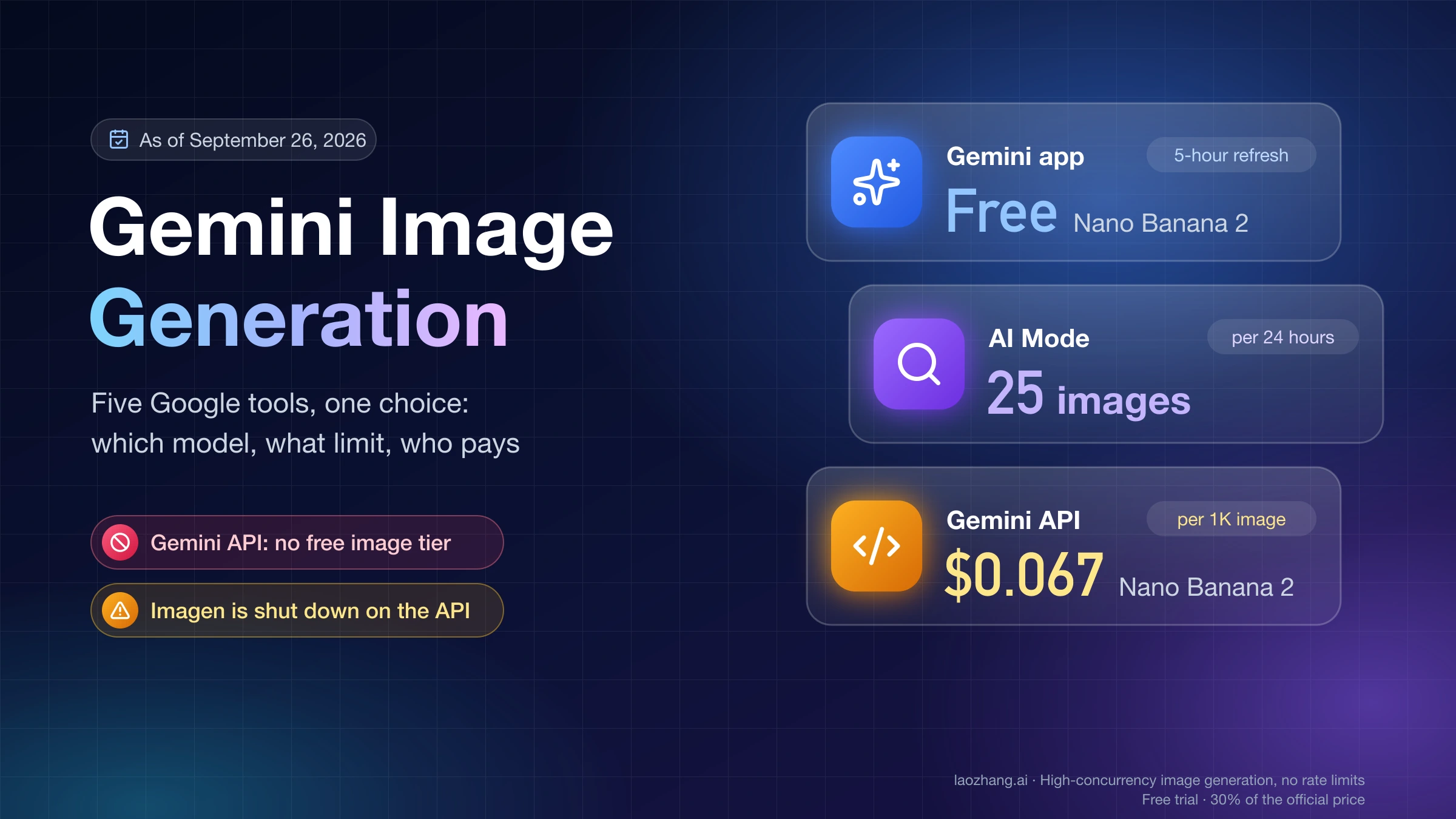
Start with Seedream when the stronger constraint is flat per-image cost and reference-heavy image workflows. As of April 3, 2026, BytePlus lists Seedream 5.0 Lite at $0.035 per image, while Google's standard Gemini 3.1 Flash Image Preview pricing is about $0.067 for 1K, $0.101 for 2K, and $0.151 for 4K. That is not a small difference if your team is generating at scale or iterating through many reference-driven drafts.
There is one important nuance on the Google side: if your workflow can queue work, Google's batch image pricing narrows the gap sharply. The current pricing page lists batch image output at about $0.034 for 1K, $0.050 for 2K, and $0.076 for 4K on Gemini 3.1 Flash Image Preview. That still does not turn Google into the simpler flat-price route, but it does mean the cost story changes if you are comfortable with asynchronous batch work instead of interactive generation.
The caution lane matters too. Some public comparison pages now treat Seedream's web search story as fully settled product truth. The current official BytePlus pages do not confirm that as cleanly as Google's docs confirm Search grounding on the Gemini side. If that specific capability is central to your decision, treat it as a re-check item rather than an established fact.
What You Are Actually Comparing
On the Google side, the route you actually need to evaluate is Gemini 3.1 Flash Image Preview, whose current model code is gemini-3.1-flash-image-preview. That is the surface where Google documents the price ladder, output sizes, and Search grounding support. If your team arrived here from Nano Banana 2 comparisons, this is the official model surface that matters.
On the Seedream side, the useful public route is Seedream 5.0 Lite, with the current ModelArk surfaces exposing seedream-5-0-260128 and the Lite alias seedream-5-0-lite-260128. That means the real choice is not nickname versus nickname. It is Google's documented grounded-image route versus BytePlus's cheaper, reference-oriented route.
That framing changes real implementation decisions. The Google route means AI Studio and the Gemini API, documented size tiers, and separate grounding charges after the shared free allowance. The Seedream route means BytePlus and ModelArk surfaces, a different rate-limit shape, and flatter per-image pricing. Once the comparison is stated at the route and surface level, the decision gets much cleaner.
The Verified Differences That Actually Change the Choice
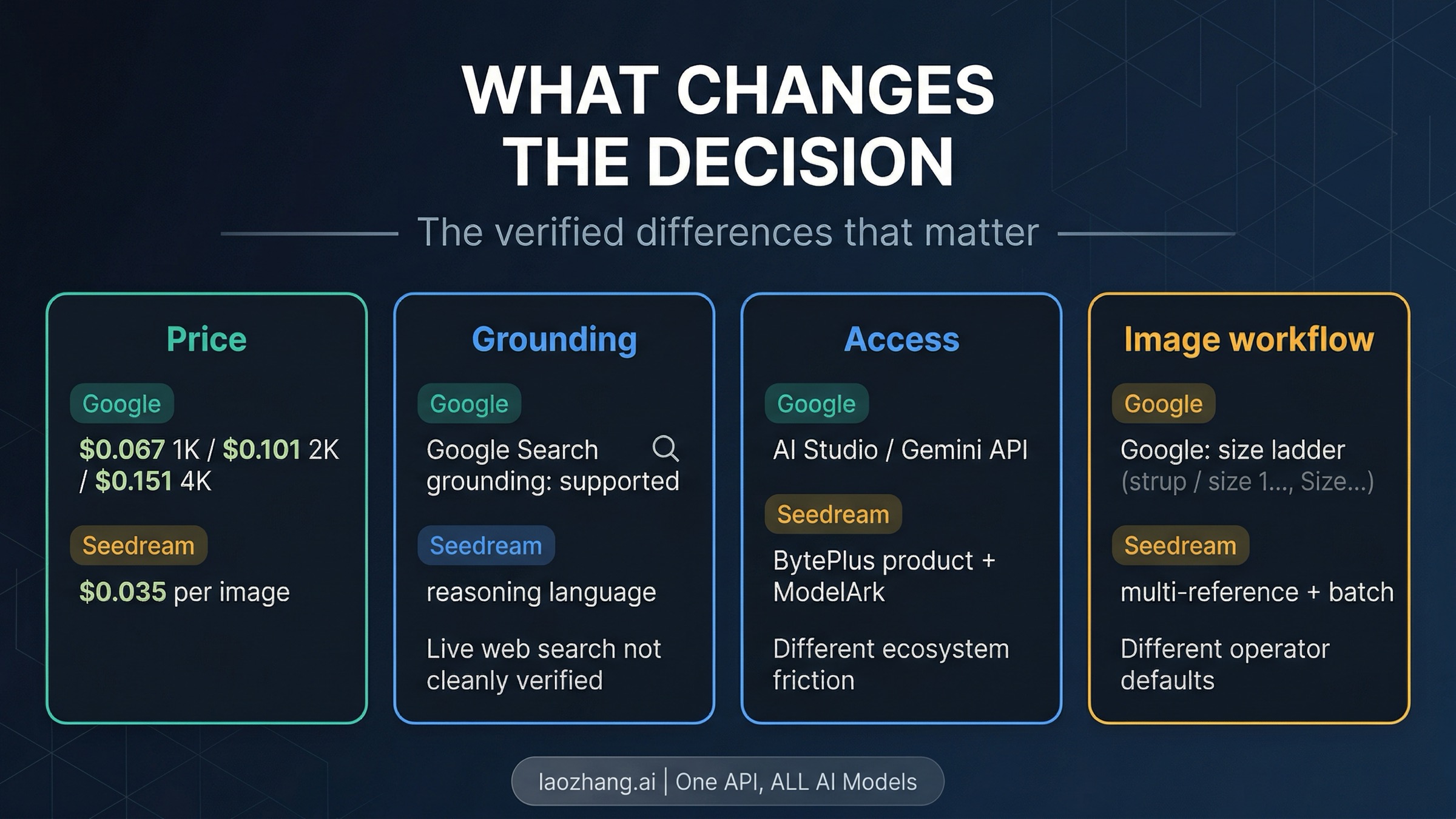
Without paid side-by-side generation tests, the safest comparison is one current official route against another. That still gives you enough to make a strong choice, because the practical differences are not subtle.
| Decision driver | Gemini 3.1 Flash Image Preview | Seedream 5.0 Lite | Why it matters |
|---|---|---|---|
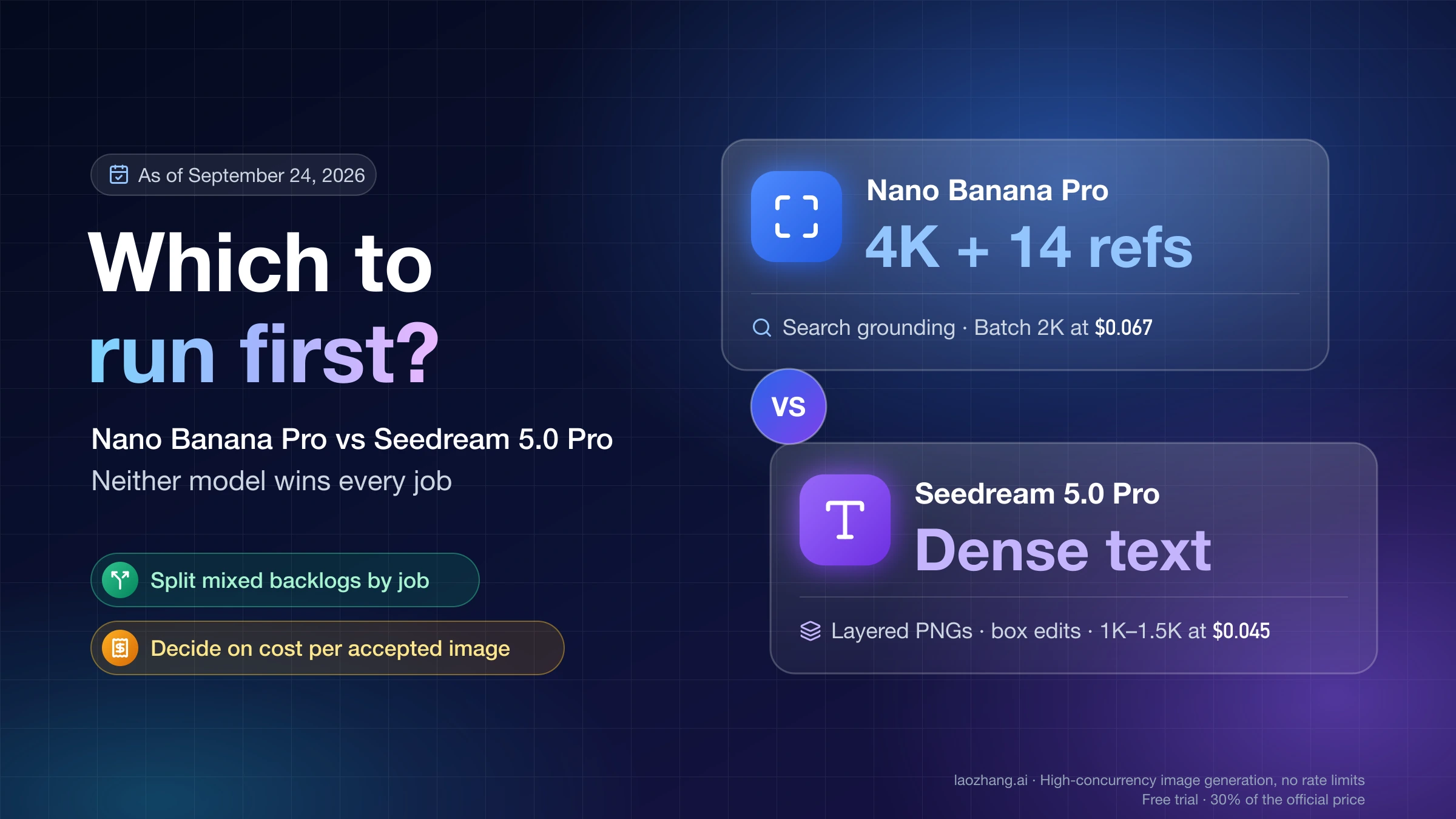
| Price shape | Standard pricing on April 3, 2026: $0.045 for 0.5K, $0.067 for 1K, $0.101 for 2K, $0.151 for 4K; lower again in batch mode | Public pricing on April 3, 2026: $0.035 per image | Google gives explicit size control; Seedream gives the simpler public cost story |
| Grounding / current information | Google explicitly documents Search grounding support | Current official docs do not cleanly verify the same built-in web-search support | If current-information grounding is essential, Google is easier to trust from docs alone |
| Access path | AI Studio and Gemini API | BytePlus product surface and ModelArk | Tooling, billing, and ops friction differ even before output quality enters the conversation |
| Image workflow | Explicit size ladder with a Google-native route | Text-to-image, image-to-image, multiple reference images, batch generation, and a documented 500 IPM rate limit | Seedream's published workflow emphasis is more reference-heavy; Google's is more explicit about size and grounding |
The first consequence is that Google's route is more legible. If you need a documented answer to what size you can ask for, what it costs, and whether grounded search exists on the image route, Google publishes all three. That makes the Google path the safer default for teams that need to defend decisions internally or build on top of a clearly documented route.
The second consequence is that Seedream's route is easier to justify on interactive price. Flat per-image pricing is easier to budget than a size ladder, and the public docs also emphasize multiple reference images and batch generation. If your daily work looks like high-volume variant creation, reference-based generation, or a cheaper experimentation lane beside a premium stack, that public route is easy to understand.
The third consequence is that the cost story is not one-dimensional. Google's standard route is plainly more expensive at common sizes, but Google's batch pricing can come close to Seedream for queued work. Seedream still wins on public simplicity, while Google becomes more competitive when the team can trade speed for lower batch cost.
The last difference is the honesty boundary. The current Google docs are explicit about grounding and output sizes. The current BytePlus docs are explicit about pricing, references, batch generation, and model access. They are not equally explicit about every promotional claim now circulating in comparison pages. That difference should shape the way you trust the market around each route.
Choose Google When...
Choose Google when the workflow needs grounded generation more than it needs the lowest possible image price. The clearest example is any image task that depends on current, externally anchored information: factual visual explainers, current-product mockups, diagrams that should reflect live terminology, or any pipeline where the team will ask, "What does the official route actually support right now?" Google gives you a cleaner answer because the current docs explicitly say Search grounding is supported.
Google is also the stronger route when output size control matters to the implementation itself. On April 3, 2026, Google's Gemini 3.1 Flash Image Preview page and pricing page together make it clear that the route supports 0.5K, 1K, 2K, and 4K, with 1K as the default. That matters for teams that know in advance whether they are optimizing for cheaper drafts, mid-size production assets, or expensive 4K outputs. If that sizing decision is part of your workflow, the Google side is unusually explicit.
The ecosystem question matters too. If your stack already lives in AI Studio, the Gemini API, or broader Google tooling, the Google route keeps naming, billing, and integration logic inside one family. That alone can outweigh the higher standard per-image cost. A route that is slightly more expensive but much easier to reason about often wins in production.
There is also a scale nuance worth keeping in mind. Google's pricing page says Search grounding gets 5,000 free prompts per month shared across Gemini 3, then shifts to $14 per 1,000 search queries. If your workflow uses grounding heavily, that charge belongs in the budget. On the other hand, if your workload can be queued instead of generated interactively, Google's batch image pricing narrows the image-cost gap enough to make the route more defensible than a simple top-line price comparison suggests. Readers who want the deeper Google-only resolution story can continue with our Nano Banana 2 4K route guide.
Choose Seedream When...
Choose Seedream when lower flat price and reference-heavy workflows matter more than Google's route for grounded current-information generation. As of April 3, 2026, BytePlus lists Seedream 5.0 Lite at $0.035 per image and offers 50 free image generations on the product page. That is the kind of public pricing story that makes budget approval much easier, especially for teams iterating through many drafts rather than shipping a smaller number of premium outputs.
Seedream is also the more obvious route when the workflow revolves around image-to-image transformation and multiple reference images. The current ModelArk docs describe text-to-image, image-to-image, multiple reference images, batch generation, and a 500 IPM rate limit. That does not prove Seedream wins every output-quality contest, but it does show where the public workflow emphasis sits. If the job is "take a set of references and generate many cheap controlled variants," Seedream's published route aligns well with that use case.
The simpler public price story has another operational advantage: it is easy to treat Seedream as a default experimentation lane. A team can keep a premium or grounded Google route for the moments that truly need explicit size control or current-information support, while using Seedream as the cheaper daily workhorse. That split makes more sense than forcing one model to behave like the answer to every image task.
The caveat is the trust boundary. The current official pages clearly confirm price, Lite naming, the free-generation callout, the model IDs, and the reference-image and batch workflow surfaces. They do not equally confirm a clean built-in live web-search story. If that feature is the reason you are choosing Seedream, verify it directly before you lock the route.
Claims to Treat Carefully
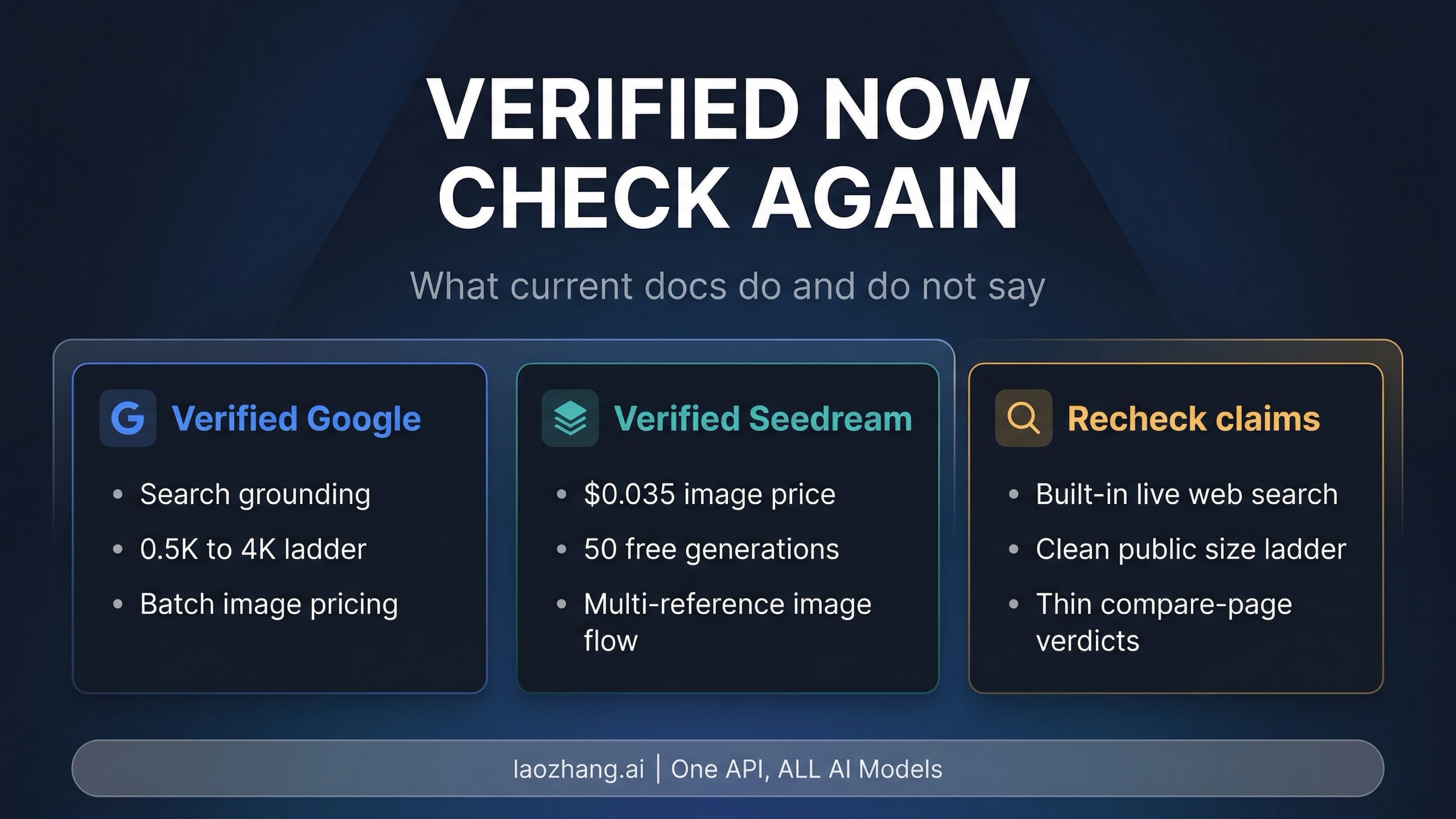
The most useful thing this page can do is draw a cleaner boundary between what current official pages actually say and what the comparison market keeps repeating.
The first claim to treat carefully is Seedream 5.0 has built-in live web search. That idea appears often in public comparison pages, but the current BytePlus product and ModelArk pages do not verify it as cleanly as Google's docs verify Search grounding for Gemini. That does not prove the claim is false. It means the official evidence visible today is not strong enough to treat it as settled product truth.
The second claim to treat carefully is any neat public resolution ladder for Seedream that mirrors Google's 0.5K / 1K / 2K / 4K language. Google's image docs are explicit about size options. The current public BytePlus pages checked here are not equally explicit. If your decision depends on a precise documented size ladder, treat Google as the clearer route unless you verify newer Seedream docs yourself.
The third claim to treat carefully is any universal quality winner statement. There are no paid side-by-side prompt tests behind this comparison, so it does not pretend to know which route wins every real-world output contest. The honest comparison is what the current official docs establish today: Google is clearer on grounding and size tiers; Seedream is cheaper in the public route and stronger in the public reference-workflow story.
Bottom line
If you want the shortest defensible answer on April 3, 2026, it is this: start with Gemini 3.1 Flash Image Preview when current-information generation via Google Search, explicit size tiers, and a Google-native route matter most. Start with Seedream 5.0 Lite when lower flat per-image cost and multiple-reference workflows matter more.
That also explains why so many public comparisons feel unsatisfying. They try to flatten two different routes into one generic winner table. A better default is to treat Google as the clearer grounded route and Seedream as the cheaper reference-heavy route, then re-check any claim that the official pages do not spell out cleanly. If you do that, the comparison becomes useful again.