Nano Banana Pro Rate Limit Guide 2026: Every Tier, Quota & RPM Explained

A
20 min readAI Image Generation

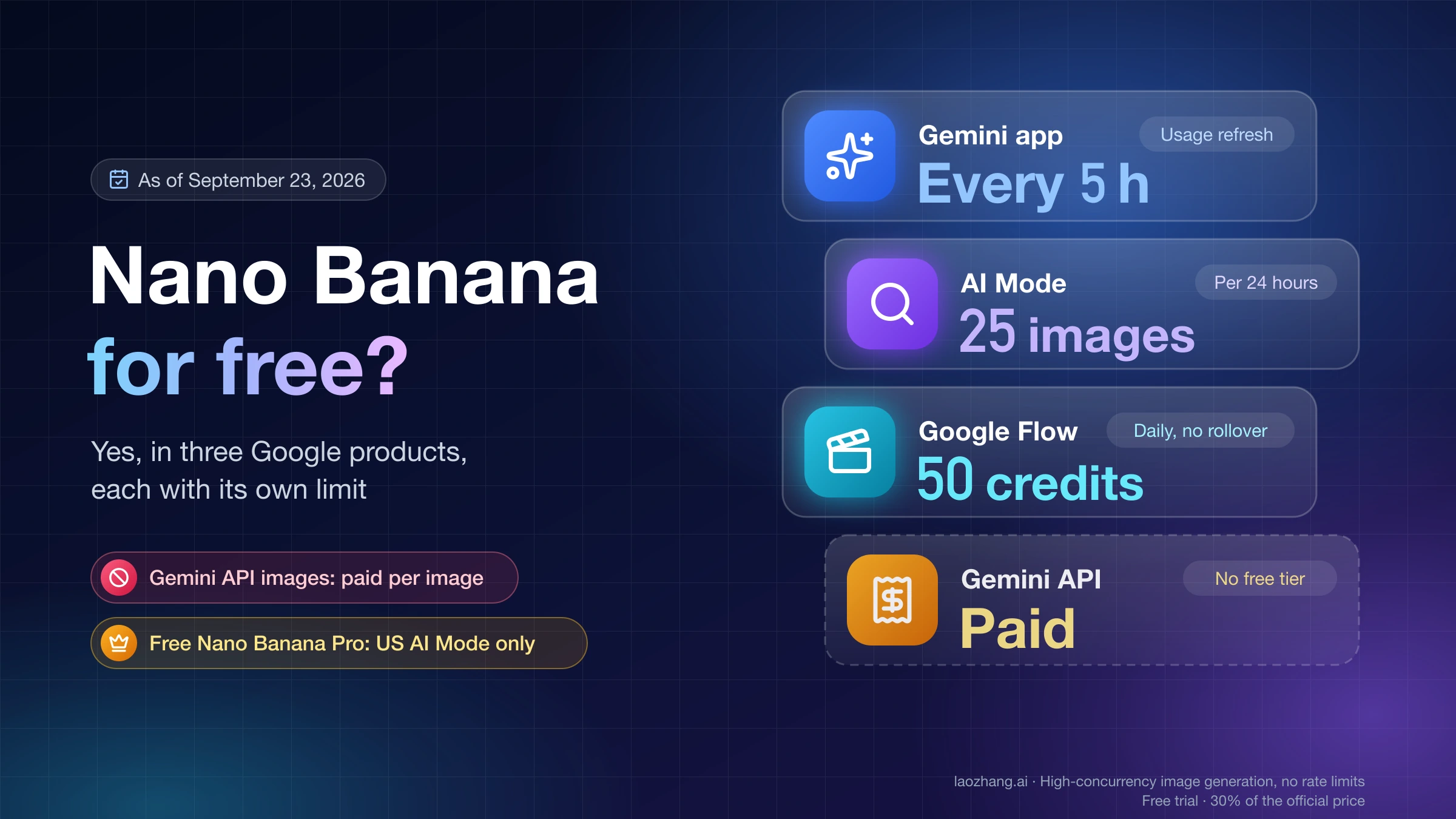
As of February 2026, Nano Banana Pro rate limits vary significantly across tiers. Free users get 2 images per day in the Gemini app, while API developers face 5-10 RPM on the free tier. Google AI Pro subscribers ($19.99/month) receive approximately 100 images daily, though real-world limits often fall between 20-80 depending on server load. This guide covers every tier, explains quota mechanics, and provides a cost-effective decision framework.

Nano Banana Pro Rate Limit Guide 2026: Every Tier, Quota & RPM Explained

As of February 2026, Nano Banana Pro rate limits vary significantly across tiers. Free users get 2 images per day in the Gemini app, while API developers face 5-10 RPM on the free tier. Google AI Pro subscribers ($19.99/month) receive approximately 100 images daily, though real-world limits often fall between 20-80 depending on server load. The API's paid Tier 1 offers up to 300 RPM with 10,000 RPD. These numbers have changed multiple times since Nano Banana Pro launched in November 2025, and this guide tracks every update through February 2026.

TL;DR

Here is the complete rate limit reference for every Nano Banana Pro tier as of February 22, 2026. This table is updated regularly as Google continues to adjust quotas across both consumer and API access points.

TierPriceDaily Images (App)API RPMAPI RPDResolution
Free$025-1050-1001K
AI Plus$7.99/mo~50Same as FreeSame as FreeUp to 2K
AI Pro$19.99/mo~100 (real: 20-80)100-300Up to 10,000Up to 2K
AI Ultra$249.99/mo1,000300+CustomUp to 4K

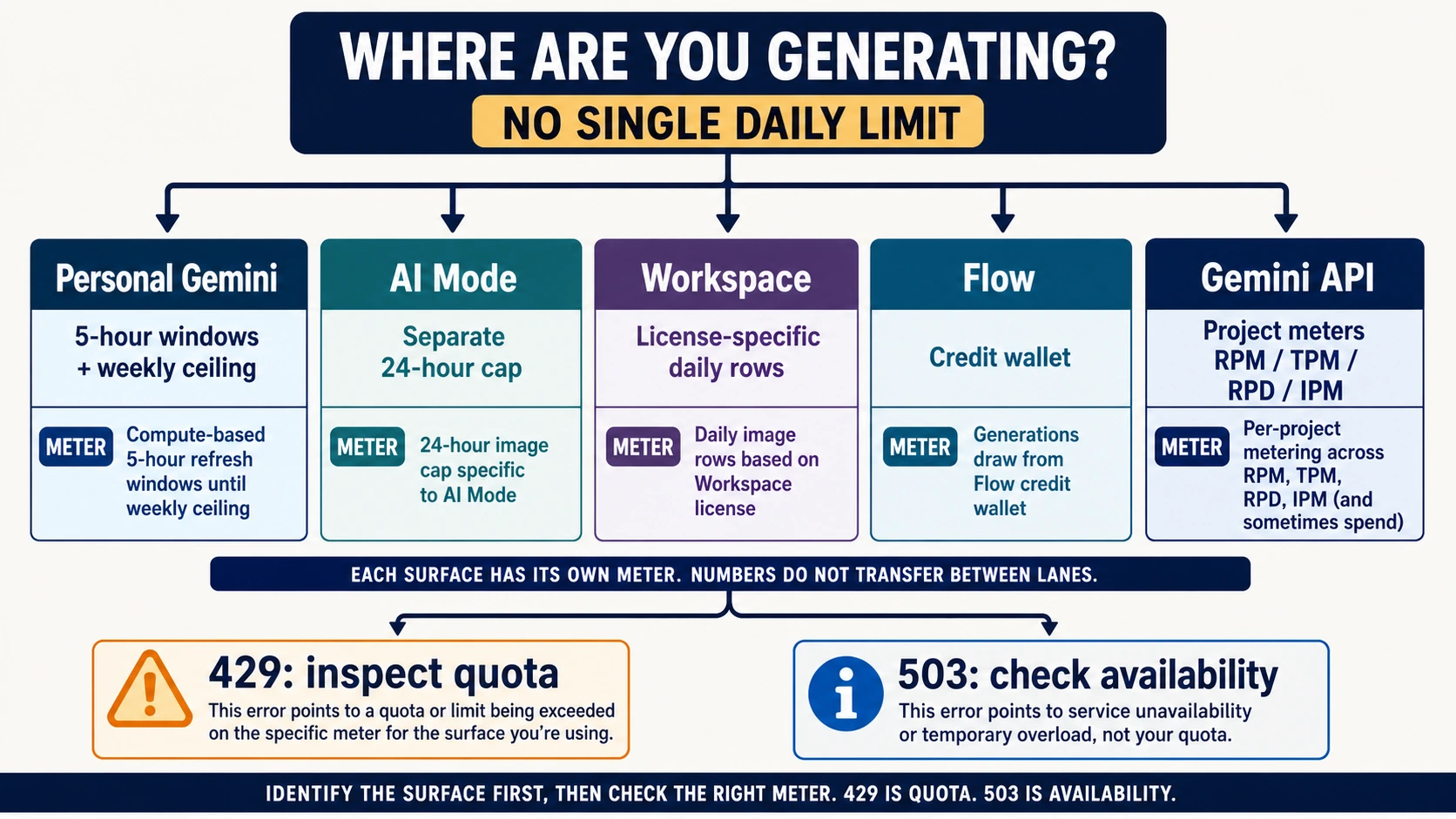
The most important distinction that most guides miss is the separation between consumer app limits (images per day in the Gemini app) and API rate limits (RPM and RPD for developers). These are completely different systems with different quotas, and confusing them leads to incorrect planning decisions. If you are building an application that needs reliable, high-volume image generation without worrying about fluctuating quotas, skip directly to the alternatives section for production-ready solutions.

Complete Subscription Tier Limits (February 2026)

Official vs real-world daily image limits comparison across all Nano Banana Pro subscription tiers

Understanding Nano Banana Pro's subscription tiers requires separating what Google officially advertises from what users actually experience in practice. This gap between promised and real-world performance has been one of the most frustrating aspects of Nano Banana Pro since its launch. The four subscription tiers, Free, AI Plus, AI Pro, and AI Ultra, each offer different levels of access to image generation through the Gemini consumer app, and the actual limits you encounter can vary significantly depending on server load, time of day, and even your geographic location.

Free Tier ($0/month)

The free tier is the most restrictive option available, and it has become even more limited since Nano Banana Pro's initial release. As of February 2026, free users can generate a maximum of 2 images per day through the Gemini app, down from the original 3 images per day that were available at launch in November 2025. These images are limited to 1K (approximately 1 megapixel) resolution, which means you cannot access the higher-quality 2K or 4K output that paid subscribers enjoy. Google reduced this limit as part of the broader December 2025 quota adjustments that affected all tiers. For most users, 2 images per day is barely enough for casual experimentation, and it is certainly not sufficient for any kind of content creation workflow. The free tier does, however, give you access to the full Nano Banana Pro model quality, so the images you generate are identical in terms of AI capability to those produced by paid subscribers, just at lower resolution and with a severe daily cap.

AI Plus Tier ($7.99/month)

Google launched the AI Plus tier in early 2026 as a more affordable entry point into paid AI features, and it represents a significant upgrade from the free tier for image generation. At $7.99 per month, AI Plus subscribers get approximately 50 images per day with access to 2K resolution output. This tier was created to fill the gap between the extremely limited free tier and the more expensive AI Pro subscription, and it has quickly become popular among casual content creators who need more than 2 images daily but do not require the full capacity of the Pro plan. The real-world limit for AI Plus tends to be more stable than Pro, with most users reporting consistent access to 30-50 images per day. One important caveat is that AI Plus is a consumer-only benefit: it does not unlock any additional API quota beyond the standard free tier limits, so developers looking for increased API access need to look at the paid API tiers instead. For a detailed comparison of Nano Banana Pro Free vs Pro tiers, including pricing analysis and feature differences, check our dedicated comparison guide.

AI Pro Tier ($19.99/month)

AI Pro is the tier that most serious image creators gravitate toward, offering approximately 100 images per day at up to 2K resolution. However, the gap between Google's official limit and what users actually experience has been a persistent source of frustration. Real-world reports from Reddit and community forums consistently show that AI Pro users generate anywhere from 20 to 80 images per day before hitting throttling, depending heavily on server load and time of day. During peak hours, particularly weekday afternoons in US time zones, the effective limit can drop to as low as 20 images. This variability is not a bug but rather a feature of Google's dynamic resource allocation system, which adjusts quotas in real time based on overall system demand. Despite this inconsistency, AI Pro remains the most cost-effective option for users who need moderate daily image generation capacity and do not want to commit to the $249.99 Ultra pricing.

AI Ultra Tier ($249.99/month)

The AI Ultra tier sits at the top of Google's consumer offering, providing access to 1,000 images per day with full 4K resolution support. At $249.99 per month, this is a premium subscription aimed at professional creators and businesses that need high-volume, high-resolution image output. Ultra subscribers consistently report more reliable quota access than Pro users, though real-world limits during extreme peak periods can still drop to around 500-800 images per day. The 4K resolution capability is exclusive to this tier and produces images at approximately 8 megapixels, which is suitable for print-quality output and large-format displays. One important detail that is rarely mentioned in other guides is that 4K generation consumes approximately 1.5 to 2 times the quota of standard resolution images, so users who exclusively generate 4K content will find their effective daily limit reduced to roughly 500-700 images even within the official 1,000-image allocation. Google positioned this tier as a replacement for the former Google One AI Premium plan, and the rebranding to AI Ultra happened alongside the launch of the new tier structure in late 2025. For most individual users, the $249.99 price point is difficult to justify unless they are generating images at a professional or commercial scale, and the alternative of using a paid API tier often provides more cost-effective access at similar or higher volumes.

Why Nano Banana Pro Rate Limits Keep Changing

Since Nano Banana Pro launched on November 20, 2025, Google has adjusted rate limits at least six times in just three months. This pattern of frequent changes has left users unable to plan around stable quotas, and understanding the timeline helps predict what might come next. The underlying reason is straightforward: Nano Banana Pro is computationally expensive to run. Each image generation request requires significant GPU resources, and Google is continuously balancing user demand against infrastructure costs and capacity constraints. Unlike text generation, which can be served relatively cheaply at scale, image generation imposes a much heavier computational burden, and Google has been iterating on pricing and quota models in real time to find a sustainable equilibrium.

To understand the economics behind these changes, consider that a single Nano Banana Pro image generation request consumes roughly 10-50 times more GPU compute than a typical text generation request of comparable input length. Google operates one of the world's largest GPU clusters, but even their infrastructure faces capacity constraints when millions of users request image generation simultaneously. The December 2025 quota crisis was widely attributed to the surge of new users who discovered Nano Banana Pro through viral social media posts, overwhelming the infrastructure that had been provisioned for a more gradual adoption curve. Google's response has been to implement dynamic rate limiting that adjusts in real time based on system load, which explains why users see different effective limits at different times of day.

The complete timeline of rate limit changes tells a clear story of progressive tightening. At launch in November 2025, free tier users could generate 3 images per day, and the API free tier offered approximately 1,000 RPD. Within the first week, on November 26, 2025, the API RPD was cut from 1,000 to 250 for several model variants. The most dramatic change came on December 7-8, 2025, when Google slashed free tier quotas across Google AI Studio by 50-80%, triggering what the community dubbed the "December quota crisis." Pro subscribers were particularly vocal about this change, as their real-world limits dropped significantly below advertised numbers. January 2026 brought further reductions, with a Reddit report from January 30 indicating that AI Studio limits for Nano Banana Pro were reduced to 100 RPD on the free tier. Then in February 2026, Google partially reversed course by adding Nano Banana Pro to the free API tier with 1,500 RPD, though the RPM limit remained at a strict 5-10 requests per minute.

DateChangeImpact
Nov 20, 2025Nano Banana Pro launchesFree: 3 img/day, API: ~1,000 RPD
Nov 26, 2025API RPD reducedRPD dropped from 1,000 to 250
Dec 7, 2025Free tier slashed 50-80%December quota crisis begins
Dec 8, 2025Pro users hit hardReal-world Pro limits drop significantly
Jan 30, 2026AI Studio limits reducedFree API: 100 RPD
Feb 2026Nano Banana Pro added to free tierFree API: 1,500 RPD, but 5-10 RPM

Looking at this pattern, there are several important takeaways for anyone building on Nano Banana Pro. First, quotas have generally trended downward for free tiers and stabilized for paid tiers, which suggests Google is pushing users toward paid access. Second, changes happen without warning and without official announcements, typically surfacing first through user reports on Reddit's r/Bard community. Third, the February 2026 addition of free API access with 1,500 RPD suggests Google may be experimenting with a model that offers generous daily limits but strict per-minute throttling, essentially allowing hobbyist usage while preventing abuse. For production applications, the lesson is clear: do not build your infrastructure around free tier quotas, because they will change. Either commit to a paid API tier with negotiated limits or use a third-party API provider that offers stable, contractual rate guarantees.

API Rate Limits Deep Dive: RPM, RPD, and IPM

API rate limits breakdown showing RPM, RPD and IPM across Free, Paid and Enterprise tiers

The API rate limit system is entirely separate from the consumer app quotas discussed above, and it uses different metrics that developers need to understand thoroughly before building applications. Google's API rate limiting operates on three primary dimensions: Requests Per Minute (RPM), which controls burst speed; Requests Per Day (RPD), which controls total daily volume; and Images Per Minute (IPM), a less commonly discussed metric that specifically tracks image generation throughput. Getting your API key set up correctly is the first step, but understanding these limits is what determines whether your application will scale successfully.

Free API Tier

The free API tier through Google AI Studio has undergone the most dramatic changes of any access level. As of February 2026, free API users have access to Nano Banana Pro with approximately 5-10 RPM and a daily quota that has fluctuated between 0 RPD (during the December 2025 crisis) and 1,500 RPD (the most recent February 2026 addition). The RPM limit is particularly restrictive because it means you can send at most one image generation request every 6-12 seconds, making real-time applications effectively impossible on the free tier. Each request also consumes tokens based on both input and output, and image generation requests are significantly more token-heavy than text requests. For a complete overview of what the free tier includes beyond image generation, see our Gemini API free tier guide, which covers text, code, and multimodal capabilities as well.

Paid API access through Google AI Studio operates on a pay-as-you-go model with tiered rate limits that increase based on your usage history and spending. Tier 1 starts at approximately 100-300 RPM with up to 10,000 RPD, which is sufficient for most small to medium production applications. The pricing for Nano Banana Pro image generation through the API works out to approximately $0.134 per standard image or $0.067 per image when using the batch API, making it competitive with other image generation services at moderate volumes. Higher tiers offer 300+ RPM and custom RPD limits, but these require establishing a spending history with Google and may involve direct contact with the sales team for quota increases. Enterprise customers accessing Nano Banana Pro through Vertex AI can negotiate custom limits that exceed the standard tier structure, though specific enterprise pricing is not publicly disclosed and varies based on committed spend levels.

Understanding IPM and Resolution Impact

Images Per Minute (IPM) is a metric that Google uses internally but rarely discusses in documentation, yet it directly affects how many images you can actually generate within your RPM allocation. The key insight is that not all requests consume the same amount of quota. A standard 1K resolution image generation request counts as approximately one unit against your RPM and RPD limits. However, requesting 2K resolution output consumes roughly 1.5 times the quota, and 4K resolution requests can consume up to 2 times the standard quota. This means a developer with a 100 RPM limit who exclusively generates 4K images effectively has only 50 RPM of actual throughput. The batch API offers a workaround for applications that do not require real-time results: batch requests are processed with lower priority but at approximately half the per-image cost and with more generous rate limits. For latency-sensitive applications, however, the standard synchronous API is the only option, and careful quota management becomes essential.

What Happens When You Hit the Limit

Hitting a rate limit is an inevitable experience for anyone who uses Nano Banana Pro regularly, and how you prepare for it makes the difference between a minor inconvenience and a production outage. The behavior differs significantly between the consumer app and the API, and understanding both scenarios is essential for planning your workflow and building resilient applications.

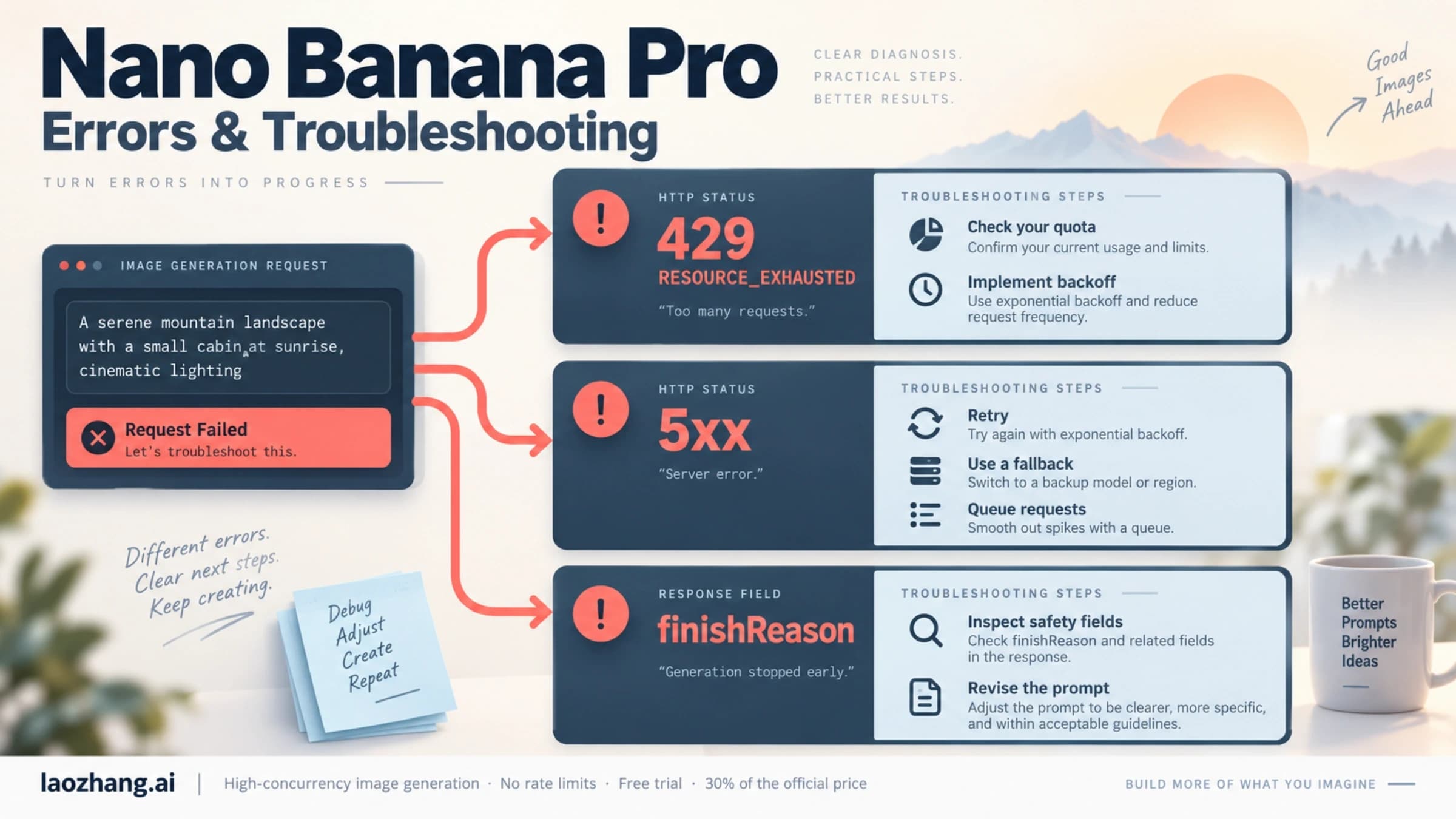
When you exceed your Nano Banana Pro rate limit, whether in the consumer app or through the API, you will encounter a 429 RESOURCE_EXHAUSTED error. This is an HTTP status code that specifically indicates rate limiting rather than a server error, and how you handle it determines whether your application degrades gracefully or crashes entirely. In the consumer Gemini app, hitting the limit simply means the image generation button becomes unavailable, and you see a message indicating that you have reached your daily quota. The app does not provide any information about when your quota will reset or how many images you have remaining, which is a significant pain point that users have been vocal about. For detailed troubleshooting of this and other errors, our complete guide to fixing RESOURCE_EXHAUSTED errors walks through every scenario step by step.

For API users, the 429 error response includes a Retry-After header that specifies how many seconds you should wait before sending another request. The proper way to handle this is with exponential backoff, a strategy where you wait progressively longer between retries to avoid hammering the rate limiter. A basic implementation starts with a 1-second delay after the first 429 response, doubles the delay for each subsequent failure, and caps the maximum delay at 60 seconds. Here is the standard pattern that works reliably with the Nano Banana Pro API:

python
import time import random def generate_with_retry(prompt, max_retries=5): for attempt in range(max_retries): try: response = model.generate_content(prompt) return response except Exception as e: if "429" in str(e) or "RESOURCE_EXHAUSTED" in str(e): wait_time = min(60, (2 ** attempt) + random.uniform(0, 1)) print(f"Rate limited. Waiting {wait_time:.1f}s...") time.sleep(wait_time) else: raise e raise Exception("Max retries exceeded")

Quota resets happen at midnight Pacific Time (PT), which is UTC-8 during standard time and UTC-7 during daylight saving time. This means that for users in Europe, quota resets occur in the early morning hours (around 8-9 AM CET), while users in Asia see their quota refresh in the late afternoon (around 4-5 PM JST). Understanding this timing is critical for production applications that need to plan their image generation workload across the day. A common strategy is to schedule batch image generation jobs to run shortly after midnight PT, when your full daily quota is available and system load is typically at its lowest, maximizing the number of successful requests before the quota gets consumed by real-time traffic later in the day.

Beyond simple retry logic, there are several architectural patterns that can help your application handle rate limiting more gracefully. Request queuing is the most common approach, where incoming image generation requests are placed in a queue rather than sent directly to the API. A background worker processes the queue at a controlled rate that stays within your RPM limit, and completed images are stored for retrieval. This pattern decouples the user-facing request from the API call, allowing your application to accept requests at any rate while ensuring the backend never exceeds the rate limit. For applications that need real-time image generation, a circuit breaker pattern can prevent cascading failures: when the error rate from rate limiting exceeds a threshold, the circuit breaker opens and immediately returns a fallback response rather than continuing to hit the rate limiter.

If your application is consistently hitting daily limits before the reset, it is a clear signal that you need to either upgrade to a higher tier, implement request queuing with overflow routing, or consider a third-party API provider that does not impose daily caps. You can also check our complete error code reference for other common errors beyond rate limiting, including authentication failures and content policy violations.

Which Tier Should You Choose?

Usage-based decision framework showing which tier to choose based on daily image needs and cost per image

Choosing the right Nano Banana Pro tier depends on three factors: your daily image volume, your resolution requirements, and whether you need consumer app access or API access. The most common mistake is choosing based on advertised limits rather than real-world performance, which leads to users overpaying for capacity they cannot actually use or underbuying and hitting frustrating rate limits. The decision framework below maps your actual usage patterns to the optimal tier, including cost-per-image calculations that factor in real-world limit variability. Before diving into the specific recommendations, it is worth emphasizing that the "right" tier can change over time as Google continues to adjust quotas. What was a good value three months ago may no longer be optimal today, and the tier that makes sense for your current usage might become insufficient if Google tightens limits further. Building flexibility into your infrastructure, whether through multi-tier access or hybrid approaches with third-party providers, is the most resilient long-term strategy.

If you generate 1-2 images per day, the free tier is sufficient. You get access to the full Nano Banana Pro model quality at 1K resolution, which is adequate for personal use and experimentation. The cost per image is obviously zero, making this the right choice for anyone who uses image generation infrequently and does not mind the resolution limitation.

If you generate 10-50 images per day, AI Plus at $7.99/month offers the best value proposition. At 50 images per day, your effective cost is approximately $0.005 per image, which is remarkably affordable for 2K resolution output. This tier is ideal for content creators who publish blog posts, social media content, or marketing materials and need a reliable daily supply of AI-generated images without the $19.99 commitment of Pro.

If you generate 50-100 images per day, AI Pro at $19.99/month is the standard recommendation, but you should go in with realistic expectations about the real-world variability. Your effective cost per image ranges from $0.007 (at 100 images/day) to $0.033 (at the sometimes-experienced 20 images/day floor). If you consistently find yourself on the lower end of that range, the frustration may not be worth the savings compared to a more reliable alternative.

If you generate more than 100 images per day, the calculation becomes more interesting. AI Ultra at $249.99/month gives you 1,000 images/day with 4K resolution, working out to approximately $0.25 per image. However, at this volume, third-party API providers like laozhang.ai offer Nano Banana Pro access at approximately $0.05 per image with no daily cap and no rate limiting during peak hours. For a developer generating 500 images per day, the math clearly favors the API approach: $25/day through laozhang.ai versus $8.33/day through Ultra, but with the API you get unlimited burst capacity, no throttling during peak hours, and no risk of Google changing your quota without notice. The trade-off is that you are relying on a third-party service rather than going directly through Google, but for production workloads where reliability and predictability matter more than direct vendor access, this is often the pragmatic choice.

Beyond Google's Limits: Unlimited Alternatives

For developers and businesses whose image generation needs exceed what any single Google tier can reliably provide, third-party API services have emerged as a practical solution. These services act as intermediaries, maintaining their own infrastructure and Google API quotas to provide their customers with higher effective rate limits and more predictable access. The key advantage is that they aggregate capacity across multiple API keys and accounts, smoothing out the quota fluctuations that individual users experience. This approach has become increasingly popular since the December 2025 quota crisis, when many production applications experienced unexpected downtime due to Google's sudden limit reductions. Organizations that had built dependencies on specific Google quota levels found themselves scrambling for alternatives, and third-party API providers saw a significant surge in adoption as a result.

The most straightforward alternative is to use a unified API gateway that provides access to Nano Banana Pro alongside other image generation models. Services like laozhang.ai offer Nano Banana Pro image generation at approximately $0.05 per image, which is roughly 60-80% less than Google's official API pricing and includes no RPM or RPD limits. The integration is typically straightforward, requiring only an API key change in your existing code since these services mirror Google's API format. For developers already using the Gemini API, switching to a third-party provider usually involves changing a single base URL and API key in your configuration. You can test image generation capabilities directly at images.laozhang.ai before committing to integration.

It is worth noting that third-party API providers have matured significantly since the early days of the Gemini API ecosystem. In 2025, many providers were unreliable or slow, but the competitive landscape has improved dramatically, with several services now offering enterprise-grade SLAs, sub-200ms latency overhead, and transparent pricing models. The key is to evaluate providers based on your specific needs rather than defaulting to the cheapest option, since factors like uptime reliability, geographic server distribution, and model version currency can have a larger impact on your application's performance than raw per-image cost.

A hybrid approach often works best for organizations with varying workload patterns. The strategy involves using Google's free or paid tier for baseline daily usage, where the predictable low volume falls well within quota limits, and routing overflow requests through a third-party API when you approach or exceed your Google quota. This approach minimizes third-party API costs while ensuring that your application never hits a rate limit wall during critical operations. Implementing this requires a simple routing layer in your application that monitors your current quota usage and switches providers when the primary source approaches its limit. The result is an effectively unlimited image generation pipeline that costs significantly less than an AI Ultra subscription while providing better reliability and burst capacity.

When evaluating third-party providers, there are several factors to consider beyond just price per image. Latency is critical for real-time applications: the best providers add less than 100 milliseconds of overhead compared to direct Google API access, while lower-quality services can add several seconds of delay. Uptime guarantees are another important differentiator, as some providers offer 99.9% SLA commitments that Google does not provide for its consumer tiers. Model version parity matters too: you want to ensure the provider is serving the same Nano Banana Pro model version that Google offers directly, rather than an older snapshot. Finally, consider the provider's geographic distribution of servers, since routing your requests through a nearby endpoint can significantly reduce round-trip latency compared to routing everything through a single region.

Frequently Asked Questions

Is the Google Nano Banana Pro API free?

Yes, Google offers a free tier for the Nano Banana Pro API through Google AI Studio. As of February 2026, the free tier provides 5-10 RPM and approximately 50-100 RPD (though this was recently expanded to 1,500 RPD for some users). The free tier is suitable for testing and small hobby projects, but the strict RPM limit of 5-10 requests per minute makes it impractical for any production use. To put this in perspective, 5-10 RPM means you can generate at most one image every 6-12 seconds, which creates a bottleneck for any application that requires interactive image generation. Paid API tiers start with pay-as-you-go pricing at approximately $0.134 per image for standard resolution, and they unlock significantly higher RPM limits that enable real-time application use cases.

How do I fix the "API rate limit exceeded" error?

The 429 RESOURCE_EXHAUSTED error means you have hit your rate limit. For RPM limits, implement exponential backoff starting with a 1-second delay and doubling with each retry up to 60 seconds. For RPD limits, you must wait until midnight Pacific Time when quotas reset. If you are consistently hitting daily limits, you should either upgrade to a higher paid tier or use a third-party API provider that offers higher quotas. Check the error response headers for the specific Retry-After value that indicates exactly how long to wait.

Does Nano Banana Pro have restrictions on generated content?

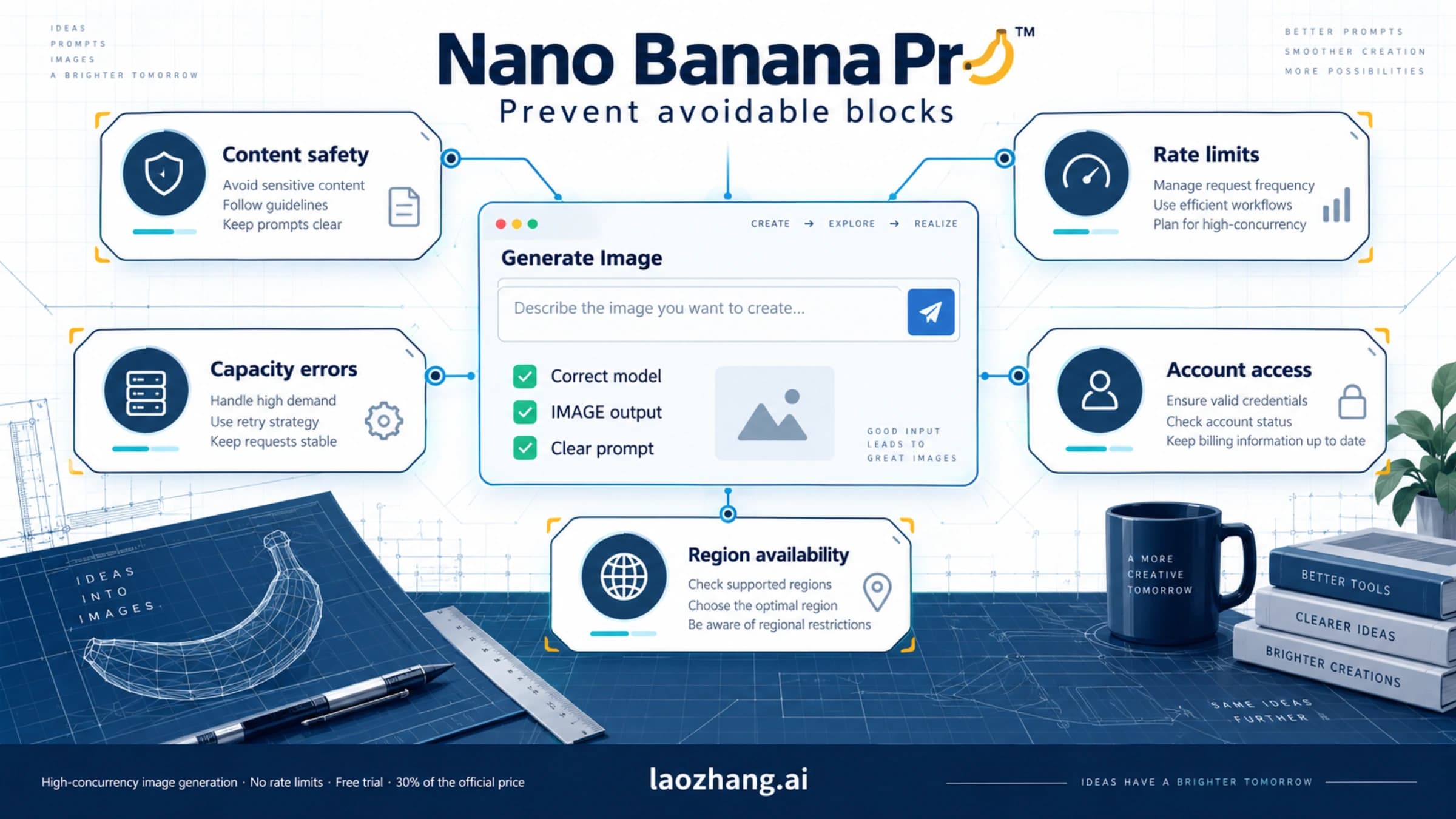
Yes, Nano Banana Pro includes content safety filters that block certain types of image generation requests. These restrictions apply regardless of your subscription tier or API access level. The model will refuse to generate images depicting realistic violence, explicit content, real public figures in misleading scenarios, and content that violates Google's AI Principles. Content policy violations return a different error code than rate limit errors, so make sure you distinguish between the two when implementing error handling in your application.

What is the difference between consumer app limits and API limits?

This is the single most misunderstood aspect of Nano Banana Pro rate limits, and getting it wrong leads to incorrect planning decisions. Consumer app limits control how many images you can generate through the Gemini web and mobile app, measured in images per day. API limits control how many requests you can send through Google AI Studio or Vertex AI, measured in RPM (requests per minute) and RPD (requests per day). These are completely separate systems with independent quota tracking. A Google AI Pro subscription at $19.99/month increases your consumer app limit to approximately 100 images per day but does not increase your API rate limits. To get higher API limits, you need to upgrade to a paid API tier through Google AI Studio, which operates on a separate pay-as-you-go pricing model.

How much does a Google AI Pro subscription cost?

Google AI Pro costs $19.99 per month (as of February 2026, verified from Google's subscription page). This gives you approximately 100 images per day through the Gemini consumer app at up to 2K resolution, along with other AI features like expanded context windows and priority access to new models. The cheaper AI Plus tier at $7.99/month offers approximately 50 images per day, while the premium AI Ultra tier at $249.99/month provides 1,000 images per day with 4K resolution support. All subscription prices are in US dollars and may vary by region.

Can I increase my rate limit without upgrading my subscription?

There are a few strategies to effectively increase your throughput without changing your subscription tier. First, if you are on the API, switching to the batch API approximately doubles your effective throughput because batch requests are processed with more generous rate limits and at roughly half the cost per image. Second, you can distribute requests across multiple API keys by creating separate Google Cloud projects, each of which receives its own independent quota allocation. Third, for consumer app users, generating images during off-peak hours (late evening to early morning Pacific Time) typically results in fewer rate limit hits because server load is lower, effectively giving you access closer to the advertised maximum rather than the reduced real-world limit experienced during peak hours.

Will Nano Banana Pro rate limits change again?

Almost certainly yes. Google has adjusted rate limits at least six times between November 2025 and February 2026, and the pattern suggests ongoing optimization as they balance user demand against computational costs. Free tier limits have generally trended downward, while paid tier limits have remained more stable. The best strategy is to avoid building hard dependencies on specific quota numbers and instead implement flexible rate limiting handling in your application. If quota predictability is critical for your use case, consider using a third-party API provider that offers contractual rate guarantees rather than relying on Google's frequently changing limits.

Share:

laozhang.ai

One API, All AI Models

AI Image

Gemini 3 Pro Image

$0.05/img
80% OFF
AI Video

Sora 2 · Veo 3.1

$0.15/video
Async API
AI Chat

GPT · Claude · Gemini

200+ models
Official Price
Served 100K+ developers
|@laozhang_cn|Get $0.1