Gemini Free Image Limit: How Many Images You Can Make and Upload
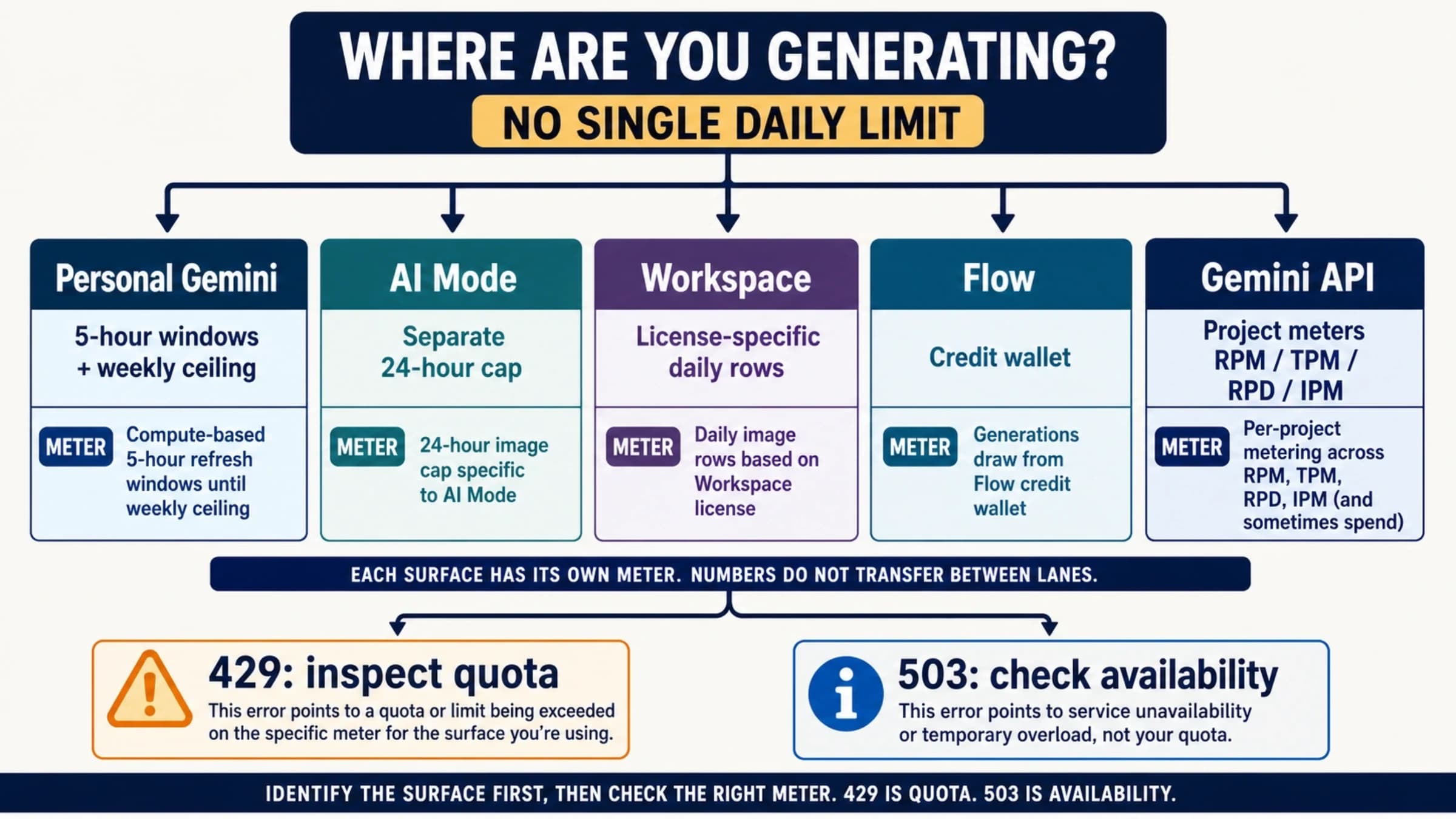
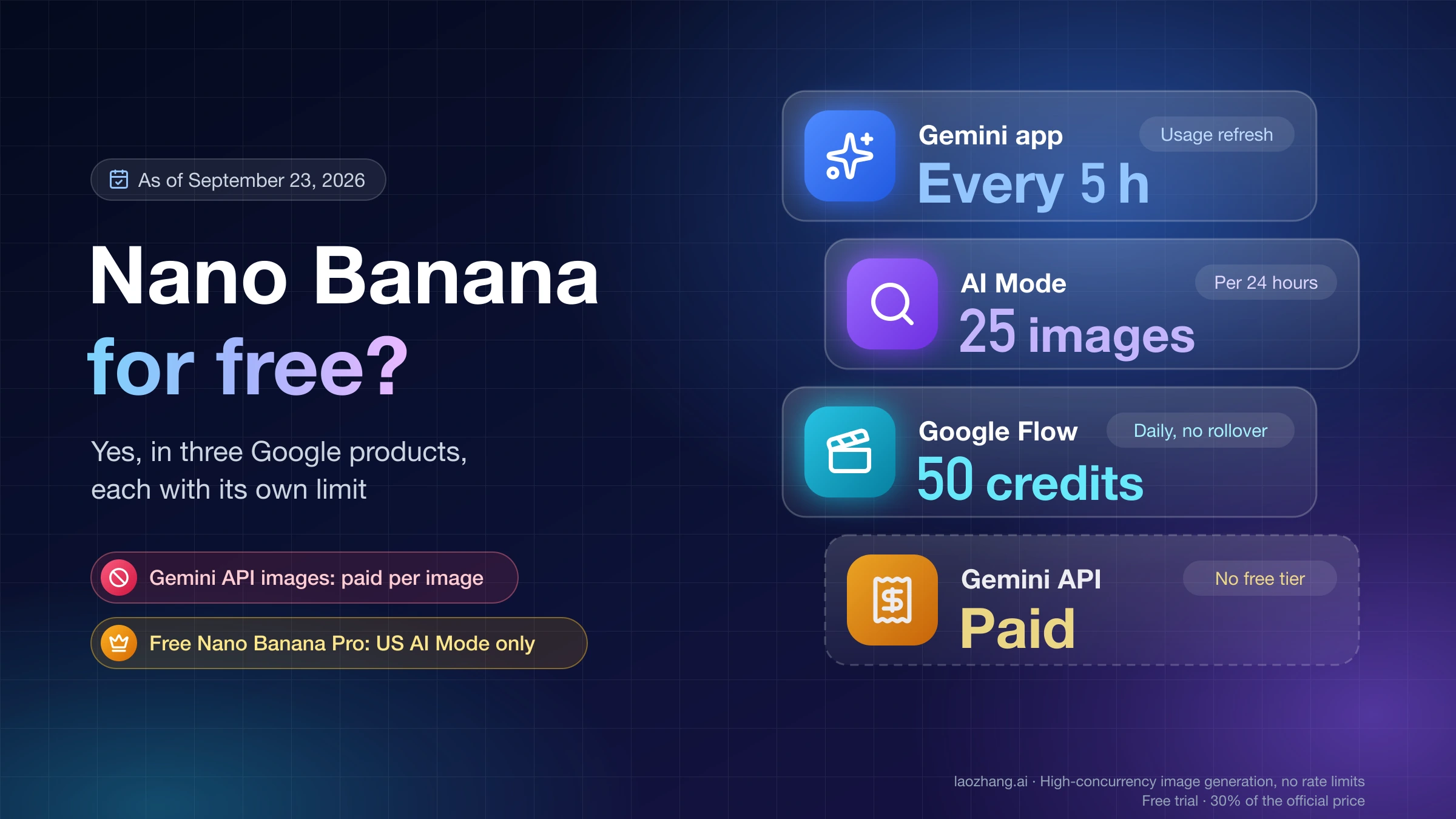
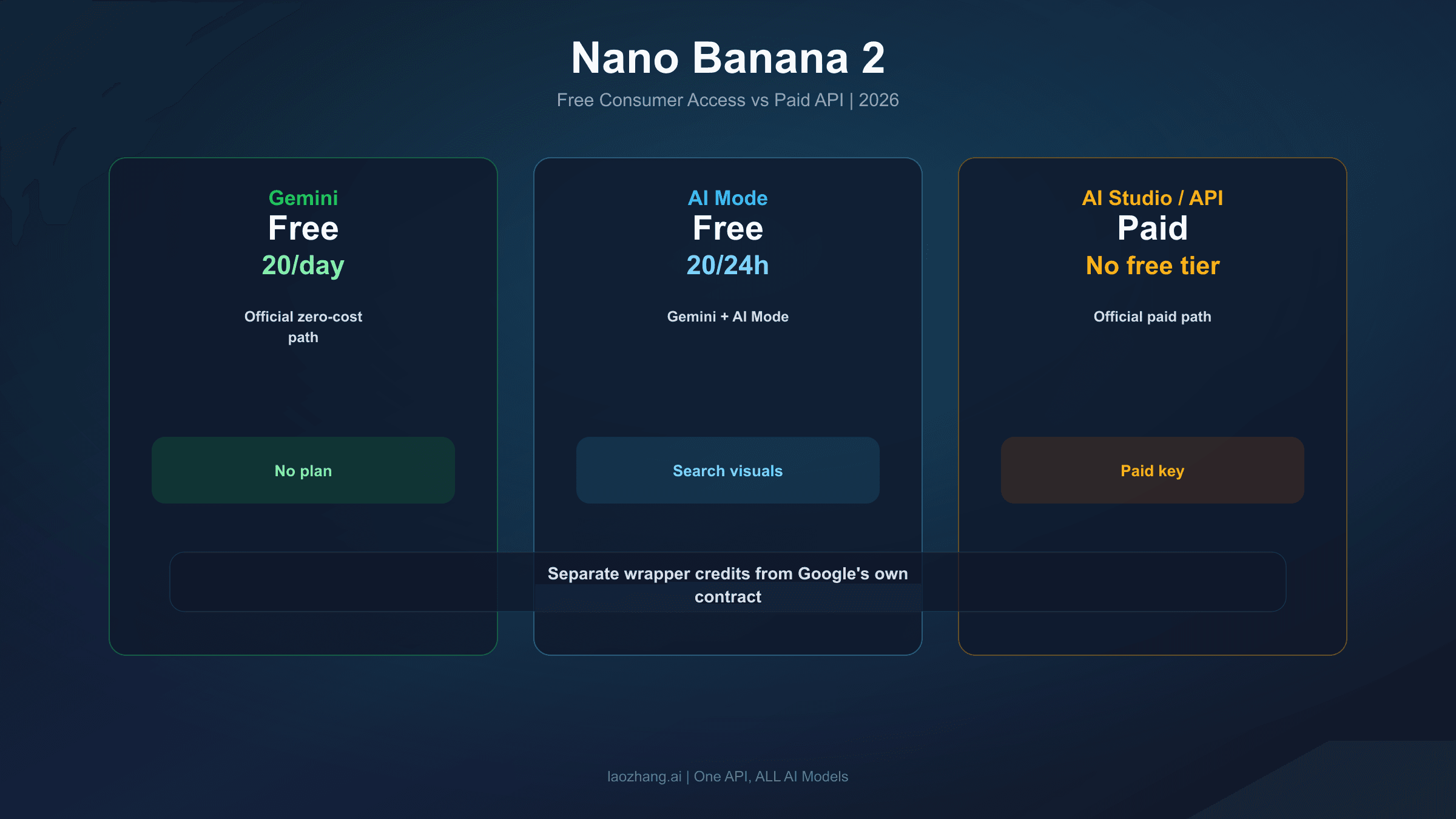
As of October 8, 2026, Google prints no image count for the free Gemini app: usage refreshes every 5 hours up to a weekly cap. AI Mode allows 25 images a day.
On this page
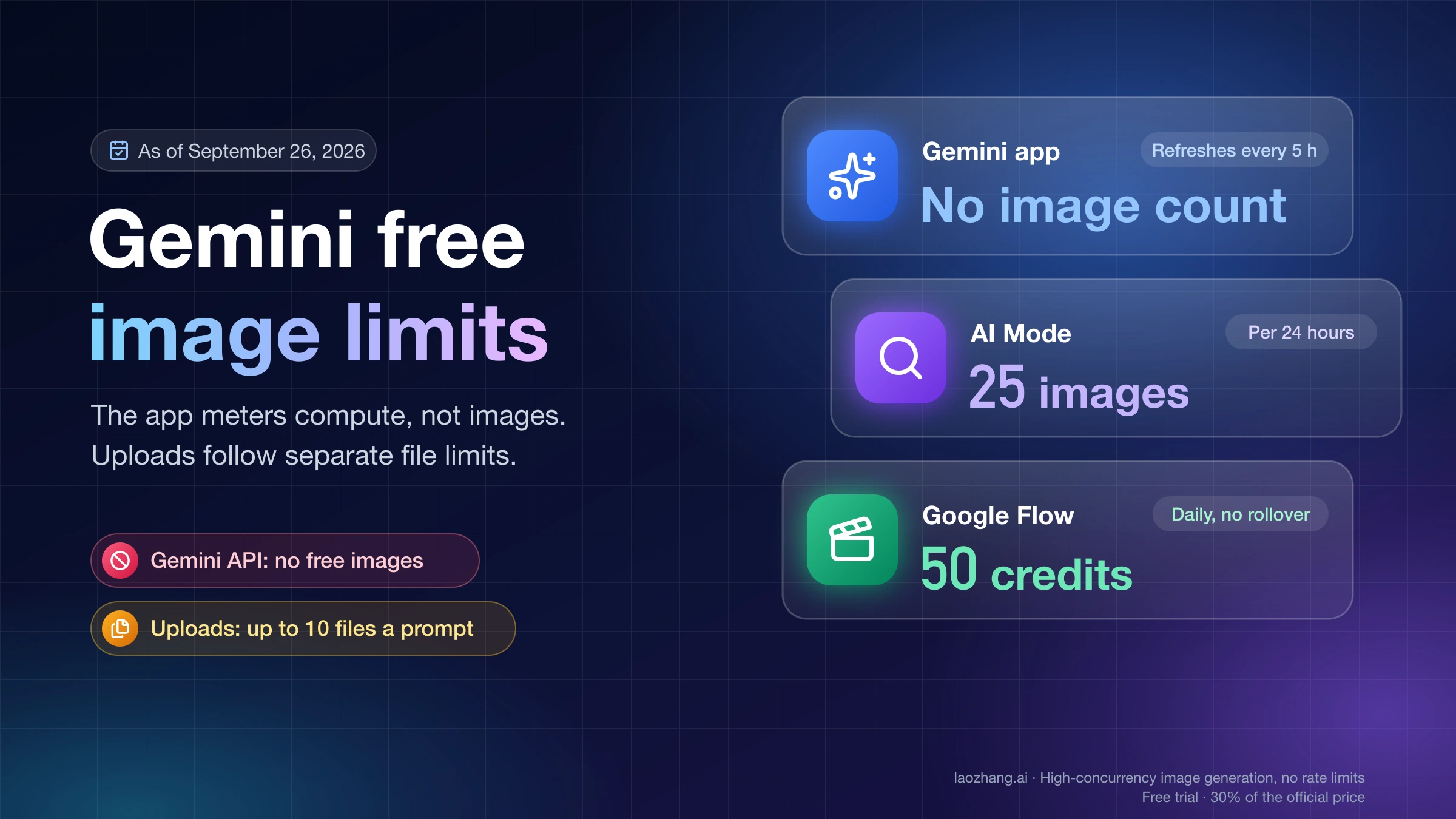
There is no fixed number. As of October 8, 2026, Google doesn't publish how many images a free account can generate in the Gemini app. The app runs on what Google calls "compute-based usage limits": every prompt draws from an allowance that "refreshes every 5 hours until you reach your weekly limit," and image generation draws more of it than a plain text answer does. How many pictures that adds up to depends on the model you pick, how complex the prompt is, and how long the chat already is (Gemini Apps Help).
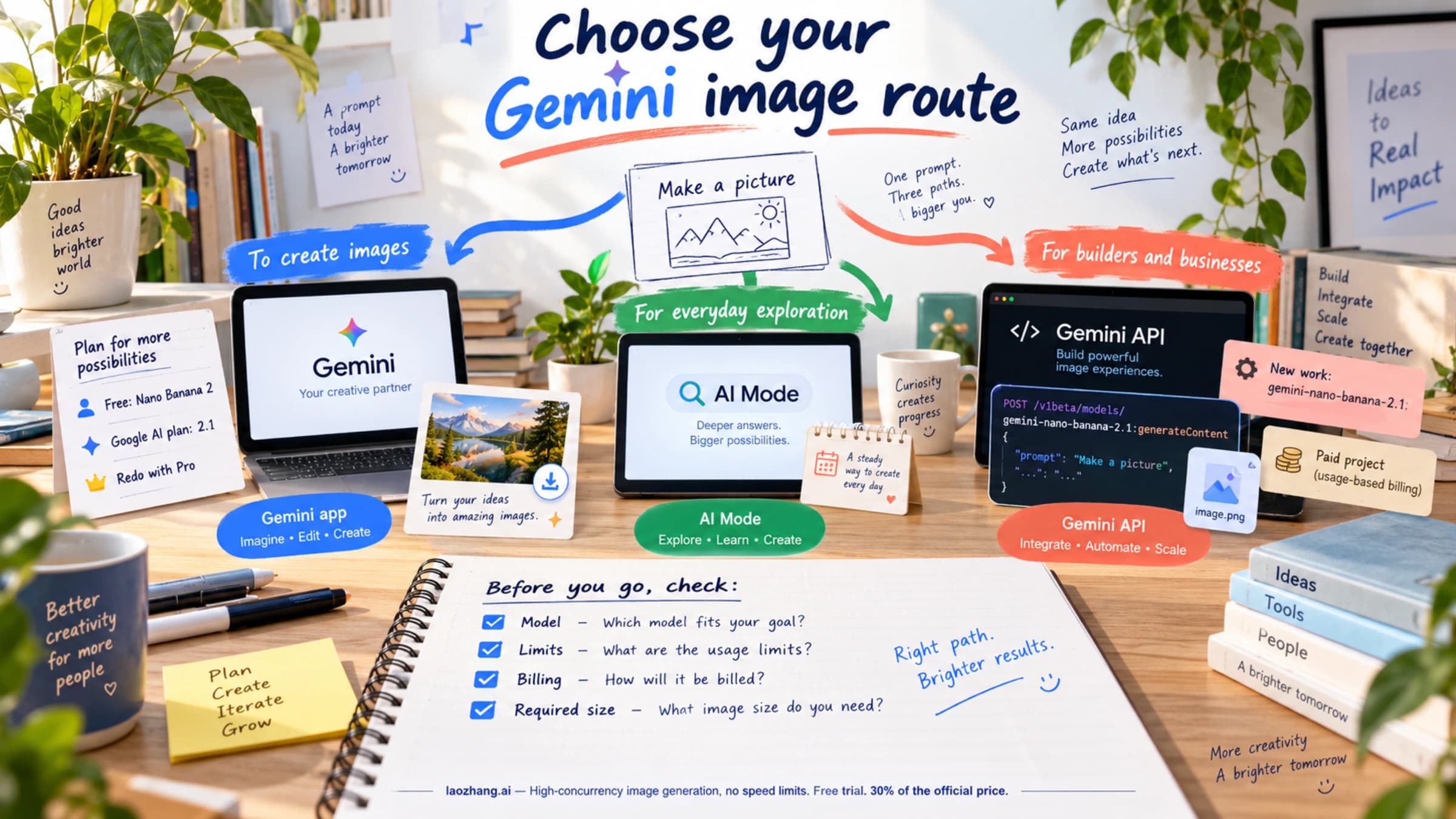
The only free image count Google prints belongs to a different product. AI Mode in Google Search allows up to 25 images in a 24-hour period without a paid plan. Google Flow gives you 50 credits a day. The Gemini API has no free image output at all. Uploading images is a separate limit again: up to 10 files per prompt, plus a rolling cap on chats with files that Google doesn't put a number on.
What changed in October 2026: Google released Nano Banana 2.1 on October 6. Free Gemini accounts still make images with Nano Banana 2. Google's Nano Banana product page says Google AI Plus, Pro, and Ultra subscribers get Nano Banana 2.1, while the Gemini help center still describes Nano Banana 2 for every plan. On the Gemini API, Nano Banana 2 is now deprecated, and the cheapest image costs $0.0336 at 1K with Nano Banana 2.1 or Nano Banana 2 Lite. None of this added a published image count.
Free image limits across Google's tools
"Gemini" covers several products, and each one meters images differently. Find the one you are using first; the answer changes with it.
| Where you create images | Free without a plan? | Published free limit | When it resets | Where to see what's left | When you hit it |
|---|---|---|---|---|---|
| Gemini app (web and mobile) | Yes: Nano Banana 2, or Nano Banana 2 Lite when Gemini is set to Flash-Lite; Nano Banana 2.1 needs a Google AI plan | No image count; free accounts get "Standard limits" | Every 5 hours, until the weekly limit | Settings → Usage limits, shown as percent used | Wait for the reset time shown, or upgrade |
| AI Mode in Google Search | Yes, 18 and older | Up to 25 images in a 24-hour period | 24-hour period | No counter documented | Wait, or upgrade for 50 / 100 / 1,000 |
| Google Flow | Yes, 18 and older | 50 Flow credits a day; Nano Banana 2 Lite is the default model "available at no charge" | Next day, counted from your first generation; unused credits don't roll over | Profile picture, top right | Wait for the next 50, or a plan adds monthly credits |
| Google AI Studio (web) | "Modest quota"; Google lists Nano Banana among the models an AI Pro plan unlocks | No image count | Daily reset, not a rolling window | Not documented for the free plan | Upgrade, or link a paid API key |
| Gemini API | No: every image model shows its free tier as "Not available" | None | Paid daily request quotas reset at midnight Pacific | AI Studio dashboard, per project | You pay per image from the first one, from $0.0336 at 1K |
Sources: Gemini Apps limits, Gemini Apps image help, AI Mode image creation, Google Flow credits, Flow models, Google AI plans for AI Studio, Gemini API pricing. Gemini app and API rows are as of October 8, 2026; AI Mode, Flow, and AI Studio rows as of September 26, 2026. Google says limits on all of these may change with capacity and demand.
All five are available in the United States. The age rules differ: the Gemini app lets you generate images at 13 but edit them only at 18, while AI Mode image creation and Google Flow require 18. Work and school accounts can have different rules, and AI Mode image creation needs a personal account you manage yourself.
A quick way to choose:
- You want a number you can plan around. Use AI Mode: 25 images per 24 hours is the only free count Google publishes. US users 18 and older can also pick Nano Banana Pro there in English, under a separate daily limit Google doesn't quantify.
- You want to edit photos or combine reference images in a conversation. Use the Gemini app, and remember that images share one allowance with everything else you ask Gemini.
- You are building frames or assets for video. Use Google Flow and keep the model on Nano Banana 2 Lite. Before switching models, open Settings in the prompt box: Flow's help pages don't print credit costs for image models, and the settings panel shows the current ones.
- You are calling Gemini from code. Budget for paid image output from the first request. The free API tier covers certain text models only; Gemini Image API Free? No Free Tier, but $5 Buys Up to 148 Images shows what a small budget buys at $0.0336 per image.
To compare the tools and image models side by side, see Gemini Image Generation Guide: Pick the Right Tool and Model.
How the Gemini app counts your images
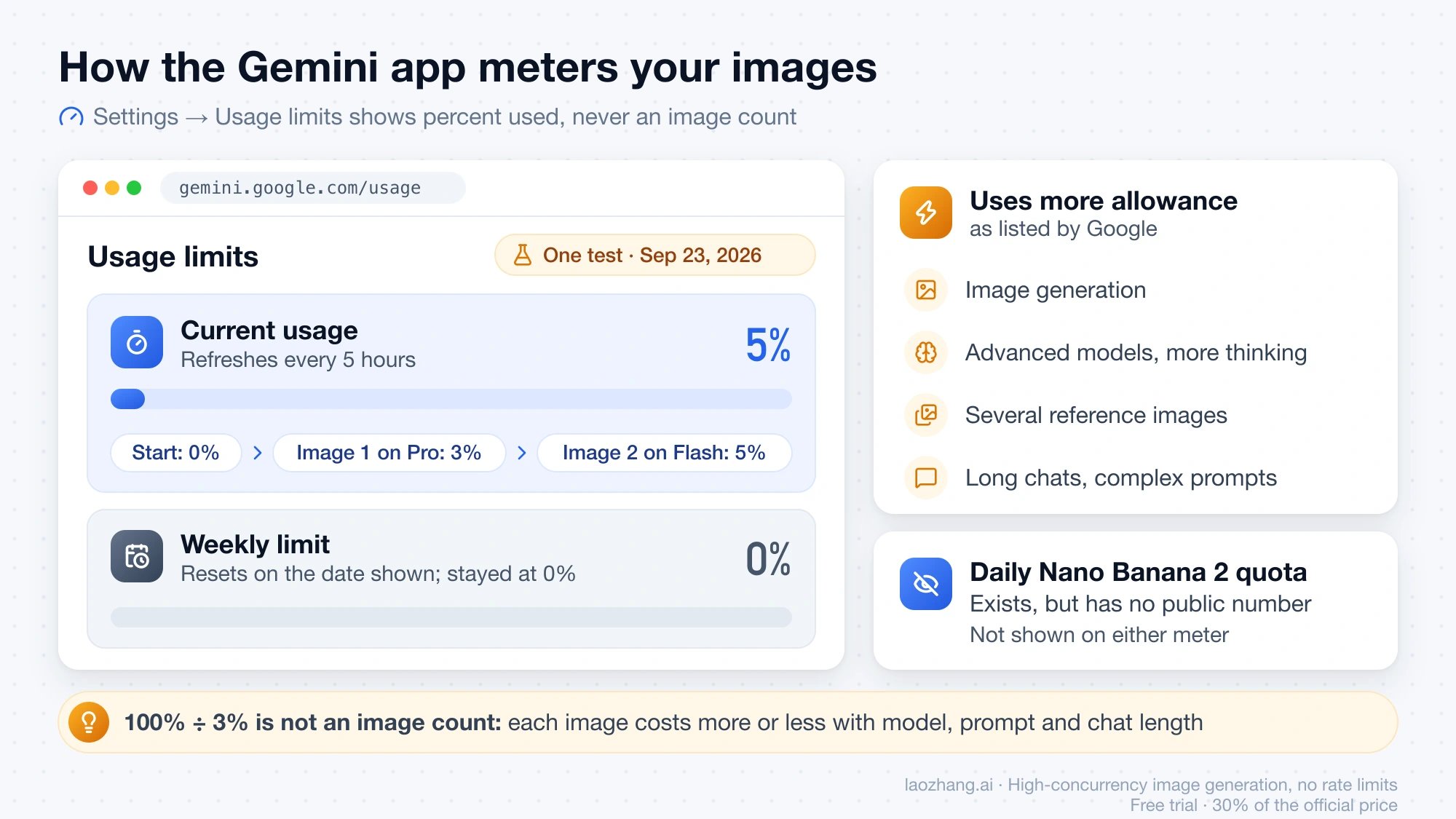
Google describes the app's limits as factoring in "the complexity of your prompt, the models and features you use, and the length of your chat." Two lines on the same help page matter for images: "Some features (like media generation or Deep Research) will consume more of your usage," and "More advanced models and higher thinking levels consume more of your usage." An image request therefore costs more than a short text question, and the same picture can cost different amounts depending on the model you start from.
The model you choose in Gemini decides which image model runs. The Gemini Apps image help page describes three, as of October 8, 2026:
- Flash-Lite uses Nano Banana 2 Lite, which is built for speed and simple ideas. Google says it isn't designed for multiple reference images or repeated edits.
- Flash or Pro uses Nano Banana 2, which handles several reference images and renders text more reliably than Lite.
- Nano Banana Pro only appears as "Redo with Pro" on an image you already made, with a paid Google AI plan and Gemini set to Pro.
Google's Nano Banana product page adds a fourth model for subscribers. It lists Nano Banana 2 as "Free" and Nano Banana 2.1 as "Our best image generation and editing model" that comes "With a Google AI plan," and says Google AI Pro, Plus, and Ultra users have access to Nano Banana 2.1. The image help page and the limits page don't mention 2.1 yet, so they still say paid plans generate with Nano Banana 2. The paid-plan model described here comes from Google's pages, not from a test inside a paid account. Neither page says how much of the allowance a Nano Banana 2.1 image uses. For how the four models differ in quality and price, see Nano Banana 2 Lite vs 2 vs 2.1 vs Pro: Which Model to Use Now.
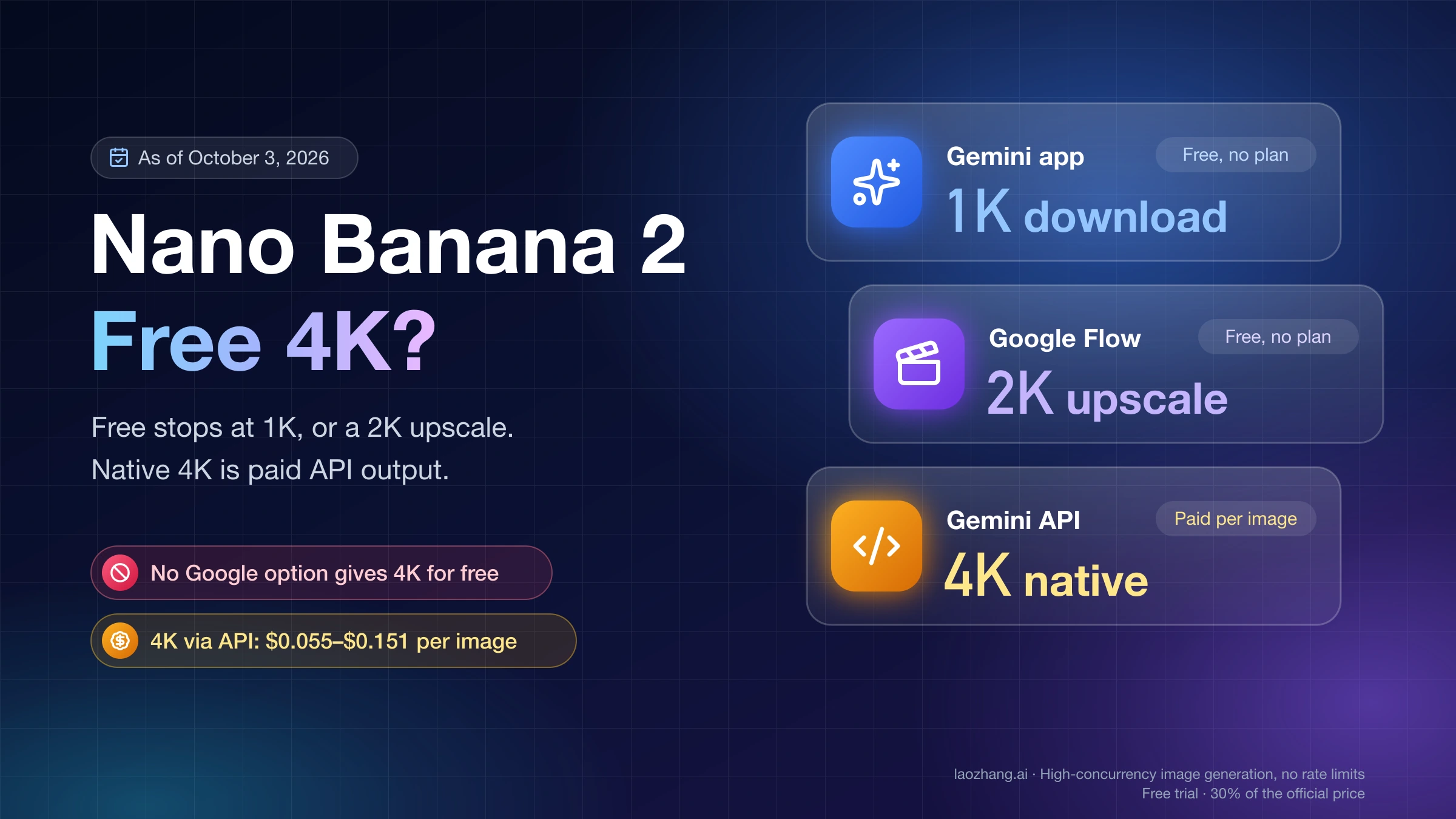
Free accounts download images at 1K; any Google AI plan raises that to 2K, according to the image help page. The product page's model cards show "2K resolution" for both models, but they don't separate previews from downloads.
There is one more limit that the meter doesn't show. Google's image help page says: "If you reach your daily quota of Nano Banana 2 images, you can't redo any additional images with Nano Banana Pro." So a daily quota for Nano Banana 2 images does exist, but its size isn't published, and once you reach it, "Redo with Pro" stops working too. When someone asks whether Gemini has a daily image limit, the accurate answer is yes, with no public number, sitting alongside the 5-hour and weekly meters.
One test on a free personal account on September 23, 2026 shows the scale, not a rule. A simple watercolor image made with the Pro model moved the current-usage meter from 0% to 3%. A second image on Flash moved it to 5%. The weekly meter stayed at 0%. The meter rounds to whole percentages, and a long prompt, several reference images, or edits deep into a long chat can cost more, so dividing 100% by 3% doesn't give you a reliable number of images per window.
Paid plans multiply the same baseline rather than adding a known number of images:
| Plan (US price) | Gemini app usage | Image features in the app |
|---|---|---|
| No plan ($0) | "Standard limits" | Nano Banana 2 and Nano Banana 2 Lite, 1K downloads |
| Google AI Plus ($4.99/month) | 2x standard | Nano Banana 2.1 per Google's product page (the help center still lists Nano Banana 2), Redo with Nano Banana Pro, 2K downloads |
| Google AI Pro ($19.99/month) | 4x standard | Same image features as Plus |
| Google AI Ultra ($99.99 or $199.99/month) | 5x or 20x AI Pro | Same image features as Plus |
The multipliers are from Google's limits page as of October 8, 2026; prices are from Google's US plans page as of September 26, 2026. Because the baseline is measured in compute, not images, "4x" can't be converted into an image count either. Google also warns that when capacity is tight, free accounts "may be limited before users with a plan." Model-by-model detail, including how the API's per-project rate limits work, is in Nano Banana 2 Limits: How Gemini Usage and API Rate Limits Work.
Where the "100 images a day" figure came from
In 2025, Google said free Gemini users could make up to 100 images a day and Pro and Ultra subscribers up to 1,000. Early in 2026, the image help page carried a per-plan image table instead; that table is gone. The limits page then announced changes to Gemini usage limits starting May 17, 2026, and today it describes only compute-based limits, with no image count for any plan.
Other numbers you may come across don't match Google's current pages either:
- "500 free image requests a day through the API." The pricing page, last updated October 7, 2026, lists every Nano Banana model's free tier as "Not available," Nano Banana 2.1 included.
- "500 to 1,000 free images a day in AI Studio." Google describes the free AI Studio plan only as a "modest quota," and it lists Nano Banana among the premium models that an AI Pro plan unlocks there.
- "1,600+ free images a day by combining channels." Adding up those numbers only works if each one is true, and the two largest aren't.
A single daily image number for the free Gemini app either predates the compute-based system or describes a different product, most often AI Mode.
How to check how much you have left
In the Gemini app on the web:
- Go to gemini.google.com.
- At the bottom left, open Settings, then Usage limits. The page lives at gemini.google.com/usage.
- Read the two meters. Current usage shows the percentage used and a "Resets at" time. Weekly limit shows its own percentage and the date and time it resets.
Neither meter shows an image count. Gemini also notifies you when you are close to your limit, and again when you reach it, with the time it will refresh.
When something stops working, the message tells you which limit you hit:
| What you see | What it means | What to do |
|---|---|---|
| Gemini says you reached your limit and shows a refresh time | The 5-hour or weekly compute limit | Wait for the time shown, or upgrade for a larger allowance |
| "Redo with Pro" stops working on a paid plan | The unpublished daily quota of Nano Banana 2 images | Wait for the daily quota to return |
| "You've reached your limit for chats with files" | The rolling upload limit, not image generation | Try again later; AI Pro and Ultra have higher upload limits |
| "Delete data to upload file" | Gemini Apps storage for saved chats and files is full | Delete older Gemini Apps activity |
| AI Mode stops creating images for the day | The 25-images-per-24-hours cap on the free plan | Wait for the 24-hour period to pass, or upgrade |
| Flow says you don't have enough credits | Today's 50 credits are used up | Wait for the next day's credits |
In Google Flow, your remaining credits appear under your profile information when you click your profile picture at the top right. For the Gemini API, rate limits apply per project, not per key, and you can see live values and usage in the AI Studio dashboard (Gemini API rate limits). If an API image call returns 429, Gemini Image 429 Rate Limit: How Long It Lasts and How to Fix It explains which limit caused it.
Generation limits and upload limits are separate
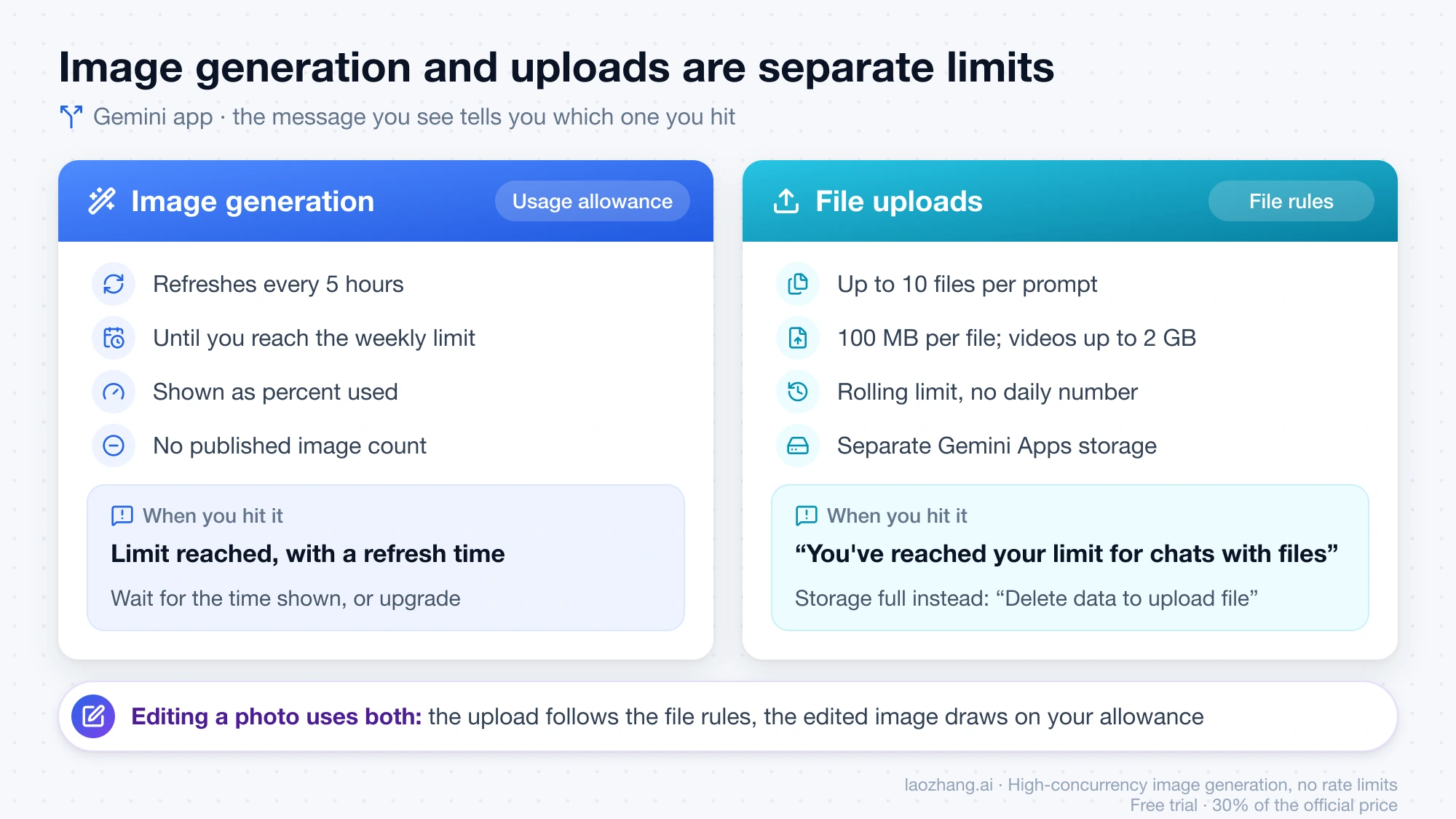
Uploading images to Gemini, whether to ask about them or to edit them, falls under the file upload rules, not the image generation meter (Upload & analyze files in Gemini Apps):
| Upload rule in the Gemini app | Limit |
|---|---|
| Files per prompt | Up to 10, "subject to availability"; every file inside an uploaded folder counts |
| Size per file | 100 MB; videos up to 2 GB |
| Total video length | 5 minutes; 1 hour with Google AI Pro or Ultra |
| Total audio length | 10 minutes; 3 hours with Google AI Pro or Ultra |
| ZIP files | Up to 10 files and 100 MB, no video or audio inside |
| Uploads over time | "Rolling limits" on uploading and analyzing files; no daily number published |
| Storage | A separate Gemini Apps storage limit for saved chats and files |
So Gemini doesn't allow unlimited image uploads, and it doesn't publish a per-day upload count. The rolling limit resets "after some time," and Google points to AI Pro and Ultra for higher upload limits.
Editing a photo touches both limits. The upload counts toward the file rules above. The edited image is a new generation, so it also uses your usage allowance, and editing requires you to be 18 or older. AI Mode also lets adults upload an image and edit it there.
What to do when the free allowance runs out
Wait for the reset. In the Gemini app, the reset time is on the Usage limits page, and the weekly limit ends on the date shown there. AI Mode counts a 24-hour period. Flow's next 50 credits arrive the day after your first generation; if you first use Flow on August 12, the next 50 credits become available August 13, and anything you didn't use is gone.
Use a lighter model before you run out. Google says more advanced models use more of your allowance, so creating quick images with Gemini set to Flash-Lite should stretch the meter further than Pro. The trade-off is Nano Banana 2 Lite's weaker handling of reference images and repeated edits. A lighter model won't help once the meter is already at 100%.
Switch tools. AI Mode in Google Search has its own published limit of 25 images per 24 hours, and Google Flow gives 50 credits a day with Nano Banana 2 Lite as its no-charge model. Can You Use Nano Banana for Free? Google's No-Cost Options walks through getting started in each of these free tools. If you specifically want Nano Banana Pro, see Nano Banana Pro Limits: Gemini, AI Mode, Workspace and API Quotas.
Upgrade. Google AI Plus ($4.99/month) doubles the standard Gemini app allowance, raises AI Mode to 50 images a day, and adds 200 Flow credits a month. Google AI Pro ($19.99/month) gives 4x the standard allowance, 100 AI Mode images a day, and 1,000 Flow credits a month. On either plan, Google's product page says Gemini app images come from Nano Banana 2.1 and adds "Redo with Pro." The same page says college students can unlock a free Google AI Pro plan for one year; for the US offer's eligibility rules and claim steps, see Google AI Pro Is Free for Eligible U.S. College Students for 12 Months.
Pay per image through the Gemini API. When you need a predictable number of images, the API gives you exact per-image prices instead of a meter (Gemini API pricing, last updated October 7, 2026):
| Model | API model ID | Price per image (standard) |
|---|---|---|
| Nano Banana 2.1 | gemini-nano-banana-2.1 | $0.0336 at 1K, $0.0504 at 2K, $0.113 at 4K |
| Nano Banana 2 Lite | gemini-3.1-flash-lite-image | $0.0336 at 1K |
| Nano Banana 2 (deprecated) | gemini-3.1-flash-image | $0.045 at 0.5K, $0.067 at 1K, $0.101 at 2K, $0.151 at 4K |
| Nano Banana Pro | gemini-3-pro-image | $0.134 at 1K or 2K, $0.24 at 4K |
Batch requests cost half as much, and input and thinking tokens are billed on top of the per-image price. Nano Banana 2 is deprecated on the Gemini API with no shutdown date announced, and Google recommends Nano Banana 2.1 for all new projects. The original Nano Banana (gemini-2.5-flash-image, $0.039 per image) is deprecated as well; Google's pricing page still says it shuts down on October 2, 2026, while the deprecations table lists March 15, 2027.
To compare with a subscription: 100 Nano Banana 2.1 images at 1K cost 100 × $0.0336 = $3.36 in image output through the API, plus the input and thinking tokens of each call. Google AI Plus costs $4.99 a month for a larger meter with no fixed image count. The API wins when you need an exact count or automation; a plan wins when you mostly work in the app and also use Gemini for other tasks. Nano Banana 2.1 API Pricing: Per-Image Price vs Cost per Call works out what a full call costs once thinking tokens are added.
Paid third-party APIs are another option for code-based work. LaoZhang API, for example, charges one price per call whatever the output size or thinking level: $0.045 for Nano Banana 2.1, $0.025 for Nano Banana 2 Lite, $0.055 for Nano Banana 2, and $0.09 for Nano Banana Pro, through an OpenAI-compatible endpoint (public pricing as of October 7, 2026; the console shows the current rate). Google's own price is lower for Nano Banana 2.1 at 1K, while the flat $0.045 is lower than Google's $0.113 at 4K. This is a paid service, not Google, and it doesn't add to any free allowance.
FAQ
Is Gemini image generation free?
Yes, within limits. A free Google account can generate images in the Gemini app with Nano Banana 2, in AI Mode in Google Search (up to 25 images per 24 hours), and in Google Flow (50 credits a day). Image generation through the Gemini API is not free.
Do free Gemini users get Nano Banana 2.1?
No. As of October 8, 2026, Google's Nano Banana product page lists Nano Banana 2 as the free model and Nano Banana 2.1 as available "With a Google AI plan." The Gemini help center hasn't added 2.1 yet and still describes Nano Banana 2 for every plan.
Does Gemini have a daily limit for images?
In the Gemini app, the main limit is a compute allowance that refreshes every 5 hours, up to a weekly cap, and Google also mentions an unpublished daily quota of Nano Banana 2 images. AI Mode's limit is daily: 25 images per 24 hours on the free plan. Flow's is 50 credits per day.
How many images can I generate with Google AI Pro?
In the Gemini app, AI Pro gives 4x the standard usage allowance, which Google doesn't express as an image count; Google's product page says those images use Nano Banana 2.1. In AI Mode, AI Pro allows up to 100 images per 24 hours. In Google Flow, it adds 1,000 credits a month on top of the daily 50.
Is there a free Gemini API tier for image generation?
No. As of October 8, 2026, Google's pricing page lists the free tier as "Not available" for every Nano Banana model, Nano Banana 2.1 included. The free API tier gives free tokens on certain text models; image output starts at $0.0336 per 1K image with Nano Banana 2.1 or Nano Banana 2 Lite.
How many images can I create in Google Flow for free?
Google gives 50 Flow credits a day without a subscription, and Nano Banana 2 Lite is the image model Flow lists as "available at no charge." Flow's help pages don't publish credit costs for its image models, so check the prompt box Settings before switching to Nano Banana 2 or Nano Banana Pro.
Why did Gemini stop me after only a few images?
The allowance is shared with everything else you do in Gemini, and Google says media generation, advanced models, long chats, and complex prompts all use more of it. A long conversation with several edits on the Pro model can use up a 5-hour window much faster than a few quick images on Flash-Lite. The Usage limits page shows how much of the window and the week you have used.
Sources12
External pages this guide links to, in the order they appear. Last updated Oct 8, 2026.
Sources12
External pages this guide links to, in the order they appear. Last updated Oct 8, 2026.
- 1.Gemini Apps Helpsupport.google.com/gemini/answer/16275805
- 2.Nano Banana product pagegemini.google/overview/image-generation
- 3.Gemini Apps image helpsupport.google.com/gemini/answer/14286560
- 4.AI Mode image creationsupport.google.com/websearch/answer/16649374
- 5.Google Flow creditssupport.google.com/flow/answer/16526234
- 6.Flow modelssupport.google.com/flow/answer/16729550
- 7.Google AI plans for AI Studioai.google.dev/gemini-api/docs/google-ai-plans
- 8.Gemini API pricingai.google.dev/gemini-api/docs/pricing
- 9.Google's US plans pagegemini.google/us/subscriptions
- 10.gemini.google.comgemini.google.com
- 11.Gemini API rate limitsai.google.dev/gemini-api/docs/rate-limits
- 12.Upload & analyze files in Gemini Appssupport.google.com/gemini/answer/14903178