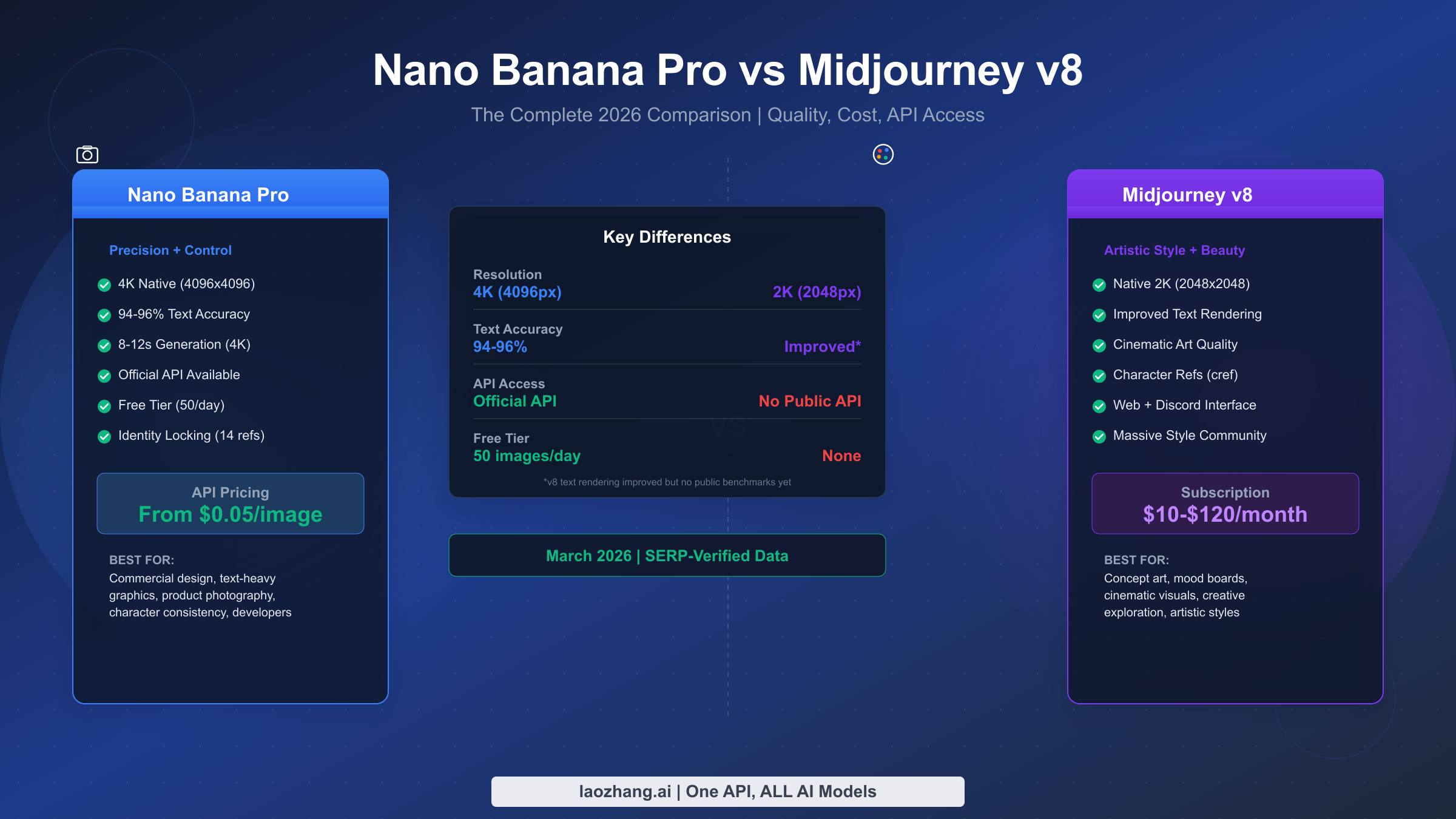
Nano Banana Pro and Midjourney v8 are the two most capable AI image generators available in March 2026, but they solve fundamentally different problems. Nano Banana Pro (Google's Gemini 3 Pro Image model) delivers precision, text rendering at 94-96% accuracy, and native 4K output starting at $0.05 per image through API providers like laozhang.ai. Midjourney v8 produces unmatched artistic aesthetics and cinematic quality through its subscription model at $10-$120 per month. This guide compares every dimension that matters for your decision: verified quality benchmarks, real cost calculations at four different usage levels, API access options, and free trial paths.
What Sets Them Apart: Two Philosophies of AI Image Generation
The difference between Nano Banana Pro and Midjourney v8 goes deeper than features — it reflects two fundamentally different philosophies about what AI image generation should be. Understanding this distinction is the fastest way to determine which tool matches your workflow, because the architecture shapes every practical decision you will make as a user.
Nano Banana Pro is built on Google's Gemini 3 Pro multimodal architecture, which means it does not simply generate pixels from text prompts. It reasons through your instructions using what Google calls a "thinking" process before it begins creating the image. When you prompt Nano Banana Pro to "create a product mockup with the text 'Summer Sale 30% Off' in a modern sans-serif font on a gradient background," the model parses the spatial relationships, text content, typography requirements, and composition rules before generating a single pixel. This reasoning-first approach is why Nano Banana Pro achieves 94-96% text accuracy (spectrumailab benchmark, December 2025) and can maintain character identity across multiple images through its Identity Locking system that processes up to 14 reference images simultaneously. The practical consequence is that Nano Banana Pro excels at tasks where precision matters more than artistic interpretation — commercial design, product photography, infographics, and any workflow requiring consistent, controllable output.
Midjourney v8 takes the opposite approach. Built on a diffusion architecture that was completely rewritten in early 2026 — switching from TPUs to GPUs with a PyTorch codebase — Midjourney v8 prioritizes aesthetic quality and artistic interpretation. When you give Midjourney the same product mockup prompt, it will often produce something more visually striking but with less precise text rendering and potentially creative reinterpretation of your spatial instructions. The new v8 architecture introduces native 2K resolution (2048x2048, up from v7's 1024x1024), improved text rendering that handles short words and phrases reliably, and a Character Reference (cref) system for maintaining character consistency across images. Midjourney's core strength remains what the creative community calls "the vibe" — that cinematic, painterly quality that makes images look like concept art from a high-budget film. Where Nano Banana Pro acts as your precision engineer, Midjourney v8 is your soulful art director.
This philosophical split has real-world implications for how each tool handles edge cases and ambiguous prompts. If you ask for "a futuristic city at sunset," Nano Banana Pro will generate a technically accurate, photorealistic cityscape with proper lighting physics and clear architectural details. Midjourney v8 will more likely produce something with dramatic color grading, atmospheric haze, and compositional choices that feel emotionally resonant but potentially less "accurate" to what you might have expected. Neither approach is inherently better — the right choice depends entirely on what you need the image for, which is why the remaining sections of this guide focus on specific use cases and practical comparisons rather than declaring an overall winner.
Head-to-Head: Quality, Speed, and Resolution Compared
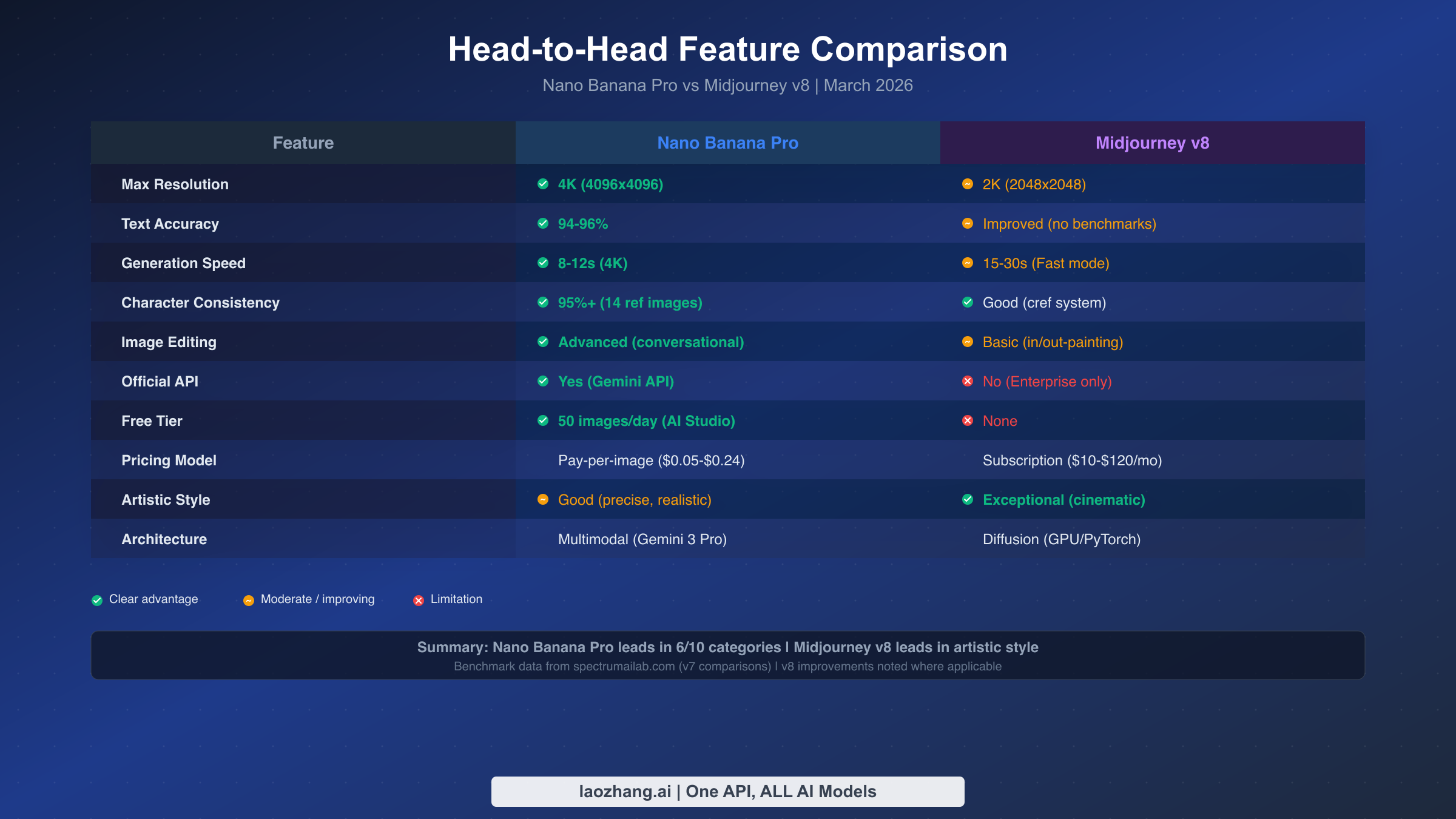
Before diving into the comparison data, it is important to note a significant limitation: most publicly available benchmarks compare Nano Banana Pro against Midjourney v7, not v8. Midjourney v8 launched in February 2026 with major improvements to resolution, text rendering, and semantic understanding, but third-party benchmark organizations have not yet published comprehensive v8 test results as of March 2026. Where v8-specific data is available, we use it; otherwise, we note the v7 baseline and describe the qualitative v8 improvements reported by early users and Midjourney's own documentation.
The resolution gap is one of the clearest differentiators. Nano Banana Pro generates images natively at up to 4096x4096 pixels (4K), which means the model's training data and generation process are optimized for this resolution — you get genuine detail, not upscaled artifacts. Midjourney v8 introduced native 2K (2048x2048) generation, which is a massive upgrade from v7's 1024x1024 native output but still half the linear resolution of Nano Banana Pro's maximum. For use cases like large-format printing, billboard design, or detailed product photography, this 2x resolution advantage is significant. For social media posts, web graphics, or concept art, 2K resolution is more than sufficient and the difference becomes less relevant.
Generation speed tells an interesting story about priorities. Nano Banana Pro takes 8-12 seconds to produce a 4K image (Google documentation, March 2026), which is remarkably fast considering the output resolution. Midjourney v8 in Fast mode generates images in roughly 15-30 seconds, though Relax mode (available on Standard plans and above) queues jobs with variable wait times of 1-10 minutes. If you are running an e-commerce operation that needs 200 product shots per day, generation speed directly impacts your throughput and costs — this is an area where the comparison extends to our detailed analysis of batch API cost optimization strategies.
| Feature | Nano Banana Pro | Midjourney v8 |
|---|---|---|
| Max Resolution | 4K (4096x4096) | 2K (2048x2048) |
| Text Accuracy | 94-96% (benchmarked) | Improved over v7 (no public benchmark) |
| Generation Speed | 8-12s (4K) | 15-30s (Fast mode) |
| Character Consistency | 95%+ with 14 ref images | Good with cref system |
| FID Score | 12.4 (vs v7's 15.3) | Not yet benchmarked for v8 |
| Prompt Adherence | 89% | 72% (v7 data) |
| Image Editing | Advanced conversational editing | In-painting, out-painting |
| Artistic Style | Precise, photorealistic | Cinematic, painterly |
For a broader perspective on how these models compare against other options in the market, including FLUX.2 and GPT Image, see our comprehensive comparison of Gemini Flash Image, GPT Image, and Flux which covers the full landscape of 2026 image generation models.
The Text Rendering Test and Character Consistency Deep Dive
Text rendering and character consistency are the two capabilities that most sharply divide these tools, and they happen to be the two capabilities that matter most for commercial and professional workflows. If you are creating marketing materials, social media graphics, product mockups, or any visual content that includes readable text, this section will likely determine your tool choice.
Nano Banana Pro's text rendering achieves 94-96% accuracy on standardized benchmarks (spectrumailab, December 2025), which means it can reliably generate legible text in multiple languages, maintain proper font layouts, and even create complex infographic layouts with bullet points and structured data. The practical implication is transformative for workflows that previously required post-processing: you can prompt Nano Banana Pro to generate a complete poster with headline text, body copy, and a call-to-action button, and the output will typically be usable without manual text correction. This capability stems from the Gemini 3 Pro architecture's multimodal understanding — the model does not treat text as visual patterns to be approximated but as semantic content that must be rendered correctly. When you specify "write 'GRAND OPENING' in bold white letters on a dark background," Nano Banana Pro understands the instruction semantically and generates each character with deliberate accuracy.
Midjourney v8 represents a genuine improvement over v7 in text rendering, but approaches it from a fundamentally different angle. Short words and phrases — think "STOP," "CAFE," "SALE" — render reliably in v8, especially when the text is a natural part of the scene rather than an overlay. However, longer sentences, specific font requirements, or complex text layouts still present challenges. Midjourney's text rendering treats text as a visual element that should look beautiful within the image's composition, which means it sometimes prioritizes aesthetic integration over character-level accuracy. For concept art where a storefront sign reading "Bookshop" adds atmosphere, v8 delivers beautifully. For a client deliverable where the sign must read exactly "Smith & Associates Financial Advisory — Est. 2019," you will likely need post-processing or a different tool entirely.
Character consistency follows a similar pattern of divergence. Nano Banana Pro's Identity Locking system allows you to provide up to 14 reference images of a character, from which the model builds what is effectively a three-dimensional understanding of the subject's facial structure, body proportions, and distinguishing features. You can then generate that exact character in a coffee shop, on a spaceship, or in a cartoon style without their appearance drifting. This consistency is measured at 95% or higher in controlled tests, with the practical significance being most evident in sequential content creation — comic strips, children's books, brand mascots across marketing campaigns, or product photography with consistent models. For e-commerce businesses in particular, this consistency means you can create an entire product line catalog with the same model, lighting style, and composition rules, producing visually cohesive results that would typically require an expensive photo studio session. Our guide to Nano Banana Pro for e-commerce product photography covers practical prompt strategies for achieving this level of commercial consistency.
Midjourney v8's Character Reference (cref) system is capable and has improved meaningfully over v7, but it approaches consistency from an artistic rather than technical perspective. Users report that the cref system works well for maintaining a general likeness when the character appears in similar contexts — same lighting conditions, similar poses, consistent art style. However, it can struggle with dynamic poses, dramatic lighting changes, or style transfers that significantly alter the context around the character. The cref system works by extracting high-level facial features and general body proportions from reference images, then applying those features as constraints during generation. This means it captures the "essence" of a character rather than the precise geometric details, which is often exactly what artists want for creative work but falls short for commercial applications that require pixel-level consistency. The fundamental architectural difference — Nano Banana Pro processing 14 reference images simultaneously through a reasoning engine versus Midjourney extracting style features from single references — explains why Nano Banana Pro achieves measurably higher consistency scores in controlled benchmarks.
The Real Cost: How Much You'll Actually Spend
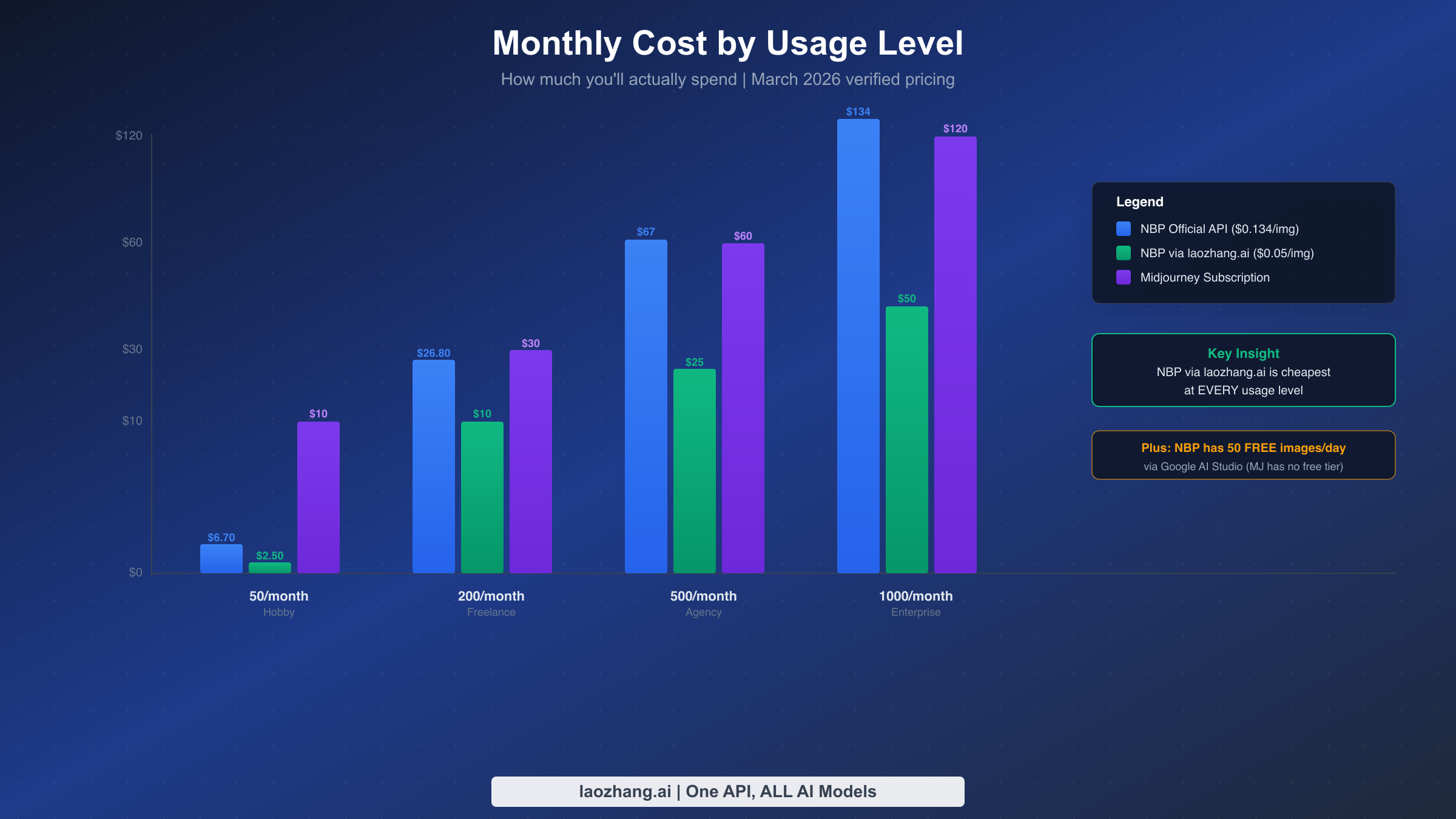
The pricing comparison between Nano Banana Pro and Midjourney v8 is not straightforward because they use fundamentally different pricing models. Nano Banana Pro charges per image through Google's API, while Midjourney charges a monthly subscription with GPU time allocation. This makes direct comparison impossible without specifying a usage level, which is exactly what we will do across four realistic scenarios — and it is the analysis that none of the top-ranking comparison articles currently provide.
Understanding the pricing structures. Nano Banana Pro through Google's official API costs $0.134 per image at 2K resolution and $0.24 per image at 4K resolution (Google AI pricing, March 2026). Through API aggregators like laozhang.ai, you can access Nano Banana Pro at $0.05 per image regardless of resolution — a significant cost reduction that makes the per-image model even more attractive. For high-volume users, the Batch API offers an additional 50% discount, bringing the Google official price down to $0.067 per image at 2K. Midjourney's subscription plans are: Basic at $10/month (3.3 hours of Fast GPU time, roughly 200 images), Standard at $30/month (15 hours plus unlimited Relax mode), Pro at $60/month (30 hours plus Stealth Mode), and Mega at $120/month (60 hours). All plans offer a 20% discount with annual billing (Midjourney official documentation, March 2026).
The real cost at four usage levels:
| Usage Level | Images/Month | NBP Official | NBP via laozhang.ai | Midjourney Plan | MJ Cost |
|---|---|---|---|---|---|
| Hobby | 50 | $6.70 | $2.50 | Basic | $10 |
| Freelance | 200 | $26.80 | $10.00 | Standard | $30 |
| Agency | 500 | $67.00 | $25.00 | Pro | $60 |
| Enterprise | 1,000 | $134.00 | $50.00 | Mega | $120 |
The pattern is clear: at every usage level, Nano Banana Pro through laozhang.ai is the most cost-effective option. Even at the official Google API price, Nano Banana Pro is cheaper than the corresponding Midjourney tier at lower usage levels (Hobby and Freelance). The crossover point where Midjourney's subscription becomes more cost-effective than Google's official API price occurs around 450-500 images per month — but this crossover never occurs when using laozhang.ai pricing.
There is an additional cost consideration that most comparisons overlook entirely: Midjourney's subscription is all-or-nothing. If you generate zero images in a given month, you still pay the full subscription fee. If you need 210 images one month and 50 the next, you either pay for the Standard plan both months ($60 total) or juggle plan changes. Nano Banana Pro's per-image model means you pay exactly proportional to your usage, with no wasted spend during quiet months. For businesses with variable creative output — seasonal marketing campaigns, project-based agencies, or freelancers with fluctuating workloads — this flexibility can represent significant savings over an annual period.
Annual cost projection. To illustrate the long-term impact, consider a freelance designer who averages 200 images per month but with seasonal variation (100 in slow months, 400 in busy months). With Midjourney, you would need the Standard plan year-round ($30 x 12 = $360), upgrading to Pro during busy months would push costs higher. With Nano Banana Pro through laozhang.ai at $0.05 per image, the annual cost tracks actual usage: approximately $120 total for 2,400 images across the year. That is a $240 annual savings — real money for freelancers and small studios. Even against Google's official API pricing ($0.134 per image), the annual cost of approximately $322 still undercuts Midjourney's Standard plan. For high-volume production workflows, explore our batch API cost optimization guide which covers strategies to reduce per-image costs even further through Google's 50% batch discount.
There is one scenario where Midjourney's subscription model has a cost advantage: if you are a heavy user who generates thousands of images monthly using Relax mode. The Standard plan's unlimited Relax mode means you can theoretically generate an unlimited number of images for $30/month if you are willing to accept queue wait times of 1-10 minutes per image. For hobbyists and artists who generate images for personal creative exploration and do not need fast turnaround, this unlimited ceiling is genuinely valuable and impossible to replicate on a per-image pricing model.
Getting Started for Free: Zero-Risk Trial Options
One of the most important practical differences between these two tools is how easy it is to try them before committing any money. This section provides the complete free access paths for both tools, so you can evaluate quality and workflow fit before making a financial decision.
Nano Banana Pro offers genuinely generous free access through two channels. The first is the Gemini App (gemini.google.com), where free-tier users can generate 2-3 images per day at standard resolution. This is enough to test basic prompts, evaluate text rendering quality, and understand the model's style. The second and more powerful free path is Google AI Studio (aistudio.google.com), which provides approximately 50 image generation requests per day at no cost, with access to all resolutions including 4K. AI Studio requires a Google account and basic familiarity with API-style interfaces, but it is genuinely free with no credit card required, no trial period expiration, and no watermarks on output. Between these two channels, you can generate over 50 high-quality images per day completely free — enough to complete a small project or run thorough quality comparisons. For a complete walkthrough of accessing Gemini image models at the lowest possible cost, including free tiers, see our guide to the cheapest Gemini image API options in 2026.
Midjourney v8 has no free tier. There was briefly a limited free trial in Midjourney's early days, but as of March 2026, every plan requires payment before you can generate a single image. The minimum commitment is the Basic plan at $10 per month (or $8/month with annual billing). While $10 is not a significant financial barrier for most professionals, it does mean you cannot evaluate Midjourney's output quality, style characteristics, or workflow integration before paying. For users who are genuinely unsure which tool to choose, this asymmetry in free access creates a natural recommendation: start with Nano Banana Pro's free tier to establish your baseline expectations for AI image quality, then decide whether Midjourney's artistic style is worth a separate subscription based on informed comparison rather than marketing materials.
The onboarding experience also differs significantly, and this matters more than most comparison articles acknowledge because the time from "deciding to try a tool" to "generating your first useful image" directly affects adoption decisions. To start using Nano Banana Pro through AI Studio, you need a Google account, navigate to aistudio.google.com, select the Gemini 3 Pro Image model from the model dropdown, type a prompt, and click generate — total time from zero to first image is genuinely under five minutes with no software installation, no payment information required, and no learning curve beyond writing a descriptive text prompt. The AI Studio interface is straightforward: it shows your prompt on the left, the generated image on the right, and settings for resolution and safety parameters. For users who prefer an even simpler experience, the Gemini App (gemini.google.com) provides a conversational interface where you simply chat with the model and request images in natural language.
For Midjourney, the onboarding path involves more steps. You need to either create a Discord account and join the Midjourney server (legacy path) or sign up on midjourney.com's web interface (newer path). Both require subscribing to a plan and entering payment information before you can generate anything. The web interface is cleaner and more intuitive than the Discord workflow, but it still requires understanding Midjourney-specific concepts like aspect ratio parameters (--ar 16:9), style references (--sref), and generation modes (Fast vs Relax). Experienced users find these parameters powerful; newcomers find them intimidating. Midjourney's community documentation and prompt sharing culture help flatten this learning curve over time, but the initial barrier is noticeably higher than Nano Banana Pro's "type and generate" simplicity.
For Developers and Teams: API Access and Integration
If you need to integrate AI image generation into an application, automate image creation workflows, or build custom tools on top of image generation capabilities, the API access difference between Nano Banana Pro and Midjourney v8 is not a nuance — it is a binary decision point that eliminates one of the options entirely for many use cases.
Nano Banana Pro is accessible through Google's official Gemini API, which is well-documented, supported by official SDKs in Python, JavaScript, Go, and several other languages, and backed by Google's enterprise-grade infrastructure. You can make API calls to generate images with full control over resolution, style parameters, safety settings, and output format. The API supports both synchronous generation (wait for the image and receive it in the response) and batch processing (submit many requests and retrieve results later at a 50% discount). Rate limits for free-tier API access are 50 requests per day; paid tier limits scale with your plan. The API is the same one used by Google's own products — Gemini App, Google Ads, and Google Workspace — which means it receives priority stability and performance attention from Google's engineering teams.
For developers who want simplified API access without managing Google Cloud credentials or dealing with per-resolution pricing complexity, aggregation platforms like laozhang.ai provide a unified API endpoint that routes to Nano Banana Pro (and other models) with simplified pricing ($0.05 per image regardless of resolution). This is particularly valuable for startups and small teams that need reliable image generation without the overhead of managing multiple API provider relationships and billing accounts.
Midjourney v8 has no official public API. This is worth stating clearly and emphatically because it is the single most significant limitation for technical users and organizations. Enterprise customers can negotiate custom API access through Midjourney's sales team, with pricing starting at approximately $500/month for custom plans (aitoolsdevpro.com, 2026), but the standard individual, startup, and small business tiers have no programmatic access whatsoever. For everyone else, the only way to automate Midjourney image generation is through unofficial third-party APIs (apiframe.ai, goapi.ai, and similar services) that reverse-engineer the Discord or web interface. These unofficial APIs are inherently unreliable — they break when Midjourney updates its interface, introduce additional latency, charge premium pricing (typically $0.02-0.10 per image on top of your Midjourney subscription), and most critically, they violate Midjourney's terms of service, which means your account can be terminated without warning or refund.
The practical consequence of this API gap is substantial. If your use case involves automated e-commerce product photography where an upload triggers image generation, dynamic content personalization in web applications, batch processing of hundreds of marketing assets through a CI/CD pipeline, or any workflow where a human manually entering prompts into a web UI is a bottleneck — Nano Banana Pro through the Gemini API is not just the better option, it is the only viable option between these two models. This limitation also affects team workflows: Nano Banana Pro's API enables centralized billing, usage monitoring, access controls, and integration with project management tools, none of which are possible with Midjourney's consumer-oriented interface.
The Hybrid Approach: Using Both Tools Together
Rather than treating this comparison as a winner-take-all decision, many professional creative teams have discovered that using both tools together produces results that neither can achieve alone. The key insight, identified by photographers like Chase Jarvis and UX professionals, is that Midjourney and Nano Banana Pro have complementary strengths that map to different phases of a creative workflow.
The most effective hybrid workflow uses Midjourney v8 for creative exploration and mood development, then switches to Nano Banana Pro for precision refinement and production-ready output. In practice, this looks like: start by generating 10-20 variations in Midjourney using loose, atmospheric prompts ("futuristic eco-city, morning light, organic architecture, warm palette") to explore compositional ideas and mood directions. Select the 2-3 most promising compositions, then use Nano Banana Pro to recreate the concept with precise specifications — exact text overlays, specific brand colors, consistent character placement, and 4K output resolution. This workflow leverages Midjourney's "happy accident" creativity for ideation while using Nano Banana Pro's precision for execution.
This approach makes practical sense when you consider the cost structure. Midjourney's Standard plan ($30/month with unlimited Relax mode) is ideal for high-volume creative exploration where speed is not critical — you can queue dozens of variations in Relax mode and review them in batches. Then, for the 5-10% of concepts that move to production, Nano Banana Pro at $0.05 per image through laozhang.ai adds minimal cost for significantly higher precision and resolution. A monthly workflow of 500 exploration images on Midjourney Relax mode plus 50 production images on Nano Banana Pro would cost approximately $32.50 — less than the Pro plan on either platform alone, while delivering both artistic range and production quality.
There is also a cost-optimization angle to the hybrid approach that deserves attention. If you use Midjourney exclusively on Relax mode for creative exploration (meaning you accept slower generation times but pay no extra beyond the Standard $30/month subscription), your exploration phase costs are fixed regardless of volume. Then, switching to Nano Banana Pro through laozhang.ai at $0.05 per image for only the final production renders keeps your precision costs minimal. A creative agency that explores 1,000 concepts per month on Midjourney Relax mode and produces 100 final deliverables on Nano Banana Pro would spend approximately $35/month total — significantly less than either tool alone would cost for comparable output quality and creative range.
That said, running two subscriptions and learning two interfaces is overhead that only makes sense for certain use cases. If your work is primarily commercial design with clear specifications (product photography, marketing materials, infographics), Nano Banana Pro alone handles the full workflow from ideation to delivery. If your work is primarily artistic exploration with less emphasis on text accuracy and technical precision (concept art, mood boards, personal creative projects), Midjourney alone delivers better results for that specific workflow. The hybrid approach shines for agencies, studios, and creative professionals who need both capabilities regularly — and for anyone who views Nano Banana Pro's comparison with other models like Seedream as evidence that no single tool dominates every dimension.
The Verdict: Which Tool Wins for Your Use Case?
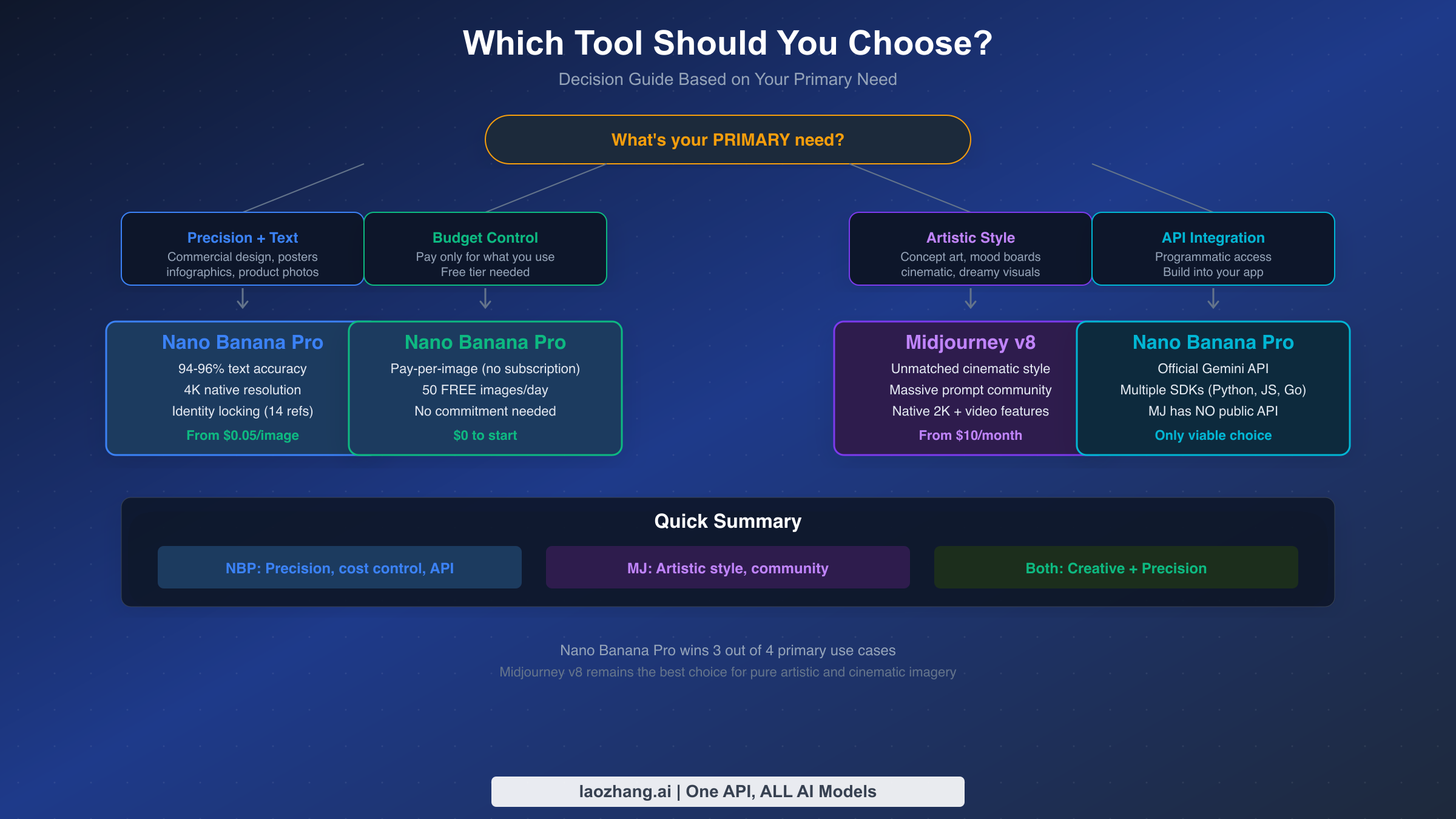
After comparing every major dimension — quality benchmarks, real-world costs, free access options, API capabilities, and workflow characteristics — the recommendation splits clearly along four user profiles. There is no single winner, but there is almost certainly a clear winner for your specific situation.
Choose Nano Banana Pro if your work requires text accuracy (posters, infographics, marketing materials), character consistency across multiple images (brand mascots, comic strips, product models), API integration (automated workflows, custom applications), budget predictability (pay-per-image with no subscription commitment), or maximum resolution (4K output for print or large-format). Nano Banana Pro is also the clear choice if you are budget-conscious at any usage level — from $0 through the AI Studio free tier to $0.05 per image through laozhang.ai, it offers the most affordable path to professional-quality AI image generation in 2026. Nano Banana Pro wins three out of four primary use case categories and is the stronger overall recommendation for professional and commercial workflows.
Choose Midjourney v8 if your primary need is artistic style and aesthetic quality — concept art, mood boards, stylized illustrations, and creative exploration where the "cinematic vibe" is more important than technical accuracy. Midjourney's massive community of prompt engineers, style libraries, and aesthetic presets make it unmatched for creative inspiration and rapid visual ideation. If you value a curated creative community and the ability to browse millions of generated images for inspiration, Midjourney's ecosystem is a genuine advantage that no other tool currently replicates. Midjourney v8 is the best choice for artists, illustrators, and creative directors whose workflow centers on visual exploration and emotional impact rather than technical precision.
Use both together if you work in a creative agency or studio where projects require both ideation and production, if your creative process naturally separates exploration from execution, or if you have the budget and willingness to learn two tools. The hybrid workflow described in the previous section ($30-35/month total) offers the best of both worlds for teams that need full creative range.
A note on future developments. Both tools are actively evolving. Google has released Nano Banana 2 (Gemini 3.1 Flash Image), a faster but slightly less capable sibling to Nano Banana Pro, and Imagen 4, a separate image model family with its own strengths. Midjourney has announced native video generation and 3D asset export capabilities for future v8 updates. The landscape will continue shifting, but the fundamental philosophical difference — precision engineering versus artistic expression — is structural and unlikely to change. Choosing the right primary tool now does not lock you in forever, but it does determine which ecosystem's workflow patterns and prompt conventions you invest time learning.
The bottom line is that AI image generation in 2026 is no longer about finding the "best" tool — it is about matching the right tool to your specific workflow, budget, and quality requirements. For the majority of professional and commercial use cases, Nano Banana Pro offers the stronger combination of precision, cost efficiency, API access, and free entry points. For purely artistic and creative exploration, Midjourney v8 remains in a class of its own. Whether you start with Nano Banana Pro's free tier on AI Studio or Midjourney's $10 Basic plan, the most important step is to test with your actual prompts and judge the output against your actual quality standards — not hypothetical benchmarks. The data and cost analysis in this guide gives you the framework to make that decision confidently, and the free tier comparison ensures you can test before spending a single dollar.