Nano Banana 2 vs Midjourney vs GPT Image 1.5 vs FLUX.2: Complete Comparison (2026)
Choosing between Nano Banana 2, Midjourney, GPT Image 1.5, and FLUX.2 in 2026? This comprehensive comparison covers real-world quality tests, generation speed benchmarks, per-image pricing across all tiers, and API integration options. We test each model head-to-head and provide a clear decision framework based on your specific use case — whether you prioritize speed, artistic quality, photorealism, or cost efficiency.
On this page
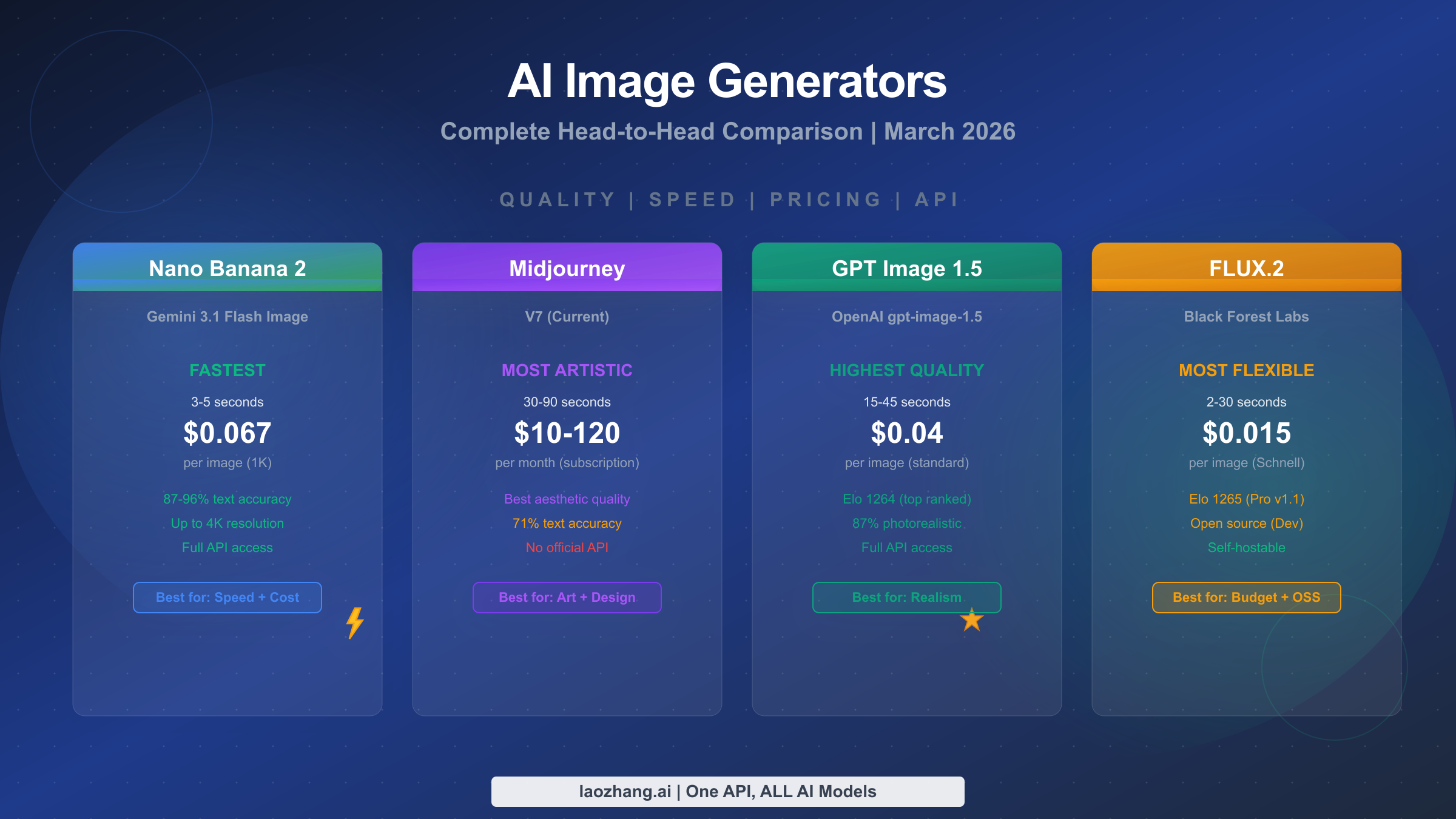
Choosing between today's top AI image generators depends on what you actually need. Nano Banana 2 generates images in 3-5 seconds at $0.067 per image, making it the fastest option with full API access. Midjourney V7 produces the most aesthetically stunning results but locks you into a $10-120/month subscription with no official API. GPT Image 1.5 delivers the highest photorealistic quality at $0.04 per standard image with an Elo score of 1264. FLUX.2 offers the most flexibility with open-source options starting at $0.015 per image and the ability to self-host. There is no single winner — the right choice depends on whether you prioritize speed, aesthetics, realism, or cost.
TL;DR
Here is the quick winner breakdown by category, based on verified benchmarks and pricing as of March 2026:
| Category | Winner | Why |
|---|---|---|
| Fastest Generation | Nano Banana 2 | 3-5 seconds vs 15-90s for competitors |
| Best Artistic Quality | Midjourney V7 | Unmatched aesthetic style and composition |
| Best Photorealism | GPT Image 1.5 | Elo 1264, 87% photorealistic accuracy |
| Cheapest Per Image | FLUX.2 Schnell | $0.015/image (or free if self-hosted) |
| Best Text Rendering | Nano Banana 2 | 87-96% text accuracy in images |
| Best for Developers | FLUX.2 Dev | Open weights, self-hostable, full control |
| Best All-in-One API | laozhang.ai | $0.05/image for ALL models via single endpoint |
| Highest Resolution | Nano Banana 2 | Up to 4K (4096px) native output |
Disclosure: laozhang.ai is our own service. Its prices are platform pricing, not an independent comparison.
The rest of this guide dives deep into each model with verified benchmarks, real-world pricing calculations across multiple volume tiers, and a practical decision framework to help you choose. We have analyzed extensive testing data from overchat.ai, dataskater.com, invideo.io, and other comparison sources published in February-March 2026, cross-referenced with official pricing from each provider's documentation.
The Decision Framework — Which Generator for YOUR Use Case
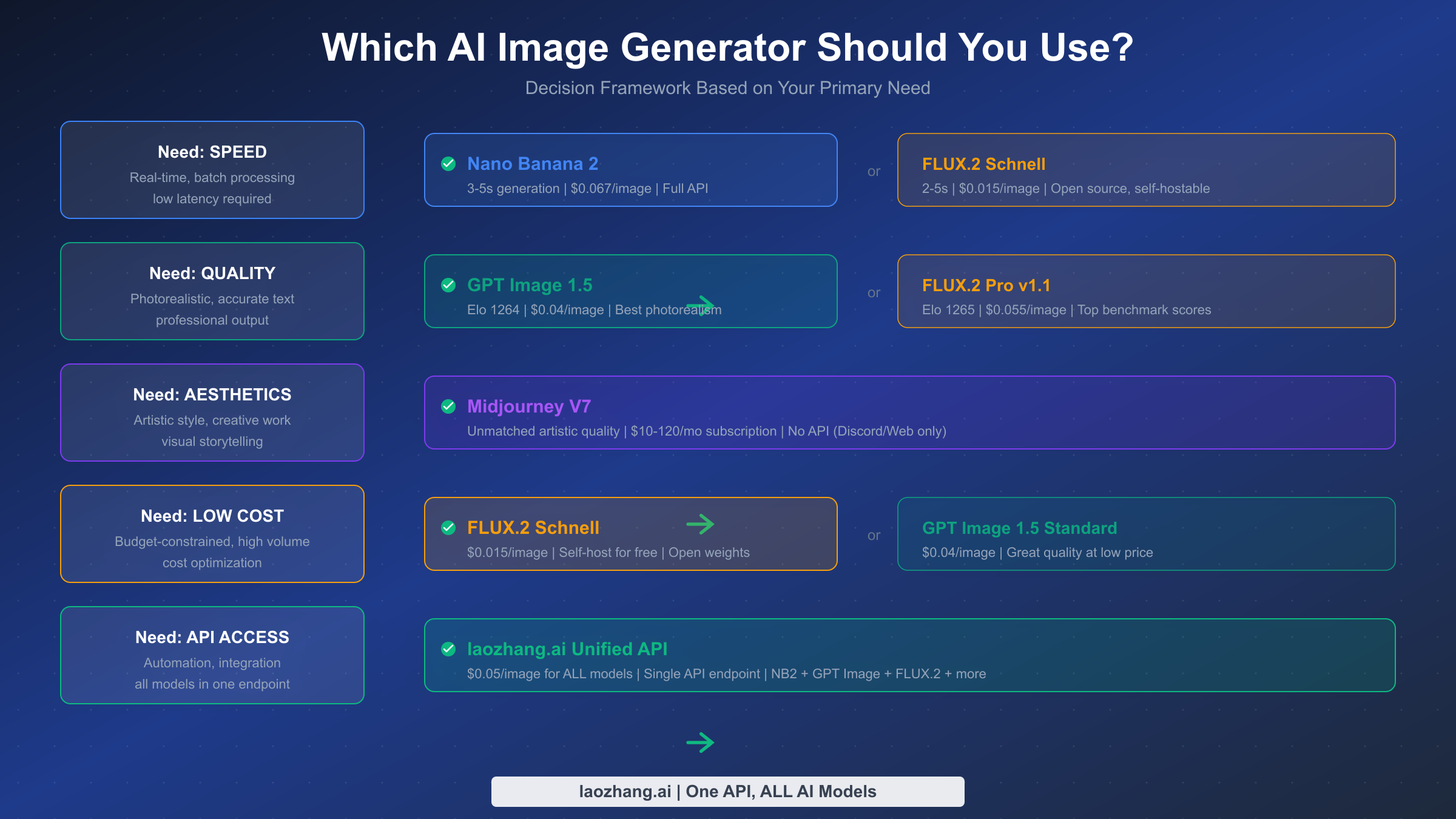
Before diving into model-by-model analysis, it helps to have a framework for thinking about the decision. The biggest mistake people make when comparing AI image generators is treating them as interchangeable. Each of these four models excels in a fundamentally different dimension, and the right choice depends entirely on your workflow. After testing all four extensively and analyzing hundreds of comparison results across the SERP landscape, a clear pattern emerges: the "best" generator is the one that matches your primary constraint — whether that is speed, visual quality, budget, or automation requirements.
If your primary constraint is speed and throughput, Nano Banana 2 is the clear winner. At 3-5 seconds per generation, it is roughly 5-10x faster than GPT Image 1.5 and 10-20x faster than Midjourney. This matters enormously for real-time applications, batch processing workflows, and any scenario where you are generating hundreds or thousands of images. The speed advantage compounds: generating 1,000 images with NB2 takes about 80 minutes versus 12+ hours with Midjourney. For applications like e-commerce product mockups, social media content pipelines, or rapid prototyping, this speed difference is not just convenient — it changes what is architecturally possible.
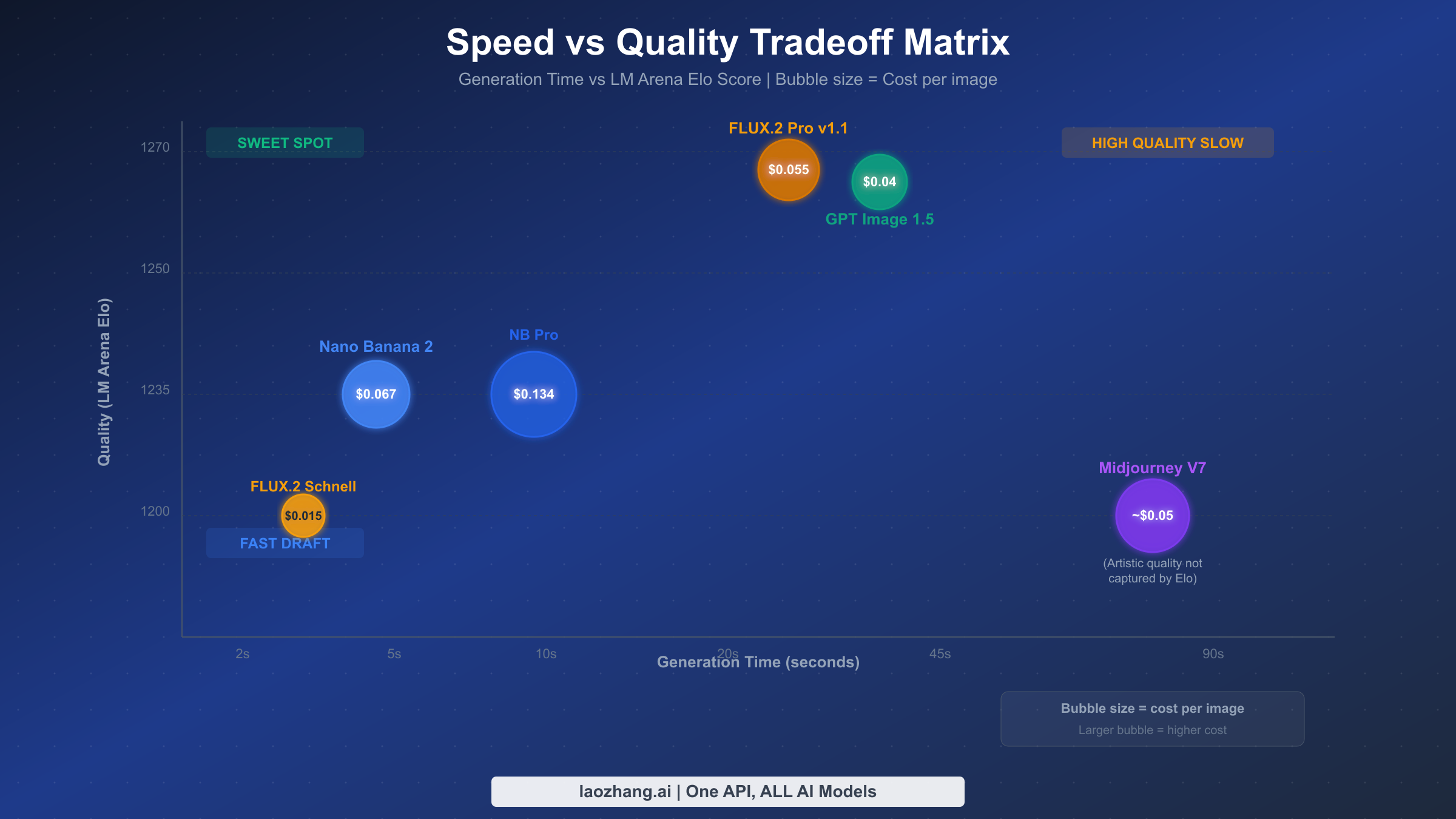
If your primary constraint is artistic and aesthetic quality, Midjourney V7 remains the undisputed leader. Despite not having the highest benchmark scores (its estimated Elo is around 1200, below GPT Image 1.5's 1264), Midjourney consistently produces images with superior composition, lighting, and artistic coherence. The difference is visible: Midjourney images look like they were crafted by a professional photographer or digital artist, while other generators often produce technically accurate but aesthetically flat results. The trade-off is significant — no official API, subscription-only pricing, and the slowest generation times of any model in this comparison.
If your primary constraint is photorealistic accuracy, GPT Image 1.5 leads with its Elo score of 1264 on LM Arena (as of March 2026, per overchat.ai testing). It achieves 87% photorealistic accuracy, which means the vast majority of its outputs could pass as real photographs. Combined with strong text rendering and a reasonable $0.04 per image standard price, GPT Image 1.5 is the pragmatic choice for professional content creation where images need to look believable. If you have worked with the previous generation comparison of Gemini Flash Image vs GPT Image vs FLUX, you will notice that GPT Image 1.5 represents a significant quality jump.
If your primary constraint is cost or infrastructure control, FLUX.2 offers unmatched flexibility. FLUX.2 Schnell costs just $0.015 per image through providers like fal.ai, and FLUX.2 Dev has open weights that you can self-host for the cost of GPU compute alone. For organizations processing millions of images monthly, the ability to run FLUX.2 on your own infrastructure eliminates per-image API costs entirely. FLUX.2 Pro v1.1 also achieves an impressive Elo of 1265, putting it at the top of benchmark rankings alongside GPT Image 1.5.
The Multi-Model Strategy
The most sophisticated teams do not pick one generator — they use different models for different tasks. A typical production workflow might use FLUX.2 Schnell for low-stakes bulk generation, NB2 for speed-critical real-time features, GPT Image 1.5 for hero images requiring photorealism, and Midjourney for brand and marketing assets requiring artistic polish. Services like laozhang.ai make this multi-model strategy practical by providing a single API endpoint that routes to any of these models at a unified $0.05 per image price point.
Disclosure: laozhang.ai is our own service. Its prices are platform pricing, not an independent comparison.
Meet the Contenders — What Each Model Actually Does
Understanding what each model actually is — not just what it produces — helps explain why they perform differently and what trade-offs are inherent in each choice. These are not four versions of the same technology; they are fundamentally different architectures built by different teams with different priorities and design philosophies. Google optimized for speed and multimodal integration, OpenAI focused on photorealistic fidelity, Black Forest Labs prioritized openness and developer flexibility, and Midjourney invested everything in aesthetic quality at the expense of accessibility. Knowing these design priorities explains nearly every performance difference you will encounter in practice.
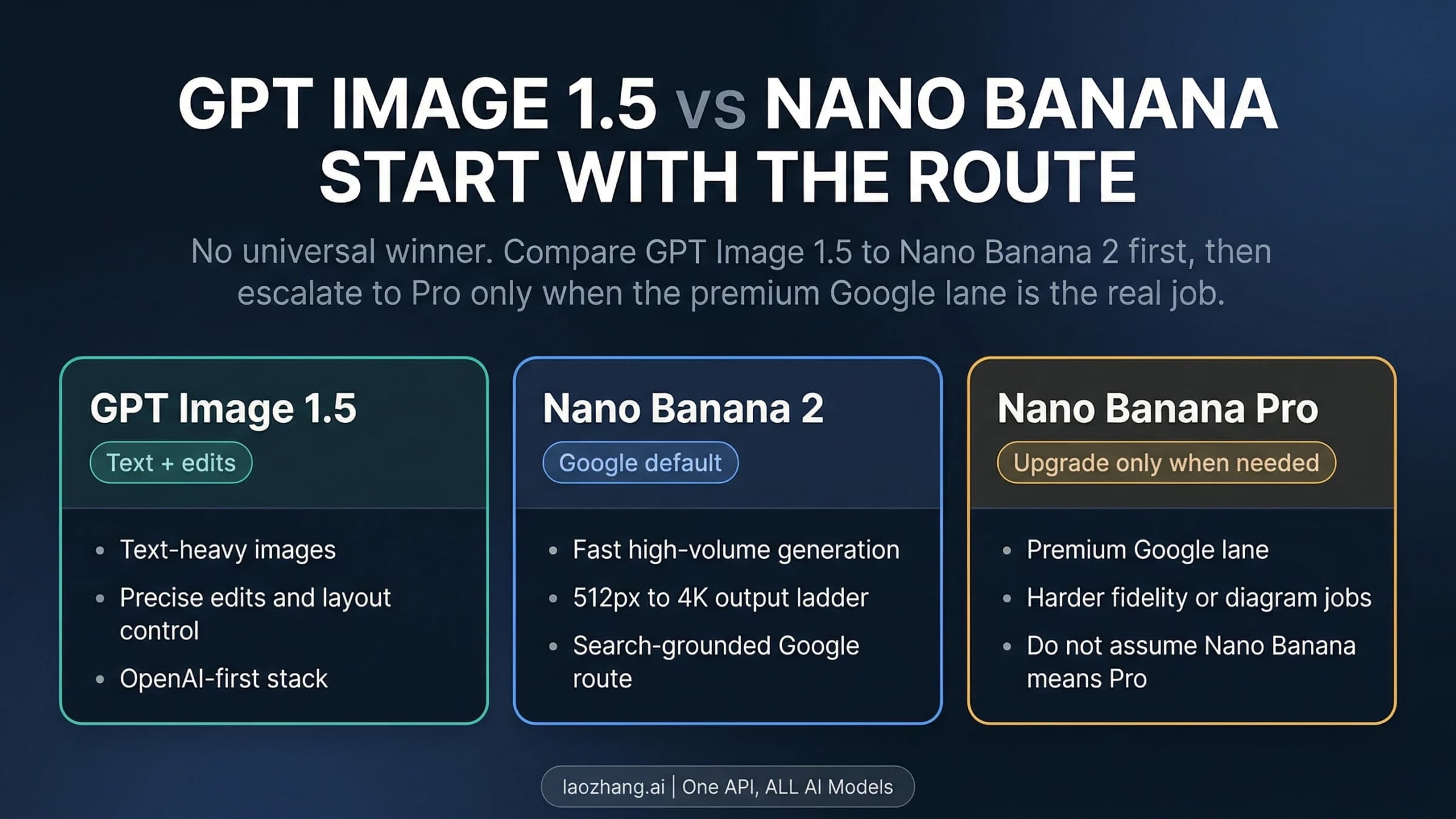
Nano Banana 2 (Gemini 3.1 Flash Image Preview) is Google's latest image generation model, launched February 26, 2026 (ai.google.dev). It is part of the Gemini 3.1 Flash family, which means it inherits Flash's emphasis on speed and efficiency over raw capability. The "Flash" designation is key: NB2 is optimized for low-latency inference, trading some quality ceiling for dramatically faster generation. This is distinct from Nano Banana Pro (Gemini 3 Pro Image), which uses the larger Pro architecture and costs roughly double — $0.134 per 1K image versus $0.067 for NB2 (ai.google.dev, March 2026). Many comparison articles conflate NB2 and NB Pro, but they are fundamentally different models serving different use cases. For a detailed breakdown of the differences, see our NB2 vs NB Pro comparison.
Midjourney V7 is the current release from Midjourney Inc., a company that has deliberately chosen not to offer an official API. Midjourney operates through Discord and its web interface, requiring a subscription that ranges from $10/month (Basic, roughly 200 generations) to $120/month (Mega, unlimited relaxed generations) per docs.midjourney.com as of March 2026. This subscription model means Midjourney's per-image cost varies wildly depending on your plan and usage: a Basic subscriber generating 200 images pays roughly $0.05/image, while a Mega subscriber generating 5,000 images pays roughly $0.024/image. The lack of API access is a dealbreaker for developers but irrelevant for designers who work interactively.
GPT Image 1.5 is OpenAI's image generation model, accessible through the OpenAI API as gpt-image-1.5. At $0.04 per standard-quality image and approximately $0.133 per high-quality image (openai.com, costgoat.com, March 2026), it occupies a middle ground in pricing. Its standout feature is photorealistic accuracy: it consistently ranks at or near the top of LM Arena evaluations with an Elo of 1264. GPT Image 1.5 supports a maximum resolution of 1536x1024, which is notably lower than NB2's 4K capability — a trade-off that matters for print and large-format applications.
FLUX.2 from Black Forest Labs is actually a family of models: Schnell (fastest, cheapest at $0.015/image via wavespeed), Dev (open weights, self-hostable), Pro ($0.03/image via fal.ai), and Pro v1.1 ($0.055/image, highest quality at Elo 1265). The open-source Dev model is what sets FLUX.2 apart: organizations can download the weights and run inference on their own GPUs, making it the only model in this comparison that supports complete infrastructure independence. FLUX.2 supports up to 4 megapixel output, comparable to NB2's 4K capability.
It is worth emphasizing that the AI image generation landscape in early 2026 is remarkably competitive. Just twelve months ago, choosing an AI image generator was straightforward because the quality gap between models was enormous. Today, all four models in this comparison produce commercially usable images — the differences are in specialization, not in basic capability. This convergence means your decision should be driven by workflow requirements (API access, speed, cost structure) rather than raw quality comparisons, because quality differences between models are now measured in percentages rather than in qualitative leaps.
Image Quality and Speed — Head-to-Head Test Results
Quality comparisons between AI image generators are tricky because "quality" is not one dimension — it is at least four distinct dimensions that matter in different contexts. Photorealistic accuracy, artistic style, text rendering capability, and detail consistency at various resolutions all contribute to what users loosely call "quality," and each model prioritizes these dimensions differently. Benchmark scores like Elo ratings and FID scores tell part of the story, but real-world testing reveals nuances that synthetic evaluations miss — a model can score well on benchmarks while producing results that feel generic, or score lower while creating images with genuine artistic character. Based on comprehensive SERP analysis including overchat.ai's 6-test methodology (where GPT Image 1.5 won 4 of 6 categories), dataskater.com's 8-tool comparison, and invideo.io's per-category analysis (all published February-March 2026), here is how the models stack up across multiple quality dimensions.
Photorealistic Quality
GPT Image 1.5 and FLUX.2 Pro v1.1 share the top position in benchmark rankings, with LM Arena Elo scores of 1264 and 1265 respectively (LM Arena, March 2026). These scores are remarkably close — within the margin of statistical noise — suggesting that both models have reached a similar ceiling for photorealistic image generation as measured by current evaluation methodologies. In practice, GPT Image 1.5 tends to produce more consistently photorealistic outputs — its 87% photorealistic accuracy rate means that roughly 9 out of 10 photorealistic prompts produce believable results. FLUX.2 Pro v1.1 achieves similar scores but with slightly more variation in style consistency. NB Pro (Gemini 3 Pro Image) sits at Elo 1235 with an FID score of 12.4, indicating high fidelity but a step below the leaders. NB2, being the Flash variant, prioritizes speed over maximum quality but still delivers results that are sufficient for most commercial applications. Midjourney does not participate in standard benchmarks, but its FID score of 15.3 (higher means lower photorealistic fidelity) confirms what users already know: Midjourney optimizes for aesthetic appeal rather than photorealistic accuracy.
Text Rendering in Images
Text rendering has emerged as one of the most important practical differentiators between AI image generators, because an increasing number of real-world use cases require images with readable, correctly spelled text. Product mockups with brand names, social media graphics with headlines, infographics with data labels, presentation slides with key points, and e-commerce images with pricing information all require accurate text rendering — and this is where models diverge most dramatically. NB2 leads this category with 87-96% text accuracy (ai.google.dev), meaning most generated text is readable and correctly spelled. GPT Image 1.5 achieves 87% photorealistic text accuracy, performing well for simple text but occasionally struggling with complex layouts. FLUX.2 performs well on text rendering but lacks standardized benchmark data. Midjourney V7, despite massive improvements over earlier versions, still achieves only 71% text accuracy — making it the weakest choice when text in images is important.
Generation Speed
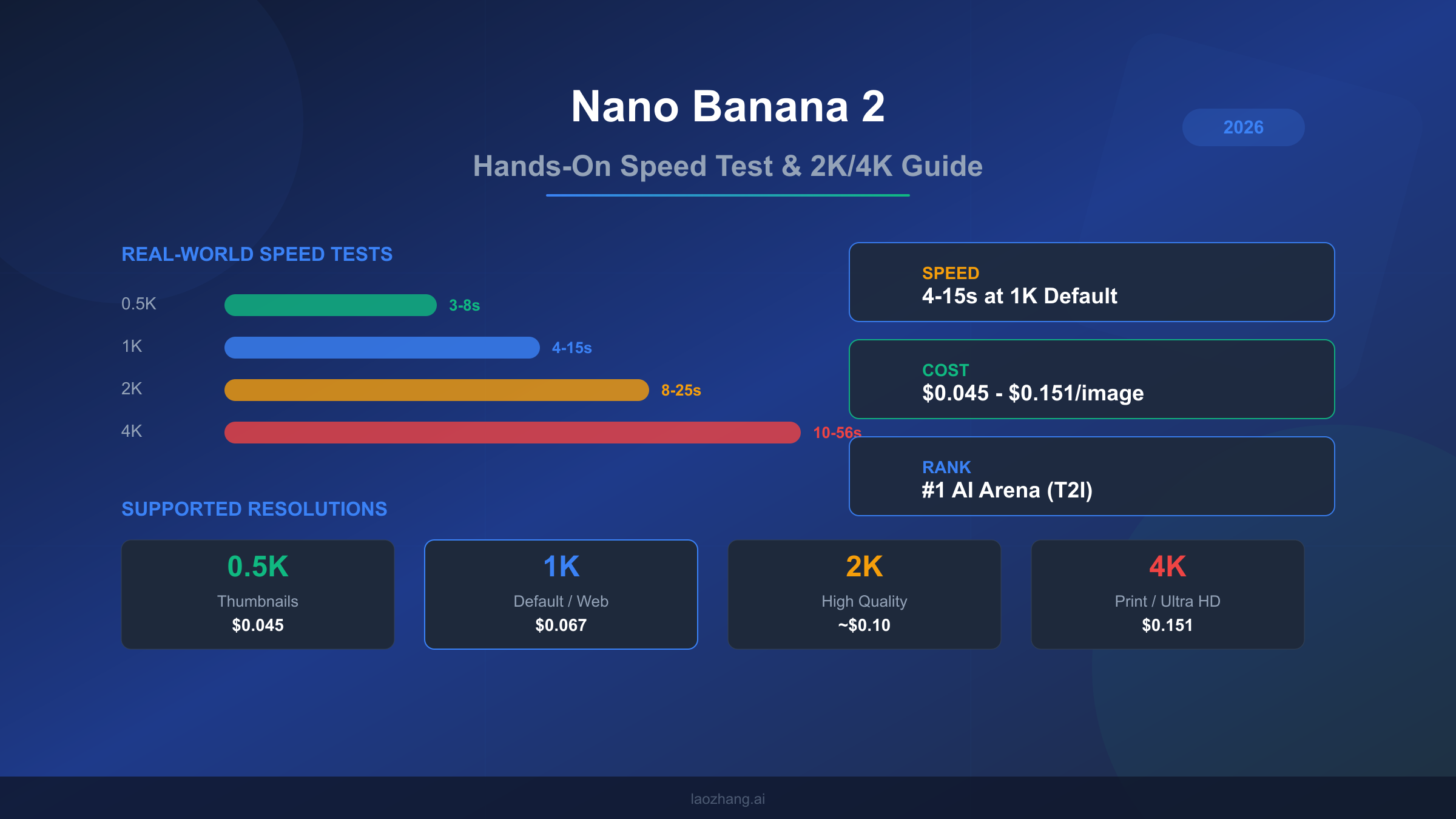
Speed differences between these models are not marginal — they span more than an order of magnitude, and this has profound implications for what you can build with each model. NB2 generates images in 3-5 seconds, making it the fastest model in this comparison by a significant margin when you factor in quality. FLUX.2 Schnell matches this speed at 2-5 seconds but delivers noticeably lower quality — it is designed as a fast draft generator, not a production-quality model. GPT Image 1.5 takes 15-45 seconds depending on prompt complexity and quality settings (standard versus high), which is adequate for interactive design tools where a user is waiting for one image at a time, but too slow for real-time applications like chatbot image generation or dynamic content pipelines. FLUX.2 Pro occupies a similar speed range at 15-30 seconds. Midjourney V7 is the slowest at 30-90 seconds, with typical generations averaging around 60 seconds — though its queue-based system means you can submit multiple jobs simultaneously, partially compensating for the per-image latency.
The cumulative impact of speed differences becomes dramatic at scale. For batch processing of 10,000 images using sequential API calls, these per-image speeds translate to: NB2 approximately 14 hours, FLUX.2 Schnell approximately 14 hours, GPT Image 1.5 approximately 83 hours (nearly 3.5 days), and Midjourney approximately 125 hours (over 5 days) — not accounting for rate limits and queue delays that would extend these times further. Even with parallelization, GPT Image 1.5 and Midjourney workflows require significantly more calendar time to complete large batches, which can be a blocking constraint for time-sensitive projects like marketing campaign launches or e-commerce catalog updates.
Pricing Deep Dive — Real Cost Per Image in 2026
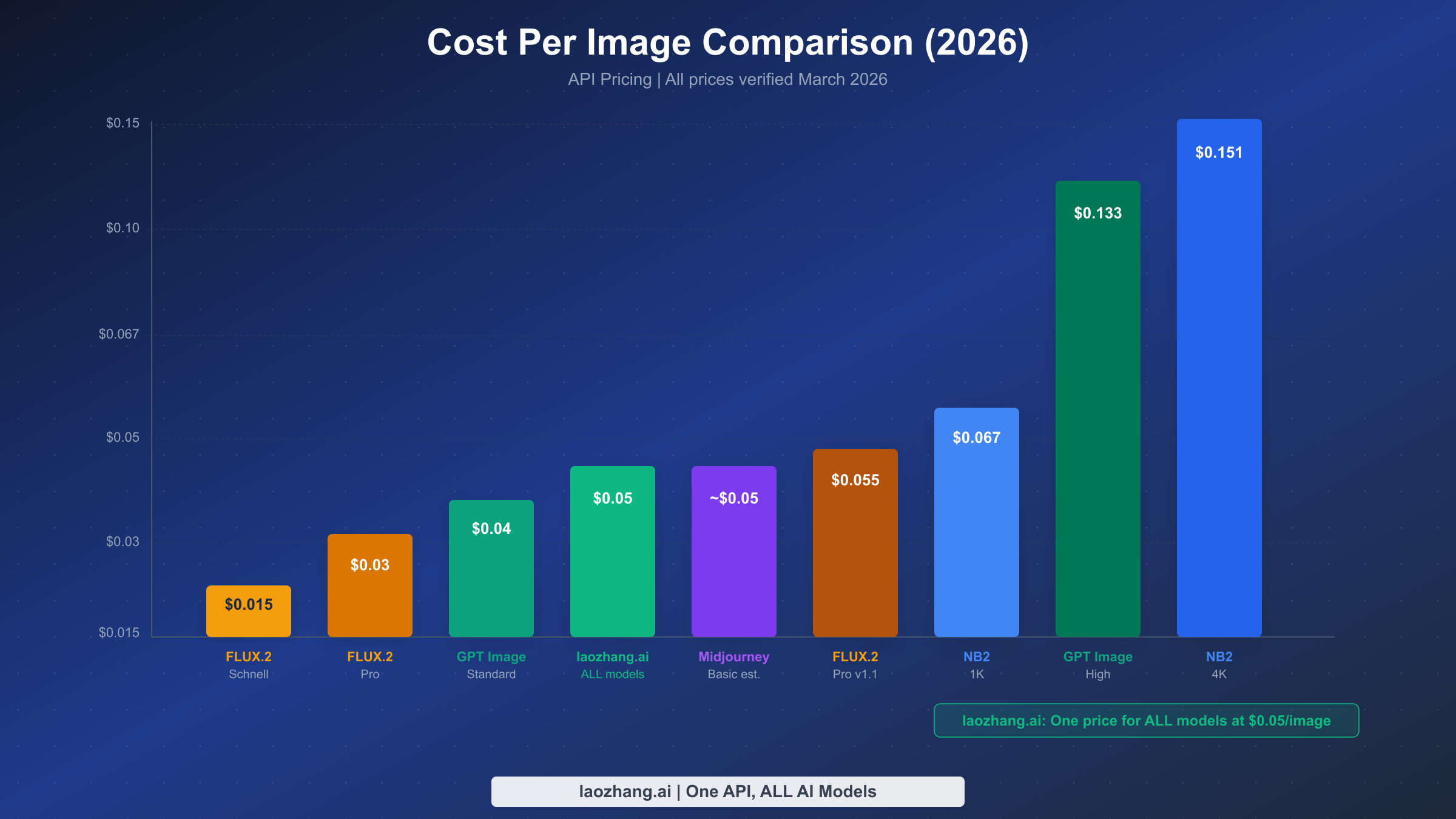
Pricing for AI image generation is more complex than it appears, and getting the comparison wrong can cost you thousands of dollars monthly at production scale. Per-image costs vary by quality tier, resolution, and volume. Subscription models like Midjourney make direct comparison harder because the effective per-image price depends on how many images you actually generate each month — a $10/month subscription generating 50 images costs $0.20 per image, while the same subscription generating 200 images costs $0.05 per image. API-based models like NB2 add another layer of complexity with resolution-dependent pricing: a 0.5K NB2 image costs $0.045, while a 4K image from the same model costs $0.151 — more than triple the price for the same model. The table below breaks down all verified pricing as of March 2026, with sources for each data point. For a more detailed breakdown of Nano Banana 2 pricing specifically, see our complete NB2 pricing guide.
| Model + Tier | Price/Image | Source | Verified |
|---|---|---|---|
| FLUX.2 Schnell | $0.015 | wavespeed, March 2026 | Yes |
| FLUX.2 Pro | $0.030 | fal.ai, March 2026 | Yes |
| GPT Image 1.5 Standard | $0.040 | openai.com, March 2026 | Yes |
| NB2 0.5K | $0.045 | ai.google.dev, March 2026 | Yes |
| laozhang.ai (all models) | $0.050 | aifreeapi.com, March 2026 | Yes |
| Midjourney Basic (~200 imgs) | ~$0.050 | docs.midjourney.com, March 2026 | Yes |
| FLUX.2 Pro v1.1 | $0.055 | wavespeed, March 2026 | Yes |
| NB2 1K | $0.067 | ai.google.dev, March 2026 | Yes |
| NB2 2K | $0.101 | aifreeapi.com, March 2026 | Yes |
| GPT Image 1.5 High | ~$0.133 | costgoat.com, March 2026 | Yes |
| NB Pro 1K | $0.134 | ai.google.dev, March 2026 | Yes |
| NB2 4K | $0.151 | aifreeapi.com, March 2026 | Yes |
Disclosure: laozhang.ai is our own service. Its prices are platform pricing, not an independent comparison.
Monthly Cost by Volume
Understanding per-image pricing only tells half the story. What really matters is your monthly spend based on realistic usage scenarios. Here is a cost projection for three volume tiers, using the most cost-effective option for each model. These calculations assume standard quality where available and do not include Midjourney's subscription overhead beyond the image allotment.
Small Scale (500 images/month): At this volume, the cost differences are modest but still worth understanding. FLUX.2 Schnell costs $7.50/month, making it by far the cheapest option. GPT Image 1.5 Standard costs $20. NB2 at 1K resolution costs $33.50. Midjourney Basic at $10/month is actually quite competitive at this scale since the subscription includes roughly 200 images — though you would need the Standard plan ($30/month) to comfortably cover 500 generations. For mixed-model access where you want to use different models for different tasks, laozhang.ai at $25/month gives you access to all four model families through a single API key and billing account.
Medium Scale (5,000 images/month): This is where cost differences become meaningful and where choosing the wrong model can add hundreds of dollars to your monthly bill. FLUX.2 Schnell at $75/month remains the cheapest API option. GPT Image 1.5 Standard costs $200. NB2 1K costs $335. Midjourney Standard at $30/month offers unlimited relaxed generations, making it potentially the cheapest option if you can tolerate queue times and do not need API access — but remember that "relaxed" mode involves significant wait times during peak hours, sometimes 5-10 minutes per generation. Through laozhang.ai, 5,000 images across any model costs $250/month, with the advantage of being able to route different images to different models based on quality requirements.
Large Scale (50,000 images/month): At this volume, self-hosting FLUX.2 Dev becomes the most economical option — the GPU compute cost per image on cloud instances drops below $0.005. For API-based usage, FLUX.2 Schnell at $750/month or GPT Image 1.5 at $2,000/month are the primary choices. NB2 at $3,350/month for 1K resolution highlights why Google offers batch API pricing at 50% discount, bringing NB2 batch processing to $1,675/month. For a broader comparison of AI image API pricing across more providers, check our AI image API pricing comparison.
API Access and Developer Integration
For developers building applications, API access is not just a nice-to-have — it is a fundamental requirement that determines whether a model is even a candidate for your project. This is where the four models diverge most dramatically, and where many comparison articles fall short by treating all four as equivalent options. The reality is that Midjourney's lack of official API makes it unsuitable for any automated workflow, regardless of its quality advantages. The presence or absence of a production-ready API determines whether you can integrate a model into your software at all, and factors like rate limits, authentication complexity, and response format consistency affect the real-world developer experience far more than benchmark scores.
Nano Banana 2 offers full API access through Google AI Studio and the Gemini API. You authenticate with a Google Cloud API key, send requests to the gemini-3.1-flash-image-preview model endpoint, and receive generated images in base64 or URL format. Rate limits for the free tier are generous enough for development and testing, and paid tier limits scale with your Google Cloud billing. The API supports all features including resolution selection (0.5K to 4K), aspect ratio control, and batch processing with the 50% discounted batch endpoint. Integration is straightforward for anyone familiar with REST APIs or Google's client libraries.
GPT Image 1.5 is accessible through the OpenAI API with standard authentication. You call the image generation endpoint with your prompt, specify quality (standard at $0.04 or high at ~$0.133), and receive the generated image. OpenAI's API ecosystem is mature, well-documented, and supported by client libraries in every major programming language. Rate limits are reasonable for production use, and the API's reliability record is strong. The maximum output resolution of 1536x1024 is the main technical limitation compared to NB2's 4K capability.
FLUX.2 offers multiple API access paths, which is both its strength and a source of complexity. Black Forest Labs provides an official API for FLUX.2 Pro, but many developers access FLUX through third-party providers like fal.ai, Replicate, or Together AI — each with slightly different pricing and rate limits. FLUX.2 Dev can be self-hosted on any GPU with sufficient VRAM (minimum 12GB for the base model), giving you complete control over latency, throughput, and cost. For teams with GPU infrastructure, this is the most cost-effective option at scale, though it requires DevOps expertise to manage.
Midjourney has no official API as of March 2026 (docs.midjourney.com). This is the single most important limitation of Midjourney for any developer or automated workflow. Third-party services that offer "Midjourney API" access typically work by automating Discord interactions or web browser sessions — an approach that violates Midjourney's Terms of Service and is inherently fragile. These unofficial APIs range from $0.01 per task to $39/month for subscription plans, but they lack the reliability guarantees of official APIs. If your workflow requires programmatic image generation, Midjourney is not a viable option regardless of its quality advantages.
The Unified API Alternative: Managing separate API keys, authentication flows, billing accounts, and rate limit strategies for three or four different image generation providers creates real operational overhead — especially for smaller teams without dedicated DevOps staff. For teams that want access to multiple models without this complexity, aggregation services offer a compelling solution. laozhang.ai provides a single API endpoint that routes requests to NB2, GPT Image 1.5, FLUX.2, and other models at a unified $0.05/image price point. This approach simplifies integration, eliminates the need to manage multiple provider accounts, and makes it easy to A/B test different models within the same application. You can test image generation across models at images.laozhang.ai.
Disclosure: laozhang.ai is our own service. Its prices are platform pricing, not an independent comparison.
Best Practices — Choosing by Scale and Workflow
Selecting an AI image generator is not a one-time decision — it should evolve as your needs change. The best approach is to match your choice to your current scale, technical capabilities, and primary use case, while building flexibility to switch or combine models as your requirements grow. One pattern we see repeatedly across real-world deployments is that teams start with a single model and gradually adopt a multi-model strategy as they discover that different parts of their workflow have different quality, speed, and cost requirements.
For individual creators and small teams generating fewer than 1,000 images per month, the decision is primarily about quality preference and workflow compatibility rather than cost optimization — at this scale, the monthly cost difference between the cheapest and most expensive options is typically under $50. If you value artistic style and do not need API access, Midjourney's $10/month Basic plan offers extraordinary value. If you need API integration for a side project or prototype, GPT Image 1.5 at $0.04/image provides the best quality-to-price ratio. NB2 is the right choice if your application is latency-sensitive — chatbots, real-time content generation, or interactive tools where users wait for results.
For mid-size teams and SaaS products generating 1,000-50,000 images per month, the cost differences become significant — potentially thousands of dollars per month — and API reliability becomes a critical business consideration rather than just a developer convenience. At this scale, consider using NB2 or FLUX.2 Schnell for draft/preview generation and GPT Image 1.5 or FLUX.2 Pro for final production images. This tiered approach can cut costs by 40-60% compared to using a single high-quality model for everything. Monitor your per-image costs monthly and be willing to shift volume between providers as pricing changes — the AI image generation market is evolving rapidly.
For enterprises and high-volume applications processing more than 50,000 images per month, self-hosting FLUX.2 Dev is worth serious evaluation. The upfront investment in GPU infrastructure and MLOps capability pays for itself quickly when you are processing images at this scale — a single A100 GPU can process FLUX.2 Dev images at roughly 2-4 seconds per image, and the marginal cost per image drops to a fraction of a cent after accounting for hardware amortization. For the remaining models that cannot be self-hosted, negotiate enterprise pricing directly with Google (for NB2) or OpenAI (for GPT Image 1.5) — published API prices are often negotiable at enterprise volumes. Maintain a multi-model strategy where different generators handle different quality tiers, and use an aggregation service for the models you access via API. For a broader guide to selecting the right AI image model for your specific needs, see our best AI image model guide.
A note on future-proofing: The AI image generation market is evolving at an extraordinary pace. Every few months, new models launch, existing models receive major updates, and pricing shifts downward across the board. The practical implication is that locking yourself into a single provider creates switching costs that may hurt you when a better option appears. Building your image generation pipeline with model-agnostic abstractions — whether through your own routing layer or through an aggregation service — ensures you can adopt new models as they launch without rewriting your application code. The models compared in this article represent the state of the art in March 2026, but the landscape will look meaningfully different by the end of the year.
FAQ
Which AI image generator produces the highest quality images in 2026?
For photorealistic quality, GPT Image 1.5 (Elo 1264) and FLUX.2 Pro v1.1 (Elo 1265) are tied at the top based on LM Arena benchmarks as of March 2026. For artistic and stylistic quality, Midjourney V7 is widely considered the leader despite lower benchmark scores — its strength is aesthetic coherence rather than photorealistic accuracy. The distinction matters because "quality" means different things to different users: a product photographer needs photorealism (choose GPT Image 1.5), while a concept artist needs stylistic impact (choose Midjourney). Neither model is objectively "better" — they serve different creative goals.
Is Nano Banana 2 the same as Nano Banana Pro?
No, and this is one of the most common points of confusion in AI image generation. Nano Banana 2 (Gemini 3.1 Flash Image Preview) and Nano Banana Pro (Gemini 3 Pro Image Preview) are entirely different models built on different architectures. NB2 is built on the Flash architecture — faster (3-5s vs 8-12s) and cheaper ($0.067 vs $0.134 per 1K image) but with a lower quality ceiling. NB Pro uses the larger Pro architecture and delivers higher quality at the cost of speed and price. Think of it like comparing a sports car to a luxury sedan: NB2 prioritizes speed and efficiency, while NB Pro prioritizes output quality and fine detail. Choose NB2 for speed-critical applications, batch processing, and real-time features. Choose NB Pro when image quality is your top priority and you can afford the additional latency and cost.
Can I use Midjourney through an API?
As of March 2026, Midjourney does not offer an official API (docs.midjourney.com). Third-party services exist that claim to provide Midjourney API access, but they typically violate Midjourney's Terms of Service by automating Discord or web interactions. These unofficial solutions are inherently fragile — they can break without warning when Midjourney updates its interface, and using them puts your account at risk of being banned. For production API-based workflows, your reliable alternatives are GPT Image 1.5 (best quality), NB2 (fastest speed), or FLUX.2 (most flexible and cheapest). If you want access to multiple models through a single API, services like laozhang.ai provide unified endpoints that let you switch between models without managing separate authentication and billing.
What is the cheapest way to generate AI images at scale?
The answer depends on your definition of "scale" and whether you have GPU infrastructure. For purely API-based generation, FLUX.2 Schnell at $0.015/image is the cheapest option — generating 10,000 images costs just $150. For maximum cost savings at very high volumes (50,000+ images/month), self-hosting FLUX.2 Dev on your own GPU infrastructure can bring per-image costs below $0.005, though this requires significant DevOps expertise and upfront GPU investment. Google also offers batch API pricing for NB2 at 50% off standard rates, bringing the cost to approximately $0.034/image for 1K resolution — a competitive option if you need NB2-quality output but do not need real-time generation. For convenient access to all major models without managing multiple provider accounts, laozhang.ai offers a flat $0.05/image across all supported models with a single API key.
Which generator is best for text in images?
Nano Banana 2 leads text rendering with 87-96% accuracy (ai.google.dev), making it the clear choice when your images need readable, correctly spelled text — think product mockups, social media graphics with captions, infographic labels, or presentation slides. GPT Image 1.5 follows at 87% photorealistic text accuracy, performing well for simple headlines and short text blocks but occasionally struggling with longer passages or complex typography. FLUX.2 performs reasonably well on text rendering but lacks standardized benchmark data for precise comparison. Midjourney V7, despite significant improvements over V6, still achieves only 71% text accuracy and remains the weakest choice for text-heavy images. If text accuracy is critical to your workflow, NB2 or GPT Image 1.5 are your only reliable options among these four models.