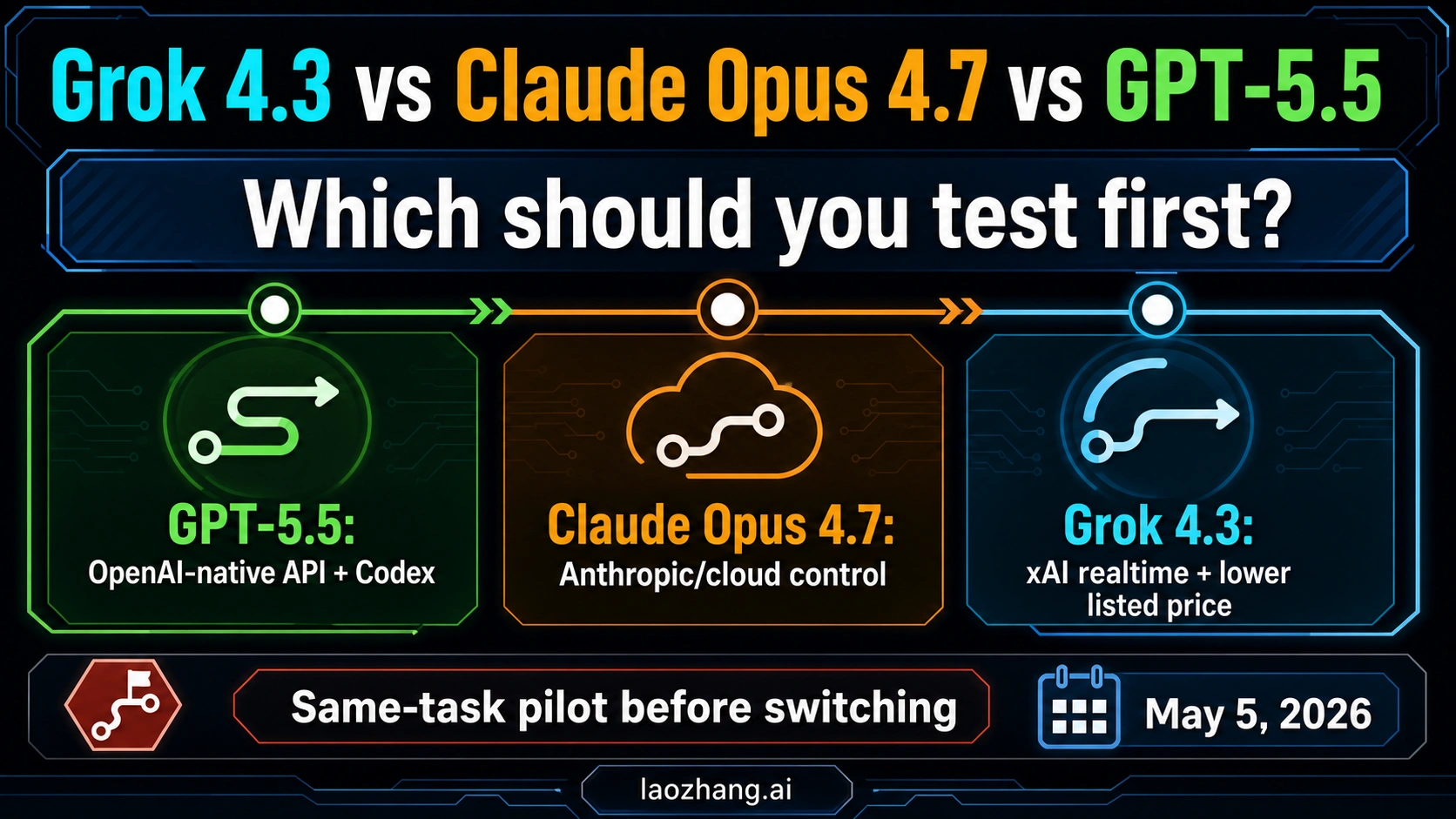
As of May 5, 2026, the safest answer is route-first: test GPT-5.5 first if your stack is already OpenAI-native, keep Claude Opus 4.7 as the premium Anthropic or cloud control, and test Grok 4.3 first when xAI realtime/X search, lower listed token price, or long-context pilots are the reason you are comparing.
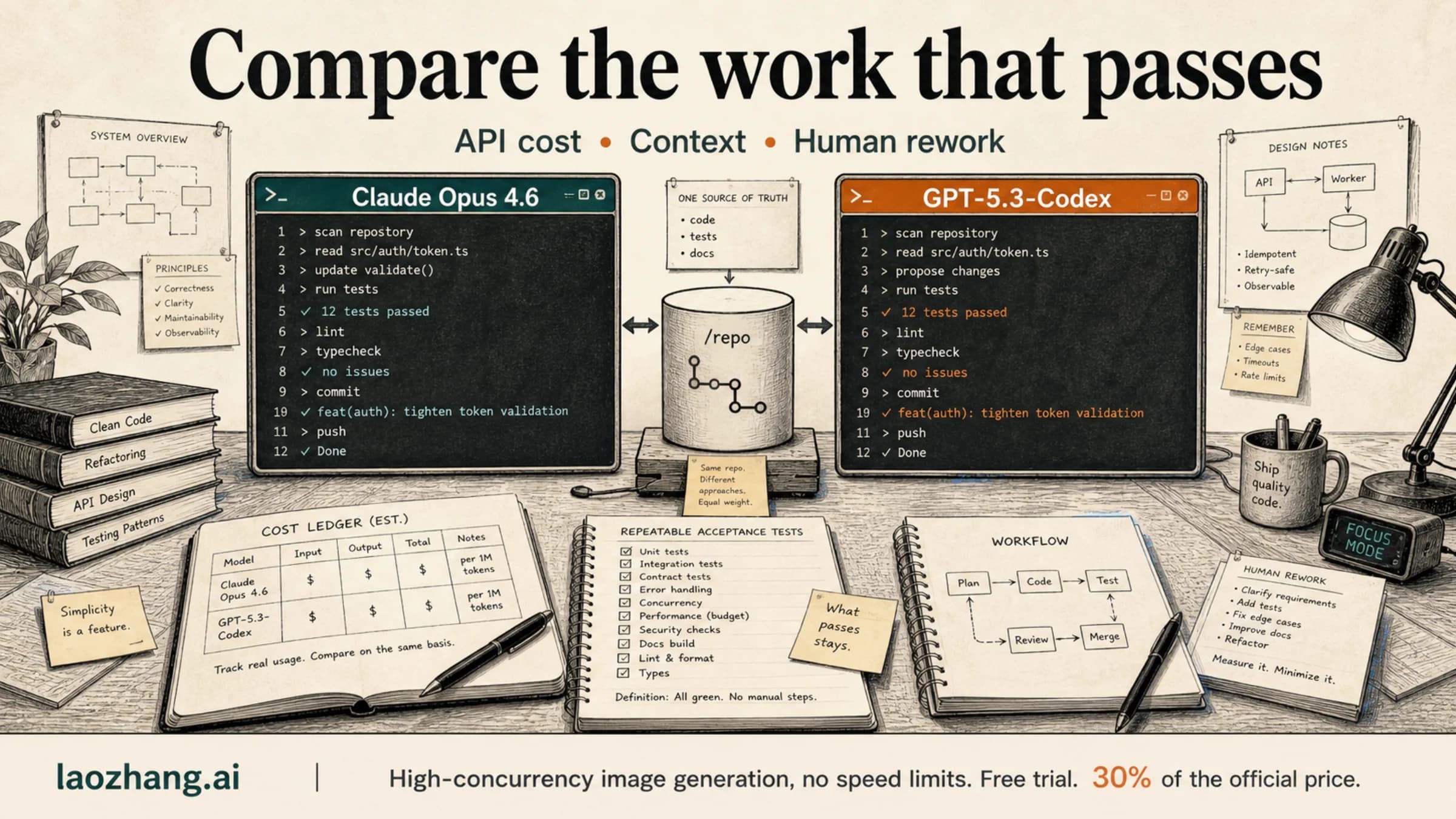
Do not switch a production default from a single benchmark, video, or launch-week impression. Run the same prompt, same tools, same budget, and same scoring rubric before moving traffic.
| First route to test | Use it when | Do not assume |
|---|---|---|
| GPT-5.5 | You need OpenAI-native API, Responses API patterns, Codex, tool-heavy reasoning, or an existing OpenAI eval harness. | Codex access, API-key authentication, credits, and rate limits are the same contract. |
| Claude Opus 4.7 | You need the premium Anthropic route, Claude API, Bedrock, Vertex, Microsoft Foundry, or a stable control for high-risk coding agents. | A higher quality control is automatically cheaper once output, tokenizer behavior, and retries are counted. |
| Grok 4.3 | You need xAI account access, realtime/X freshness, lower listed token price, or a long-context pilot. | Lower listed price replaces a same-task cost and quality test. |
Start With The Contract You Can Actually Call
The useful comparison starts with route ownership. OpenAI owns the GPT-5.5 API, Responses API, and Codex facts. Anthropic owns the Claude Opus 4.7 API, Claude product, and cloud-provider facts. xAI owns the Grok 4.3 model, account availability, tool pricing, long-context threshold, and console visibility. Anything else can suggest what to test, but it should not decide model IDs, endpoint behavior, price rows, context limits, or production access.
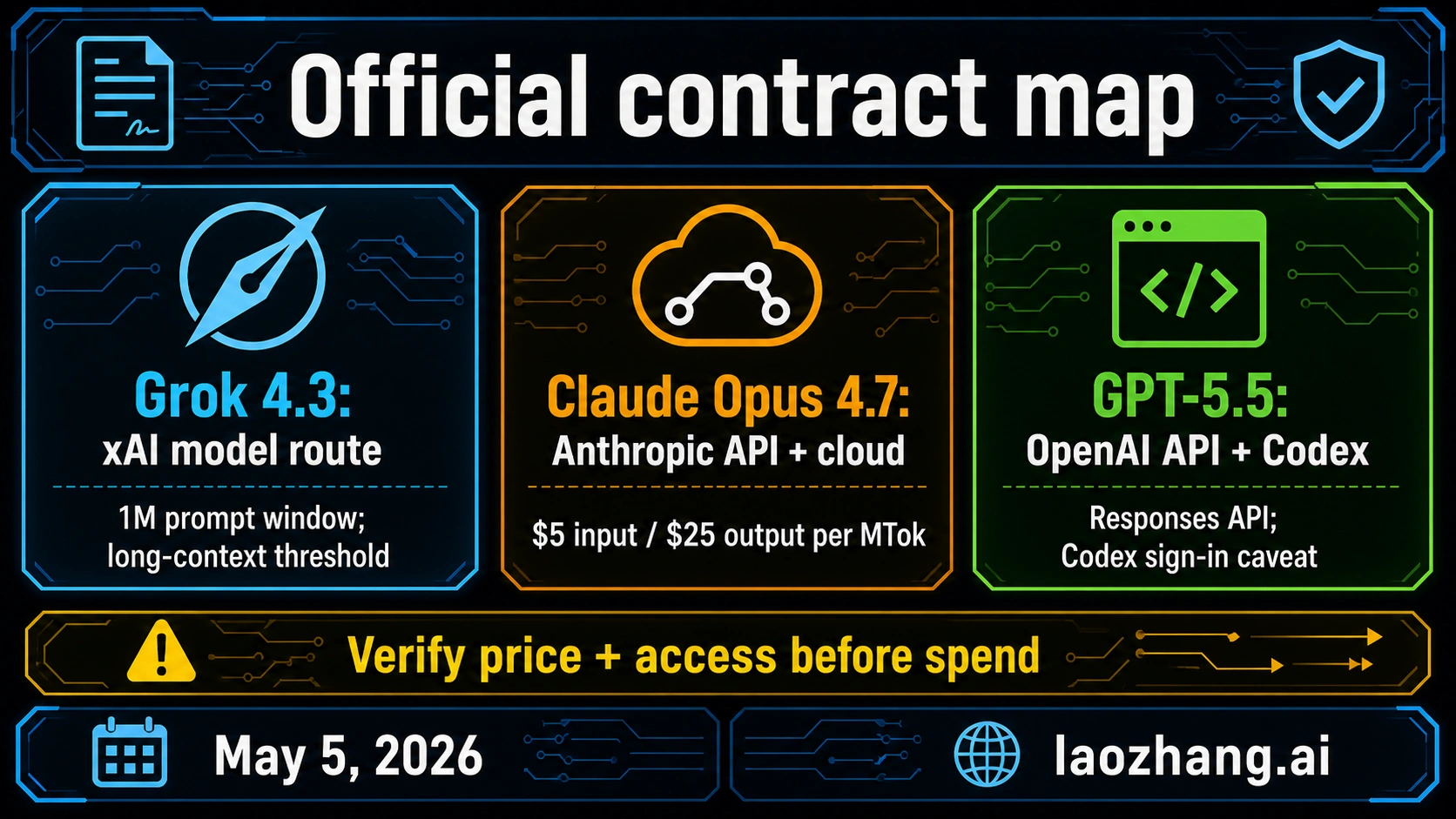
| Contract item | GPT-5.5 | Claude Opus 4.7 | Grok 4.3 |
|---|---|---|---|
| Route owner | OpenAI developer platform and Codex product surface | Anthropic API, Claude products, Bedrock, Vertex AI, and Microsoft Foundry | xAI API, xAI Console, Grok model docs, and xAI server-side search tools |
| Model label to verify | gpt-5.5 and dated GPT-5.5 snapshots in OpenAI developer docs | claude-opus-4-7 in Anthropic docs and cloud model IDs | grok-4.3, grok-4.3-latest, or the current console alias |
| Strongest first-test reason | OpenAI-native tool loops, Responses API, structured outputs, hosted tools, Codex, and existing OpenAI evals | Premium deployable control for high-risk coding agents, cloud deployment, and correctness-sensitive work | xAI route, realtime/X search with server-side tools, lower listed token price, and long-context pilots |
| Current cost caveat | OpenAI Codex credits and OpenAI API token pricing are different surfaces. Verify the exact API or Codex billing route before spend. | Anthropic lists Opus 4.7 at $5 input and $25 output per MTok, with tokenizer behavior that can change counted tokens. | xAI model data and console visibility must be rechecked; long-context and server-side search tools can change successful-task cost. |
| Do not merge | API access, ChatGPT/Codex sign-in access, API-key authentication, credits, and rate limits | Claude app usage, Anthropic API, cloud provider route, priority tier, and tokenizer cost | Grok chat, xAI API, search-tool freshness, aliases, region/account availability, and long-context price threshold |
OpenAI's GPT-5.5 guide says GPT-5.5 works best through the Responses API and points teams toward reasoning effort, verbosity, Structured Outputs, prompt caching, hosted tools, state handling, and the Agents SDK. OpenAI's Codex model docs also make GPT-5.5 the frontier Codex choice for complex coding and knowledge work, but Codex model-picker access and API-key authentication are separate deployment contracts.
Anthropic's Claude Opus 4.7 launch page says Opus 4.7 is generally available across Claude products, the Anthropic API, Amazon Bedrock, Google Vertex AI, and Microsoft Foundry. Anthropic's model overview and pricing docs are the sources to recheck for the model ID, 1M context, price, cloud IDs, and tokenizer caveat before a paid rollout.
xAI's model docs list Grok 4.3 as a current model, and the broader models and pricing page says realtime events require server-side search tools rather than base-model memory. That matters for this comparison: if realtime/X freshness is why you are testing Grok, your pilot has to include Web Search or X Search cost and failure behavior, not only text-token cost.
Which Workload Points To Which First Test
The clean routing rule is not "which model is best." It is "which model deserves the first controlled test for this workload."
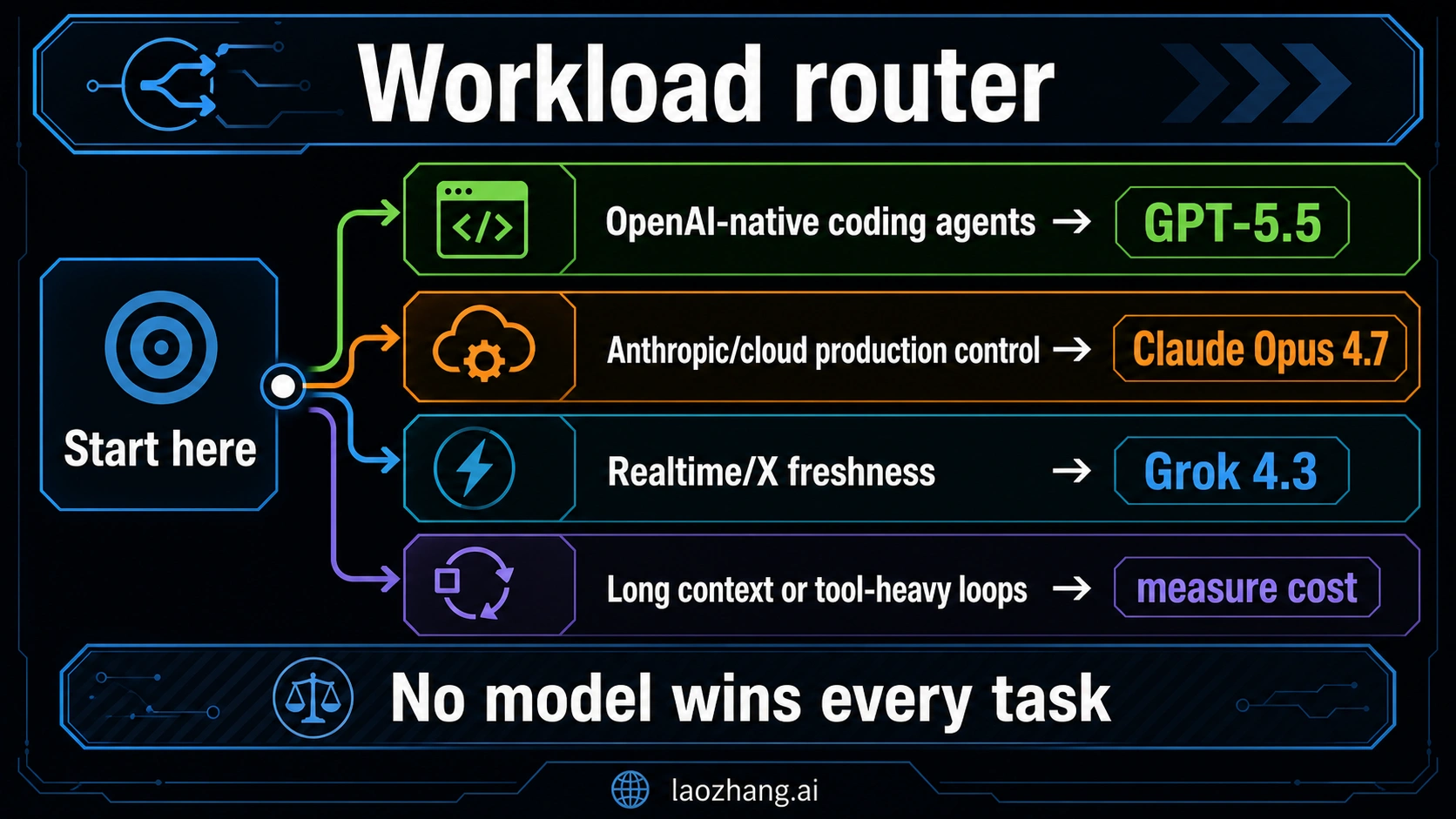
| Workload | First route | Why it fits | What to score |
|---|---|---|---|
| OpenAI-native coding, Codex, Responses API tools, structured outputs | GPT-5.5 | It sits closest to the OpenAI tool surface, Codex workflow, and existing OpenAI eval harness. | Accepted diffs, tool recovery, structured-output stability, review time, token and credit use. |
| Correctness-sensitive coding agents, multi-tool workflows, cloud deployment | Claude Opus 4.7 | It is the premium Anthropic control when failure cost is higher than model cost. | Defect severity, rollback behavior, tool-call reliability, reviewer trust, latency under load. |
| Realtime or X-informed answers | Grok 4.3 | xAI is the route owner for Grok and the search-tool path that can bring live data into the request. | Freshness accuracy, tool invocation count, search cost, citation quality, false freshness claims. |
| Long-context repository, document, or evidence analysis | Route-specific test | All three can be used in large-context workflows, but limits, output behavior, and price thresholds differ by route. | Truncation, recall quality, output length, long-context threshold, total completed-task cost. |
| Budget-sensitive exploration | Grok 4.3 first, then control against GPT-5.5 or Opus | Grok's listed token row can make it attractive for pilots, but only if quality and retries hold. | Success rate, retry count, p95 latency, output repair time, cost per accepted result. |
| Production default change | Dual-run the candidate against the incumbent | A public comparison cannot measure your prompts, files, tools, policies, or failure cost. | Regression count, human minutes, cost, rollback success, user-visible failure rate. |
GPT-5.5 gets the first OpenAI-native test when the value is integration with OpenAI's developer surface. If your code already uses Responses API state, hosted tools, structured outputs, prompt caching, file search, computer use, or Codex workflows, you can observe GPT-5.5 inside the same operating system that will run production.
Claude Opus 4.7 gets the premium control lane when the risk is expensive failure. It is the right comparison anchor for high-risk coding agents, multi-step cloud workflows, regulated review, and tasks where a senior engineer's review time costs more than token price. A higher listed price can still be cheaper if it prevents severe defects.
Grok 4.3 gets the first xAI test when the job needs realtime/X freshness, xAI account access, or a lower listed token row. Keep the reason narrow. If the task does not need search tools, xAI-specific access, or long-context/cost pressure, Grok should still be compared, but it should not automatically own the production default.
Cost Needs A Same-Surface Comparison
Raw token rows are useful, but this comparison can go wrong quickly if you mix billing surfaces. GPT-5.5 may be used through API docs, OpenAI account controls, or Codex credits. Claude Opus 4.7 may be used through Anthropic directly or through a cloud provider. Grok 4.3 may combine model tokens with server-side search tools, long-context thresholds, aliases, and account availability. The dollar row is only the first filter.
For GPT-5.5, use the current OpenAI API pricing or console row when you are building an API service, and use Codex pricing only when you are evaluating Codex credits. The Codex page currently lists GPT-5.5 credit rates for Business and new Enterprise customers, but that does not replace API token pricing for a backend service.
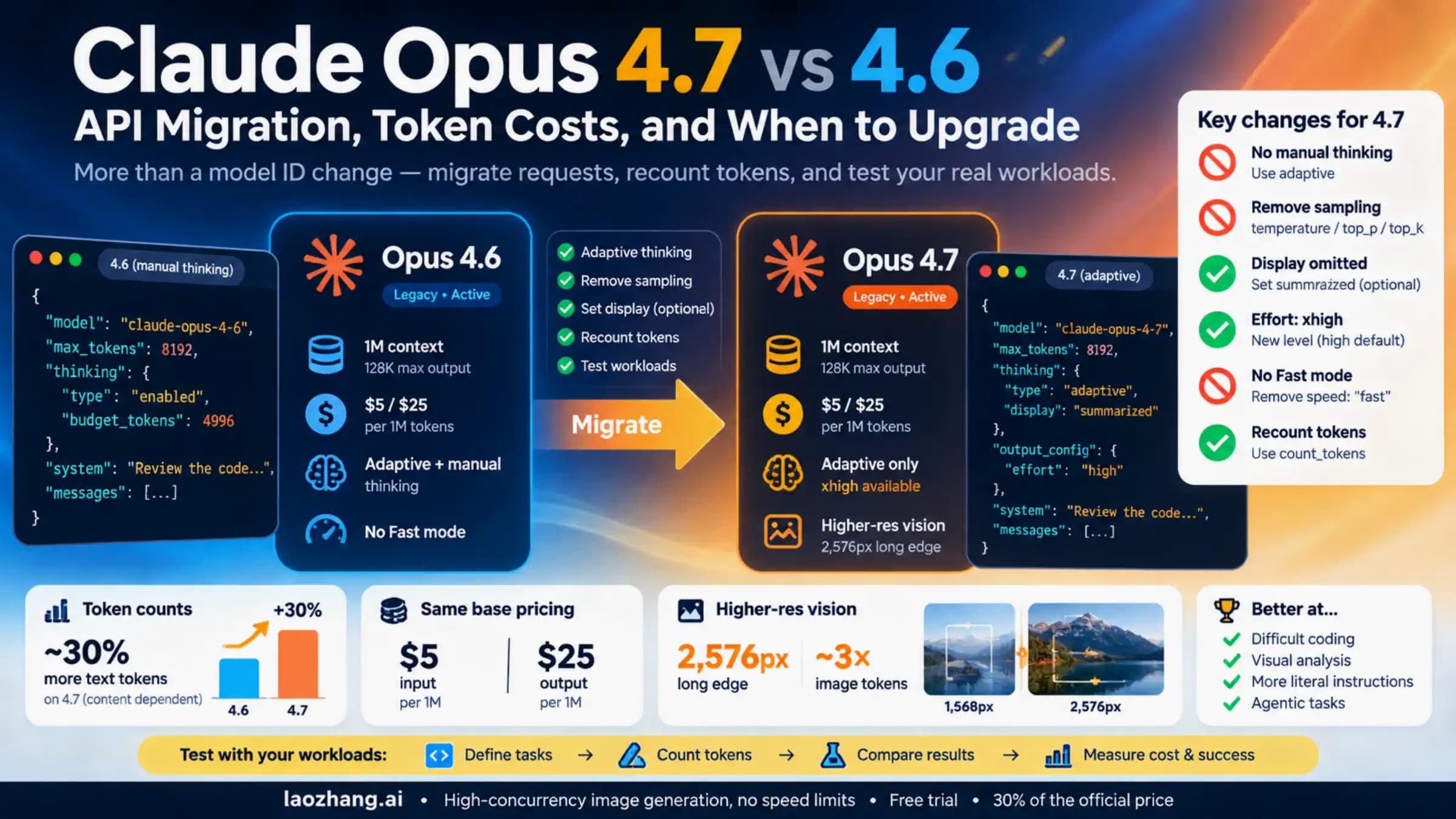
For Claude Opus 4.7, Anthropic's public materials list $5 input and $25 output per MTok, and the tokenizer note matters because the same fixed text can count as more tokens than older Claude models. That is not just a footnote. If your workload is long prompts, tool logs, or repeated repo context, tokenization can move the total bill even when the price row looks stable.
For Grok 4.3, treat the lower listed token price as a reason to test, not as the decision. xAI's docs point readers to the console for the most current model availability, and its realtime story depends on server-side tools. A Grok pilot that uses X Search or Web Search should record both model tokens and tool invocations. A long-context Grok pilot should record whether the prompt crosses the current long-context threshold.
Use this cost ledger before choosing a default:
| Cost variable | Why it changes the ranking |
|---|---|
| Input and cached input | Long prompts, repeated repo context, and prompt caching can change the winner. |
| Output length | Output-heavy agents can make a cheap input row irrelevant. |
| Tool calls | Search, file, browser, computer-use, or custom tools can dominate route cost. |
| Retry rate | Lower token price loses if the model needs multiple attempts. |
| Human review minutes | For coding agents, the expensive line item is often the person accepting or repairing the result. |
| Rollback cost | A model that fails rarely but severely can be more expensive than its average token cost suggests. |
The metric that matters is successful-task cost: one accepted answer, one merged code change, one correct agent action, or one completed analysis packet. If Grok wins that ledger, it deserves more traffic. If Opus prevents expensive failures, it can justify its premium. If GPT-5.5 reduces integration friction in OpenAI-native workflows, the higher model cost can still be the cheaper route.
Read Benchmarks As Test Suggestions
Benchmarks and hands-on videos can be useful, but they should not pick a production default. Coding-agent tests, browsing tasks, long-context recall, math, safety, visual reasoning, and cost-per-score tables are different jobs. A strong GPT-5.5 result in an OpenAI-native agent benchmark is a reason to test GPT-5.5 in your OpenAI harness. It is not proof that Claude Opus 4.7 is no longer the right premium control, or that Grok 4.3 cannot be cheaper on realtime-heavy work.
The same boundary applies in the other direction. A Claude Opus 4.7 launch claim is a reason to include it as a control, not a reason to skip same-task measurement. A Grok 4.3 price or speed claim is a reason to build a cost pilot, not a reason to assume it can replace an incumbent on high-risk coding work.
Use a four-step evidence ladder:
- Official docs decide whether the route exists, what the model is called, what access surface applies, and what price or limit must be verified.
- Public benchmarks suggest which workloads deserve test coverage.
- Your same-task harness decides whether the model should receive production traffic.
- A staged rollout decides whether the improvement survives real users, permissions, latency, quotas, and failures.
That ladder prevents the most common model-comparison mistake: declaring a universal winner from evidence that only covers one task shape. The route answer is intentionally narrower. GPT-5.5 is the OpenAI-native first test. Claude Opus 4.7 is the premium Anthropic/cloud control. Grok 4.3 is the xAI route for realtime/X freshness, lower listed token-price pilots, and long-context experiments that can be measured.
Same-Task Pilot Before You Switch
A useful pilot can be small, but it has to be fair. Do not give one model a better prompt, wider context, looser output format, or easier tool budget and then call the result a model comparison.
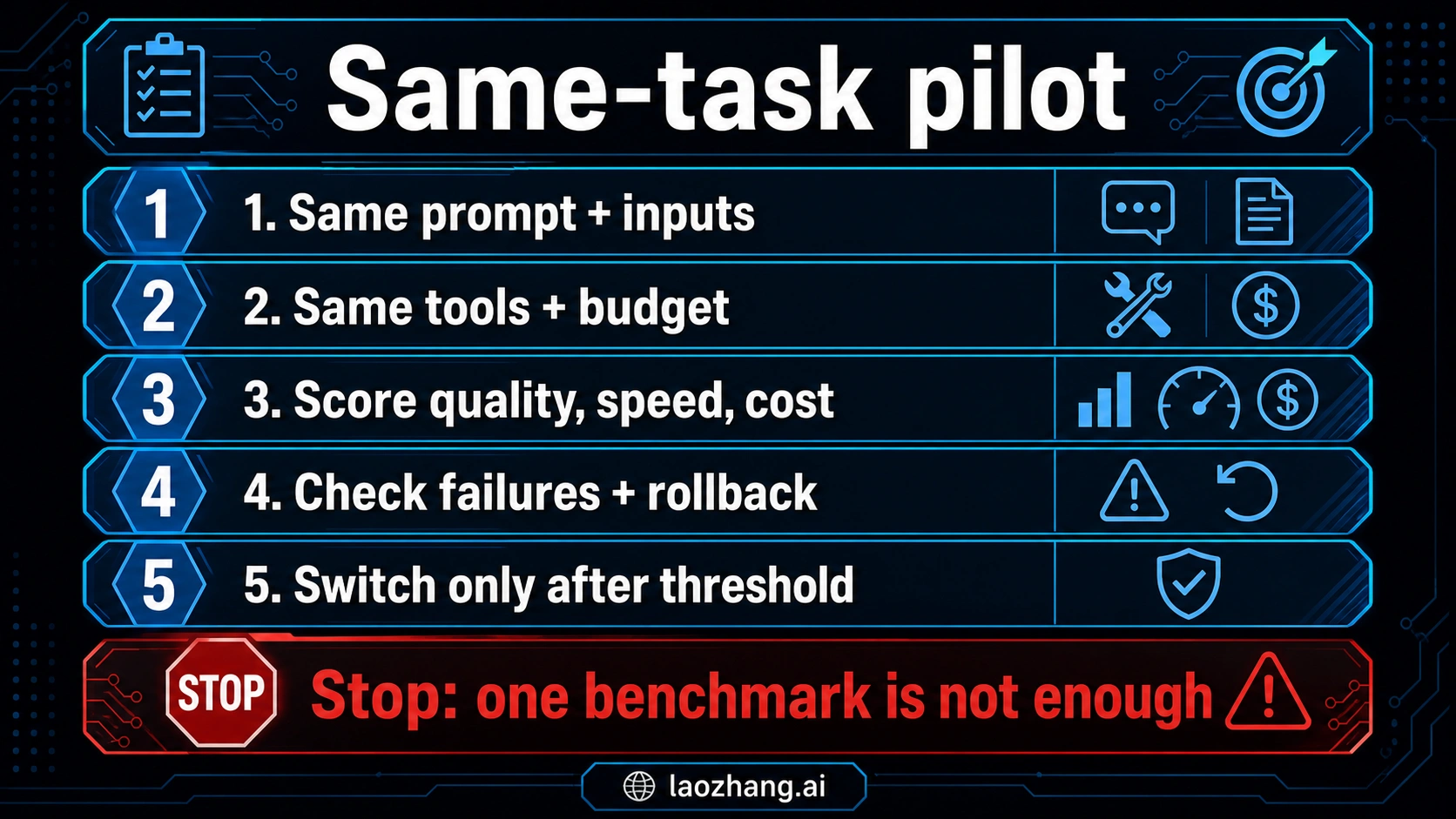
| Pilot gate | What to hold constant | Pass condition |
|---|---|---|
| Route access | Model label, endpoint, account, region, quota, billing surface, fallback | The team can call the route it plans to deploy. |
| Prompt and files | Same system prompt, same user task, same repo or document pack | Differences come from model behavior, not better inputs. |
| Tool budget | Same tool definitions, permissions, timeout, retry rule, and search availability where possible | Tool-heavy success is comparable. |
| Task sample | Easy task, hard task, long-context task, strict-format task, failure-prone task | The sample matches work that costs money or review time. |
| Scoring | Correctness, severity, security risk, output format, reviewer minutes, accepted-result rate | The candidate reduces total work, not just demo quality. |
| Cost and latency | Input, cached input, output, tool calls, retries, p95 latency, completed-task cost | Savings survive full-task accounting. |
| Rollback | Failure threshold, fallback model, routing switch, monitoring owner | The old route can return without rebuilding the system. |
For a team already running a stable default, keep the incumbent in place while shadow-running the candidate. Promote only when the candidate reduces total work and does not introduce a new high-severity failure mode. "It looked better once" is not a rollout plan.
For a team choosing a first model, start with the route that matches the stack. OpenAI-native products should begin with GPT-5.5 and use Opus as the premium control. Anthropic or cloud-heavy teams should start with Opus and add GPT-5.5 when OpenAI tools matter. Teams whose real problem is realtime/X freshness or listed token price should test Grok 4.3 first, then force it through the same acceptance harness.
Adjacent Decisions
The tri-model decision is narrow: Grok 4.3 vs Claude Opus 4.7 vs GPT-5.5 as a route-first first-test comparison. If your question is narrower, use the guide that matches the narrower job.
If your real decision is only OpenAI versus Anthropic, use GPT-5.5 vs Claude Opus 4.7. That pairwise guide can spend more space on OpenAI-native tool orchestration versus Anthropic deployment.
If you need the DeepSeek cost lane instead of xAI realtime/X freshness, use DeepSeek V4 Pro vs Claude Opus 4.7 vs GPT-5.5. If you want an even wider low-cost pool, use Kimi K2.6 vs DeepSeek V4 vs GPT-5.5 vs Claude Opus 4.7.
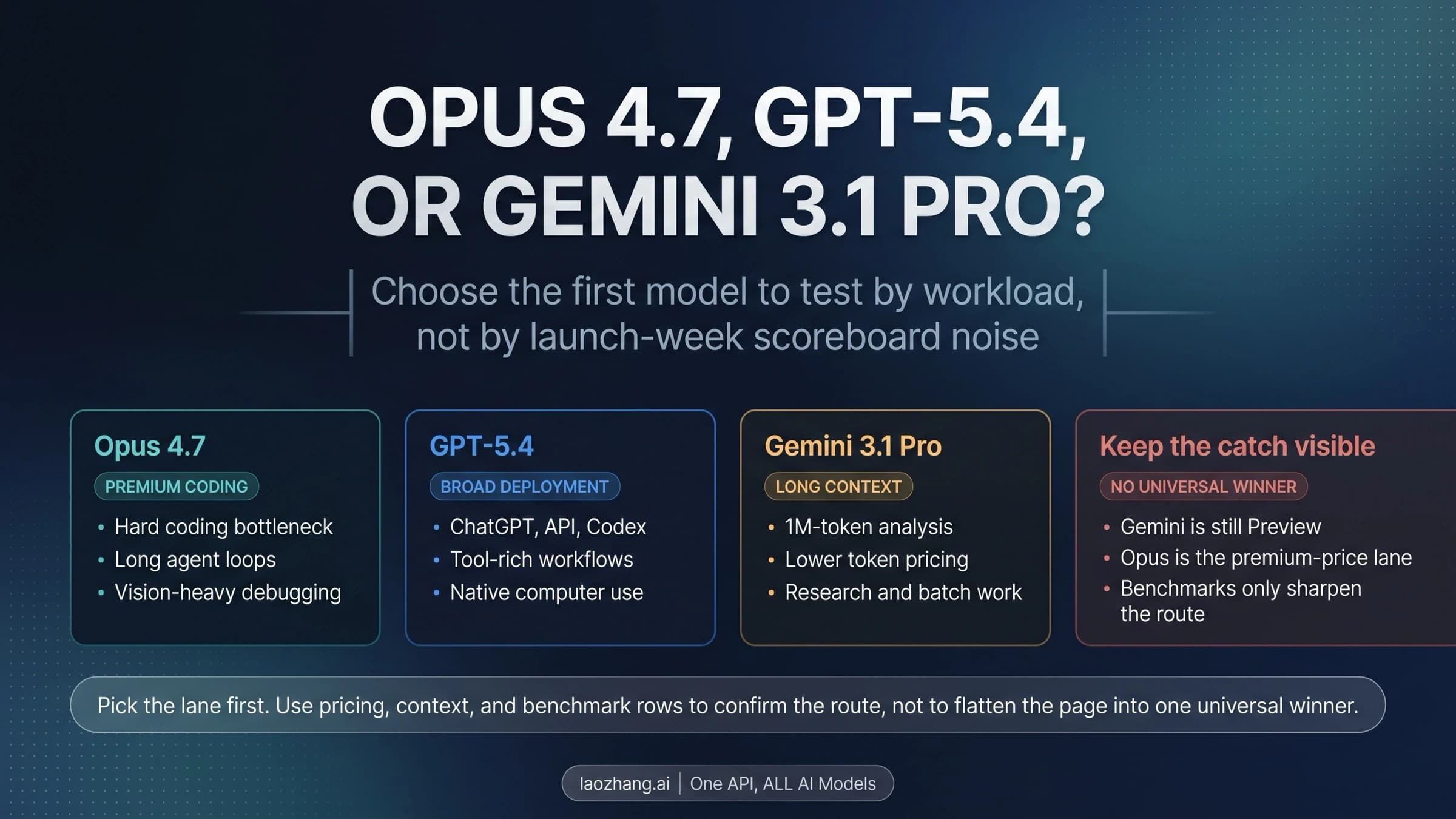
If you are still comparing older official frontier API routes, use Claude Opus 4.7 vs GPT-5.4 vs Gemini 3.1 Pro. The practical point is the same: choose the route you can call, measure the task you will run, and keep a rollback path.
FAQ
Is GPT-5.5 better than Claude Opus 4.7 and Grok 4.3?
GPT-5.5 is the better first test when the system is already OpenAI-native, especially for Responses API, Codex, tool-heavy reasoning, structured outputs, or an existing OpenAI eval harness. It is not a universal winner. Claude Opus 4.7 remains the premium Anthropic/cloud control, and Grok 4.3 deserves the first xAI test when realtime/X search, lower listed token price, or long-context pilots are the reason to compare.
Is Grok 4.3 cheaper than GPT-5.5 and Claude Opus 4.7?
Grok 4.3 can look cheaper on the current xAI listed token row, but do not stop there. Recheck the xAI Console, long-context threshold, account availability, server-side search-tool charges, retries, latency, and accepted-result rate. The right comparison is completed-task cost, not only the model-token row.
Should I use Claude Opus 4.7 for coding agents?
Use Claude Opus 4.7 as the premium control when coding-agent failures are expensive, the Anthropic or cloud route fits deployment, and correctness matters more than raw token price. Use GPT-5.5 first when the agent is OpenAI-native. Add Grok 4.3 when realtime/X data, xAI access, or lower listed token price is central to the pilot.
Is GPT-5.5 available through the API?
OpenAI developer docs currently publish a GPT-5.5 API guide and list GPT-5.5 snapshots in current developer surfaces. Codex access, API access, API-key authentication, credits, rate limits, and organization visibility are still separate. Verify the model in your current OpenAI account and deployment route before production traffic.
Does Grok 4.3 have realtime data by default?
No. xAI's models and pricing docs say realtime events require server-side search tools such as Web Search or X Search. If realtime/X freshness is your reason for choosing Grok 4.3, include those tool calls in the pilot, cost ledger, freshness scoring, and failure review.
Which model should I test first for long-context work?
Test the deployment route you can actually use. GPT-5.5, Claude Opus 4.7, and Grok 4.3 all have large-context stories, but limits, billing, long-context thresholds, output behavior, and recall quality differ. Run the same long prompt, same retrieval pack, same output budget, and same scoring rubric before choosing a default.
What is the safest production switch rule?
Do not switch from a benchmark, video, launch claim, or listed price gap alone. Dual-run the candidate against the incumbent with the same prompts, tools, files, budgets, acceptance tests, and rollback threshold. Promote only when the new route reduces total work and survives a staged rollout.
The practical answer is a route plan: GPT-5.5 for OpenAI-native first tests, Claude Opus 4.7 for premium Anthropic/cloud control, and Grok 4.3 for xAI realtime, lower listed-price, or long-context pilots. Make the model earn production traffic on your tasks before changing the default.