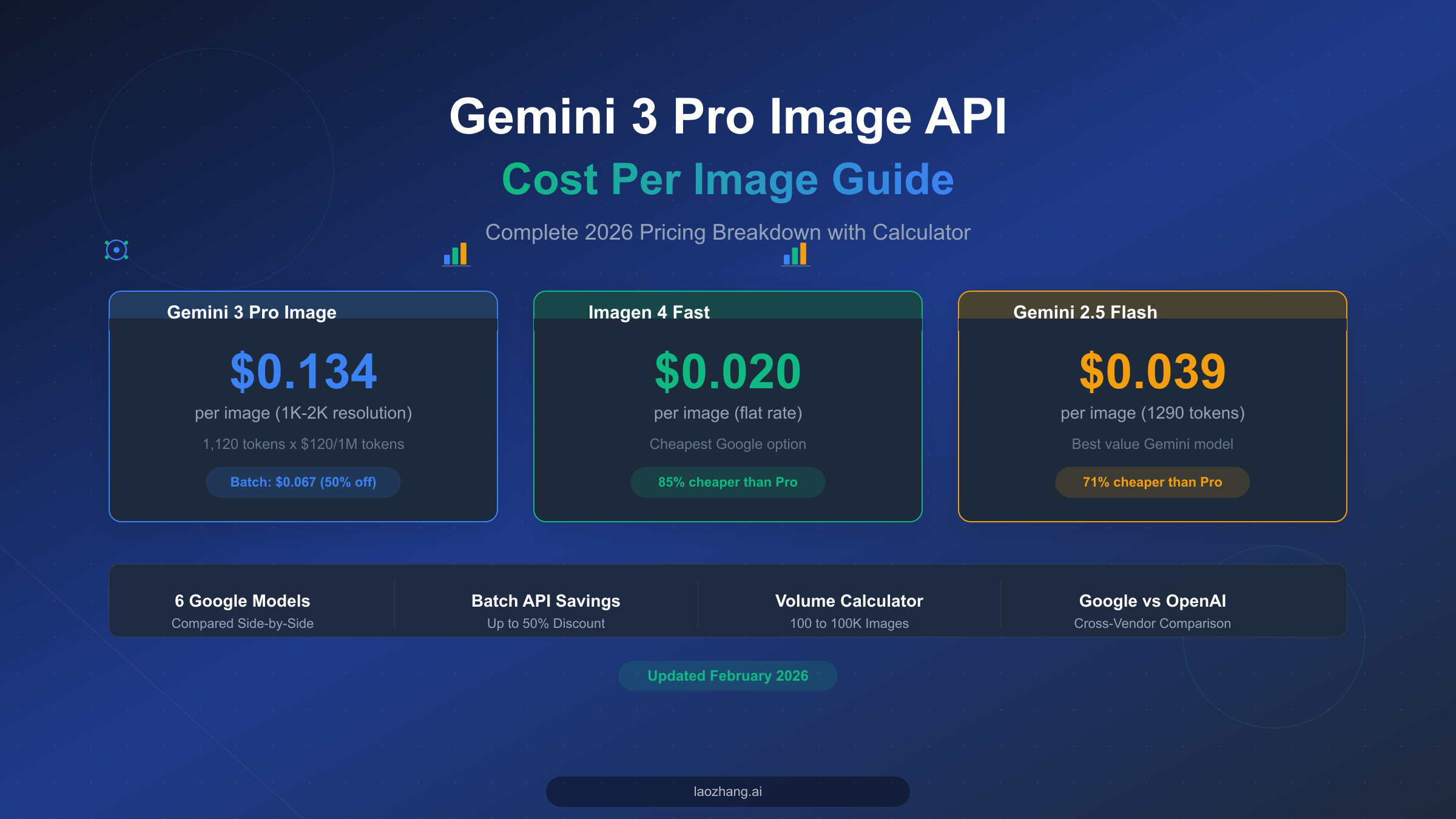
Generating images through the Gemini 3 Pro Image API costs exactly $0.134 per image at standard 1K-2K resolution and $0.24 per image at 4K resolution, based on Google's token-based pricing model where image output tokens are charged at $120 per million tokens (ai.google.dev, February 2026). The cheapest Google image generation option is Imagen 4 Fast at just $0.02 per image, while the Batch API offers a 50% discount on any model, bringing Gemini 3 Pro down to $0.067 per image. If you are comparing across vendors, GPT Image 1 Low starts at $0.011 per image, though quality varies significantly. This guide walks through the exact token math, compares all six Google image models plus three major competitors, and provides ready-to-use monthly cost projections from 100 to 100,000 images.
TL;DR
The Gemini 3 Pro Image API uses token-based pricing that can be confusing if you are coming from flat-rate services like DALL-E or Midjourney. Here is what you need to know: each image generated at 1K-2K resolution consumes 1,120 image output tokens, and Google charges $120 per million image output tokens, which works out to $0.134 per image. At 4K resolution, token consumption jumps to 2,000 tokens, pushing the cost to $0.24 per image. The Batch API cuts these prices in half but requires a 24-hour processing window. For budget-conscious projects, Imagen 4 Fast delivers images at just $0.02 each with flat per-image pricing, making it 85% cheaper than Gemini 3 Pro. Gemini 2.5 Flash Image sits in the middle at $0.039 per image, offering a solid balance between Gemini quality and cost efficiency. The free tier only applies to Gemini 2.0 Flash with a limit of 1,500 images per day, so Gemini 3 Pro Image has no free usage available.
How Gemini 3 Pro Image Token-Based Pricing Actually Works
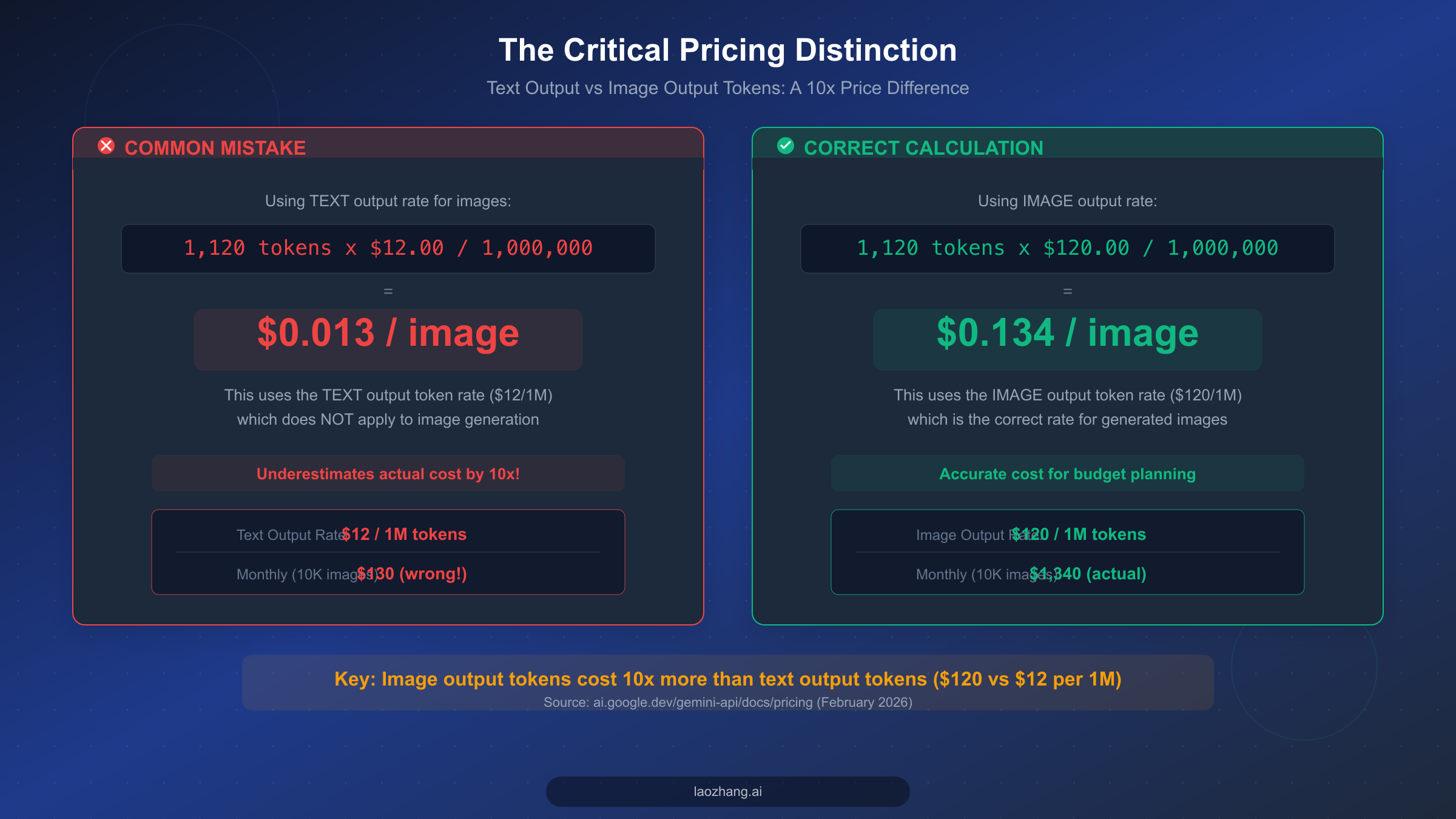
Understanding the Gemini 3 Pro Image pricing model requires grasping one critical distinction that trips up most developers: Google charges different rates for text output tokens and image output tokens, and the difference is a full order of magnitude. According to the official Gemini API pricing page (ai.google.dev/gemini-api/docs/pricing, February 2026), text output tokens for Gemini 3 Pro cost $12 per million tokens for requests under 200K context, while image output tokens cost $120 per million tokens. That 10x multiplier is the single most important thing to understand about Gemini image generation costs, and getting it wrong means your budget estimates will be off by a factor of ten.
The token consumption per image depends on the resolution you request. At standard 1K-2K resolution, each generated image consumes exactly 1,120 image output tokens. At the higher 4K resolution tier, token consumption increases to 2,000 tokens per image. These are fixed values that do not vary based on image content or complexity. The calculation is straightforward once you know the right rate to apply: multiply the token count by the image output rate divided by one million. For a standard resolution image, that works out to 1,120 multiplied by $120 divided by 1,000,000, which equals $0.1344 per image, commonly rounded to $0.134.
The Common Mistake That Costs You 10x
Many developers and even some pricing comparison articles make the critical error of using the text output token rate when calculating image generation costs. If you use the $12 per million text output rate instead of the $120 per million image output rate, you would calculate 1,120 tokens times $12 divided by 1,000,000, arriving at just $0.013 per image. That looks incredibly cheap, but it is wrong by a factor of ten. The actual cost of $0.134 per image is what you will see on your bill. This confusion exists because the Gemini 3 Pro model handles both text and image outputs, and the pricing page lists both rates. Always look for the row specifically labeled "Image output" when calculating image generation costs.
Input tokens also contribute to cost, though they are a smaller component. Text input to Gemini 3 Pro is charged at $2.00 per million tokens, which typically adds $0.001 to $0.003 per image depending on prompt length. If you are sending an image as input for editing or transformation, that image consumes 560 input tokens at the $2.00 per million input rate, adding approximately $0.0011 per input image. For most workflows, input token costs represent less than 2% of total cost and can be safely estimated as a rounding error, but at high volumes they do add up and should be included in production budget forecasts.
Resolution and Cost: 1K-2K vs 4K
The resolution choice has a meaningful impact on cost. A 4K image at 2,000 tokens costs $0.24, which is roughly 79% more expensive than a standard 1K-2K image at $0.134. Before defaulting to 4K, consider whether your use case truly requires it. For social media thumbnails, email marketing assets, and web content displayed at moderate sizes, 1K-2K resolution is more than sufficient. Reserve 4K generation for hero images, print materials, or applications where users will zoom in on fine details. This single resolution decision can reduce your monthly bill by nearly half without any visible quality difference in most deployment scenarios.
Complete Cost-Per-Image for Every Google Image Model
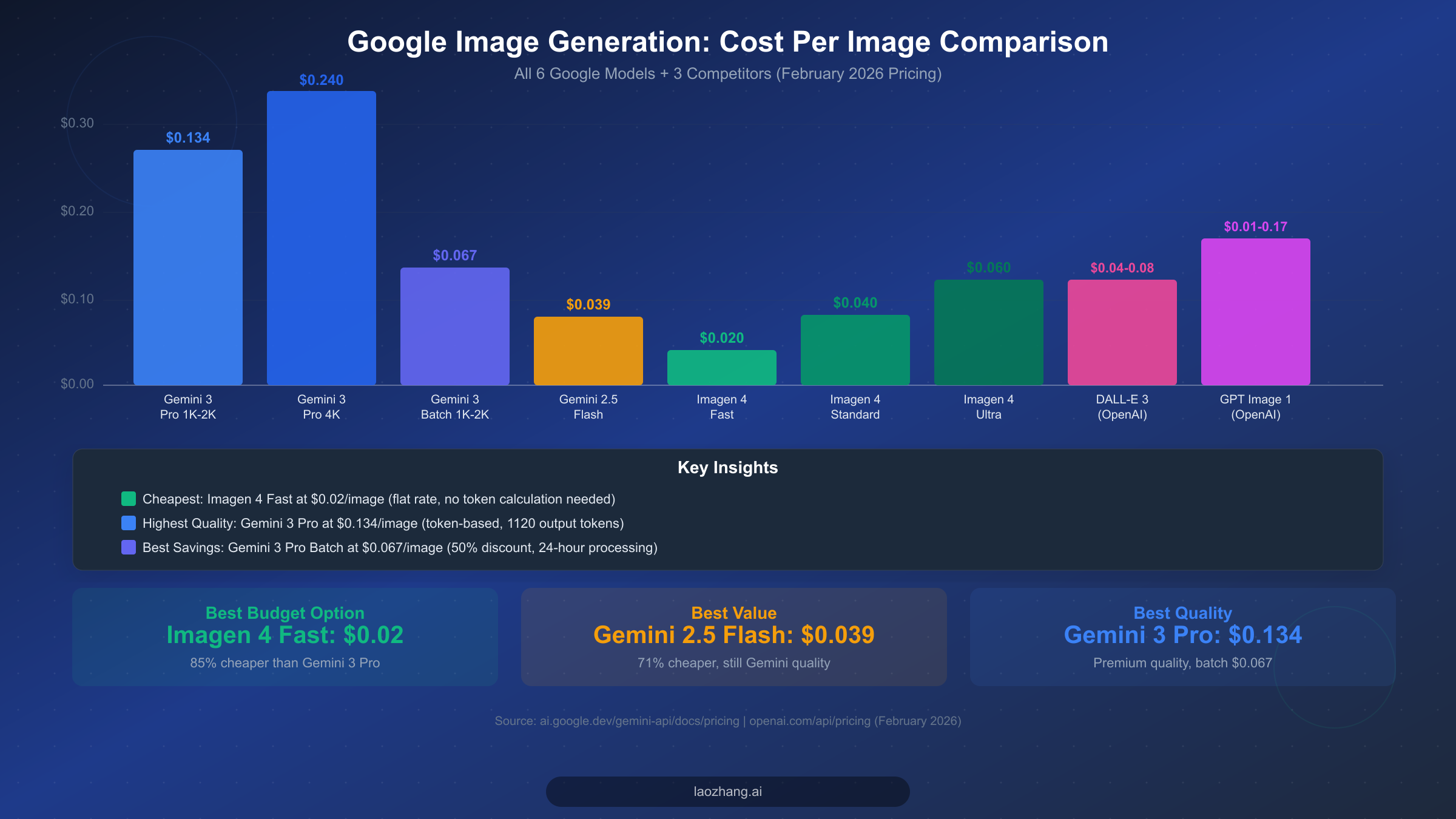
Google now offers six distinct image generation models through its API ecosystem, each positioned at a different point on the quality-versus-cost spectrum. Understanding the full landscape prevents the common mistake of defaulting to Gemini 3 Pro when a less expensive model would serve your needs perfectly well. The following breakdown covers every model available as of February 2026, with pricing verified against the official Google AI pricing page (ai.google.dev/gemini-api/docs/pricing).
Gemini 3 Pro Image (model ID: gemini-3-pro-image-preview) sits at the premium end of Google's lineup. It uses token-based pricing with image output tokens charged at $120 per million. At 1K-2K resolution, each image consumes 1,120 tokens for a cost of $0.134, while 4K images use 2,000 tokens at $0.24 each. This model delivers the highest quality image generation with the most accurate prompt following and photorealistic output. The Batch API variant cuts both prices in half to $0.067 and $0.12 respectively, making it significantly more affordable for non-time-sensitive workloads. If you are running into availability issues with this model, check our troubleshooting guide for 503 errors which covers common solutions.
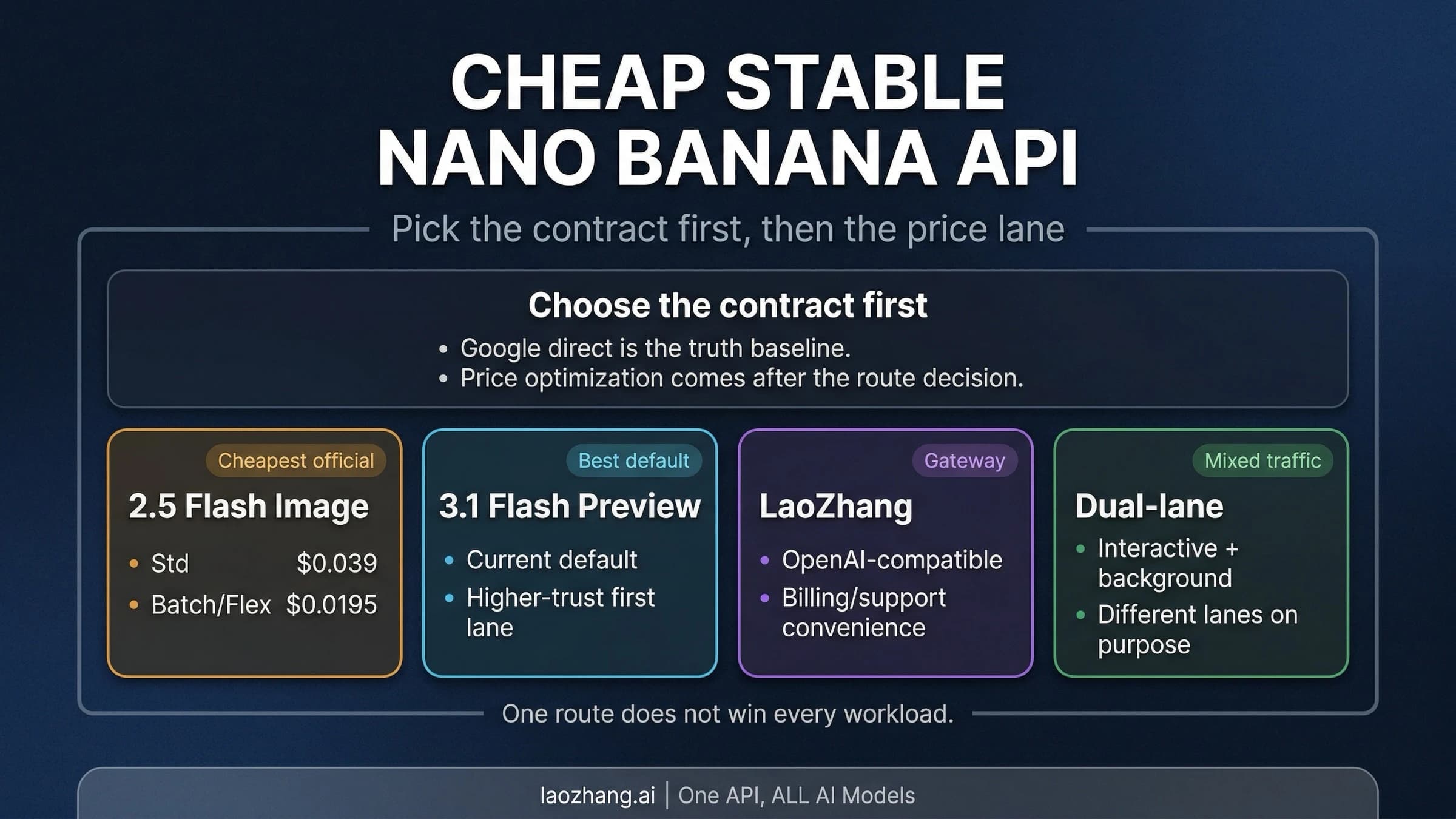
Gemini 2.5 Flash Image (model ID: gemini-2.5-flash-preview-image-generation) uses a different output token rate of $30 per million tokens, and each image consumes approximately 1,290 tokens. This works out to $0.039 per image, making it 71% cheaper than Gemini 3 Pro while still delivering solid image quality. For many production use cases where top-tier photorealism is not critical, Gemini 2.5 Flash offers the best value among the Gemini family. Its lower cost comes primarily from the reduced per-token rate rather than fewer tokens per image, as it actually generates slightly more tokens than the Pro model.
The Imagen 4 Family: Flat Per-Image Pricing
The Imagen 4 lineup uses a fundamentally different pricing structure: flat per-image rates with no token calculations required. Imagen 4 Fast costs just $0.02 per image, making it the cheapest Google image generation option by a wide margin. Imagen 4 Standard steps up to $0.04 per image with improved quality and more detailed outputs. Imagen 4 Ultra, the top of the line, costs $0.06 per image and delivers the highest quality in the Imagen family. All three models use simple per-image billing that makes cost prediction trivially easy compared to token-based models. For a deeper dive into how these models compare in real-world performance, see our complete speed test results.
The key trade-off between Imagen and Gemini models is flexibility versus cost. Gemini models can handle both text-and-image input/output in a conversational context, support image editing through natural language instructions, and maintain conversation history for iterative refinement. Imagen models are image-generation-only tools: you send a prompt, you get an image, and there is no conversation or editing capability. If your workflow is straightforward prompt-to-image generation, Imagen 4 Fast at $0.02 per image saves 85% compared to Gemini 3 Pro. If you need conversational image editing or text rendering within images, Gemini models are your only option in the Google ecosystem.
| Model | Per Image Cost | Tokens/Image | Pricing Type | Quality Tier |
|---|---|---|---|---|
| Gemini 3 Pro (1K-2K) | $0.134 | 1,120 | Token-based | Premium |
| Gemini 3 Pro (4K) | $0.240 | 2,000 | Token-based | Premium |
| Gemini 3 Pro Batch (1K-2K) | $0.067 | 1,120 | Token-based | Premium |
| Gemini 2.5 Flash Image | $0.039 | 1,290 | Token-based | Standard |
| Imagen 4 Fast | $0.020 | N/A | Flat rate | Basic |
| Imagen 4 Standard | $0.040 | N/A | Flat rate | Standard |
| Imagen 4 Ultra | $0.060 | N/A | Flat rate | High |
5 Proven Strategies to Cut Image Generation Costs by 50-85%
Once you understand the pricing landscape, the next step is optimizing your costs. Whether you are generating hundreds of images for a small project or hundreds of thousands for a production application, these five strategies can dramatically reduce your monthly bill. The savings range from a straightforward 50% for the Batch API to up to 85% when combining multiple optimization techniques together.
Strategy 1: Use the Batch API for Non-Urgent Workloads
The Batch API is the simplest and most impactful cost-saving tool available. Google offers a flat 50% discount on all API calls processed through the Batch API, with the trade-off being a 24-hour processing window instead of real-time responses. For Gemini 3 Pro Image, this drops the per-image cost from $0.134 to $0.067 at 1K-2K resolution, and from $0.24 to $0.12 at 4K. The break-even analysis is straightforward: if your workflow can tolerate a 24-hour delay on any portion of image generation, route those requests through the Batch API. Common candidates include background catalog image generation, marketing asset creation for future campaigns, bulk product photo variations for e-commerce, and any pre-scheduled content pipeline. Even if only 30% of your images can be batched, you save 15% on your total monthly bill, which at 50,000 images per month translates to over $1,000 in savings.
Strategy 2: Optimize Resolution to Match Actual Display Size
The 79% cost premium for 4K images over 1K-2K images represents one of the easiest wins available. Most web applications display images at effective resolutions well below 4K, meaning you are paying for pixels that users never see. A social media post displayed at 1080x1080 pixels gains nothing from 4K generation. Product thumbnails on an e-commerce grid are typically shown at 300-600 pixels. Even hero banner images rarely exceed 1920 pixels in display width. Audit your actual display sizes across all surfaces where generated images appear, and you will likely find that 1K-2K resolution covers 90% or more of your use cases. The quality difference at web-display sizes is negligible, but the cost difference between $0.134 and $0.24 per image is very real.
Strategy 3: Avoid Hidden Costs from Retries and Input Tokens
Production systems inevitably encounter failures, safety filter rejections, and quality-related retries that inflate your actual per-image cost above the nominal rate. Each failed generation attempt still consumes input tokens, and if you are retrying prompts with image inputs, those 560 tokens per input image add up quickly. A system prompt that runs on every request might consume 500-1,000 input tokens, adding $0.001-$0.002 per call. With a retry rate of 15% (common during peak hours when 503 overload errors spike), your effective per-image cost rises by roughly 5-10%. To mitigate this, implement exponential backoff with jitter to reduce failed retries, cache and reuse successful generations where possible, keep system prompts concise, and monitor your actual cost-per-successful-image metric rather than the nominal API rate.
Strategy 4: Choose the Right Model for Each Use Case
Not every image needs the premium quality of Gemini 3 Pro. A thoughtful model selection strategy across different use cases can reduce average cost by 50-70% without visible quality degradation. The key insight is that most applications generate images across a range of quality requirements, and treating every generation as a premium request is the most common source of unnecessary spending. Map your quality requirements to models systematically: use Imagen 4 Fast ($0.02) for internal drafts, placeholder content, rapid prototyping, and any images that will be displayed at small sizes or viewed briefly. Use Gemini 2.5 Flash ($0.039) for standard production content, blog illustrations, social media posts, and email marketing visuals where good quality matters but pixel-perfect photorealism is not required. Reserve Gemini 3 Pro ($0.134) exclusively for hero images, client-facing premium content, and cases where accurate text rendering within images is a hard requirement. In practice, most production applications find that 60-80% of their images can be routed to the cheapest tier without any user-visible quality impact, because context and display size mask the quality differences between models. This tiered approach means you only pay the premium rate for the small percentage of images that truly demand it, dramatically reducing your blended average cost per image.
Strategy 5: Consider Third-Party API Providers for Additional Savings
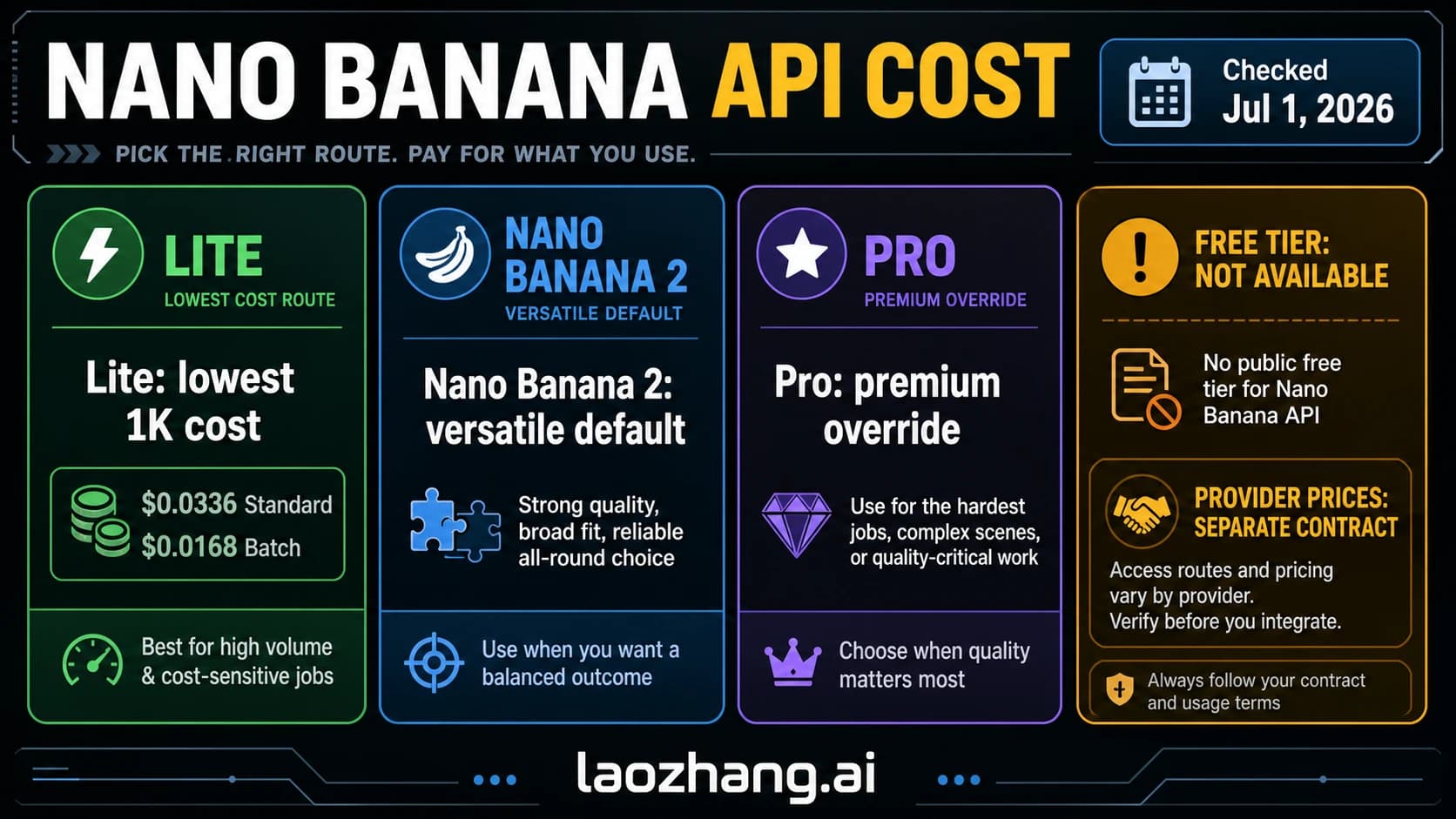
Third-party API aggregators can provide access to the same Google models at significantly reduced prices by pooling demand and negotiating volume discounts. For example, laozhang.ai offers Gemini 3 Pro Image generation at approximately $0.05 per image, representing a 63% savings compared to the official $0.134 rate. These providers typically offer a unified API endpoint that is compatible with existing code, meaning you can switch providers with minimal integration effort. For teams already committed to a comprehensive guide to finding the cheapest Gemini image API, third-party providers represent the highest percentage savings available, though you should evaluate reliability, rate limits, and support quality alongside raw pricing.
Monthly Cost Calculator: 100 to 100,000 Images
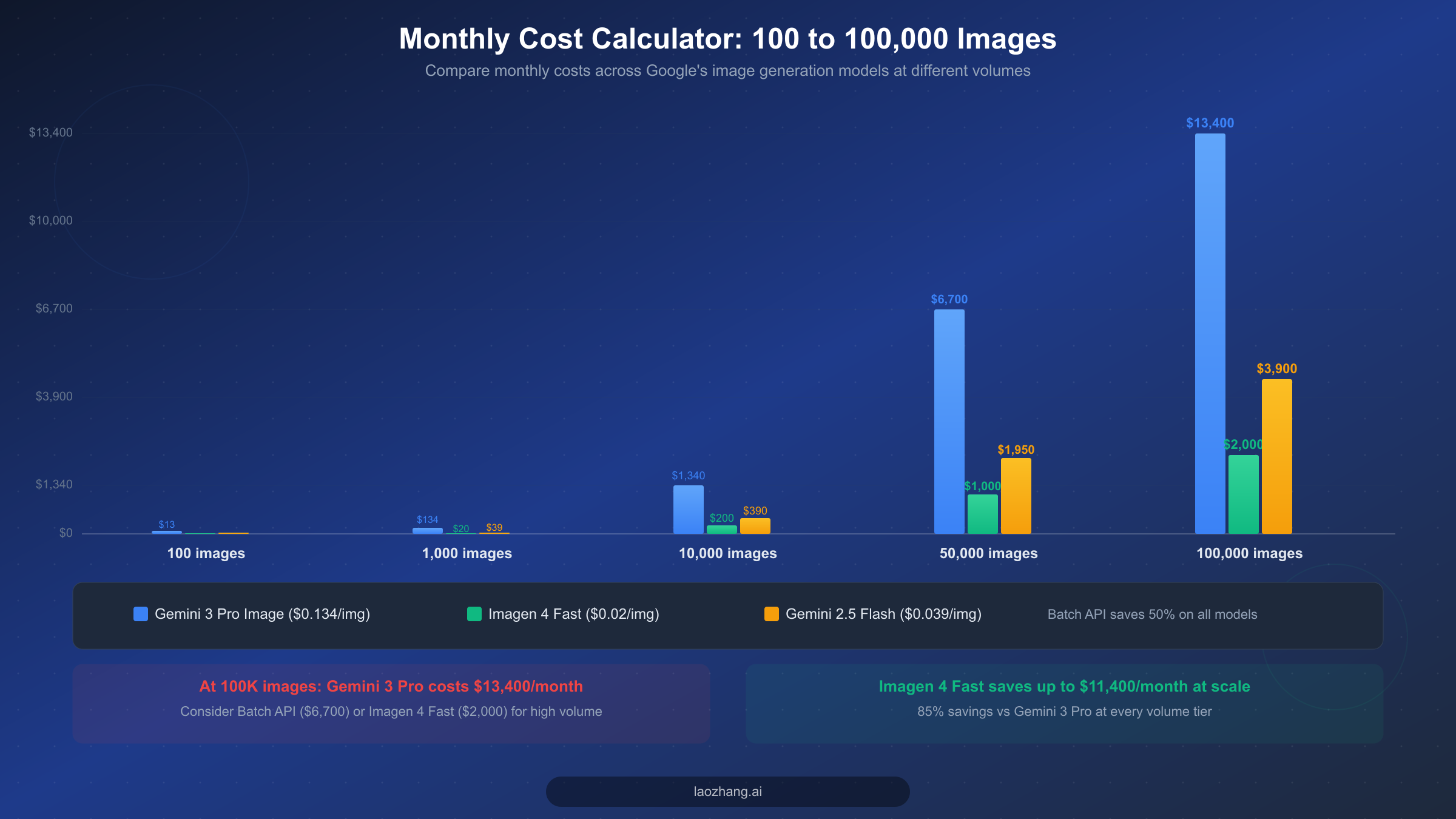
Budget planning for image generation requires more than knowing the per-image price. Stakeholders want monthly dollar amounts they can plug into a budget spreadsheet, and the numbers vary dramatically depending on which model you choose and what volume you operate at. The tables below provide ready-to-use monthly cost projections across all major models at five common volume tiers, covering both real-time API and Batch API pricing.
At low volumes of around 100 images per month, pricing differences between models are practically negligible. Gemini 3 Pro costs $13.40 per month, while Imagen 4 Fast costs just $2.00. At this scale, model selection should be driven entirely by quality requirements rather than cost considerations. Even the most expensive option would not strain a project budget, so the real decision point for cost optimization begins around the 1,000 images per month mark where monthly bills start reaching triple digits.
The differences become dramatic at production scale. At 10,000 images per month, Gemini 3 Pro costs $1,340 while Imagen 4 Fast costs just $200, a $1,140 monthly difference. At 50,000 images, the gap widens to $5,700 per month ($6,700 versus $1,000). And at 100,000 images per month, you are looking at $13,400 for Gemini 3 Pro compared to $2,000 for Imagen 4 Fast, an annual difference of over $136,000. These numbers make it clear why model selection and Batch API usage become critical business decisions at scale rather than mere technical preferences.
| Monthly Volume | Gemini 3 Pro (1K-2K) | Gemini 3 Pro Batch | Gemini 2.5 Flash | Imagen 4 Fast | Imagen 4 Std | Imagen 4 Ultra |
|---|---|---|---|---|---|---|
| 100 images | $13.40 | $6.70 | $3.90 | $2.00 | $4.00 | $6.00 |
| 1,000 images | $134 | $67 | $39 | $20 | $40 | $60 |
| 10,000 images | $1,340 | $670 | $390 | $200 | $400 | $600 |
| 50,000 images | $6,700 | $3,350 | $1,950 | $1,000 | $2,000 | $3,000 |
| 100,000 images | $13,400 | $6,700 | $3,900 | $2,000 | $4,000 | $6,000 |
The Batch API deserves special attention for high-volume users. At 100,000 images per month, switching from real-time Gemini 3 Pro to Batch Gemini 3 Pro saves exactly $6,700 per month, which is $80,400 per year, with zero quality difference. The only requirement is that your pipeline can accommodate the 24-hour processing window. For most content generation workflows that plan content in advance, this is an easy trade-off. Even a partial migration, moving just 50% of volume to Batch processing, saves $3,350 monthly at the 100,000-image tier.
Input Token Costs at Scale
While output tokens dominate the cost picture, input tokens become significant at high volumes. A typical text prompt of 50-100 tokens at $2.00 per million adds roughly $0.0001-$0.0002 per image, which is negligible even at 100K monthly volume (under $20 total). However, if your workflow involves image-to-image generation where each request includes an input image at 560 tokens, the input cost reaches $0.0011 per image, totaling $110 at 100,000 monthly images. System prompts that run on every request add another layer: a 500-token system prompt at scale adds $100 per month at 100K volume. Include these input costs in your budget forecasts for a complete picture, especially if your average prompt is longer than typical.
Which Model Should You Actually Use? A Decision Framework
Choosing the right model is not just about finding the cheapest option. It is about matching your quality requirements, feature needs, and budget constraints to the model that delivers the best value for your specific use case. The decision framework below maps common scenarios to recommended models, eliminating the guesswork from model selection.
For e-commerce product imagery where you need consistent, clean product photos at moderate quality, Imagen 4 Standard at $0.04 per image offers the best combination of visual quality and cost efficiency. Product images do not typically require the advanced text rendering or conversational editing capabilities of Gemini models. At 10,000 product images per month, you would spend $400 with Imagen 4 Standard compared to $1,340 with Gemini 3 Pro, saving $940 monthly without meaningful quality loss for catalog-style imagery.
Social media and marketing content benefits from Gemini 2.5 Flash Image at $0.039 per image. These assets need higher creative quality than basic product shots but rarely justify the premium cost of Gemini 3 Pro. Flash handles diverse creative prompts well, supports reasonable text rendering within images, and processes requests quickly. Marketing teams generating 5,000 assets per month would spend $195 with Flash versus $670 with Pro, keeping monthly costs under $200 while maintaining professional quality.
Premium content creation, including hero images for landing pages, client deliverables, editorial illustrations, and applications requiring accurate text within images, is where Gemini 3 Pro Image justifies its premium pricing. The model's superior prompt following, photorealistic quality, and advanced text rendering capabilities produce noticeably better results for these high-visibility applications. At typical premium content volumes of 500-2,000 images per month, the cost ranges from $67 to $268, which is reasonable for high-value applications.
Rapid prototyping and internal tools should default to Imagen 4 Fast at $0.02 per image without exception. When you are iterating on prompts, generating placeholder content, powering internal dashboards, or running automated quality assurance on image generation pipelines, there is no justifiable reason to pay seven times more for Gemini 3 Pro quality. The images produced by Imagen 4 Fast are more than sufficient for evaluating composition, color palette, and general prompt adherence during development. Development teams running 1,000 test generations per day would spend roughly $600 per month with Imagen 4 Fast compared to $4,020 with Gemini 3 Pro, a $3,420 monthly savings that compounds dramatically over multi-month development cycles. Another practical application is A/B testing: generate candidate images with Fast for initial selection, then regenerate only the winning concepts with a higher-quality model for production deployment.
| Use Case | Recommended Model | Cost/Image | Monthly (5K) | Why This Model |
|---|---|---|---|---|
| Product catalog | Imagen 4 Standard | $0.04 | $200 | Clean, consistent quality |
| Social media | Gemini 2.5 Flash | $0.039 | $195 | Good creative quality |
| Hero/premium | Gemini 3 Pro | $0.134 | $670 | Best quality + text rendering |
| Prototyping | Imagen 4 Fast | $0.02 | $100 | Fast iteration, lowest cost |
| Bulk background | Gemini 3 Pro Batch | $0.067 | $335 | Pro quality at 50% discount |
| Art/creative | Imagen 4 Ultra | $0.06 | $300 | High detail, flat pricing |
Google vs OpenAI vs Midjourney: Complete Price Comparison
The most practical comparison for most developers is not between Google models but between Google and OpenAI, the two dominant API providers for image generation. Midjourney operates primarily through its Discord interface and subscription model, making direct API comparison less straightforward, but we include it for completeness. The pricing data below reflects February 2026 rates from official sources.
OpenAI's current image generation lineup consists of DALL-E 3 and GPT Image 1. DALL-E 3 uses flat per-image pricing ranging from $0.04 to $0.08 depending on resolution and quality settings, positioning it as a direct competitor to Imagen 4 Standard and Ultra. GPT Image 1 has a wider range from $0.011 at the lowest quality tier (GPT Image 1 Low) to $0.167 at the highest quality tier (GPT Image 1 HD), making it competitive with both budget and premium Google options. The GPT Image 1 Low tier at $0.011 per image is actually the cheapest option across all major providers, though the quality reflects the price and is best suited for draft work.
In terms of pure cost, Google's Imagen 4 Fast at $0.02 per image offers a compelling middle ground: it is nearly twice the price of GPT Image 1 Low but delivers noticeably better quality, while still being half the price of DALL-E 3's baseline. Gemini 3 Pro at $0.134 competes directly with GPT Image 1 HD at $0.167, with Gemini being 20% cheaper for comparable premium quality. When you factor in the Batch API discount, Gemini 3 Pro Batch at $0.067 significantly undercuts all premium OpenAI options.
Midjourney V7 operates on a subscription model that translates to roughly $0.30-$0.60 per image depending on your plan tier and usage patterns. This makes it by far the most expensive option for API-scale generation, costing 2-4 times more than even the premium Gemini 3 Pro model. Midjourney is widely praised for its superior artistic style, creative consistency, and ability to produce visually striking images with less prompt engineering, which explains its popularity among designers and creative professionals. However, for developers building production applications that require programmatic access, Midjourney presents significant limitations. It relies primarily on Discord-based interaction rather than a standard REST API, which makes automated integration cumbersome. Rate limits are tied to subscription tiers rather than pay-per-use scaling, creating cost inefficiency at both low and high volumes. For applications requiring thousands of images per month, Midjourney's subscription model becomes economically unviable compared to Google and OpenAI's pay-per-image approach.
For teams evaluating the full landscape of cost-effective options, our complete comparison of the best AI image models provides additional context on quality differences that complement the pricing analysis here. Third-party providers like laozhang.ai further expand the options by offering access to multiple models through a single API at reduced rates, with Gemini 3 Pro Image available at approximately $0.05 per image.
| Provider | Model | Cost/Image | Pricing Type | Best For |
|---|---|---|---|---|
| Imagen 4 Fast | $0.02 | Flat | Budget production | |
| Gemini 2.5 Flash | $0.039 | Token | Value balance | |
| Imagen 4 Standard | $0.04 | Flat | Standard quality | |
| OpenAI | DALL-E 3 | $0.04-$0.08 | Flat | Creative content |
| Imagen 4 Ultra | $0.06 | Flat | High detail | |
| Gemini 3 Pro Batch | $0.067 | Token | Premium at discount | |
| Gemini 3 Pro | $0.134 | Token | Best Google quality | |
| OpenAI | GPT Image 1 HD | $0.167 | Flat | Best OpenAI quality |
| Midjourney | V7 | $0.30-$0.60 | Subscription | Artistic style |
Frequently Asked Questions
How many tokens does each Gemini 3 Pro image consume?
Each Gemini 3 Pro Image generation at standard 1K-2K resolution consumes exactly 1,120 image output tokens. At 4K resolution, this increases to 2,000 image output tokens. These are fixed values that do not change based on image content, prompt complexity, or generation style. When an input image is provided (for image editing or transformation), it consumes an additional 560 input tokens. The token counts are documented on the official Gemini API pricing page (ai.google.dev/gemini-api/docs/pricing, February 2026) and remain consistent across all API endpoints including the Batch API.
Is the Gemini 3 Pro Image API free to use?
No, Gemini 3 Pro Image does not have a free tier. The free tier for Google image generation applies only to Gemini 2.0 Flash, which allows up to 1,500 free images per day. Gemini 3 Pro Image (model: gemini-3-pro-image-preview) is exclusively a paid model starting at $0.134 per image for 1K-2K resolution. This is a common point of confusion because the Google AI Studio interface shows both free and paid models, and promotional materials sometimes emphasize the free tier without clearly specifying which models it covers. If you need zero-cost image generation for testing purposes, use Gemini 2.0 Flash during development and switch to your production model when ready to deploy.
How does the Batch API discount work for image generation?
The Batch API provides a flat 50% discount on both input and output token costs for Gemini models, bringing Gemini 3 Pro Image down from $0.134 to $0.067 per image at 1K-2K resolution. The trade-off is processing time: batch requests are queued and processed within a 24-hour window rather than returning results in real-time. You submit your requests through the batch endpoint, receive a batch ID, and poll for results or set up a callback. There is no minimum volume requirement, so even a single image can be processed through the batch system. The quality is identical to real-time generation since it uses the same underlying model, making batch the clear choice for any workflow that does not require immediate results.
Why is my Gemini image bill higher than expected?
Several factors can inflate your actual costs beyond the nominal per-image rate. First, verify you are calculating with the image output token rate ($120/1M) and not the text output token rate ($12/1M), as this 10x error is the most common cause of budget surprise. Second, account for input tokens: text prompts, system prompts, and input images all consume tokens at $2.00/1M. Third, failed generation attempts (due to safety filters, content policy violations, or server errors) still consume input tokens even though no image is produced. Fourth, if your application includes retry logic, each retry is a new billable request. Monitor your actual cost-per-successful-image in your billing dashboard rather than relying solely on nominal rates when setting budgets.
How does Gemini 3 Pro compare to DALL-E 3 on price?
Gemini 3 Pro Image at $0.134 per image (1K-2K) is more expensive than DALL-E 3's standard tier ($0.04) but comparable to DALL-E 3's HD tier ($0.08). However, the comparison shifts when you factor in the Batch API: Gemini 3 Pro Batch at $0.067 is cheaper than DALL-E 3 HD and offers comparable or superior image quality, particularly for text rendering within images. OpenAI's GPT Image 1 HD at $0.167 is 25% more expensive than Gemini 3 Pro for similar premium quality. The best approach depends on your existing infrastructure: if you are already in the Google ecosystem, Gemini models integrate more naturally, while OpenAI models work better within GPT-based application stacks.
The Bottom Line: What You Should Pay Per Image in 2026
After analyzing every pricing tier, discount option, and optimization strategy, here is what different types of users should plan to spend on image generation in 2026. These recommendations balance cost efficiency with practical quality requirements based on real-world deployment patterns.
For startups and individual developers generating under 1,000 images per month, the model choice matters less than you think from a pure cost perspective. At this volume, even Gemini 3 Pro at $0.134 per image costs under $134 monthly, and most startups will generate far fewer than 1,000 images. Start with Gemini 2.5 Flash at $0.039 per image for a good balance of quality and cost. This model handles diverse creative prompts well, produces professional-quality output suitable for customer-facing applications, and keeps your monthly spend comfortably under $40 at typical early-stage volumes. Upgrade to Gemini 3 Pro only for specific images that need premium quality or accurate text rendering, and consider Imagen 4 Fast at $0.02 for any internal or development-stage images. At this scale, focus your optimization energy on prompt engineering and quality rather than cost reduction.
For mid-size applications generating 5,000-20,000 images monthly, model selection becomes a significant cost lever that can mean the difference between a sustainable budget and runaway expenses. At 10,000 images per month, the spread between Gemini 3 Pro ($1,340/month) and a blended strategy ($300-$400/month) represents over $10,000 in annual savings. Implement a tiered approach: route approximately 70% of images through Imagen 4 Fast or Standard ($0.02-$0.04) for standard production assets, 25% through Gemini 2.5 Flash ($0.039) for higher-quality customer-facing content, and only 5% through Gemini 3 Pro ($0.134) for premium needs like hero images and marketing materials requiring accurate text rendering. This blended approach yields an average cost around $0.03-$0.04 per image, keeping monthly bills between $150-$800 even at higher volumes. The implementation requires routing logic in your API layer that selects the appropriate model based on tags or categories associated with each generation request, but the engineering investment pays for itself within the first month at these volumes.
For enterprise-scale operations generating 50,000 or more images monthly, the Batch API and model optimization deliver the largest absolute savings, and the numbers are striking enough to warrant executive attention. Route all non-urgent generation through Batch processing for an immediate 50% discount on every image. Combine this with intelligent model routing that assigns each generation request to the most cost-effective model for its quality requirements, and you can achieve a blended effective rate of $0.025-$0.05 per image depending on your quality mix. At 100,000 monthly images, this means spending $2,500-$5,000 instead of the $13,400 you would pay using Gemini 3 Pro for everything. That represents annual savings of $100,000 or more with minimal visible quality impact on the final product. Enterprise teams should also consider implementing a cost monitoring dashboard that tracks per-image costs by model, use case, and success rate, enabling continuous optimization as usage patterns evolve and new models are released. Google frequently adjusts pricing and releases new model variants, so building cost awareness into your infrastructure ensures you capture savings opportunities as they appear.
The bottom line is clear: Gemini 3 Pro Image at $0.134 per image is a premium product priced accordingly. For most use cases, you should not be paying that rate for every image. Use the decision framework and cost calculator above to find your optimal model mix, leverage the Batch API wherever possible, and implement the resolution optimization strategy to keep your image generation costs predictable and sustainable as your application scales.