Claude Code Max Account Banned After Recharge? Complete Fix Guide (2026)
Just paid $100-200 for Claude Code Max and instantly got banned? This guide covers the 5 real causes behind payment-triggered bans, a diagnostic flowchart to identify your specific ban type, step-by-step appeal instructions with email templates, payment safety levels, and prevention rules. Based on 50+ real GitHub Issues and Anthropic's official Transparency Hub data showing a 3.3% appeal success rate from 52,000 cases.
On this page
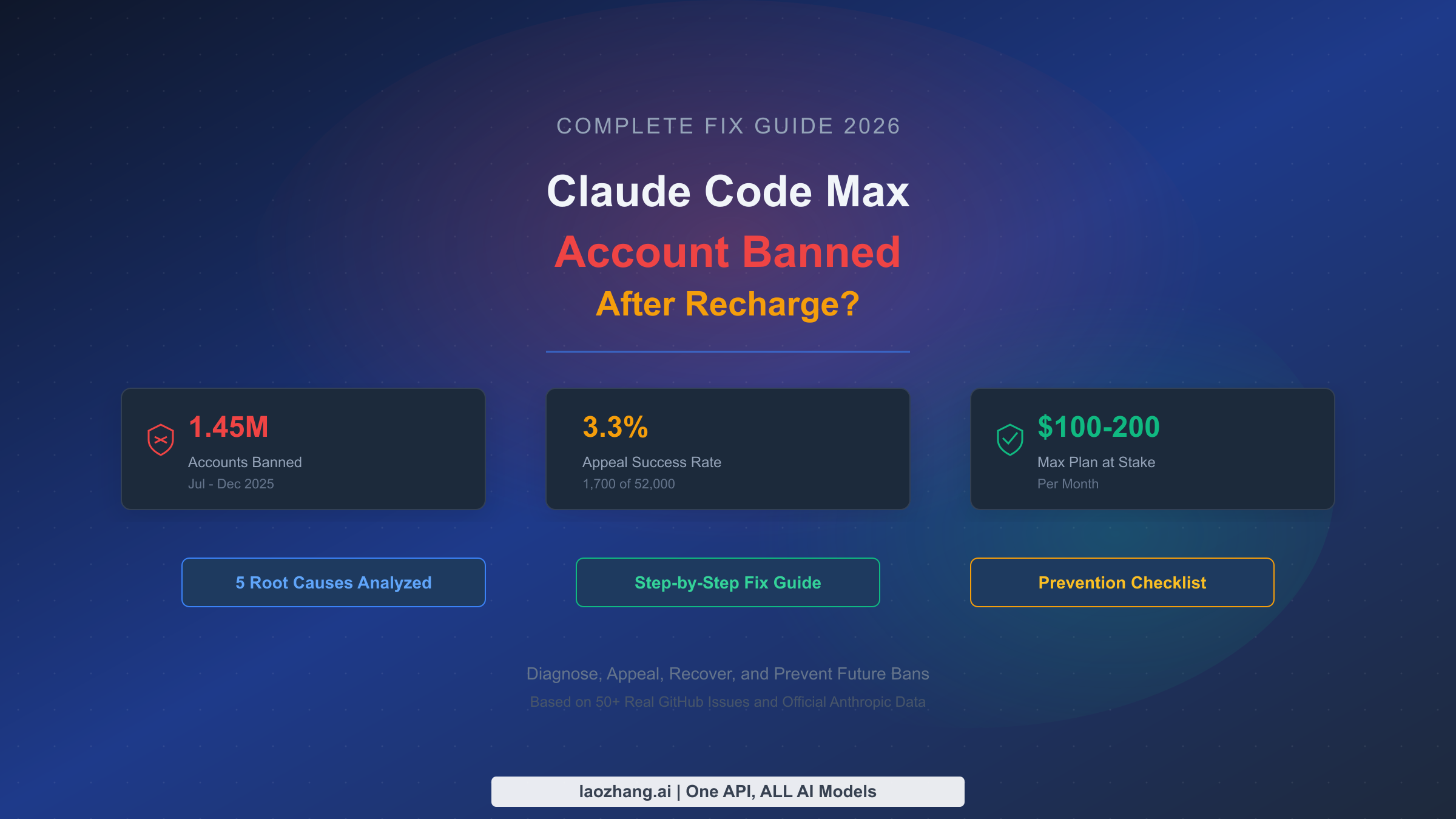
Few things are more frustrating than paying $100 or $200 for a Claude Code Max subscription and immediately losing access to your account. According to Anthropic's Transparency Hub (published January 29, 2026), the company banned 1.45 million accounts in the second half of 2025 alone, with only 1,700 successful appeals out of 52,000 filed — a 3.3% overturn rate. If you just got hit with a "This organization has been disabled" or "Your account has been disabled" message right after upgrading, this guide will walk you through exactly what happened, how to diagnose your situation, and what to do next.
TL;DR
- Not every lockout is a ban. The March 11, 2026 Anthropic outage caused thousands of false "banned" reports. Always check status.claude.com first before panicking.
- Payment-triggered bans usually stem from 5 causes: geographic mismatch, suspicious payment methods, third-party tool usage, automated fraud detection, or billing system errors.
- Appeal success rate is only 3.3% (1,700 out of 52,000), but your odds improve significantly when you provide payment proof, a clear use case description, and submit through the correct channels.
- Refunds are possible if Anthropic terminates your account without a policy violation, per the Consumer Terms of Service (effective October 8, 2025). If banned for a violation, no refund is provided.
- Prevention is better than cure. Use a real credit card from a supported country, avoid third-party tools that proxy through your subscription, and maintain a consistent IP address.
- API access is the safest alternative for users in unsupported regions. It has no geographic restrictions and eliminates subscription-based ban risks entirely.
Understanding Claude Code Max Account Bans in 2026
The landscape of Claude account enforcement changed dramatically in early 2026. Anthropic began aggressively enforcing its Terms of Service in ways that caught many legitimate users off guard. Understanding the scale and context of these bans helps you make better decisions about your own situation and approach to recovery.
Anthropic's Transparency Hub, released on January 29, 2026, provides the most authoritative data available on the company's enforcement actions. During July through December 2025, the company disabled approximately 1.45 million accounts across all Claude products. While this number sounds alarming, it represents accounts flagged across Claude.ai, the Claude API, and Claude Code combined. The vast majority of these were automated detections related to abuse, spam, or Terms of Service violations, not paying subscribers who suddenly lost access.
However, a disturbing pattern emerged starting in January 2026 when Anthropic implemented technical safeguards to block third-party applications from accessing Claude through subscription credentials. This crackdown, which The Register reported on February 20, 2026, specifically targeted tools like OpenCode, Cline, and other unofficial clients that routed requests through Claude Pro and Max accounts. Many developers who had been using these tools for months suddenly found their accounts disabled, often within minutes of making a payment. The timing was not coincidental: payment transactions often trigger a deeper review of account activity, surfacing violations that may have gone unnoticed before.
The situation intensified in March 2026, when multiple reports on GitHub (Issues #5088, #9950, #12118, #24235, and #32918) documented cases of users losing access immediately after purchasing or renewing Claude Code Max plans. These reports revealed a pattern where the payment itself appeared to trigger an automated security review that resulted in account suspension. Understanding whether your case falls into this pattern, or whether it involves a different issue entirely, is the critical first step toward resolution.
Why Your Account Gets Banned Right After Payment
The "pay and get banned immediately" phenomenon is not random. Through analysis of dozens of GitHub Issues and community reports, five distinct triggers emerge that explain why payment events specifically lead to account suspensions. Each trigger has different implications for your recovery prospects and requires a different approach.
Geographic and IP Mismatch Detection
The most common trigger for post-payment bans involves geographic inconsistencies. When you make a payment, Anthropic's systems compare multiple signals: your credit card's billing country, your current IP address location, your account registration information, and your historical login patterns. If you are paying from an unsupported region (mainland China being the most frequently affected, per Anthropic's supported countries page), or if your IP address suddenly shifts from one country to another between browsing and payment, the automated fraud detection system flags your account for review. Field reports from the developer community (cited in articles from March 2026) suggest that roughly 60% of payment-triggered bans involve some form of IP or geographic mismatch. This is particularly problematic for users who rely on VPNs, as a VPN disconnect during the payment process can expose your real IP address, creating an immediate red flag.
Suspicious Payment Method Flags
Anthropic's payment processor (Stripe) runs its own fraud detection algorithms alongside Anthropic's systems. Certain payment methods carry inherently higher risk scores. Virtual credit cards, prepaid Visa gift cards, and cards from cryptocurrency-to-fiat services are frequently flagged. When a $100 or $200 charge from a high-risk payment source hits the system, it can trigger an immediate hold on the associated account. Additionally, if you have had previous failed payment attempts, if the card name does not match the account name, or if the card has been associated with previously banned accounts, the probability of a payment-triggered ban increases dramatically. GitHub Issue #5088 documents exactly this scenario: a user paid for Claude Code Max 5x and was immediately locked out with "This organization has been disabled," despite having used the account normally for months before the payment.
Third-Party Tool Detection at Payment Time
Anthropic's January 2026 crackdown on third-party tools created a particularly cruel timing trap. Some users had been running unofficial Claude clients (like OpenCode or custom harnesses that accessed Claude through subscription credentials) for weeks without issue. The moment they made a payment, however, the system performed a comprehensive review of their account activity history. This review surfaced the unauthorized tool usage, and the payment triggered the ban. If you have been using any third-party tool that accesses Claude through your subscription (rather than through the official API), making a payment is essentially asking Anthropic to take a closer look at your account — and that closer look results in a ban. As noted in the Dev Genius article from January 2026 about breaking Claude's ToS, many developers did not realize that using subscription credentials in third-party tools violated the Terms of Service until enforcement began.
Automated Fraud Detection False Positives
Sometimes the ban is simply a false positive. Anthropic's automated systems process millions of transactions, and no fraud detection system is perfect. Changes in your payment routine (upgrading from Pro to Max, switching credit cards, paying from a new device) can all trigger automated flags that result in temporary account suspension. GitHub Issue #24235 describes a case where a user's Pro subscription was revoked after an "internal investigation of suspicious signals" found a violation, but the user maintained they had done nothing wrong. These false positive cases are the most frustrating because the user has genuinely followed all rules, yet still faces the same suspension message. The good news is that false positive cases have the highest appeal success rate, since Anthropic can verify that no actual violation occurred.
Billing System Synchronization Errors
Claude Code and Claude.ai operate on partially separate billing systems. When you upgrade or renew, there is a brief window where the two systems may be out of sync. GitHub Issue #32918 documents a "Payment past due" error appearing despite an active subscription, and Issue #12118 describes a ban that occurred specifically during a subscription renewal. These billing-related bans are typically the easiest to resolve because they are clearly Anthropic's error rather than a policy violation. However, they can still take days to resolve due to support queue backlogs, and the account remains inaccessible during the resolution period. If you see billing-related error messages rather than policy violation messages, this is likely your scenario.
How to Diagnose Your Specific Ban Type
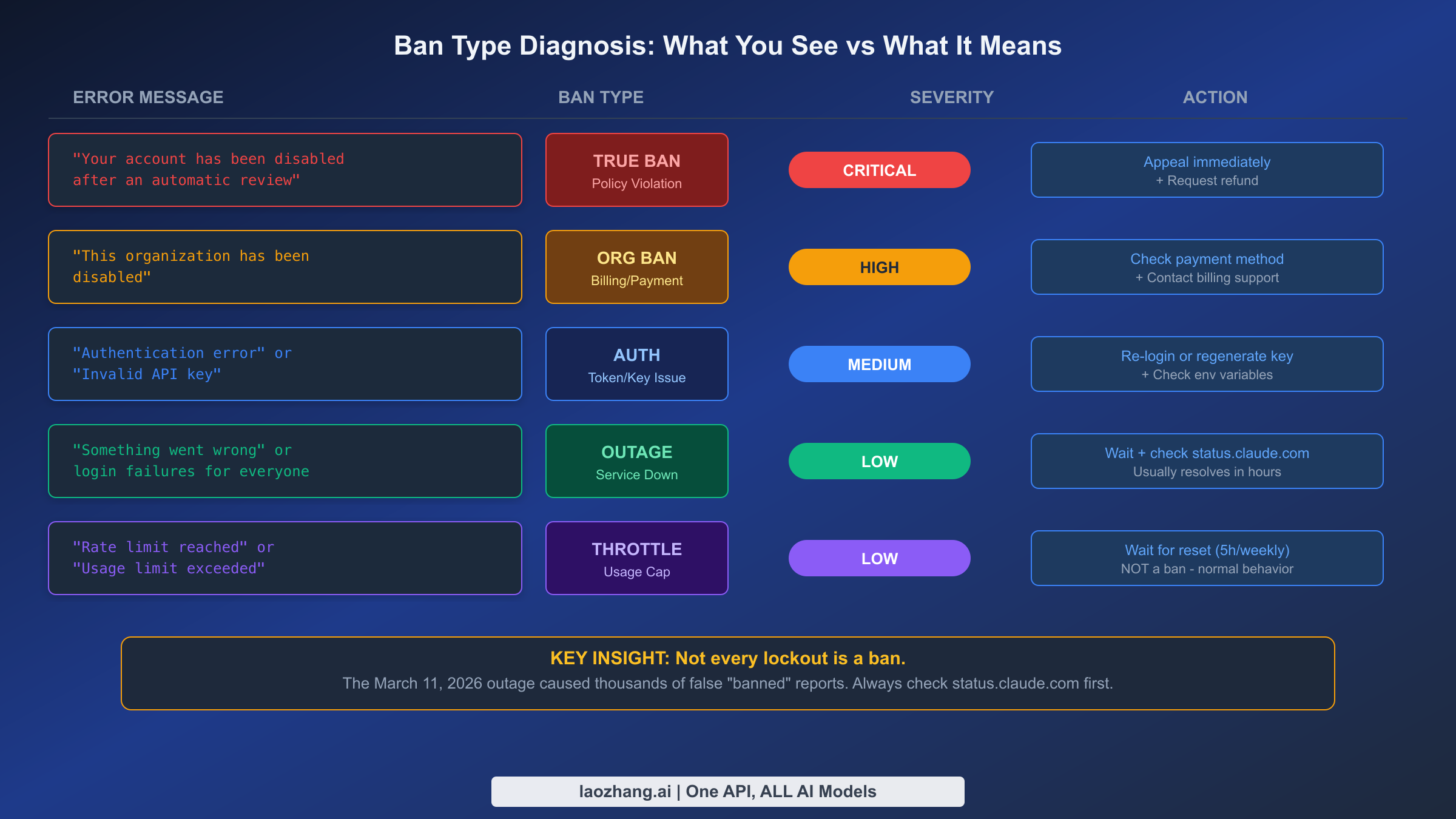
Before you spend time on an appeal, you need to determine exactly what kind of problem you are dealing with. Not every lockout is a ban, and not every ban is permanent. The error message you see is the most important diagnostic clue, because different messages indicate different problems with different solutions.
The first thing you should do — before anything else — is visit status.claude.com. On March 11, 2026, a widespread Anthropic service outage prevented thousands of users from logging into both Claude.ai and Claude Code. Many of these users assumed they had been banned and filed appeals, wasted time troubleshooting, or even created new accounts (which itself can trigger a ban for duplicate accounts). A quick status page check takes 10 seconds and can save you hours of unnecessary anxiety and effort. If you are reading this article within hours of encountering an issue, there is a real possibility that a service disruption is the cause rather than an actual account suspension.
If the status page shows all systems operational, examine the specific error message you received. The message "Your account has been disabled after an automatic review of your recent activities" indicates a true policy violation ban — this is the most serious type, typically triggered by Terms of Service violations detected by automated systems. The message "This organization has been disabled" usually indicates a billing or organizational-level issue, which could be a payment problem, a fraud detection flag, or an administrative action on the Console side. Authentication errors like "Invalid API key" or sudden login failures without a clear ban message often indicate a technical issue with your credentials or session, not an actual ban. And rate limit messages ("Usage limit exceeded" or "Rate limit reached") are not bans at all — they are normal Claude Code rate limits that reset automatically every 5 hours or weekly, depending on your plan.
Understanding the distinction between these categories is critical because the resolution path is completely different for each one. A true ban requires a formal appeal. A billing issue requires contacting payment support. A technical issue requires re-authentication. And a rate limit just requires patience. Pursuing the wrong resolution path wastes time and can even make your situation worse — for example, creating a new account when you have been banned often triggers an additional ban on the new account as well.
Step-by-Step Appeal and Refund Guide
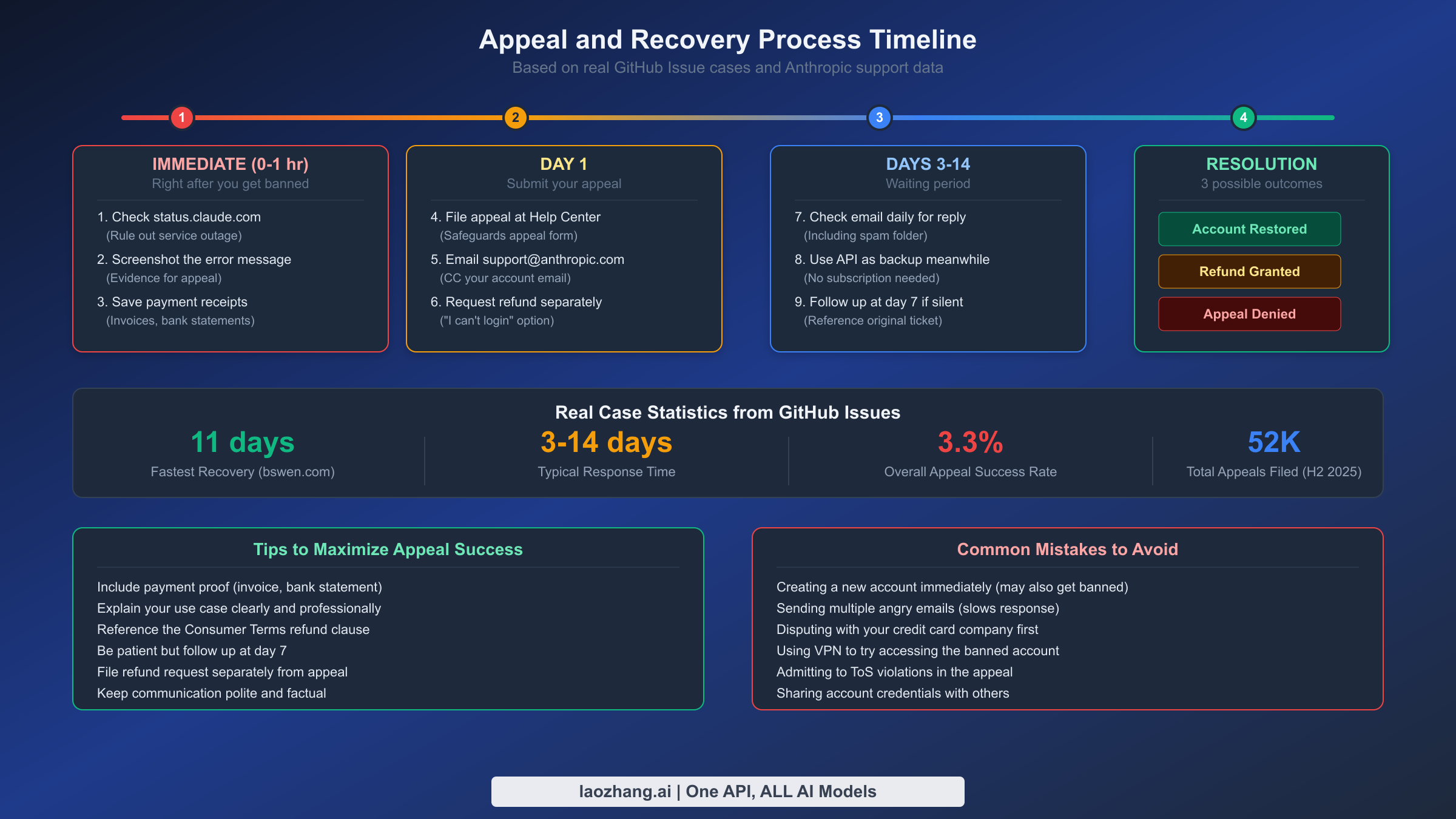
Once you have diagnosed your ban type, the appeal and refund process follows a specific sequence. The key insight from analyzing dozens of real cases is that speed and documentation matter enormously. Users who submit a well-documented appeal within the first 24 hours consistently report better outcomes than those who wait days or send emotional messages. Here is the exact process, broken down into actionable steps with realistic timelines based on reported cases.
Immediate Actions (First Hour)
Within the first hour of discovering your ban, your priority is evidence preservation. Take a screenshot of the exact error message — this is your primary diagnostic evidence and will be needed for the appeal. If you can still access your email, locate and save any correspondence from Anthropic, including the original subscription confirmation, any payment receipts, and any warning emails you may have received. If you have access to your Stripe payment history or bank statements showing the Claude charges, save those as well. This documentation is not optional — appeals without payment proof are far less likely to succeed, because Anthropic's support team needs to verify that you are a paying customer and not an abuser of free accounts.
Additionally, check the ANTHROPIC_API_KEY environment variable on your machine by running env | grep ANTHROPIC in your terminal. If you see an old or invalid key, this could be contributing to authentication issues that look like a ban but are actually a configuration problem.
Day 1: Submit Your Appeal
Anthropic provides multiple channels for account recovery, and using the right one matters. For a true ban (policy violation), go to the Safeguards Warnings and Appeals page in the Claude Help Center and fill out the appeal form with your account email, a description of your use case, and your payment documentation. For billing-related issues, use the Help Center messenger by clicking your initials in the lower left corner of Claude.ai (if you can still access the page), selecting "Get help," then "Send us a message," and choosing "I can't login." This routes you to billing support rather than the policy team.
If you cannot access Claude.ai at all, email support@anthropic.com directly. Include the email address associated with your account, your payment documentation, and a clear, professional description of what happened. Here is a template that covers the key elements:
Subject: Account Disabled After Claude Code Max Payment - Request for Review

Dear Anthropic Support Team,

My Claude account ([your email]) was disabled on [date] immediately after
I completed payment for the Claude Code Max [5x/20x] plan.

Payment details:
- Plan: Claude Code Max [5x/20x] ($[100/200]/month)
- Payment date: [date]
- Payment method: [card type, last 4 digits]
- Invoice/receipt: [attached or reference number]

I believe this may be a false positive or billing system error because:
- I have been a paying subscriber since [date]
- I use Claude Code exclusively through the official CLI
- My usage has been consistent with normal development workflows

I respectfully request:
1. A review of my account suspension
2. Restoration of my account access
3. If restoration is not possible, a pro-rata refund per the Consumer Terms

I have attached my payment receipt and a screenshot of the error message.

Thank you for your prompt attention to this matter.

[Your name]
Important: File the refund request separately from the appeal. The appeal goes through the policy/safety team, while refunds go through billing. You can pursue both simultaneously, and one does not affect the other. Per the Consumer Terms of Service (effective October 8, 2025), if Anthropic terminates your subscription without a policy violation on your part, you are entitled to a pro-rata refund of the unused portion. If the ban is for a confirmed policy violation, no refund is provided under the Terms.
Days 3-14: The Waiting Period
Based on reported timelines from GitHub Issues and community forums, you should expect a response within 3 to 14 business days. The fastest documented recovery was 11 days (reported by bswen.com). During this period, check your email daily, including the spam folder, as Anthropic's automated responses sometimes get filtered. If you have not received any response by day 7, send a polite follow-up referencing your original ticket or email.
While waiting, consider using the Claude API as a temporary alternative. API access is completely separate from subscription access, works through the Console rather than Claude.ai, and is not affected by subscription-level bans. You can use Claude Sonnet 4.6 through the API for $3/$15 per million input/output tokens, which may be more cost-effective than a subscription depending on your usage patterns.
Resolution Outcomes
Your case will result in one of three outcomes. The best case is account restoration, where Anthropic determines the ban was in error and reinstates your access. The middle case is a refund without restoration, where Anthropic acknowledges you deserve your money back but maintains the account suspension. The worst case is a denied appeal with no refund, which typically happens when a genuine policy violation is confirmed. In the worst case, your remaining option is to create a new account with a clean setup and use the API for access rather than a subscription.
Safe Payment Methods and Account Setup
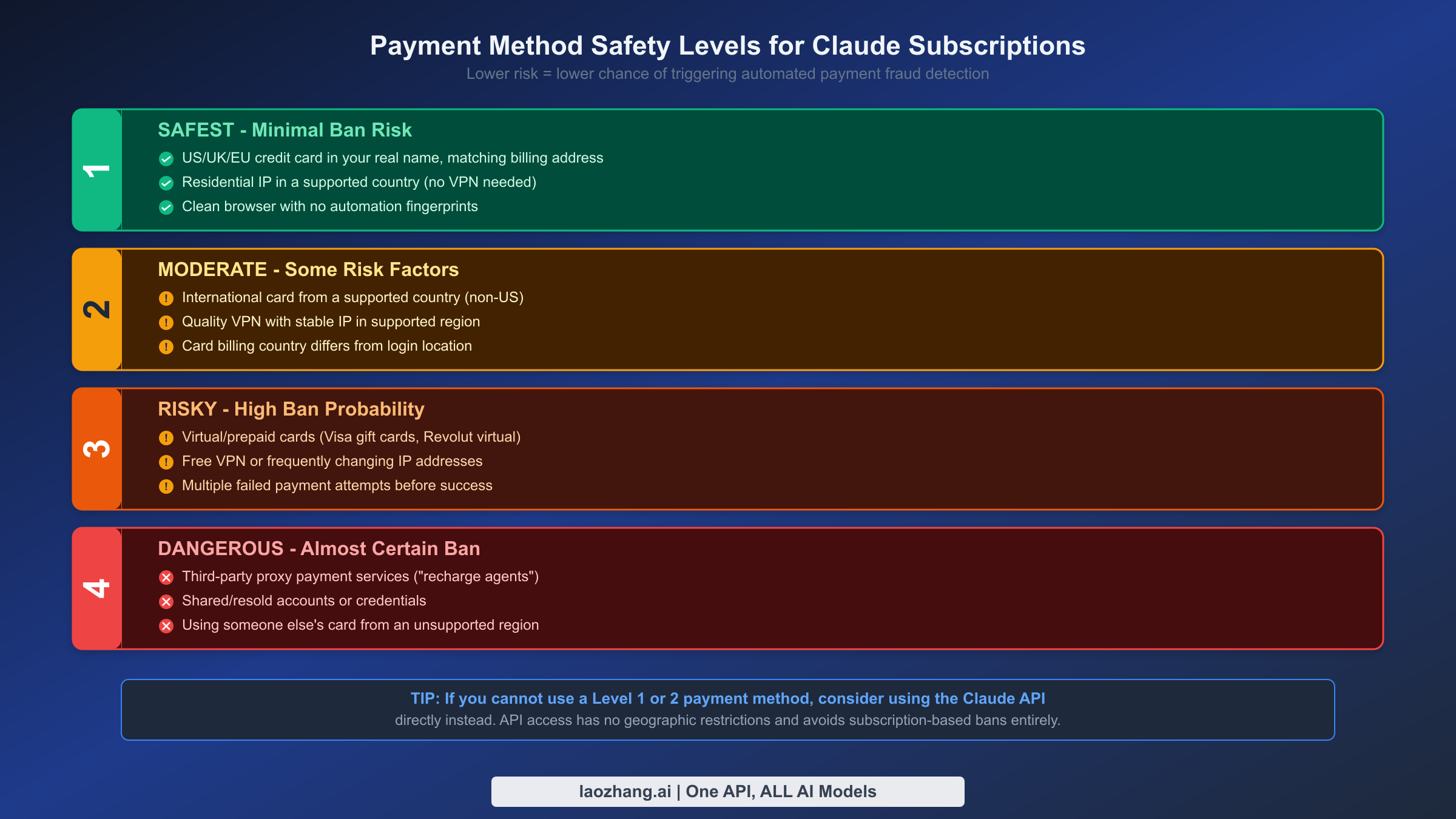
Prevention starts at the payment step. Based on the analysis of dozens of banned account reports, certain payment configurations carry significantly lower risk of triggering automated fraud detection. This is the information that no other guide provides: a systematic risk assessment of different payment approaches, ranked from safest to most dangerous.
Level 1 (Safest): Real Credit Card from Supported Country
The gold standard is a credit card issued by a major bank in the United States, United Kingdom, or European Union, registered in your real name, with a billing address in that country, and used from a residential IP address in the same region. When every signal aligns — card country, IP location, billing address, account registration — the fraud detection system has no reason to flag your transaction. If this option is available to you, use it. There is virtually zero risk of a payment-triggered ban with a fully consistent, supported-country setup.
Level 2 (Moderate Risk): International Card from Supported Country
If you live in a supported country that is not the US (for example, Japan, South Korea, Australia, or most of Europe), using a local credit card is generally safe but carries slightly more risk due to occasional regional processing delays or currency conversion flags. The key is ensuring your IP address matches the card's country of origin. A Japanese credit card used from a Japanese IP address is perfectly fine. A Japanese credit card used from a US VPN introduces an inconsistency that raises risk.
Level 3 (Risky): Virtual Cards and VPN Combinations
Virtual credit cards (from services like Revolut, Wise, or Privacy.com) and free VPN services represent a significant escalation in risk. These payment methods are disproportionately used by fraudsters, so fraud detection algorithms weight them heavily. If your only option is a virtual card, pair it with a high-quality paid VPN service that provides a static (dedicated) IP address, and ensure the VPN location matches the virtual card's billing country. Never use free VPNs for payment — they use shared IPs that are almost certainly blacklisted by fraud detection systems.
Level 4 (Almost Certain Ban): Proxy Payment and Shared Accounts
Third-party "recharge agents" who pay on your behalf, shared or resold accounts, and using someone else's credit card from an unsupported region virtually guarantee a ban. These methods create irreconcilable inconsistencies in the transaction data that no amount of other precautions can overcome. Anthropic specifically mentions "account creation from an unsupported location" as an official suspension trigger. If you cannot access Claude through Level 1-3 methods, the API is a far better alternative than risking a Level 4 approach.
8 Rules to Never Get Banned Again
Recovering from a ban is painful and time-consuming. Preventing the next one is far more valuable. These eight rules, drawn from official Anthropic documentation, real ban cases, and community experience, represent the complete prevention framework. Following all of them dramatically reduces your risk profile.
Rule 1: Use Only Official Claude Tools. This is the single most important rule since Anthropic's January 2026 enforcement changes. Do not use OpenCode, Cline, or any other third-party tool that accesses Claude through your subscription credentials. If you need Claude in your development workflow, use Claude Code (the official CLI), the Claude.ai web interface, or the official API. Third-party tools that proxy through your subscription are explicitly against the Terms of Service. The correct way to build applications with Claude is through the API, not by routing through a subscription account.
Rule 2: Maintain a Consistent IP Address. Frequent IP changes, especially between countries, are a major trigger for automated security reviews. If you use a VPN, choose one with a dedicated (static) IP address and connect to the same server consistently. Never switch VPN servers mid-session, and never disconnect your VPN during a payment transaction. The geographic "jump" from one country to another within minutes is one of the strongest fraud signals in Anthropic's detection system.
Rule 3: Keep Payment Information Consistent. Use the same credit card for all Claude payments. Ensure the name on the card matches the name on your Claude account. Avoid changing payment methods frequently, and if you do need to update your card, do it during a period when you are not actively using Claude Code for critical work. Multiple failed payment attempts followed by a successful one from a different card is a common pattern for stolen credit card testing, and fraud detection systems know this.
Rule 4: Do Not Create Multiple Accounts. Running multiple Claude accounts to circumvent rate limits or to hedge against bans is itself a bannable offense. Anthropic can and does link accounts through shared payment methods, IP addresses, device fingerprints, and other signals. If your primary account is banned and you create a second one, the second account is likely to be banned as well, often within hours.
Rule 5: Stay Within Usage Norms. While Claude Code Max provides generous limits (5x or 20x the Pro tier), usage patterns that look automated or like bot traffic can trigger security reviews. If you are running Claude Code in CI/CD pipelines or automated workflows, use the API with proper rate limiting rather than a subscription account. Subscription accounts are designed for interactive, human-directed usage, and understanding Claude Code's rate limits helps you stay within expected usage patterns.
Rule 6: Monitor Your Account Status Regularly. Do not wait until a critical project deadline to discover your account has been flagged. Log into Claude.ai at least weekly to verify your account status and check for any warning emails from Anthropic. Before any major payment event (upgrading plans, renewing subscriptions, or adding team members), verify that your account is in good standing. Early detection of issues gives you more options for resolution, and catching a warning before it escalates to a ban can save you from the entire appeal process.
Rule 7: Keep Payment Receipts and Communication Records. Document everything. Save every payment receipt, every email from Anthropic, and every invoice. If you ever need to file an appeal, this documentation can mean the difference between a successful recovery and a permanent ban. Set up a folder specifically for Claude-related financial records.
Rule 8: Have a Backup Plan Ready. Even with perfect compliance, bans can still happen due to system errors or false positives. Maintain an active API key through the Claude Console as a backup access method — this key works independently of your subscription status and will continue to function even if your subscription account is suspended. Export important conversations regularly, keep local copies of any Claude-generated code, and familiarize yourself with the appeal process before you need it. The developers who recover from bans most smoothly are those who treated the possibility as a planning consideration rather than an impossible event. Having alternatives ready means a ban is a temporary inconvenience rather than a workflow crisis that halts your productivity for weeks.
Alternative: Using Claude Through API Access
For users who face repeated subscription issues, live in unsupported regions, or simply want to eliminate subscription-related ban risks entirely, the Claude API offers a fundamentally different access model that is immune to most of the issues discussed in this guide. API access has no geographic restrictions beyond US sanctions compliance, no subscription-based billing to trigger fraud detection, and no connection to the Claude.ai web interface.
The Claude API is accessed through the Console at console.anthropic.com, which is separate from your Claude.ai subscription. You pay only for what you use, with no monthly commitment. As of March 2026, Claude Sonnet 4.6 costs $3 per million input tokens and $15 per million output tokens, while Claude Opus 4.6 costs $5/$25. For many developers, especially those who work in concentrated bursts rather than throughout the day, pay-per-use can be more cost-effective than a $100 or $200 monthly subscription.
The main trade-off is that API access does not include the Claude.ai web interface, so you need to use the API through a client application, a development environment, or a service. Claude Code itself can be configured to work through the API by setting the ANTHROPIC_API_KEY environment variable, which provides essentially the same Claude Code development experience without the subscription dependency.
For developers who need API access with additional features like model aggregation, higher rate limits, or access to multiple AI providers through a single endpoint, relay services like laozhang.ai offer an OpenAI-compatible API that routes to Claude (and other models) without requiring a direct Anthropic subscription. This approach is particularly useful for teams in regions where direct Anthropic API access may have connectivity issues, as relay services maintain their own enterprise-grade connections and can route around temporary outages. The pricing typically mirrors or matches the official API pricing, and you get the added benefit of a single API key that works across Claude, GPT, Gemini, and other models. You can find detailed API documentation at docs.laozhang.ai.
When comparing the subscription model to the API model, there are distinct advantages and trade-offs worth considering. The subscription gives you a fixed monthly cost ($100 or $200) with unlimited usage up to your tier's limits, plus the Claude.ai web interface with features like Projects and Artifacts. The API gives you pay-per-use flexibility, no geographic restrictions, no subscription-level ban risk, and the ability to integrate Claude into custom tools and workflows. For developers primarily using Claude Code rather than the web interface, the API is often the superior choice both economically and from a risk management perspective.
FAQ
Can I get a refund if my Claude Code Max account is banned for a policy violation?
Per Anthropic's Consumer Terms of Service (effective October 8, 2025), if your subscription is terminated due to a confirmed policy violation, no refund is provided. However, if Anthropic terminates your access for reasons other than a policy violation (such as a billing error or a false positive), the Terms state that you are entitled to a pro-rata refund of the unused portion of your subscription. This distinction is critical: always request a refund separately from your appeal, and frame the request in terms of the Consumer Terms. Even in cases where the appeal itself is denied, a refund may still be granted if the circumstances warrant it.
How long does the appeal process take?
Based on documented cases from GitHub Issues and community reports, most users receive an initial response within 3 to 7 business days. Full resolution, whether that means account restoration, a refund, or a denial, typically takes 7 to 14 days. The fastest documented recovery was 11 days from ban to full restoration. During periods of high enforcement activity (like the March 2026 ban wave), response times can extend to 2-3 weeks due to increased support volume. Filing your appeal within 24 hours of the ban and providing complete documentation tends to shorten the response time.
Is using a VPN with Claude against the Terms of Service?
Anthropic's Terms of Service do not explicitly ban VPN usage. However, the Terms do prohibit accessing Claude from unsupported regions, and they reserve the right to disable accounts that were "created from an unsupported location." The practical reality is that VPN usage introduces geographic inconsistency signals that increase your risk of triggering automated fraud detection, especially during payment transactions. If you must use a VPN, choose a reputable paid service with a dedicated IP address in a supported country, and maintain a consistent connection to minimize detection risk.
What happens to my conversation history and projects if my account is banned?
When your account is disabled, your conversation history and any Claude Projects become inaccessible. Anthropic does not currently offer a data export feature for banned accounts. This is why Rule 7 (keeping backups) is so important — if you are working on critical projects through Claude, maintain local copies of important conversations and generated code. For Claude Code users specifically, your local codebase is not affected by a ban, since Claude Code works on local files. Only the ability to make new API calls through the subscription is lost.
Should I dispute the charge with my credit card company?
This should be your last resort, not your first action. Initiating a credit card chargeback before exhausting Anthropic's internal support channels can result in Anthropic permanently blacklisting your payment method and potentially your identity across all future accounts. Try the appeal and refund process first, and give Anthropic at least 14 business days to respond. If Anthropic denies both the appeal and the refund request, and you believe the charge was made in error (for example, you were banned within minutes of payment and never received any service for that payment cycle), then a chargeback may be appropriate as a last resort. However, understand that it will almost certainly make any future Anthropic account creation impossible with that payment method, and possibly with your identity across other accounts as well.
What is the difference between a Claude.ai ban and a Claude Code ban?
Claude.ai and Claude Code share the same underlying account and subscription system. If your Claude.ai account is disabled, your Claude Code access is also disabled, and vice versa. However, the Claude API (accessed through the Console at console.anthropic.com) operates on a separate billing and access system. A subscription-level ban does not affect your API access unless Anthropic specifically bans your Console organization as well, which is less common. This is why maintaining an API key as a backup is one of the most effective mitigation strategies. If your subscription access is suspended, your API key will typically continue to work, allowing you to continue development while you resolve the subscription issue.