Is ChatGPT Plus Recharge Reliable? 2026 Safety Guide + Cheaper Alternatives That Actually Work
Most ChatGPT Plus recharge services carry significant risks including account bans, data exposure, and financial loss. As of February 2026, safer alternatives include the new ChatGPT Go plan at $8/month, direct API access starting at $0.25/1M tokens with GPT-5 mini, and free competitors like DeepSeek and Gemini. This guide provides a 5-point trust framework, verified pricing data, and a personalized decision guide.
On this page
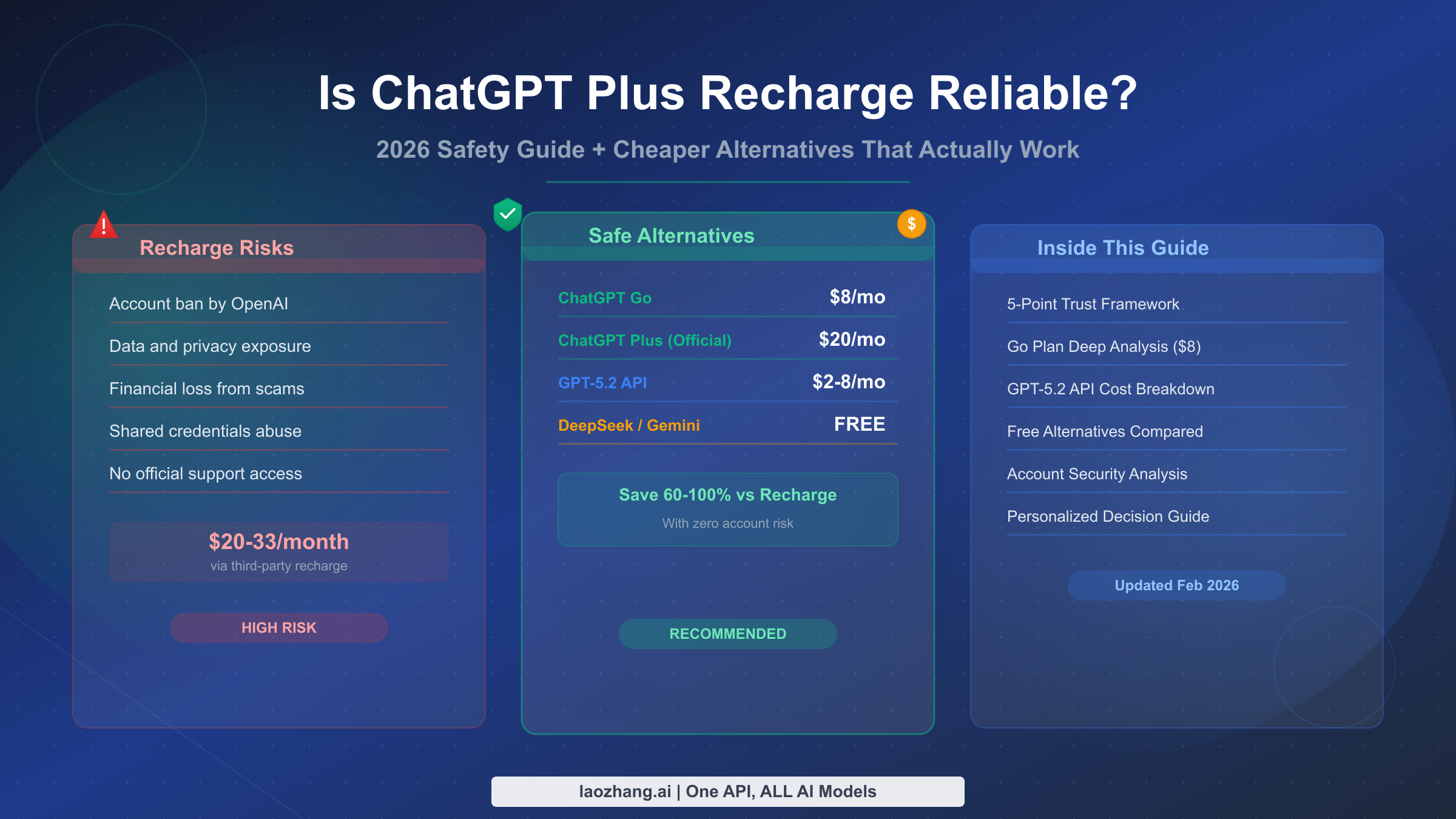
Most ChatGPT Plus recharge services carry significant risks including account bans, data exposure, and financial loss. As of February 2026, safer alternatives include the new ChatGPT Go plan at $8/month, direct API access starting at $0.25/1M tokens with GPT-5 mini, and free competitors like DeepSeek and Gemini. This guide provides a 5-point trust framework for evaluating any recharge service, updated pricing data verified directly from OpenAI's official pages, and a decision guide tailored to your specific needs.
The Truth About ChatGPT Plus Recharge Services in 2026
The ChatGPT Plus recharge market has grown dramatically as millions of users in regions like China, Southeast Asia, and the Middle East struggle to subscribe directly to OpenAI's services. Without access to international credit cards or payment methods accepted by OpenAI, these users turn to third-party recharge services that promise ChatGPT Plus access at prices ranging from $20 to $33 per month. But the fundamental question remains: are these services actually reliable, and more importantly, are they worth the risk when cheaper official alternatives now exist?
The honest answer is that most recharge services operate in a gray area that puts your account, your data, and your money at risk. OpenAI's Terms of Service explicitly prohibit account sharing, credential transfer, and unauthorized reselling of subscriptions. When you use a recharge service, you're essentially trusting a third party with access to an account tied to your conversations, custom GPTs, and potentially sensitive business data. If OpenAI detects unusual activity patterns, such as logins from multiple geographic locations or sudden subscription method changes, your account can be suspended or permanently banned without warning.
The recharge market typically operates through several models, each carrying distinct risks. Direct recharge services claim to subscribe to ChatGPT Plus on your behalf using their own payment methods, but this means they need your account credentials or create accounts they control. Shared account services split a single Plus subscription among multiple users, resulting in reduced usage limits, potential conversation visibility issues, and the constant risk of the account owner disappearing. Apple Gift Card methods involve purchasing US App Store gift cards to subscribe via the iOS app, which is arguably the safest third-party method but still involves purchasing gift cards from potentially unreliable sources. If you're struggling with payment issues on the official platform, our troubleshooting guide for ChatGPT payment issues covers legitimate solutions before you consider third-party alternatives.
The pricing landscape tells its own story about the recharge market's reliability. Third-party services in the Chinese market charge between 148 and 238 RMB per month (approximately $20 to $33 USD), which means many recharge services actually cost more than the official $20/month Plus subscription. This premium doesn't buy you additional features; instead, it buys convenience at the cost of security. When you factor in the risk of losing your account and all associated data, the true cost of recharge services becomes significantly higher than their sticker price.
How to Evaluate Any Recharge Service: The 5-Point Trust Framework
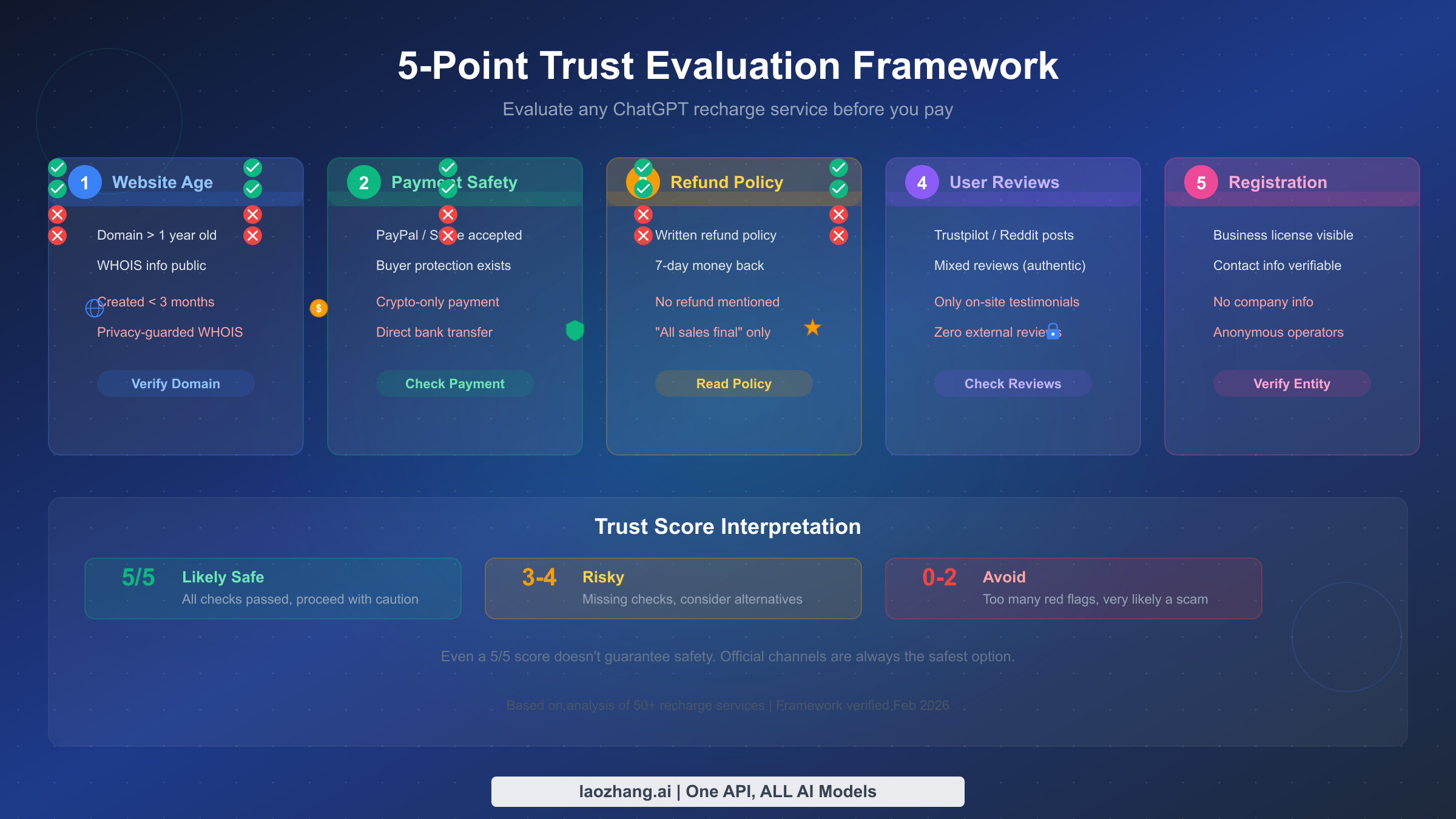
If you've decided to use a recharge service despite the risks, you need a systematic way to evaluate whether a specific provider is trustworthy. Most articles simply warn you to "be careful" without explaining how to actually assess a service. The following 5-point trust framework gives you concrete, actionable criteria that you can apply to any recharge service before handing over your money or credentials. For those who prefer a step-by-step walkthrough of the recharge process itself, our complete step-by-step ChatGPT Plus recharge guide covers the technical details.
Point 1: Website and Domain Age. The first and most revealing indicator of a recharge service's legitimacy is the age and transparency of their online presence. Use tools like WHOIS lookup services to check when the domain was registered. A domain that's been active for more than a year with publicly visible registration information suggests a business with some commitment to long-term operation. Conversely, a domain registered within the last three months with privacy-guarded WHOIS information is a significant red flag. Scam operations typically register cheap domains, operate for a few weeks or months to collect payments, and then disappear. During our research, we found that one prominent discount site (chatgptplusdiscount.com) referenced by multiple SERP articles was already returning 404 errors, illustrating how quickly these services can vanish.
Point 2: Payment Protection Methods. Legitimate businesses accept payment methods that offer buyer protection. Services that accept PayPal, Stripe, or credit card payments through established processors give you chargeback options if the service fails to deliver. Services that only accept cryptocurrency, direct bank transfers, or TG/Alipay with no dispute mechanism leave you with no recourse if something goes wrong. The payment method itself reveals how confident the service is in its ability to deliver on its promises, as services accepting reversible payment methods are implicitly guaranteeing their service quality.
Point 3: Refund Policy Clarity. A trustworthy service has a clearly written refund policy that specifies conditions, timeframes, and procedures. Look for specific language like "7-day money-back guarantee" or "full refund if service not delivered within 24 hours." Services that display "all sales final" notices or simply don't mention refunds at all are telling you exactly what will happen if things go wrong: nothing. The absence of a refund policy should be treated as a deal-breaker regardless of how attractive the pricing appears.
Point 4: External User Reviews. On-site testimonials are meaningless because any service can fabricate them. What matters is the presence of reviews on independent platforms that the service cannot control. Search for the service name on Reddit, Trustpilot, and community forums. Authentic review patterns include a mix of positive and negative feedback (no service has 100% satisfaction), specific details about the user experience, and responses from the service to complaints. A complete absence of external reviews for a service that claims thousands of users is itself a warning sign.
Point 5: Company Registration and Contact Information. The most trustworthy services provide verifiable business registration details, a physical address, and multiple contact methods including email and live chat. Anonymous services operated by individuals with no business registration, no physical address, and only a Telegram channel for support should be approached with extreme caution. While having a business registration doesn't guarantee honesty, the willingness to operate transparently suggests a service with more to lose from scamming its customers.
The scoring interpretation is straightforward: a service scoring 5 out of 5 is likely safer but still carries inherent third-party risks, a score of 3 to 4 means significant risk factors exist and you should strongly consider alternatives, and a score of 0 to 2 means you should avoid the service entirely as it displays too many characteristics common to scam operations.
The $8 ChatGPT Go Plan: The Alternative Most People Don't Know About
One of the most significant developments in OpenAI's pricing strategy has gone almost entirely unnoticed by the recharge service market: the introduction of the ChatGPT Go plan at $8 per month (openai.com/chatgpt/pricing, verified February 2026). This plan sits between the free tier and the $20 Plus plan, offering access to GPT-5.2, OpenAI's current flagship model, at a 60% discount compared to Plus. For the majority of users who turn to recharge services simply because they want access to advanced AI capabilities at a lower price, the Go plan eliminates the primary motivation for using third-party services entirely.
The Go plan includes access to GPT-5.2 for standard conversations, which is the same model available to Plus subscribers. The key differences between Go and Plus are in usage limits and premium features. Plus subscribers get extended access to GPT-5.2 Thinking (the advanced reasoning mode), Codex agents for autonomous coding tasks, Sora video generation capabilities, and a 32K context window for longer conversations. Go subscribers receive more limited allocations of these premium features but still get the core GPT-5.2 experience that most users need for daily productivity tasks. For a detailed breakdown of ChatGPT Plus usage limits and how they compare across plans, our dedicated analysis covers every feature tier in depth.
The practical implications are striking when you consider the user profiles that typically seek recharge services. Students using ChatGPT for research and writing assistance, professionals drafting emails and documents, and casual users exploring AI capabilities rarely exhaust even the Go plan's limits. These users don't need Codex agents or Sora video generation. They need reliable access to a powerful language model for everyday tasks, and the Go plan delivers exactly that at $8 per month, which is cheaper than most recharge services charge and comes with the full protection of an official OpenAI subscription.
Subscribing to the Go plan follows the same process as any other OpenAI subscription. If you can access chatgpt.com directly, you can subscribe through the web interface. If direct payment is your challenge, the Apple Gift Card method (purchasing a US App Store gift card and subscribing through the iOS app) remains a viable approach that costs approximately $8 plus any gift card premium, typically bringing the total to $9 to $11. This is still significantly less than most recharge services and infinitely more secure.
Account Security: What Really Happens When You Use Recharge Services
Understanding the technical security implications of recharge services requires looking beyond the surface-level warnings that most guides provide. When you share your OpenAI credentials with a recharge service, or when you use an account managed by a third party, several concrete security risks emerge that can have lasting consequences for your digital life and professional work.
The most immediate risk is credential exposure. When you provide your email and password to a recharge service, that information is stored in their systems, often with minimal security. If the recharge service itself gets hacked, which happens frequently with small operations that don't invest in proper security infrastructure, your OpenAI credentials become part of a data breach. Since many users reuse passwords across services, this can cascade into compromises of your email, social media, and even financial accounts. OpenAI does offer two-factor authentication, but many recharge services require you to disable it or share your 2FA codes, eliminating this critical security layer.
The conversation data risk is less obvious but equally serious. Every conversation you have with ChatGPT is stored in your account. For personal users, this might include private thoughts, creative writing, or personal information shared during conversations. For business users, this could include proprietary code, business strategies, client information, or draft communications. Anyone with access to your account can read every conversation you've ever had with ChatGPT. Shared account services make this risk even more acute, as multiple strangers may have simultaneous access to the same account, and there's no guarantee that conversation separation is properly maintained.
OpenAI's enforcement mechanisms have become increasingly sophisticated over time. The platform monitors for unusual login patterns including rapid geographic switches (logging in from New York and Shanghai within minutes), multiple simultaneous sessions from different IP addresses, and sudden changes in subscription payment methods. When these patterns are detected, OpenAI may temporarily restrict the account, require re-verification, or in cases of clear Terms of Service violations, permanently ban the account. An account ban means losing not just your subscription but all custom GPTs you've created, your entire conversation history, any files you've uploaded, and any projects or tasks you've configured. For users who have integrated ChatGPT deeply into their workflows, this loss can be devastating.
If you still choose to use a recharge service, the minimum security precautions should include creating a dedicated email address exclusively for OpenAI (never use your primary email), using a unique password that isn't shared with any other service, never conducting sensitive personal or business conversations on a recharge-managed account, and regularly exporting important conversations. However, the most effective security measure remains avoiding third-party recharge services altogether.
API Alternative: How Developers Save 75-90% on GPT-5.2 Access
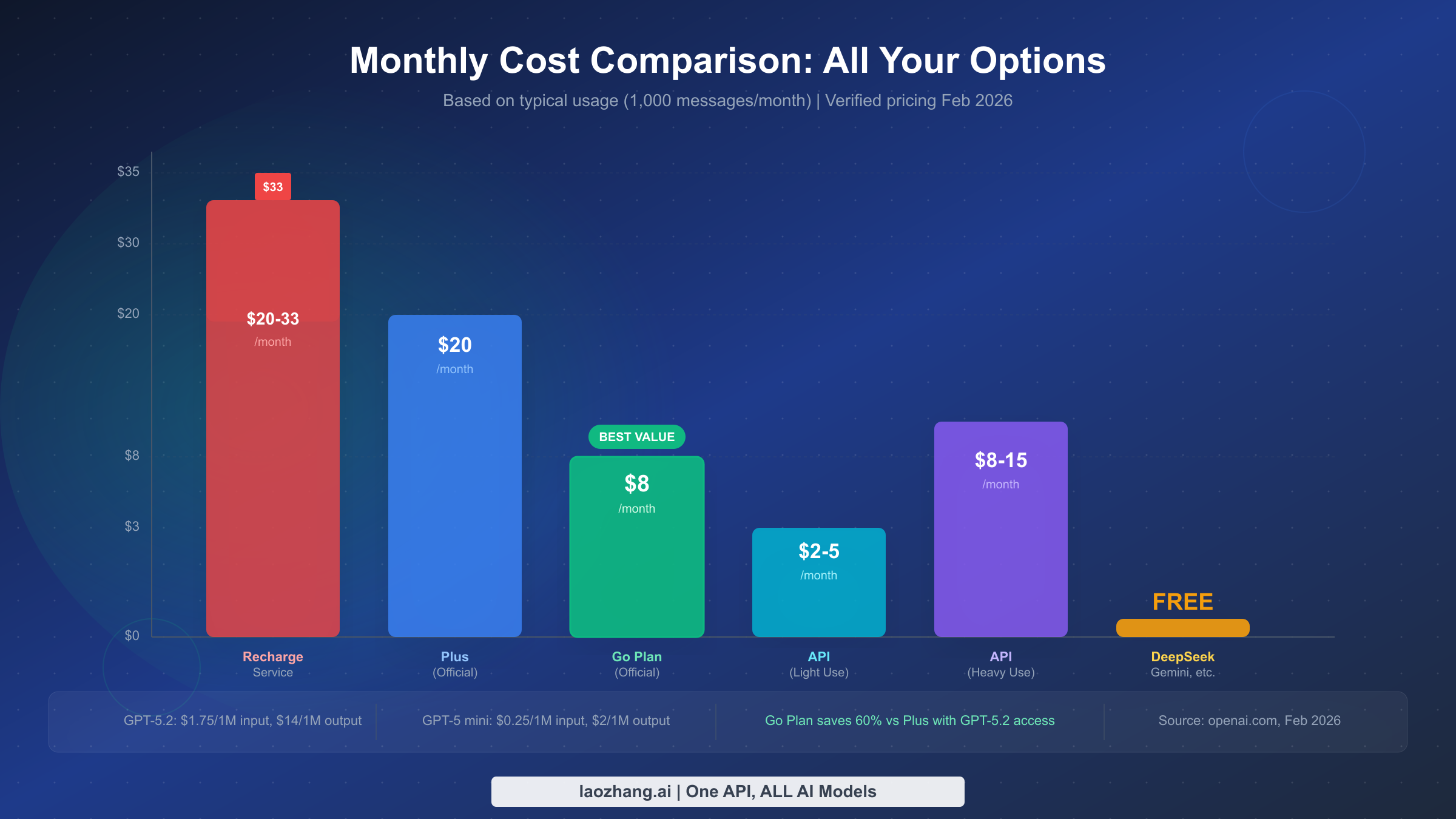
For technically inclined users, the OpenAI API represents the most cost-effective way to access GPT-5.2 capabilities, with potential savings of 75% to 90% compared to a Plus subscription. The API pricing model, verified directly from openai.com/api/pricing in February 2026, is based on token usage rather than a flat monthly fee, meaning light users pay dramatically less than the $20 monthly subscription.
The current GPT-5.2 API pricing is $1.750 per million input tokens and $14.000 per million output tokens. For the more economical GPT-5 mini model, pricing drops to $0.250 per million input tokens and $2.000 per million output tokens. To translate these per-token costs into practical monthly expenses, consider that a typical conversation of about 500 words of input and 1,000 words of output uses approximately 750 input tokens and 1,500 output tokens. Using GPT-5 mini, this single conversation costs roughly $0.003. Even at 30 conversations per day (900 per month), your total monthly cost would be approximately $2.70, which is just 13.5% of the Plus subscription cost.
For heavier API users working with the flagship GPT-5.2 model, the break-even analysis changes. The same 900 monthly conversations would cost approximately $1.58 for input tokens plus $18.90 for output tokens, totaling around $20.48 per month, roughly equivalent to a Plus subscription. However, most API users employ optimization strategies like GPT-5.2's cached input pricing of $0.175 per million tokens (a 90% discount for repeated context), mixing GPT-5 mini for simple tasks and GPT-5.2 for complex ones, and implementing prompt compression techniques that reduce token usage by 30% to 50%.
The practical barrier to API usage has dropped significantly in 2026. You no longer need to be a developer to use the API. Several user-friendly platforms now provide ChatGPT-like interfaces powered by the API, giving non-technical users the cost advantages of per-token pricing with the familiar chat experience they expect. Services like laozhang.ai aggregate multiple AI models through a single API endpoint, providing access to GPT-5.2, Claude, Gemini, and other models at competitive pricing without the complexity of managing multiple API keys or accounts. For users who can't access OpenAI directly but want to avoid the risks of recharge services, API proxy platforms represent a practical middle ground that offers legitimate access at significantly lower cost.
The key calculation for deciding between API and subscription is straightforward. If you use ChatGPT for fewer than 30 substantial conversations per day (which describes the vast majority of individual users), the API with GPT-5 mini will cost you between $2 and $5 per month. If you're a power user sending hundreds of messages daily, the Plus subscription at $20 per month or the Go plan at $8 per month offers better value through unlimited messaging within plan limits.
Free AI Alternatives That Rival ChatGPT Plus in 2026
The competitive landscape for AI assistants has transformed dramatically since the early days of ChatGPT's dominance. Several free alternatives now offer capabilities that rival or exceed ChatGPT Plus for specific use cases, making it unnecessary for many users to pay anything at all for advanced AI assistance. Before spending money on a recharge service or even an official subscription, it's worth evaluating whether these free options meet your needs.
DeepSeek has emerged as one of the most compelling free alternatives, particularly for users in China and Asia-Pacific regions. DeepSeek's reasoning model delivers performance comparable to GPT-5.2 on coding tasks, mathematical reasoning, and complex analysis, and it's available completely free with generous usage limits. For users whose primary use case involves coding assistance, technical problem-solving, or analytical tasks, DeepSeek represents a genuinely superior option to paying for ChatGPT Plus through a recharge service. The main limitation is that DeepSeek's creative writing and conversational abilities, while competent, don't quite match the polish of GPT-5.2's outputs.
Google's Gemini offers another strong free tier that deserves serious consideration. Gemini provides access to Google's latest model with deep integration into the Google ecosystem, including Gmail, Docs, and Search. For users who work primarily within Google's suite of productivity tools, Gemini's free tier may actually be more useful than ChatGPT Plus because of these native integrations. Gemini also handles multimodal tasks well, accepting image inputs for analysis and generating images as part of its free offering, capabilities that require a paid ChatGPT subscription.
Claude, developed by Anthropic, offers a free tier that excels at long-form writing, careful analysis, and nuanced conversation. Claude is particularly valued for tasks requiring careful reasoning about ambiguous or sensitive topics, making it an excellent complement to ChatGPT for users who need different strengths for different tasks. The free tier includes access to Claude's current model with reasonable daily usage limits that work well for moderate use patterns.
The strategic approach for budget-conscious users is to combine multiple free services rather than paying for a single premium service. Using ChatGPT Free for casual conversations, DeepSeek for coding and math, Gemini for Google-integrated productivity tasks, and Claude for long-form analysis creates a multi-model workflow that collectively surpasses what any single paid subscription offers. This approach costs exactly $0 per month and carries zero account security risks.
Which Option Is Right for You? A Quick Decision Guide
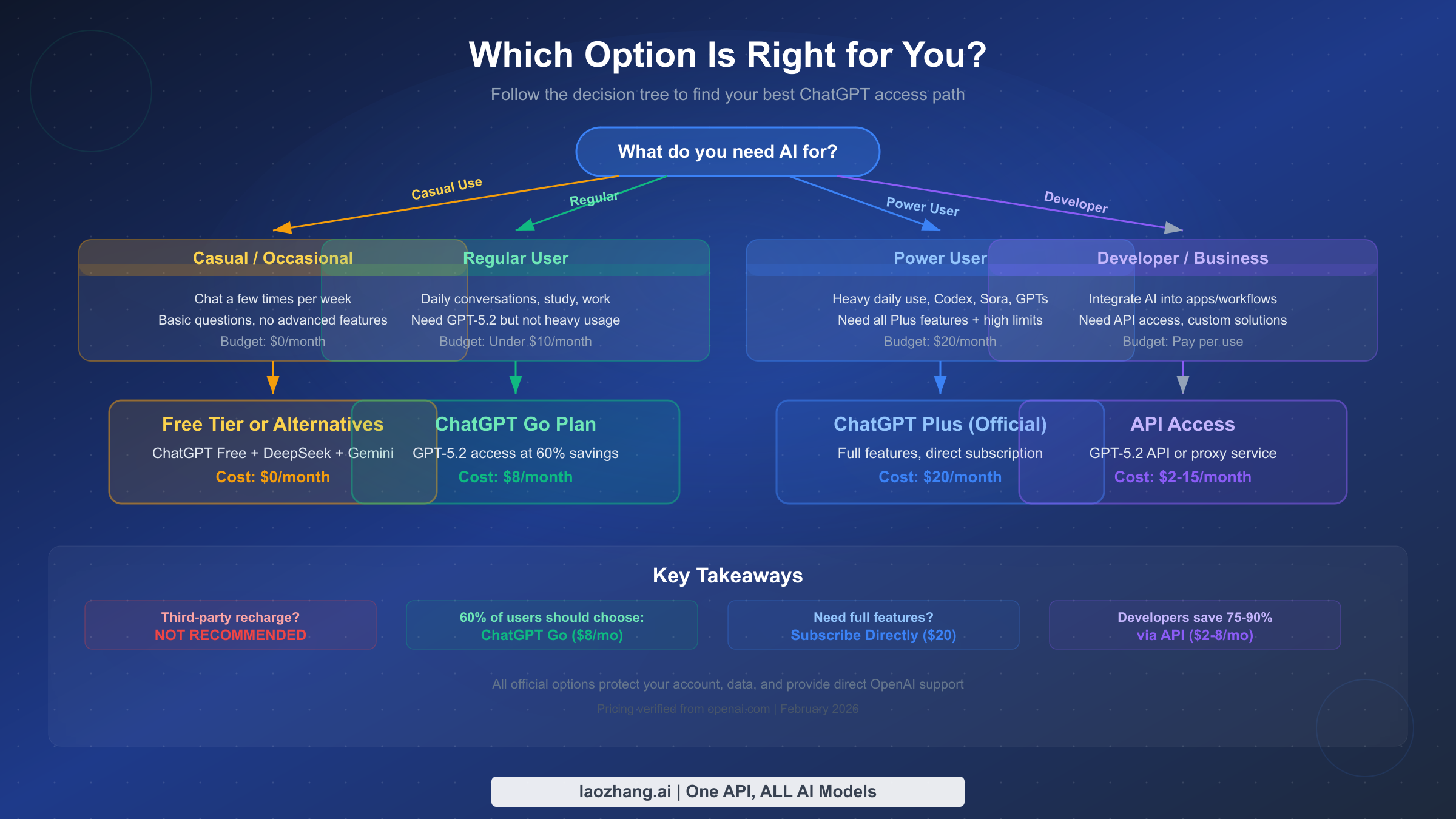
After understanding all the options available, the final decision depends on three factors: your use case, your budget, and your technical comfort level. Rather than presenting abstract comparisons, here are concrete recommendations based on the four most common user profiles we've identified through our research.
The Casual User checks in with AI a few times per week for quick questions, writing help, or curiosity-driven conversations. If this describes you, the free tier of ChatGPT combined with DeepSeek or Gemini is more than sufficient. There is absolutely no reason to pay for a recharge service, subscribe to Plus, or even consider the Go plan. The free tiers of modern AI assistants handle casual use cases extremely well, and you'll have access to multiple models for different types of tasks. Monthly cost: $0. Risk: zero.
The Regular User relies on AI daily for work, study, or personal productivity. You want reliable access to a powerful model but don't need advanced features like Codex agents or Sora video generation. The ChatGPT Go plan at $8 per month is designed specifically for you. It provides GPT-5.2 access at 60% less than Plus, with an official subscription that protects your account and data. If direct payment is difficult, the Apple Gift Card method brings the effective cost to approximately $9 to $11, which is still cheaper and infinitely safer than any recharge service. Monthly cost: $8 to $11. Risk: minimal.
The Power User needs maximum AI capability with high usage limits, access to Codex agents, Sora, custom GPTs, and extended reasoning. You push ChatGPT to its limits daily and need the full Plus feature set. For you, the official ChatGPT Plus subscription at $20 per month is the correct choice. If you absolutely cannot subscribe directly, the Apple Gift Card method remains the safest alternative. Using a recharge service for a power user account is especially risky because the account contains extensive conversation history, custom configurations, and integrated workflows that would be devastating to lose. Monthly cost: $20. Risk: minimal with official subscription.
The Developer or Business User needs API access to integrate AI into applications, automate workflows, or serve multiple users through a single integration. The API is your optimal path, offering GPT-5.2 access at per-token pricing that typically results in monthly costs between $2 and $15 depending on volume. For developers who can't access OpenAI's API directly, proxy services like laozhang.ai provide aggregated access to multiple AI models through a single endpoint, solving both the access problem and the cost problem simultaneously. Monthly cost: $2 to $15. Risk: low with legitimate API proxy services.
The common thread across all recommendations is that third-party recharge services are never the optimal choice for any user profile. There is always a safer, often cheaper alternative that doesn't require trusting a third party with your credentials and data.
FAQ: ChatGPT Plus Recharge Safety Questions Answered
Is it safe to buy ChatGPT Plus from a third-party recharge service?
No third-party recharge service can guarantee safety because they all operate outside OpenAI's Terms of Service. Even the most reputable services carry inherent risks including account suspension, data exposure, and financial loss. The safest approaches are always official channels: direct subscription, the Go plan at $8 per month, or the API for technical users.
What happens if my recharged ChatGPT Plus account gets banned?
When OpenAI bans an account, you lose everything: all conversation history, custom GPTs, uploaded files, projects, and configured workflows. The recharge service may or may not refund your payment, but there is no way to recover the data and configurations lost with the banned account. OpenAI does not provide appeals processes for accounts banned due to Terms of Service violations.
Is the ChatGPT Go plan available in all countries?
The ChatGPT Go plan at $8 per month is available through OpenAI's standard subscription process at chatgpt.com. Payment availability depends on your country and payment method. Users in regions without direct payment access can use the Apple Gift Card method through the iOS app to subscribe to the Go plan at a small premium above the base $8 price.
How much does the GPT-5.2 API actually cost for a typical user?
For a typical user sending about 30 conversations per day using GPT-5 mini, the API costs approximately $2 to $5 per month. Using the flagship GPT-5.2 model for all conversations increases costs to approximately $15 to $20 per month for the same volume. Most cost-effective users mix GPT-5 mini for routine tasks and GPT-5.2 for complex ones, keeping their monthly costs between $5 and $10 (openai.com/api/pricing, verified February 2026).
Are free alternatives like DeepSeek really as good as ChatGPT Plus?
For specific use cases, yes. DeepSeek matches or exceeds GPT-5.2 performance on coding and mathematical reasoning tasks. Gemini offers superior Google ecosystem integration with its free tier. Claude excels at careful analysis and long-form writing. None of these free alternatives perfectly replicate the full ChatGPT Plus experience across all dimensions, but combining two or three free services creates a toolkit that covers most use cases without any cost.
Sources1
External pages this guide links to, in the order they appear. Last updated Feb 22, 2026.
Sources1
External pages this guide links to, in the order they appear. Last updated Feb 22, 2026.