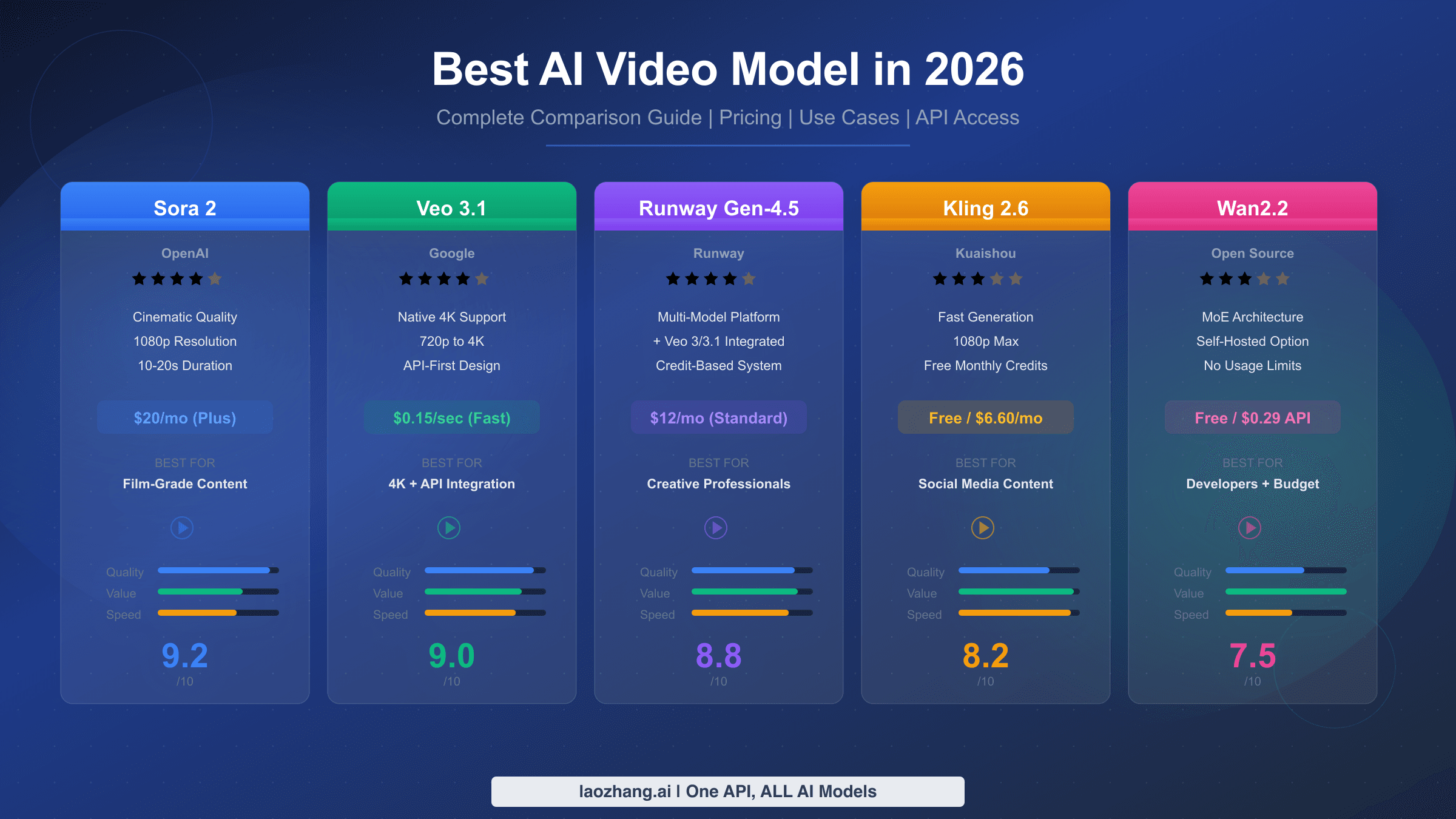
Seedance 2.0 vs Kling 3.0 vs Sora 2 vs Veo 3.1: The Complete 2026 AI Video Generator Comparison
Comparing the 4 leading AI video generators of February 2026: Seedance 2.0 wins for creative control with 12-file multimodal input, Kling 3.0 for value with native 4K@60fps and a free tier, Sora 2 for physics realism with 25-second clips, and Veo 3.1 for cinema-grade 4K quality with native audio. Cost ranges from $0.50 to $2.50 per 10-second 1080p clip.
On this page
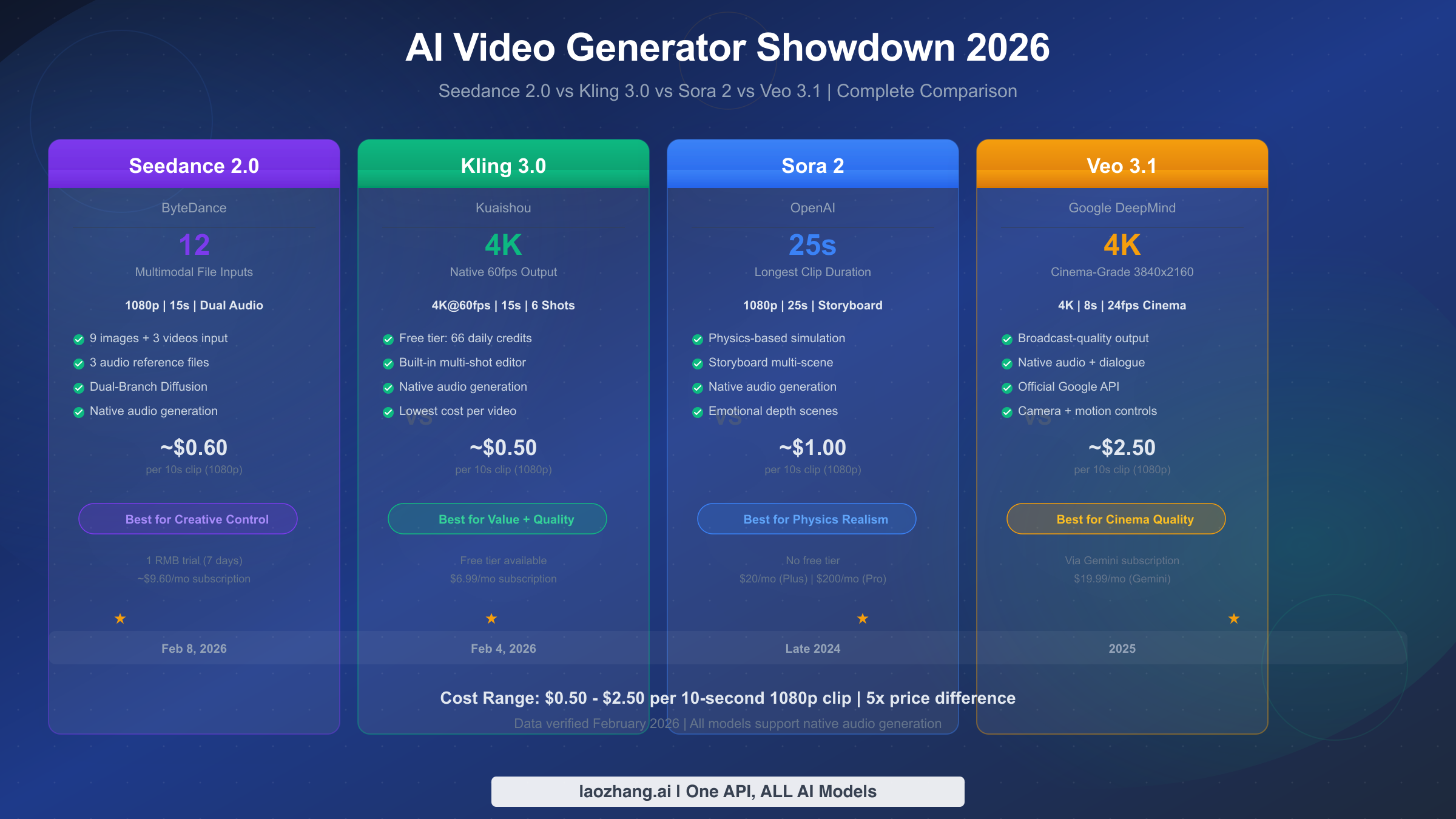
Comparing Seedance 2.0, Kling 3.0, Sora 2, and Veo 3.1 in February 2026, the AI video generation landscape has reached a turning point where no single model dominates every category. Seedance 2.0 leads in creative flexibility with its unprecedented 12-file multimodal input system, Kling 3.0 delivers the best value proposition with native 4K at 60fps and a generous free tier, Sora 2 produces the most physically realistic scenes with 25-second clip support, and Veo 3.1 sets the standard for cinema-grade output at 4K resolution with native audio generation. The cost per 10-second 1080p clip ranges from approximately $0.50 (Kling) to $2.50 (Veo), representing a 5x price difference that makes choosing the right model a critical budget decision.
TL;DR - Quick Comparison Table
The AI video generation market has never been more competitive. Within a single two-week period in early February 2026, both ByteDance and Kuaishou released major new versions of their video models, joining OpenAI's Sora 2 and Google DeepMind's Veo 3.1 in what has become a four-way race for dominance. Before diving into the detailed analysis, here is the essential comparison data that most readers need immediately. This table draws from verified specifications across official documentation and multiple independent reviews, all cross-referenced as of February 2026.
| Feature | Seedance 2.0 | Kling 3.0 | Sora 2 | Veo 3.1 |
|---|---|---|---|---|
| Developer | ByteDance | Kuaishou | OpenAI | Google DeepMind |
| Release | Feb 8, 2026 | Feb 4, 2026 | Late 2024 | 2025 |
| Max Resolution | 1080p | 4K @ 60fps | 1080p | 4K (3840x2160) |
| Max Duration | 15s | 15s (6 shots) | 25s | 8-10s typical |
| Audio | Dual-Branch native | Native | Native | Native |
| Image Input | Up to 9 | 1-2 | 1 | 1-2 |
| Free Tier | 1 RMB trial | 66 daily credits | None | Via Gemini |
| Cost/10s clip | ~$0.60 | ~$0.50 | ~$1.00 | ~$2.50 |
| Best For | Creative control | Value + quality | Physics realism | Cinema production |
Quick verdict: If budget matters most, start with Kling 3.0. If you need maximum creative input flexibility, choose Seedance 2.0. If physics realism and longer clips are essential, Sora 2 is your model. If absolute cinema-grade quality justifies premium pricing, Veo 3.1 stands alone. For a more detailed breakdown of how these models compare across specific use cases, read on for verified data, pricing analysis, API integration guides, and a decision framework tailored to your specific needs.
Technical Specifications Breakdown
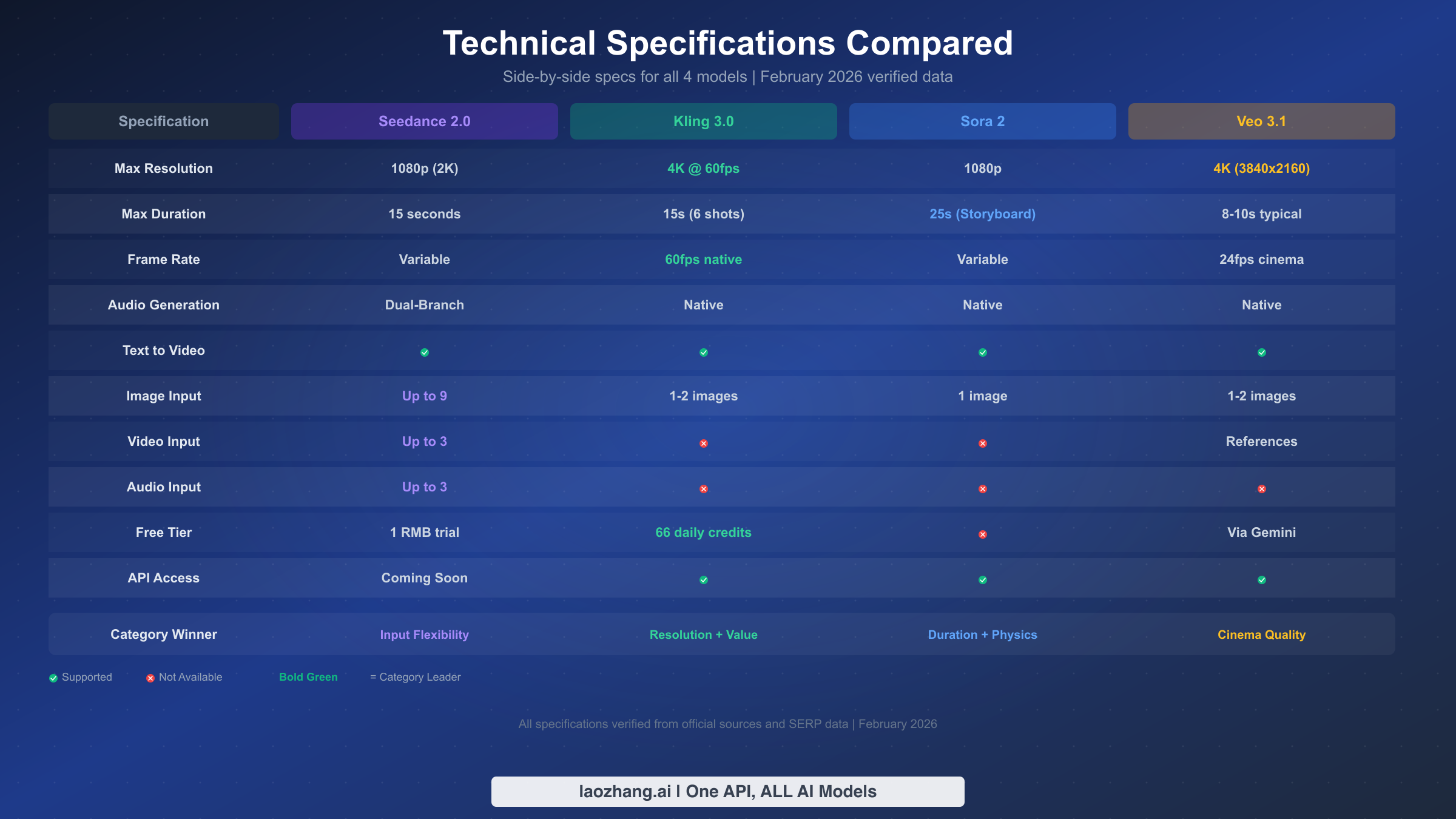
Understanding the technical specifications of each model reveals why the "best" AI video generator depends entirely on what you are trying to accomplish. Each of these four models has made deliberate engineering trade-offs that optimize for different output characteristics, and understanding those trade-offs is the key to making an informed decision. The data presented here has been verified against official documentation and cross-referenced across multiple independent sources as of February 2026.
Resolution and Frame Rate
The resolution battle currently has two clear tiers. Kling 3.0 and Veo 3.1 both offer 4K output, but their approaches differ significantly in ways that matter for production workflows. Kling 3.0 is the first AI video model to deliver native 4K at 60 frames per second, which makes it the go-to choice for content that needs smooth motion, such as product demonstrations, action sequences, or any scenario where frame-by-frame fluidity matters more than cinematic aesthetics. Veo 3.1, on the other hand, outputs at 4K (3840x2160) but locks its frame rate at 24fps, the cinema standard. This is not a limitation but a deliberate choice: 24fps is what audiences associate with film quality, and it gives Veo's output an inherently cinematic feel that 60fps content simply cannot replicate. The trade-off is that 24fps can introduce visible motion blur in fast-action scenes, which may or may not be desirable depending on your creative intent.
Seedance 2.0 and Sora 2 both cap at 1080p, which remains sufficient for the vast majority of social media, web, and presentation use cases. The resolution gap matters primarily for broadcast television, cinema projection, and large-format display applications where 4K is a hard requirement. For YouTube, TikTok, Instagram Reels, and most marketing applications, 1080p delivers excellent quality without the additional computational cost.
Duration and Multi-Scene Capabilities
Sora 2 holds the outright duration record at 25 seconds per clip when using its Storyboard feature, which allows creators to plan multi-scene sequences within a single generation. This is a substantial advantage for narrative content, explainer videos, and any application where scene transitions need to flow naturally without cutting between separately generated clips. Seedance 2.0 and Kling 3.0 both support up to 15 seconds, though Kling 3.0's built-in multi-shot storyboard editor allows combining up to 6 shots into a cohesive sequence, effectively extending usable duration beyond the single-clip limit. Veo 3.1 typically generates 8 to 10 seconds per clip, which can feel limiting for longer narrative sequences but is often sufficient for social media content, advertising spots, and visual effects shots that will be composited into larger productions.
Input Flexibility and Multimodal Control
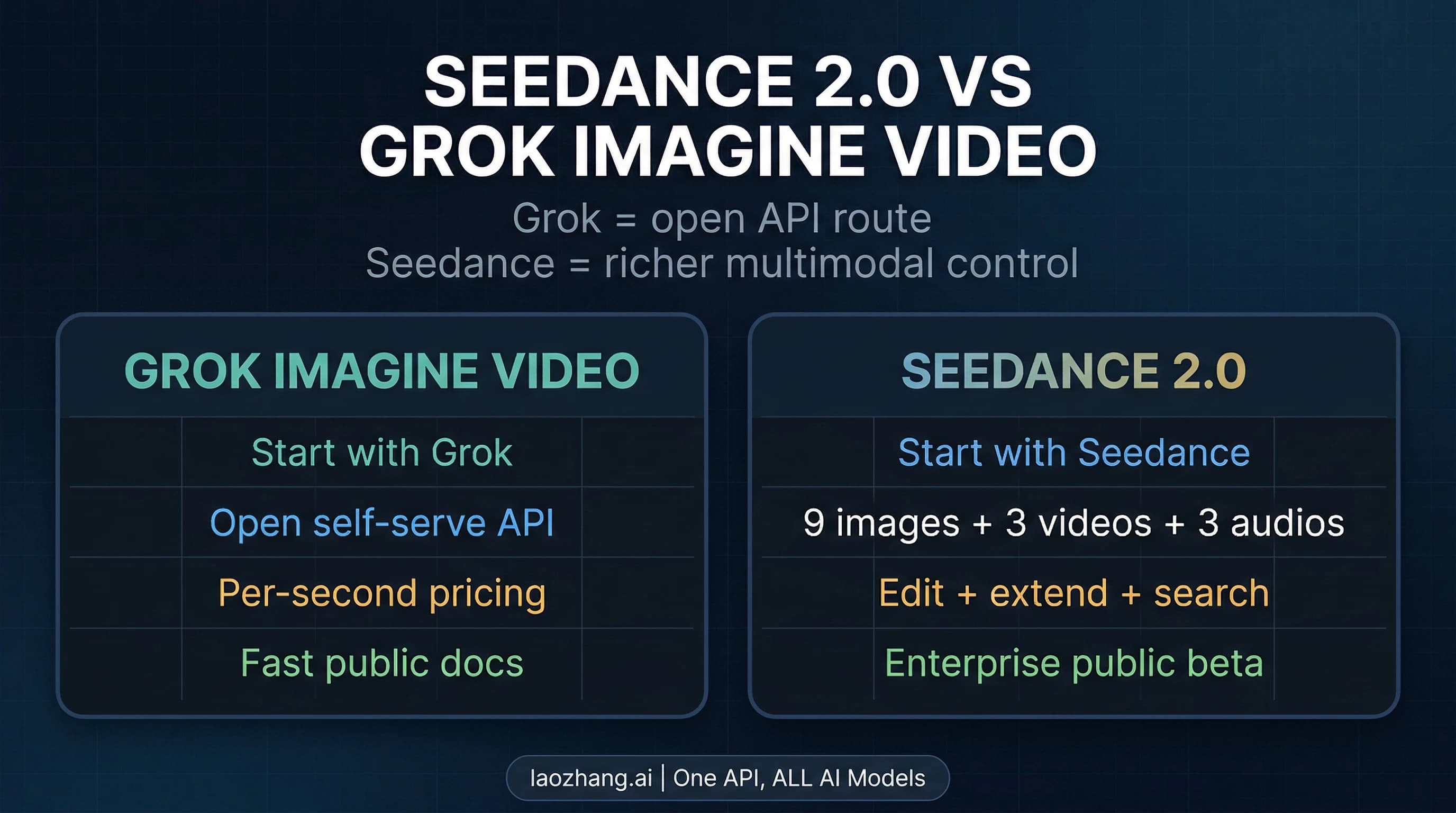
This is where Seedance 2.0 makes its strongest case. ByteDance's model accepts up to 12 files simultaneously: 9 images, 3 videos, and 3 audio files as reference inputs. No other model comes close to this level of multimodal input capability. The practical impact is significant for creative professionals who work with mood boards, style references, and audio-driven content. You can provide a reference image for visual style, a video clip for motion reference, and an audio file for rhythm matching, all in a single generation request. As we explored in our detailed three-model comparison, this multimodal input system is what gives Seedance 2.0 its distinctive creative advantage over competitors. Sora 2 accepts a single image input for image-to-video generation, Kling 3.0 supports 1-2 reference images, and Veo 3.1 offers reference images plus additional camera and motion controls through its API.
Audio Generation Architecture
All four models now support native audio generation, marking 2026 as the year synchronized audio-video became standard rather than exceptional. However, the approaches differ in meaningful ways. Seedance 2.0 uses what ByteDance calls a "Dual-Branch Diffusion Transformer" architecture that generates audio and video simultaneously through parallel processing streams, allowing the audio to be structurally informed by the visual content during generation rather than being applied as a post-processing step. Veo 3.1's native audio includes dialogue generation capabilities that the other models have not yet matched, making it the strongest choice for scenes that require realistic speech or conversation. Sora 2 and Kling 3.0 both generate native audio but with less emphasis on dialogue precision.
Pricing and Cost Analysis
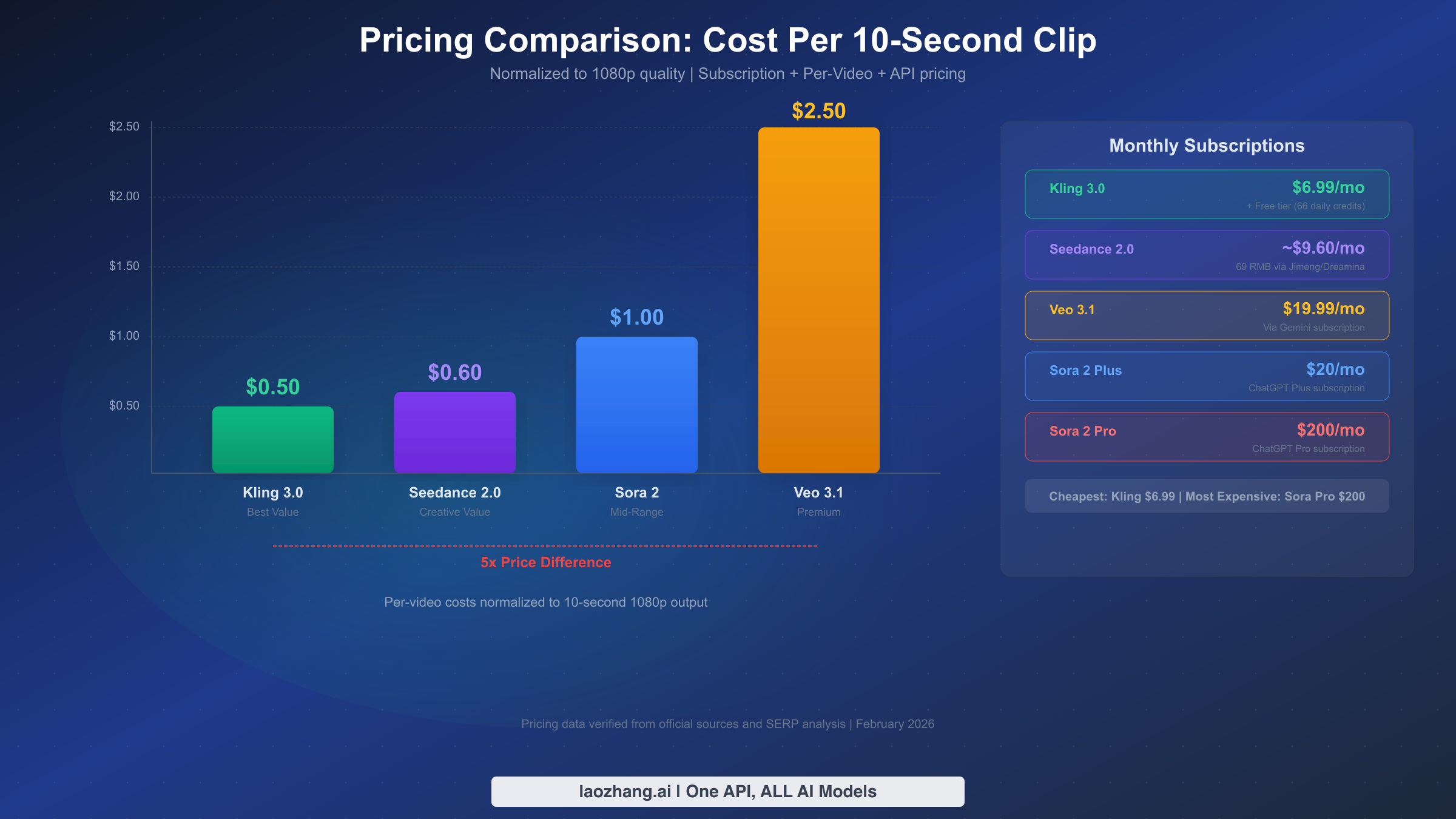
The 5x cost difference between the cheapest and most expensive options makes pricing the single most important factor for many users evaluating these models. However, raw per-clip pricing tells only part of the story. Subscription tiers, free allocations, API pricing models, and hidden costs like failed generation charges all affect the true cost of ownership. The pricing data below has been normalized to a common metric, the cost per 10-second 1080p video clip, and verified against official pricing pages and multiple independent sources as of February 2026.
Normalized Cost Comparison
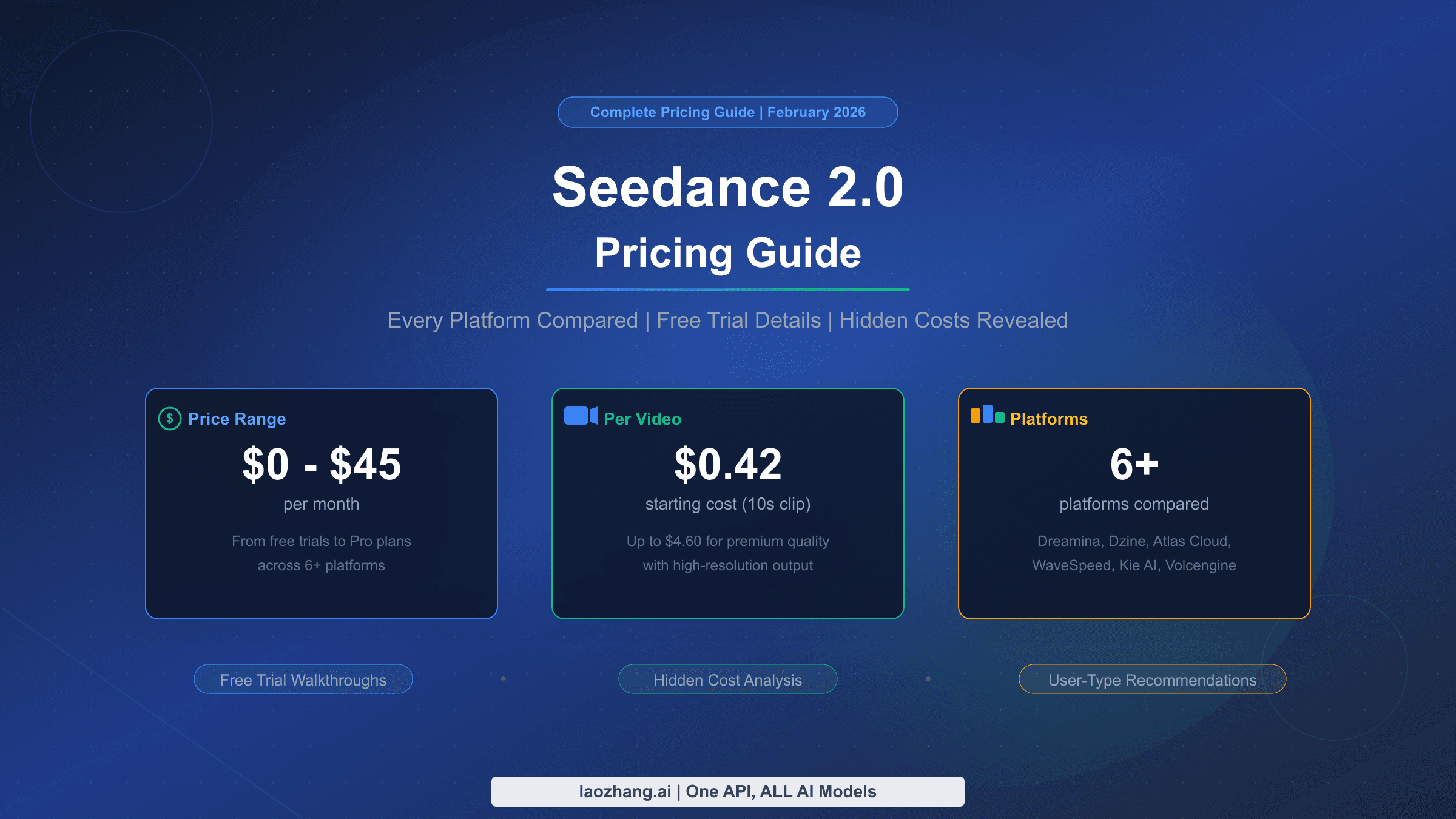
When comparing per-video costs across different pricing models, the hierarchy becomes clear: Kling 3.0 at approximately $0.50 per 10-second clip is the most affordable option, followed closely by Seedance 2.0 at around $0.60. Sora 2 occupies the middle ground at approximately $1.00, while Veo 3.1 commands a premium at roughly $2.50 per equivalent clip. These figures represent typical costs under standard subscription tiers and may vary based on resolution settings, duration, and whether you are using consumer platforms or API access. For users who need to understand Seedance 2.0 pricing and free trial details, the platform offers a 1 RMB (approximately $0.14) seven-day trial through the Jimeng/Dreamina platform, making it one of the lowest-barrier entry points for testing.
Subscription Tiers Explained
The subscription landscape varies dramatically across platforms. Kling 3.0 offers the most accessible entry point with a genuinely useful free tier providing 66 daily credits, enough to generate several videos per day without paying anything. Its paid subscription starts at just $6.99 per month, making it the lowest ongoing cost for regular users. Seedance 2.0's subscription runs approximately $9.60 per month (69 RMB) through ByteDance's Jimeng platform, which includes access to the full suite of creative tools. Veo 3.1 is accessible through Google's Gemini subscription at $19.99 per month, which bundles video generation with Gemini's broader AI capabilities. Sora 2 requires a ChatGPT Plus subscription at $20 per month for basic access, with the Pro tier at $200 per month offering higher generation limits and priority access, making it the most expensive subscription option by a significant margin.
API Pricing for Developers
For developers integrating video generation into applications, API pricing follows different structures that can significantly impact project economics at scale. Kling 3.0's API charges $0.18 to $0.24 per second depending on quality tier, while Sora 2's API ranges from $0.10 to $0.50 per second. Veo 3.1 is accessible through Google's Gemini API and Vertex AI. For developers seeking lower-cost API access to Sora 2 and Veo 3.1 models, third-party API aggregators like laozhang.ai offer async endpoints starting at $0.15 per request for Sora 2 and $0.15 per request for Veo 3.1 fast mode, with a failure-no-charge policy that eliminates the risk of paying for unsuccessful generations. This pricing model is particularly attractive for batch processing workflows where some percentage of generations may fail content moderation checks.
Free Tier Maximization
Budget-conscious users should pay close attention to free tier offerings. Kling 3.0's 66 daily credits reset every day, providing a sustainable way to generate content without subscription costs. At standard quality settings, this translates to roughly 3-5 video generations per day, which is sufficient for casual content creation, experimentation, and learning the platform. Seedance 2.0's 1 RMB trial provides seven days of access, enough time to thoroughly evaluate the model before committing to a subscription. Veo 3.1 is accessible through Gemini's free tier with limited generations, though the exact allocation varies. Sora 2 notably has no free tier at all, requiring at minimum the $20 per month ChatGPT Plus subscription for any access, which creates a meaningful barrier for users who want to test before committing.
Visual Quality and Creative Control
Judging visual quality in AI-generated video is inherently subjective, but certain measurable dimensions help structure the comparison. Rather than declaring a single "best looking" model, the most useful framework evaluates quality across specific dimensions that matter for different production contexts: motion consistency, physics accuracy, cinematographic aesthetics, detail preservation, and creative controllability.
Motion and Physics Realism
Sora 2 has earned its reputation as the physics simulation benchmark among these four models. OpenAI's approach treats video generation as a world simulation problem, which means objects in Sora 2 outputs tend to obey physical laws more consistently than outputs from other models. Water flows realistically, objects cast appropriate shadows, and human movement maintains anatomical plausibility across longer sequences. This physics-first approach makes Sora 2 the default choice for scenes involving complex physical interactions, such as pouring liquids, fabric movement, weather effects, or any scenario where unrealistic physics would immediately break immersion. Kling 3.0 performs well in motion consistency thanks to its 60fps native rendering, which provides more frames for smooth motion interpolation, but its physics accuracy does not quite match Sora 2's simulation-based approach. It is worth noting that CreatOK's benchmarks (February 2026) gave Kling 3.0 a temporal consistency score of 8.9 out of 10, indicating strong but not perfect motion stability, with some reported reliability issues where generation occasionally stops near the end of clips.
Cinematographic Aesthetics
Veo 3.1 produces the most cinematic output among the four models, and this is by design rather than coincidence. Google DeepMind's choice of 24fps at 4K resolution, combined with film-style color grading and camera motion patterns that mimic professional cinematography, gives Veo 3.1 output an inherently professional look that other models require post-processing to achieve. The difference is most apparent in dialogue scenes, architectural shots, and slow-motion sequences where the 24fps frame rate creates a natural film cadence. For advertising agencies, film pre-visualization teams, and content creators targeting premium audiences, Veo 3.1's aesthetic quality justifies its higher price point. Veo 3.1 is also 30-40% faster in generation time compared to Sora 2 according to independent benchmarks (CreatOK, February 2026), which can matter significantly in production workflows with tight deadlines.
Creative Control Depth
Seedance 2.0's 12-file multimodal input system represents the deepest creative control currently available in any AI video generator. The ability to simultaneously provide style reference images, motion reference videos, and audio reference files creates a level of directorial control that approaches traditional pre-production workflows. This is particularly valuable for music video production (where audio rhythm needs to drive visual pacing), brand content creation (where visual style guides must be followed precisely), and any project where consistency across multiple generated clips is essential. The Dual-Branch Diffusion Transformer architecture means audio and video are generated in sync, eliminating the temporal misalignment that can occur when audio is generated or applied separately. Veo 3.1 offers its own set of creative controls through camera controls, motion controls, style references, and character consistency features, accessible through its API. These professional-grade controls make it suitable for production environments where shot-level creative direction is required.
API Access and Developer Integration
For developers building applications that incorporate AI video generation, API maturity, reliability, and integration complexity are often more important than raw output quality. The current landscape shows significant variation in API readiness across the four models, with implications for development timelines, architecture decisions, and long-term platform risk.
API Availability and Maturity
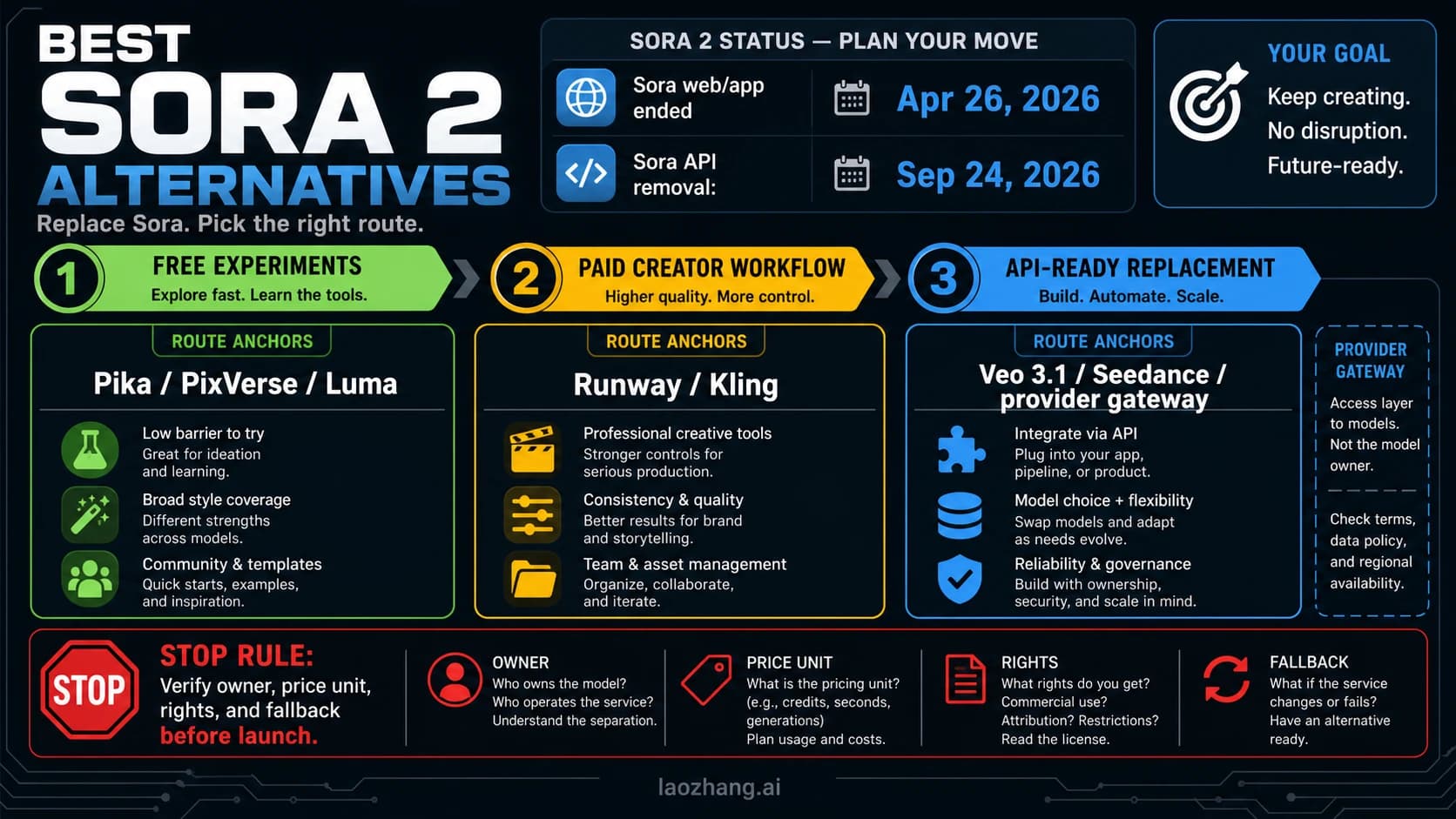
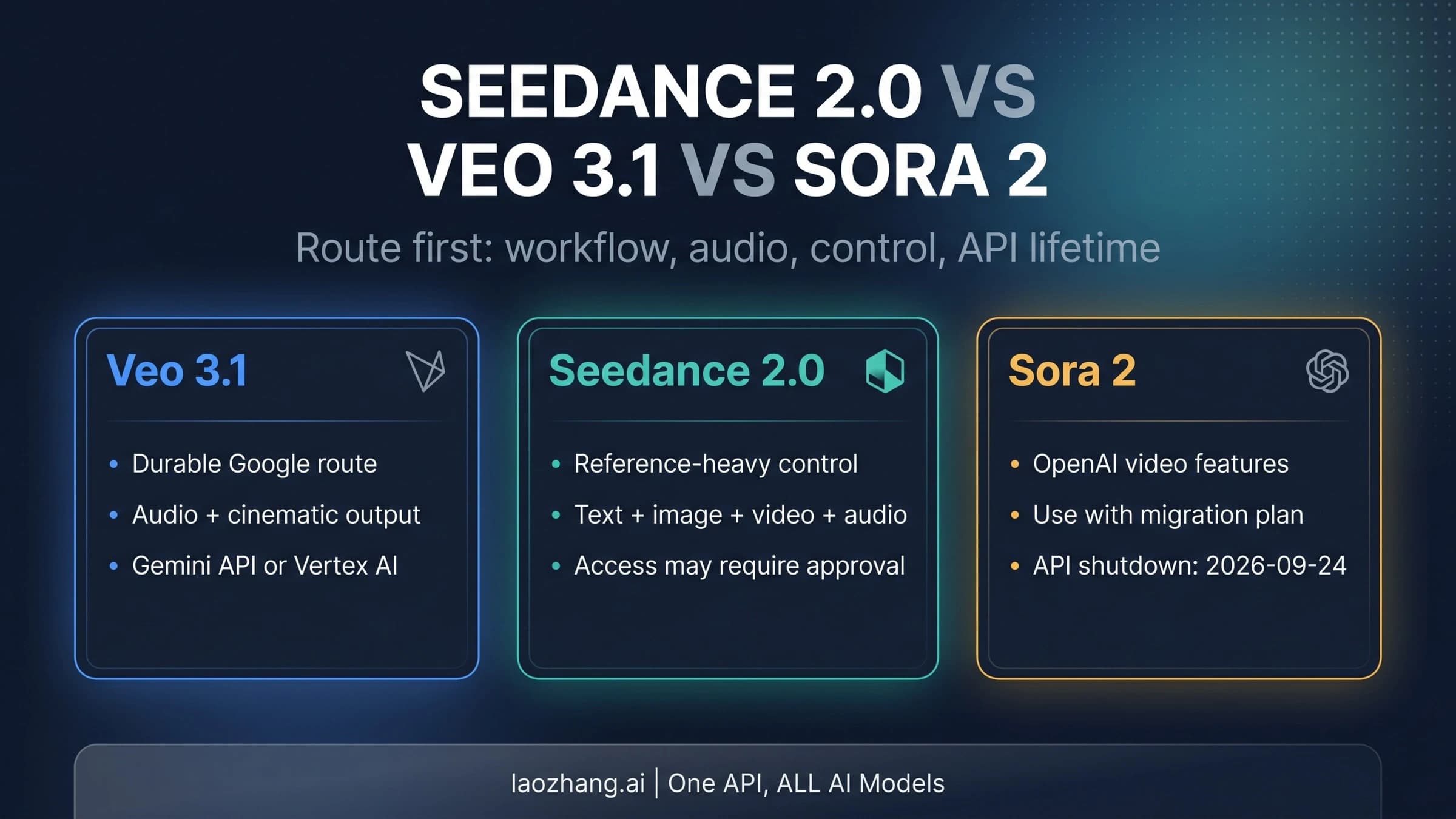
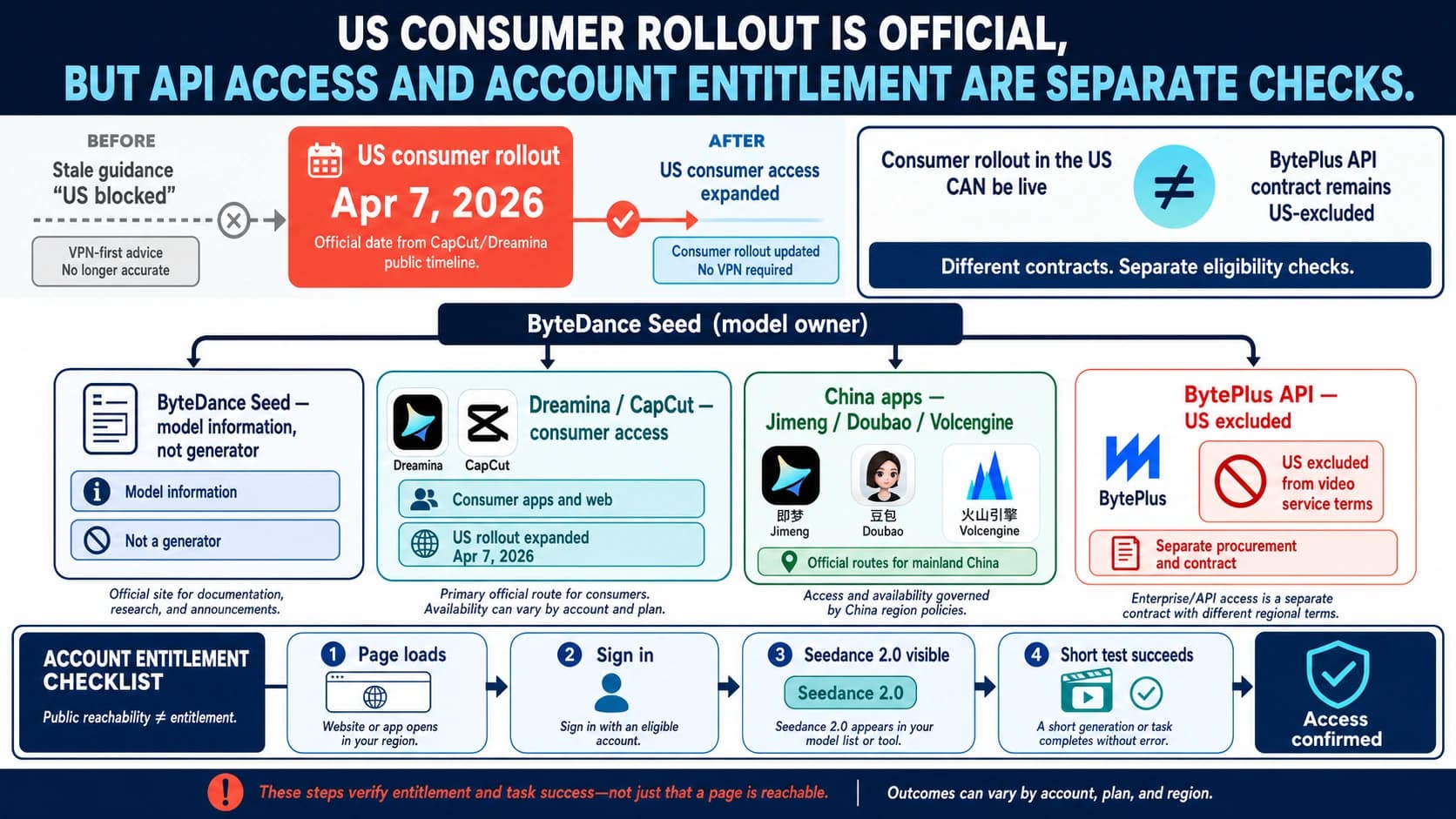
The API maturity spectrum ranges from fully available to not yet launched. Sora 2 has the most established API through OpenAI's platform, benefiting from OpenAI's broad developer ecosystem and well-documented authentication systems. Veo 3.1 is accessible through both Google's Gemini API and Vertex AI, offering enterprise-grade infrastructure with Google Cloud's reliability guarantees. Kling 3.0 provides API access through klingai.com/dev with straightforward REST endpoints. Seedance 2.0's API was expected to launch around late February 2026, meaning developers evaluating it for integration should verify current availability before beginning development work.
Integration Approaches
For teams building with Sora 2, the OpenAI API provides a familiar interface that most developers already know. The endpoint structure follows OpenAI's established patterns, making integration straightforward for teams already using GPT models. However, video generation is inherently asynchronous, meaning developers need to implement polling mechanisms to check generation status rather than expecting synchronous responses. For those seeking the most stable Sora 2 API access, reliability across different access methods varies significantly.
Veo 3.1 integration through Google's ecosystem offers additional advantages for teams already invested in Google Cloud. The Vertex AI integration provides enterprise features including VPC Service Controls, audit logging, and SLA-backed uptime guarantees that matter for production deployments. The Gemini API provides a simpler integration path for smaller projects.
For developers building production applications that need to access multiple video models through a single endpoint, laozhang.ai provides a unified async API that aggregates both Sora 2 and Veo 3.1. The key technical advantage is the failure-no-charge policy: if a generation fails for any reason, including content moderation rejection or timeout, no charges are applied. This is particularly relevant for production workloads where batch processing may result in some percentage of failed generations. Here is a basic integration example:
import requests

API_KEY = "your_api_key"

# Sora 2 generation via unified endpoint
response = requests.post(
    "https://api.laozhang.ai/v1/videos",
    headers={"Authorization": f"Bearer {API_KEY}"},
    json={
        "model": "sora-2",
        "prompt": "A golden retriever playing in autumn leaves",
        "size": "1280x720",
        "seconds": "15"
    }
)
task = response.json()
# Poll task["id"] for completion status
For those interested in finding the cheapest stable Sora 2 API, comparing direct API pricing against aggregator pricing at scale can yield significant cost savings, especially for high-volume production environments.
SDK and Language Support
All four platforms provide REST APIs accessible from any programming language. OpenAI's Python and Node.js SDKs offer the most polished developer experience for Sora 2 integration. Google provides client libraries for Python, Node.js, Go, Java, and more through its Cloud SDK for Veo 3.1 access. Kling 3.0's API follows standard REST conventions but does not yet offer official SDKs, meaning developers will typically use HTTP client libraries directly. The practical impact of SDK availability is primarily developer convenience and reduced boilerplate code; all four models can be integrated using standard HTTP requests from any language.
Real-World Production Workflow
Professional video production teams are increasingly adopting multi-model strategies rather than committing to a single AI video generator. This approach recognizes that each model excels in different types of shots and scenarios, and combining models in a production workflow produces better overall results than any single model alone.
Multi-Model Production Strategy
The most effective production workflow leverages each model's specific strengths for different shot types within a single project. Kling 3.0 works exceptionally well for first drafts and rapid iteration, providing a cost-effective way to explore concepts and visual directions before committing production budget. At $0.50 per 10-second clip and with a free tier available, teams can generate dozens of concept variations without significant expense. Seedance 2.0 excels for shots that require precise creative direction, particularly when working with brand guidelines, existing visual assets, or audio-driven content. The ability to upload reference images, videos, and audio files simultaneously gives creative directors a level of control that other models cannot match. Sora 2 is the go-to for scenes requiring physical realism, particularly interactions between objects, natural phenomena, and human movement that must look convincing. Its 25-second clip duration also makes it valuable for longer narrative sequences that need smooth scene transitions without visible cuts. Veo 3.1 serves as the final render engine for hero shots and premium content that will be prominently featured. Its cinema-grade 4K output at 24fps provides the quality level needed for broadcast, film pre-visualization, and high-end advertising.
Practical Workflow Integration
Integrating AI video generation into existing production pipelines requires thoughtful workflow design. The most common approach treats AI-generated clips as raw footage that enters the standard post-production pipeline rather than as finished output. This means generated clips pass through color grading, sound design, editing, and compositing stages just like traditionally captured footage. Teams typically use Kling 3.0 or Seedance 2.0 during the pre-production phase for storyboarding and concept visualization, then switch to Sora 2 or Veo 3.1 for final asset generation when visual quality requirements are higher. As explored in our comprehensive ranking of AI video models, the ideal model choice also depends on the specific content category and target platform.
Batch Processing and Scale
For teams generating video content at scale, API-based workflows become essential. Synchronous generation through web interfaces works for individual clips but does not scale to production volumes. The async API approach, where generation tasks are submitted and results are polled for completion, allows teams to submit hundreds of generation requests simultaneously and process results as they become available. This is particularly important for e-commerce product videos, social media content calendars, and personalized video campaigns where volume matters as much as quality. Generation speed varies significantly: Veo 3.1 is 30-40% faster than Sora 2 according to independent benchmarks, while Kling 3.0's generation speed benefits from its optimized 60fps pipeline.
Which Model Should You Choose?
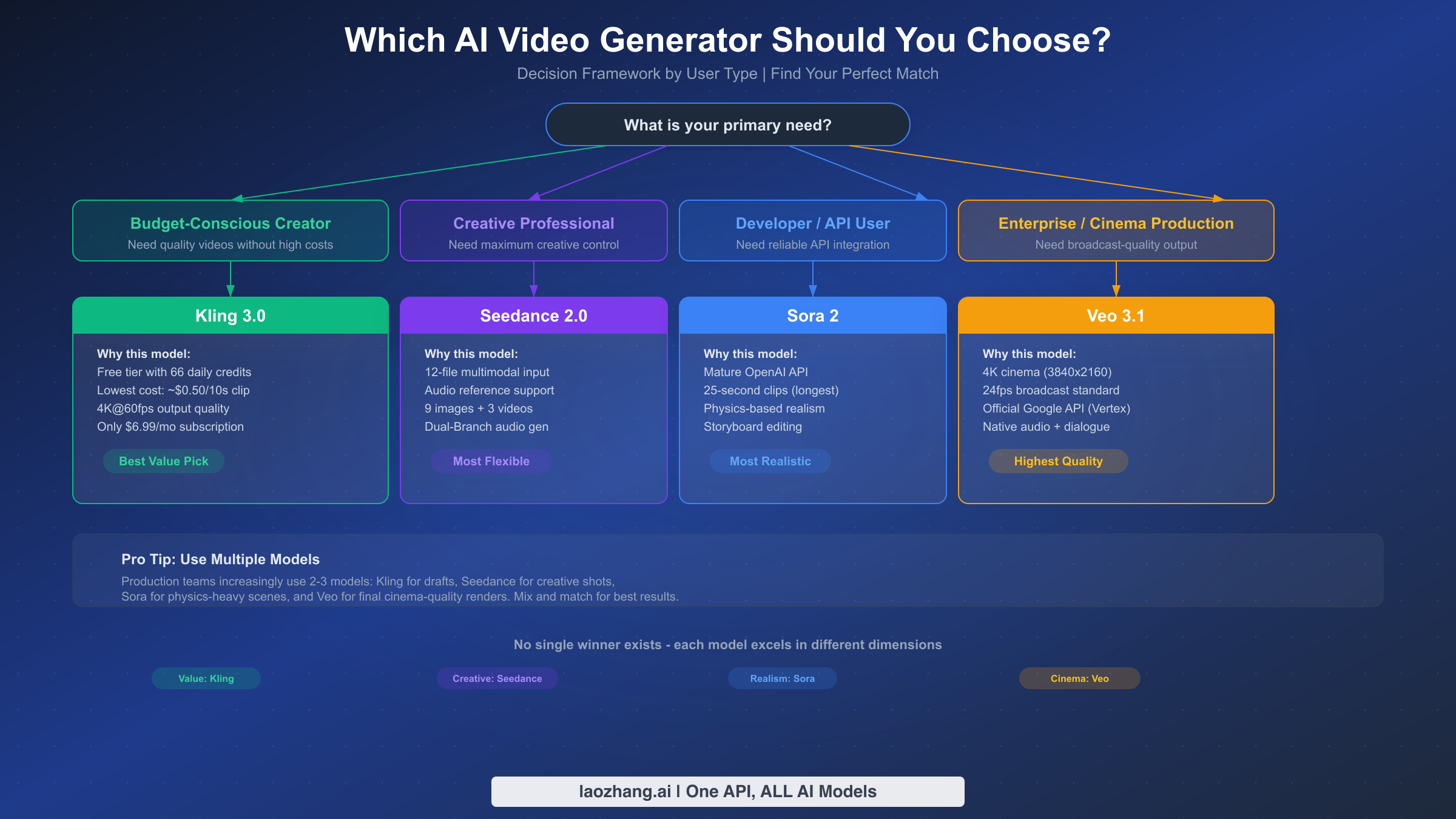
Rather than declaring a single winner, the most useful guidance maps specific user profiles to the model that best serves their particular needs. The following decision framework is based on the verified specifications, pricing data, and quality assessments presented throughout this comparison. Each recommendation considers not just the model's technical capabilities but also the total cost of ownership, learning curve, and ecosystem maturity.
For Content Creators and Social Media
If you are creating content for YouTube, TikTok, Instagram, or other social platforms, Kling 3.0 offers the best combination of quality and value. Its free tier with 66 daily credits allows you to experiment extensively before committing any budget, and its 4K at 60fps output exceeds the quality requirements of every major social platform. The $6.99 monthly subscription is the lowest ongoing cost among all four models, making it sustainable for individual creators. The primary limitation is that Kling 3.0 has been reported to have reliability issues where generation occasionally stops near the end of clips, potentially wasting credits. If budget is a secondary concern and you need the longest possible clips for storytelling content, Sora 2's 25-second Storyboard feature provides a unique advantage.
For Creative Professionals and Agencies
Seedance 2.0 is the strongest choice for creative professionals who need precise control over output. The 12-file multimodal input system aligns with professional creative workflows where mood boards, style guides, and reference materials drive the creative direction. The Dual-Branch audio generation is particularly valuable for music video production and audio-driven content where timing precision matters. The approximately $9.60 monthly subscription (69 RMB via Jimeng) is reasonable for professional use, though the API was not yet publicly available as of mid-February 2026. Veo 3.1 serves as an excellent alternative for agencies that prioritize output polish over input flexibility, particularly for clients in luxury, film, and broadcast verticals.
For Developers and Technical Teams
Sora 2 and Veo 3.1 offer the most mature API ecosystems. Sora 2 benefits from OpenAI's extensive documentation, established authentication patterns, and the familiarity that most development teams already have with OpenAI's platform. Veo 3.1 through Vertex AI provides enterprise-grade features including SLA guarantees, compliance certifications, and integration with Google Cloud's broader infrastructure. Kling 3.0's API is functional but less polished, while Seedance 2.0's API availability should be confirmed before starting development. For cost-sensitive development projects, evaluate third-party API aggregators that may offer lower per-request pricing with value-added features like failure-no-charge policies.
For Enterprise and Cinema Production
Veo 3.1 is the clear recommendation for enterprise and cinema production teams. Its 4K output at 24fps cinema standard, combined with Google's enterprise infrastructure, compliance certifications, and native audio with dialogue capabilities, makes it the only model in this comparison that consistently delivers broadcast-ready output without post-processing upscaling. The premium pricing of approximately $2.50 per clip is justified in professional contexts where output quality directly impacts revenue or brand perception. The official Google API through Vertex AI also provides the governance and audit capabilities that enterprise procurement teams typically require.
Frequently Asked Questions
Can I use AI-generated videos commercially? All four platforms allow commercial use of generated content under their respective terms of service, though specific restrictions vary. Sora 2 and Veo 3.1 follow their parent companies' standard commercial terms, while Kling 3.0 and Seedance 2.0 operate under their platform-specific licenses. Always review the latest terms before commercial deployment, as policies evolve frequently in this rapidly changing space.
Which model handles human motion best? Sora 2 currently produces the most physically accurate human motion thanks to its simulation-based approach to video generation. Veo 3.1 follows closely with strong character consistency features. Kling 3.0 benefits from its 60fps frame rate for smoother motion interpolation, while Seedance 2.0's motion quality varies more depending on the complexity of the scene and reference inputs provided.
What are the generation speed differences? Generation times vary significantly. According to independent benchmarks (CreatOK, February 2026), Veo 3.1 generates 30-40% faster than Sora 2 for equivalent clips. Kling 3.0's optimized pipeline also delivers fast generation times. Seedance 2.0's generation speed is competitive but can increase with the number of reference files provided. Exact times depend on resolution, duration, and server load, but typical 10-second 1080p clips take anywhere from 2 to 10 minutes across all four models.
Are there free options for AI video generation? Kling 3.0 offers the most generous free tier with 66 daily credits that reset every day, providing ongoing free access to video generation. Seedance 2.0's 1 RMB trial (approximately $0.14) provides seven days of access. Veo 3.1 offers limited free access through Gemini's free tier. Sora 2 has no free option, requiring a minimum $20/month ChatGPT Plus subscription.
Can I combine multiple models in one project? Absolutely, and this is increasingly the recommended approach for professional production. Since all four models output standard video files (typically MP4), clips from different models can be freely combined in any video editing software. Many production teams use different models for different shot types within the same project, leveraging each model's specific strengths.
Which model is best for API integration? For most developers, Sora 2 (via OpenAI API) and Veo 3.1 (via Gemini API or Vertex AI) offer the most mature integration paths. Both have well-documented APIs, official SDKs, and established developer ecosystems. Kling 3.0's API is functional but less documented. Seedance 2.0's API availability should be confirmed before planning integration work.