Nano Banana 2 Alternative for 429 Errors: What to Use Instead (2026)
A Nano Banana 2 429 error does not always mean you need a new model. This guide shows when to switch to GPT Image 1.5, when FLUX is the better non-Google route, and when the real fix is keeping Nano Banana 2 while changing your quota path.
On this page
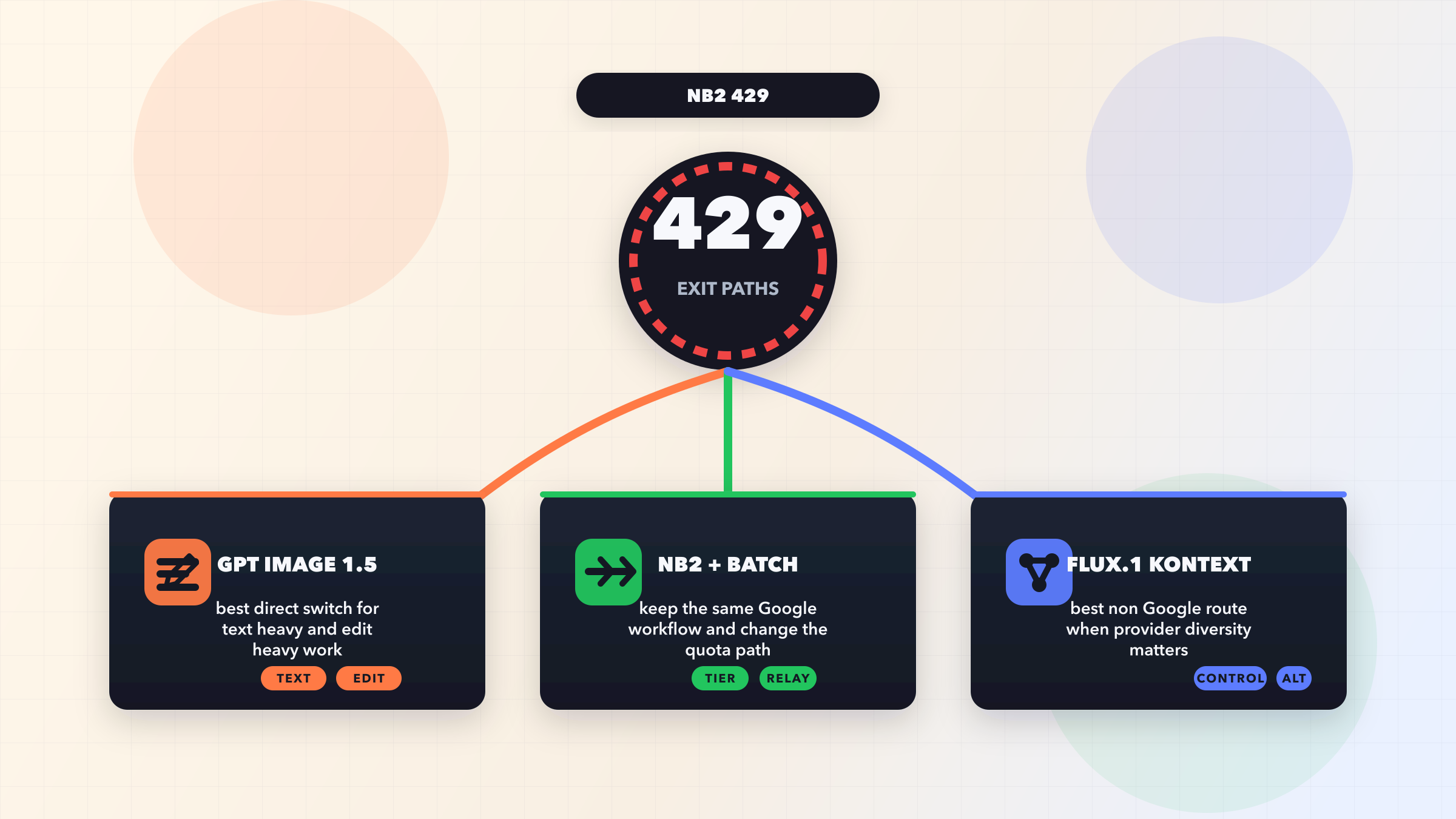
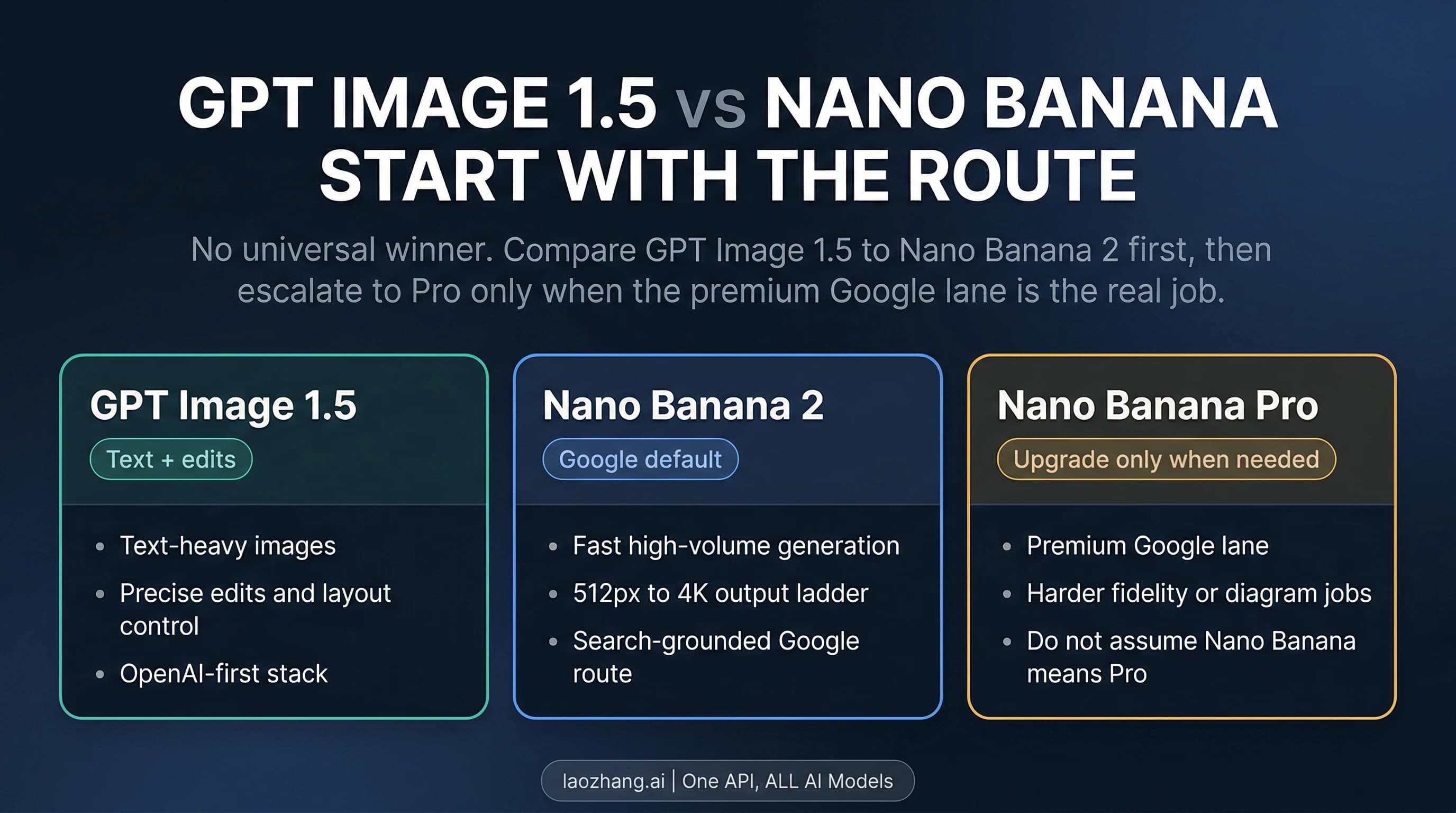
If Nano Banana 2 is throwing 429 RESOURCE_EXHAUSTED, the best replacement for most teams is not one universal winner. The practical default is this: switch to GPT Image 1.5 if text rendering and iterative edits matter most, switch to FLUX if you want a non-Google provider contract, and stay on Nano Banana 2 if the model is still right but your quota path is wrong.
That distinction matters because a 429 is not always a model-fit problem. Sometimes it means Nano Banana 2 no longer matches your traffic pattern. Sometimes it means Google's preview-style quota behavior is the real instability. And sometimes it means your team actually wanted stronger text and edit control all along, so a switch to OpenAI is the better long-term move anyway.
Google's own current Nano Banana 2 launch page positions Nano Banana 2 as Gemini 3.1 Flash Image, available through the Gemini API in Google AI Studio and requiring a paid API key there. OpenAI's current image generation docs position gpt-image-1.5 as the strongest GPT Image model, with both generation and edit support. Black Forest Labs' current FLUX pricing page lists both FLUX.1 Kontext [pro] and FLUX1.1 [pro] at $0.04 per image, which makes FLUX the cleanest official non-Google route if your real goal is provider diversification rather than a near-clone of Nano Banana 2.
TL;DR
| If this is your real problem | Best path | Why it wins | Main tradeoff |
|---|---|---|---|
| You need the closest direct replacement for text-heavy or edit-heavy work | GPT Image 1.5 | Better current text and edit contract, clear official pricing, easy API migration | Slower generation and smaller official size options than Nano Banana 2 |
| You want a non-Google route because quota unpredictability is the real blocker | FLUX.1 Kontext / FLUX1.1 | Official BFL API, clean provider diversification, strong developer-control story | Less like-for-like with Nano Banana 2's Google-native workflow |
| You still want Nano Banana 2 itself | Keep NB2, change the quota path | Preserves the same model family and editing behavior | You are solving traffic, billing, or routing, not escaping Google's contract |
The mistake most teams make is jumping from "I saw a 429" straight to "I need a new flagship image model." That skips the harder but more useful question: what part of Nano Banana 2 were you actually relying on?
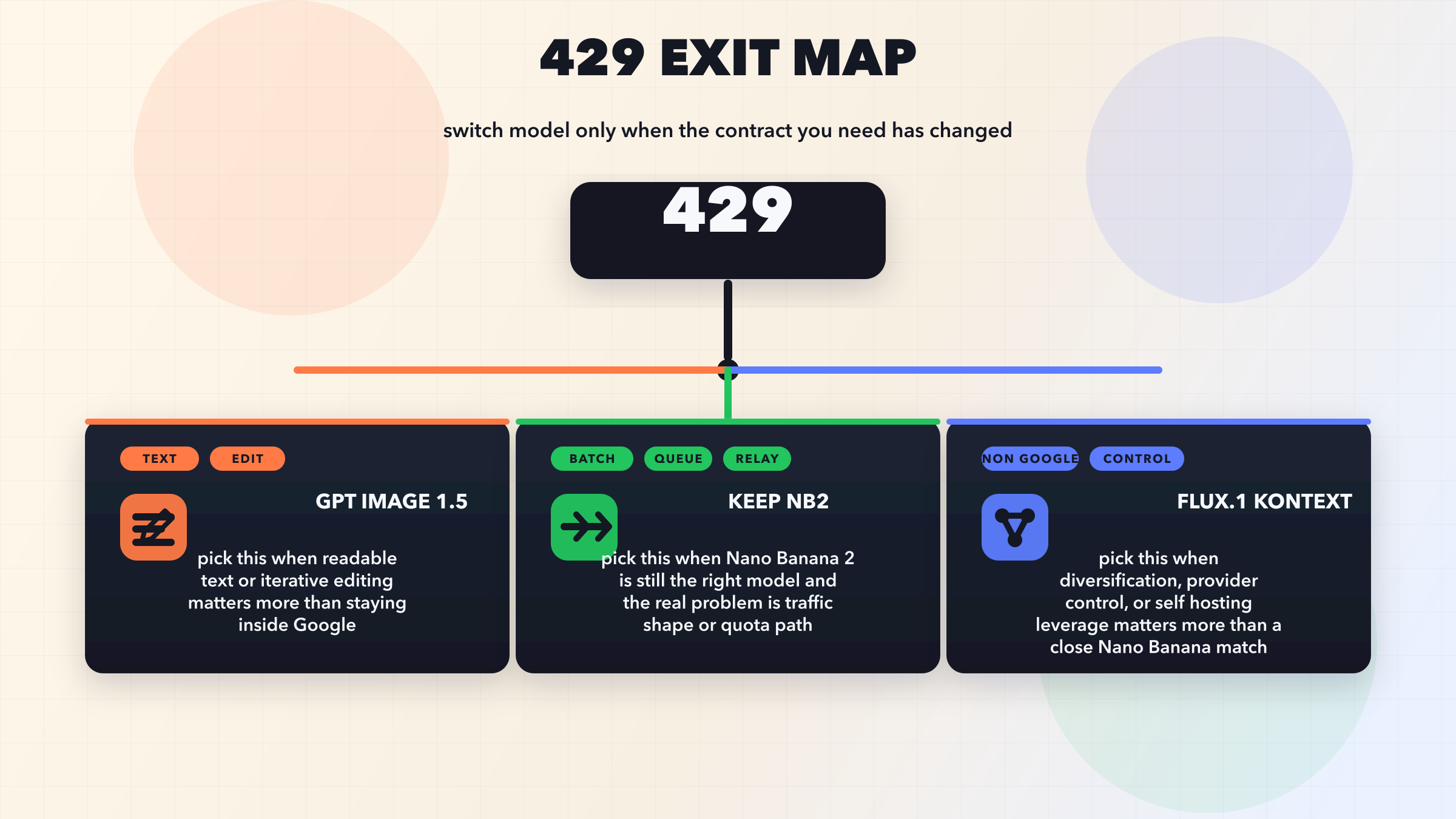
If the answer is "fast Google-native image generation and editing," a contract change is usually smarter than a model change. If the answer is "readable text and reliable edits," GPT Image 1.5 is the better fit. If the answer is "I no longer want this quota dependency on Google," FLUX is the cleaner exit.
First, Figure Out Whether This Is A Model Problem Or A Quota-Path Problem
Before you switch, separate two very different situations.
The first is the simple one: you are legitimately overrunning the path you are on. That usually means burst traffic, poor queueing, or a workload that no longer fits the current project tier. In that case, a new model may fix symptoms, but it does not answer the deeper operational issue that your traffic shape has outgrown the current contract.
The second is messier: the model still fits the work, but the path into it is unstable enough that you no longer trust it. Google's own public docs make two points that matter here. First, Nano Banana 2 is still routed as a paid API workflow in AI Studio and the Gemini API. Second, Google's broader Gemini Apps Help pages split consumer Nano Banana 2 limits, Nano Banana Pro redo limits, and AI Mode behavior into different surfaces. That is your warning not to flatten everything into "Google image generation" as if every path behaves the same.
Google's developer forum also has multiple threads from paid-tier users reporting immediate 429 RESOURCE_EXHAUSTED responses even when visible usage looked low. That is not the same thing as an official promise that the platform is broken. It is a useful operational signal that some 429 scenarios are better understood as quota-path instability than as proof that Nano Banana 2 itself is the wrong model for the job.
So ask this first:
- Did Nano Banana 2 still produce the kind of images you wanted when it worked?
- Is the failure mostly around burst traffic, billing propagation, preview throttling, or per-project quota behavior?
- Or did the
429merely expose that you wanted a different workflow contract all along?
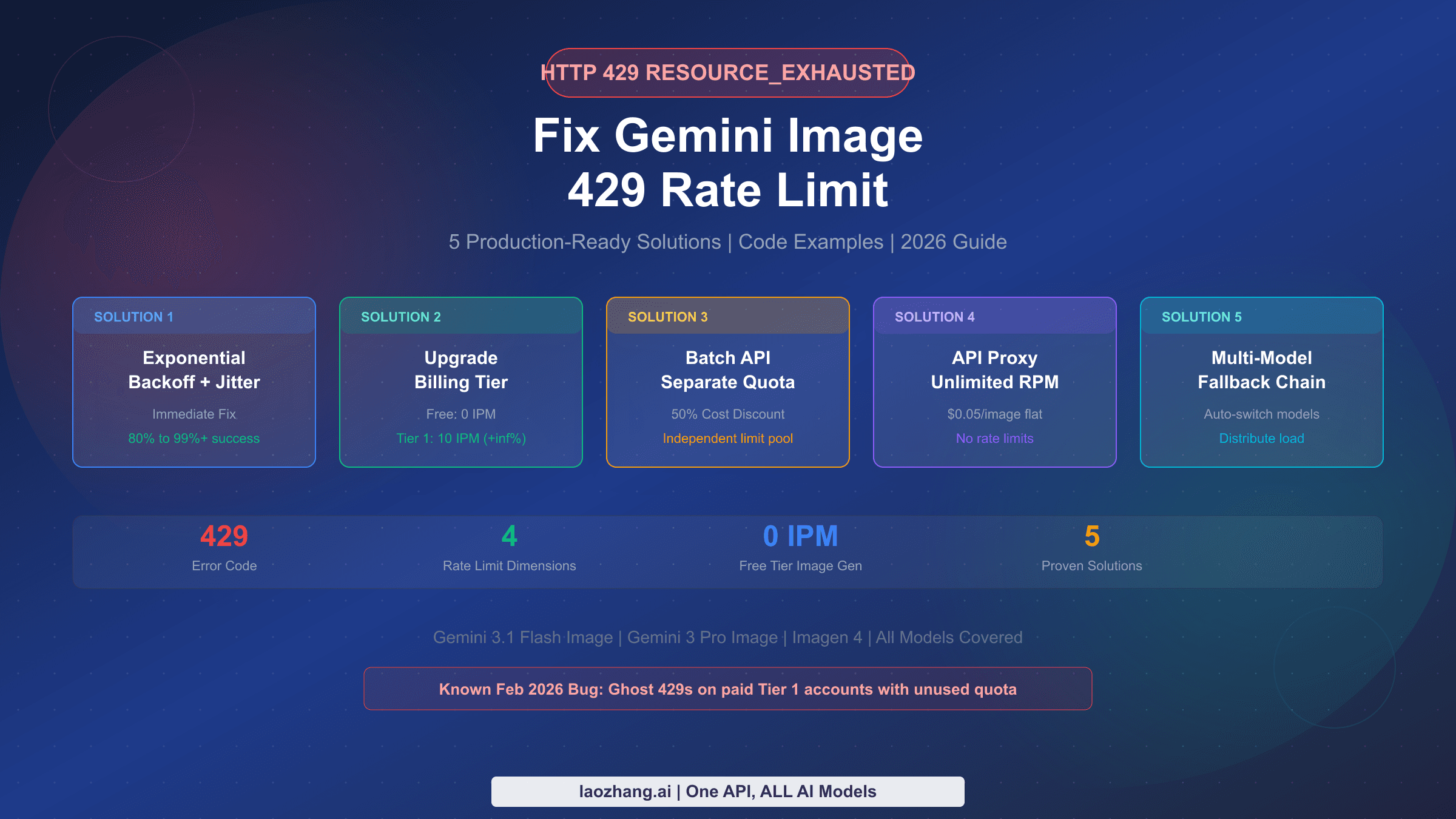
If Nano Banana 2 is still the right creative fit, the better move is often to keep it and change the path: queue requests, smooth bursts, use Batch for non-urgent generation, move to a higher tier, or route through a gateway that gives you a different quota contract. If you want the full technical breakdown of Google's 429 behavior, our Gemini image 429 guide goes deeper on that side of the problem.
GPT Image 1.5 Is The Best Alternative When Text And Editing Matter Most
The strongest direct replacement for many Nano Banana 2 users is not another Google image path. It is gpt-image-1.5.
The reason is not just brand familiarity. OpenAI's current image docs describe gpt-image-1.5 as the latest and most advanced GPT Image model, and the current API surface supports both generation and edits. That matters because many teams do not leave Nano Banana 2 due to pure photorealistic quality complaints. They leave because they need a more predictable text-and-editing workflow in production.
That is where GPT Image 1.5 wins.
If your prompts regularly ask for:
- readable labels inside diagrams
- text-heavy social or product graphics
- iterative edits to existing assets
- higher-fidelity preservation of input images during edits
then GPT Image 1.5 is usually the cleaner move than trying to stay inside the Nano Banana 2 contract.
OpenAI's current docs also make the migration decision unusually easy to price. For square images, the official per-image output pricing is currently:
| Quality | 1024x1024 output |
|---|---|
| Low | $0.009 |
| Medium | $0.034 |
| High | $0.133 |
That is not automatically cheaper in a like-for-like sense than every Nano Banana 2 workflow, because the output contract is different. But it does mean you can move quickly without waiting for a complex enterprise sales path or inventing your own cost model first.
The tradeoff is equally important. OpenAI's current GPT Image docs still list latency, composition control, and perfect text placement as limitations even though the model is much better than older DALL-E-era behavior. And the official size options today top out at 1536x1024 or 1024x1536, not Nano Banana 2-style 2K or 4K output. So if the main thing you loved about Nano Banana 2 was fast high-resolution generation, GPT is not a perfect drop-in.
But if the real requirement is "I need my image API to behave better when text, edits, and controlled revisions matter," GPT Image 1.5 is the best direct alternative on the table right now.
FLUX Is The Better Alternative When You Want A Different Provider Contract
The best Nano Banana 2 alternative is not always the model with the most similar output. Sometimes it is the one that changes the operating contract you are tired of.
That is why FLUX belongs in this article.
Black Forest Labs' current official pricing page is straightforward:
FLUX.1 Kontext [pro]:$0.04per imageFLUX.1 Kontext [max]:$0.08per imageFLUX1.1 [pro]:$0.04per imageFLUX1.1 [pro] Ultra:$0.06per image
More important than the sticker price is how BFL currently separates the workloads. FLUX.1 Kontext [pro] is positioned for creating and editing images with text and images. FLUX1.1 [pro] is positioned as the standard fast text-to-image route. That gives you a cleaner split between "I need a modern edit contract" and "I need a stable generation contract" than many generic model roundups admit.
FLUX is the better answer than GPT Image 1.5 when:
- your real problem is being too dependent on one provider
- you want a non-Google path without moving into a consumer-app workflow
- you care more about provider control than about getting the closest Nano Banana 2-like feel
- you want a model family that already fits a more developer-shaped routing mindset
This does not mean FLUX is the closest Nano Banana 2 replacement for everyone. It is not. If your biggest priority is crisp text or a polished multi-turn edit workflow, GPT Image 1.5 is usually easier to recommend. But if your biggest priority is "stop letting Google's quota path dictate my uptime," FLUX is the better strategic move.
That is the key distinction. GPT is the stronger workflow override. FLUX is the stronger provider override.
Sometimes The Best Alternative Is To Keep Nano Banana 2 And Change The Path
This is the part most "best alternative" articles get wrong.
If Nano Banana 2 still gives you the right combination of speed, Google-native image editing, and output style, the highest-value move is often not to replace it. It is to keep it and change the contract around it.
That can mean:
- smoothing burst traffic with proper queueing and backoff
- moving non-urgent generation to Batch-style workflows
- upgrading the billing tier or moving the workload to a project with a better quota posture
- routing through a provider or gateway that changes the quota contract without changing the model family
This is the right path when the sentence "Nano Banana 2 is exactly what we want, except it keeps rate-limiting us" still feels true.
It is also the right path when your team chose Nano Banana 2 for reasons that are hard to preserve elsewhere:
- you built around Google's broader Gemini stack
- you care about the particular speed-to-edit tradeoff Nano Banana 2 gives you
- you do not want to retrain prompts and expectations across a new model family
That is why the middle path in this article matters. A model switch is expensive. Prompt behavior changes. Editing behavior changes. Cost heuristics change. Image review criteria change. If the creative contract is still correct, fix the traffic contract first.
A gateway path can help here too. If you need multi-provider routing or a simpler API surface without rebuilding your app around three different vendors, an infrastructure layer such as LaoZhang AI can be useful. The right way to think about that option is not "magic unlimited Nano Banana." It is "a different routing and billing contract around the workflows I already need."
Do Not Treat Gemini App Or AI Mode As A Drop-In API Alternative
This is another place readers lose time.
Google's consumer help pages are useful for understanding today's product map, but they are not proof that the consumer surfaces solve an API 429 problem in any clean engineering sense.
The current Gemini Apps Help pages document subscriber image limits for Image generation & editing with Nano Banana 2 and separate Redo images with Nano Banana Pro limits. Google's current AI Mode help page positions Nano Banana Pro inside AI Mode as a more specialized route for infographics and diagrams. Those are real surfaces, but they are not the same contract as a direct production API path.
So if you are building an application, do not read those help pages and conclude:
my API 429 means I should just move the workload into Gemini app or AI Mode
That is almost never the useful interpretation.
Read those surfaces as:
- proof that Google's Nano Banana family is now split across distinct product contracts
- a warning that "Google image access" is not one flat route
- context for why staying inside Google may still require a different technical path than the one that just failed
The Fastest Decision Table
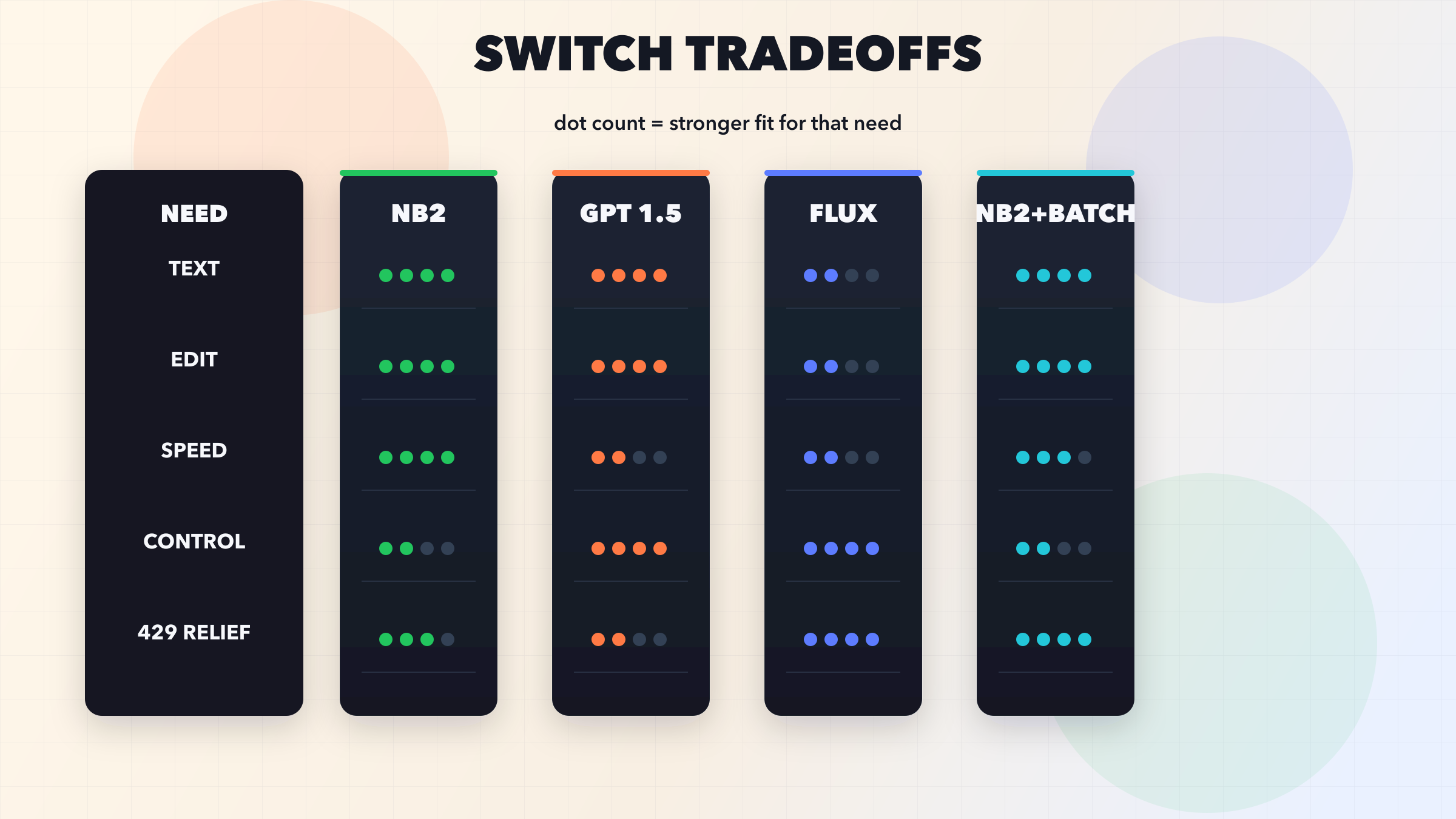
If you need the shortest practical answer, use this table:
| Choose this path | When it is the best answer | What gets better | What gets worse |
|---|---|---|---|
| GPT Image 1.5 | You care most about text, edit quality, and predictable revisions | text rendering, image edits, current official pricing clarity | less like-for-like with Nano Banana 2's size and speed envelope |
| FLUX.1 Kontext / FLUX1.1 | You want a non-Google route and more provider flexibility | diversification, cleaner provider override, strong official API path | less direct Nano Banana continuity |
| NB2 + Batch / Tier / Relay | You still want Nano Banana 2 itself | preserves current prompts, current model family, and Google-native workflow | you still live with the Nano Banana family and must solve the quota path correctly |
That is the real decision frame behind the keyword. Not "which image model is objectively best?" but "which path preserves the thing I actually needed from Nano Banana 2?"
The Migration Mistake Most Teams Make
Teams usually fail in one of two ways.
The first mistake is over-migrating. They see 429, assume the model is the problem, and jump to a new image stack when they really only needed queueing, Batch, or a different billing path.
The second mistake is under-migrating. They keep forcing Nano Banana 2 through a quota path that already broke, even though the real workflow need was stronger text rendering, better input-preserving edits, or a non-Google provider contract. In that case, staying put is not discipline. It is denial.
The point of this article is to help you avoid both mistakes.
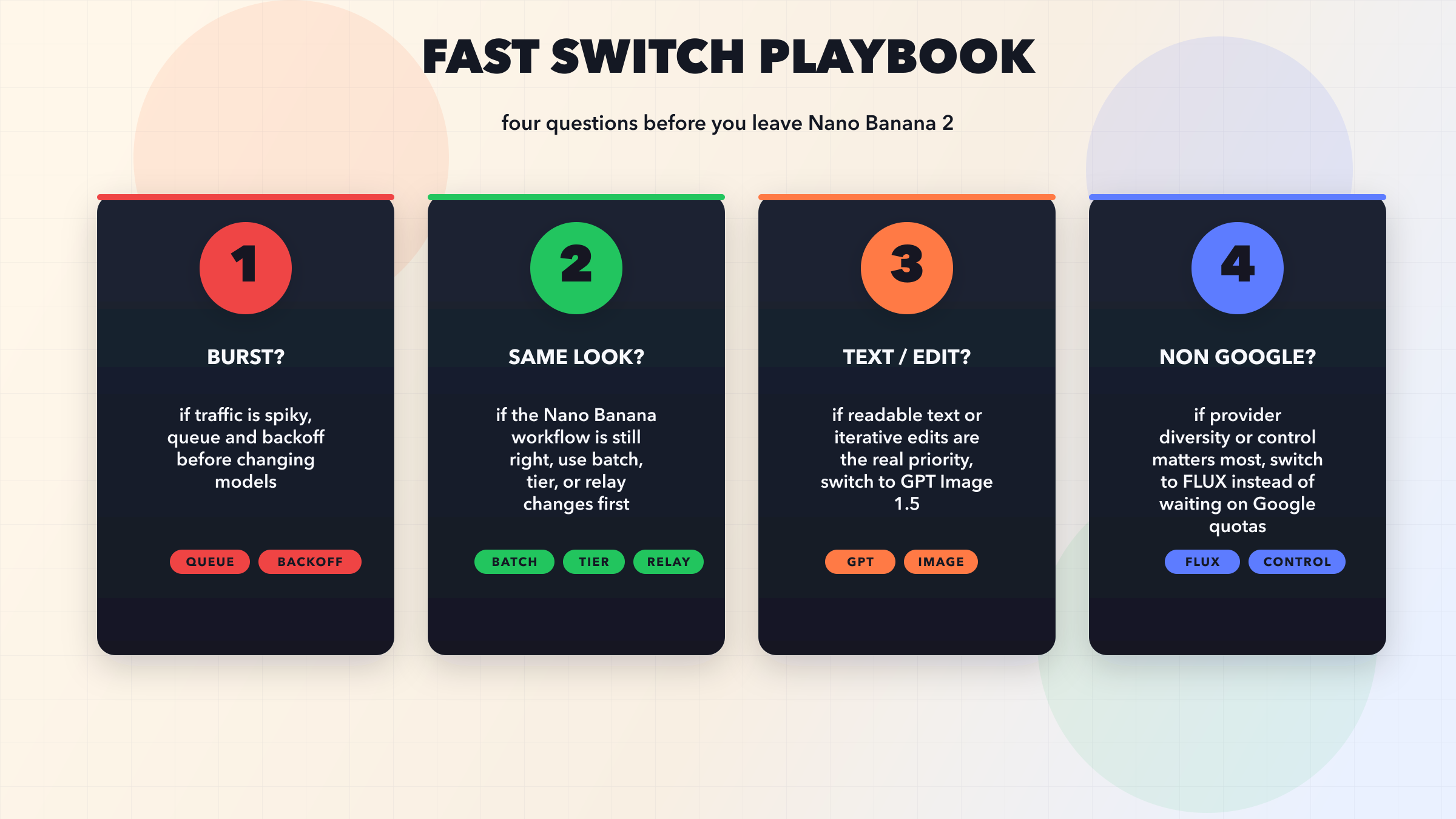
If you want one compact decision rule, use this:
- Need the closest better text/edit route? Move to GPT Image 1.5.
- Need a non-Google route? Move to FLUX.
- Need Nano Banana 2 itself, just without today's quota pain? Keep NB2 and change the path.
That is a much better answer than a generic list of "good image generators."
FAQ
What is the closest Nano Banana 2 alternative right now?
For many API teams, it is gpt-image-1.5, especially if the blocked workload is text-heavy or edit-heavy. If your real need is keeping the same Google-native workflow, the closer answer is not another model at all. It is Nano Banana 2 on a better quota path.
Does a Nano Banana 2 429 mean the model is down?
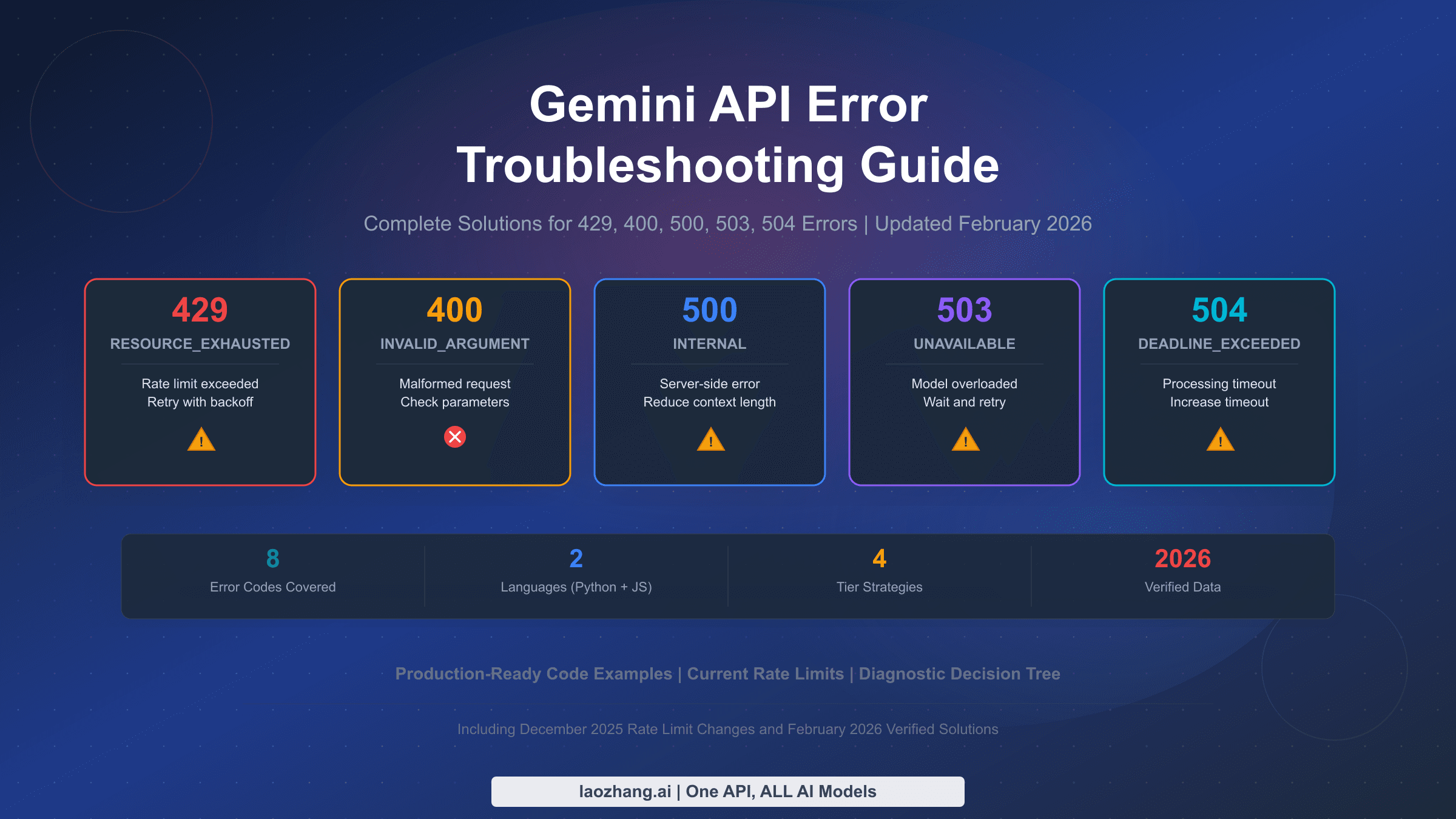
No. A 429 means your current request path hit a quota or throttling boundary. That can still be operationally serious, but it is different from a full service outage. For the broader troubleshooting side, see Gemini image common errors.
Should I wait or switch immediately?
Wait only if Nano Banana 2 is still clearly the right fit and you have a straightforward path to fix queueing, billing, or tiering. Switch immediately if the 429 exposed that you really wanted better text/editing or a non-Google provider contract anyway.
Is GPT Image 1.5 cheaper than Nano Banana 2?
Sometimes, but not in a simple one-line way. OpenAI's official square-image pricing currently starts at $0.009 low and $0.034 medium, but the output contract is different from Nano Banana 2's sizing and workflow shape. Compare the job, not just the sticker.
Can I use Gemini app or AI Mode instead of the API?
Not as a clean drop-in engineering replacement. Those surfaces have their own product contracts and limits. They are useful context, not an automatic substitute for the API path that just failed.
What if I want a long-term image stack, not just an emergency fallback?
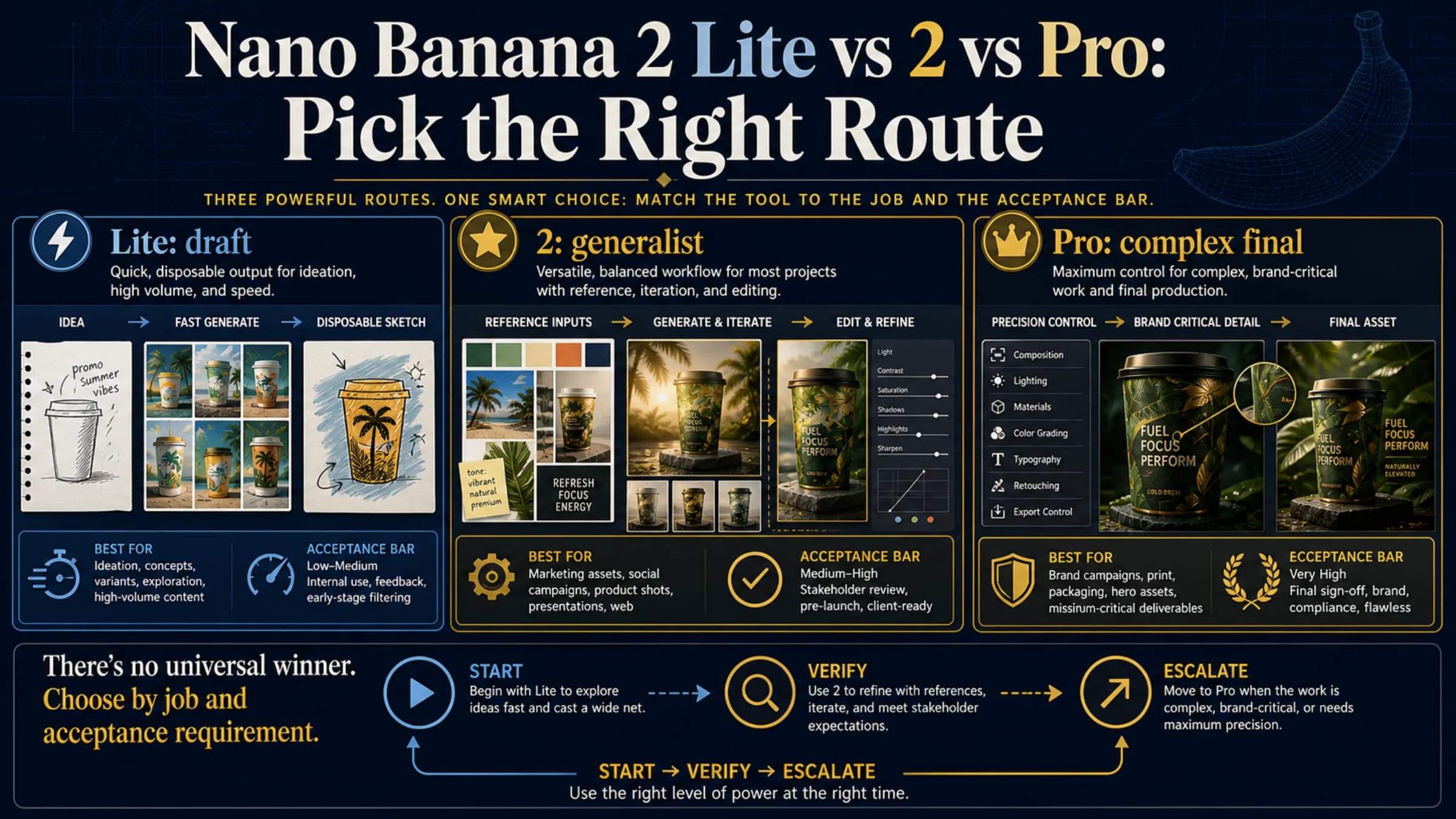
Then your question is broader than this article. Start with our best AI image model guide for the higher-level workflow decision, then come back to this piece if Nano Banana 2 quota behavior is still the blocker.
Nano Banana 2 429 errors are frustrating because they look like one problem. They are really three different decisions hiding under one error code. Once you separate those decisions, the right alternative becomes much easier to choose.