Gemini 3 Complete Comparison: Pro, Flash, Nano Banana Pro Full Guide [2026 Update]

A
25 min readAI Model Comparison

Gemini 3 is Google's latest AI model family released in 2025-2026, featuring Pro, Flash, Deep Think, and Nano Banana Pro. This guide provides in-depth analysis of performance differences, pricing strategies, and optimal use cases to help you make informed decisions.

Gemini 3 Complete Comparison: Pro, Flash, Nano Banana Pro Full Guide [2026 Update]

Gemini 3 is Google's latest AI model family released in 2025-2026, comprising Pro (flagship reasoning), Flash (high value), Deep Think (deep reasoning), and Nano Banana Pro (image generation). Flash is priced at just $0.50/M tokens yet scores 78% on SWE-bench coding benchmarks, surpassing Pro's 76.2%—meaning for most developers, Flash is the true value champion.

TL;DR

Before diving into details, here's the bottom line: Gemini 3 Flash is the best choice for most development scenarios, offering near or even superior performance to Pro at a quarter of the price. For deep reasoning tasks, Pro with Deep Think mode is the way to go. Nano Banana Pro is Google's image generation model—don't confuse it with text models. For developers in China, services like laozhang.ai provide stable access to all Gemini APIs.

Gemini 3 Family Overview

Gemini 3 Product Family diagram showing the positioning of Pro, Flash, Deep Think, and Nano Banana Pro

Understanding the Gemini 3 series starts with clarifying each model's positioning and relationships. Google released multiple models throughout 2025-2026, forming a complete product matrix where each model is optimized for different use cases and budget requirements.

Gemini 3 Pro is the flagship product, released on November 18, 2025. As Google's most intelligent model, it excels in multimodal understanding, complex reasoning, and long-context processing. Pro targets enterprise applications and scenarios demanding the highest quality—deep research analysis, complex multi-step task execution, and projects requiring extensive context handling. On the LMArena Leaderboard, Gemini 3 Pro achieved 1,501 Elo, surpassing its predecessor Gemini 2.5 Pro and demonstrating significant capability improvements.

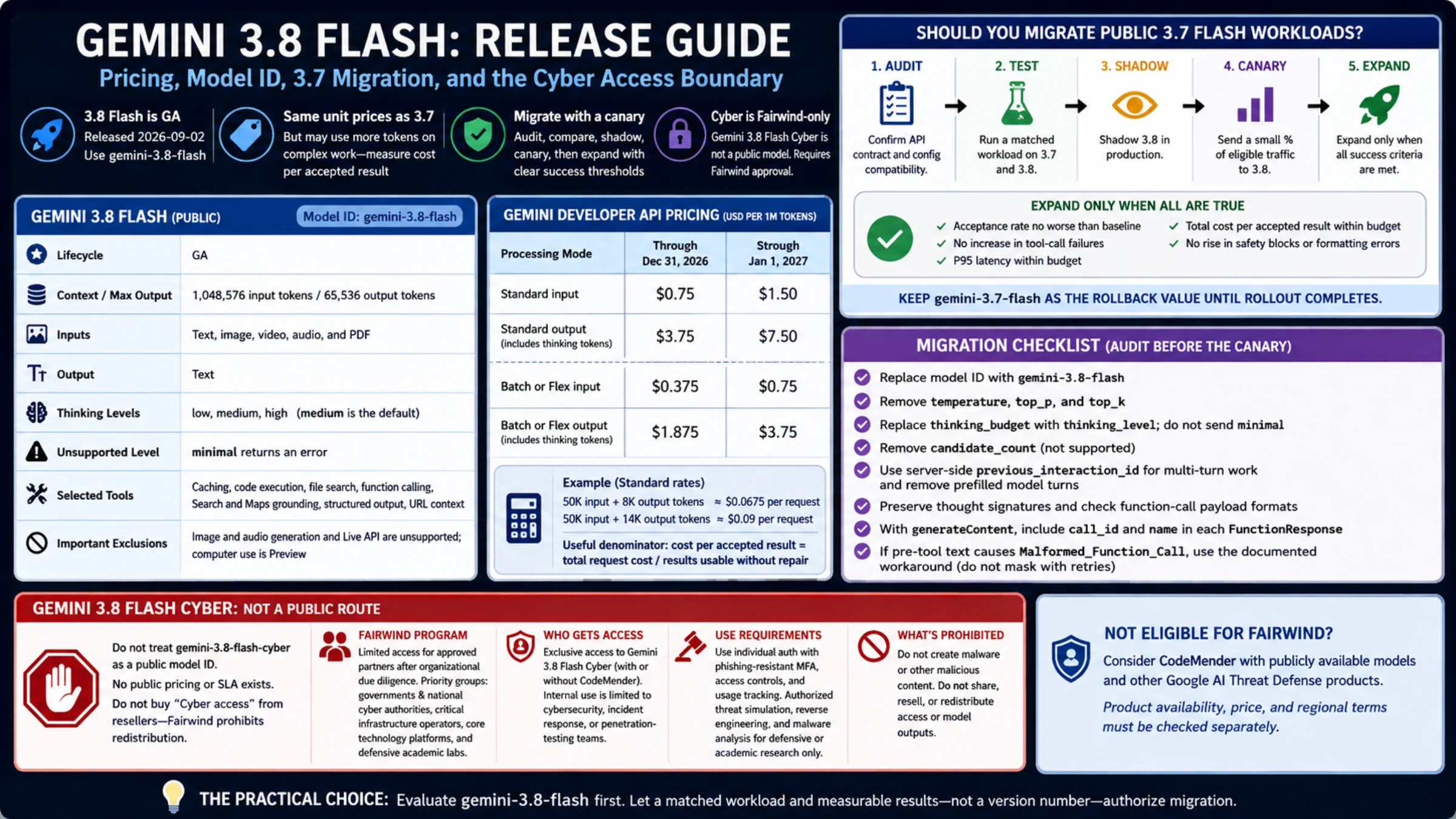
Gemini 3 Flash, released February 2, 2026, is the most surprising product in this lineup. Google officially positions it as "Pro-level intelligence + Flash speed and low cost," a claim validated in actual testing. Flash's core advantage lies in its optimization for agentic workflows, meaning it may actually outperform Pro in automation tasks, code generation, and multi-turn conversations. More importantly, Flash offers a free tier, allowing developers to explore at zero cost.

Gemini 3 Deep Think is an enhanced mode of the Pro model, specifically optimized for complex mathematical, scientific, and logical problems. Its unique feature is the ability to display complete chains of thought, letting users see how the model reasons step by step. This is particularly valuable for educational scenarios, mathematical verification, and applications requiring explainability. Deep Think achieved 95% accuracy on AIME 2025, demonstrating powerful reasoning capabilities.

Nano Banana Pro is a product many people confuse. Its official name is Gemini 3 Pro Image—a high-quality image generation model, not a text processing model. Nano Banana Pro generates high-quality images from text descriptions, supporting 1K-2K and 4K resolution outputs. If you need image generation capabilities, this is the correct choice—not Pro or Flash for image generation tasks.

These four products form a complete capability matrix: Pro handles high-end reasoning, Flash covers everyday development, Deep Think tackles complex problems, and Nano Banana Pro handles visual creation. Understanding this positioning is fundamental to making the right selection decisions.

Performance Showdown: Deep Dive into Benchmarks

Gemini 3 benchmark performance comparison chart: SWE-bench, GPQA, AIME and other core metrics

Specifications and marketing claims aren't enough—we need authoritative benchmarks to objectively evaluate each model's real capabilities. All data below comes from official Google documentation and third-party testing platforms, verified as of February 2, 2026.

On SWE-bench Verified (software engineering capability test), a counterintuitive result emerged: Gemini 3 Flash scored 78.0%, surpassing Pro's 76.2%. This initially seems surprising, but makes sense upon deeper analysis—Flash is specifically optimized for agentic workflows, and code generation and debugging are typical agentic tasks. In scenarios requiring rapid iteration and multiple attempts, Flash's response speed and task completion rate can actually outperform Pro's pursuit of single-response perfection. For reference, GPT-5.2 scored 80.0% and Claude Opus 4.5 scored 80.9% on this test.

On GPQA Diamond (scientific reasoning test), the situation differs completely. Gemini 3 Pro leads significantly at 91.9%, with Flash at 90.4%, while GPT-5.2 and Claude Opus 4.5 hover around 88%. This test evaluates reasoning capabilities in physics, chemistry, biology, and other scientific fields, requiring deep understanding and complex reasoning. Pro demonstrates its flagship status here—one key reason for its higher pricing.

On AIME 2025 (American Invitational Mathematics Examination), Gemini 3 Pro achieved an impressive 95.0%, Flash scored 90.4%, and Claude Opus 4.5 scored 92.8%. This test is the gold standard for evaluating mathematical reasoning, and Pro with Deep Think mode can show detailed solution steps—particularly valuable for scenarios requiring mathematical proofs or teaching.

On MMMU Pro (multimodal understanding) and Video-MMMU (video understanding), Pro and Flash perform almost identically, both in the 81-87% range. This indicates Flash has reached Pro's level in multimodal processing—another key reason for Flash's excellent value proposition.

Key Insight: If your primary scenarios are code generation, automation tasks, or conversational applications, Flash is not only cheaper but potentially better performing. Only for deep scientific reasoning, complex mathematical proofs, and similar scenarios is Pro the clearly superior choice. The assumption that "expensive means better" doesn't always hold in AI model selection.

Pricing Deep Dive and Cost Calculations

Understanding pricing structure is key to making informed choices. Gemini 3's pricing strategy reflects Google's market positioning for different user segments. Below is official pricing data as of February 2, 2026.

Gemini 3 Pro Preview uses tiered pricing: for requests under 200K tokens, input is $2.00/M tokens and output is $12.00/M tokens; beyond 200K tokens, input rises to $4.00/M and output to $18.00/M. Pro currently has no free tier—all usage requires payment. This pricing reflects its flagship positioning, suitable for enterprises with sufficient budgets and high quality requirements.

Gemini 3 Flash Preview offers much friendlier pricing: text, image, and video input is uniformly $0.50/M tokens, audio input is $1.00/M tokens, and output is uniformly $3.00/M tokens. More importantly, Flash provides a free tier, letting developers start using and testing without spending a penny. Flash's input price is just 25% of Pro's, and output price is also 25%—the cost advantage is clear.

Nano Banana Pro (Gemini 3 Pro Image) uses completely different billing since it's an image generation model. Text and image inputs are billed per token ($2.00/M), but output is billed per generated image. 1K-2K resolution images cost approximately $0.134 each, while 4K resolution images cost approximately $0.24 each. This pricing is competitive in the image generation market while reflecting the additional computational cost of high-resolution output.

Let's calculate actual monthly costs through three typical scenarios. Scenario One: Individual Developer, assuming 1 million tokens monthly usage (roughly 750,000 characters of text processing), choosing Flash costs approximately $0.50 (input) + $3.00 (output) = $3.50, while Pro would cost $2.00 + $12.00 = $14.00. Flash saves 75%. Scenario Two: Small Startup Team, 10 million tokens monthly—Flash costs approximately $35, Pro approximately $140. Scenario Three: Enterprise Application, 100 million tokens monthly—Flash costs approximately $350, Pro approximately $1,400.

Cost optimization strategies: First, leverage Flash's free tier for development and testing; second, use Flash for most scenarios and only switch to Pro for deep reasoning needs; third, design prompts carefully to reduce unnecessary token consumption; fourth, use caching mechanisms to avoid duplicate calculations for identical requests. For more details on free quotas, check out our Gemini API Free Tier Guide.

Nano Banana Pro Deep Dive

This may be the most important clarification in this entire article: Nano Banana Pro is an image generation model, not a text model. While researching TOP10 search results, I found many articles conflating Nano Banana Pro with other Gemini models, leading users to make incorrect choices.

Nano Banana Pro's official name is Gemini 3 Pro Image, released by Google in early 2026 as a high-quality image generation product. This model is built on Google's image generation technology stack and can generate high-quality images from text descriptions (text-to-image). It belongs to the same product line as Imagen 4 and similar products—not the same category as text models like Gemini 3 Pro or Flash.

From a technical capability perspective, Nano Banana Pro supports generating images at both 1K-2K and 4K resolutions. Google officially positions it as "Google's highest quality image generation model," meaning it achieves industry-leading levels in image detail, color accuracy, and overall aesthetics. For users needing to generate marketing materials, product images, or creative content, this is a powerful tool.

Regarding pricing, Nano Banana Pro uses per-image billing. Input (text descriptions and reference images) is billed per token at $2.00/M tokens; output is billed per generated image, with 1K-2K resolution at approximately $0.134 each and 4K resolution at approximately $0.24 each. This pricing is competitive in the image generation market, especially considering Google's promised image quality.

When should you choose Nano Banana Pro? If you need to generate marketing images for products, create social media content, make presentation illustrations, or engage in any form of visual creation, Nano Banana Pro is the correct choice. But if you need code generation, text processing, data analysis, or conversational capabilities, choose Pro or Flash—not this image generation model.

A simple rule: if your output needs to be text, choose Pro or Flash; if your output needs to be images, choose Nano Banana Pro. Don't assume it's similar to Gemini 3 Pro just because "Pro" appears in the name.

How to Choose: Scenario-Based Decision Guide

Gemini 3 scenario-based selection decision flowchart: coding, conversation, research, and image generation scenarios with recommendations

Rather than giving you a pile of data to analyze yourself, let me tell you directly: which model you should choose for your specific scenario. Here's a decision framework based on actual use cases.

If your primary scenario is coding and development, choose Gemini 3 Flash first. The reason is simple: Flash scores 78% on SWE-bench, exceeding Pro's 76.2%; Flash costs only 25% of Pro; Flash is optimized for agentic workflows, particularly suitable for iterative tasks like code generation, debugging, and refactoring. Unless you're doing very complex architectural design or need to handle extremely long codebase contexts, Flash should be your default choice.

If your primary scenario is conversation and customer service, Flash is also the first choice. Conversational scenarios typically require fast responses and high-concurrency processing—Flash's low latency and low cost meet these needs perfectly. Additionally, Flash's free tier lets you test and deploy at small scale without incurring costs. In terms of conversation quality, Flash's performance fully meets most customer service scenario requirements.

If your primary scenario is deep research and complex reasoning, choose Pro, and enable Deep Think mode as needed. Pro scores 91.9% on GPQA Diamond, clearly leading other models; Deep Think mode can display complete reasoning processes, particularly valuable for scenarios requiring explainability; the 95% accuracy on AIME 2025 also proves Pro's strength in complex reasoning. Research, academic, and scenarios requiring deep analysis justify paying Pro's higher price.

If you need image generation, choose Nano Banana Pro (Gemini 3 Pro Image). This is the only correct choice, as other Gemini models are text processing models without image generation capabilities. Nano Banana Pro provides high-quality image output, supports multiple resolutions, and has competitive pricing.

For different user types, I have specific recommendations. Individual developers should start with Flash's free tier—sufficient for personal projects and small-scale applications. Enterprise technical leads can consider Pro as their primary model, combined with volume discounts to reduce costs. AI entrepreneurs can adopt a combination strategy: use Flash for initial screening and bulk processing, use Pro for final refinement. Developers in China need to consider access issues and can obtain stable API access through services like laozhang.ai.

How China Users Can Access Gemini API

This is a topic almost nobody mentions in the TOP10 search results, yet it's one of the most critical questions for developers in China: how to reliably use Gemini API domestically?

For well-known reasons, Google's services cannot be accessed directly from mainland China, including Gemini API. Direct calls to official API endpoints encounter connection timeouts or blocking—a real obstacle for developers needing to integrate Gemini into their products.

The mainstream solution is using API relay services. These services deploy servers overseas, proxy requests to Google API, and provide domestically accessible endpoints. For developers, simply changing the API address from the official endpoint to the relay service endpoint is all that's needed—no other code modifications required.

laozhang.ai is a recommended relay service choice. It provides a unified API interface supporting not only Gemini but also GPT, Claude, and other mainstream models, letting developers access all major models through one interface. For stability, laozhang.ai deploys multi-region nodes providing good availability guarantees. Pricing is competitive while avoiding the hassle and cost of setting up your own proxy servers.

When using relay services, keep a few things in mind. First, choose reputable service providers—data security is an important consideration. Second, understand the relay service's pricing structure, which typically adds some markup to official prices. Third, test whether service latency and stability meet your business requirements. Fourth, maintain the ability to access official APIs to quickly switch if service issues arise.

If you have more questions about API usage, check out our Gemini API Rate Limits Complete Guide to learn how to maximize API quota utilization within limits.

For developers in China, relay services are currently the most practical solution. While there are additional costs and some latency increase, compared to being unable to use these advanced AI capabilities, this is a reasonable trade-off.

Gemini 3 vs Competition: Complete Comparison

Technical selection shouldn't focus on just one vendor—let's put Gemini 3 in the broader market context and objectively compare it with competitors like GPT-5.2 and Claude Opus 4.5.

In terms of performance, each vendor has strengths. Gemini 3 Pro leads in scientific reasoning (GPQA 91.9%) and mathematics (AIME 95%); Claude Opus 4.5 has a slight edge in code generation (SWE-bench 80.9%); GPT-5.2 shows consistent overall balance. No single model is best across all dimensions—selection should be based on which capabilities matter most to you.

In terms of pricing, Gemini 3 Flash is one of the most cost-effective options currently on the market. $0.50/M input and $3.00/M output, combined with a free tier, is very friendly for budget-conscious developers. In comparison, GPT-4o is priced at $5.00/$20.00 per M tokens, Claude Opus 4.5 at $5.00/$25.00 per M tokens. Of course, Pro's pricing ($2.00/$12.00) is also reasonable compared to competitors.

In terms of ecosystem, OpenAI has the most mature developer community and toolchain; Anthropic's Claude invests most heavily in safety and alignment; Google's advantage lies in deep integration with Google Cloud ecosystem and leading capabilities in multimodal (especially video understanding). If you're already deeply using Google Cloud, Gemini integration will be smoother.

My recommendation: don't lock yourself into a single vendor. For different tasks, choose the most suitable model. Use Flash or Claude for code generation, Pro for deep research, Nano Banana Pro or DALL-E 3 for image generation—for video understanding, Gemini currently has virtually no competition. Through aggregation services like laozhang.ai, you can access all these models through a unified interface, flexibly switching based on task requirements.

For more detailed comparisons of Claude models, check out our Claude Opus 4 vs Sonnet 4 Deep Comparison.

Summary and Action Items

After this deep analysis, let's review key takeaways and provide specific action recommendations.

Core Conclusions: Gemini 3 Flash is the best choice for most development scenarios, offering near or superior performance at 25% of the price. Pro remains irreplaceable for deep reasoning scenarios. Nano Banana Pro is an image generation model—don't confuse it with text models.

Action Items: Step one, create an account at Google AI Studio and start exploring with Flash's free tier. Step two, use this article's scenario guide to determine your primary use case and corresponding model choice. Step three, if you're in China, register at laozhang.ai for stable API access. Step four, after validating effectiveness through small-scale testing, consider expanding usage.

Quick Reference Data: Flash input $0.50/M, output $3.00/M, free tier available; Pro input $2.00/M, output $12.00/M, no free tier; Nano Banana Pro image generation $0.134-0.24/image. Flash scores 78% on SWE-bench coding test, exceeding Pro's 76.2%. Pro leads at 91.9% on GPQA scientific reasoning test.

The Gemini 3 series represents Google's latest achievements in AI. Whether you're an individual developer, startup team, or enterprise user, you can find the right choice in this product matrix. The key is understanding each model's positioning and strengths, making decisions based on actual needs rather than blindly pursuing the most expensive or newest option.