Gemini 3.2 Flash News: Official Status, Leak Signals, and What Developers Should Use Now

A
11 min readAI Model News

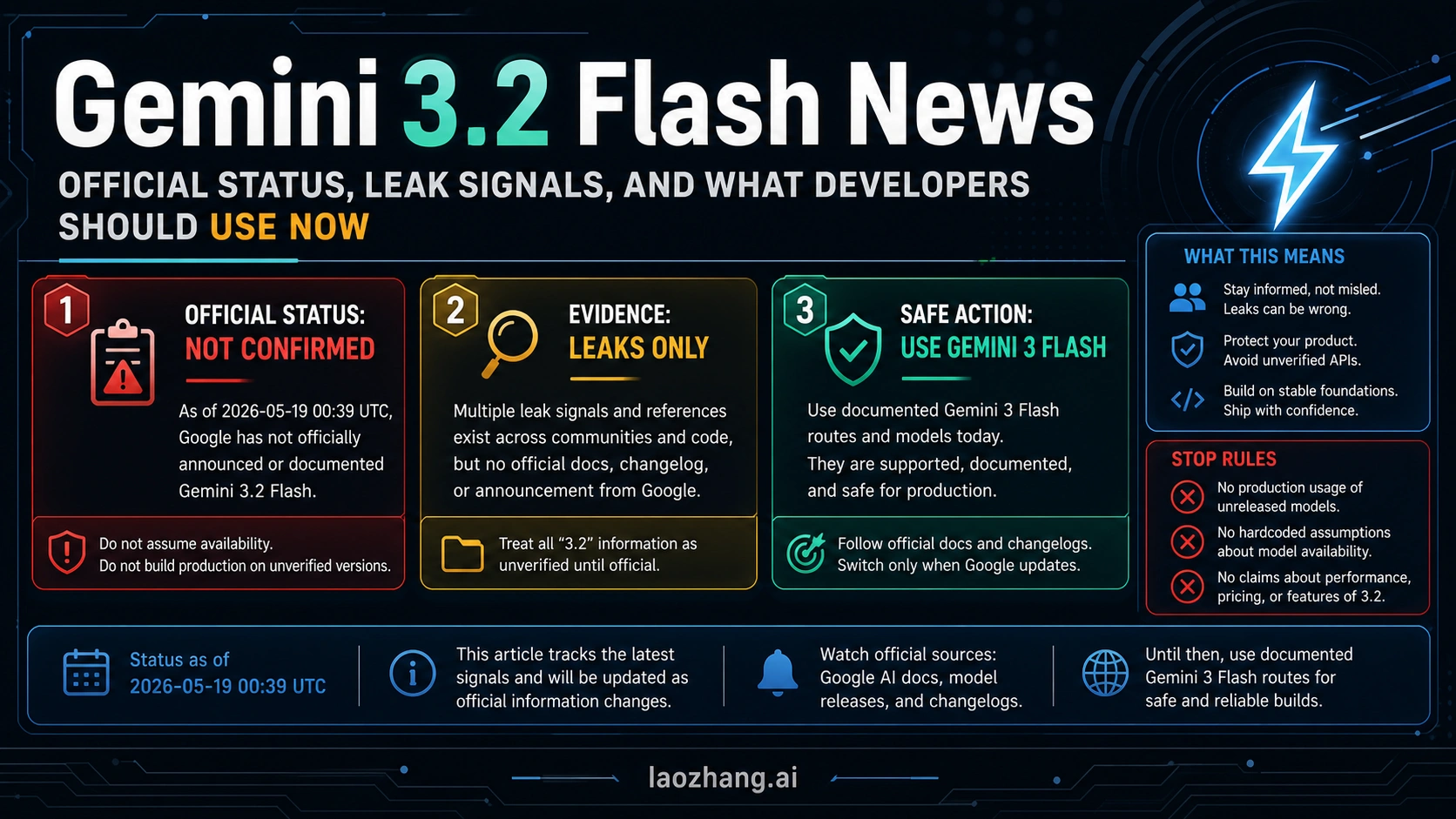
Google had not confirmed Gemini 3.2 Flash in checked official sources at 2026-05-19 00:39 UTC. Treat sightings as signals, not an API contract.

Gemini 3.2 Flash News: Official Status, Leak Signals, and What Developers Should Use Now

As of May 19, 2026 at 00:39 UTC, the checked official Google sources did not confirm a Gemini 3.2 Flash release, model ID, price, or API availability. The safe developer action is to keep using documented Gemini 3 Flash routes such as gemini-3-flash-preview until Google publishes a 3.2 contract.

The name is still worth tracking because pre-I/O sightings and third-party reports are appearing around Gemini surfaces, but those signals can only show that Google may be testing something. They cannot prove production API access, Vertex availability, pricing, rate limits, or launch timing.

Treat the status check as a ledger: first check official Google sources, then grade the leak evidence, then choose the current safe route. Do not swap model strings, write pricing, or tell users Gemini 3.2 Flash is available until the Google blog, AI Studio/Gemini API docs, pricing page, changelog, and Vertex catalog line up.

TL;DR: what is safe to say today

  • Official status: no checked Google source confirmed Gemini 3.2 Flash at 2026-05-19 00:39 UTC.
  • Current model to use: gemini-3-flash-preview remains the documented general Flash route in the Gemini API.
  • What the leaks can show: possible pre-release testing, product labels, internal strings, or routing experiments.
  • What the leaks cannot show: official model ID, API availability, pricing, rate limits, benchmark claims, or production support.
  • Production stop rule: do not change a production model string to gemini-3.2-flash or gemini-3.2-flash-preview until Google lists it in official docs.

The practical answer is not "ignore every signal." The practical answer is to keep two ledgers separate: a watch ledger for signs that Google may be preparing a Flash update, and a production ledger for what Google has actually documented.

What official Google sources currently confirm

The official baseline is Gemini 3 Flash, not Gemini 3.2 Flash. Google's Gemini 3 Flash announcement describes Gemini 3 Flash as the fast general Gemini 3 model and says it is available across the Gemini app, AI Mode in Search, Gemini API in AI Studio, Gemini CLI, Antigravity, Vertex AI, and Gemini Enterprise.

The developer-facing model string that matters for most backend work is still gemini-3-flash-preview. Google's Gemini API docs and model catalog also show related 3-series branches such as gemini-3.1-flash-lite, gemini-3.1-flash-lite-preview, gemini-3.1-flash-live-preview, gemini-3.1-pro-preview, and image-oriented Gemini 3 variants. None of the checked official sources listed a gemini-3.2-flash model entry at the timestamp above.

That boundary matters because "Gemini 3.2 Flash" can become true only in specific ways. Google could publish a blog post, add a model page, update the Gemini API model list, add pricing, update the changelog, show it in AI Studio, or expose it in Vertex AI. Until one or more of those official surfaces changes, a 3.2 claim is a tracked signal, not a contract.

QuestionOfficially supported answer at the check timeWhat would change the answer
Is Gemini 3.2 Flash announced?No checked official Google source confirmed it.Google blog, DeepMind, Gemini API docs, or I/O announcement.
Is there an API model ID?No official gemini-3.2-flash ID found.Model page, model catalog, SDK docs, or changelog entry.
Is there official pricing?No 3.2 pricing entry found.Pricing table update with the exact model name.
Should developers migrate now?No. Use documented Gemini 3 Flash routes.Official model ID plus migration notes and availability details.

For the broader Flash-family decision, the current route split is covered in the Gemini 3 Flash vs Flash Live vs Flash-Lite guide.

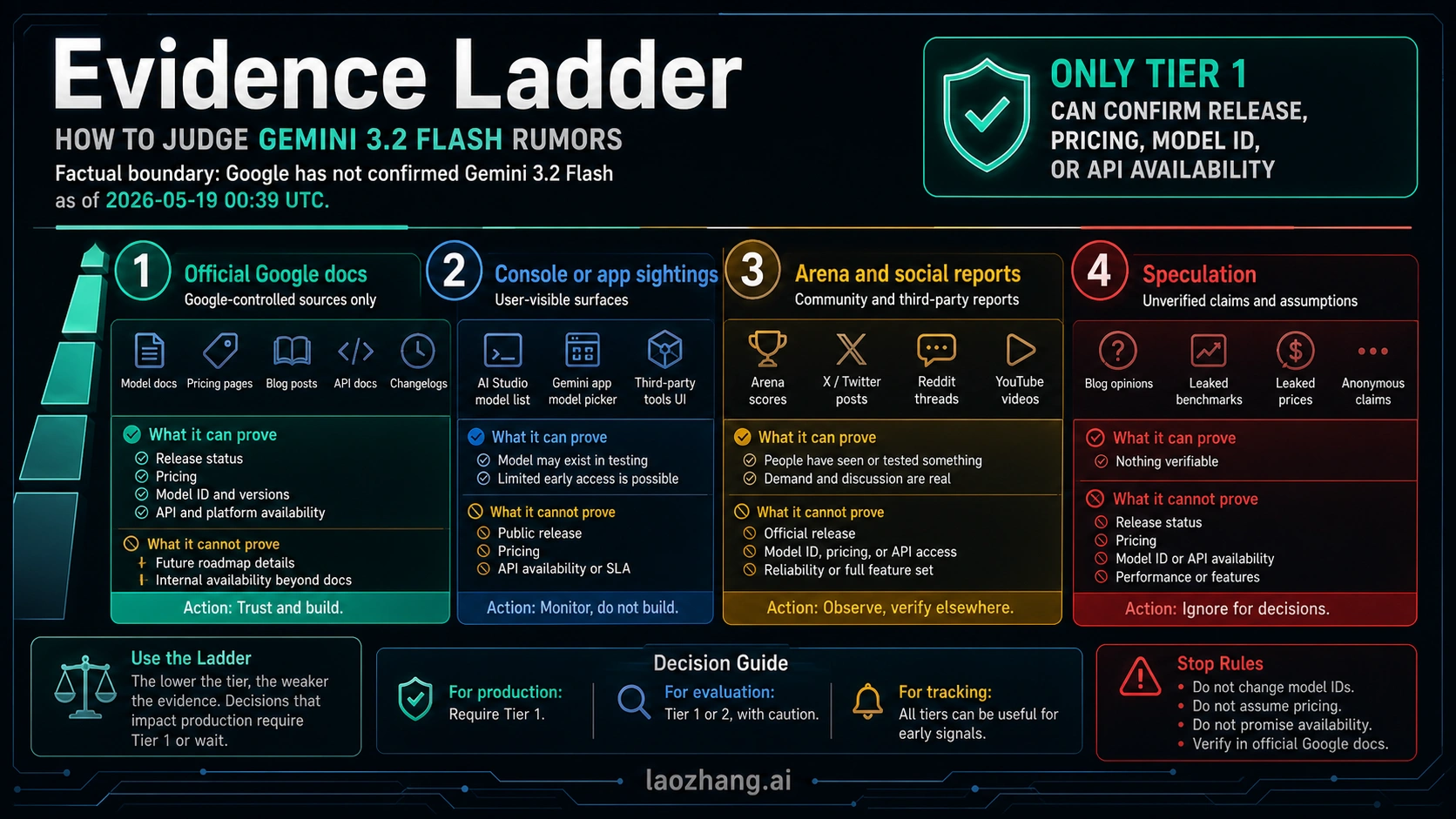
Evidence ladder for Gemini 3.2 Flash rumors

Gemini 3.2 Flash evidence ladder

The easiest way to misread Gemini 3.2 Flash news is to treat every sighting as equal. It is better to rank evidence by what it can safely prove.

Evidence tierExamplesWhat it can proveWhat it cannot prove
Tier 1: official Google sourceGoogle blog, DeepMind post, Gemini API docs, pricing page, changelog, Vertex catalogLaunch status, model ID, API route, price, limits, supported regionsNothing beyond the published contract
Tier 2: Google-controlled but indirect signalApp label, AI Studio UI hint, Cloud Console metadata, SDK enum, hidden stringGoogle may be testing or preparing a routePublic availability, production readiness, stable naming
Tier 3: credible third-party reportTechnical blog, model-tracking post, testing report, arena sightingA rumor is worth monitoring and may reflect visible testingOfficial launch, price, benchmark truth, supported API behavior
Tier 4: social or forum claimReddit, X, screenshots, user reports, reposted snippetsSearch demand and rumor propagationAny production decision

The rule is simple: only Tier 1 can update a production contract. Tier 2 and Tier 3 can justify monitoring. Tier 4 can explain why people are asking, but it should not define what developers ship.

This is especially important around Google I/O. A conference window can make every screenshot feel urgent, but a launch-sensitive model article should still separate "seen somewhere" from "documented somewhere official."

What the current leak signals can and cannot mean

Current Gemini 3.2 Flash discussion appears to cluster around a few kinds of signals: app labels, AI Studio or Cloud Console metadata, arena-style model sightings, Antigravity user reports, and social posts. Those signals are not worthless. They can suggest that Google is testing a new routing layer, a hidden preview, a naming experiment, or an upcoming release branch.

They do not identify the public contract. A label inside one Google product does not guarantee the same name exists in the Gemini API. A Cloud Console hint does not guarantee Vertex availability in every region. An Antigravity behavior change does not prove a new model is exposed to direct API calls. A benchmark screenshot does not prove final model quality, final pricing, or final safety policy.

The safer interpretation is a set of possibilities:

SignalConservative interpretationProduction interpretation
App or UI labelGoogle may be preparing or testing a model name.Do not change backend code.
AI Studio or console metadataA developer surface may have internal references.Wait for docs, model page, and pricing.
Antigravity reportAn IDE route may be using a different backend or routing policy.Do not assume API parity.
Arena resultA candidate model may be evaluated externally.Do not publish benchmark claims as final.
Social postThe rumor has demand and visibility.Treat it as a watch item only.

That split protects teams from two opposite mistakes: dismissing all early signals as noise, or shipping against a model that Google has not yet documented.

Which Gemini Flash route developers should use now

The safe default is still gemini-3-flash-preview for general Gemini API work. It is the documented fast Gemini 3 Flash model and the right starting point for most multimodal app backends, agent workflows, structured output tasks, retrieval-heavy apps, and product features that need a broad model surface.

If your workload is high-volume and cost-sensitive, compare against gemini-3.1-flash-lite or gemini-3.1-flash-lite-preview depending on the exact surface and docs you use. Flash-Lite is the margin route, not a Gemini 3.2 substitute. It is useful when the workload is translation, extraction, classification, moderation, transcript cleanup, or other repeatable background tasks.

If your product is voice-first, use the Live API branch such as gemini-3.1-flash-live-preview. Do not confuse a possible 3.2 Flash rumor with a Live API migration plan. Live is a different runtime contract built around real-time audio behavior.

Developer jobUse nowWhy
Normal app backendgemini-3-flash-previewDocumented general Flash route.
Cheap background pipelinegemini-3.1-flash-lite / gemini-3.1-flash-lite-previewCost and throughput route.
Real-time voicegemini-3.1-flash-live-previewLive API route, not standard backend route.
Testing future 3.2 claimsNo production model swapWait for official docs and price table.

Pricing and quotas should come from official Google tables, not leak posts. The current Gemini cost landscape is easier to track in the Gemini API pricing guide, and quota behavior belongs in the Gemini API rate limits guide.

Availability is not one contract

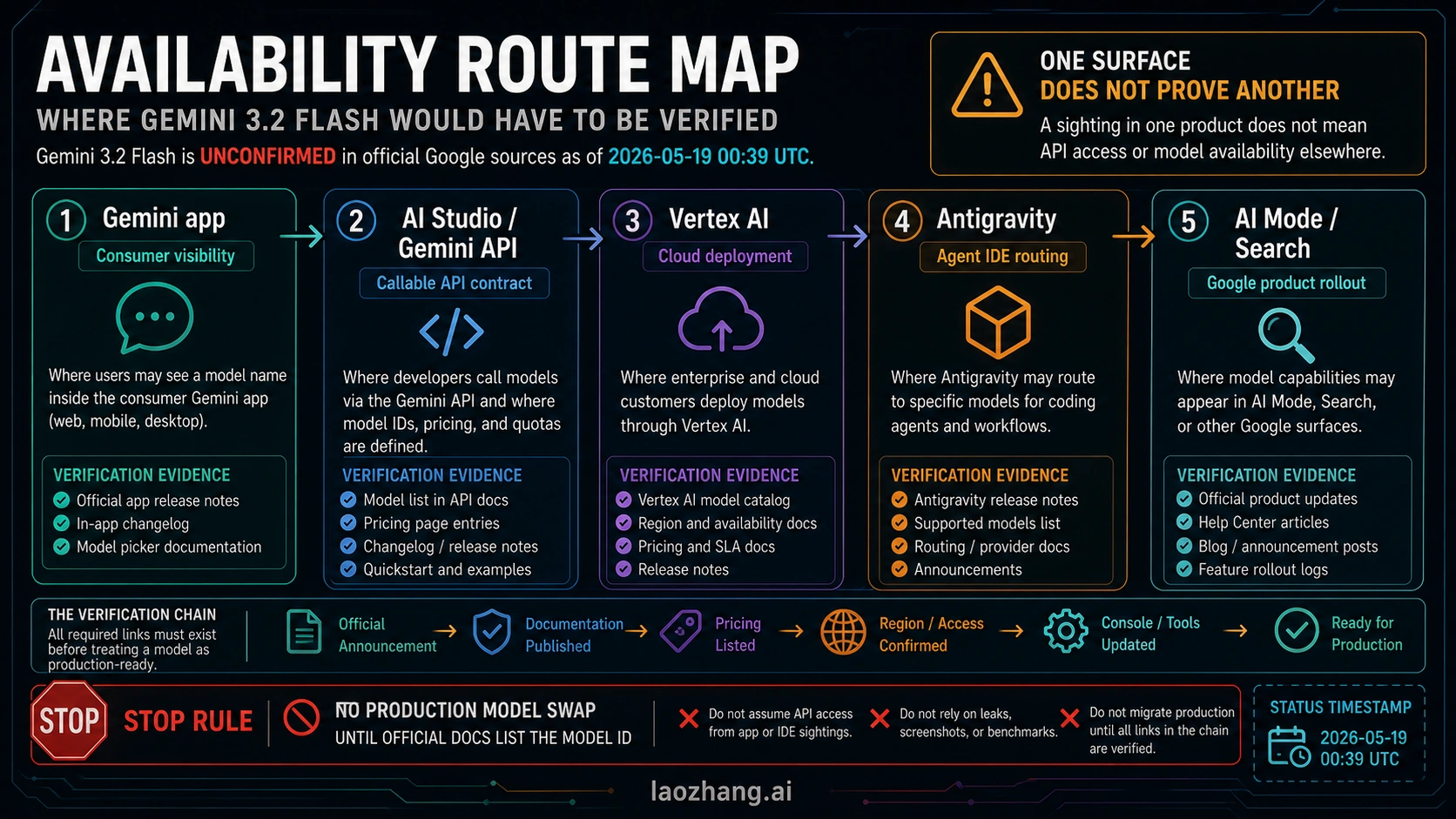
Gemini 3.2 Flash availability route map

The most common source of Gemini 3.2 Flash confusion is route collapse. People see a model name on one surface and assume it means every Google surface has the same model, same timing, same access rules, and same price. That assumption is dangerous.

Google can expose, test, or mention a model across several surfaces:

SurfaceWhat to verifyWhy it is separate
Gemini appProduct label, release note, user-facing model pickerConsumer visibility does not prove API access.
AI Studio / Gemini APIModel ID, SDK examples, input/output support, pricingThis is the route most developers can call directly.
Vertex AIModel catalog, region, quotas, SLA, enterprise controlsCloud availability can lag or differ from AI Studio.
AntigravityIDE release notes, supported model list, routing docsAgent IDE routing may not map 1:1 to public API names.
AI Mode / SearchProduct announcement, help docs, rollout regionSearch product availability is not a developer API contract.

A serious release-status check has to ask which surface changed. If only a consumer product changed, backend developers still need Gemini API evidence. If only Antigravity behavior changed, cloud teams still need Vertex evidence. If a model appears in AI Studio but not pricing, finance and procurement teams still need the price table.

That is why the safest wording is surface-specific: "reported in Antigravity", "not listed in the Gemini API model docs", "not found in the pricing table", "not confirmed in Vertex AI." Surface-specific wording stays useful even if one route updates before another.

Production stop rules

The risk is not merely being wrong in a headline. The risk is changing code, docs, pricing assumptions, or customer promises around a model that does not yet have a public contract.

Use these stop rules until official Google sources change:

  • Do not call gemini-3.2-flash or gemini-3.2-flash-preview in production unless the exact ID appears in official Gemini API or Vertex documentation.
  • Do not write official pricing for Gemini 3.2 Flash unless Google's pricing table lists it.
  • Do not claim Antigravity support proves Gemini API support.
  • Do not treat arena or social benchmark numbers as final performance.
  • Do not tell customers a 3.2 route is available in a region until the relevant Google surface says so.
  • Do not update internal docs with 3.2 as a settled model until model ID, route, price, and availability are all clear.

The positive action is just as important: keep your current Gemini 3 Flash integration clean. Keep model IDs centralized, keep route-specific tests separate, and keep any experimental 3.2 tracking behind a non-production note. If Google announces a new model, that setup lets you move quickly without pretending the contract existed before it did.

Post-I/O verification checklist

Gemini 3.2 Flash post I/O verification checklist

Google I/O 2026 is the obvious watch window, but the verification standard should not change just because a keynote happens. A production team should update the status only when official sources agree.

Check these surfaces in order:

  1. Google blog or DeepMind announcement for the public release claim.
  2. Gemini API model page for the exact model ID and supported inputs or outputs.
  3. Gemini API pricing page for text, image, audio, output, cache, batch, and free-tier details.
  4. Gemini API changelog for date, version, migration notes, and behavior changes.
  5. AI Studio model selector for callable developer availability.
  6. Vertex AI model catalog for cloud regions, quotas, SLA, and enterprise controls.
  7. Limits or rate-limit docs for RPM, TPM, batch, and regional differences.
  8. Migration docs or SDK examples for code changes and compatibility notes.

Only after those checks should teams update production docs, migration plans, customer messaging, or cost forecasts. If the official sources disagree, write the disagreement plainly. For example: "listed in AI Studio, not yet priced" is more useful than "available."

FAQ

Is Gemini 3.2 Flash officially released?

Not in the checked official sources at 2026-05-19 00:39 UTC. The checked Google blog, Gemini API docs, pricing page, and model catalog did not confirm a Gemini 3.2 Flash release, model ID, price, or public API contract.

Is there a gemini-3.2-flash API model ID?

No official gemini-3.2-flash model ID was confirmed in the checked sources. Use gemini-3-flash-preview for the documented general Gemini 3 Flash route unless Google publishes a new model ID.

What should developers use instead?

Use gemini-3-flash-preview for most Gemini Flash backend work. Use Flash-Lite for cost-sensitive background jobs and Flash Live for real-time voice. Those are documented routes; Gemini 3.2 Flash is still a status watch item until official sources change.

Does an Antigravity sighting prove API availability?

No. Antigravity is a product surface with its own routing behavior. A sighting there can be worth watching, but it does not prove Gemini API, Vertex AI, pricing, or region availability.

Could Google still announce Gemini 3.2 Flash at I/O?

Yes. The status can change quickly during Google I/O. The safe update path is to revise the timestamp, official-source list, model ID status, route availability, pricing, and stop rules together after Google publishes the relevant docs.

Should leaked pricing or benchmarks be included in production planning?

Not as fact. Leaked pricing and benchmark claims can go on a watchlist, but production planning needs official Google pricing, official model docs, and repeatable internal evaluation.

Share:

laozhang.ai

One API, All AI Models

AI Image

Gemini 3 Pro Image

$0.05/img
80% OFF
AI Video

Sora 2 · Veo 3.1

$0.15/video
Async API
AI Chat

GPT · Claude · Gemini

200+ models
Official Price
Served 100K+ developers
|@laozhang_cn|Get $0.1