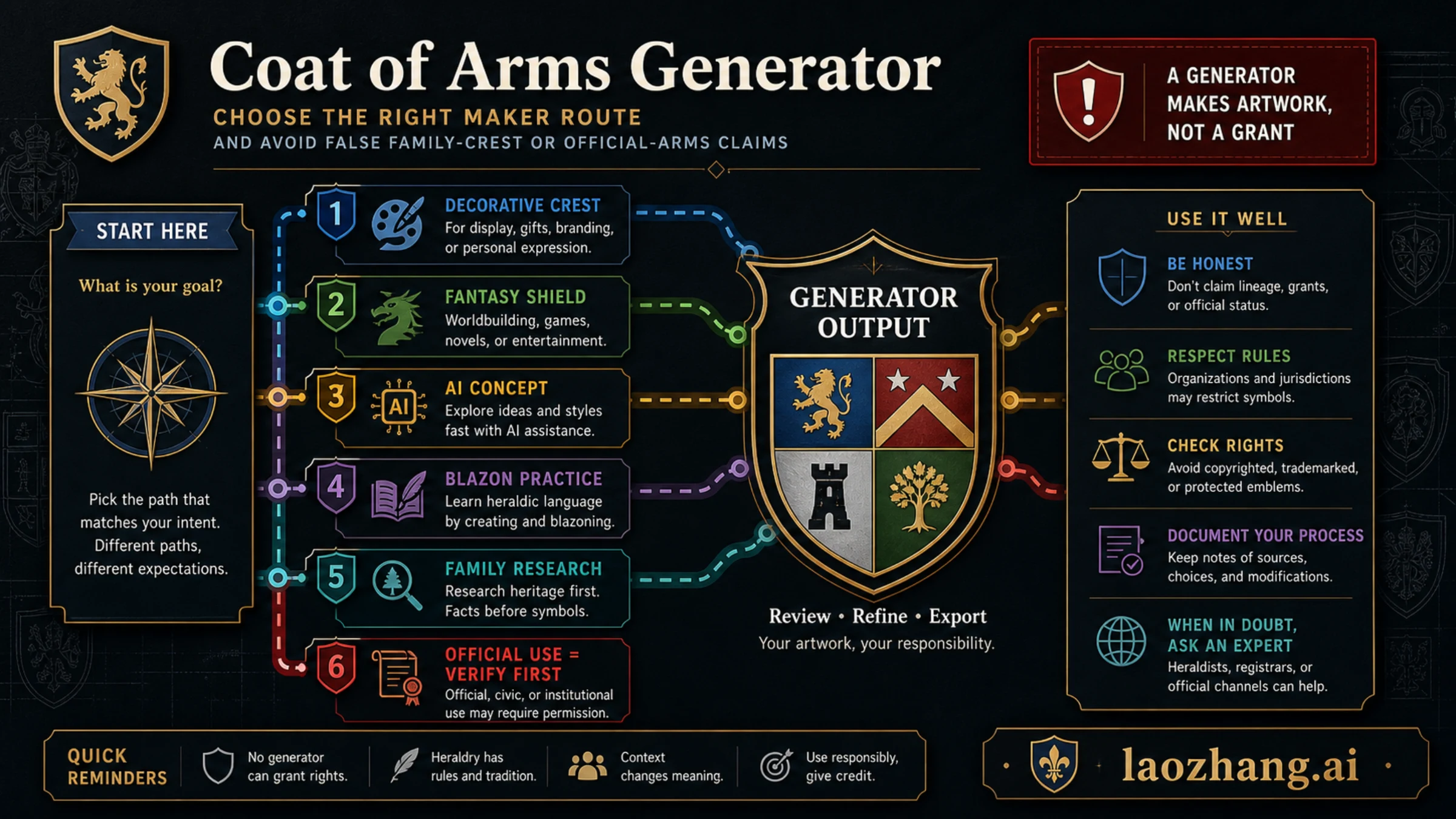
A coat of arms generator is useful for decorative crests, fantasy shields, club marks, and first drafts, but it does not grant official arms or prove that a surname owns a family crest. Start by choosing your route: a simple maker for quick artwork, an AI image generator for style concepts, a fantasy maker for games, a blazon tool for heraldry practice, a family-research path for inherited claims, or an official authority path for public or institutional use.
If the design will be published, sold, used by an organization, or tied to family lineage, stop and verify sources, permissions, and local heraldic rules before treating the result as more than artwork.
| Your goal | Start with this route | What the result means | Verify before |
|---|---|---|---|
| Decorative crest for a profile, gift, event, or club concept | Simple coat of arms maker | Original-looking artwork or a draft | License, export quality, trademark risk |
| Visual style exploration | AI coat of arms generator | Concept art that may ignore heraldic rules | Rights, prompts, protected symbols, final redraw needs |
| Game, novel, roleplay, or worldbuilding shield | Fantasy or random shield maker | Fictional heraldic-looking art | Game/community rules and commercial reuse |
| Learning real heraldic structure | Blazon or heraldry tool | A practice shield tied to heraldic vocabulary | Whether the blazon is valid and readable |
| Existing family or surname arms | Research path first | A lead for genealogy, not proof | Documented descent, jurisdiction, source quality |
| Public, civic, school, company, or official use | Authority or professional route | Needs a separate permission or grant path | Relevant authority, legal review, organization policy |
Fast Route: Choose by Intended Use, Not by One Ranking
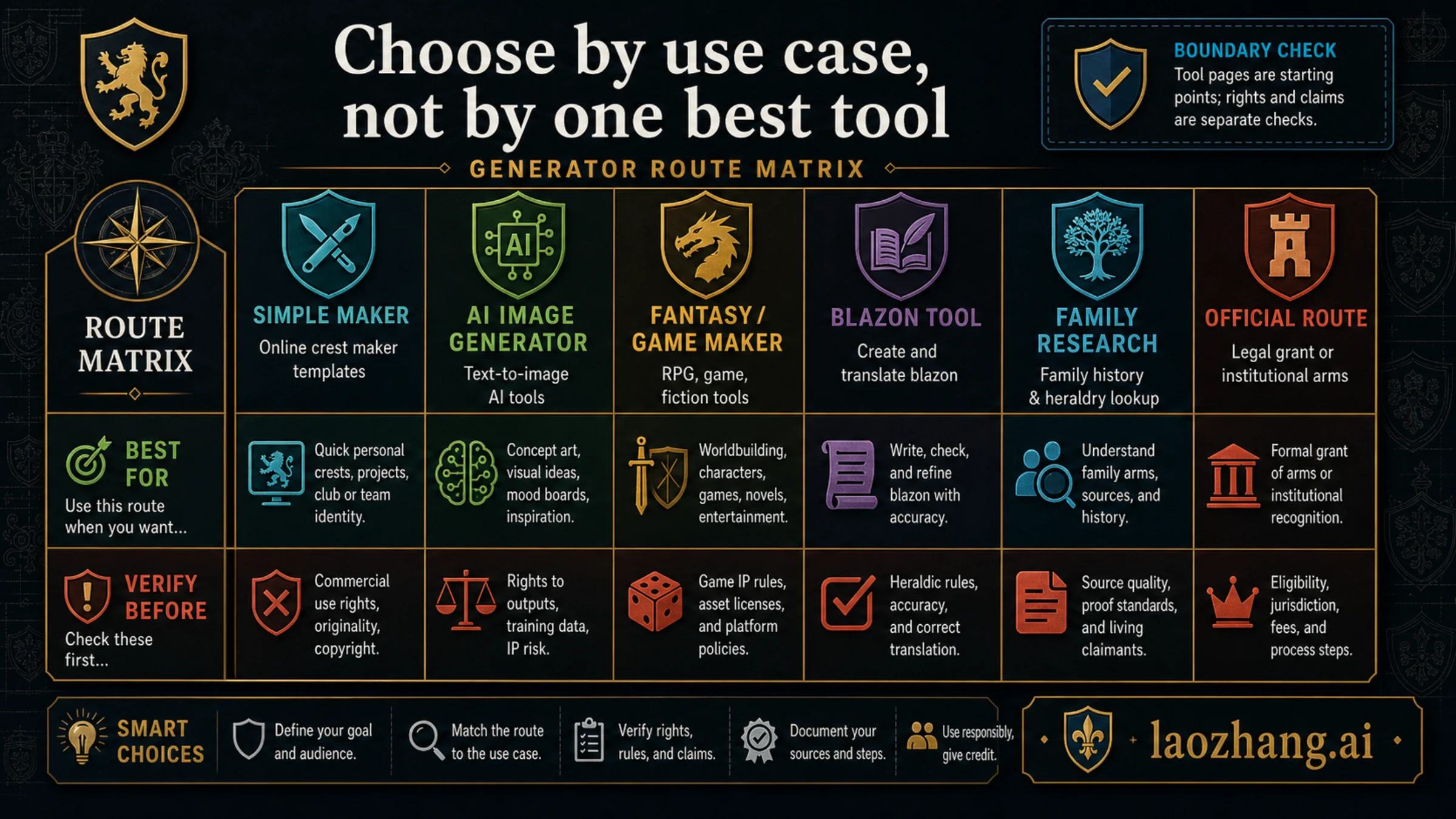
There is no single best coat of arms generator because the tools solve different jobs. A drag-and-drop maker is good when you want a fast emblem-like image. An AI image tool is good when you want atmosphere, material, lighting, and style variations. A fantasy generator is good when the shield belongs to a fictional house, campaign, or game setting. A blazon tool is good when the point is learning heraldic language rather than making logo art.
That split matters more than the brand name on the tool. A polished AI crest can still be wrong as heraldry. A correct blazon render can still look too plain for a logo. A family-crest page can still be decorative marketing unless it connects the arms to a documented person, lineage, and jurisdiction.
Use this short decision rule:
| Route | Use it when | Main advantage | Main limit |
|---|---|---|---|
| Simple maker | You need a quick crest-like graphic | Fast choices, low learning curve | Often shallow on heraldic accuracy and rights |
| AI generator | You need style, texture, mood, or many concepts | Strong visual exploration | May invent symbols, text, or rules |
| Fantasy maker | You need fictional or game-friendly shields | Built for worlds, factions, and characters | Usually not a real heraldry workflow |
| Blazon tool | You want heraldic practice or precision | Connects words to shield structure | Requires vocabulary and patience |
| Research route | You think a family crest already exists | Keeps entitlement separate from art | Slower, evidence-dependent |
| Official route | The arms will represent an institution or formal identity | Starts from authority and policy | Not solved by a generator |
What Tool Type Fits Each Job?
For a personal decorative crest, start with a simple maker if the real job is speed. Your quality check is not "is this official?" but "is this coherent, legible, exportable, and honest about being created artwork?" Avoid copying a famous national, municipal, military, university, or royal-looking design. Keep a record of the tool used and the license terms visible on the day you exported the file.
For AI concept art, use the generator as an ideation layer. Ask for a shield style, palette, charge, motto placement, and mood. Then inspect the result like a designer: does the shield read at small size, are the symbols too generic, is the motto misspelled, and did the model invent official-looking seals or protected emblems? AI is strongest when you want options quickly; it is weakest when you need precise heraldic grammar or reliable text.
For fantasy work, a coat of arms generator can be exactly the right tool. Fictional kingdoms, tabletop factions, sports teams in a private league, or novel houses do not need inherited arms unless you choose to build that lore. The honest label is what makes the route safe: call it a fictional house shield, campaign crest, or decorative emblem, not ancestral proof.
For heraldry practice, use a blazon-first route. DrawShield is useful here because it provides heraldry and blazonry resources, menu-based tools, random ideas, and a create-from-blazon workflow. A blazon is the structured verbal description of the arms, so it forces you to think about field, tinctures, charges, ordinaries, and position rather than only surface style.
For family research, do not start with a generator. Start with records, names, places, dates, and reliable heraldic or genealogical sources. A surname match on a website is not enough. Arms are normally attached to a person, family line, corporate body, or authority context, not to every person who shares the same last name.
Make the Generated Crest Look Intentional
Most generated shields fail because they try to do too much. A good crest-like mark should read quickly, survive small sizes, and have a reason for each symbol. The basics from heraldry are helpful even when you are making decorative artwork.
English Heritage's beginner guide, checked on June 20, 2026, is a good non-specialist reminder that heraldic design uses a limited set of colors, metals, ordinaries, charges, and blazon vocabulary. You do not need to become a herald to make better generated art, but you should borrow the discipline.
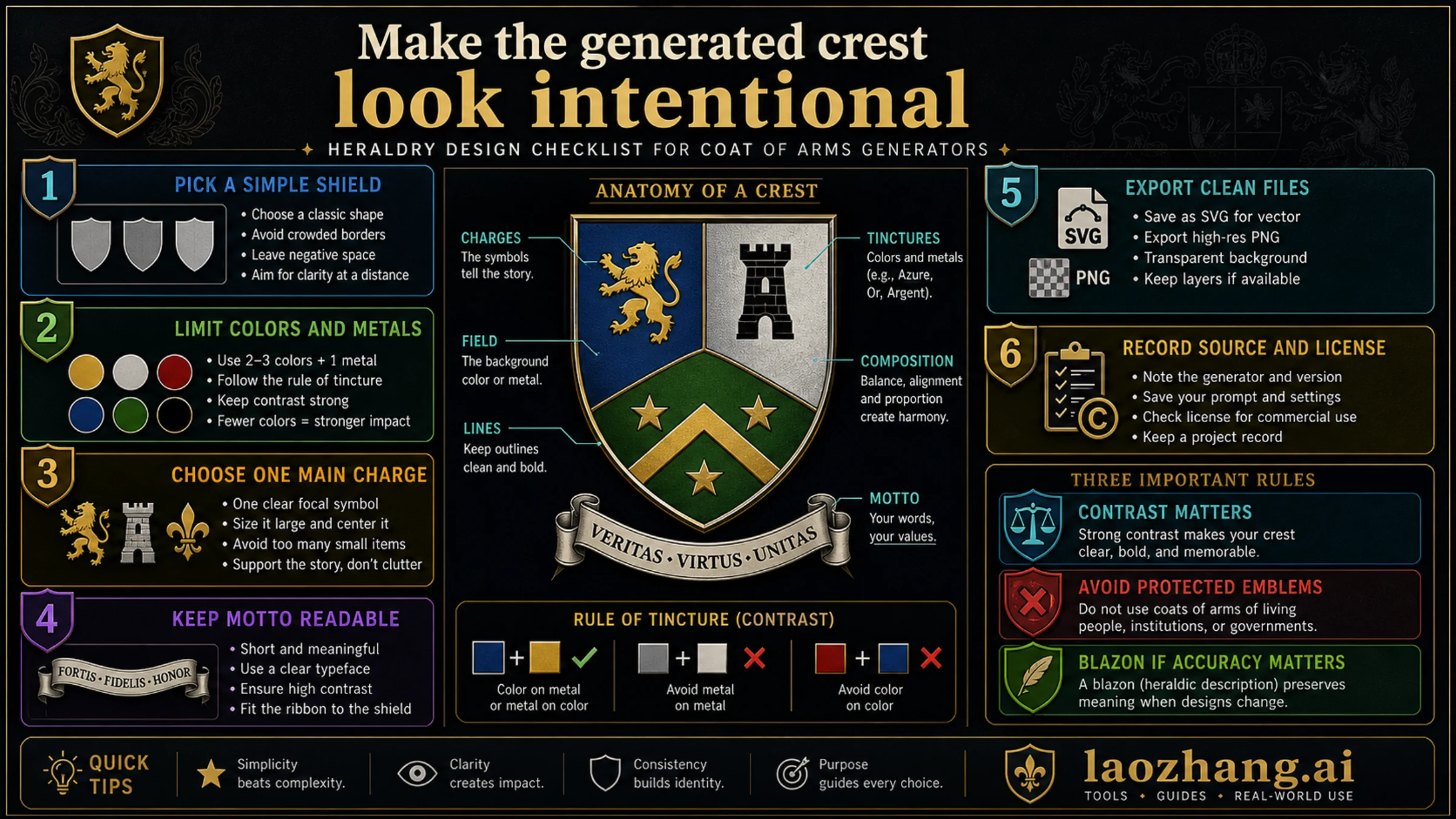
Use this inspection pass after the generator gives you a draft:
| Check | Good sign | Fix if it fails |
|---|---|---|
| Shield shape | One clear shield form, not a collage of frames | Pick a simpler shield outline |
| Color and metal | Strong contrast between background and symbols | Reduce the palette and avoid muddy gradients |
| Main charge | One dominant animal, object, plant, tower, star, or geometric mark | Remove extra icons until the idea is visible |
| Ordinary or division | The stripe, chevron, cross, quartering, or field division supports the main mark | Use one structural device, not several competing devices |
| Motto | Short, readable, and spelled correctly | Drop it if the generator cannot render text cleanly |
| Export | Clean file at the size and format you need | Export again or redraw before public use |
| Source record | Tool, prompt, date, and license are saved | Record them before publishing |
If the generator offers a random result you like, do one more pass before using it. Ask what each element means. If the answer is "nothing, it looked good," that may be fine for decorative art, but it is not enough for a public identity. Replace random symbols with choices that match the person, team, project, or fictional world.
AI Art Versus Blazon Accuracy
AI and blazon tools are not rivals; they are different contracts. AI gives you visual breadth. Blazon gives you structured precision. If you want a dramatic black-and-gold lion shield with cinematic lighting for a fantasy story, AI is faster. If you want a shield that another heraldic artist could redraw from text, blazon matters.
The practical hybrid workflow is often best:
- Sketch the intent in plain English: owner, values, colors, symbols, and use.
- Generate several AI concepts or simple-maker drafts.
- Pick one concept and simplify it to a clear field, charge, and palette.
- If heraldic correctness matters, translate the design into a blazon and test it in a blazon tool.
- Redraw or refine the final art instead of treating the first generated image as finished.
This keeps AI where it is strong without letting it invent authority. It also gives you a record of why the final design looks the way it does.
Family Crest and Official Arms Stop Rules
The risky part of this topic is not making a shield. It is making a claim. "I generated a crest" is an art statement. "This is my family's coat of arms" or "this is our official arms" is a proof statement.
The American Heraldry Society's Guidelines for Heraldic Practice, checked on June 20, 2026, are framed as recommended practice, not a government mandate, but they show the kind of discipline serious heraldry expects: heredity, arms-bearing customs, good design, and clarity about authority. DrawShield also warns users that the right to use heraldic devices is restricted in many countries and that grants belong to the relevant heraldic authority. That is the boundary your article, school project, club page, or family-history note should respect.
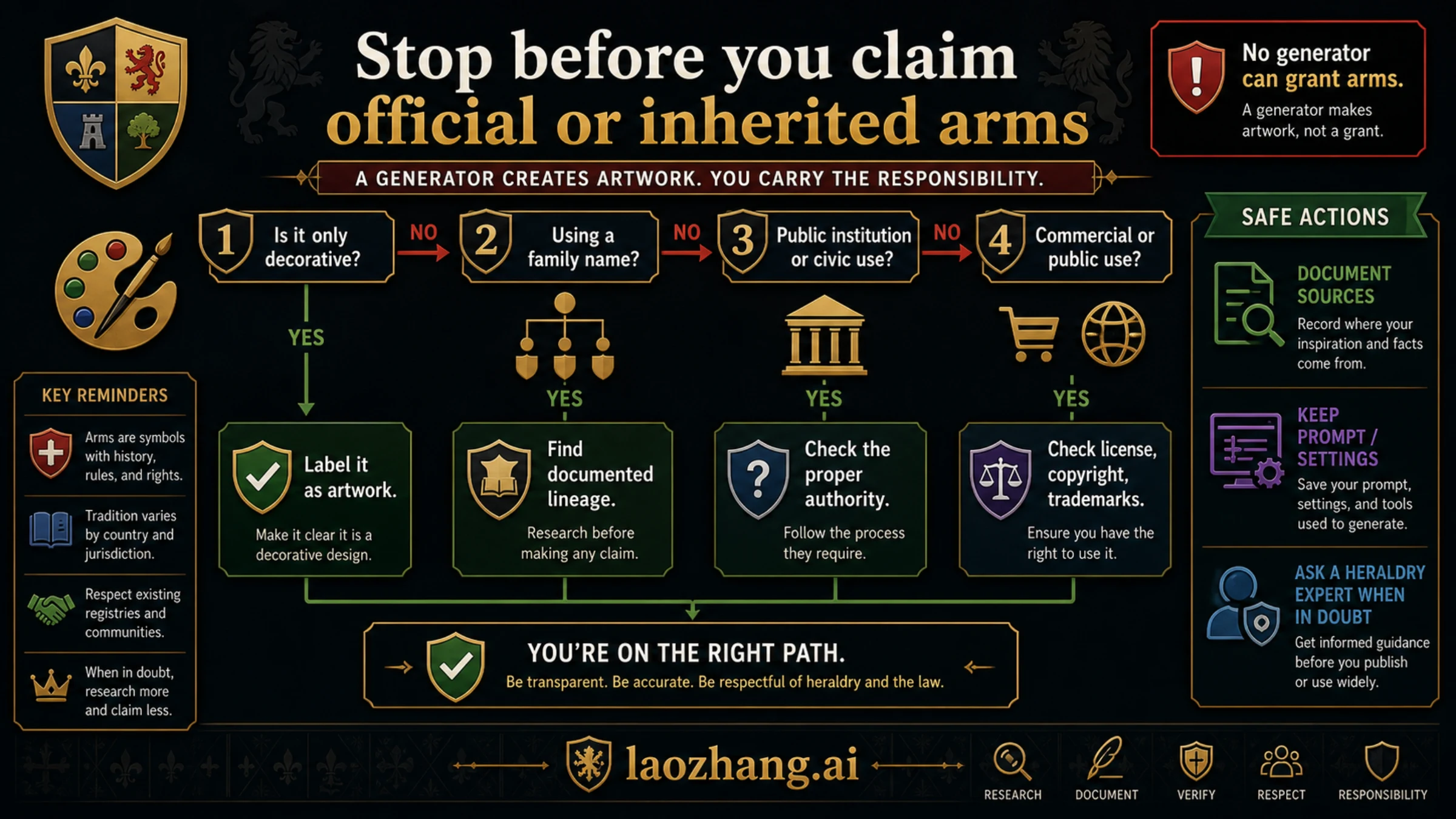
Use this stop table before public use:
| Claim you want to make | Do this first | Safe wording until verified |
|---|---|---|
| "This is my family crest" | Find a documented link from the arms to a named ancestor and line of descent | "A crest-like design for our family project" |
| "This is official" | Check the relevant heraldic, civic, school, company, or legal authority | "A proposed emblem" |
| "This is historic" | Keep the source image, archive, book, or registry reference | "Inspired by historical heraldry" |
| "We can sell this on merchandise" | Check tool terms, copyright, trademarks, and protected symbols | "Draft pending rights check" |
| "This represents our organization" | Get approval from the organization and avoid confusing public authority symbols | "Concept mark" |
This is not legal advice. The point is simpler: a generator can create a design, but stronger claims need stronger evidence.
Export and Public-Use Checklist
Before you publish, sell, print, embroider, or put the shield on a website, run a final checklist.
- Save the tool name, prompt, settings, export date, and license page.
- Keep a high-resolution source file and a web-optimized copy.
- Check that the motto or visible text is spelled correctly.
- Search for obvious conflicts with famous emblems, national arms, school marks, sports logos, military insignia, and trademarks.
- If it is for a club, business, school, or public body, get written approval from the owner of that identity.
- If it is linked to family history, document the lineage or use decorative wording only.
- If a country or organization has a heraldic authority, registry, or formal approval path, follow that path before claiming official arms.
The best generator output is the one you can explain. If you cannot explain where the symbols came from, what the file license allows, and why the design is not pretending to be official, the design is not ready for public use.
A Practical Workflow
Use this workflow when you want a credible result without overbuilding the project:
- Write one sentence for the use: decorative art, fantasy, club draft, family research, or official proposal.
- Pick the matching route from the table near the top.
- Generate three to six drafts, not fifty.
- Choose one draft and remove anything that does not carry meaning.
- Check contrast, main symbol, motto, export quality, and protected-symbol risk.
- Save evidence: tool, prompt, date, license, and any source references.
- Label the output honestly: artwork, fictional shield, concept mark, practice blazon, researched arms, or official submission.
That workflow is fast enough for casual use and disciplined enough to keep you out of the most common false-claim traps.
FAQ
Can a coat of arms generator create official arms?
No. A generator can create artwork, a draft, a fictional shield, or a practice design. Official arms depend on the relevant authority, jurisdiction, institution, or accepted heraldic practice. Do not treat a generated image as a grant.
Is a family crest maker the same thing as family-history proof?
No. "Family crest maker" is often search and marketing language. It can help you make a decorative design, but it does not prove that everyone with a surname has the same arms. For inherited arms, you need documented descent or another recognized proof path.
Should I use AI or a blazon tool?
Use AI when you want visual concepts, styles, textures, and many options quickly. Use a blazon tool when accuracy, heraldic vocabulary, or repeatable structure matters. For serious work, use AI for ideation and blazon for the precision pass.
What is a blazon?
A blazon is the formal written description of a coat of arms. It tells a knowledgeable reader how to draw the shield from words. Learning even basic blazon vocabulary helps you understand field, tincture, ordinary, charge, and arrangement instead of relying only on visual guesses.
What is the best free coat of arms generator?
There is no stable universal answer. Free, login, export, and license rules change. Choose by the job: simple maker for quick art, fantasy tool for fictional worlds, AI generator for visual ideation, and blazon tool for heraldry practice. Check the tool's current terms before exporting.
Can I use a generated coat of arms commercially?
Maybe, but only after checking the specific tool license, generated-asset terms, copyright risk, trademarks, and any symbols that may be protected or restricted. If the design represents an organization or public body, get approval before publishing or selling it.