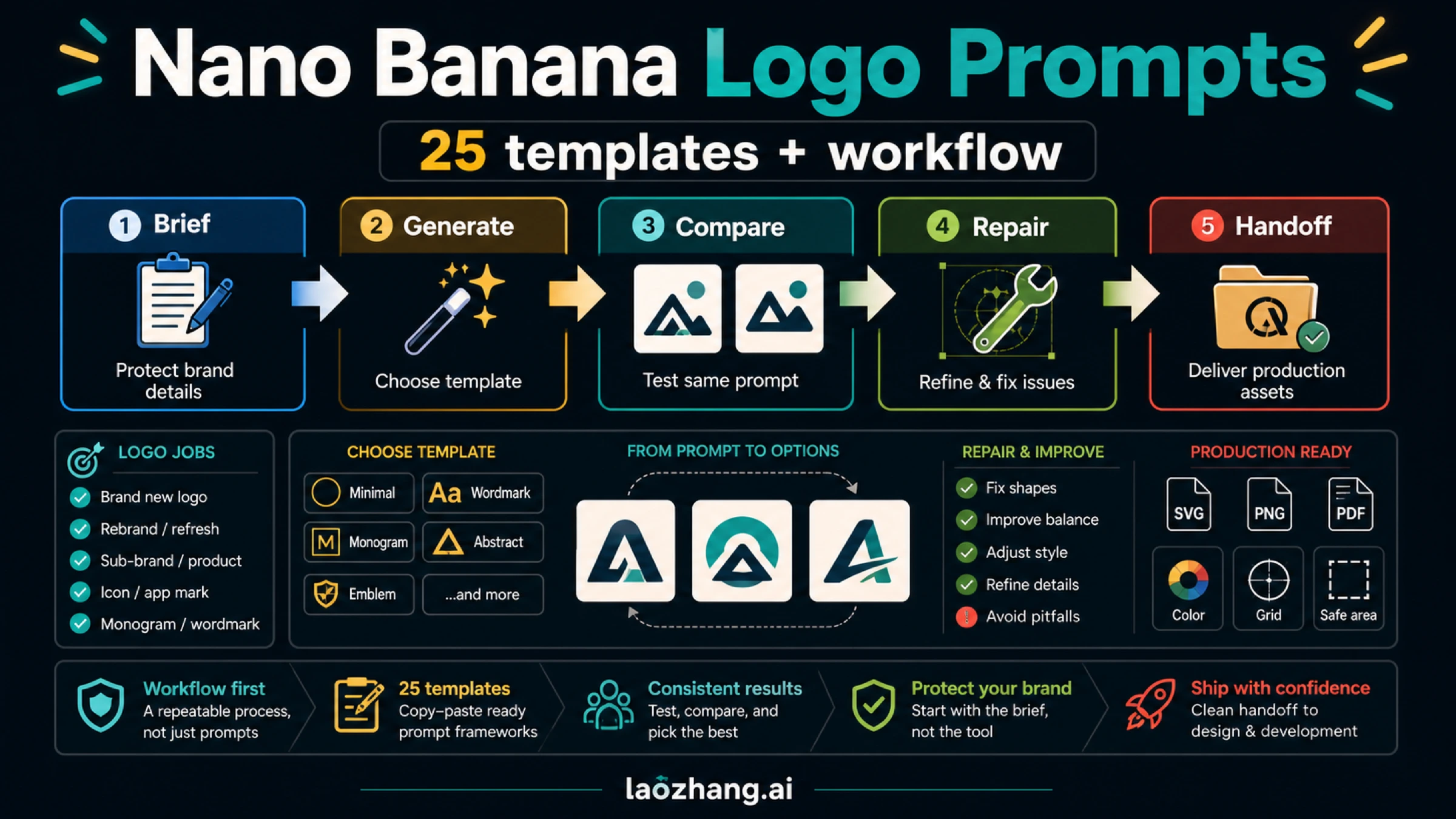
Use these Nano Banana logo prompts as a workflow: choose the logo job, fill a compact brand brief, paste a matching template, generate 3-5 outputs with the same prompt, score them, then repair only the weak dimension.
| Logo job | Start with this template family | Brief fields you must fill | Test before you trust it | Stop rule |
|---|---|---|---|---|
| Wordmark | Text-first prompts | Brand name, typography feel, spacing, forbidden letter treatments | Read it at favicon size and header size | Do not accept warped or misspelled letters |
| Icon mark | Symbol-first prompts | Object metaphor, geometry, negative space, color boundary | Compare three silhouettes in one prompt run | Do not claim trademark clearance |
| Monogram | Initial-combination prompts | Initials, symmetry, line weight, brand mood | Check whether the letters survive in black and white | Do not force unreadable initials |
| Badge or emblem | Badge-system prompts | Shape, inner mark, border, secondary text policy | Test whether the mark works without the small text | Do not keep decorative filler |
| Mascot direction | Character-direction prompts | personality, posture, brand-safe avoid list | Compare expression, pose, and simplified shape | Do not publish it as a final brand asset without design review |
The stop rule is simple: a generated logo concept is not trademark clearance, final vector production, or a finished brand system. Use the templates to reach a direction faster, then use repair prompts, same-prompt tests, and designer handoff notes before you treat the output as usable.
Fill the brand brief before you paste any template
A logo prompt fails when it asks for "a modern logo" and leaves the model to invent the brand. The brief does not need to be long, but it must remove the decisions you already know.
Use this compact brief as the first block inside any template:
| Brief field | What to write | Bad shortcut to avoid |
|---|---|---|
| Brand name | The exact text that may appear in the mark | Asking for multiple name spellings |
| Sector | The real category and buyer context | "Tech company" when the product is specific |
| Audience | Who should trust or enjoy the brand | Vague "everyone" positioning |
| Personality | 3-5 adjectives that can guide form | Long mood boards with conflicting words |
| Typography feel | Geometric, humanist, serif, rounded, condensed, editorial, or playful | "Cool font" |
| Color boundary | 2-3 colors or a palette constraint | Unlimited gradients |
| Must avoid | Protected symbols, competitors, cliches, taboo colors, hard-to-read letters | Famous-logo imitation |
| Output use | Website header, app icon, pitch deck, label, community avatar, or signage | No size context |
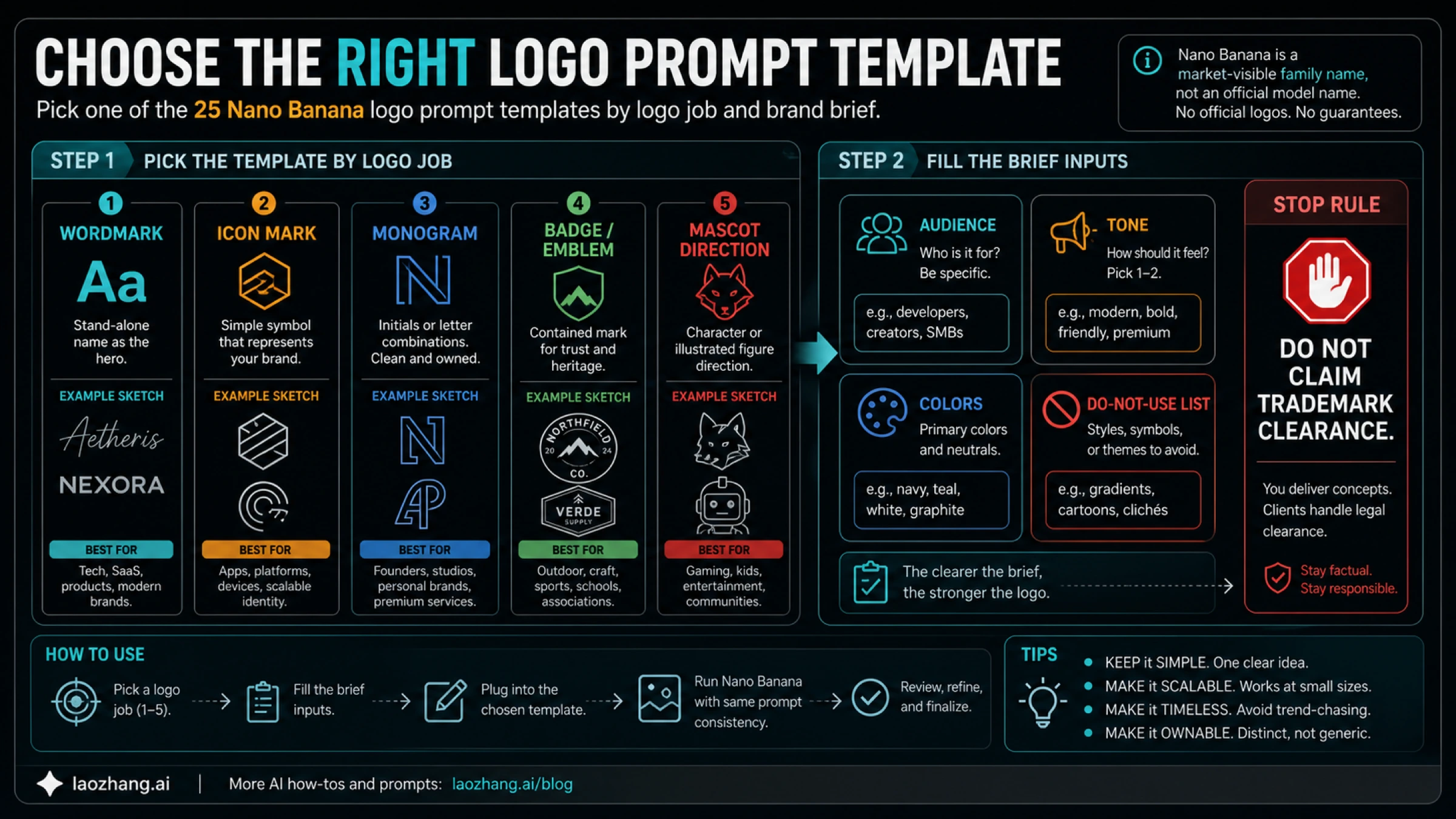
Treat the brief as part of the prompt, not as a note beside it. If the brief changes between attempts, you are no longer comparing templates; you are running a new test.
The reusable prompt formula
The useful formula is:
textCreate a [logo job] for [brand name], a [sector] brand for [audience].
Use this brand personality: [personality].
Use this typography or shape direction: [type/shape direction].
Use this palette boundary: [colors].
Avoid: [protected marks, competitor cues, overused symbols, unreadable text].
Output goal: [where the logo will be used].
Generate [number] distinct directions and keep each one simple enough to test at small size.
That formula is deliberately stricter than many prompt lists. It makes the logo job, brand brief, constraints, and evaluation context visible. The templates below are copy-paste starting points; replace the bracketed fields before you generate.
25 copy-paste Nano Banana logo prompt templates
Wordmark prompts
1. Clean SaaS wordmark
textCreate a clean wordmark logo for [brand name], a [sector] product for [audience]. Use a geometric sans-serif feel, balanced letter spacing, and a calm premium tone. Palette: [colors]. Avoid distorted letters, faux 3D, gradients, and any resemblance to [competitors/protected marks]. Show 4 distinct wordmark directions on a plain background.
Use this when the brand name is short and needs to carry the identity. Repair by asking for wider tracking, fewer decorative cuts, or a black-and-white proof.
2. Editorial wordmark
textCreate an editorial wordmark for [brand name] with a refined serif or high-contrast type feel. The brand serves [audience] in [sector]. Keep the mark readable in a website header and on a printed card. Palette boundary: [colors]. Avoid luxury cliches, thin hairlines that disappear, and copied magazine logos.
Use this for consulting, education, publishing, design, or premium consumer products. Repair by simplifying terminals and testing the name at 160 px wide.
3. Friendly rounded wordmark
textCreate a friendly rounded wordmark for [brand name], a [sector] brand that should feel [personality]. Use soft corners, simple letter shapes, and strong readability. Palette: [colors]. Avoid childish bubble letters, clutter, shadows, and mascot characters. Generate 5 clean directions.
Use this when trust and warmth matter more than sharp authority. Repair by reducing roundness and removing novelty ligatures.
4. Condensed launch wordmark
textCreate a condensed wordmark for [brand name] that can work in a landing-page hero and narrow mobile header. The brand is in [sector] for [audience]. Keep the silhouette strong, the letters readable, and the style [personality]. Avoid stretched text, fake italics, and unreadable custom characters.
Use this for long names. Repair by asking for fewer custom letter treatments and a plain-text comparison row.
Icon mark prompts
5. Abstract symbol mark
textCreate an abstract icon mark for [brand name], representing [core metaphor] without showing a literal object. The brand serves [audience] and should feel [personality]. Use simple geometry, strong negative space, and a palette of [colors]. Avoid generic sparks, copied app icons, and protected symbols. Show 4 symbol directions with one small-size preview each.
Use this when the brand should feel flexible and not tied to one product feature.
6. Object-simplified mark
textCreate a simplified symbol mark based on [object/metaphor] for [brand name]. Reduce it to a memorable flat shape that works in one color. Keep the tone [personality] and avoid photorealism, mascot faces, or complex line art. Include a black-and-white version beside the color version.
Use this when the category has a clear metaphor. Repair by asking for fewer strokes and stronger silhouette.
7. Negative-space icon
textCreate a negative-space logo icon for [brand name]. Combine [shape A] and [shape B] in a subtle way that still reads at small size. Use [colors], flat vector-like style, and generous whitespace. Avoid optical illusions that make the mark hard to recognize.
Use this only when the two-shape idea is genuinely useful. Repair by asking for one dominant idea instead of two equal ideas.
8. App-icon-ready mark
textCreate an app-icon-ready logo mark for [brand name], a [sector] app for [audience]. The mark must fit inside a rounded-square icon, remain readable at 48 px, and avoid tiny text. Use [colors] and a [personality] tone. Show the mark on light and dark backgrounds.
Use this for mobile apps, Chrome extensions, and social avatars. Repair by removing words and simplifying the central shape.
Monogram prompts
9. Two-letter monogram
textCreate a two-letter monogram for the initials [initials] for [brand name]. Use a [typography feel] style, balanced spacing, and a simple geometry that can be redrawn as vector. Palette: [colors]. Avoid unreadable letter fusion, shields, crowns, and famous-brand references.
Use this when initials are more distinctive than the full name.
10. Interlocking monogram
textCreate an interlocking monogram using [initials] for a [sector] brand. Make the overlap intentional, clean, and readable in one color. Tone: [personality]. Avoid overly complex knots, thin strokes, and mirrored letters that confuse the initials.
Repair by asking for a single baseline and fewer intersections.
11. Monogram plus wordmark lockup
textCreate a logo lockup with a monogram icon using [initials] and a wordmark for [brand name]. The mark should work with and without the wordmark. Use [colors], [typography feel], and a [personality] tone. Avoid tiny taglines and decorative separators.
Use this when the brand needs both favicon and full-header uses.
Badge and emblem prompts
12. Circular badge
textCreate a circular badge logo for [brand name], a [sector] brand. Include one central symbol based on [metaphor] and a simple border system. If text appears, keep it large and minimal. Palette: [colors]. Avoid tiny rim text, vintage clutter, and official-seal cues.
Use this for community, food, events, or outdoor products. Repair by removing secondary text first.
13. Minimal emblem
textCreate a minimal emblem for [brand name] using [shape direction] and one symbolic detail. The emblem should feel [personality] and work as a sticker, label, and website mark. Use flat color, strong contrast, and no more than two internal shapes.
Use this when the brand needs a contained mark but not a heavy badge.
14. Premium crest without legal cues
textCreate a premium crest-inspired logo for [brand name] without using government, university, military, or legal-seal cues. The brand is [sector] for [audience]. Use [colors], refined geometry, and one central metaphor. Avoid crowns, eagles, official shields, and tiny Latin text.
Use this carefully. Repair by asking for "badge-inspired, not official-looking."
15. Event badge
textCreate an event badge logo for [event/brand name] with the theme [theme]. It must work on a digital banner, sticker, and social avatar. Use a bold shape, simple inner icon, and [colors]. Avoid dense sponsor-style layouts and tiny date text.
Use this for short-lived campaigns. Repair by isolating the central mark before adding secondary details.
Product, rebrand, and social prompts
16. Product-line mark
textCreate a product-line logo for [product name] under the parent brand [parent brand]. The product is for [audience] and should feel [personality]. Keep the mark related to the parent without copying it. Use [colors] and avoid visual conflict with the parent logo.
Use this when a product needs identity but must stay inside an existing brand system.
17. Rebrand exploration prompt
textCreate 5 rebrand directions for [brand name] in [sector]. Preserve these recognizable elements: [elements to keep]. Change these weak parts: [problems]. The new directions should feel [personality] and avoid copying competitors. Show a one-line rationale for each direction.
Use this when you already have a mark and need directions, not a final logo.
18. Social avatar mark
textCreate a social-avatar logo mark for [brand name]. It must be readable in a circular crop, at small size, and on light and dark backgrounds. Use [object/metaphor], [colors], and a [personality] tone. Avoid wordmark-only solutions and tiny details.
Use this for newsletters, communities, creators, and podcasts.
19. Mascot direction prompt
textCreate a mascot-direction logo concept for [brand name], a [sector] brand for [audience]. The character should feel [personality] and be simple enough to become a logo mark. Avoid realistic anatomy, copyrighted character styles, excessive facial detail, and complex scenes.
Use this as direction only. Repair by asking for fewer features and a simpler silhouette.
20. Character badge
textCreate a simple character badge for [brand name] using [animal/object/persona] as inspiration. Keep it friendly, flat, and easy to redraw. Use [colors]. Avoid famous character references, aggressive expressions, tiny accessories, and text-heavy layouts.
Use this for community brands, education products, and playful apps.
21. Mascot-to-icon simplification
textTake the mascot idea [describe concept] and simplify it into a logo icon. Reduce the character to one head shape or one gesture, no detailed body, no background scene, and no small props. Keep the tone [personality] and test the mark at favicon size.
Use this after a mascot concept becomes too illustrative.
22. Local business mark
textCreate a logo for [business name], a local [business type] serving [location/audience]. Use one simple metaphor from [local cue or service cue], a trustworthy tone, and [colors]. Avoid clip-art cliches, fake heritage seals, and unreadable script fonts.
Use this when the logo must be practical on signage, menus, uniforms, or invoices.
23. Creator brand mark
textCreate a personal creator logo for [name/handle] in [topic]. The mark should feel [personality], work as a profile image, and avoid looking like a corporate SaaS logo. Use [colors], one symbolic cue, and no tiny text.
Use this for newsletters, YouTube channels, podcasts, and portfolios.
24. Technical product icon
textCreate a technical product icon for [product name], a [developer/tool category] product. Use abstract geometry to imply [core function]. Keep it sharp, flat, and compatible with docs, dashboards, and GitHub readmes. Avoid code brackets unless they are truly distinctive.
Use this for APIs, devtools, model dashboards, or infrastructure products.
25. Logo system exploration
textCreate a small logo system for [brand name]: one wordmark, one standalone icon, one app-avatar version, and one monochrome version. The brand is [sector] for [audience]. Use [personality], [colors], and these constraints: [must avoid]. Keep every version clearly related.
Use this when you need a direction pack before a designer redraws the final system.
Run a same-prompt test before choosing a winner
The fastest way to fool yourself is to change the prompt every time. A better test keeps the brief and template fixed, asks for 3-5 variants, then scores the outputs against the same criteria.
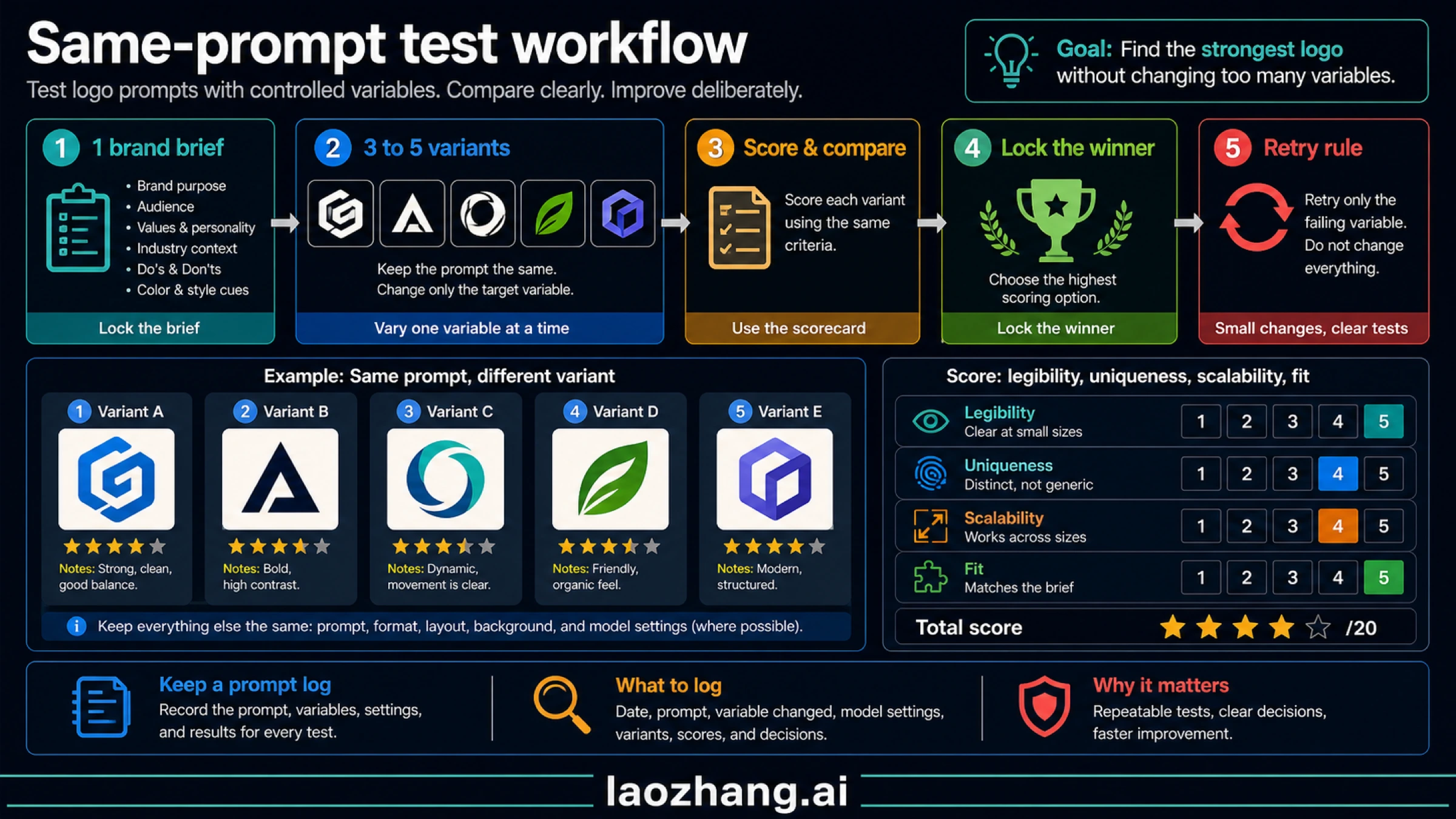
Use this scorecard:
| Criterion | Ask this question | Pass signal | Repair if it fails |
|---|---|---|---|
| Legibility | Can the name or initials be read at small size? | No warped letters, no ambiguous initials | Ask for plain typography and fewer custom cuts |
| Silhouette | Is the mark recognizable in one color? | Shape still reads in black and white | Ask for a simpler outer shape |
| Originality | Does it avoid obvious category cliches? | It does not look like the first icon a stock site would show | Replace the metaphor or add a brand-specific constraint |
| Brand fit | Does it match the audience and tone? | The mark feels plausible for the buyer | Tighten personality words and remove conflicting adjectives |
| Production path | Can a designer redraw it? | Clear structure, simple colors, no tiny effects | Ask for flat, vector-friendly geometry |
The winner is not the prettiest raster. The winner is the direction that survives the smallest-size check, the black-and-white check, and the brand-fit check with the fewest repairs.
Repair prompts for common logo failures
Use repair prompts when the concept is close enough to keep. If the logo job is wrong, go back to the template selector instead.
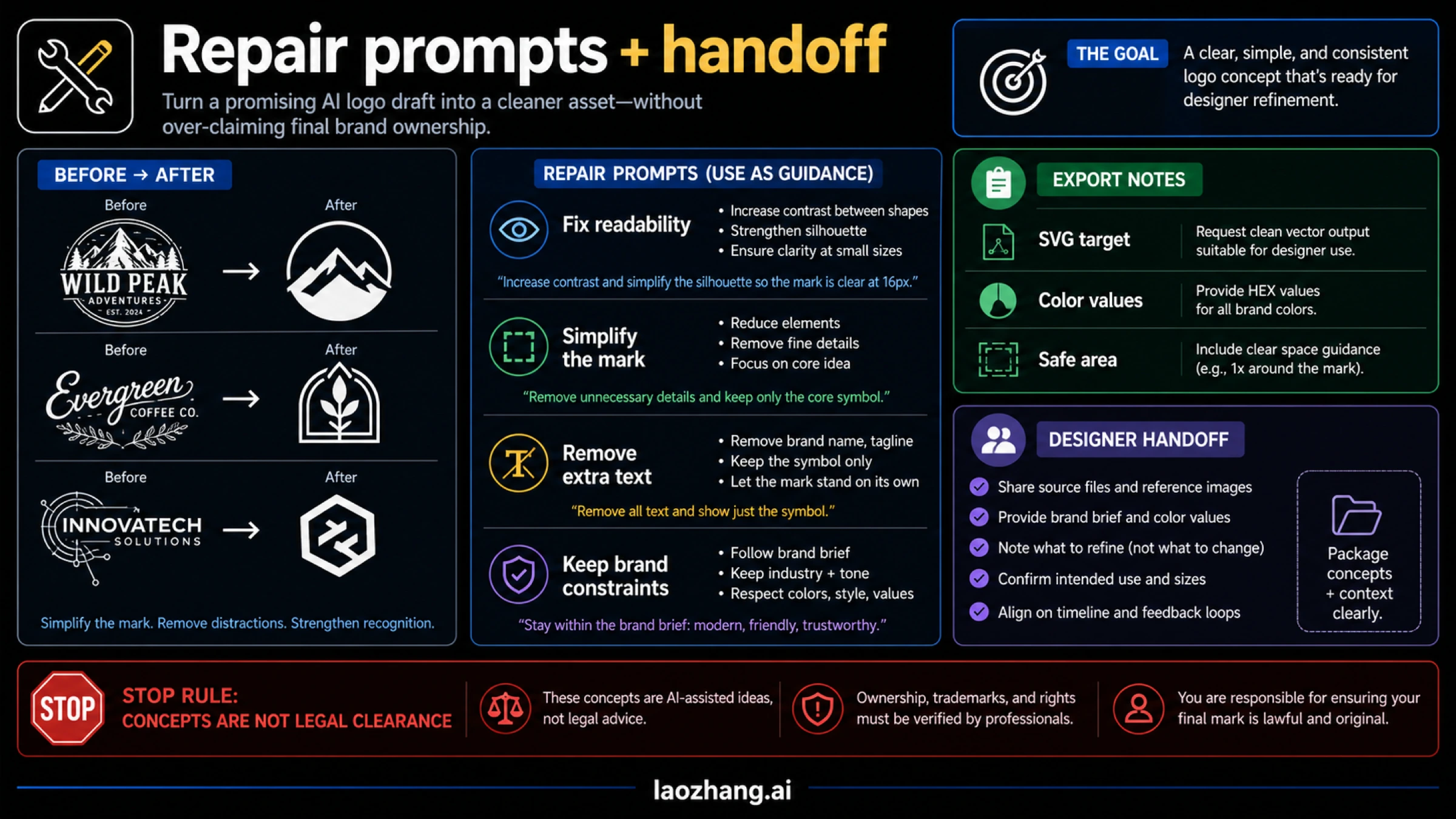
| Failure | Repair prompt |
|---|---|
| The wordmark is misspelled or warped. | "Keep the same overall direction, but rebuild the wordmark with clear, correctly spelled text. Use simpler letterforms, fewer custom cuts, and no decorative distortion." |
| The icon has too many details. | "Simplify the mark into a stronger silhouette. Remove secondary objects, tiny lines, shadows, textures, and background scene elements." |
| The output looks generic. | "Keep the logo job, but replace the generic metaphor with [brand-specific metaphor]. Preserve the palette and make the shape less stock-like." |
| The colors drift away from the brand. | "Regenerate the same logo direction using only [approved colors]. Do not introduce gradients, extra accent colors, or metallic effects." |
| The mascot is too illustrative. | "Convert the mascot into a logo-ready icon: one head shape or one gesture, flat geometry, no detailed body, no scene, no tiny accessories." |
| The badge has unreadable rim text. | "Remove small rim text and keep only the brand name or central mark. Make the badge work without secondary wording." |
| The mark resembles a protected logo. | "Change the concept so it no longer resembles [protected mark or competitor]. Use a different metaphor, different geometry, and a different layout." |
Do not use repair prompts to force a bad direction into production. Use them to test whether one weak dimension can be fixed without damaging the rest of the mark.
Nano Banana 2 vs Nano Banana Pro: where the route matters
The prompt workflow above works across Nano Banana-capable surfaces, but the route still matters when you decide how much pressure to put on a result.
As checked on June 22, 2026, Google's Gemini image generation docs describe Gemini 3.1 Flash Image as the speed and high-volume lane, while Gemini 3 Pro Image is positioned for professional asset production. Google's own Nano Banana prompting guide also treats structured prompts and reference workflows as first-class prompting patterns, not as decoration. In the Gemini app help flow, Google presents Nano Banana 2 as the default create/edit route and Nano Banana Pro as a paid-subscriber regeneration option.
Those facts support a practical split:
| Need | Better first route | Why |
|---|---|---|
| Many early logo directions | Nano Banana 2 or the default Nano Banana-capable surface | You need iteration volume more than final polish |
| Text-heavy wordmark pressure | Nano Banana Pro when available | Text fidelity and structure matter more |
| Complex brand-system exploration | Nano Banana Pro when available | The prompt carries more constraints and comparison pressure |
| Early idea screening | Nano Banana 2 or default surface | You are still testing logo jobs and metaphors |
Official references: Google's Nano Banana prompting guide, Gemini API image generation docs, Gemini 3 Pro Image model docs, and Gemini Apps image generation help. Avoid turning this into a price claim unless you are looking at the current pricing page in the same session; pricing and quotas move faster than a prompt template page should.
Designer handoff checklist
Before handing a generated logo direction to a designer, package the decision so it can be redrawn, reviewed, and challenged.
- Best direction: include the selected output and two rejected alternatives.
- Prompt record: include the exact template, brief fields, and repair prompts used.
- Use context: state whether the mark is for a website header, app icon, pitch deck, packaging, signage, or avatar.
- Color notes: list intended color values if known, plus a black-and-white check.
- Shape notes: explain what must survive in vector redraw and what can change.
- Rights note: record protected marks, competitor cues, and symbols to avoid.
- Open questions: list anything the AI output did not settle, such as typography licensing, final vector construction, or trademark review.
The handoff keeps the AI output in the right role: a fast direction, not a finished legal identity.
FAQ
Can I copy these Nano Banana logo prompts exactly?
Yes, but replace every bracketed field first. The template is the structure. The brand brief is what makes the output yours.
Which prompt should I start with?
Start with the logo job. Use wordmark prompts when the name must lead, icon prompts when the symbol must lead, monogram prompts when initials are distinctive, badge prompts for contained marks, and system prompts when you need multiple related outputs.
Is Nano Banana Pro always better for logos?
No. Use the default or Nano Banana 2-style iteration lane for early exploration. Escalate to Nano Banana Pro when the result needs stronger text fidelity, more complex structure, or professional-asset pressure. Check the current product surface before relying on availability.
Can AI logo output be used as a final logo?
Treat it as a direction until a human reviews rights, redraws or cleans the vector asset, checks small-size behavior, and confirms the brand system. A generated raster is not trademark clearance.
How do I fix bad logo text?
Do not just ask for "better text." Ask for clear, correctly spelled text, simpler letterforms, fewer custom cuts, no distortion, and a black-and-white proof. If the model still fails, move the text work to a designer.
Should I imitate a famous logo style?
No. Name the qualities you want, such as geometric, friendly, editorial, premium, playful, or high-contrast. Do not ask for protected brand imitation, competitor copying, or trademark-safe claims.