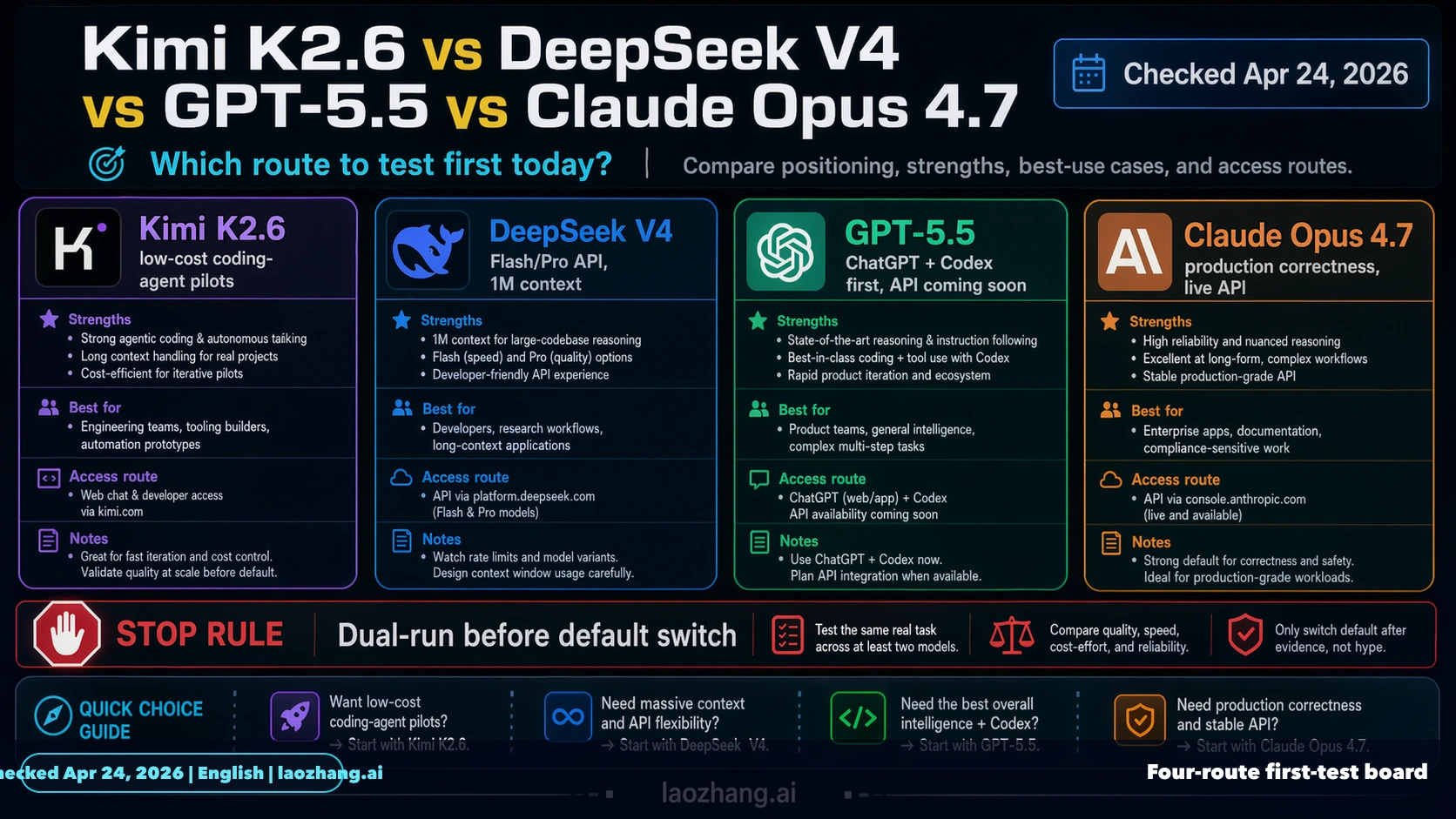
All four model families have documented API options, including GPT-5.5. For budget-sensitive text coding tasks, DeepSeek V4 Flash is a useful low-cost candidate to test; Kimi K2.6 is another candidate when its context and multimodal inputs fit the work. GPT-5.5 and Claude Opus 4.7 give you larger context windows than Kimi K2.6, but their higher token prices need to earn their place through accepted results or lower review effort.
This compares the named models using documentation checked on September 7, 2026. It is not a ranking of every vendor's newest release, and none is an automatic winner for your repository. The useful question is what it costs to finish a task that passes your tests and review.
API access and context at a glance
| Model | Official API model ID | Documented context | A practical reason to include it |
|---|---|---|---|
| Kimi K2.6 | kimi-k2.6 | 262,144 tokens | Compare its coding workflow and text, image or video inputs if your task fits within this context. |
| DeepSeek V4 Flash | deepseek-v4-flash | 1M tokens | Establish a low token-cost baseline for text-based coding tasks. |
| DeepSeek V4 Pro | deepseek-v4-pro | 1M tokens | Test whether a different DeepSeek model improves accepted results enough to justify the higher rate. |
| GPT-5.5 | gpt-5.5 | 1,050,000 tokens | Evaluate a documented OpenAI API model in your existing Responses or Chat Completions integration. |
| Claude Opus 4.7 | claude-opus-4-7 | 1M tokens | Compare against an established Claude integration or an existing Opus baseline. |
Sources: Kimi K2.6 specifications and pricing, DeepSeek models and pricing, GPT-5.5 model details, and Claude long-context pricing.
DeepSeek V4 is the model family compared here. DeepSeek V2 is a different, older model; substituting V4 specifications under a V2 heading would produce a misleading comparison.
GPT-5.5 is no longer an API-access question waiting for a future announcement: its current model page lists Responses, Chat Completions and Batch support, with a 128,000-token maximum output. Anthropic's lifecycle page lists Opus 4.7 as Active. These are documented product states, not a promise about a particular account's credentials or quota.
A context window is a capacity limit, not the amount of a repository that a model will reliably understand. Tools, conversation history, retrieved files and generated output compete for that capacity. Use the files needed for the task and measure the actual request rather than converting tokens into a fixed number of code files.
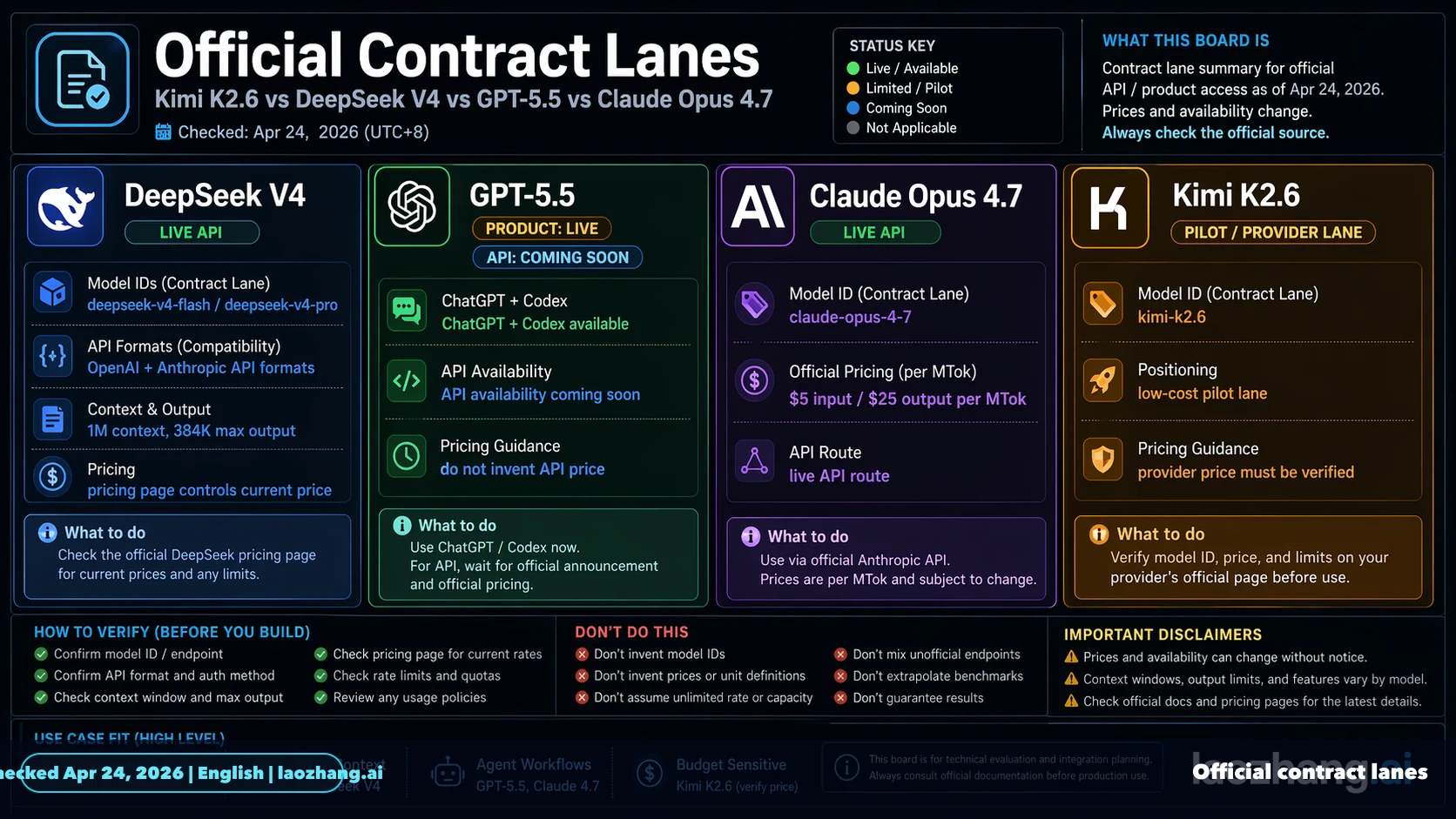
Current token prices, with the conditions that change the bill
The table uses prices per one million tokens. Kimi prices below are in Chinese yuan (CNY) from its Chinese platform page; the other rows are in US dollars (USD). They have not been converted to a common currency.
| Model and billing condition | Uncached input | Cached input read | Output |
|---|---|---|---|
| Kimi K2.6 — CNY | ¥6.50 | ¥1.10 | ¥27.00 |
| DeepSeek V4 Flash — USD, peak | $0.44 | $0.014 | $1.32 |
| DeepSeek V4 Flash — USD, off-peak | $0.22 | $0.007 | $0.66 |
| DeepSeek V4 Pro — USD, peak | $1.32 | $0.044 | $3.96 |
| DeepSeek V4 Pro — USD, off-peak | $0.66 | $0.022 | $1.98 |
| GPT-5.5 — USD, standard short-context rate | $5.00 | $0.50 | $30.00 |
| Claude Opus 4.7 — USD, standard | $5.00 | $0.50 | $25.00 |
These rows come from the current Kimi, DeepSeek, OpenAI and Anthropic documentation, not a blended comparison-site price.
Three details materially change this table's use:
- DeepSeek peak hours are Monday through Friday, 01:00–04:00 and 06:00–10:00 UTC. Other times use the off-peak rates. Record request time when estimating a recurring workload.
- GPT-5.5 prompts above 272K input tokens incur 2× input and 1.5× output pricing for the full session under the documented standard, Batch and Flex rules. Do not apply the short-context row to a large-context run. Regional processing adds a separate uplift.
- Claude cache creation is separately priced: Opus 4.7 charges $6.25 per million tokens for a five-minute cache write and $10 for a one-hour write. The $0.50 row is a cache read. Anthropic includes the 1M context window at standard token rates.
API token prices also exclude any separately charged tools and your own infrastructure. A coding agent can make multiple model requests and repeat context along the way; a single request estimate is not the price of the whole task.
What does a request cost in practice?
Here is a hypothetical accounting example: 100,000 uncached input tokens and 10,000 output tokens, with no tool fees, cache writes, Batch discount or regional modifier. The quantities are deliberately identical for calculation; this is not a claim that the same text produces identical token counts across models.
| Model | Calculation | Request cost |
|---|---|---|
| Kimi K2.6 | 0.1 × ¥6.50 + 0.01 × ¥27.00 | ¥0.92 CNY |
| DeepSeek V4 Flash, peak | 0.1 × $0.44 + 0.01 × $1.32 | $0.0572 USD |
| DeepSeek V4 Pro, peak | 0.1 × $1.32 + 0.01 × $3.96 | $0.1716 USD |
| GPT-5.5 | 0.1 × $5.00 + 0.01 × $30.00 | $0.80 USD |
| Claude Opus 4.7 | 0.1 × $5.00 + 0.01 × $25.00 | $0.75 USD |
The two DeepSeek examples cost half as much off-peak. Kimi's yuan result needs a dated exchange rate and any actual payment costs before you compare it with the dollar rows.
To evaluate a coding workflow, expand the calculation:
Cost per accepted task = (model charges for all attempts + tool and infrastructure charges + review and correction cost) ÷ accepted tasks.
Use one currency throughout. Count failed attempts in the numerator. If no task passes, report the spend and failures; do not calculate a cost per accepted task by dividing by zero. Review time can be reported separately in minutes if your team does not use an internal hourly cost.
Run two coding tests before changing your default
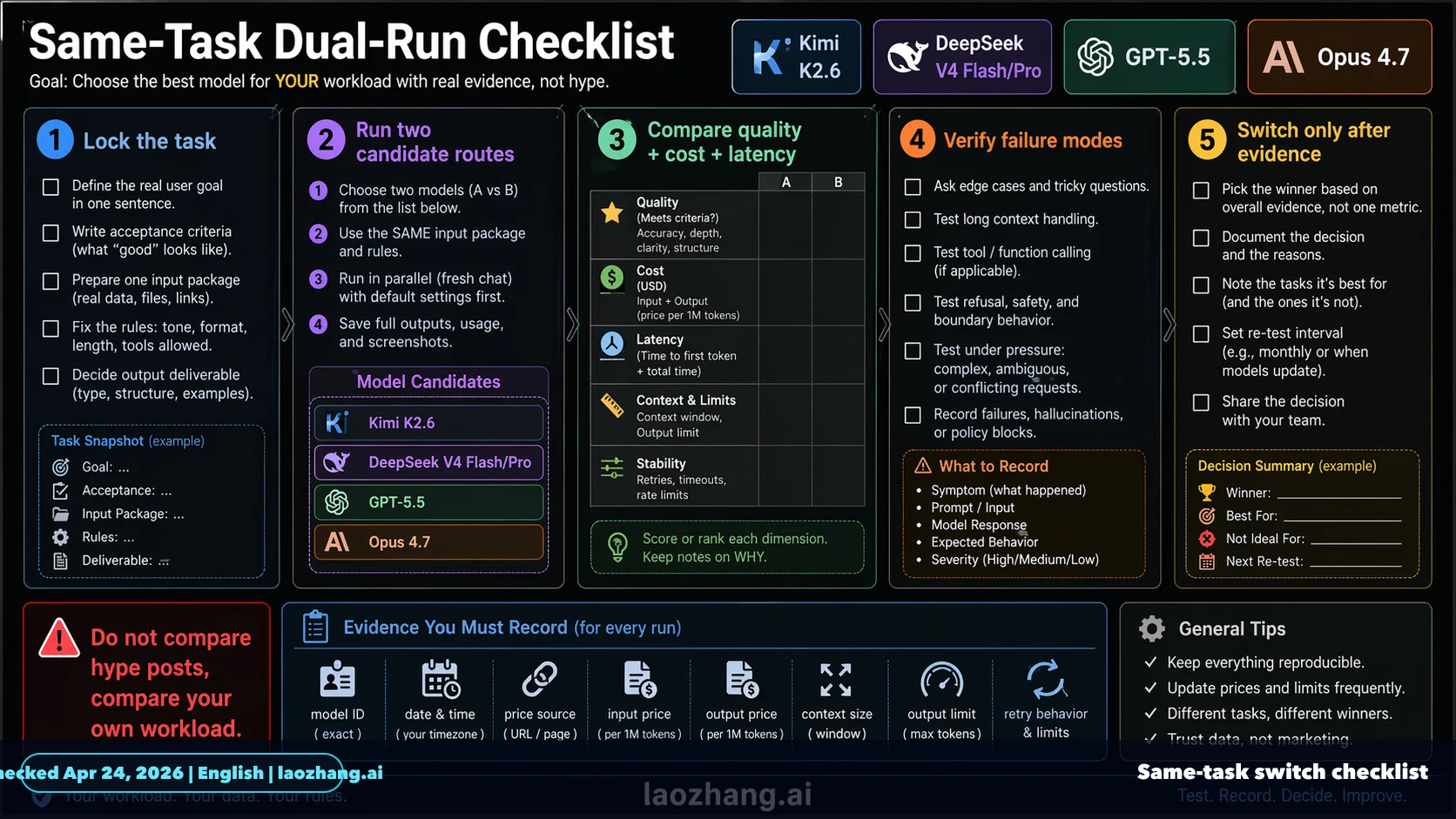
Keep token cost, defects, reviewer time and integration work separate. Use two tasks from your own backlog to compare them:
- A bug fix across several files. Start from a pinned repository commit and a reproducible failing test. Give each model the same issue, allowed tools and execution budget. Check whether the patch fixes the failure without breaking the regression suite, and record manual corrections.
- A refactor with an unchanged public interface. Use a task where tests already describe the expected behavior. Check compatibility, unnecessary changes and whether the model can recover from a failed tool call. Record how much of the diff a reviewer accepts.
Keep the agent harness, repository state and tool permissions consistent. Use each model's supported settings and record its reasoning mode; forcing identical parameter names onto incompatible APIs is not a fair comparison. Repeat tasks when you need to distinguish an isolated success from reliable behavior.
| Record for each run | What it tells you |
|---|---|
| Exact model ID, provider and reasoning settings | Which configuration produced the result |
| Input, cached, output and retry usage | The actual billable work, including unsuccessful attempts |
| Test results and accepted diff | Whether the task was completed correctly |
| Reviewer minutes and manual edits | Whether lower token cost shifted work to people |
| Elapsed time, tool failures and recovery | Whether the workflow is practical to operate |
Choose your acceptance criteria before running the comparison. A security-sensitive change may tolerate no unresolved security defect, while a draft test-generation task may allow more review. Those are team policies, not universal rules such as “three defects” or “twice the review time.”
How to use public benchmarks without turning them into a guarantee
The Artificial Analysis comparison of GPT-5.5 and Kimi K2.6 separates output speed, time to first token, token use and cost per task. Its displayed blended token price uses a particular cache/input/output mix, and its headline intelligence values were marked as estimates when checked.
That distinction matters for a coding agent: fast output can coexist with a long wait before the answer, and cheap cached input may contribute little to a workload that rarely reuses a prefix. Use public results to identify candidates, then use the two tasks above to decide whether the candidate improves your own cost or completion rate.
If you already have a working integration, include it as the baseline. Keeping that model while testing one alternative is usually easier to interpret than changing the model, agent software and prompt at the same time. For a narrower shortlist, the Kimi K2.6 and Claude Opus 4.7 comparison and GPT-5.5 and Claude Opus 4.7 comparison cover those pairs.