Free AI Image Generation API in 2026: What Is Actually Free?
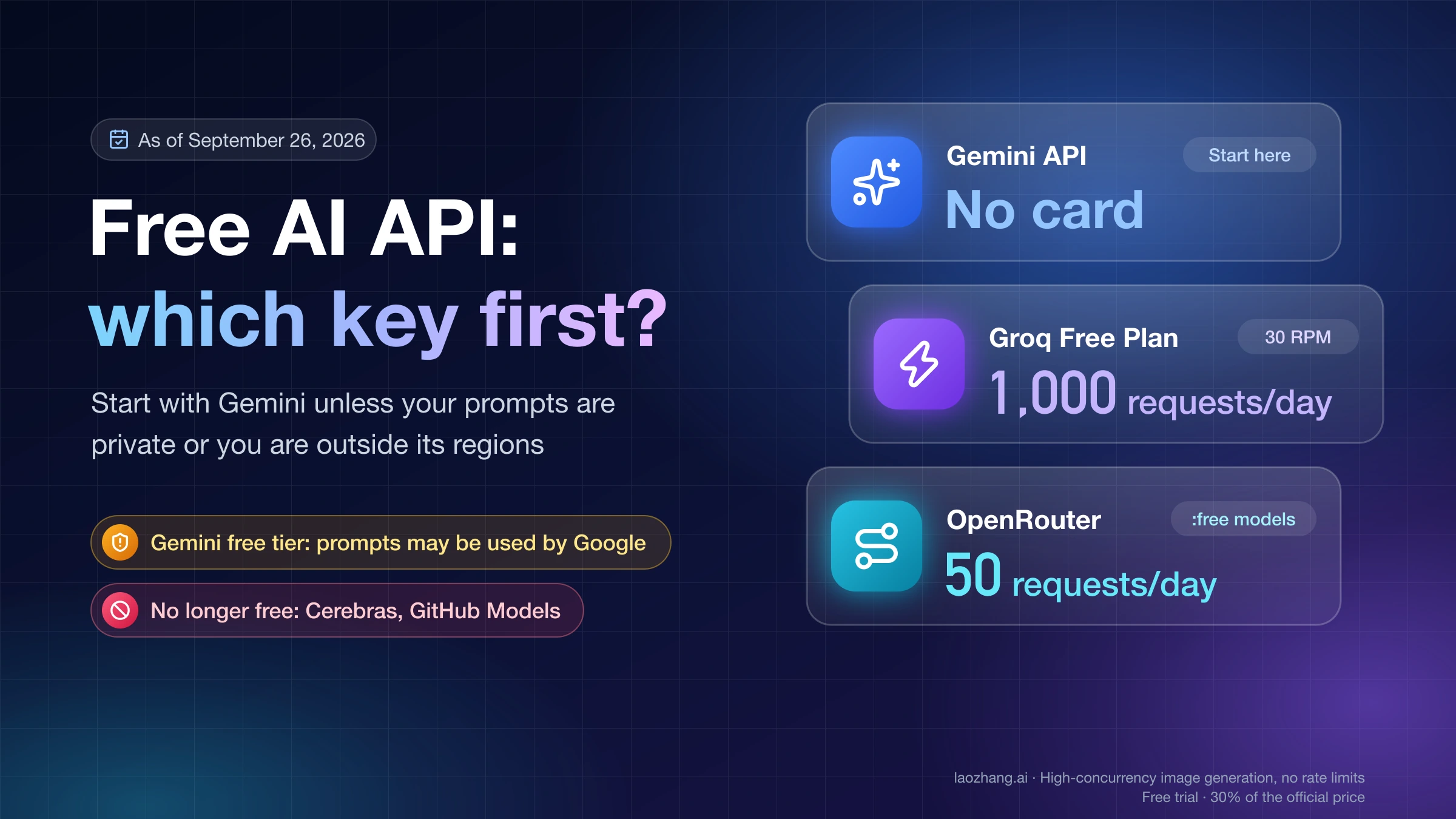
If you want a truly free AI image generation API in 2026, the honest answer is narrower than most search results suggest. The big direct-provider APIs are paid, and the real free options are mostly small testing paths.
On this page
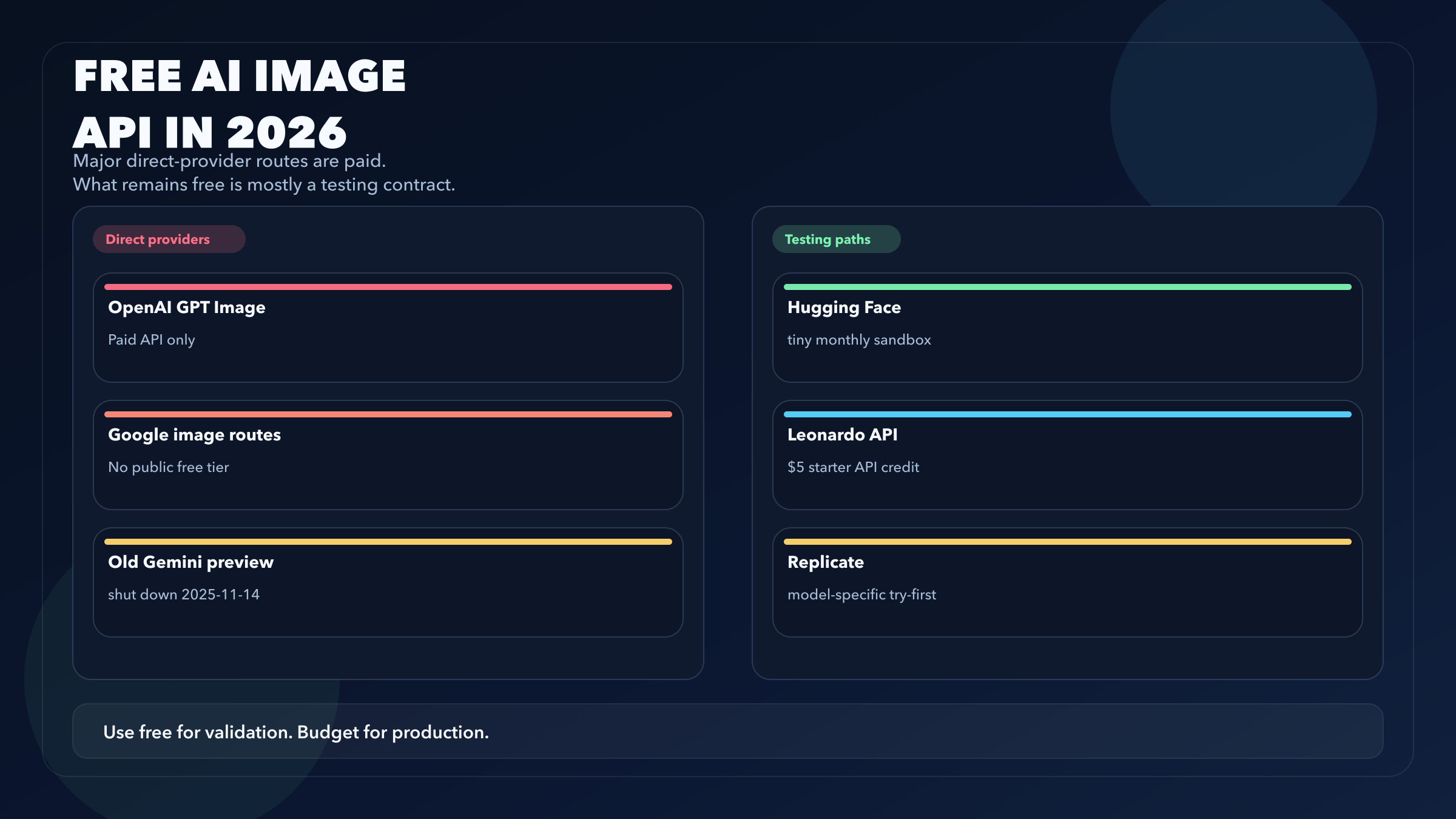
If you want a truly free AI image generation API in 2026, start by deleting one outdated assumption: the mainstream closed-provider routes are no longer cleanly free. OpenAI's current GPT Image models do not support a free API tier. Google's current image pricing pages also show Free Tier: Not available for its major image-generation routes, and the older Google preview path that many blog posts still cite was shut down on November 14, 2025. What still exists is not a durable zero-dollar production API. It is a set of small testing contracts: Hugging Face monthly credits, Leonardo's starter API credit, and some model-specific try-for-free or playground routes on Replicate.
That distinction matters because this keyword is full of stale advice. A page can still rank for free ai image generation api while quietly relying on an old Google preview model, a consumer UI quota, or a one-time trial that was never a real recurring API tier in the first place. If your actual job is shipping an integration, not just clicking around a demo, those differences are the whole decision.
Everything below was rechecked against current official documentation on March 29, 2026. When a vendor's own current contract is limited, ambiguous, or clearly meant for evaluation rather than long-term use, I say so directly instead of smoothing it into a nicer story.
TL;DR
Here is the short answer.
| If your real job is this | Best starting point | Why it wins | Main catch |
|---|---|---|---|
| You want the most honest no-pay API sandbox | Hugging Face Inference Providers | Free accounts still get a small recurring monthly credit, and the docs explicitly support text-to-image through InferenceClient | The included credit is tiny, so it is for smoke tests, not real production traffic |
| You want the biggest explicit API trial budget | Leonardo API | New API accounts start with $5 in free API credit and clear API onboarding | Leonardo explicitly says all API requests consume API credit, so this is a starter credit, not a durable free tier |
| You want to try a specific public model fast | Replicate | Strong model catalog, clear API docs, and some try-for-free or playground-style entry points | The free story is model-specific and not a stable general recurring API entitlement |
| You want direct access to a major closed-provider image API | None of them are cleanly free now | OpenAI GPT Image is paid, and Google's current public image routes no longer offer the old easy free answer | Search results still surface stale Google preview-era advice |
| You need a true long-lived zero-cost image backend | Self-hosting open models, not a managed API | That is the only route that can still become structurally free at volume | You are taking on infra, latency, moderation, and reliability yourself |
The practical takeaway is simple: if you need a real production image API, budget for paid usage from day one. If you only need to validate prompts, latency, UX, or integration shape, then small free testing paths still exist. The mistake is treating those two situations as the same.
Why Most "Free AI Image API" Advice Is Stale
This topic changed faster than a lot of content did. That is why search results still feel misleading.
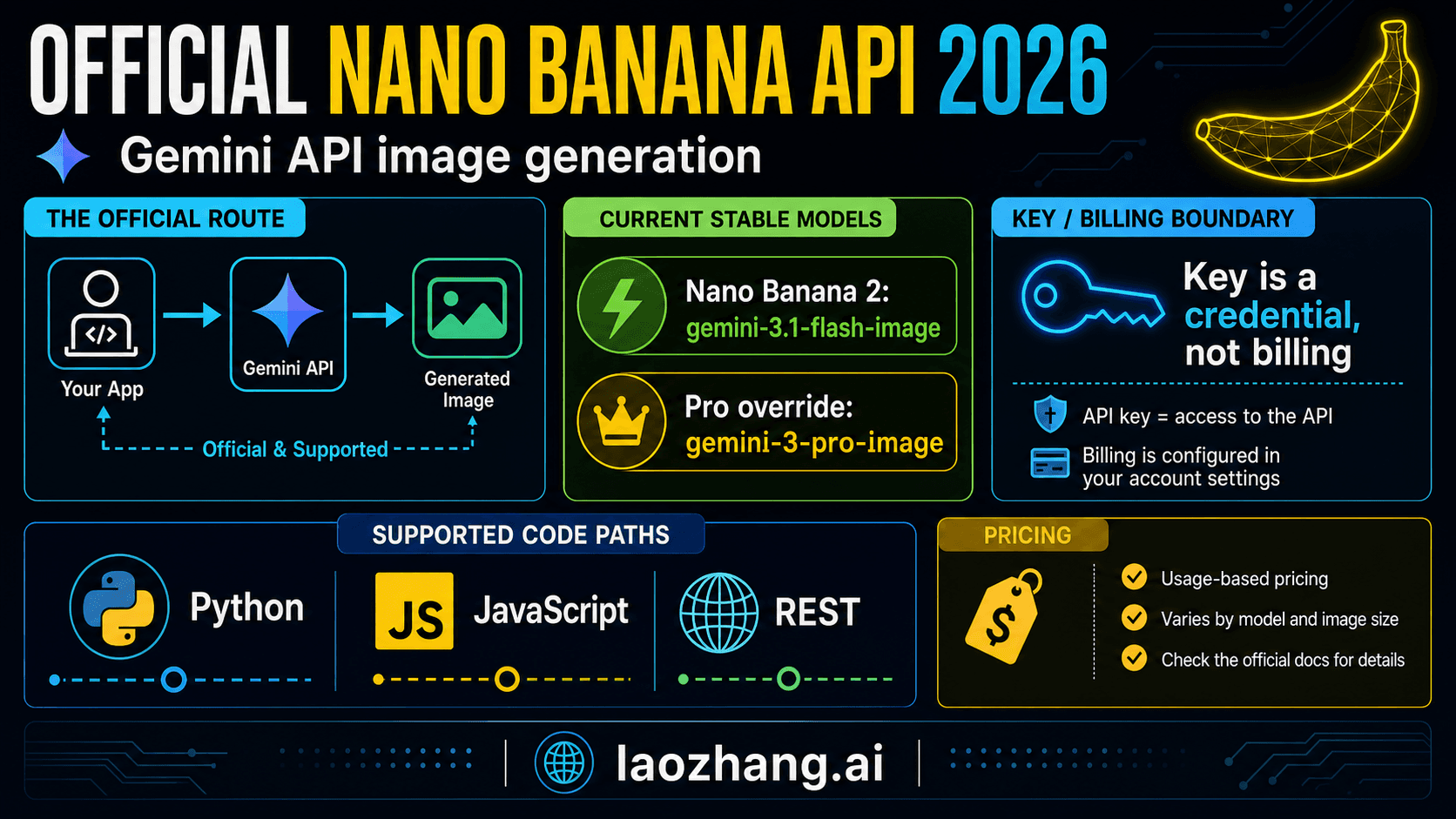
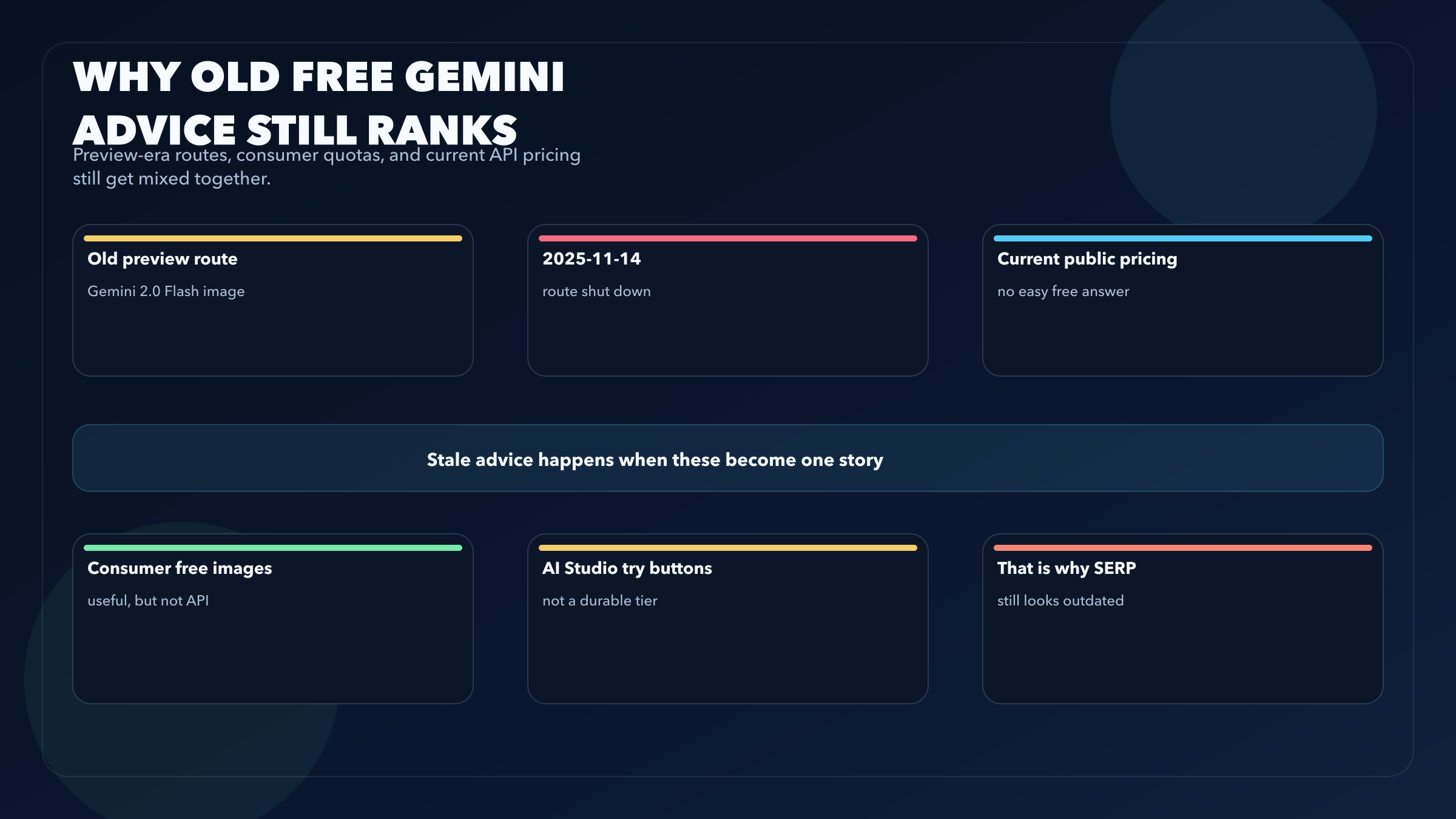
The biggest stale pattern is the old Google answer. Many pages still imply that Google's image API has an easy free path because they are anchored to an earlier preview model or to old quota screenshots. But Google's own changelog shows that gemini-2.0-flash-preview-image-generation, the route behind a lot of those claims, was shut down on November 14, 2025. The same changelog also shows that gemini-2.5-flash-image launched as GA on October 2, 2025, which is exactly the kind of product transition that leaves stale roundups behind. Once that old preview path disappeared, the simple "Google has a free image API, OpenAI doesn't" story stopped being a safe default answer.
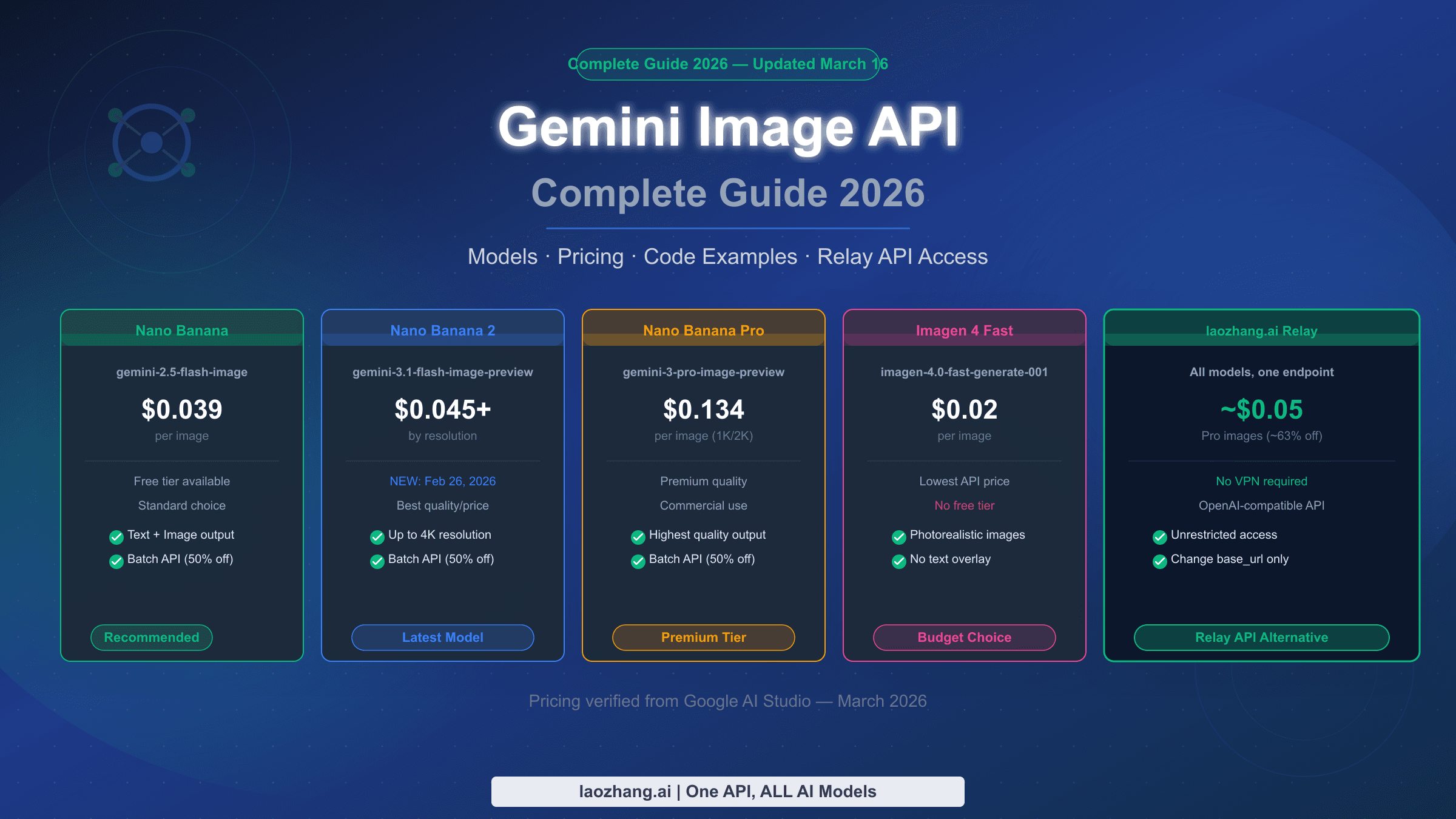
Google's current pricing pages make that gap clearer than many listicles do. Today, the public Gemini pricing docs show Free Tier: Not available for Gemini 3 Pro Image Preview and for Imagen 4 pricing. That does not mean Google has no free image generation anywhere in its consumer products. It does mean you should stop conflating consumer access, AI Studio try-it surfaces, and a durable Gemini API free tier for programmatic image generation. Those are not the same contract.
OpenAI is even less ambiguous. The current OpenAI model docs for gpt-image-1.5, gpt-image-1, and gpt-image-1-mini all show Free: Not supported, and the image generation guide positions gpt-image-1.5 as the latest and most advanced image model. In other words, OpenAI's image API story is straightforward: the flagship routes exist, they are documented, and they are paid.
This is why "what is free?" is the wrong first question unless you also ask free in what sense. Are you talking about a recurring API tier? A new-account credit? A playground run? A consumer app quota? A marketplace account that routes to someone else's paid model? Once you split the category that way, the confusing SERP starts making more sense.
What Is Still Actually Free in API Form
The real answer in 2026 is not "here are ten forever-free APIs." It is "here are the few legitimate low- or no-cost paths that still let you test an image workflow without immediately paying standard production rates."
Hugging Face Is the Cleanest Tiny Recurring Sandbox
If you want the most honest answer to "what still works without paying upfront?" start with Hugging Face Inference Providers. Hugging Face's current pricing and forum support materials still point free users to a very small included monthly credit, and the current Inference Providers docs explicitly support text-to-image through InferenceClient. That matters because it gives you a real programmatic path, not just a marketing promise.
The catch is scale. The included credit is intentionally small. This is not a hidden free production tier. It is a low-friction evaluation path. You can test prompt formatting, provider selection, image delivery, and basic product integration without doing billing setup first, but you should not build a real traffic forecast around it. The value is speed, not volume.
Hugging Face is also structurally different from OpenAI or Google. It is a routing layer and provider marketplace, not one model family with one pricing contract. That can be a strength for experimentation because the same account can expose multiple providers and models through one interface. It also means you should think of Hugging Face as a sandbox and routing layer rather than as a forever-free image model vendor.
For very small developer experiments, though, it is still the cleanest recurring API answer I found in this refresh. If you need to write code, make a real request, inspect output, and stop there, Hugging Face is the least misleading starting point.
Leonardo Gives the Largest Explicit API Trial
Leonardo's API is not free in the long-term sense, but it is refreshingly explicit about the testing path. Leonardo's current API page says that every new API account starts with $5 in free API credit, and its FAQ also says all API requests will cost API credit. That combination is actually helpful. It tells you exactly what you are getting: a real trial budget, not a mystery quota disguised as a free tier.
That makes Leonardo attractive if your evaluation is bigger than a smoke test. You can validate a slightly richer prototype, compare several prompt patterns, or test how a product flow behaves when it is generating more than a handful of images. It is still a testing contract, not an ongoing free home, but it is a more generous and better-labeled testing contract than many competitors offer.
Leonardo is also easier to reason about than a lot of vague "credits included" stories because it does not pretend the API is free after the credit runs out. The company explicitly frames the API as pay-as-you-go and experimentation-friendly, with the starter credit there to help you validate the integration before you spend. That is a much more honest story than a free-plan landing page that never tells you when the free part effectively ends.
If your real sentence is "I need a real API trial, not just a tiny recurring sandbox," Leonardo is the strongest current answer.
Replicate Is Useful, but It Is a Playground Contract More Than a Tier
Replicate is easy to overstate if you are not careful. Its official docs clearly support running public models through a cloud API, and many model pages expose a Playground or a try-first experience. That makes Replicate excellent when your real job is: "I want to touch a specific model quickly and see whether it is worth deeper integration."
But Replicate is not the same thing as a stable general-purpose free image API tier. The free story is model-specific and surface-specific. Some model pages can be tried in a Playground. Some models appear in broader "try for free" collections. Some require billing sooner. And some provider-hosted listings still depend on the upstream vendor's own paid contract. Replicate's listing for GPT Image 1.5 is a good example: the page is useful, but it still tells you to bring a verified OpenAI API key, which means the underlying model remains paid even if the access surface feels more accessible.
That does not make Replicate weak. It makes Replicate a different kind of answer. It is a strong model exploration platform and a useful integration layer. It is just not the cleanest "free AI image API" answer if what you mean is a lasting, predictable, no-pay API quota you can revisit every month.
Use Replicate when the model catalog is the value. Do not confuse that with a durable free-tier contract.
What To Stop Confusing With a Free API
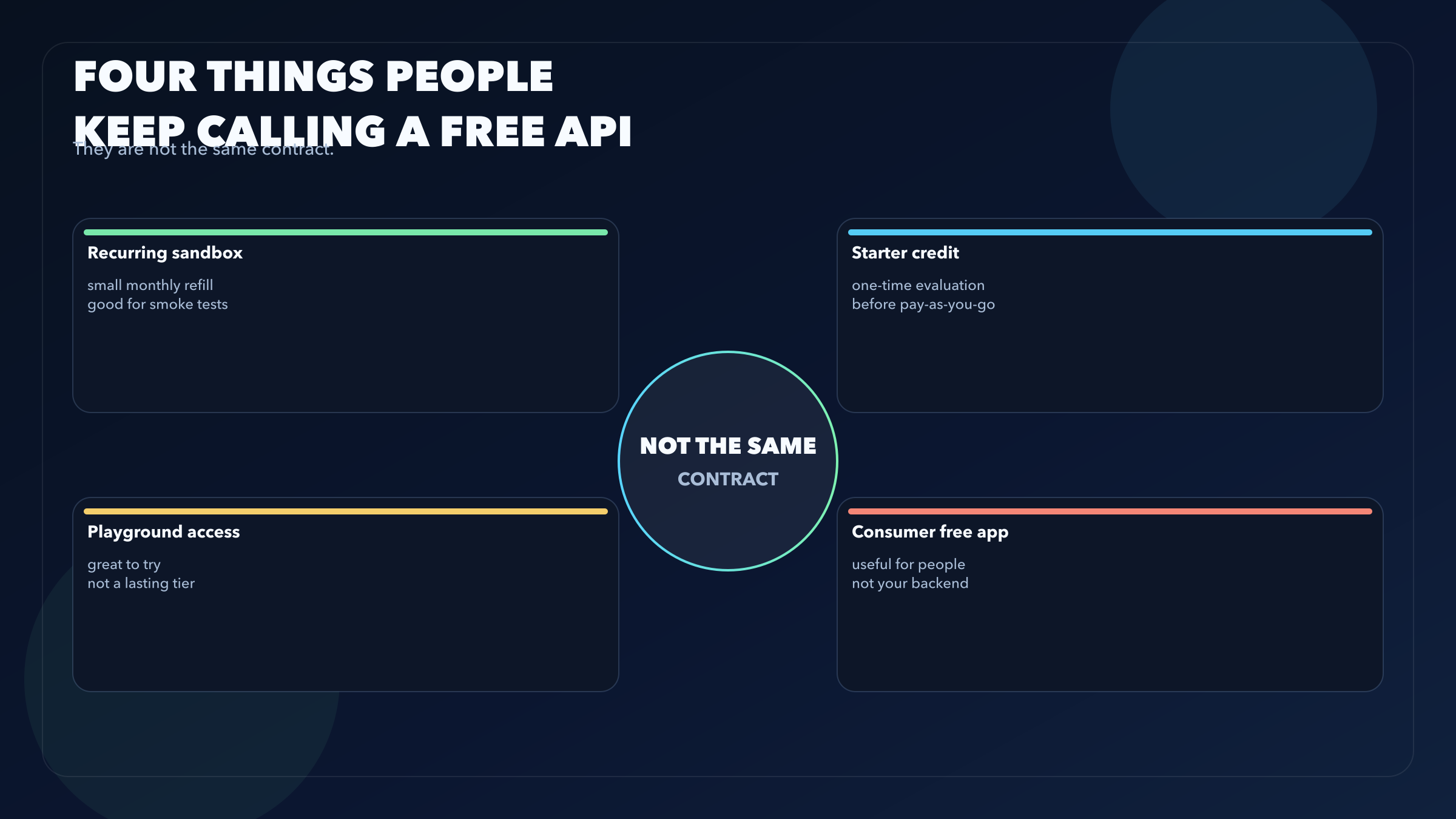
A lot of wasted evaluation time comes from mixing up four different things.
A consumer image product is not an API contract. Gemini's consumer image allowance and ChatGPT's consumer image features may be useful if you are just trying to make images. They are not the same thing as a programmable image-generation API tier that your app can depend on.
A preview model is not a forever route. The old Google preview path is exactly why this distinction matters. If an article's free answer depends on a preview model, you need to ask whether that model is still alive, whether the model ID changed, and whether the free quota survived the product transition. Often it did not.
A trial credit is not the same as recurring free usage. Leonardo is a good example of a legitimate test-credit contract. It is useful. It is also different from a monthly free allowance that refills on its own.
A playground run is not the same as an API free tier. Replicate's try-first surfaces help you evaluate models. That does not automatically mean you have a lasting free API entitlement for production code.
Once you separate those categories, the market stops looking contradictory. The contradiction was mostly in the language.
Which Option Should You Pick?
The right pick depends on the size and seriousness of your evaluation.
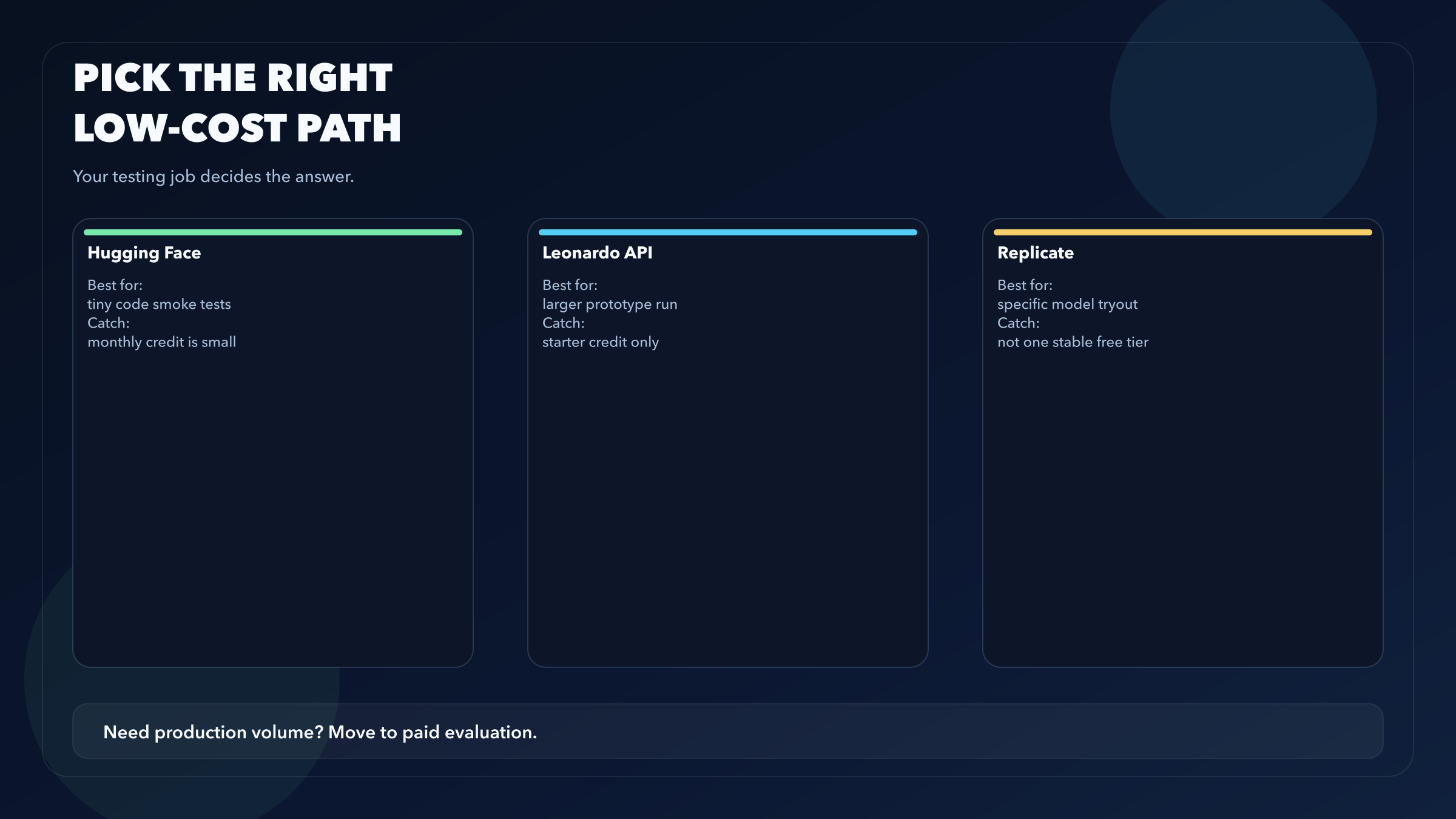
If you want to write a few real requests, validate prompt shape, and prove your frontend or backend wiring works, start with Hugging Face. It is the cleanest recurring no-pay API sandbox, even though the credit is tiny.
If you want a more substantial proof of concept and you are comfortable with the fact that the free part is a starter credit, start with Leonardo API. It gives you more room to test a real feature flow before you switch to pay-as-you-go.
If you mainly care about touching a specific model or browsing the model landscape quickly, use Replicate. It is strongest as a model access layer and exploration environment, not as the clearest free-tier contract.
If you already know you need predictable volume, latency planning, or a production commitment, stop looking for a magical free answer and move directly to a paid comparison. That is where our broader AI image generation API comparison becomes the more useful read.
What If You Actually Need a Production Image API?
Then the best answer is not "find the cleverest free loophole." The best answer is to decide how much you are willing to pay and which tradeoff matters most.
For major direct providers, the current contract is clear. OpenAI's GPT Image family is paid. Google's current public image pricing pages no longer give the old free-preview answer many posts still imply. That means a production team should evaluate image APIs on price, quality, rate limits, editing support, compliance, and routing flexibility, not on a free-tier rumor that may already be dead.
If you do not need an API at all and really just want a free image tool, read our best free AI image generator guide instead. That is a different market. If you do need an API and want the full paid landscape, use the 2026 AI image generation API comparison.
There is one exception to the "paid from day one" rule: self-hosting open image models. If you control the infra, your marginal cost can eventually become very low or effectively zero for some workloads. But that is not a managed API answer. It is a systems and operations answer. You are trading vendor pricing for GPU cost, latency control, reliability engineering, and your own moderation burden. That may be the right move for some teams. It is just a different article.
FAQ
Is there any truly free mainstream AI image generation API in 2026?
Not from the major closed providers. OpenAI's GPT Image API does not support a free tier, and Google's old free-preview image API answer is no longer a safe current default.
Is Google Gemini image generation still free through the API?
The old easy answer is outdated. Google's older preview image-generation route was shut down on November 14, 2025, and the current public pricing pages for major Google image routes such as Gemini 3 Pro Image Preview and Imagen 4 show Free Tier: Not available.
Is OpenAI's image API free?
No. OpenAI's current model pages for gpt-image-1.5, gpt-image-1, and gpt-image-1-mini all show Free: Not supported.
What is the best free AI image generation API for testing?
For a tiny recurring no-pay sandbox, Hugging Face is the cleanest answer. For a larger explicit trial budget, Leonardo is stronger because every new API account starts with $5 in free API credit.
Is Replicate a real free image API?
It is better understood as a model platform with some try-first surfaces than as one simple recurring free tier. It is very useful, but the free story is model-specific and sometimes still depends on the upstream provider's paid contract.
What if I only need a free image tool, not an API?
Then this is the wrong category. Use our best free AI image generator guide, which is about consumer and creator-facing tools rather than programmatic integrations.