Claude Capybara vs Opus 4.6: Should You Wait or Use Opus Now?
Claude Capybara is not a public Anthropic model contract you can select today. Anthropic's public docs still point to Claude Opus 4.6 as the top shipping model, while Capybara remains a leak-backed future-tier signal. Here's how to decide whether to use Opus 4.6 now or keep Capybara on your roadmap watchlist.
On this page
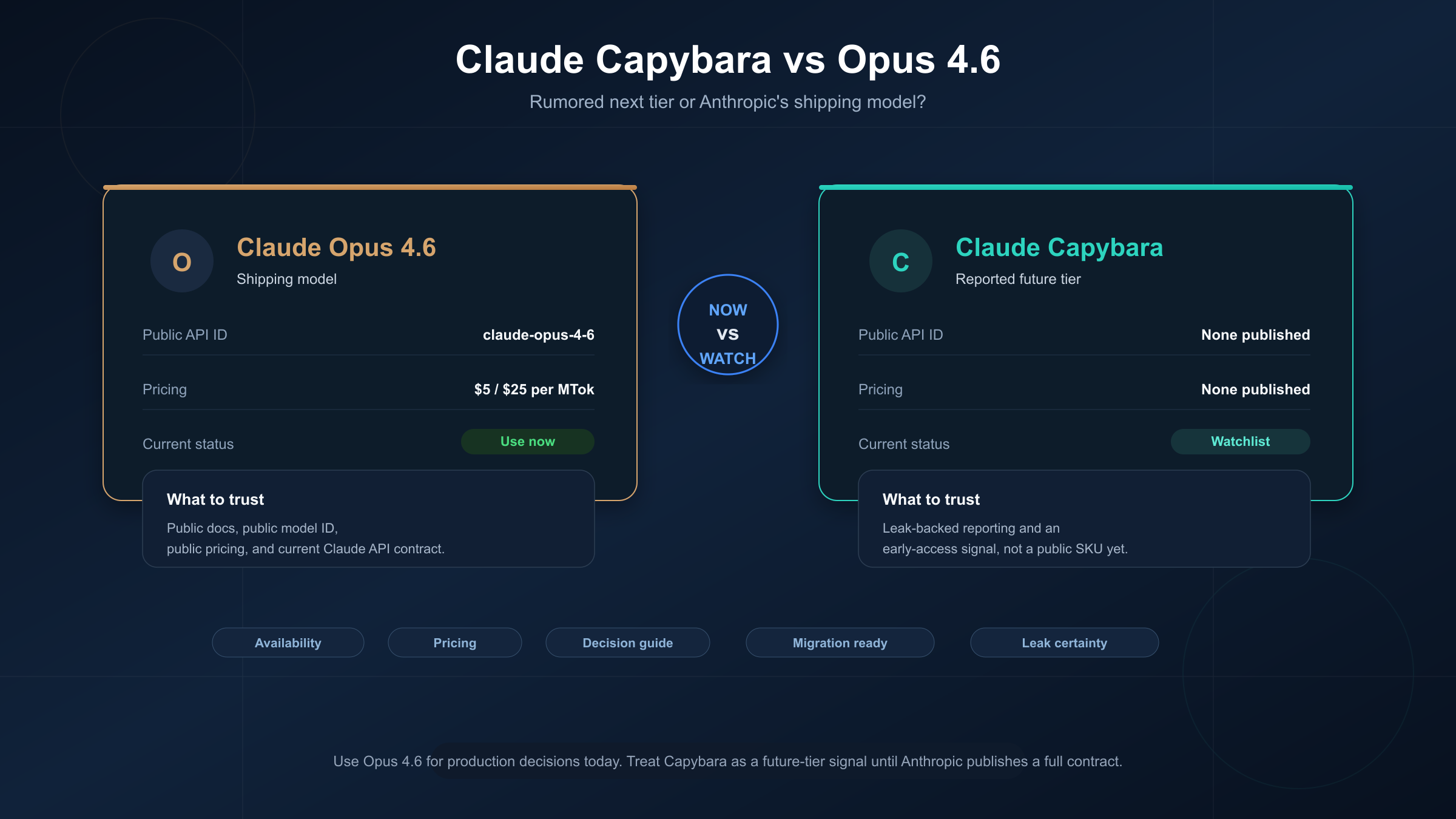
Claude Capybara is not a public Anthropic model you can select today. As of March 28, 2026, Anthropic's public docs still point developers to Claude Opus 4.6 as the top shipping Claude model, with a public API ID, public pricing, and documented limits. Capybara, by contrast, appears only in leak-backed reporting around a more capable early-access system that Anthropic says it is testing with a small group of customers.
That makes the decision much simpler than the headline suggests. If your choice is operational right now, use Claude Opus 4.6. Only keep Claude Capybara on your watchlist if you are explicitly scouting the next frontier tier, preparing evaluation harnesses for a future release, or tracking how Anthropic's top-end roadmap may change over the next few months.
TL;DR
| If your question looks like this... | Best answer right now |
|---|---|
| "Which Claude model can I actually route production traffic to today?" | Claude Opus 4.6 |
| "Is Claude Capybara already a public Anthropic model?" | No |
| "Should I wait for Capybara before I build?" | Usually no |
| "When is Capybara worth tracking?" | When you are doing future-tier scouting, not current deployment |
Evidence note: This article was checked on March 28, 2026 against Anthropic's public model documentation and a March 26, 2026 Fortune report quoting Anthropic about a more capable early-access model. That means Opus 4.6 facts below are public-product facts. Capybara facts remain provisional unless Anthropic publishes them directly.
What Claude Capybara Actually Is Right Now
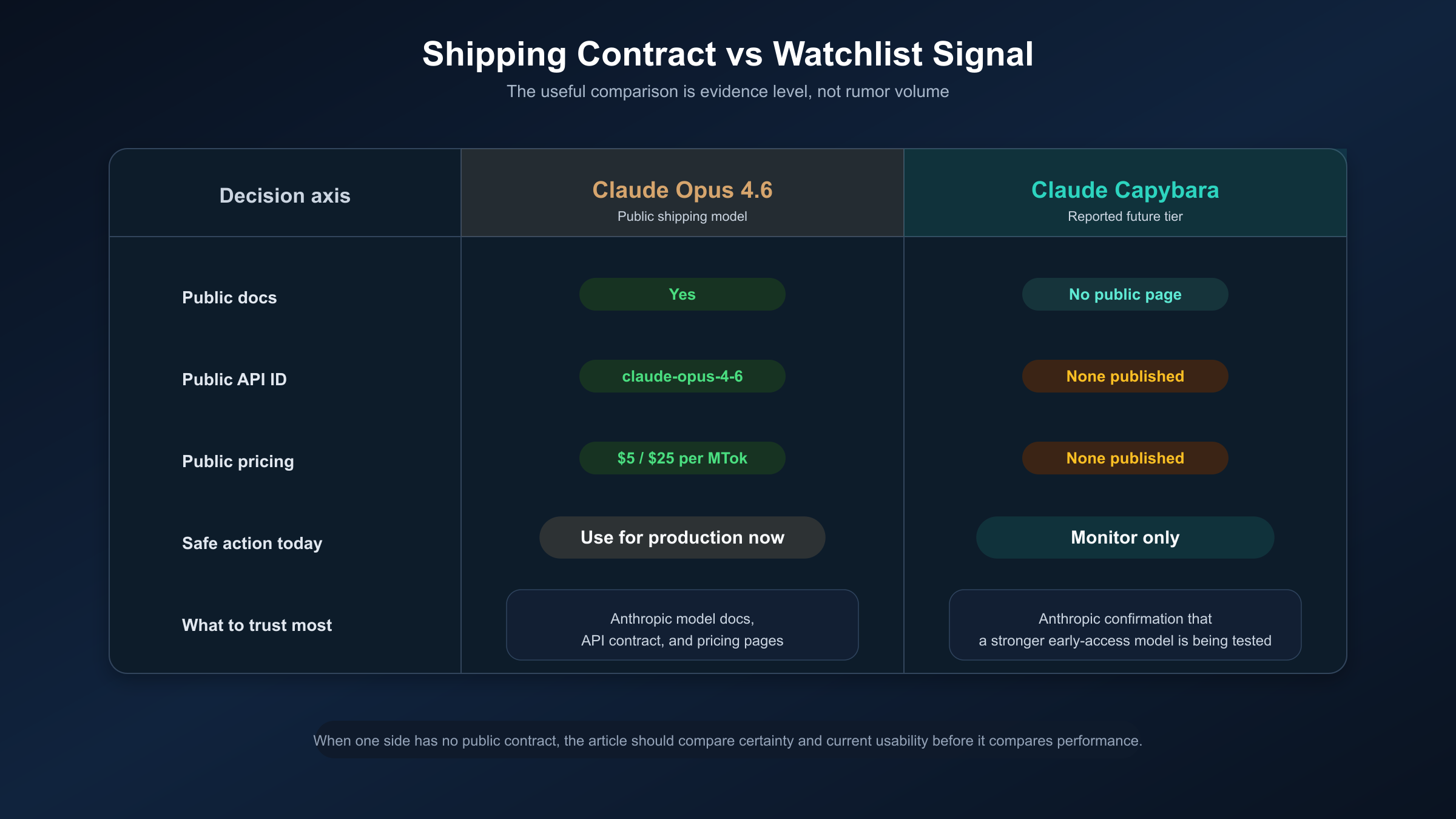
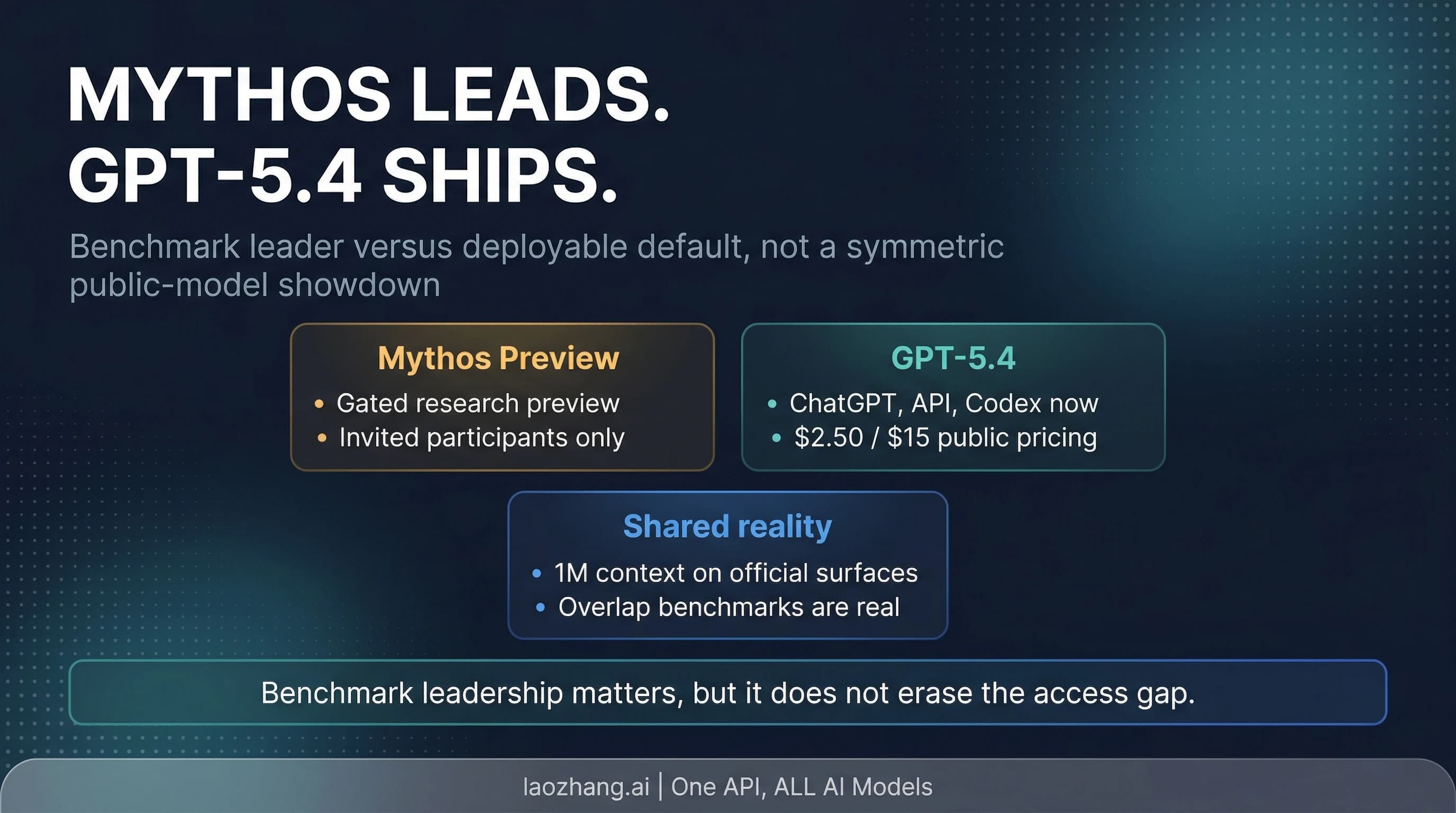
The most important thing to understand is that Claude Capybara is not a public Anthropic SKU in the same way Opus 4.6 is. There is no public Anthropic model page today that lists a Capybara API ID, no public pricing card you can budget from, and no public launch note you can hand to procurement or engineering and say, "this is now our production choice."
Where the name comes from is much narrower. On March 26, 2026, Fortune reported that Anthropic acknowledged it is developing and testing a new model with early-access customers and described it as a "step change" in capability and the most capable system it has built to date. The same report said leak-backed draft material referred to the new system as Claude Mythos and described Capybara as a new tier above Opus. That is important enough to watch, but it is still not the same thing as a public launch contract.
This distinction matters because a lot of model-comparison content quietly erases it. Once an unpublished system gets a memorable codename, people start talking about it as if it already has a stable price, stable latency, stable rate limits, stable benchmark methodology, and a stable rollout path. None of that is public yet here. The responsible reading is narrower: Anthropic appears to be testing something stronger than Opus 4.6, and Capybara is one name connected to that effort. That is real enough to monitor, but not real enough to plan against as if it were already in the model picker.
If you are trying to answer the question, "Can I use Claude Capybara today?" the honest answer is therefore no, not as a public model contract. If you are trying to answer the slightly different question, "Should I pay attention to the name Capybara?" the answer is yes, but as roadmap intelligence rather than as a current deployment target.
What Opus 4.6 Gives You Today
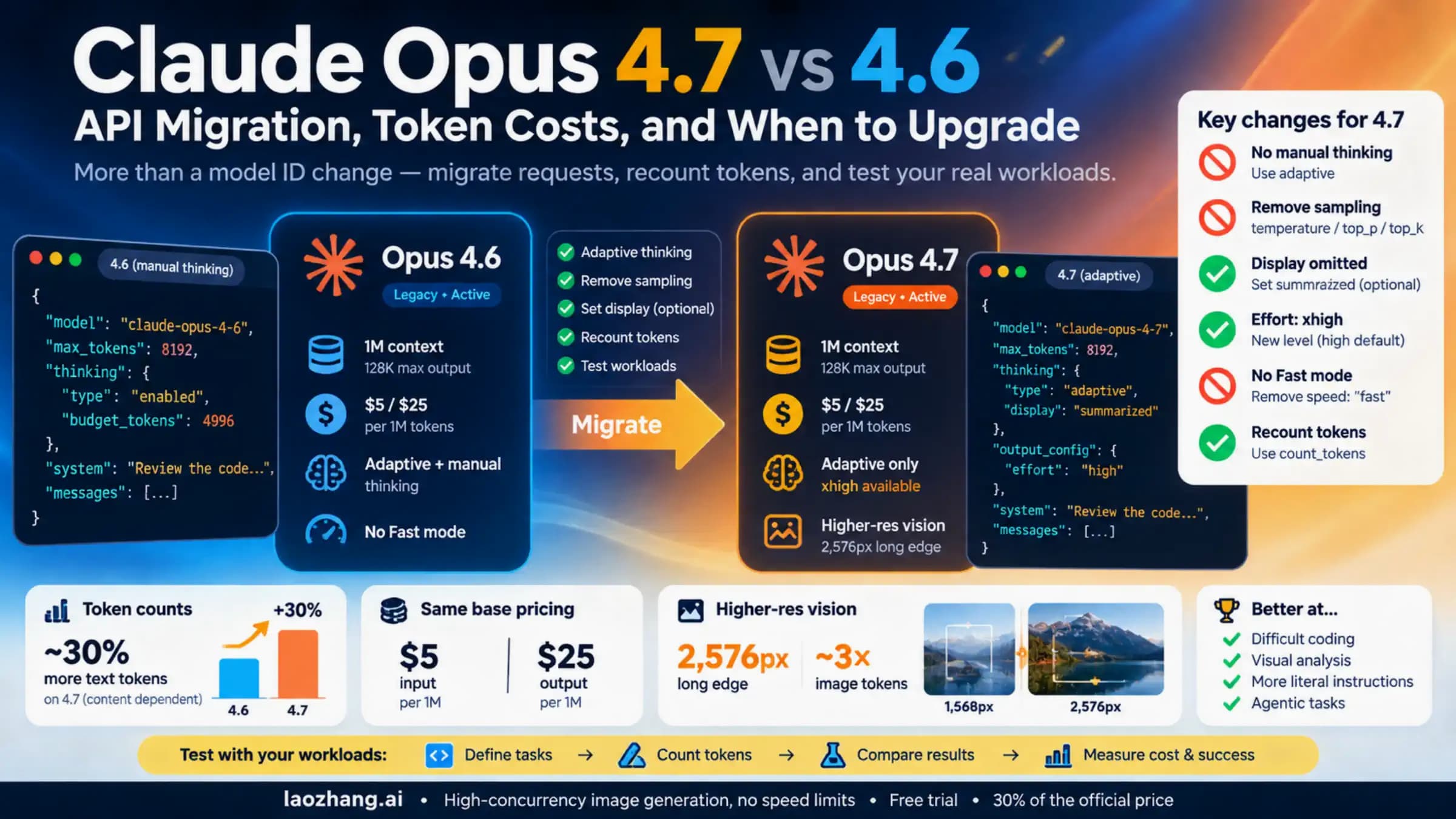
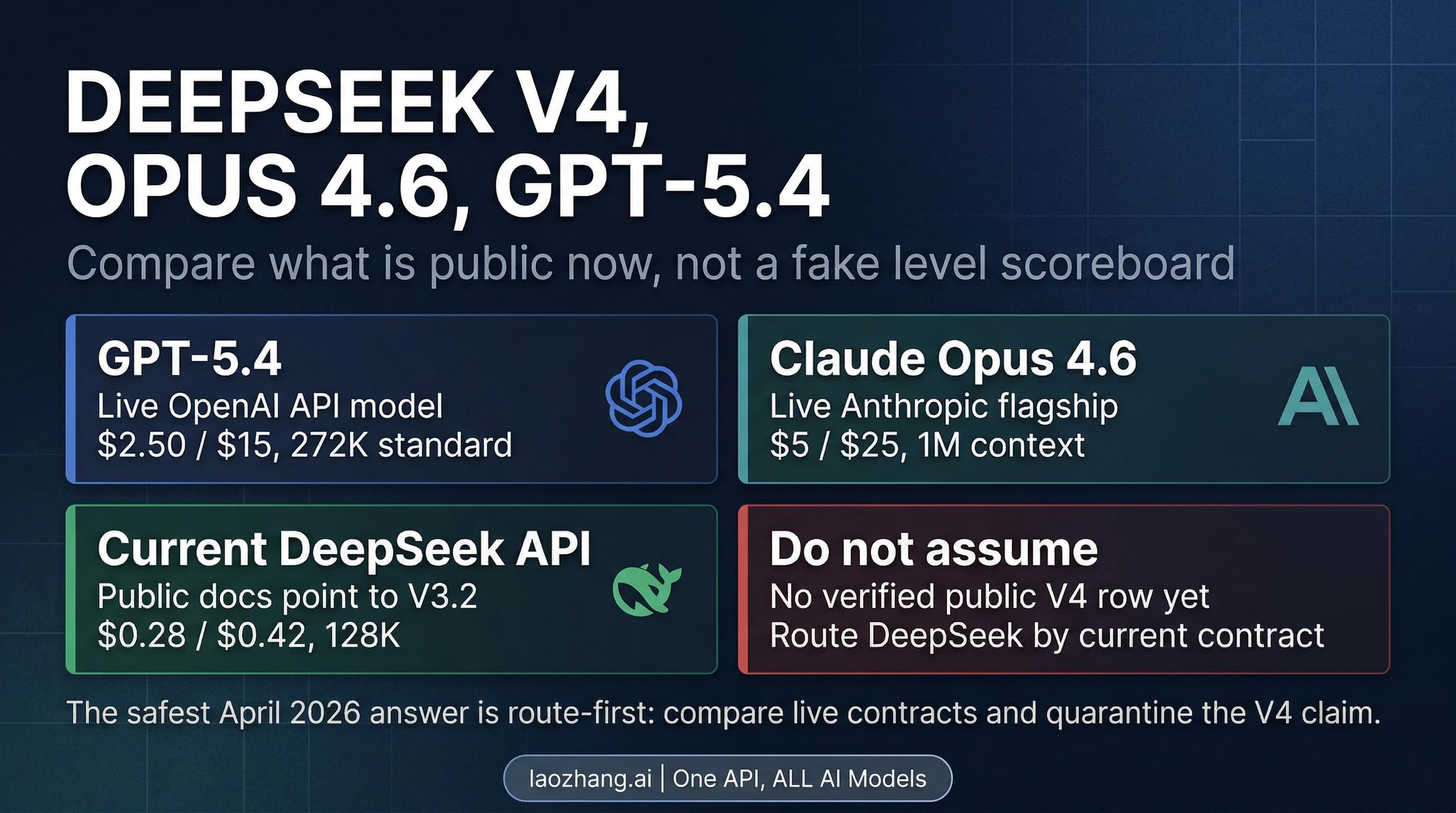
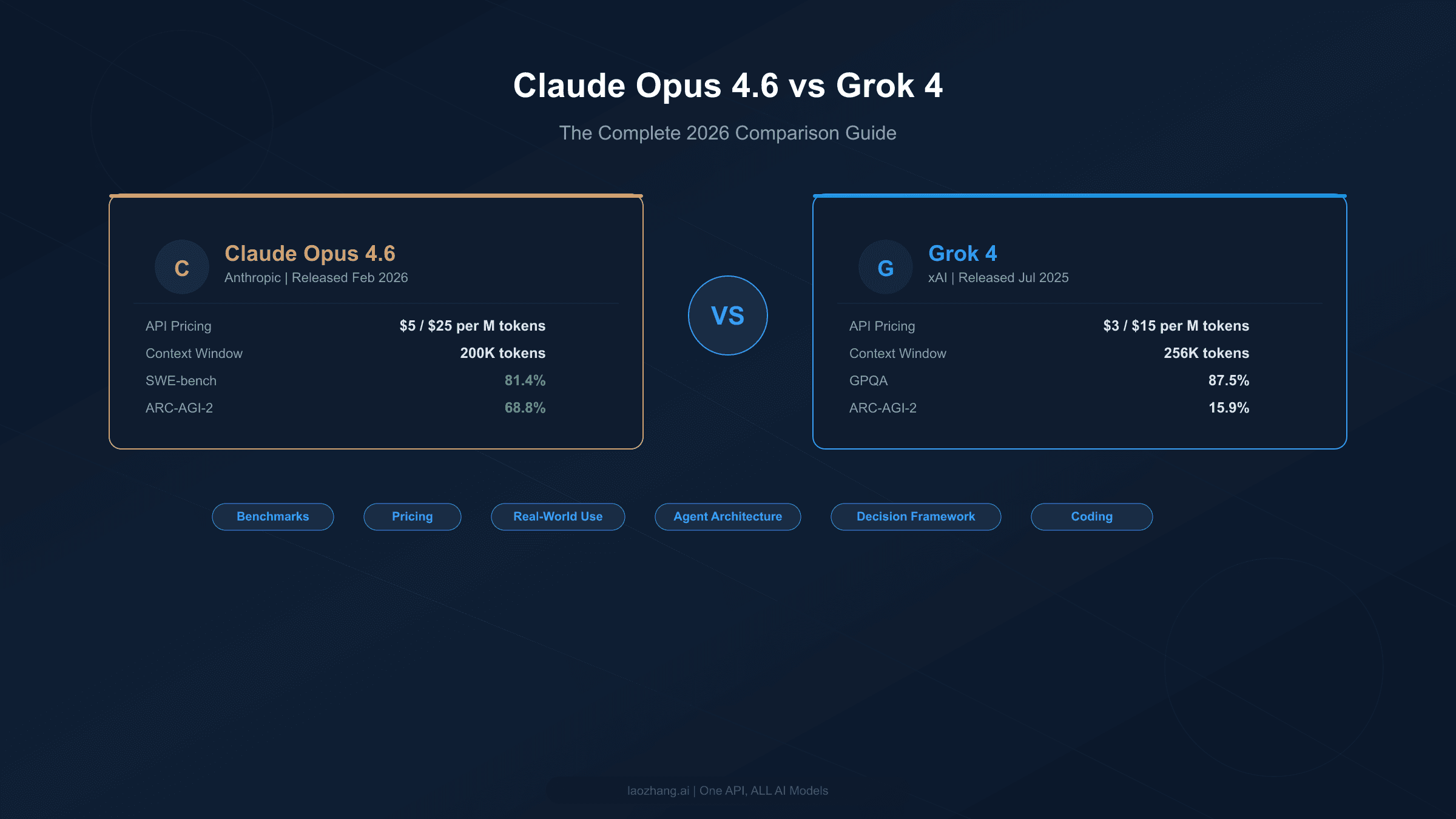
Anthropic's public docs are much clearer on the Opus side. In the current Claude models overview, Anthropic lists Claude Opus 4.6, Claude Sonnet 4.6, and Claude Haiku 4.5 as the latest public Claude lineup. The same public docs give Opus 4.6 a real API model ID, claude-opus-4-6, and list pricing at $5 per input million tokens and $25 per output million tokens. Anthropic also documents a 1M-token context window and 128k max output for Opus 4.6, plus positions it as the most intelligent Claude model for complex work.
That is what a usable product contract looks like. You can budget from it. You can run evaluations against it. You can build internal guidelines around it. You can route production traffic to it today and know which exact model string you are calling. That may sound obvious, but it is precisely the difference that gets blurred when rumor-driven posts try to write a flashy "Capybara vs Opus 4.6" showdown before Anthropic has actually published Capybara as a shipping option.
Opus 4.6 is also the right default if your team wants the strongest current Claude model without waiting for launch uncertainty to settle. If you care about deep reasoning, large-context analysis, or agent-style coding workloads, Opus 4.6 gives you a public, documented baseline right now. If your real question is more detailed than this article can cover in one pass, our full Claude Opus 4.6 pricing guide breaks down the current public pricing and access picture in more detail.
There is a second advantage to starting from Opus 4.6: it gives you a meaningful internal benchmark for whatever comes next. If Anthropic later launches a Capybara-tier model publicly, you will want to compare it against your own Opus 4.6 workloads, not against whatever leaked scorecards happened to circulate on launch-rumor day.
Should You Wait for Capybara or Ship on Opus 4.6?
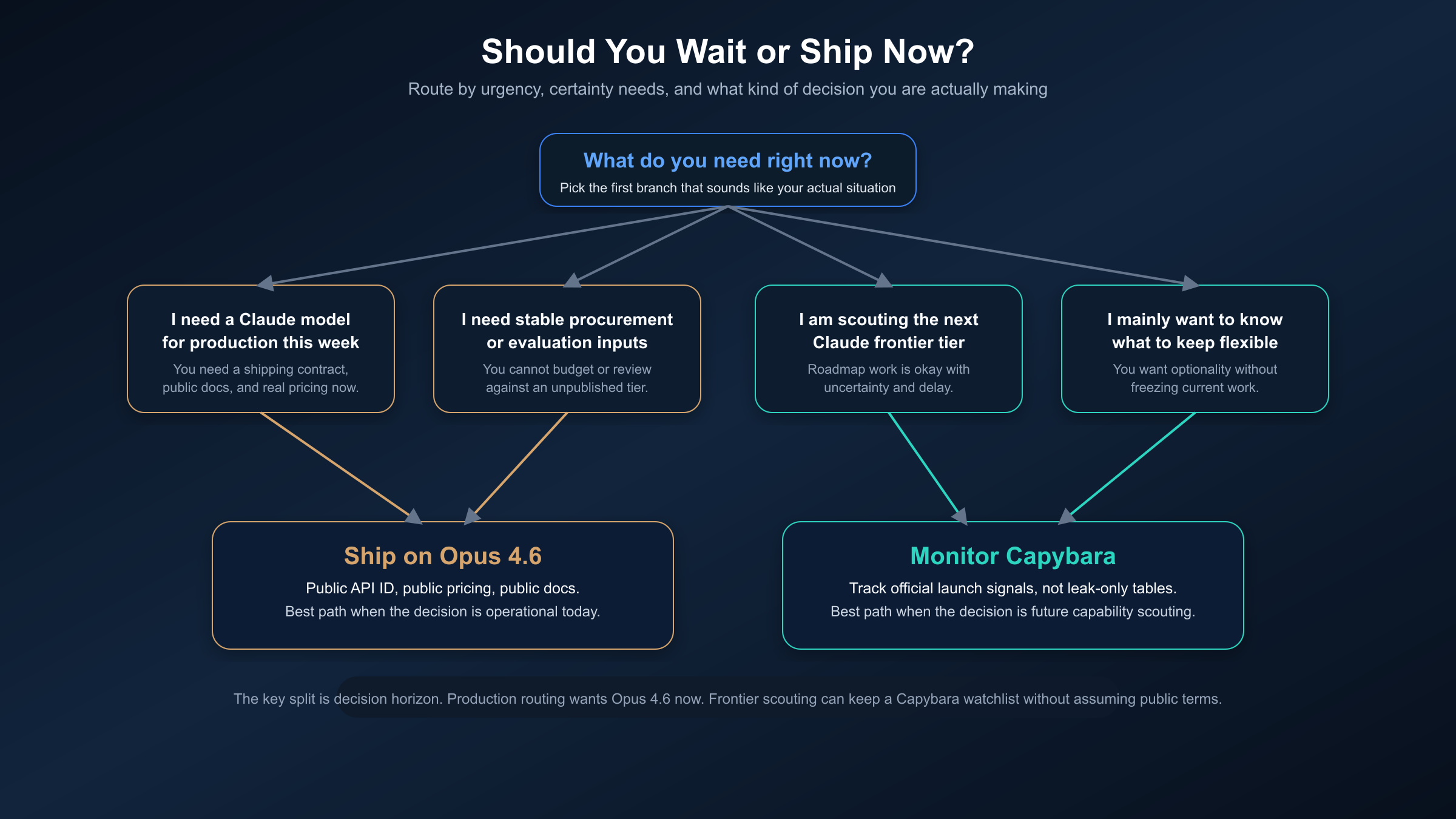
For most teams, the answer is straightforward: ship on Opus 4.6 now.
That is especially true if any of the following sound like your actual situation. You need a Claude model this week. You need a public pricing card for budgeting or customer quotes. You need a stable model ID for evaluation. You need documentation that engineering, finance, procurement, and security can all read without relying on a media report. Or you simply need to stop thinking about rumors and choose a real model so the rest of the project can move.
Capybara becomes worth tracking in a narrower set of cases. Maybe you are the person responsible for maintaining a frontier-model watchlist for a larger organization. Maybe your team runs structured evals every time the top tier changes and wants early warning that Anthropic may publish a more expensive or more capable tier above Opus. Maybe you work in a domain where a genuine step-change in coding or cybersecurity performance would alter your model mix materially. In those cases, Capybara is worth following closely. But even then, the right operational posture is still "monitor and prepare," not "pretend the public contract already exists."
The trap to avoid is freezing useful work while waiting for details that are not public yet. Teams often do this without saying it out loud. They stop choosing a current model because a rumored future one sounds better, then spend weeks in a weird planning limbo with no new deployment, no new evaluation baseline, and no new budget certainty. Unless your organization genuinely benefits from waiting on the next tier, that is usually a bad trade.
A good practical rule is this: if your question is about what to deploy, buy, or test today, choose Opus 4.6. If your question is about what Anthropic might ask you to reconsider later, keep Capybara on the watchlist.
What to Keep Flexible If Capybara Eventually Launches
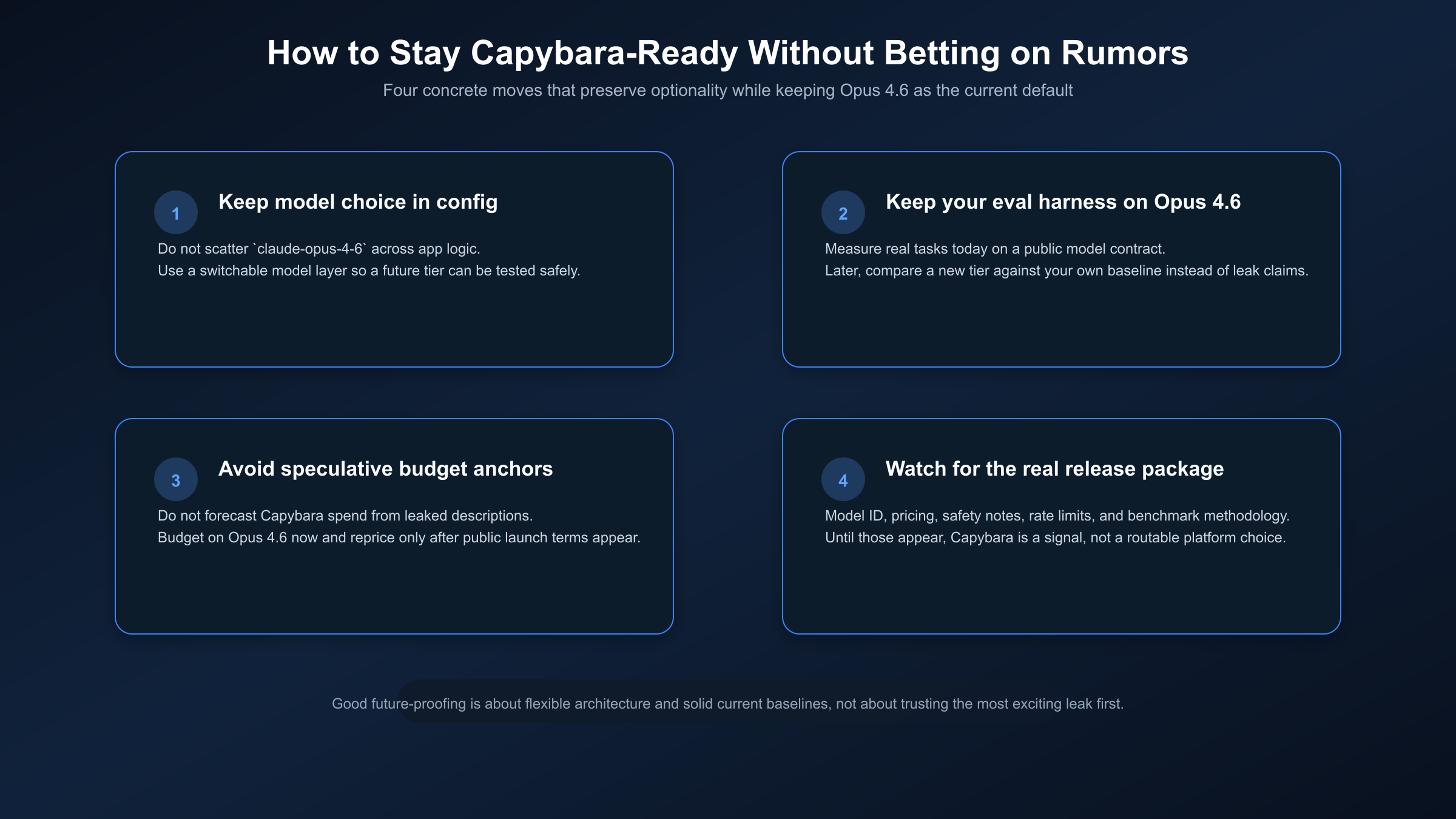
The best way to respect the Capybara signal without overreacting to it is to make a few narrow decisions flexible now.
First, keep model choice behind configuration rather than baking claude-opus-4-6 into application logic, prompts, or procurement documents more deeply than you need to. That does not mean treating all models as interchangeable. It just means letting yourself swap a future tier into the same evaluation harness instead of rewriting half the stack to see whether it helps.
Second, keep your performance conversation anchored to Opus 4.6 on your own tasks. That is the model Anthropic publicly ships today, which means it is the one you can reliably test against your coding jobs, long-context workloads, or agent tasks. If Capybara later launches and really is a tier above Opus, your most useful question will not be "does it beat the rumor?" It will be "does it beat our current Opus 4.6 baseline enough to justify the migration cost?"
Third, avoid speculative budget anchors. One of the fastest ways to damage a model rollout is to start forecasting spend from half-published or leaked descriptions. A future tier above Opus may well be more expensive. It may also have different long-context rules, different access gates, or different batch economics. Until Anthropic publishes those details directly, the only safe budget is the public Opus 4.6 budget.
Fourth, watch for the real release package rather than a single name. If Capybara becomes public, the meaningful signals will be a stable API model ID, public pricing, official rate-limit or rollout guidance, safety notes, and benchmark methodology you can actually inspect. That bundle is what turns a rumor into a usable platform choice.
If you are specifically using Claude inside longer-running agent setups, our OpenClaw Opus 4.6 guide is a better reference for current implementation details than any leak-based next-tier speculation.
What This Means for Buyers, Builders, and Model Watchers
Different readers should walk away with different levels of urgency.
If you are a builder, the answer is to use Opus 4.6 unless your stack is so frontier-sensitive that next-tier watchlist work is part of the job. If you are a buyer or engineering lead, the answer is even clearer: budget, approval, and rollout discussions should stay on public products until Anthropic publishes the full Capybara contract itself. And if you are a model watcher, the real value in Capybara right now is not that it gives you a new deployment target. It gives you an early signal that Anthropic may be preparing to move the top tier upward again.
That is why this article should not end with a fake winner declaration. One side is a product you can use right now. The other side is a credible future-tier signal with incomplete public terms. Those are different kinds of objects, and good decision-making starts by refusing to compare them as if they were already equally real.
FAQ
Is Claude Capybara a real Anthropic model?
Capybara appears in leak-backed reporting tied to a stronger early-access Anthropic system, and Anthropic has publicly confirmed it is testing a more capable model with early-access customers. But that is not the same thing as a public model contract you can select today.
Has Claude Capybara replaced Opus 4.6?
No. Anthropic's public docs still list Claude Opus 4.6 as the current top shipping Claude model.
Should I wait for Capybara before building?
Usually no. If your decision is operational now, use Opus 4.6. Wait only if your role specifically involves future-tier scouting and your project can tolerate uncertainty.
Do we know Capybara pricing yet?
No public pricing page is available as of March 28, 2026. Any firm pricing claim should be treated as unverified until Anthropic publishes it directly.
Do we know when Capybara launches?
No public release date has been published. Right now the most defensible language is that Anthropic has acknowledged testing a more capable model with early-access customers, not that a general launch date is set.
Do we know the Capybara API model ID?
No public API model ID has been published in Anthropic's current docs.
Can I apply for Capybara early access right now?
Anthropic has not published a public Capybara signup page or public early-access application flow as of this article's verification date.
What is the best public Anthropic model right now?
Anthropic's public models overview currently points to Claude Opus 4.6 as the strongest current Claude model for the most complex tasks.
What is the relationship between Capybara and Mythos?
Fortune's report said leak-backed draft material used both names, with Mythos appearing to refer to the underlying model and Capybara to a tier above Opus. Until Anthropic publishes the launch materials itself, treat the naming as provisional.
If you only need the bottom line, it is this: Opus 4.6 is the model to use now. Capybara is the model to watch, not the model to buy against yet.