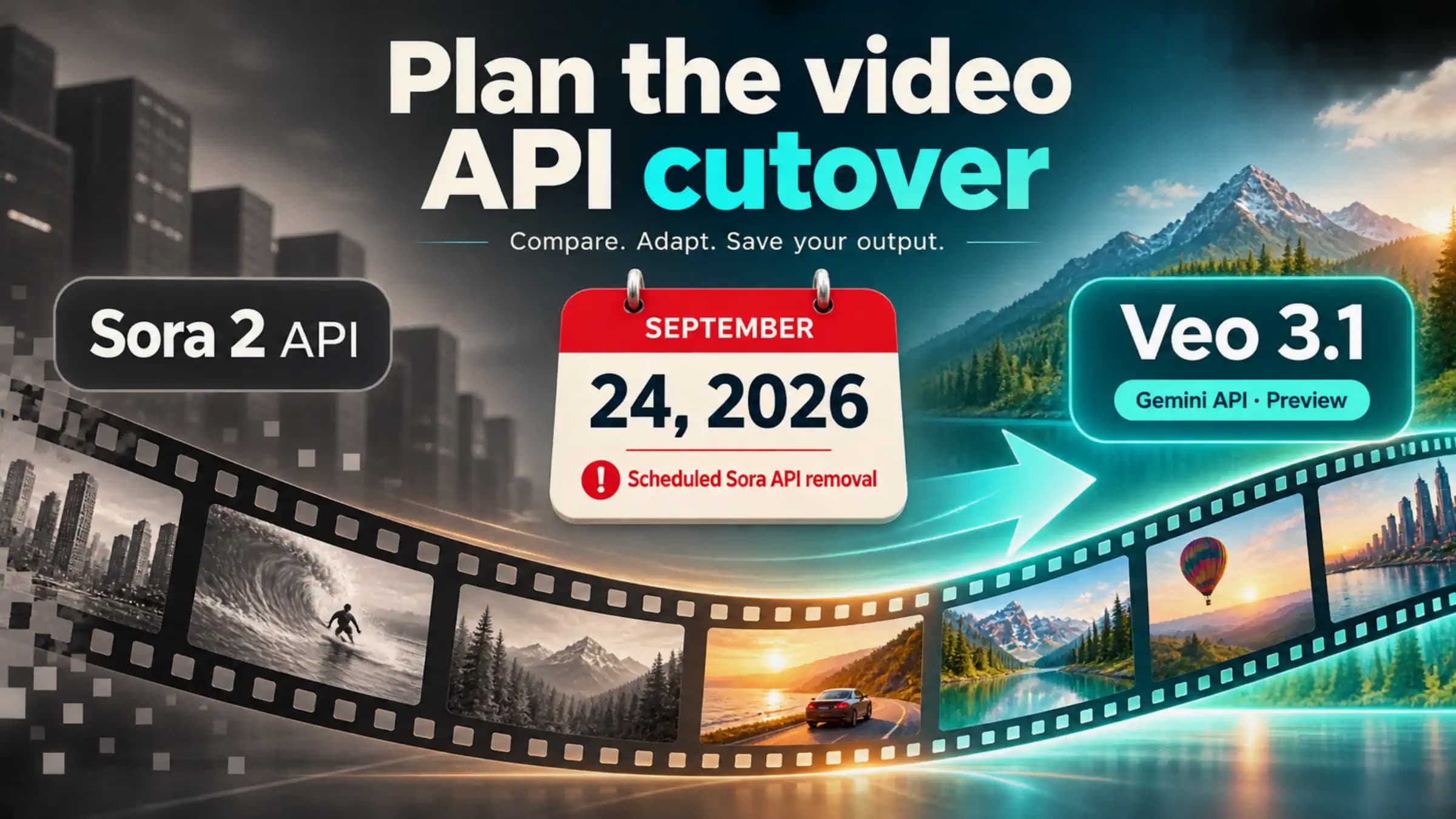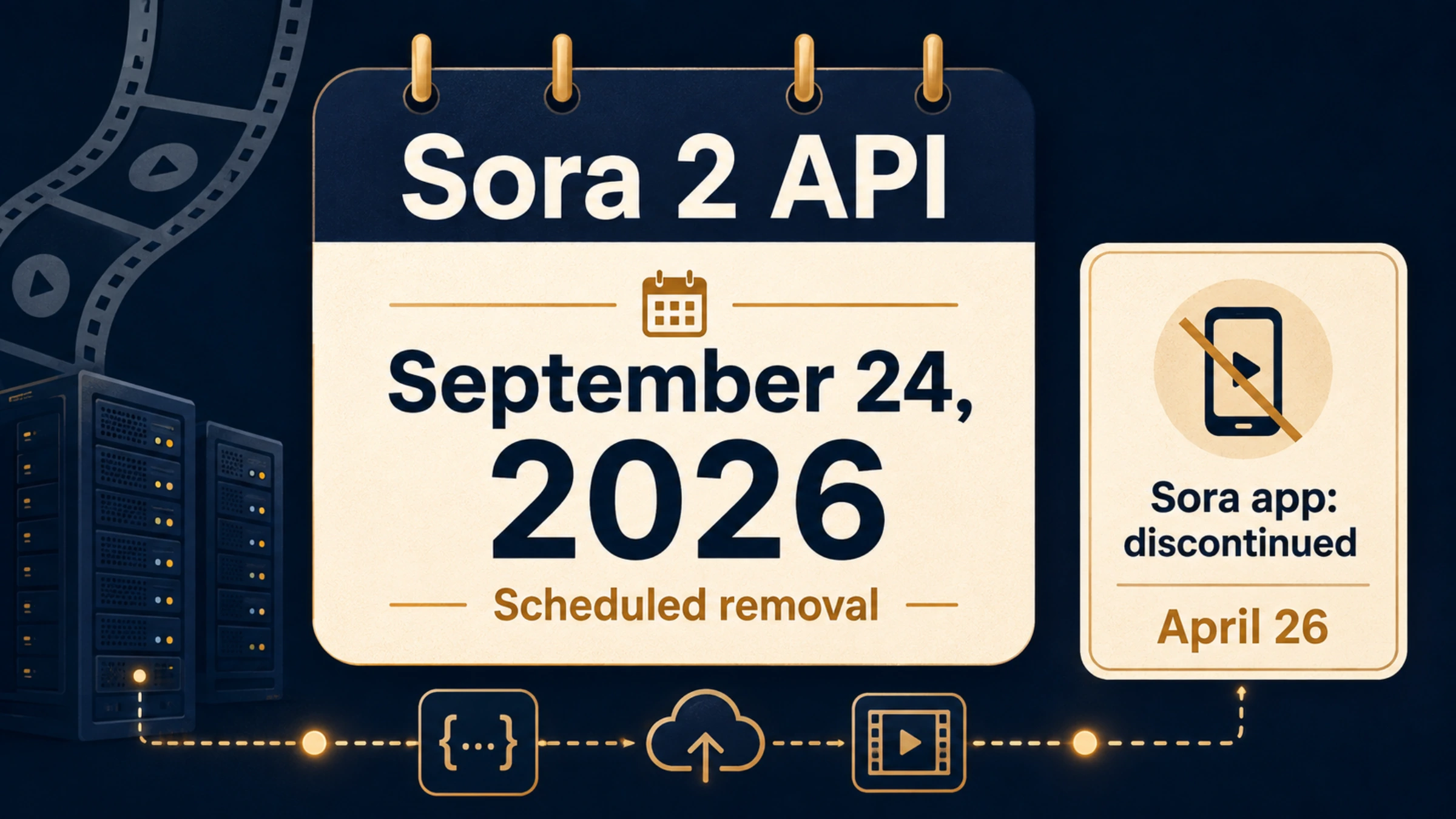
OpenAI confirmed on March 24, 2026 that Sora — its AI video generation platform including the iOS app, API, and Sora.com — will be completely shut down. While no exact shutdown date has been announced, the company stated it will share timeline details soon. Developers currently using the Sora 2 API need to start planning their migration immediately, and the good news is that several alternatives offer better pricing and comparable or superior quality.
TL;DR
The Sora 2 API is confirmed to be shutting down as of the March 24, 2026 announcement. Here is what you need to know at a glance:
- Confirmed shutdown: iOS app, Sora.com, and API all being discontinued — no exact date yet, but OpenAI says "soon"
- Sora 2 model stays in ChatGPT: The underlying model remains available through ChatGPT Pro/Plus subscriptions, just not as a standalone product
- Best alternative for quality: Runway Gen-4.5 (Elo 1,247, $0.12/sec) leads the quality rankings among available alternatives
- Best alternative for budget: Hailuo 2.3 starts at just $0.01/sec — up to 97% cheaper than Sora 2 Pro
- Migration is simple: Most alternatives use OpenAI-compatible API formats, and platforms like laozhang.ai let you switch by changing a single model parameter
- Save your videos now: Download all content from Sora.com before the shutdown date is announced
What Happened — The Full Sora 2 Shutdown Story
On Tuesday, March 24, 2026, OpenAI posted a brief but significant message on X: "We're saying goodbye to Sora. We'll share more soon, including timelines for the app and API and details on preserving your work." Within hours, major outlets including Bloomberg, NBC News, TechCrunch, and Variety confirmed the complete discontinuation of OpenAI's AI video generation platform.
The scope of the shutdown is comprehensive. Every consumer-facing and developer-facing component of Sora is being retired: the iOS application that became the most downloaded app in the Photo and Video category on its September 2025 launch day, the Sora.com web experience where users could generate and share AI videos, and the Sora 2 API that developers had integrated into production applications. This is not a temporary pause or a feature reduction — it is a complete product withdrawal.
Perhaps the most striking casualty of this decision is the Disney partnership. In December 2025, Walt Disney Co. announced a three-year deal with OpenAI centered on Sora, with plans for a $1 billion investment in AI video capabilities. That partnership is now being wound down entirely. A Disney spokesperson confirmed the company "respects OpenAI's decision and will explore other AI platforms" (Variety, March 24, 2026).
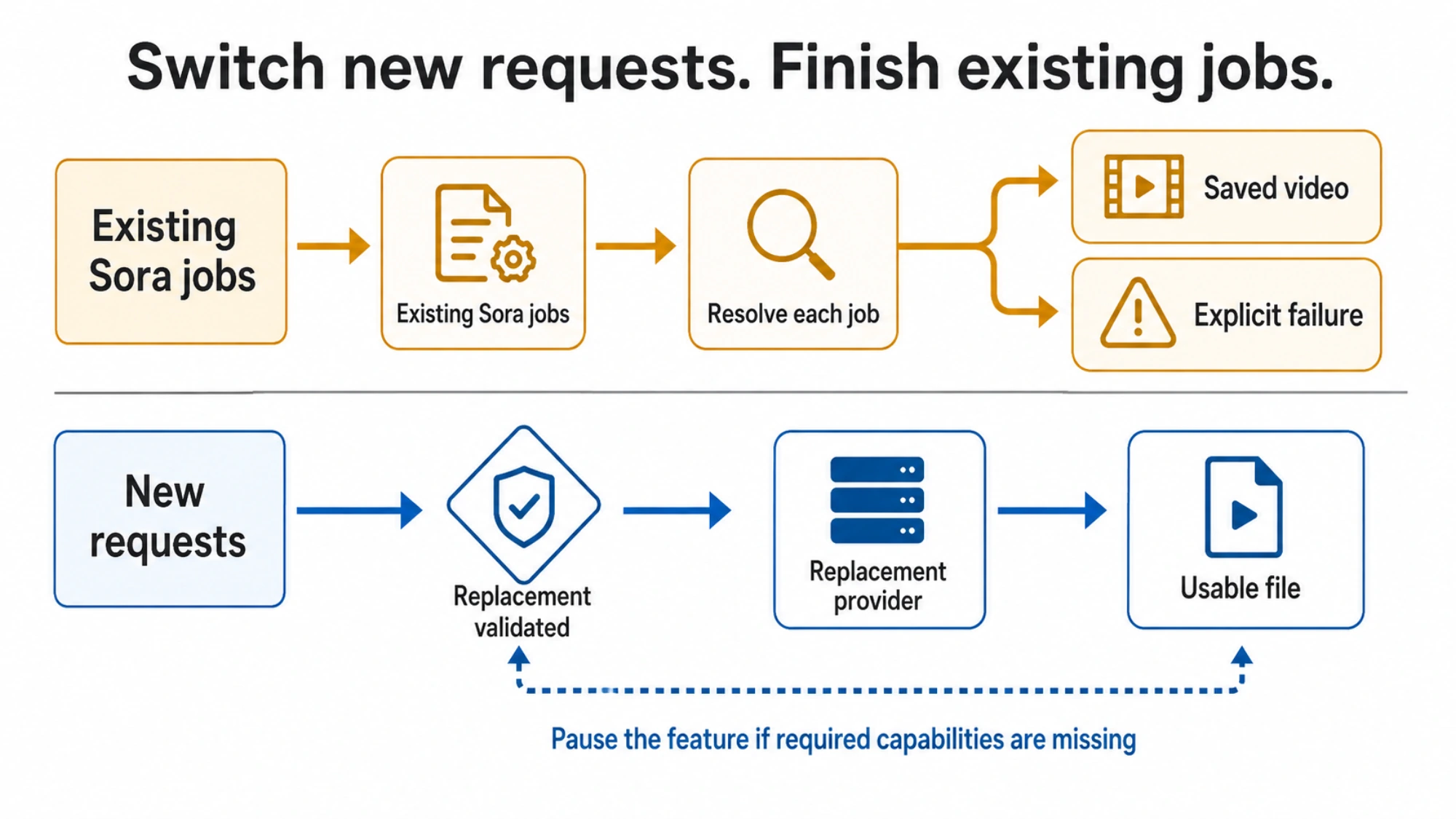
There is one important nuance that developers should understand: the Sora 2 video generation model itself is not disappearing entirely. It remains accessible through ChatGPT for paying subscribers (Plus and Pro plans). What is being eliminated is the standalone product ecosystem — the dedicated app, the social sharing platform, and critically for developers, the API endpoint. This means you can still generate Sora-quality videos through the ChatGPT interface, but you cannot do so programmatically through your own applications using the official OpenAI API.
The financial context puts this decision in perspective. According to analysis by WentuoAI, Sora generated approximately $2.1 million in revenue while consuming GPU resources costing hundreds of millions annually. OpenAI recently raised $110 billion at a valuation of approximately $730 billion (NBC News, March 24, 2026), and the company is preparing for an upcoming IPO — making loss-making experimental products increasingly difficult to justify to future investors.
Shutdown Timeline — What We Know and What to Expect
As of March 25, 2026, OpenAI has not announced a specific shutdown date. The official statement says only that details about "timelines for the app and API" will be shared soon. This ambiguity creates urgency for developers who need to plan their migration strategy, but historical precedent from OpenAI product changes can help us form reasonable expectations.
When OpenAI deprecated the GPT-3 series models in early 2024, they provided roughly a three-month transition window. The Codex API deprecation followed a similar pattern with about 90 days of notice. Based on these precedents, and considering that OpenAI has committed to helping users preserve their content, a reasonable estimate is that developers will have somewhere between 30 and 90 days from the formal timeline announcement to complete their migration.
However, waiting for the official date would be a mistake. The announcement itself has already disrupted the ecosystem — third-party providers who relied on Sora API access are scrambling to adapt, and the longer you wait, the more likely you are to face migration bottlenecks when everyone rushes to switch simultaneously. The recommended action timeline is clear: start evaluating alternatives this week, begin testing your top two choices within the next 7 days, and have a production migration plan ready within 14 days. This way, when OpenAI announces the exact shutdown date, you will be prepared rather than panicked.
For users of the Sora iOS app and Sora.com, the priority should be downloading all generated content immediately. OpenAI has committed to providing guidance on content preservation, but there is no guarantee that the download window will extend far beyond the shutdown date. Export everything now while you still have access.
Why OpenAI Killed Sora — 5 Real Reasons Behind the Decision

Understanding why Sora was discontinued matters beyond simple curiosity — it helps developers evaluate the long-term viability of alternative platforms and make smarter infrastructure decisions. The shutdown was driven by five interconnected factors that reveal fundamental challenges in the AI video generation market.
The compute economics were unsustainable. This is the most straightforward reason and arguably the most important one. Sora 2's video generation demanded enormous GPU resources for every single request. According to WentuoAI's analysis, the service generated only $2.1 million in revenue while GPU costs easily exceeded hundreds of millions annually. Each product improvement created a vicious cycle: better quality attracted more users, who generated more videos, which consumed more compute, which deepened losses. The Character Cameo API, which achieved over 95% face consistency across clips, was technically impressive but computationally devastating. This was not a business model problem that could be solved with pricing adjustments — the fundamental cost structure made profitability unreachable at any realistic price point.
OpenAI is strategically pivoting to its core strengths. As NBC News reported, OpenAI executives stated they cannot do "everything at once" and are sharpening the company's focus. The computing resources previously allocated to Sora will be redirected toward "more lucrative coding, reasoning, or text-generation tasks." This is a classic resource allocation decision: video generation was an experimental bet, while text, code, and reasoning AI represent OpenAI's proven competitive advantages and primary revenue drivers. The contrast with Anthropic is instructive — Anthropic has deliberately avoided resource-heavy image and video products, instead concentrating entirely on text and code generation. That focused strategy has helped Claude gain significant enterprise market share, putting competitive pressure on OpenAI to concentrate its own resources more effectively.
IPO preparation demands financial discipline. OpenAI is approaching an initial public offering with a valuation of approximately $730 billion. Public market investors scrutinize loss-making product lines far more aggressively than venture capital investors do. A service that burns hundreds of millions in GPU costs while generating only $2.1 million in revenue would be a conspicuous liability in an IPO prospectus. Shutting down Sora before going public demonstrates financial discipline and a willingness to make tough decisions — exactly the kind of signal that institutional investors want to see.
Competitive dynamics shifted against Sora. When Sora first launched, it was a genuine market leader in AI video generation. By March 2026, the landscape has changed dramatically. Google's Veo 3.1 offers native 4K output. Runway Gen-4.5 leads quality benchmarks. Kling 3.0 provides 180-second videos at lower cost. Rather than investing heavily to regain competitive advantage in a market where multiple well-funded competitors are rapidly advancing, OpenAI chose to exit and reallocate those resources to markets where it maintains stronger positions.
Intellectual property and legal liability became untenable. This factor is often underreported but critically important. As AtlasCloud's analysis noted, "Sora didn't fail because AI video generation hit a wall. It failed because of a licensing and IP problem." The deepfake concerns that followed Sora's launch were significant enough to attract regulatory attention, and the unresolved questions around training data rights created ongoing legal exposure. The collapse of the Disney partnership — with its planned $1 billion investment — suggests that even major entertainment companies grew uncomfortable with the IP risks associated with AI-generated video content.
7 Best Sora 2 API Alternatives Ranked for 2026

Choosing the right Sora replacement depends on your specific needs — quality, cost, maximum duration, and feature requirements all matter. Here is a detailed breakdown of the seven most viable alternatives, ranked by Elo rating from the Artificial Analysis leaderboard (where available), along with practical guidance on which to choose.
Runway Gen-4.5 — Best Overall Quality
Runway holds the highest Elo rating among available alternatives at 1,247, making it the quality benchmark for AI video generation. At $0.12 per second, it costs less than Sora 2 Pro while delivering superior VFX capabilities including scene relighting, 4K upscaling, and multi-camera consistency. Runway supports lip-sync, multi-character scenes, and native audio generation. The main limitation is a 10-second maximum duration per generation, though clips can be extended. Runway is the right choice for professional VFX work, film production, and any application where visual quality is the primary concern.
Google Veo 3.1 — Best for 4K and Long Duration
Veo 3.1 is the only alternative offering native 4K output without upscaling, making it technically unmatched for resolution-sensitive applications. It supports up to 148 seconds through chained generation, has native audio capabilities, and offers image-to-video functionality including a unique first-and-last-frame mode that generates transition videos between two images. Pricing ranges from $0.15/request (fast mode) to $0.40/request (standard mode) through providers like laozhang.ai, where async endpoints ensure you are never charged for failed generations. Veo 3.1 is ideal for applications requiring the highest resolution output or extended video sequences.
Kling 3.0 — Best Value for Long Videos
Kuaishou's Kling 3.0 offers the longest single-generation duration at up to 180 seconds, combined with competitive pricing of $0.07-0.14 per second. It supports multi-character scenes, lip-sync, and image-to-video — making it the closest overall replacement for Sora 2's feature set. The Elo rating of 1,225 places it just slightly below Veo but well within professional-quality territory. Kling is particularly strong for content creators who need longer videos without the complexity of chained generation, and for applications where cost-per-minute is a critical metric. For a detailed comparison of Seedance 2.0, Kling 3.0, Sora 2, and Veo 3.1, see our comprehensive analysis.
Seedance 2.0 from ByteDance showed enormous promise as an alternative but its international API was suspended on March 15, 2026 due to copyright disputes with major studios. BytePlus currently offers only Seedance 1.5 Pro, and recovery of the full 2.0 API depends on implementing copyright protections that are unlikely before mid-2026. Monitor this space, but do not build production dependencies on it today. For current pricing details, see our Seedance 2.0 pricing breakdown.
MiniMax Hailuo 2.3 is the budget champion at $0.01-0.03 per second — making it up to 97% cheaper than Sora 2 Pro. Its Elo rating of 1,208 indicates solid quality, and it offers strong face consistency for character-based content. The trade-offs are a maximum 6-second duration and no 4K or lip-sync support. Hailuo is the right choice for high-volume applications where cost is the primary constraint and short clips are acceptable.
Luma Ray 3 offers a compelling combination of 30-second single generation, HDR/EXR export capability, and extremely low pricing ($0.002-0.007 per megapixel). With an Elo of 1,211, it delivers good quality at a price point that makes it viable for experimental and prototyping use cases. It lacks audio and lip-sync, so it works best for visual-only applications.
Pika 2.5 rounds out the alternatives as the most beginner-friendly option, with simple API integration and pricing of $0.03-0.08 per second. Its lower Elo of 1,195 reflects somewhat less sophisticated output, and the 5-second maximum duration is the shortest among alternatives. Pika is best suited for hobbyist projects, quick social media content, and developers who are new to video generation APIs.
Cost Comparison — How Migration Affects Your Budget

One of the most common concerns about forced API migration is cost impact. The data shows that moving away from Sora 2 will actually reduce costs for most developers — often dramatically. Here is a scenario-based analysis using 1,000 ten-second videos per month as the baseline, which represents a typical mid-volume production workload.
| Platform | Cost/10s Video | 1,000 Videos/Month | vs Sora 2 Std | vs Sora 2 Pro |
|---|---|---|---|---|
| Sora 2 Standard | $1.00 | $1,000 | baseline | -80% |
| Sora 2 Pro | $5.00 | $5,000 | +400% | baseline |
| Runway Gen-4.5 | $1.20 | $1,200 | +20% | -76% |
| Veo 3.1 Fast (laozhang.ai) | $0.15 | $150 | -85% | -97% |
| Kling 3.0 | $0.70 | $700 | -30% | -86% |
| Hailuo 2.3 | $0.10 | $100 | -90% | -98% |
| Luma Ray 3 | ~$0.30 | $300 | -70% | -94% |
| Pika 2.5 | $0.30 | $300 | -70% | -94% |
| Sora 2 via laozhang.ai | $0.15 | $150 | -85% | -97% |
The numbers tell a clear story: every alternative except Runway is cheaper than Sora 2 Standard, and all alternatives are dramatically cheaper than Sora 2 Pro. For developers who were using Sora 2 Pro at $0.30-0.50/second, the migration represents a significant cost reduction regardless of which alternative they choose.
For developers looking for the most cost-effective approach, aggregator platforms like laozhang.ai offer an additional advantage: access to multiple video models through a single API key, with async endpoints that ensure you are never charged for failed generations. This is particularly valuable during the migration period when you may want to test multiple alternatives without managing separate accounts and billing for each provider. For a broader perspective on video generation costs, see our comprehensive guide to AI video generation costs.
The financial impact scales proportionally for larger workloads. A developer generating 10,000 videos per month on Sora 2 Pro was spending approximately $50,000 monthly. Switching to Veo 3.1 through laozhang.ai would reduce that to $1,500 — a savings of $48,500 per month or $582,000 annually. Even for smaller operations generating 100 videos per month, the migration from Sora 2 Standard ($100) to Hailuo 2.3 ($10) represents a meaningful 90% reduction in video generation costs.
Migration Guide — Switch Your API in Under 30 Minutes
The practical migration process is simpler than most developers expect. If you are using an OpenAI-compatible API format — which most modern video generation APIs support — the core change is updating the model parameter and potentially the base URL. Here is a step-by-step walkthrough covering the most common migration paths.
Step 1: Audit Your Current Integration
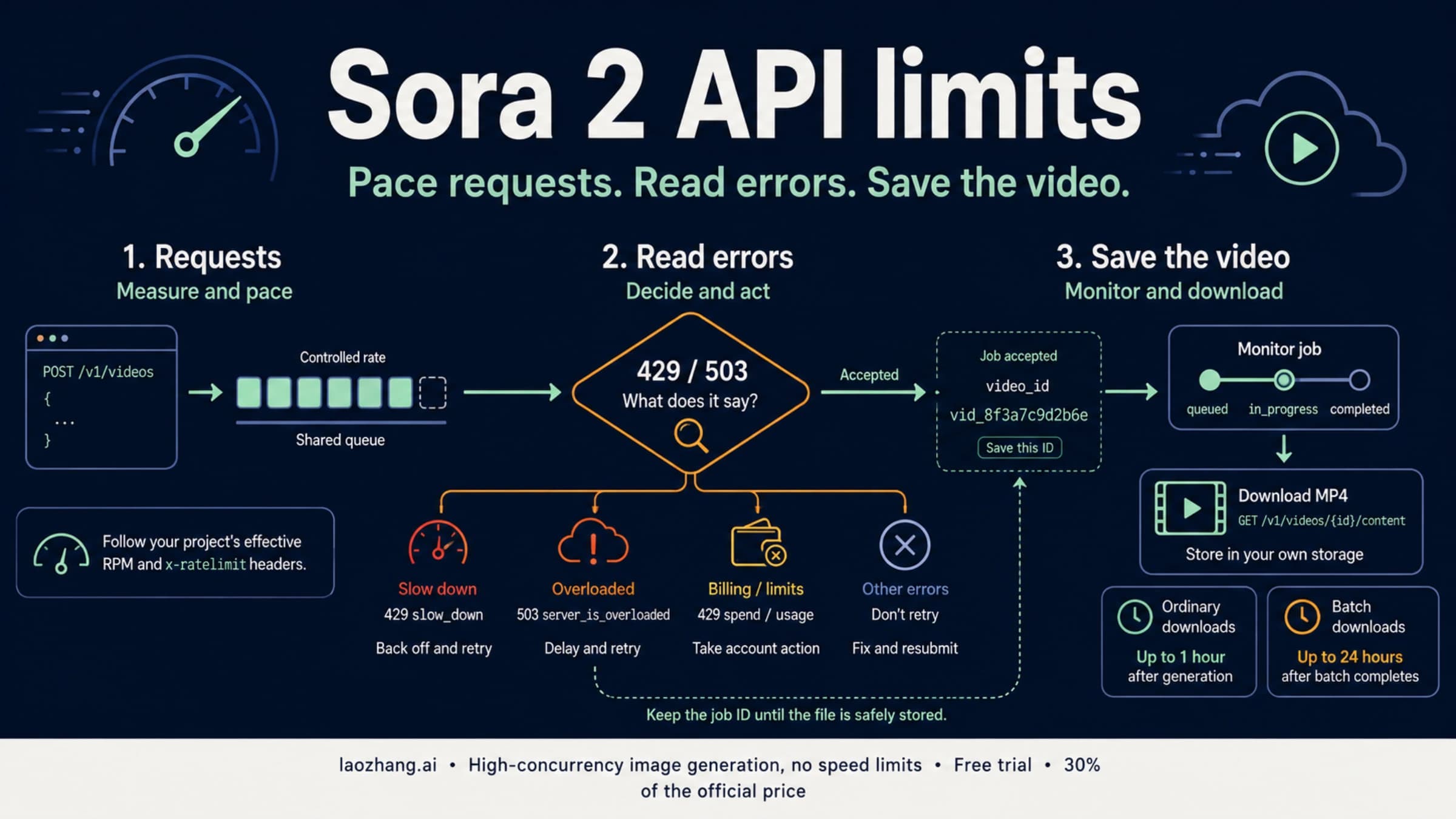
Before changing any code, document your current Sora 2 usage. Identify which endpoints you call (/v1/videos or /v1/chat/completions), what parameters you pass (resolution, duration, image references), and how you handle the async response flow. This audit typically takes 5-10 minutes and ensures you do not miss any edge cases during migration.
Step 2: Choose Your Target Platform
Based on the alternatives analysis above, select one or two platforms to test. For most developers, the fastest path is using an aggregator like laozhang.ai that provides access to multiple models through a single API key — this lets you test Veo 3.1, Sora 2 (while still available through proxy), and other models without setting up separate accounts.
Step 3: Update Your Code
For developers migrating to Veo 3.1 through an OpenAI-compatible endpoint, the code change is minimal:
pythonfrom openai import OpenAI client = OpenAI(api_key="sk-openai-key") response = client.chat.completions.create( model="sora-2", messages=[{"role": "user", "content": [{"type": "text", "text": "A sunset over the ocean"}]}], stream=True ) # After: Veo 3.1 via laozhang.ai (change 2 lines) from openai import OpenAI client = OpenAI( api_key="your_laozhang_api_key", base_url="https://api.laozhang.ai/v1" ) response = client.chat.completions.create( model="veo-3.1-fast", # Changed model parameter messages=[{"role": "user", "content": [{"type": "text", "text": "A sunset over the ocean"}]}], stream=True )
For the async /v1/videos endpoint, the migration is equally straightforward:
python# Before: Sora 2 async response = requests.post( "https://api.openai.com/v1/videos", headers={"Authorization": f"Bearer {OPENAI_KEY}"}, json={"model": "sora-2", "prompt": "...", "seconds": "10"} ) # After: via laozhang.ai (change URL + key + model) response = requests.post( "https://api.laozhang.ai/v1/videos", headers={"Authorization": f"Bearer {LAOZHANG_KEY}"}, json={"model": "veo-3.1-fast", "prompt": "...", "seconds": "10"} )
Step 4: Test and Validate
Run your test suite with the new configuration. Pay attention to three things: response format compatibility (most alternatives maintain OpenAI-compatible response structures), generation quality at your specific use case, and error handling for the new provider's specific error codes. Budget 10-15 minutes for this validation step.
Step 5: Deploy with a Fallback
For production deployments, implement a model abstraction layer that lets you switch between providers without code changes. This protects you against future disruptions — if any single provider experiences issues, you can redirect traffic to an alternative by changing a configuration value rather than deploying new code. For information about building resilient video API integrations, see our guide on the most stable Sora 2 API providers.
How to Save Your Sora Videos Before the Shutdown
With the shutdown timeline still unannounced, preserving your Sora-generated content should be a top priority. OpenAI has committed to providing guidance on content preservation, but prudent developers will not wait for official instructions when their content is at risk.
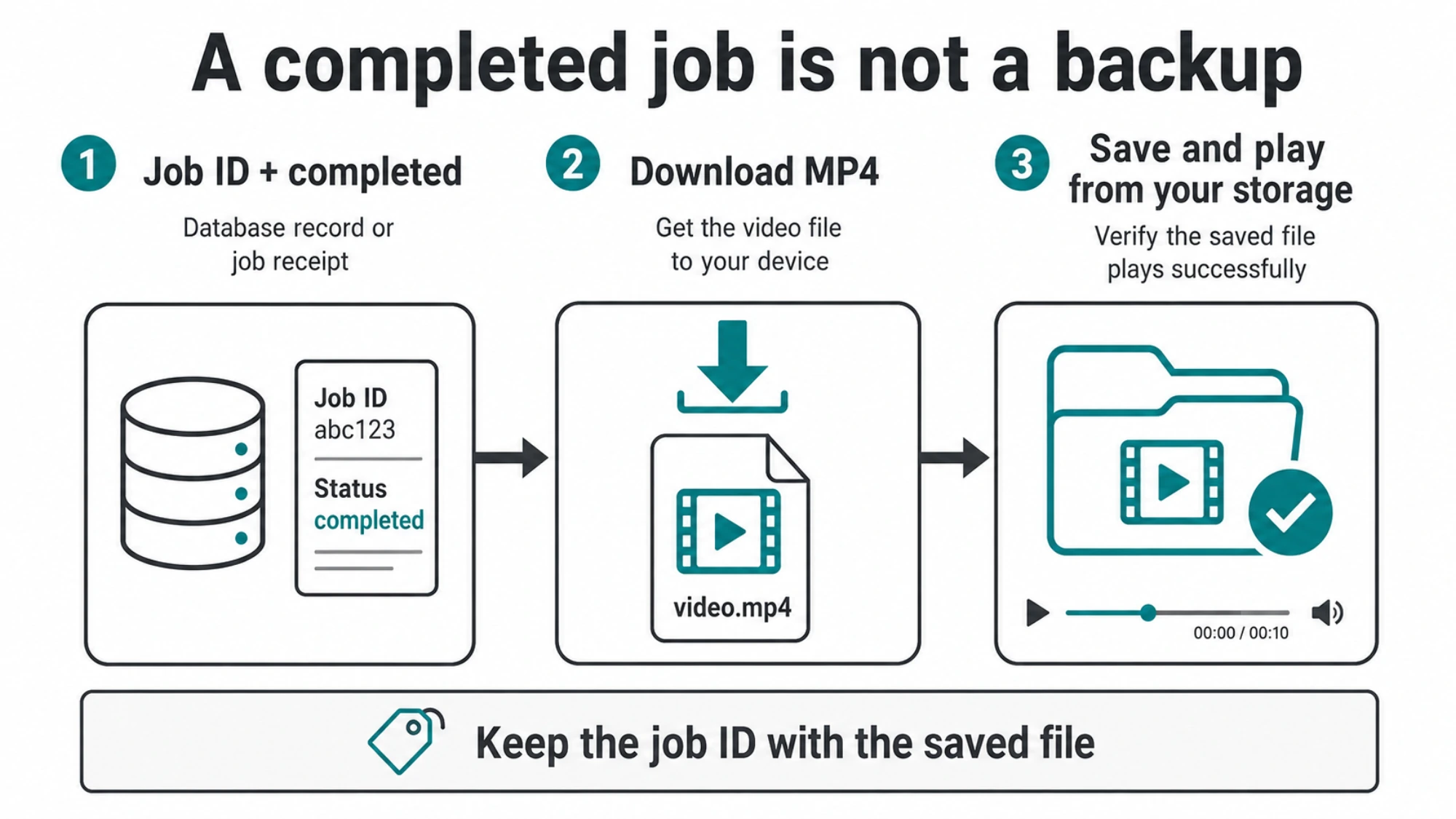
For content created through Sora.com, log in to your account and navigate to your video library. Select each video and use the download option to save the highest available resolution to your local storage. If you have a large library, consider working through it systematically — downloading in batches of 20-30 videos at a time to avoid potential rate limiting or session timeouts. Save both the video files and any associated metadata (prompts, settings) that you may want to reproduce with an alternative platform.
For content generated through the API, your situation depends on how you handled the generated video URLs. If you stored the download URLs, verify that they are still active and download any videos you have not already saved locally. If you relied on Sora's 24-hour storage and did not preserve the videos, those clips may already be lost. Going forward, update your pipeline to immediately download and store generated videos locally or in your own cloud storage rather than relying on provider-side retention.
As a backup strategy, consider archiving your most important Sora prompts and generation parameters. Even though the Sora API will no longer be available, you can reuse these prompts with alternative platforms to recreate similar content. The creative investment you made in crafting effective prompts transfers directly to other video generation APIs.
FAQ — Common Questions About the Sora Shutdown
When exactly will the Sora 2 API stop working?
OpenAI has not announced a specific date as of March 25, 2026. The official statement says they will "share more soon, including timelines for the app and API." Based on OpenAI's historical deprecation patterns (GPT-3 and Codex both had approximately 90-day windows), developers should expect a 30-90 day transition period from whenever the formal timeline is announced.
Can I still use Sora 2 through ChatGPT?
Yes. The Sora 2 model itself remains available within ChatGPT for Plus and Pro subscribers. You can generate videos through the ChatGPT interface, but you cannot access Sora 2 programmatically through an API. This means manual, one-at-a-time generation is still possible, but automated production workflows are not.
What is the single best Sora 2 API replacement?
There is no universal answer — it depends on your priorities. For maximum quality, choose Runway Gen-4.5. For best value with long video support, choose Kling 3.0. For lowest cost, choose Hailuo 2.3. For native 4K, choose Veo 3.1. For multi-model flexibility with a single API key, use an aggregator like laozhang.ai.
Will my Sora API key still work with third-party providers?
Some third-party providers like laozhang.ai offered Sora 2 access through proxy endpoints. These may continue working for a limited time depending on the provider's own access arrangements, but you should plan to migrate to a natively supported model (Veo 3.1, Kling, Runway) as your primary solution.
What does this mean for the AI video generation industry?
Sora's shutdown does not signal that AI video generation is failing — the market continues to grow rapidly with strong competition from Google, Runway, Kuaishou, and others. What it does signal is that standalone AI video products face extreme compute cost challenges, and that the business model for video generation APIs is still evolving. Developers should expect continued innovation from surviving platforms, with pricing likely decreasing as competition intensifies and compute efficiency improves.
Is Seedance 2.0 a viable alternative?
Not currently. Seedance 2.0's international API was suspended on March 15, 2026 due to copyright disputes, with BytePlus only offering the older 1.5 Pro version. Recovery is unlikely before mid-2026. It is worth monitoring but should not be your primary migration target today.