Claude Opus 4.7 Temperature Parameter: Remove It, Do Not Retune It
Claude Opus 4.7 no longer accepts old sampling controls. Remove `temperature`, find the layer injecting it, and use prompting or `effort` for the right replacement job.
On this page
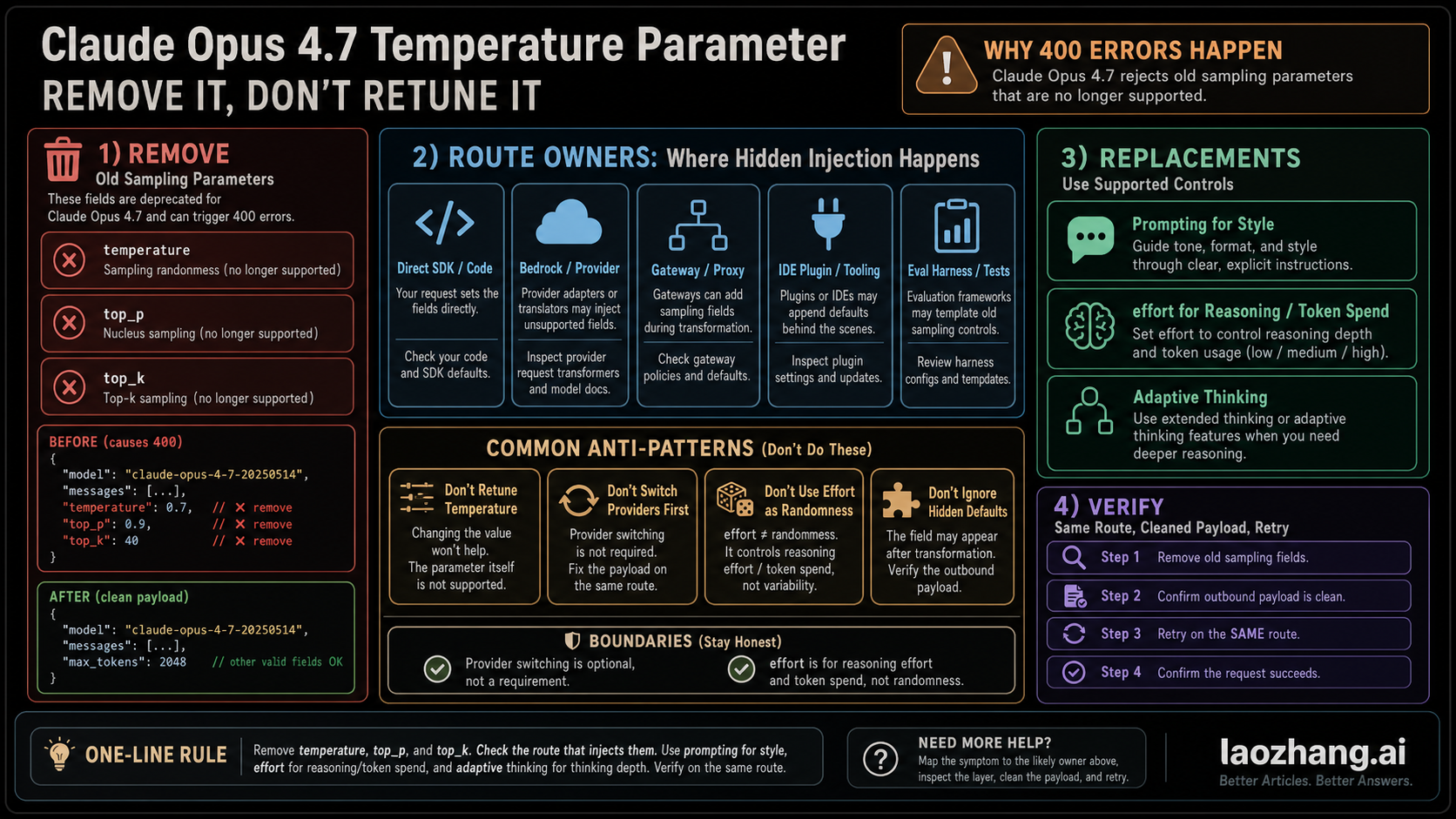
If Claude Opus 4.7 returns a 400 because your request still sends temperature, do not look for a better temperature value. Remove the field from the request path.
The same rule applies to top_p and top_k. Your next move is to find whether your SDK call, Bedrock adapter, gateway, IDE plugin, or eval harness is still injecting the old sampling controls, then retry the same route.
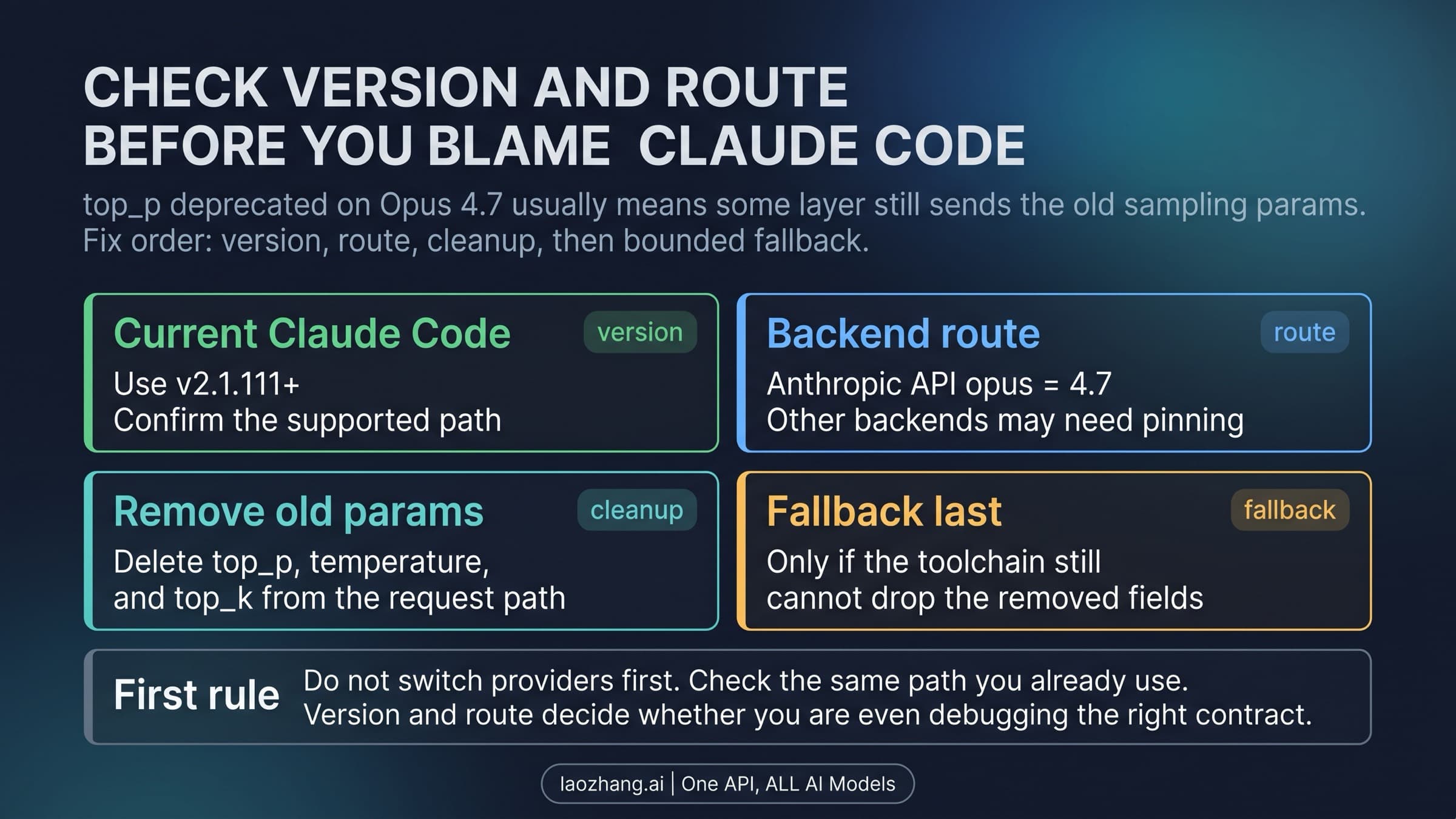
The fastest safe order is simple: delete the old sampling fields, confirm the outbound payload is clean, use prompting or effort for the control job they actually support, and only consider fallback when your current stack cannot stop adding the removed fields.
Quick Fix Matrix
Use this as a request cleanup problem before you treat it as a provider problem. The old sampling field may be visible in your application code, or it may appear later inside a wrapper that rewrites every model request.
| Where the field appears | Most likely owner | First action | Verify before switching |
|---|---|---|---|
Your code explicitly sends temperature, top_p, or top_k | Direct API or SDK call | Delete the fields entirely | Log the outbound payload and retry the same prompt on the same model |
Your app code looks clean, but the final request still has temperature | SDK defaults, shared helper, gateway, proxy, or eval harness | Patch the default request builder or strip the field at the last transformer | Confirm the request leaving that layer contains none of the old sampling fields |
| Bedrock route fails after a model upgrade | Bedrock adapter or provider schema translation | Remove sampling fields from the Bedrock payload and adapter defaults | Retry the same Bedrock model ID without changing the workload |
| IDE or agent tool fails after selecting Opus 4.7 | Plugin, agent config, model wrapper, or legacy preset | Find the preset that still stamps old generation controls | Retry the same task after the preset no longer injects them |
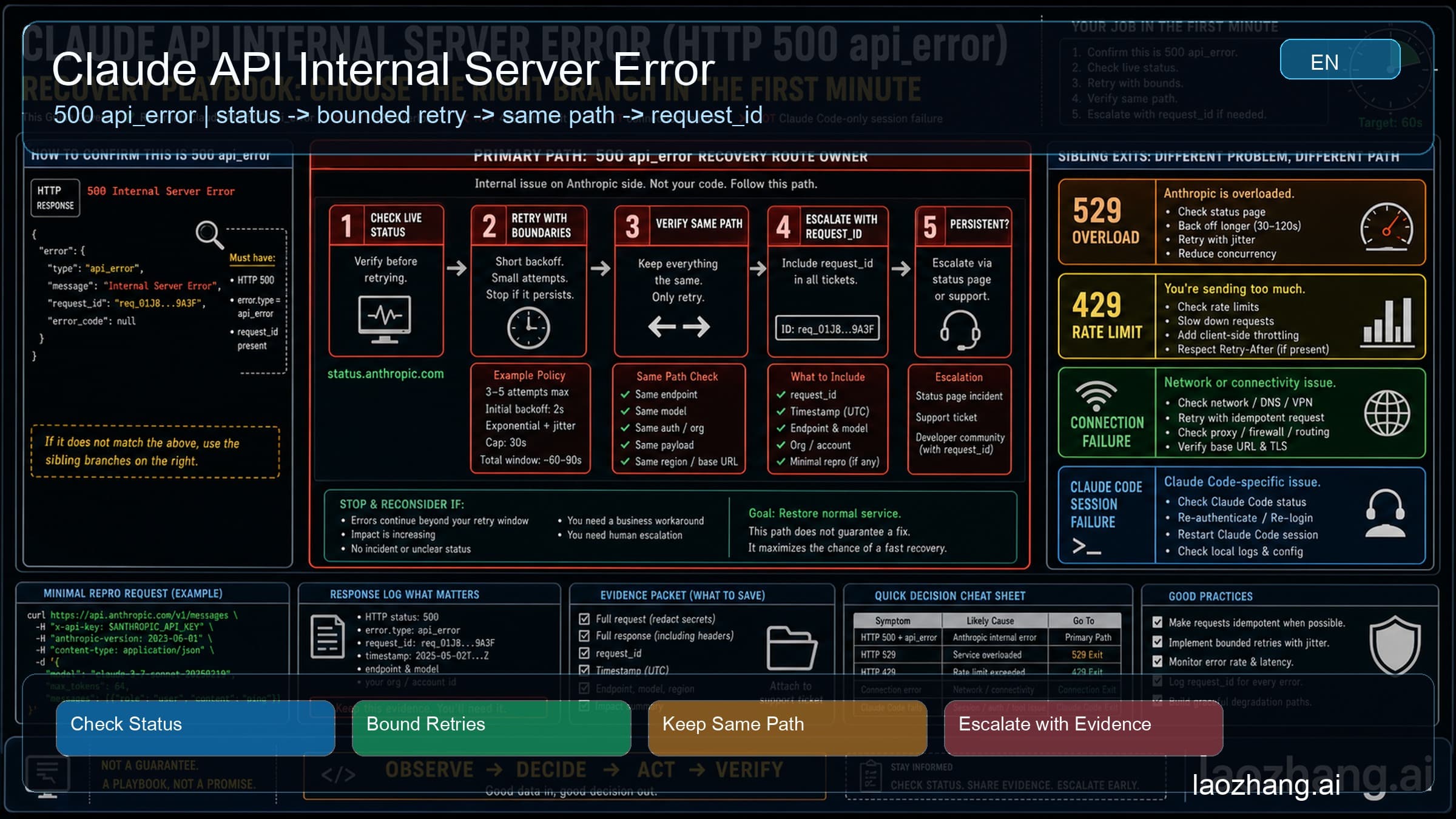
The error wording is mostly top_p deprecated inside Claude Code | Claude Code-specific branch | Use the Claude Code recovery path | Follow Claude Code Opus 4.7 top_p Deprecated because that branch starts with Claude Code version, route, and preset checks |
The important detail is the verification column. If you remove temperature and also change provider, model family, prompt, and wrapper at the same time, you no longer know what fixed the path. Keep the same route first.
What Changed in Claude Opus 4.7
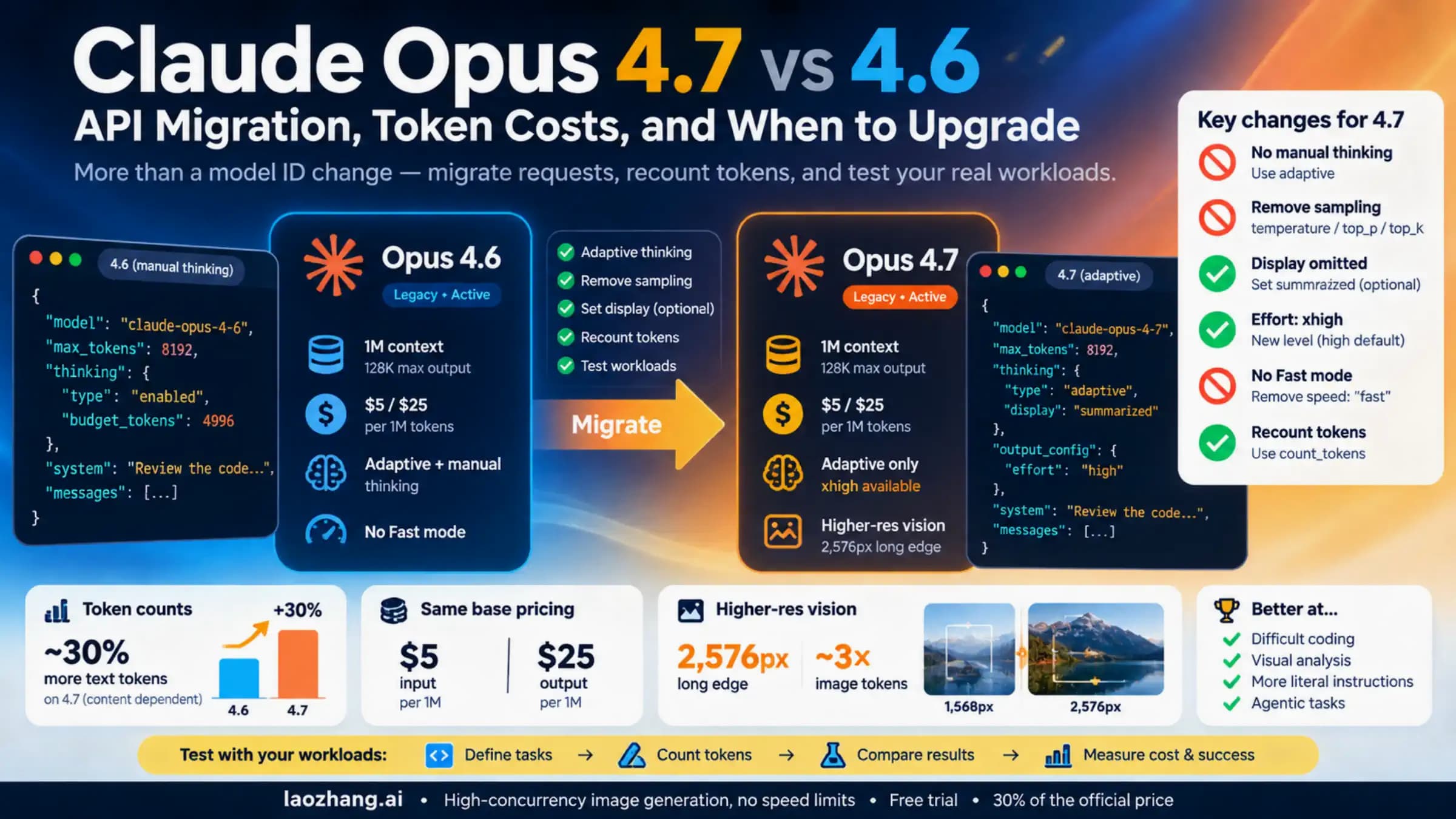
As of May 19, 2026, Anthropic's Opus 4.7 migration guide says non-default temperature, top_p, and top_k values return a 400 on Claude Opus 4.7. The safer migration advice is to omit those fields rather than hunt for a new allowed number.
That is why temperature: 0 is not the right mental model. Even on older model families, a zero temperature did not guarantee identical outputs across every run, route, or backend implementation. On Opus 4.7, the repair job is not to recreate old determinism through another sampling value. The repair job is to remove the rejected request shape.
This also changes how you describe the control you want:
| Old instinct | Better Opus 4.7 control | Why |
|---|---|---|
| "Set a lower temperature for stricter answers" | Add stricter instructions, examples, format rules, and acceptance criteria | Prompting controls behavior without sending removed sampling fields |
| "Set a higher temperature for variety" | Ask for multiple alternatives, contrastive options, or a broader exploration frame | The model can still vary outputs through task design |
"Set temperature: 0 for deterministic coding" | Use precise requirements, tests, schemas, and same-input verification | Sampling removal does not make exact determinism a field-level option |
| "Raise thinking budget manually" | Use effort where supported | effort controls reasoning and token spend, not sampling randomness |
The field name still matters because it is how errors surface in logs. But after you recognize it, switch from "temperature tuning" to "request-contract cleanup."
Patch Direct API and SDK Requests
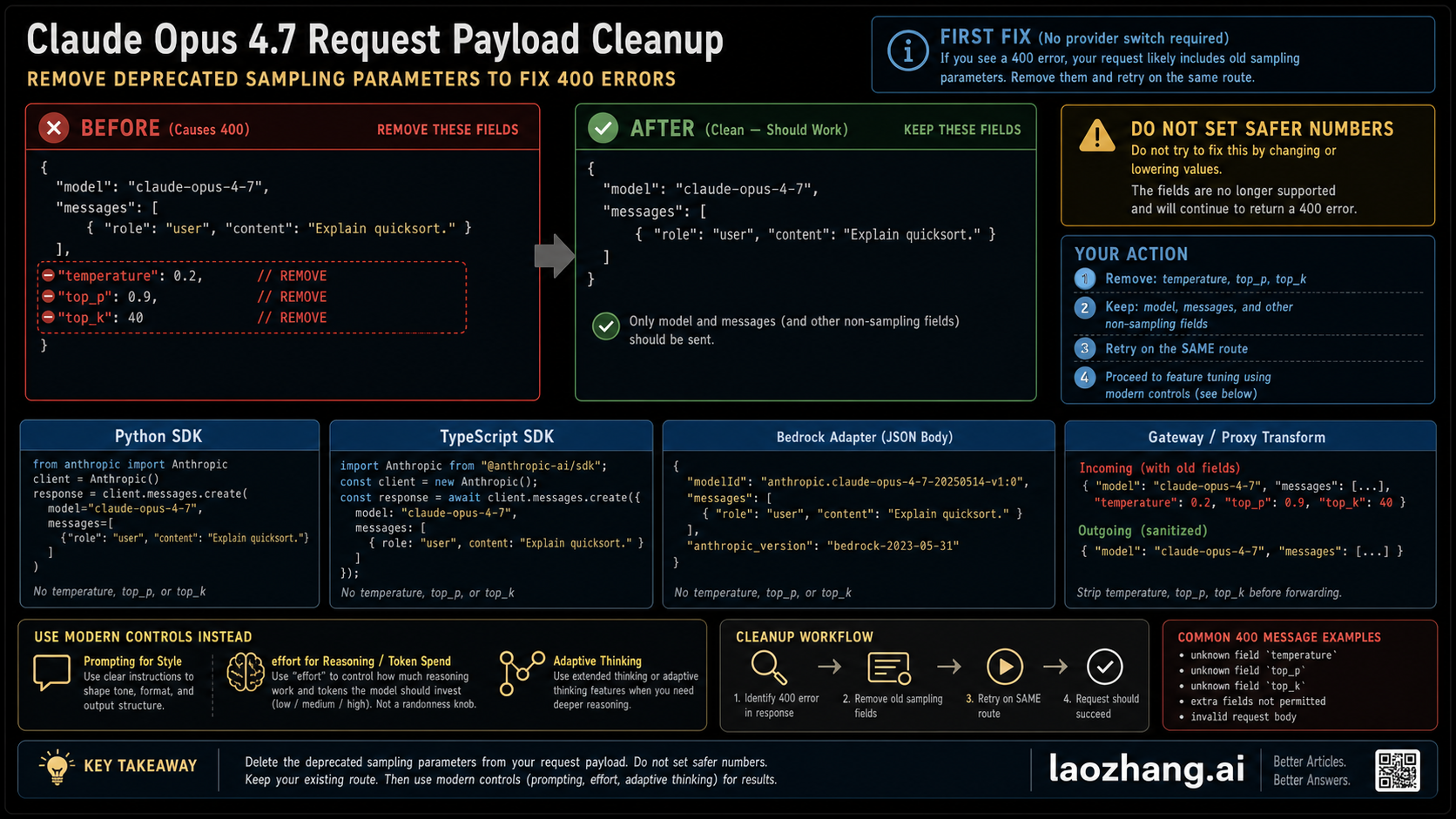
Start with the request your app actually sends. If you see temperature, top_p, or top_k, remove them rather than setting them to a default-looking value.
Python before:
message = client.messages.create(
    model="claude-opus-4-7",
    max_tokens=1200,
    temperature=0.2,
    top_p=0.9,
    messages=[
        {"role": "user", "content": "Refactor this function and explain the tradeoffs."}
    ],
)
Python after:
message = client.messages.create(
    model="claude-opus-4-7",
    max_tokens=1200,
    messages=[
        {"role": "user", "content": "Refactor this function and explain the tradeoffs."}
    ],
)
TypeScript before:
const response = await anthropic.messages.create({
  model: "claude-opus-4-7",
  max_tokens: 1200,
  temperature: 0,
  top_k: 40,
  messages: [
    { role: "user", content: "Summarize this incident and list follow-up fixes." },
  ],
});
TypeScript after:
const response = await anthropic.messages.create({
  model: "claude-opus-4-7",
  max_tokens: 1200,
  messages: [
    { role: "user", content: "Summarize this incident and list follow-up fixes." },
  ],
});
If your SDK call still fails after the visible fields are gone, print or inspect the final payload at the last possible point before it leaves your process. Many teams remove the field from one helper while a shared generation preset quietly adds it back.
For strict output, move the control into task design:
Return exactly one JSON object with keys "root_cause", "fix", and "verification".
Do not include prose outside the JSON.
If the evidence is insufficient, set "root_cause" to "unknown" and list the missing data.
That kind of instruction is more compatible with Opus 4.7 than trying to preserve temperature: 0 as a universal strictness switch.
Find the Hidden Injection Layer
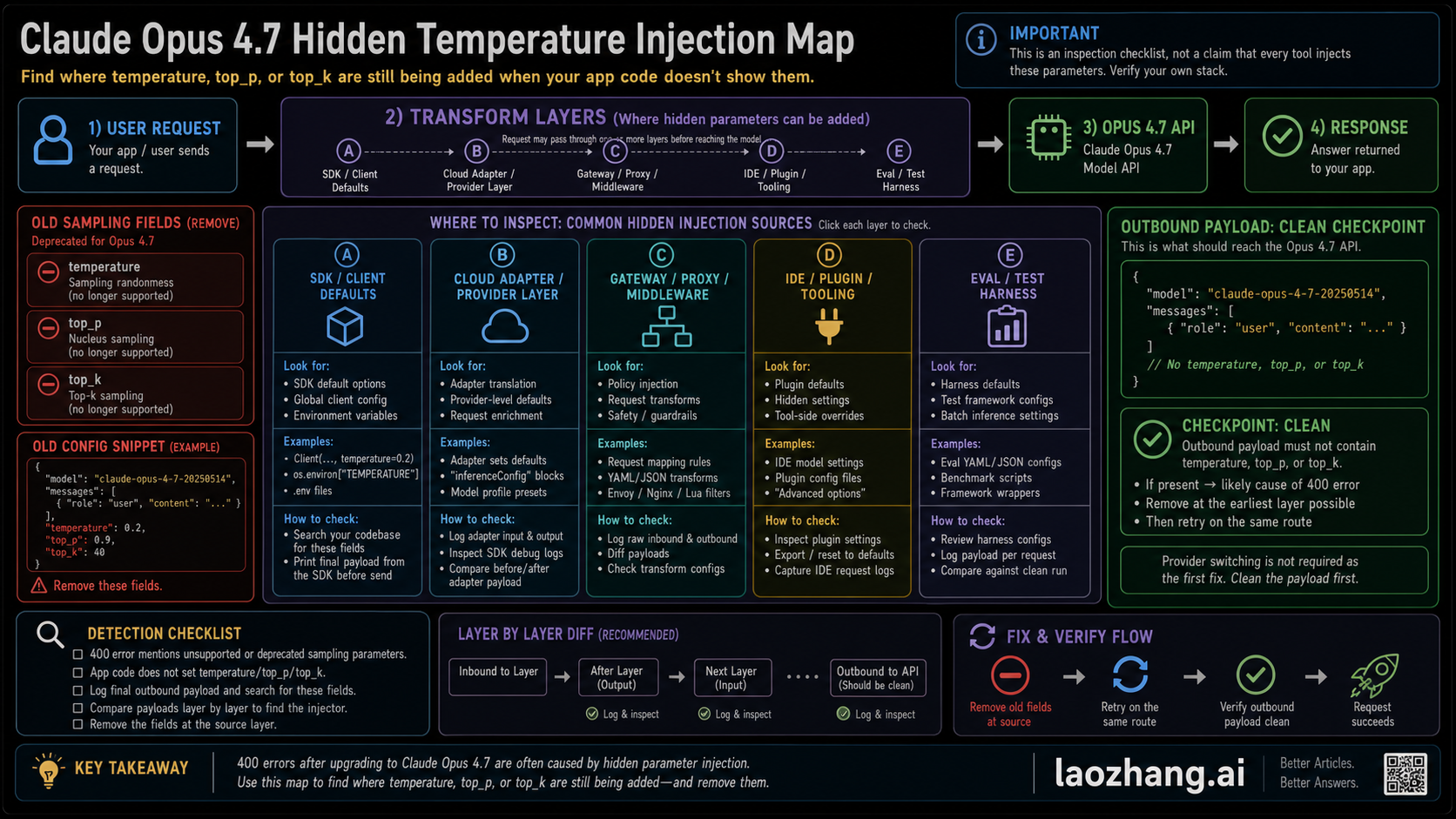
The hardest version of this bug is when your application code does not mention temperature, but the API or provider still rejects the request. In that case, assume a later layer is adding defaults.
Check these places in order:
- shared SDK wrappers that apply one generation preset to every model
- gateway middleware that maps OpenAI-style request bodies into Anthropic-style requests
- provider adapters that merge account-level defaults with per-request fields
- IDE plugins and agent tools that keep older model presets
- eval harnesses that stamp
temperature,top_p, ortop_konto every run for comparability - environment-driven config such as
MODEL_TEMPERATURE,DEFAULT_TOP_P, or JSON preset files - retry middleware that rebuilds a request from a stale template after the first failure
The useful checkpoint is the final outbound body, not the first function call. You want to prove this:
{
  "model": "claude-opus-4-7",
  "max_tokens": 1200,
  "messages": [
    {
      "role": "user",
      "content": "..."
    }
  ]
}
You do not need to expose secrets or full prompts to debug this. Log only field names, model ID, route owner, and whether the removed fields are present. The goal is to know which layer changed the request shape.
Bedrock and Provider Routes Need the Same Cleanup
The same migration rule appears outside the direct Anthropic API path. Amazon's Bedrock model card for Claude Opus 4.7 says temperature, top_p, and top_k are no longer supported for its Opus 4.7 route.
That matters because Bedrock and gateway users often debug the wrong layer. The app may send a generic request into a provider abstraction, then the adapter converts it into the provider-specific payload. If that adapter still treats temperature as a harmless default, the failure belongs to the adapter, not necessarily the business code.
Use this Bedrock-style cleanup rule:
| Route layer | What to inspect | Safe correction |
|---|---|---|
| Application request | Whether old sampling fields are in the request object | Remove them before the provider adapter sees the payload |
| Adapter mapping | Whether OpenAI-compatible fields are copied into a Bedrock Anthropic payload | Add an Opus 4.7 branch that drops temperature, top_p, and top_k |
| Account or project defaults | Whether a console preset or config file still injects generation controls | Make defaults model-aware instead of global |
| Logging and retries | Whether retries rebuild from a stale body | Rebuild retries from the cleaned payload |
Do not trust a UI label that says "Opus 4.7" by itself. Trust the final model ID, provider route, and payload fields. A correct route with an old payload will still fail.
If your real decision is whether to migrate a workload from Opus 4.6 to Opus 4.7 at all, step out to Claude Opus 4.7 vs Claude Opus 4.6. For the temperature failure path, assume Opus 4.7 is already chosen and focus on getting the broken request working again.
What Replaces Temperature?
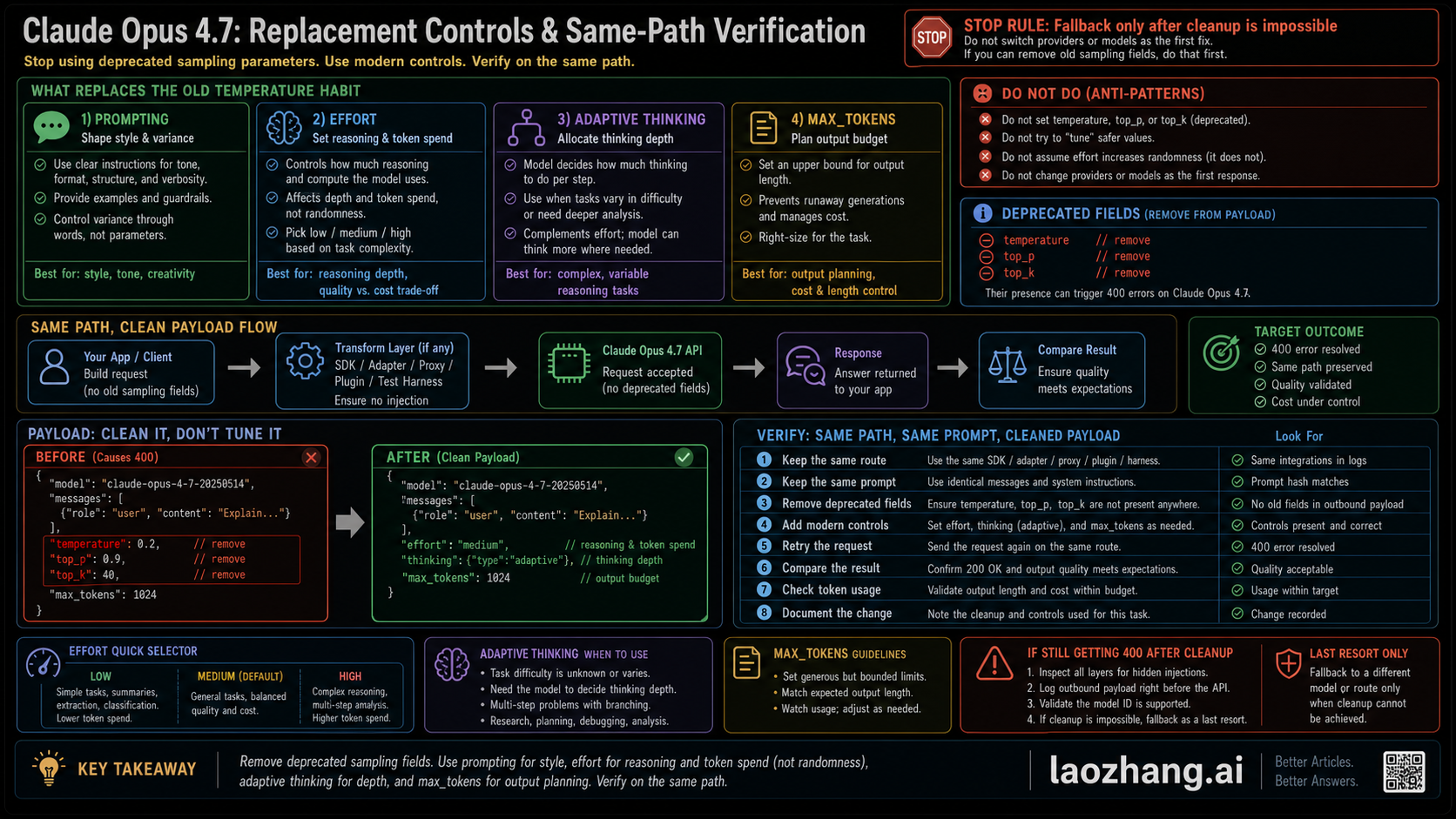
Nothing replaces temperature one-for-one. The better question is what job you used temperature for.
| Control job | Use this instead | Boundary |
|---|---|---|
| Make output follow a format | Clear schema, examples, forbidden output, and validation feedback | Prompting steers format; it does not guarantee perfect determinism |
| Make reasoning more thorough | effort where your route supports it | effort affects reasoning and token spend, not sampling randomness |
| Reduce verbose answers | Tight max_tokens, explicit answer shape, and stop conditions | Lower token budget can truncate; pair it with clear priorities |
| Generate alternative options | Ask for multiple candidates with selection criteria | Do not try to simulate diversity through removed sampling knobs |
| Stabilize production behavior | Same prompt, same route, validation tests, and regression fixtures | Stability comes from contract checks, not from sending temperature: 0 |
Anthropic's effort docs describe effort as a control for response thoroughness and token usage. Treat it as a reasoning-budget lever. It is useful for coding, agentic work, and harder analysis when supported by your route, but it is not a renamed temperature field.
Claude Opus 4.7 also uses adaptive thinking. Do not assume older manual thinking-budget request shapes still apply unchanged. If a wrapper tries to preserve both old sampling controls and old thinking controls, clean those paths separately so you can identify the real failing field.
Verify the Fix Before You Switch Routes
Your fix is not proven until the same route succeeds with a cleaned payload. Use a short verification loop:
- Keep the same model, provider route, prompt, and task.
- Remove
temperature,top_p, andtop_kfrom the request path that actually sends the payload. - Confirm the final outbound body does not contain those field names.
- Retry once.
- Save a regression check so future wrappers cannot add those fields back.
A fallback route becomes reasonable only when the current stack cannot be patched today. For example, you might temporarily keep a compatibility model, use a gateway branch that strips rejected fields, or pin a tool version while waiting for an upstream plugin fix. That should be documented as a bridge, not as the recommended Opus 4.7 setup.
Avoid this common false positive:
Changed model + changed provider + removed temperature + rewrote prompt
= not a clean fix signal
That may unblock a demo, but it does not tell you whether the original production path is now compatible with Claude Opus 4.7.
FAQ
Is the Claude Opus 4.7 temperature parameter removed or only non-default values?
Official Anthropic wording centers on non-default temperature, top_p, and top_k returning a 400. For implementation work, omission is still the safest path because SDKs, gateways, and provider adapters may disagree about what counts as a default once the field is present.
Should I set temperature to 0 for deterministic output?
No. temperature = 0 was never a universal guarantee of identical results, and Opus 4.7 migration is not solved by forcing another temperature-like value. Use stricter prompts, schemas, tests, and same-route verification instead.
Is effort the replacement for temperature?
Not directly. effort controls reasoning depth and token spend where supported. Use it when you want more or less reasoning work, not when you are trying to tune sampling randomness.
Why does Bedrock still fail if my direct code does not set temperature?
The field may be injected by an adapter, gateway, project default, or retry template after your direct code runs. Inspect the final provider payload, not only the first function call in your app.
Is this the same issue as Claude Code top_p deprecated?
It shares the same Opus 4.7 sampling-parameter boundary, but the first checks are different. If your main symptom is inside Claude Code and the visible wording is top_p deprecated, use Claude Code Opus 4.7 top_p Deprecated.
Does "Claude Opus 4.7 parameter" mean model parameter count?
For this error path, no. The useful meaning is API request parameter: temperature, top_p, and top_k. Model parameter count is a separate architecture question and does not fix the 400 response.
The Working Rule
If Claude Opus 4.7 rejects a request that still sends temperature, do not retune the number. Delete the old sampling fields, find the layer that added them, replace the old control job with prompting or effort where appropriate, and verify the same route before you switch anything else.