Claude Extra Usage Cost: Credit Math and When Max Is Cheaper
Claude extra usage bills at API rates: a 200K-token Claude Code turn costs $0.60 on Sonnet 5.5 and $3 on Fable 5.1. Over $80 a month on Pro, Max 5x usually wins.
On this page
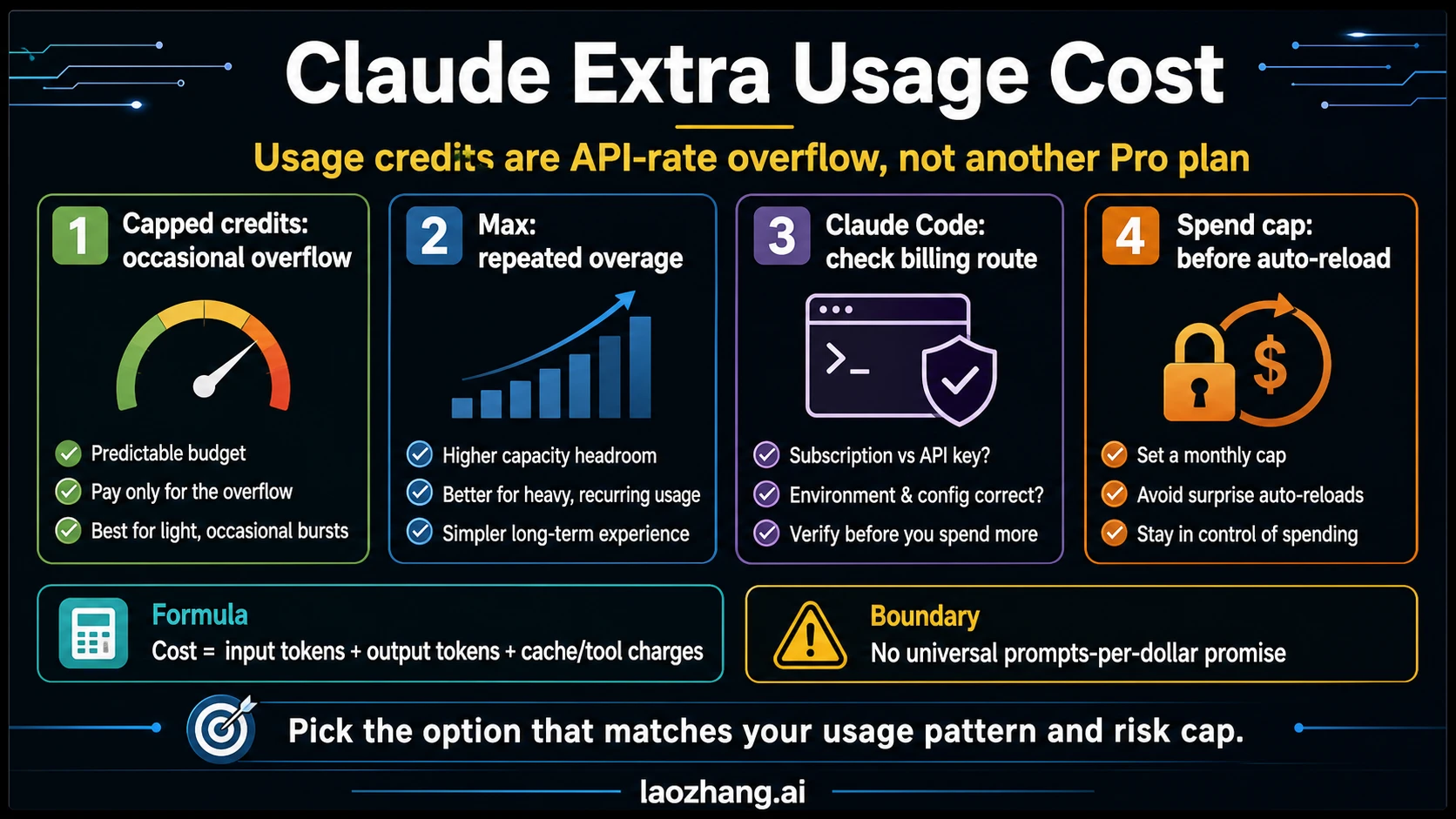
Claude extra usage, which Anthropic now calls usage credits, is pay-as-you-go billing at standard API rates once your Pro or Max plan limit runs out. It is charged per token, not per message, and it shows up as an additional charge on top of your subscription. As of October 10, 2026, one large Claude Code turn (200K tokens read, 20K written, nothing cached) costs about $0.60 on Sonnet 5.5, $1.20 on Opus 5.5, and $3.00 on Fable 5.1. That is why $20 of credits can last an afternoon on Sonnet and only a few minutes on Fable or Opus.
The short rule: credits are fine for a capped, occasional overflow. If you are on Pro and keep adding more than about $80 a month, the $100 Max 5x plan usually costs less, because $20 for Pro plus $80 of credits already equals the Max 5x price.
| Situation | Better next move |
|---|---|
| You only need a short burst and can cap it | Turn on usage credits with a low monthly spend limit. |
| You add credits every month, about $80 or more on Pro | Compare that spend with Max 5x at $100 before buying more. |
| You use Fable 5.1 on Pro | Expect every Fable request to bill credits from the first one; Max includes Fable up to half the weekly limit. |
| Claude Code suddenly feels expensive | Check whether it is signed in to your plan or running on an API key, then switch model or trim context. |
| You are considering auto-reload | Set the monthly spend limit and alerts first. |
| You buy credits regularly anyway | A usage bundle cuts the price of each credit dollar by 10–30%. |
| You cannot name the model, context size, or billing path | Do not add funds yet. |
The quick formula is:
estimated cost = input MTok x input rate + output MTok x output rate + cache read/write chargesWhat Claude Extra Usage Actually Bills: API Rates Past the Plan Limit
Extra usage is Anthropic's usage-credit feature for Pro, Max 5x, and Max 20x. According to Anthropic's help article Manage usage credits for paid Claude plans, usage credits are "billed at standard API rates" and "apply to both Claude conversations and Claude Code terminal usage." You only draw on them after your included plan usage for the current window is gone.
How it works in practice, as of October 10, 2026:
- Open Settings > Usage on the web and turn on usage credits. If you subscribe through the mobile app, you still enable them on the web.
- Add a payment method and set a monthly spend limit. You can also turn on spend alerts and auto-reload, or prepay with "Add funds."
- Keep working after you hit a limit. The overflow is charged at the API rate of whichever model you are using.
Your plan's own limits keep resetting on their normal schedule. Credits do not turn Pro or Max into an unlimited plan. They let work continue past the limit, up to the spend limit you set, and then bill for it separately.
Several credits that people confuse with extra usage do not pay for it:
| Credit or balance | Pays for extra usage? | What it is |
|---|---|---|
| Usage credits you buy (including bundles) | Yes | Your own money, spent at API rates after plan limits. |
| Max and Team monthly API credits (since October 7, 2026) | No | Max 5x gets $100 and Max 20x $200 a month for the Claude API, Managed Agents, the Agent SDK, and the Console playground. Anthropic's help article says monthly API credits "don't apply to usage credits in Claude, Claude Code, or Claude Cowork." |
| Cloud session credit ($100 on Pro, $250 on Max) | No | A one-time promotional credit. Claims closed on October 7, 2026. |
| Limit reset | No | A refill of a plan limit, not money. |
The cloud session credit is the one most often mixed up with usage credits. It was a separate promotional balance, and the claim window is now closed. What still works for people who claimed it, and how it differs from a limit reset, is covered in Claude Cloud Session Credit vs Usage Credits vs Limit Reset.
One regional rule also changed. In certain jurisdictions, such as Japan, usage credits bought from September 10, 2026 expire six months after purchase. Elsewhere, Anthropic says they generally do not expire.
Use This Formula Before You Add Funds: October 2026 Model Rates
The useful estimate is tokens times rate, not dollars per prompt. Input, output, cache reads, and cache writes each have their own price:
usage credit burn =
  fresh input MTok x input rate
+ output MTok x output rate
+ cached input MTok x cache read rate
+ newly cached MTok x cache write rate
MTok means one million tokens. These are the API list prices on Claude's pricing page as of October 10, 2026, and usage credits are charged at the same rates:
| Model | Input per 1M | Output per 1M | Cache read per 1M | Cache write per 1M |
|---|---|---|---|---|
| Fable 5.1 | $10 | $50 | $0.25 | $12.50 |
| Opus 5.5 | $4 | $20 | $0.20 | $5 |
| Sonnet 5.5 | $2 | $10 | $0.10 | $2.50 |
| Haiku 5.5, prompts up to 100K | $0.10 | $0.50 | $0.01 | $0.125 |
| Haiku 5.5, prompts over 100K | $0.50 | $2.50 | $0.05 | $0.625 |
Opus 5.5 in fast mode costs twice the listed rate. Rates you may have seen earlier in 2026 for Haiku 4.5, Sonnet 4.6, Opus 4.8, or the introductory Sonnet 5 price are history and should not go into a current estimate.
Two things in this table drive most surprises. Output costs five times as much as input on every model. And a cache read costs a small fraction of fresh input (one-twentieth on Opus 5.5, one-fortieth on Fable 5.1), so whether your context is cached matters as much as which model you pick.
Worked Examples With Assumptions: What One Claude Code Turn Costs
These numbers assume one large Claude Code turn that reads 200K tokens of context and writes 20K tokens of output. Real turns vary widely, so treat this as a unit you can scale, not a promise.
Uncached Opus 5.5, worked out:
0.2 MTok x $4 + 0.02 MTok x $20 = $0.80 + $0.40 = $1.20The cached version assumes 180K of the 200K input is served from the prompt cache and 20K is new:
0.18 MTok x $0.20 + 0.02 MTok x $4 + 0.02 MTok x $20 = $0.036 + $0.08 + $0.40 = $0.516The same math for every current model:
| Model | Uncached turn | Cached turn | Turns per $20 (uncached / cached) | Turns per $100 (uncached / cached) |
|---|---|---|---|---|
| Fable 5.1 | $3.00 | $1.245 | 6 / 16 | 33 / 80 |
| Opus 5.5 | $1.20 | $0.516 | 16 / 38 | 83 / 193 |
| Sonnet 5.5 | $0.60 | $0.258 | 33 / 77 | 166 / 387 |
| Haiku 5.5 (over-100K rate) | $0.15 | $0.069 | 133 / 289 | 666 / 1,449 |
Turn counts are rounded down. Two things raise the real number.
First, one instruction in Claude Code often runs as several model requests: it reads files, edits, runs a command, and reads the result, and each request sends the context again. A Facebook user reported on October 8, 2026 that $20 was "used up" in "approximately 3 minutes" on "Opus 5.5 on High effort." That is one person's report, but it fits the table: 16 uncached Opus turns of this size can go quickly when an agent loop fires them back to back.
Second, the cache has to be written before it can be read. If the cached context expires, the next turn pays the cache write rate on the whole prefix. On Opus 5.5 that turn costs 0.18 MTok x $5 + $0.08 + $0.40 = $1.38, more than an uncached turn. On Sonnet 5.5 it is $0.45 + $0.04 + $0.20 = $0.69. The Claude Code section below explains why that happens more often on credits.
So "How many prompts does $20 buy?" has an honest answer only once you fix the model and context size. For a heavy Claude Code session with a large repository loaded, $20 is roughly 6 Fable turns, 16 Opus turns, or 33 Sonnet turns without caching.
Credits Versus Max: The Practical Threshold Is About $80 a Month
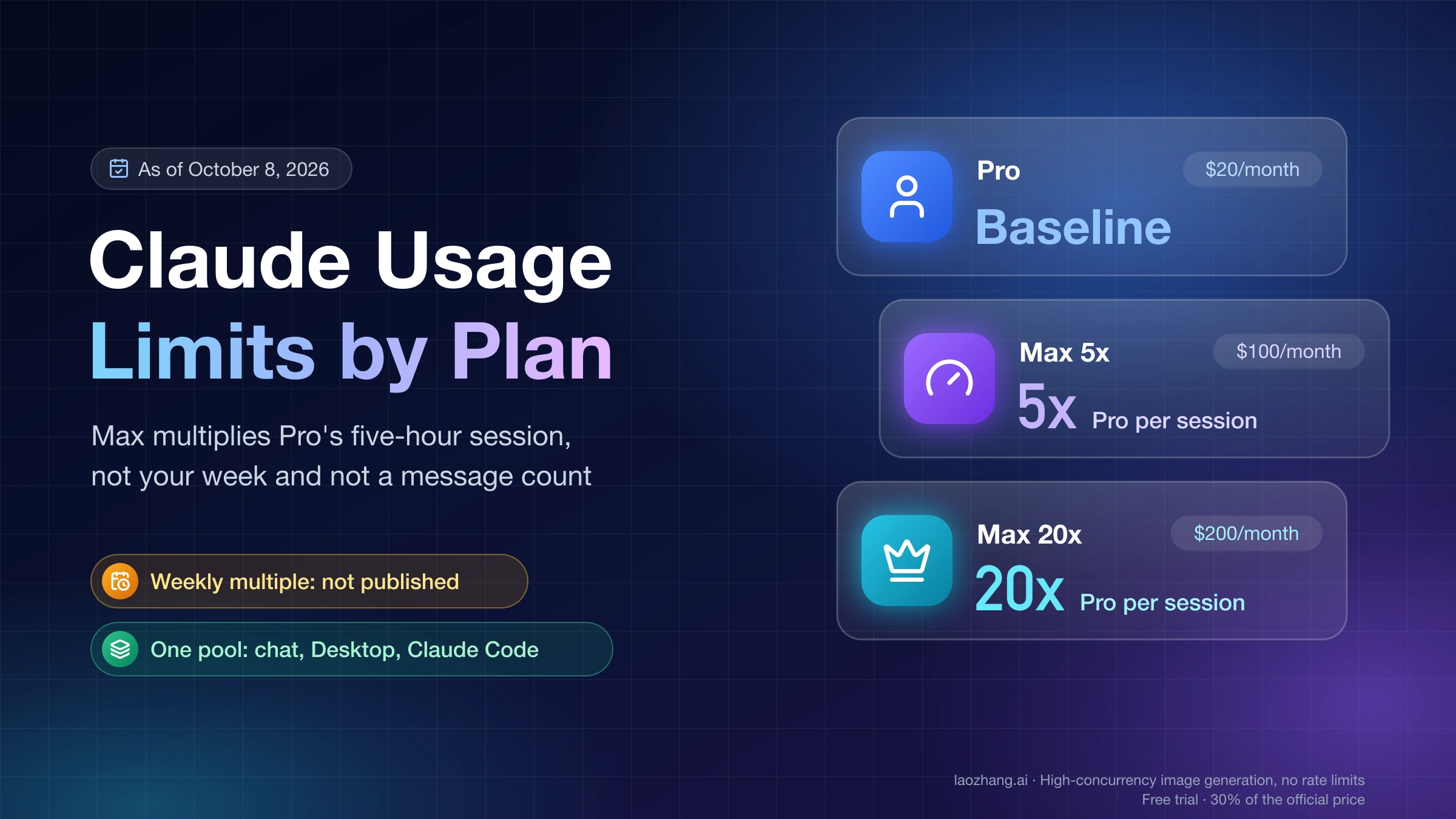
As of October 10, 2026, Pro costs $20 a month (or $17 a month billed annually at $200), Max 5x costs $100, and Max 20x costs $200, according to Claude's pricing page. The break-even follows directly:
Pro $20 + credits $80 = $100 = Max 5x
Max 5x $100 + credits $100 = $200 = Max 20x
If you are on monthly Pro and regularly add more than about $80 of credits, Max 5x usually costs less and gives you more included usage. On annual Pro the line moves to about $83. If you buy $50 bundles at $45, it moves to about $89 of credit value, because $80 / 0.90 = $88.89. The same logic applies one step up: on Max 5x, more than about $100 of credits a month points toward Max 20x.
This is a spend rule, not a token equivalence. Anthropic does not publish a dollar value for a plan's included usage, so nobody can say exactly how many API-rate dollars Max 5x replaces. What 5x and 20x multiply is explained in Claude Usage Limits by Plan.
Max also changes two costs that credits cannot:
- Fable models. On Pro and standard Team seats, Fable "aren't included in your plan's usage limits," so every Fable request bills credits from the first one. On Max, you can use up to 50% of your weekly limit on Fable at no extra cost before credits apply. A Pro user who mainly runs Fable 5.1 at $3 per large turn reaches $80 of credits in about 27 such turns.
- Monthly API credits. Max 5x includes $100 and Max 20x $200 of monthly API credits for API and Agent SDK work billed through a linked Claude Console organization. They do not pay for extra usage, but they can replace API spending you would otherwise make separately.
| Pattern | Default decision |
|---|---|
| One unusually heavy day | Use capped credits or wait for the limit to reset. |
| A predictable monthly spike under $80 on Pro | Keep Pro, use capped credits, consider a $50 bundle. |
| Repeated overage of $80 or more on Pro | Move to Max 5x. |
| Fable 5.1 is your main model on Pro | Compare with Max first; Fable is credits-only on Pro. |
| Repeated overage of $100 or more on Max 5x | Compare with Max 20x. |
| Unknown cause of the spend | Do not buy more; check model, context, and billing path. |
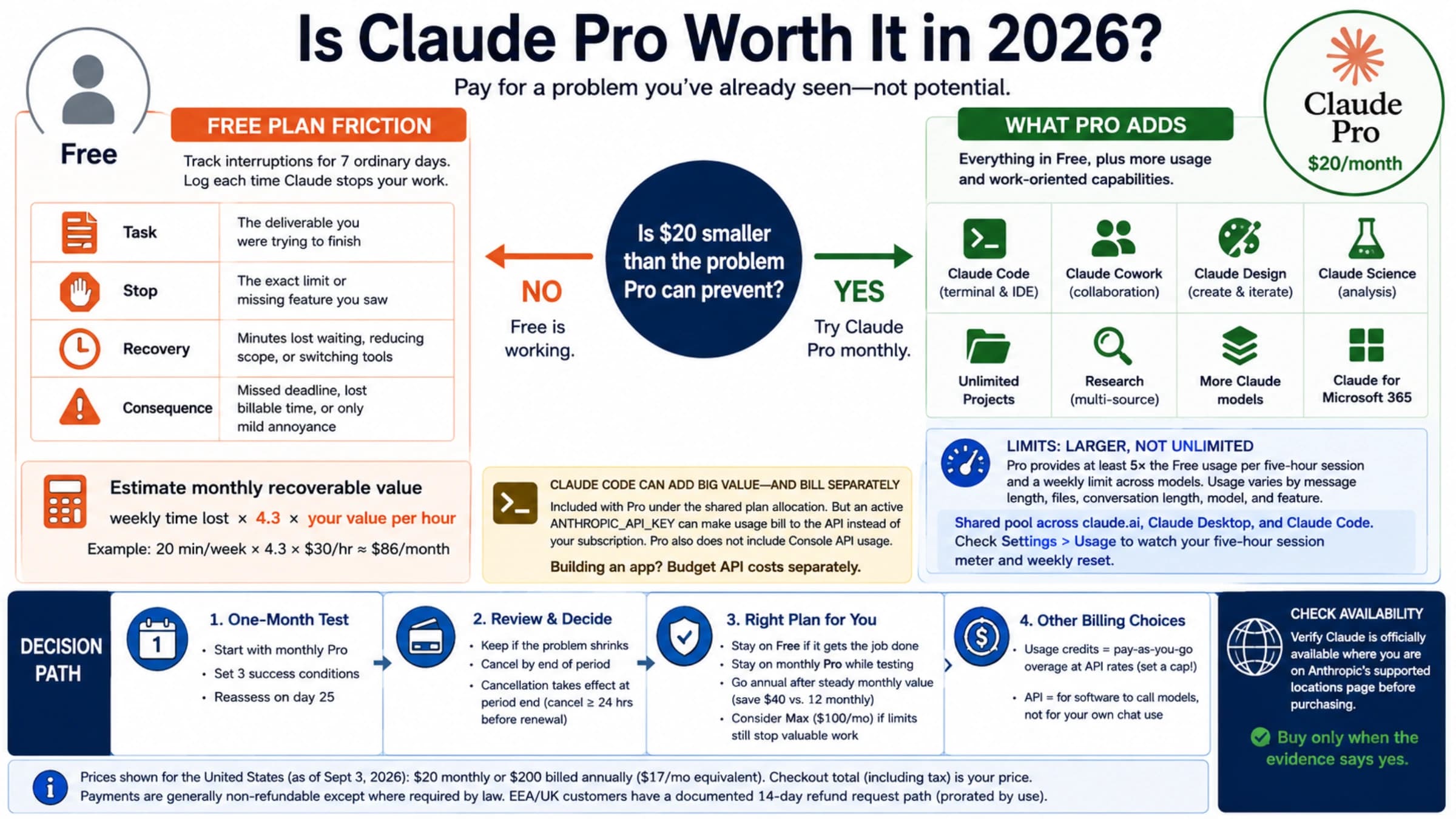
For the question one step earlier, whether the $20 plan is enough at all, see Is Claude Pro Worth It in 2026?.
Claude Code Can Change the Math: Fable, Cache Lifetime, and API Keys
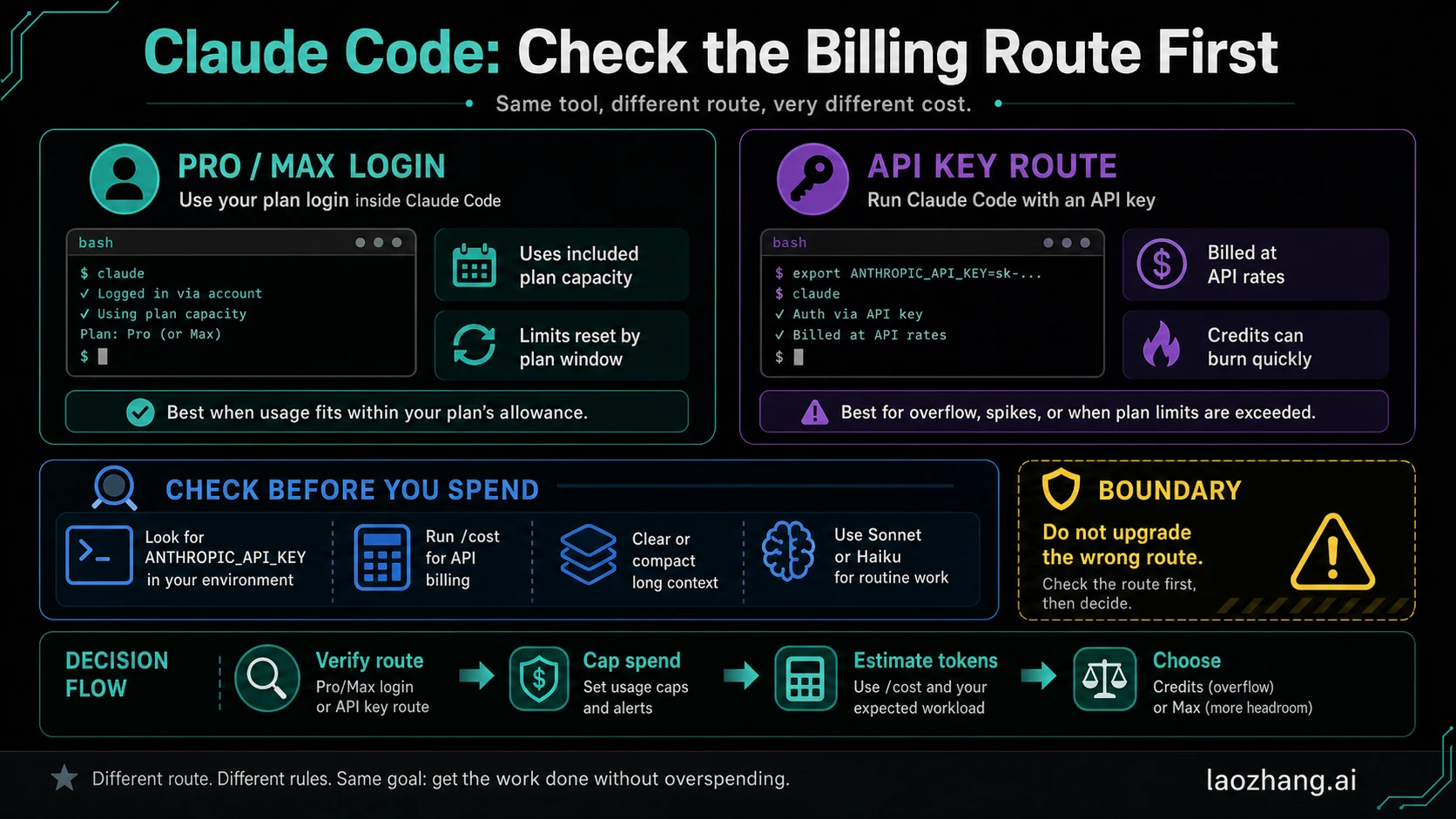
Claude Code is where extra usage gets expensive fastest, for four reasons.
The model choice. Picking Fable 5.1 on Pro means paying credits from the first request. Claude Code needs version 2.1.255 or later for Fable 5.1.
The cache lifetime. As of September 24, 2026, Claude Code's documentation says the prompt cache lasts one hour on a subscription but drops to five minutes while you are drawing on usage credits. Step away for a coffee and the next turn rewrites the cache at the higher write rate, which is the $1.38 Opus turn from the table above.
The billing path. If Claude Code is signed in with your Pro or Max account, it uses plan limits first and then usage credits. If an ANTHROPIC_API_KEY is set and active, it can bill your API account instead, outside both plan limits and usage credits. Check before adding funds:
claude
/status
/cost
Then check whether a key is set in your shell, without printing it:
env | grep -c ANTHROPIC_API_KEYAny number above 0 means a key is set. The Claude Code API key vs subscription billing guide walks through the fix. For a broader comparison of the two billing models, see Claude API vs Claude Code: Which One to Use and How You Pay. If the spend looks like repeated cache misses, the Claude Code cache TTL and token usage guide shows how to confirm it.
Scripts and the Agent SDK. Anthropic announced a change for June 15, 2026 that would have moved programmatic use off subscription limits, then paused it. Anthropic's help article states: "You can still use the Claude Agent SDK, claude -p, and third-party apps with your subscription limits." Scripted runs therefore draw on your plan limits the same way interactive sessions do.
The fastest savings in Claude Code come from four habits:
- Use Sonnet 5.5 for most coding and keep Opus 5.5 or Fable 5.1 for hard planning and debugging.
- Use Haiku 5.5 for mechanical tasks when quality allows.
- Clear or compact long context at natural breaks instead of carrying everything forward.
- Avoid long pauses mid-task while on credits, or start a fresh, smaller context after one.
Bundles, Caps, and Auto-Reload: Up to 30% Off, $2,000 a Month

Usage bundles are discounted prepaid credits. As of October 10, 2026, Anthropic's usage bundle help article lists three sizes:
| Bundle value | You pay | Discount | Cost per credit dollar | Opus 5.5 uncached turn at that price |
|---|---|---|---|---|
| $50 | $45 | 10% | $0.90 | $1.08 |
| $250 | $200 | 20% | $0.80 | $0.96 |
| $1,000 | $700 | 30% | $0.70 | $0.84 |
The rules that matter for cost:
- Bundles are available on Pro, Max, and Team. You buy them in Settings > Usage > "Buy usage," and usage credits must already be turned on.
- Individuals can buy up to $2,000 of discounted bundle value a month. Team Owners and Primary Owners can buy up to $3,000 a month. Beyond that, credits cost the standard rate.
- The balance is one pool across Claude on the web, desktop, and mobile, Claude Code, Cowork, and third-party products that use your Claude account.
- Bundle credits are spent only after your plan limits are used up.
- The bundle page does not state an expiry or refund policy. In Japan and similar jurisdictions, the six-month expiry for usage credits bought from September 10, 2026 is worth checking before a $700 prepay.
A discount does not fix a workload that burns too fast. If you buy a $1,000 bundle without knowing why credits are draining, you have only made the same burn 30% cheaper and prepaid for it. Bundles make the most sense once your monthly overflow is steady and you have already compared it with the next plan up. For other legitimate ways to pay less, see Claude Code Discounts in 2026.
If Manual Bundle Checkout Fails but Auto-Reload Still Works
Anthropic's bundle article says the discount is applied at checkout and the balance appears in Settings > Usage. A Reddit post in r/Anthropic about a failed $1,000-for-$700 bundle purchase, updated July 25, 2026, describes a manual bundle failing after 3DS while auto-reload kept working on the same saved card. That is one account's report, not proof of a wider outage.
If it happens to you, check three things: did your credit balance increase, did an invoice appear, and did your bank see an authorization? If none did, treat it as an incomplete purchase and stop retrying large amounts. Work through Anthropic's card-decline troubleshooting article, then contact Product Support through Anthropic's Get help instructions. Include the plan, bundle amount, local time and time zone, the exact error, whether 3DS completed, and whether auto-reload succeeded. Keep card numbers and invoice IDs out of any public post.
Set these controls before you rely on credits:
| Control | Why it matters |
|---|---|
| Monthly spend limit | Stops a bad session from becoming an open-ended bill. |
| Spend alerts | Warns you before a looping workflow reaches the limit. |
| Auto-reload off at first | Keeps top-ups deliberate until your monthly spend is predictable. |
| Usage page check | Separates plan usage from credit charges. |
| Claude Code sign-in check | Confirms you are not paying API rates through a stray key. |
Anthropic's usage-credit articles do not publish a universal minimum top-up amount. Use whatever the Add funds screen in your account shows.
Before Paying More, Reduce the Burn With Model and Context Choices
The cheapest extra usage is the usage you avoid without hurting the work.
Start with the model. At October 2026 rates, the same large turn costs $3.00 on Fable 5.1, $1.20 on Opus 5.5, $0.60 on Sonnet 5.5, and $0.15 on Haiku 5.5. Sonnet 5.5 handles most coding and analysis. Haiku 5.5 is often enough for extraction, cleanup, classification, or mechanical edits. Fable and Opus should have a reason, such as hard debugging or planning that a smaller model gets wrong.
Then shrink the context. Long conversations, project files, research mode, and many tools all add input tokens to every request. In Claude Code, /clear and /compact are cost controls once a session has turned into a large moving context.
Keep the cache warm or start fresh. On credits, the cache lasts five minutes. A short pause followed by a full-context turn pays the write rate. If you need a long break, compact or clear first so the next turn rewrites less.
Finally, split work. Smaller tasks with clear boundaries keep each request's context small and make the bill easier to trace.
A Simple Decision Checklist Before You Enable Usage Credits
Use this before turning on credits, buying a bundle, or moving to Max.
| Check | Pass condition |
|---|---|
| Mechanism | You know extra usage means usage credits billed at API rates after plan limits. |
| Billing path | You know whether the spend is plan usage, usage credits, or an API key. |
| Model | You know whether Fable, Opus, Sonnet, or Haiku is doing the expensive work. |
| Fable on Pro | You know every Fable request on Pro bills credits. |
| Token size | You have a rough input and output estimate per turn. |
| Spend limit | You have set a monthly spend limit and alerts before auto-reload. |
| Repetition | You know whether this is a one-off spike or a monthly pattern. |
| Max comparison | You have compared repeated spend with the $80 (Pro to Max 5x) and $100 (Max 5x to 20x) lines. |
| Other credits | You know Max monthly API credits and the cloud session credit do not pay for extra usage. |
If three or more rows are still unknown, pause. Claude pricing is knowable; what is missing is the model, context size, and billing path for your own work.
FAQ
How does extra usage work with Claude?
After your Pro or Max plan limit for the current window runs out, usage credits let you keep going and charge you at standard API rates for the model you use. You turn them on in Settings > Usage, add a payment method, and set a monthly spend limit. The charges appear separately from your subscription.
Is Claude extra usage expensive?
It can be. At October 10, 2026 rates, a large Claude Code turn costs about $0.60 on Sonnet 5.5, $1.20 on Opus 5.5, and $3.00 on Fable 5.1 without caching. Occasional capped overflow is manageable. Daily heavy sessions on Opus or Fable add up quickly.
How many Claude prompts does $20 buy?
It depends on the model and context size. For a heavy Claude Code turn of 200K tokens in and 20K out, $20 buys about 6 Fable 5.1 turns, 16 Opus 5.5 turns, or 33 Sonnet 5.5 turns without caching, and two to three times as many with most of the context cached. Short chats with little context cost far less.
Can I get unlimited usage on Claude?
No Claude plan is unlimited. Max 5x and Max 20x raise the included limits, and usage credits let you continue past them, but only up to the monthly spend limit you set and only at API rates.
What is the difference between the Claude $20 plan and the $100 plan?
Pro costs $20 a month; Max 5x costs $100 and is named for its usage relative to Pro. Max 5x also includes Fable models up to half of your weekly limit and $100 a month of API credits for API work. On Pro, Fable bills usage credits from the first request. Claude Usage Limits by Plan explains what the multipliers cover.
Is extra usage the same as another Pro plan?
No. It is not a second message allowance. It is separate pay-as-you-go billing that runs alongside your normal plan limits and their resets.
Should I buy credits or upgrade to Max?
Use credits for occasional, capped overflow. If you are on Pro and regularly spend more than about $80 a month on credits, Max 5x at $100 usually costs less. If you use Fable a lot on Pro, compare with Max sooner.
Do Max monthly API credits pay for extra usage?
No. Since October 7, 2026, Max 5x and Max 20x include $100 and $200 of monthly API credits, but Anthropic states they do not apply to usage credits in Claude, Claude Code, or Claude Cowork. They cover Claude API work through a linked Console organization.
What is the Claude cloud session credit, and is it the same as usage credits?
It is not. The cloud session credit was a one-time promotional balance of $100 on Pro and $250 on Max, and claims closed on October 7, 2026. Usage credits are money you add yourself. Claude Cloud Session Credit vs Usage Credits vs Limit Reset covers what happens to a claimed balance.
Do Claude usage credits expire?
In most places Anthropic says they generally do not expire. In certain jurisdictions such as Japan, usage credits bought from September 10, 2026 expire six months after purchase.
Do bundles make extra usage cheap?
They make it cheaper by 10%, 20%, or 30% ($45, $200, or $700 for $50, $250, or $1,000 of credits). They do not change how fast a session burns credits, and they are worth it only when your overflow is steady.
Can Claude Code use my credits without me realizing it?
Yes, if usage credits are on and you hit your plan limit, Claude Code keeps working on credits. If an API key is active instead, you pay the API bill rather than credits. Check /status, /cost, and whether ANTHROPIC_API_KEY is set before assuming where the spend came from.
Does auto-reload make sense?
Only after you set a monthly spend limit and know your typical monthly spend. It suits predictable overflow. It is risky while you still do not know whether the model, a long context, or an API key is driving the cost.
What should I do first if credits are disappearing quickly?
Check the model, check the billing path, clear or compact long context, and avoid long pauses while on credits. If the spend repeats every month and passes about $80 on Pro, compare it with Max instead of treating credits as a permanent fix.
Sources6
External pages this guide links to, in the order they appear. Last updated Oct 10, 2026.
Sources6
External pages this guide links to, in the order they appear. Last updated Oct 10, 2026.
- 1.Manage usage credits for paid Claude planssupport.claude.com/en/articles/12429409
- 2.Claude's pricing pageclaude.com/pricing
- 3.usage bundle help articlesupport.claude.com/en/articles/14246112-buy-usage-bundles
- 4.Reddit post in r/Anthropic about a failed $1,000-for-$700 bundle purchasereddit.com/r/Anthropic/comments/1v5mz45/claude_autoreload_works_but_the_failed_1000for700
- 5.card-decline troubleshooting articlesupport.claude.com/en/articles/9402418-why-was-my-card-declined
- 6.Get help instructionssupport.claude.com/en/articles/9015913-how-to-get-support