Doubao Seed Code: Open Source, API Model, or Coding Plan?
Doubao Seed Code spans open-source Seed-Coder weights, a hosted Volcengine API route, Coding Plan/tool access, Doubao App/TRAE usage, and benchmark pages; choose the route before testing.
On this page
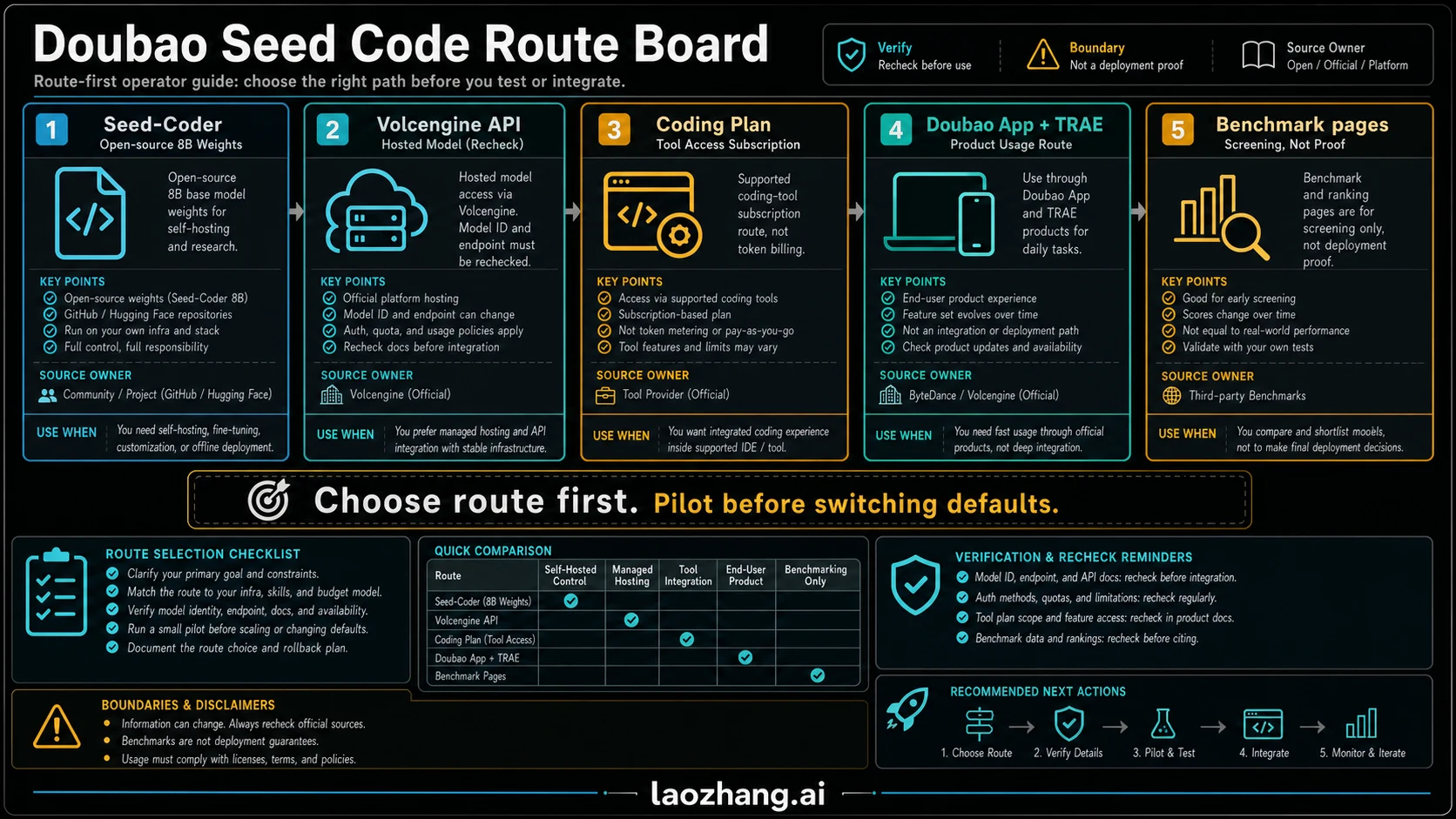
Doubao Seed Code is not one route. If you need local weights, start with Seed-Coder on GitHub or Hugging Face. If you need a hosted coding model, verify the current Volcengine Ark model ID, endpoint, context, pricing, cache, and limits before you run a repository task. If you want a supported coding-tool subscription, evaluate Coding Plan separately from token-billed API usage. Treat Doubao App and TRAE as product surfaces, and treat benchmark pages as screening rather than deployment proof.
The default move is a bounded pilot, not a default switch. Freeze one repo snapshot, run the same bugfix, refactor, or front-end task through the route you are testing, and switch only if tests pass, reviewer time drops, retry cost is acceptable, billing is clear, and rollback remains simple.
The Fast Route Board
The useful first question is not "is Doubao Seed Code good?" It is "which surface am I about to use?" The answer changes the official source, the billing model, the setup work, and the risk you need to measure.
| Route | Use it when | Verify before use | Do not assume |
|---|---|---|---|
| Seed-Coder open-source weights | You need local control, reproducible tests, offline evaluation, or self-hosting experiments. | GitHub repository, Hugging Face model card, license, variant, context length, and hardware cost. | Do not treat the open-source 8B family as the same contract as the hosted Volcengine coding model. |
| Volcengine Ark hosted API | You need an API-callable coding model for repository tasks, tool orchestration, or gateway integration. | Model ID, alias, base URL, context/input/output limits, pricing, cache behavior, RPM/TPM, and console activation. | Do not copy a stale tutorial endpoint into production without checking the console and current docs. |
| Coding Plan | You want supported coding-tool access rather than metered token billing. | Plan terms, supported tools, regions, seats, included usage, overage rules, and cancellation terms. | Do not describe Coding Plan as the same thing as token-billed API use. |
| Doubao App and TRAE | You want the product experience or IDE-adjacent workflow shipped by ByteDance. | Current app availability, TRAE integration, account requirements, and which Seed2.0 Code features are exposed. | Do not infer API limits or billing from app behavior. |
| Benchmark and review pages | You need a screening signal before spending time on a pilot. | Test date, benchmark version, task mix, price assumptions, latency, and whether coding-agent tool use was measured. | Do not make a default switch from a leaderboard row. |
If you only need one recommendation: test the Volcengine API route first for integration work, test Seed-Coder first for local control, and test Coding Plan first only when the tool subscription is the thing you actually plan to buy.
Name Map: Five Surfaces Behind One Phrase
Doubao Seed Code is a market-visible phrase, but each surface has a different owner.
Seed-Coder is the open-source route. The ByteDance-Seed/Seed-Coder repository describes the family as previously known as Doubao-Coder and provides 8B base, instruct, and reasoning variants with Hugging Face links and an MIT license. Use this route when the point is local control, reproducible evaluation, or running a small code model inside your own stack.
Doubao-Seed-Code or doubao-seed-code is the hosted API route in Volcengine material. This is the row to examine when your application needs a callable coding model through Ark, compatible endpoints, token billing, cache behavior, and rate limits.
Seed2.0 Code is the product-family launch label. ByteDance Seed's launch material says Seed2.0 includes a dedicated Code model and frames Doubao App, TRAE, and Volcano Engine as availability surfaces. That launch context is useful, but it should not replace the narrower API docs when you are configuring a request.
Coding Plan is a tool subscription route. It can be the right operational choice if the supported coding-tool workflow is what you need, but it is not the same contract as token-billed API calls.
Benchmark pages are secondary evidence. They help decide whether a pilot deserves time. They do not tell you whether your repository, tests, review process, cost limit, account setup, or rollback path will survive the switch.
Official Fact Owners
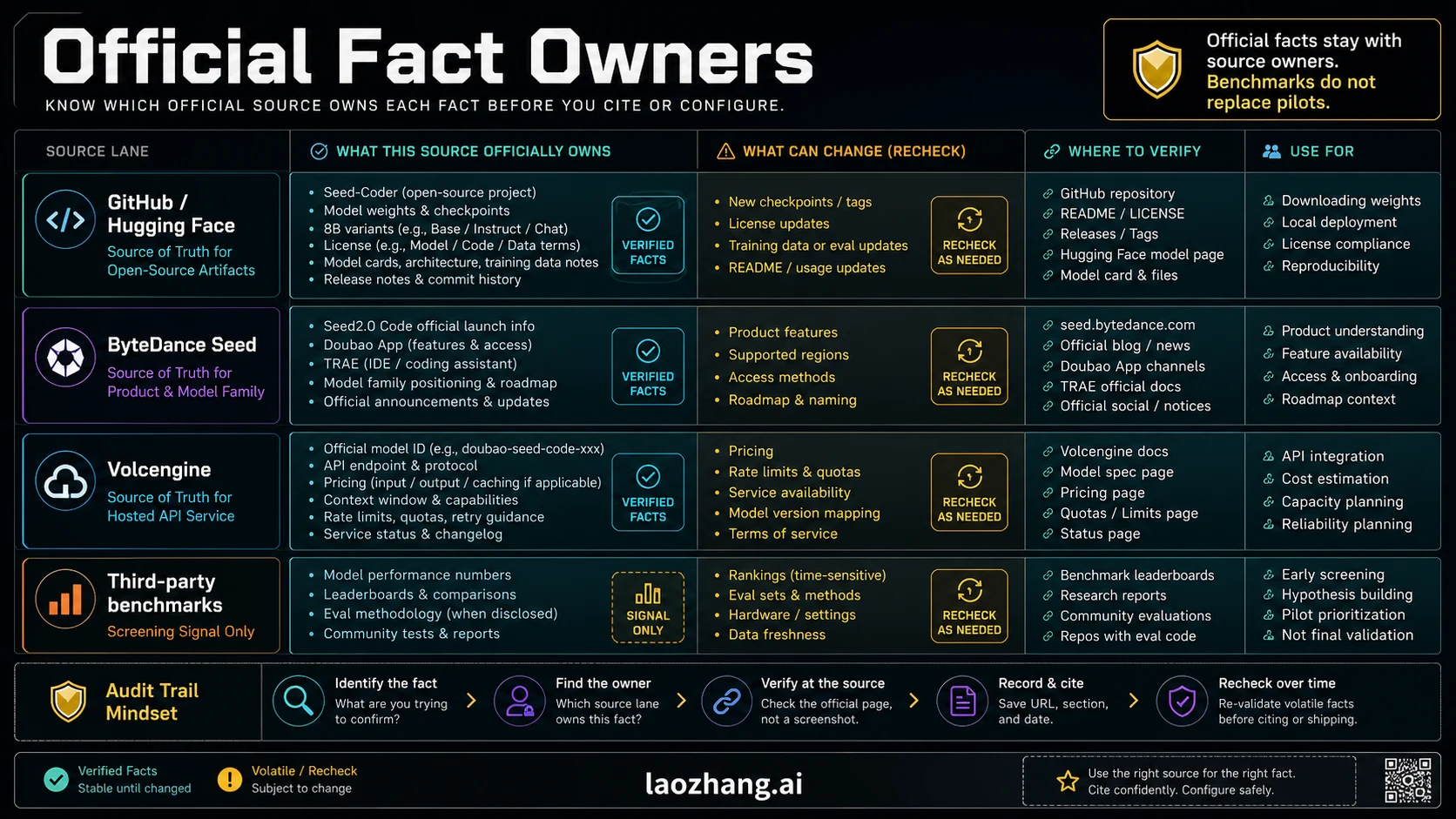
Keep each fact attached to the source that can actually own it. Checked on May 22, 2026, the useful ownership split was:
| Fact you need | Primary source to check | Why it matters in practice |
|---|---|---|
| Open-source identity, variants, license, and model downloads | Seed-Coder GitHub and linked Hugging Face cards | This controls local deployment, redistribution, reproducibility, and whether the 8B route fits your hardware. |
| Seed2.0 Code launch, Doubao App, and TRAE availability | ByteDance Seed launch page | This tells you where the product family appeared, not what your API bill or endpoint will be. |
| Hosted model ID, context, input/output limits, modalities, cache, and tool features | Volcengine model docs, including the current model detail page | This is the implementation contract for API testing. |
| Pricing, cache-hit pricing, cache storage, and plan/API distinction | Volcengine pricing and billing docs such as model pricing | These rows are volatile and should be rechecked before every serious cost estimate. |
| RPM, TPM, endpoint families, and compatible APIs | Volcengine limits and access docs such as rate limits and API access | Your pilot can fail for account, quota, endpoint, or compatibility reasons even when the model itself is strong. |
| Benchmarks and public reviews | Benchmark vendors and review sites | Use these to choose a shortlist, then run your own same-repository test. |
This source split prevents two common mistakes: treating open-source Seed-Coder facts as hosted API guarantees, and treating a pricing or endpoint row as permanent just because it appeared in a current tutorial.
Volcengine API Route: What To Recheck Today
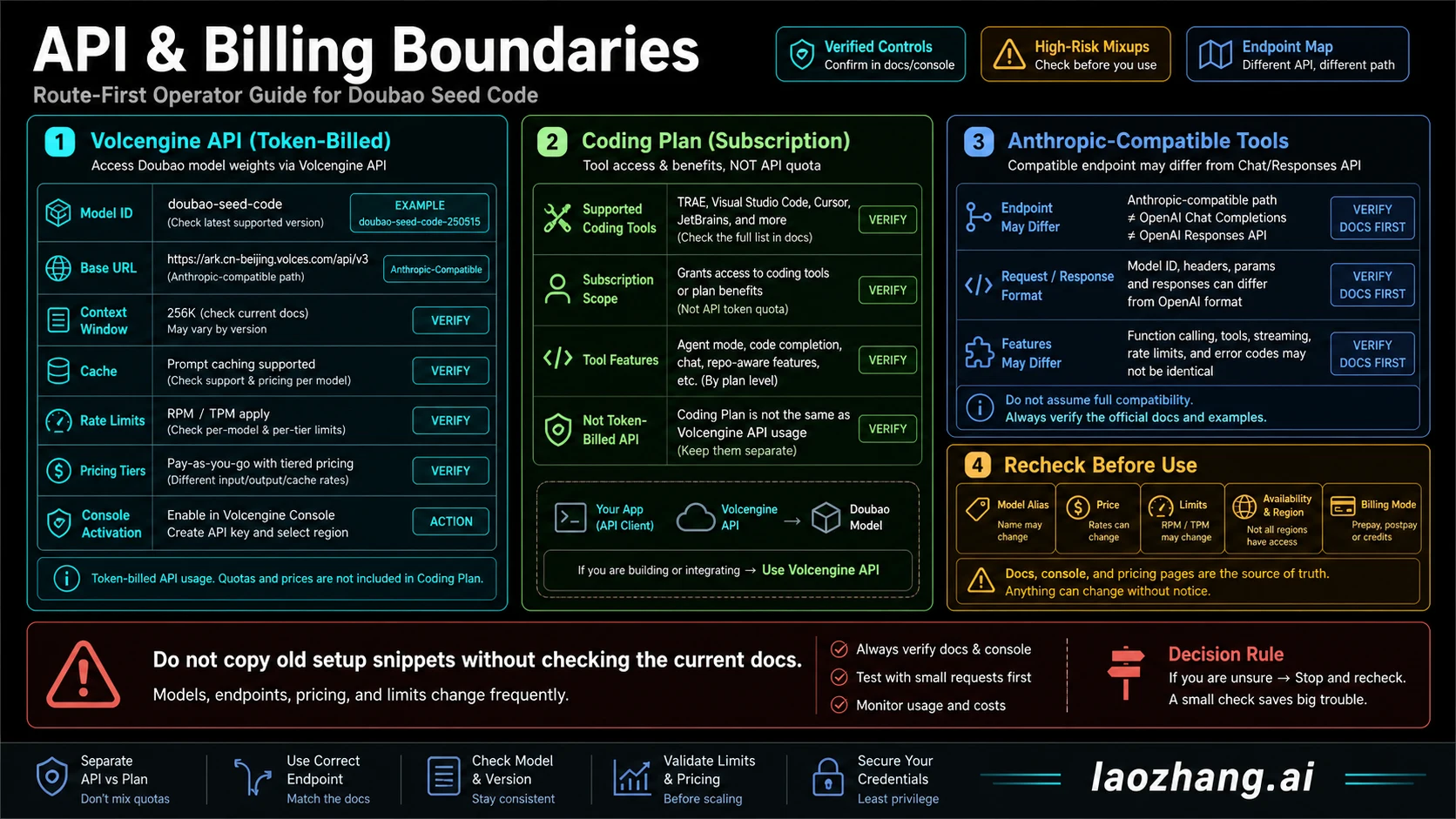
For a developer integration, the Volcengine Ark route is the row that needs the most careful freshness check. On May 22, 2026, indexed Volcengine documentation listed doubao-seed-code-preview-251028 with a 256k maximum context, 224k maximum input, 32k maximum thinking content, text output, and output caps that depend on parameter family. It also listed text, image, and video input support, function calling, deep thinking, image understanding, and transparent cache support.
Those facts are useful only if they still match your account and region. Before you run a real repository task, verify these fields in the current Volcengine console and docs:
| API field | What to check | Pilot consequence |
|---|---|---|
| Model ID and aliases | Confirm whether doubao-seed-code-preview-251028, a latest alias, or a newer dated model is active. | A stale ID breaks requests or silently tests the wrong route. |
| Base URL family | Chat API and Responses API material uses https://ark.cn-beijing.volces.com/api/v3; Anthropic-compatible material uses https://ark.cn-beijing.volces.com/api/compatible. | Claude Code-style or Anthropic-compatible tools need the compatible route, not just a chat-completions URL. |
| Context and output boundaries | Recheck maximum context, maximum input, thinking budget, max_tokens, and max_completion_tokens. | Long repository tasks fail differently when input, hidden reasoning, and output budgets are constrained. |
| Pricing | Recheck tiered input, cache-hit input, output, cache storage, and whether Coding Plan is involved. | A cheap-looking run can become expensive after retries, cache misses, and large generated diffs. |
| Rate limits | Recheck RPM, TPM, account quota, activation status, and any region-specific limits. | A batch pilot may bottleneck on quota before quality is measured. |
| Tool compatibility | Confirm whether your target tool supports the endpoint, headers, streaming, tool calls, and thinking parameters you plan to use. | A model can look weak if the adapter drops features or truncates context. |
The safest API setup is a small adapter layer that records the exact model ID, base URL family, request parameters, token counts, cache status, latency, error code, and accepted diff for every pilot task. If you cannot produce that log, you cannot tell whether a failure came from the model, the endpoint, the tool adapter, the prompt, or the repository task.
Open-Source Route: When Seed-Coder Is Enough
Choose Seed-Coder first when the job is local and controlled: security review, offline experimentation, fine-tuned evaluation, reproducible benchmarks, or cost tests where infrastructure is already paid for. The open-source route is also useful when you want to inspect behavior without tying the evaluation to a managed API account.
The tradeoff is capability and operation. An 8B local model is easier to own, but it is not automatically a drop-in replacement for a hosted coding model in long agent loops. Measure it on tasks where local control is the main benefit: targeted code completion, small bug patches, test scaffolding, repository search, and constrained refactors. Do not judge it only on a full autonomous migration if your hardware, context, or orchestration is not designed for that workload.
The acceptance bar should be specific:
| Task type | Good Seed-Coder pilot | Stop rule |
|---|---|---|
| Small bug fix | Finds the right file, proposes a minimal patch, and passes the existing test. | Stop if it invents APIs, misses the failing condition, or requires more review time than your current model. |
| Test scaffolding | Writes tests that expose a real branch and compile without large cleanup. | Stop if tests are brittle, shallow, or disconnected from source behavior. |
| Local privacy workflow | Keeps code inside your environment and produces useful patches under your hardware limit. | Stop if context trimming removes the evidence needed to patch safely. |
| Batch cleanup | Handles repetitive, low-risk edits with predictable output. | Stop if hidden behavior changes appear during review. |
Seed-Coder can still be the right route even if the hosted model wins broad benchmarks. The question is whether local ownership solves a problem your API route cannot solve.
Coding Plan, TRAE, And Tool Routes
Coding Plan belongs in a different buying conversation. It may be attractive when a team wants a supported coding-tool workflow, stable billing for a tool surface, or a simpler path for developers who do not want to manage endpoint configuration. That does not make it interchangeable with Volcengine token billing.
Before choosing Coding Plan, confirm four practical details:
| Detail | Why it decides the route |
|---|---|
| Supported tools | If your actual workflow is Claude Code-style CLI, Cursor, TRAE, OpenClaw, or another agent shell, support must be verified for that tool, not assumed from generic model availability. |
| Included usage | Subscription value depends on included limits, throttling, overage rules, and whether heavy repo tasks are practical. |
| Account and region | A plan that is easy to buy in one region may be awkward for another team or payment subject. |
| Exit path | You still need a way to return to your previous model or API route without rewriting the entire toolchain. |
TRAE and Doubao App are product surfaces. They are useful for hands-on exploration, prompt feel, and ByteDance's own coding experience, but app behavior should not be used as proof of API pricing, endpoint compatibility, context limits, or account quota.
Benchmarks Are A Filter, Not A Switch
Benchmark pages can be useful because they compress a lot of model behavior into a shortlist. They are weakest when a team turns a global score into a production default without checking its own work.
Use public scores to answer three narrow questions:
| Question | Useful benchmark signal | Missing proof |
|---|---|---|
| Is it worth a pilot? | Coding, reasoning, latency, price, and benchmark trend are competitive enough to justify time. | Your repo, toolchain, tests, review time, and rollback path. |
| Which route should I compare against? | Score profile suggests whether to compare against a cheap model, a frontier coding model, or a local model. | The exact route contract: open weights, hosted API, Coding Plan, or product surface. |
| What risk should I watch? | Weak areas in reasoning, latency, cost, or tool use point to pilot measurements. | Whether the model creates hidden defects in your codebase. |
For coding agents, the most important metric is accepted work per unit of review burden. A model that wins a benchmark but increases review time, retries, or rollback risk is not cheaper in practice.
A Same-Repository Pilot Plan
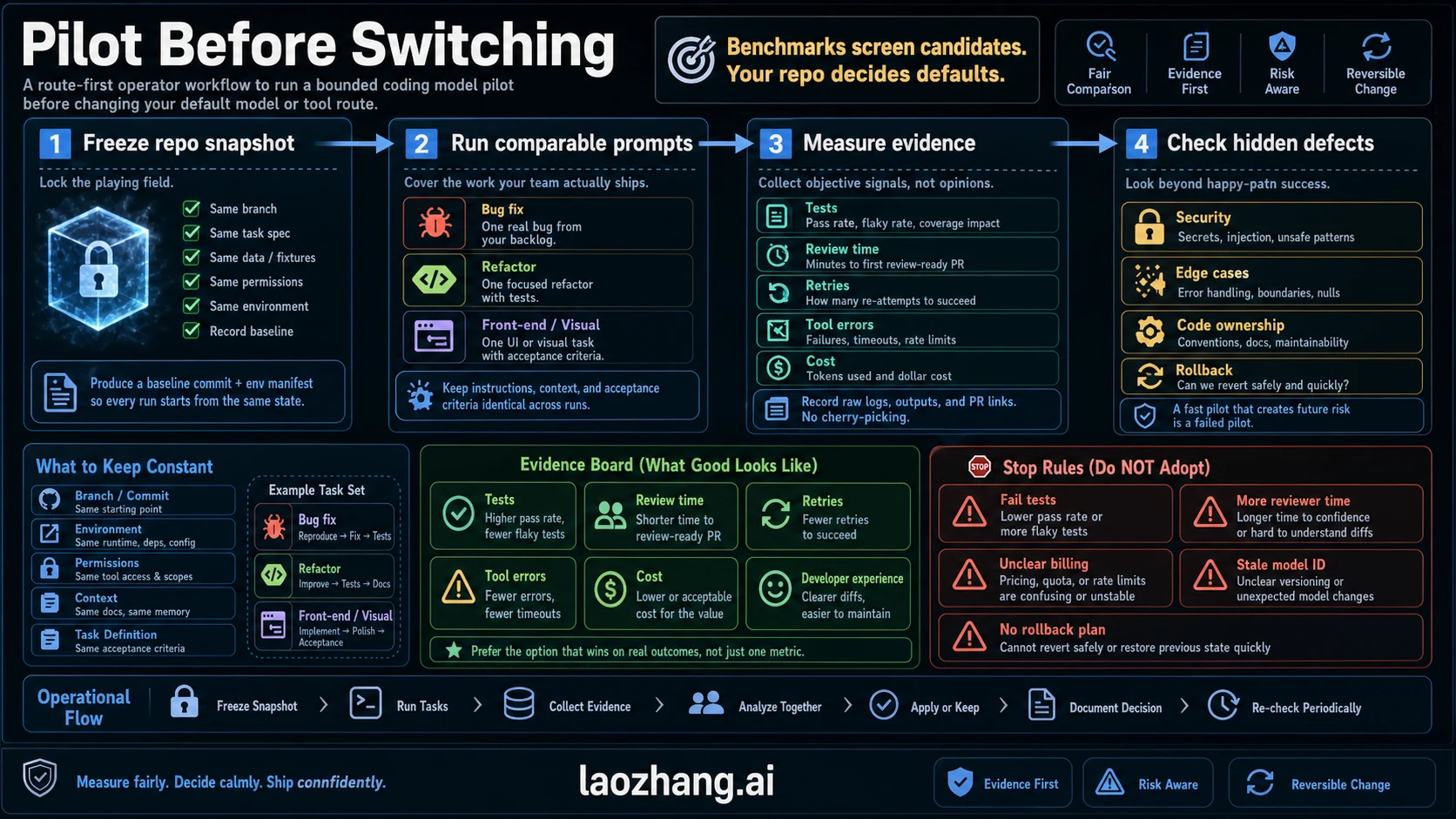
Run the pilot as a controlled comparison, not a vibe check.
| Step | What to freeze | Why it matters |
|---|---|---|
| 1. Choose one route | Seed-Coder, Volcengine API, Coding Plan, TRAE, or a current default model. | Route mixing makes the result unusable. |
| 2. Freeze a repo snapshot | Commit hash, dependency lockfile, test command, and fixture data. | The same task must face the same code. |
| 3. Pick five to ten tasks | Bug fix, refactor, test addition, UI patch, docs update, and one intentionally messy task. | A single demo task is too easy to overfit. |
| 4. Record the full run | Prompt, model ID, endpoint, adapter, tool version, token count, cache hit, latency, retries, errors, and final diff. | Cost and quality cannot be separated after the fact. |
| 5. Review like production | Tests, code review, hidden behavior check, security check, and revert plan. | Passing output is not the same as accepted work. |
| 6. Compare against your current default | Accepted diff rate, reviewer minutes, retry count, bug rate, and cost per accepted task. | The switch only matters against what you already use. |
Switch only if the tested route improves the work you actually ship. Keep the old route available until two or three real tasks have passed after the pilot, because coding-agent regressions often appear in the second wave: forgotten edge cases, shallow tests, over-broad edits, or adapters that fail under longer context.
When Not To Use Doubao Seed Code
Do not use the hosted API route when you cannot confirm the active model ID, endpoint family, pricing, quota, and account activation. A coding model with uncertain billing is not ready for a production repository task.
Do not use the open-source route when the workload depends on long autonomous reasoning and your local setup cannot preserve the necessary context. Local control is valuable, but context loss can erase that advantage.
Do not buy a tool plan just because the model name looks strong. Buy the plan only if the supported workflow, billing terms, region, limits, and exit path fit the developers who will use it.
Do not switch from your current coding model if Doubao Seed Code produces more reviewer work, more retries, or more hidden defects. The model can still be worth monitoring, but it is not your default yet.
FAQ
Is Doubao Seed Code open source?
Partly. Use Seed-Coder for the open-source route. The GitHub repository describes it as an 8B open-source family previously known as Doubao-Coder. The hosted Volcengine Doubao-Seed-Code route is a separate API surface and should not be described as the same thing as the open-source weights.
Which API route should I use?
For hosted integration work, start with Volcengine Ark and verify the current model ID, base URL family, context, output budget, price, cache, and rate limits in the console and docs. On May 22, 2026, public docs listed doubao-seed-code-preview-251028, but model IDs and aliases are volatile.
Is Coding Plan the same as API billing?
No. Coding Plan is a tool subscription route. Token-billed API use is a different operational contract. Treat them separately when comparing cost, limits, support, and exit path.
Does it work with Claude Code-style tools?
Possibly, but only after endpoint and adapter verification. Check whether your tool supports the Volcengine compatible base URL, authentication, streaming, tool calls, thinking parameters, and the model alias you intend to use. A guide that works for one adapter may not prove support for another.
Is it cheaper than my current model?
Only your pilot can answer that. Compare cost per accepted task, not price per token alone. Include retries, cache misses, failed runs, reviewer time, and the cost of reverting a bad patch.
Can benchmark scores decide the switch?
No. Benchmarks can justify a pilot. A default switch needs same-repository proof: accepted diffs, passing tests, lower review burden, stable cost, and a simple rollback path.
What should I test first?
Test one real bug fix, one refactor, one test-writing task, one UI or integration patch, and one messy task with incomplete context. Keep the same repo snapshot and review rubric across routes so the result measures the model, not the setup.